CBSE Class 12 Question Paper 2022 Solution Political Science
Finished viewing? Save it for later —
Download CBSE Class 12 Question Paper 2022 Solution Political Science (PDF · 7 pages)About CBSE Class 12 Question Paper 2022 Solution Political Science
CBSE Class 12 Question Paper 2022 Solution Political Science is available here for free download. Published by CBSE for Class 12, this solution can be viewed online or downloaded as a PDF (7 pages). Candidates preparing for Class 12 can use CBSE Class 12 Question Paper 2022 Solution Political Science to understand the exam pattern, the type of questions asked, and the overall difficulty level.
Frequently Asked Questions
How can I download CBSE Class 12 Question Paper 2022 Solution Political Science?
Open this page and click the Download button to save CBSE Class 12 Question Paper 2022 Solution Political Science as a PDF. It is completely free on AglaSem Docs.
Is CBSE Class 12 Question Paper 2022 Solution Political Science free to download?
Yes. CBSE Class 12 Question Paper 2022 Solution Political Science can be viewed online and downloaded as a PDF free of cost on AglaSem Docs.
How many pages does CBSE Class 12 Question Paper 2022 Solution Political Science have?
CBSE Class 12 Question Paper 2022 Solution Political Science contains 7 pages, which you can read online or download together as a single PDF.
Where can I find more Class 12 study material?
You can find more Class 12 question papers, sample papers, syllabus, and answer keys on AglaSem Docs.
CBSE Class 12 Question Paper 2022 Solution Political Science – Text
Read the full text of this solution below — useful to quickly search, copy and reference the content online without downloading the PDF.
📄 View text version (7 pages)
Page 1
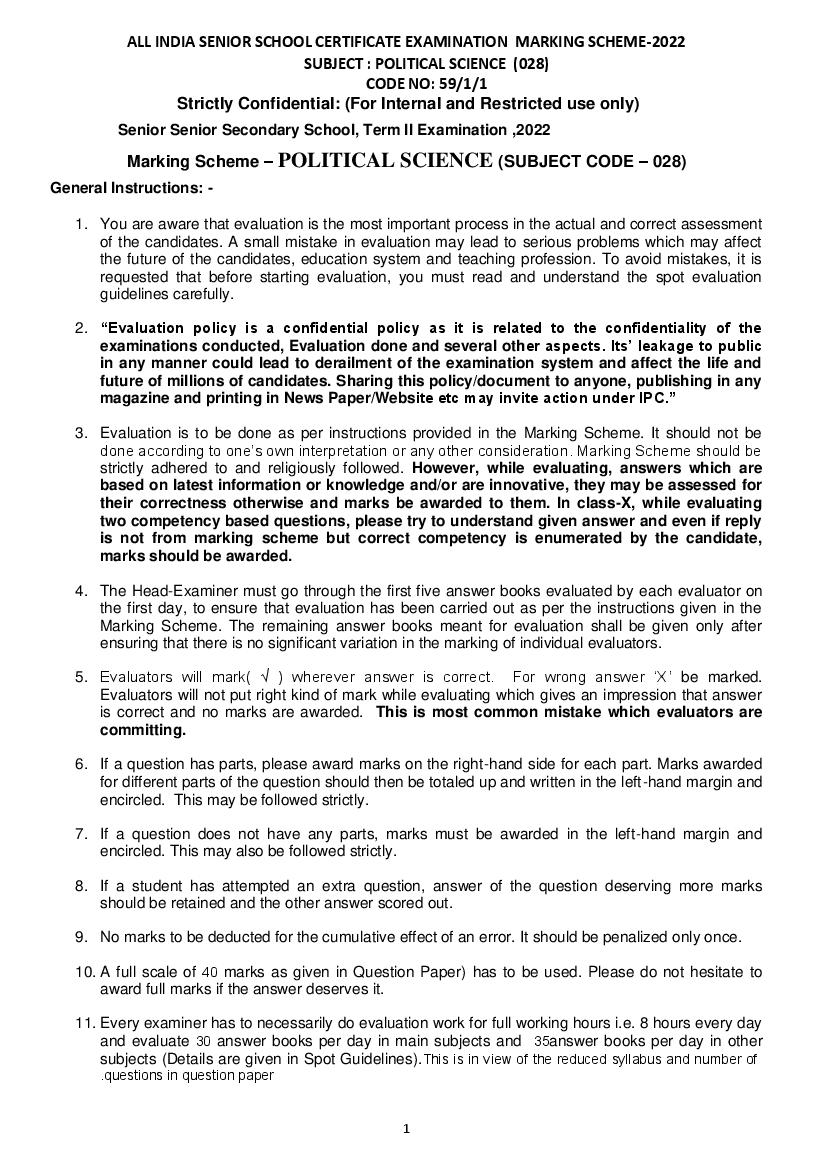
Senior Senior Secondary School, Term II Examination ,2022
Marking Scheme – POLITICAL SCIENCE (SUBJECT CODE – 028)
General Instructions: -
1. You are aware that evaluation is the most important process in the actual and correct assessment
of the candidates. A small mistake in evaluation may lead to serious problems which may affect
the future of the candidates, education system and teaching profession. To avoid mistakes, it is
requested that before starting evaluation, you must read and understand the spot evaluation
guidelines carefully.
2. “Evaluation policy is a confidential policy as it is related to the confidentiality of the
examinations conducted, Evaluation done and several other aspects. Its’ leakage to public
in any manner could lead to derailment of the examination system and affect the life and
future of millions of candidates. Sharing this policy/document to anyone, publishing in any
magazine and printing in News Paper/Website etc may invite action under IPC.”
3. Evaluation is to be done as per instructions provided in the Marking Scheme. It should not be
done according to one’s own interpretation or any other consideration. Marking Scheme should be
strictly adhered to and religiously followed. However, while evaluating, answers which are
based on latest information or knowledge and/or are innovative, they may be assessed for
their correctness otherwise and marks be awarded to them. In class-X, while evaluating
two competency based questions, please try to understand given answer and even if reply
is not from marking scheme but correct competency is enumerated by the candidate,
marks should be awarded.
4. The Head-Examiner must go through the first five answer books evaluated by each evaluator on
the first day, to ensure that evaluation has been carried out as per the instructions given in the
Marking Scheme. The remaining answer books meant for evaluation shall be given only after
ensuring that there is no significant variation in the marking of individual evaluators.
5. Evaluators will mark( √ ) wherever answer is correct. For wrong answer ‘X’ be marked.
Evaluators will not put right kind of mark while evaluating which gives an impression that answer
is correct and no marks are awarded. This is most common mistake which evaluators are
committing.
6. If a question has parts, please award marks on the right-hand side for each part. Marks awarded
for different parts of the question should then be totaled up and written in the left-hand margin and
encircled. This may be followed strictly.
7. If a question does not have any parts, marks must be awarded in the left-hand margin and
encircled. This may also be followed strictly.
8. If a student has attempted an extra question, answer of the question deserving more marks
should be retained and the other answer scored out.
9. No marks to be deducted for the cumulative effect of an error. It should be penalized only once.
10. A full scale of 40 marks as given in Question Paper) has to be used. Please do not hesitate to
award full marks if the answer deserves it.
11. Every examiner has to necessarily do evaluation work for full working hours i.e. 8 hours every day
and evaluate 30 answer books per day in main subjects and 35answer books per day in other
subjects (Details are given in Spot Guidelines). This is in view of the reduced syllabus and number of
.questions in question paper
1
Page 2
the past:-
Leaving answer or part thereof unassessed in an answer book.
Giving more marks for an answer than assigned to it.
Wrong totaling of marks awarded on a reply.
Wrong transfer of marks from the inside pages of the answer book to the title page.
Wrong question wise totaling on the title page.
Wrong totaling of marks of the two columns on the title page.
Wrong grand total.
Marks in words and figures not tallying.
Wrong transfer of marks from the answer book to online award list.
Answers marked as correct, but marks not awarded. (Ensure that the right tick mark is
correctly and clearly indicated. It should merely be a line. Same is with the X for incorrect
answer.)
Half or a part of answer marked correct and the rest as wrong, but no marks awarded.
13. While evaluating the answer books if the answer is found to be totally incorrect, it should be
marked as cross (X) and awarded zero (0)Marks.
14. Any unassessed portion, non-carrying over of marks to the title page, or totaling error detected by
the candidate shall damage the prestige of all the personnel engaged in the evaluation work as
also of the Board. Hence, in order to uphold the prestige of all concerned, it is again reiterated
that the instructions be followed meticulously and judiciously.
15. The Examiners should acquaint themselves with the guidelines given in the Guidelines for spot
Evaluation before starting the actual evaluation.
16. Every Examiner shall also ensure that all the answers are evaluated, marks carried over to the
title page, correctly totaled and written in figures and words.
17. The Board permits candidates to obtain photocopy of the Answer Book on request in an RTI application
and also separately as a part of the re-evaluation process on payment of the processing charges.
SECTION – A Marks
Q1. (a) Explain any two steps taken by the US that aided the integration of the 2X1=2
European States after the Second World War.
OR
(b) Explain the 'Vision 2020' of the regional organization ‘ASEAN’. 2
Ans (a) Steps taken by the US– 2X1=2
(i) America extended massive financial help for reviving Europe’s economy
under the ‘Marshall Plan’ after 1945.
(ii) The US created a new collective security structure under NATO.
Or Any other step
( P–58 )
( OR )
(b) Vision 2020 of the ASEAN is an outward looking role for ASEAN in the
international community. It is to encourage negotiation over conflicts in the 2
region.
2
Page 3
the East Timor crises and meets annually to discuss East Asian
Cooperation.
( P–57)
Q2. Show with the help of any two examples the interference of military in the 2X1=2
administration of Pakistan.
Ans 2X1=2
After Pakistan framed its first Constitution, General Ayub Khan took over the
administration of the country and got himself elected. He gave up the office when
popular dissatisfaction against his rule rose.
But again General Yahya Khan took over and put Pakistan under Military rule.
Examples of Zia-ul-Haq in 1977 and General Pervez Musharraf may also be given.
( Any two) — ( P–68 )
Q3. Highlight any two reasons for the ethnic conflict in Sri Lanka. 2X1=2
Ans (i) Politics in Sri Lanka is dominated by forces that represent the interests of the 2X1=2
majority Sinhala community.
(ii) They were hostile to Tamils who are in minority.
(iii) The Sinhala nationalists thought that Sri Lanka should not give concessions to
the Tamils because Sri Lanka belongs to Sinhalas only.
(Any other valid reason)
(Any two ) --(P–72 )
Q4. Name any four countries that are included in ‘South Asia'. 4x ½=2
Ans South Asia: 4x ½=2
India, Sri Lanka, Pakistan, Nepal, Bhutan, Bangladesh, Maldives and Afghanistan
(Any four ) — ( P–66 ).
Q5. Analyse any two causes of 'Globalisation'. 2X1=2
Ans Causes of globalisation: 2X1=2
(i) Fast means of Transport
(ii) Fast means of communication.
(iii)Rise of digital technology.
(Any other valid reason)
(Any two) ( P–138 )
Q6. Analyse any two reasons for the split of the Congress Party in 1969. 2X1=2
Ans Reasons for the split of the Congress Party– 2X1=2
(i) Conflict between Indira Gandhi and the Syndicate.
(ii) Presidential Election of 1969 where Indira Gandhi’s wishes were neglected
and N. Sanjeeva Reddy was declared the official candidate. Indira Gandhi
opposed him and supported V. V. Giri, an independent candidate. V. V. Giri won
the election and it led to formal split in Congress.
( P–91 to 93 )
Q7. Analyse the concept of "Total Revolution' as visualized by Jai Prakash 2
Narayan in 1975.
Ans Total Revolution as advocated by Jayaprakash Narayan was for— 2X1=2
(i) Transformation of individual, society and State.
(ii) It sought to encompass moral, cultural, economic, political and ecological
3
Page 4
(iii) It included the right to recall, importance of village/mohalla samities and call
for ‘upper ke log’ to join political struggle for a clean politics in India.
(Any two ) — Ref. Mat.
Q8. Why did the first coalition government at the Centre in India not prove to be 2
stable? Analyse the major reason.
Ans (i) Due to differences in their ideologies. 2X1=2
(ii) Regional political parties had their own interests.
(iii) The implementation of recommendation Mandal Commission – Which led to
large-scale opposition and violence. (Any two ) — ( P–176, 182)
SECTION – B
Q9. Explain any two economic consequences of Globalisation. 2×2=4
Ans Economic Consequences– 2×2=4
(i) Greater economic flows among different countries.
(ii) Restrictions imposed by different countries on imports from other countries
were reduced or removed.
(iii) Investors of the developed countries could invest in the developing or
underdeveloped countries.
(iv) Somewhere new avenues were created for the jobs.
Or any other (Any two ) — ( P–140-141 )
Q10. Describe any four excesses made by the Union Government during the period 4x1=4
of emergency imposed in 1975.
Ans The Excesses– 4x1=4
(i) Preventive detentions on a large scale.
(ii) Restrictions were imposed on Press without proper legal sanctions.
(iii) Forced Family Planning.
(iv) Demolition drives.
(v) Torture and custodial deaths. ( P–115 to 117 )
(Any four )
4
Page 5
A, B, C and D. Identify these states on the basis of the information given
below and write their correct names in your Answer Book along with the
respective serial number of the information used and the concerned alphabet
as per format that follows:
Sr. No. of the Concerned alphabet Name of the state
Information used
i
ii
iii
iv
4x1=4
(i)The State which was not under the rule of the Congress Party in1952.
(ii) The State where the Congress Party could not win majority in 1957.
(iii) The State from where K. Kamraj, a Veteran leader of the Congress
Party, lost election in 1967.
(iv) The State from where the phrase "Aaya Ram, Gaya Ham' originated.
Note: The following question is for visually impaired candidates only in lieu of
Q. No. 11.
Answer the following questions. 4x1=4
11.1 In which year was the first general election completed in India?
11.2 In which State had the Congress Party not won majority in 1957?
11.3 From which State did the phrase 'Aaya Ram, Gaya Ram' originate?
11.4 Which political party remained in power at the centre from 1952 to
1967?
Ans Sr. No. of the Concerned alphabet Name of the state 4x1=4
Information used
(i) C J&K
(ii) D Kerala
(iii) B Tamil Nadu
(iv) A Haryana
5
Page 6
For visually impaired candidates–
11.1 1952 (May also write 1951 to 1952)
11.2 Kerala
11.3 Haryana
11.4 The Congress Party
SECTION C
Q12. (a)Explain any four steps taken by China to develop its economy. 4 x1½ =6
OR
(b) Explain any four factors that make the European Union a strong 4 x1½ =6
organization.
Ans (a) Steps taken by China–
(i) Established relations with the US in 1972 4 x1½ =6
(ii) Proposed four areas of modernisation as agriculture, industry, army and
science -technology in 1973.
(iii) In 1978 – announced the ‘open door’ policy
(iv) In 1982 – Privatisation of Agriculture was done
(v) In 1998 – Privatisation of Industries was done
(vi) Trade Barriers were eliminated
(vii) Special Economic Zones were set up. ( Any four ) — ( P–59 )
( OR )
(b)
(i) EU was the world’s biggest economy.
(ii) Its share of world trade was three times larger than that of the US.
(iii)Two of its countries are permanent members of UN Security Council.
(Even if a candidate write ‘one’ in place of ‘two’, it may be considered
right). 4 x1½ =6
(iv) The EU’s combined armed forces are the second largest in the world.
(v) Its currency can pose a threat to US Dollar.
Or Any other factor ( Any four ) ( P–53-54 )
Q13. (a) Highlight any three areas where consensus has emerged among most of 3x2=6
the political parties in India after 1989.
OR
(b) Highlight any two major changes that took place in Indian politics after 2x2+2x1=6
2014 and also name any two welfare programmes that made women the real
beneficiaries.
Ans Emerging areas of Consensus:
(a)
(i) Agreement on new economic policies. 3x2=6
(ii) Acceptance of the political and social claims of the backward castes
6
Page 7
(iii)Acceptance of the role of State level parties in governance of the country.
(iv) Emphasis on pragmatic considerations rather than ideological positions.
(v) Foreign policy of India. ( Any three ) — ( P–191-192 )
( OR )
(b)
Change from caste and religion-based politics to development and
governance oriented politics.
Economic welfare schemes were made accessible to the masses. 2x2+2x1=6
Examples
(i) Jan Dhan Yojana
(ii) Beti Bachao, Beti Padhao Yojana
(iii) PM Awas Yojana
(iv) PM Suraksha Yojana
(v) Swachhata Abhiyan (Construction of Toilets)
(vi) Mother and Child Tracking System
(vii) PM Matritva Vandana Yojana
(viii) Rashtriya Mahila Kosh
(ix) STEP (Support for Training and Employment Programme)
Or any other programme which directly or indirectly benefits the women.
( Any two )
7
Document Details
| Board / Org | CBSE |
| Exam | Class 12 |
| Type | Solution |
| Pages | 7 |
| Updated | 30 Apr 2026 |