CBSE Class 12 Term Wise Syllabus 2021-22 Fine Arts
Finished viewing? Save it for later —
Download CBSE Class 12 Term Wise Syllabus 2021-22 Fine Arts (PDF · 33 pages)About CBSE Class 12 Term Wise Syllabus 2021-22 Fine Arts
CBSE Class 12 Term Wise Syllabus 2021-22 Fine Arts is available here for free download. Published by CBSE for Class 12, this syllabus can be viewed online or downloaded as a PDF (33 pages). Candidates preparing for Class 12 can use CBSE Class 12 Term Wise Syllabus 2021-22 Fine Arts to understand the exam pattern, the type of questions asked, and the overall difficulty level.
Frequently Asked Questions
How can I download CBSE Class 12 Term Wise Syllabus 2021-22 Fine Arts?
Open this page and click the Download button to save CBSE Class 12 Term Wise Syllabus 2021-22 Fine Arts as a PDF. It is completely free on AglaSem Docs.
Is CBSE Class 12 Term Wise Syllabus 2021-22 Fine Arts free to download?
Yes. CBSE Class 12 Term Wise Syllabus 2021-22 Fine Arts can be viewed online and downloaded as a PDF free of cost on AglaSem Docs.
How many pages does CBSE Class 12 Term Wise Syllabus 2021-22 Fine Arts have?
CBSE Class 12 Term Wise Syllabus 2021-22 Fine Arts contains 33 pages, which you can read online or download together as a single PDF.
Where can I find more Class 12 study material?
You can find more Class 12 question papers, sample papers, syllabus, and answer keys on AglaSem Docs.
CBSE Class 12 Term Wise Syllabus 2021-22 Fine Arts – Text
Read the full text of this syllabus below — useful to quickly search, copy and reference the content online without downloading the PDF.
📄 View text version (33 pages)
Page 1
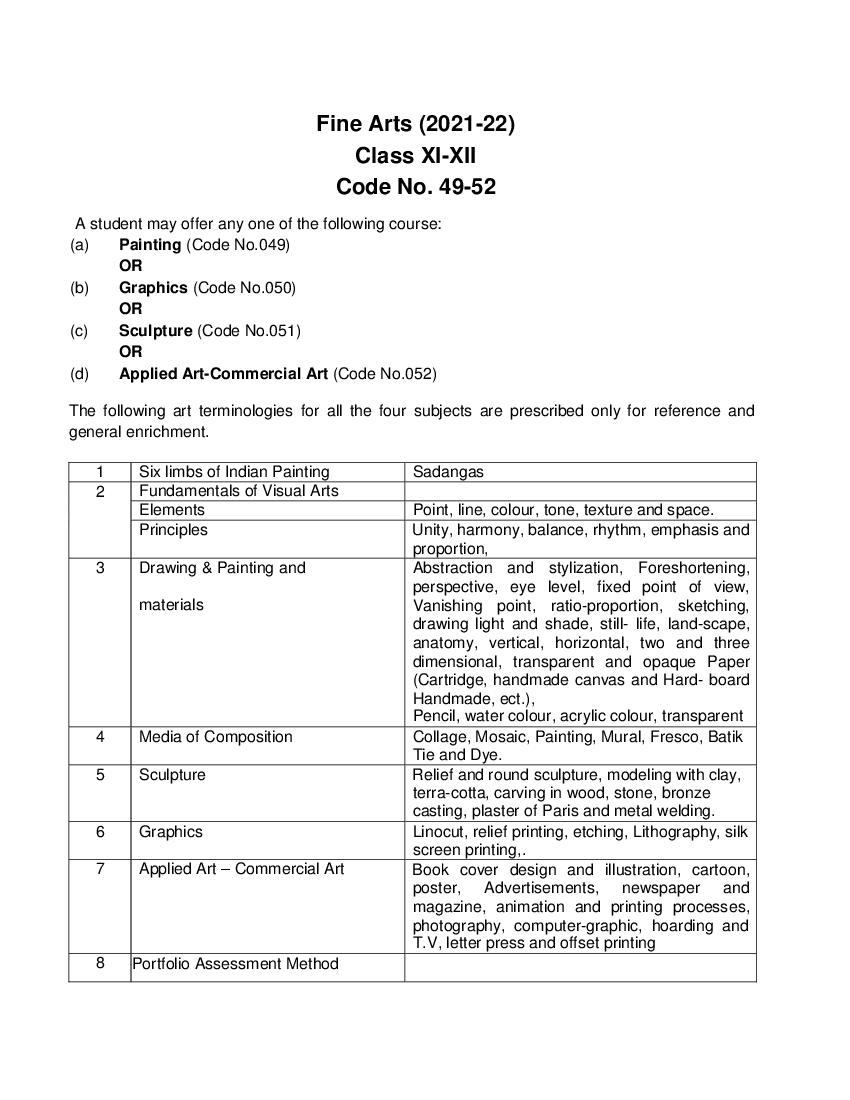
Class XI-XII
Code No. 49-52
A student may offer any one of the following course:
(a) Painting (Code No.049)
OR
(b) Graphics (Code No.050)
OR
(c) Sculpture (Code No.051)
OR
(d) Applied Art-Commercial Art (Code No.052)
The following art terminologies for all the four subjects are prescribed only for reference and
general enrichment.
1 Six limbs of Indian Painting Sadangas
2 Fundamentals of Visual Arts
Elements Point, line, colour, tone, texture and space.
Principles Unity, harmony, balance, rhythm, emphasis and
proportion,
3 Drawing & Painting and Abstraction and stylization, Foreshortening,
perspective, eye level, fixed point of view,
materials Vanishing point, ratio-proportion, sketching,
drawing light and shade, still- life, land-scape,
anatomy, vertical, horizontal, two and three
dimensional, transparent and opaque Paper
(Cartridge, handmade canvas and Hard- board
Handmade, ect.),
Pencil, water colour, acrylic colour, transparent
4 Media of Composition Collage, Mosaic, Painting, Mural, Fresco, Batik
Tie and Dye.
5 Sculpture Relief and round sculpture, modeling with clay,
terra-cotta, carving in wood, stone, bronze
casting, plaster of Paris and metal welding.
6 Graphics Linocut, relief printing, etching, Lithography, silk
screen printing,.
7 Applied Art – Commercial Art Book cover design and illustration, cartoon,
poster, Advertisements, newspaper and
magazine, animation and printing processes,
photography, computer-graphic, hoarding and
T.V, letter press and offset printing
8 Portfolio Assessment Method
Page 2
The Art Portfolio will consist of a compilation of all art works, from sketch to finished product.
The submission would include both the original and improved versions of assigned tasks
reflective of gradual improvement. Step by step development of the work will be assessed in all
units.
Components of a Portfolio:
Schedule of work
Research Skills
Resources and materials
Study of connections with artists / art movements
Art making skills
Personal artist statement
Studies (e.g.,composition/techniques-medium)
Picture of the final work (reflective skills)
Evaluation of final work (affective skills)
Any kind of personalized notes in relation to artwork
Profile of Learners Growth Values and Attitudes Rubric. The learner develops the ability
to:
Respect, appreciate and demonstrate an open mind towards the artistic expression of
others
Appears enthusiastic and willing to study artistic expressions from other cultures or
regions of the world that are very different from own.
Accept different forms and styles and tries to explore their meaning.
Be sensitive towards other's creations
Be ready to research and transfer his/her learning to his / her own art
Take initiative
Be responsible for his/her own learning and progress
Apply theoretical knowledge in practical contexts
Possess information and communication technology skills
Be resourceful and organize information effectively
Listen attentively
Page 3
THE BASIS OF FOLLOWING CRITERIA
Creativity: Candidates are required to produce evidence that demonstrates a creative approach to
problem-solving. Evidence should also include the ability to interpret a given brief and original
approaches to produce a solution. Sketchbooks, notebooks and relevant support material should
form part of this evidence.
1. Drawing
2. Detailed Study - observation, record, analysis, interpreting a variety of subject
3. Mood reflected
4. Follow-up of the Fundamentals of Visual Arts (Elements and Principles)
5. Message the artist wants to convey
Innovation: The knowledge gained with the help of case study (historical importance, great artist).
How has the above been understood in relation to the topic or the theme taken up by
the student?
Technique: To foster creativity and self-expression (basic understanding of colour concept and
application in relation to colour and texture of the material used by the student). Size,
details, proportion required according to the base used for the painting medium
chosen according to their art stream. Techniques studied from folk style, contemporary
art or traditional art should be used while creating a new concept.
The learners:
Discover their potential for creativity, self-expression and visual awareness through painting.
Feel confident with the chosen medium as a means of communicating and generating ideas.
Develop observation, recording, manipulation and application skills.
Experiment with a range of media and techniques.
Relate their work to other artists work and understand the historical context of this work.
Understand the basic principles of colour.
Develop critical awareness.
Execution of Work
Highlight the method of work giving a historical study of the work.
Originality in the presentation (paintings, sketches, etc.)
Demonstrate an understanding of basic colour principles, colour mixing and
representation.
Employ a variety of traditional and experimental techniques and processes
Use a variety of media and materials
Observe, record, analyses, interpret a variety of subjects, including:
– the manufactured environment
– the natural environment
– the human figure
Present evidence of personal enquiry and self-expression
Discuss and relate own work to recognize artists work
Page 4
Make informed critical judgment on work in progress
Experimentation
A. Progressive Work: Candidates are required to show evidence of research carried out. It is
expected that their skills will demonstrate evidence of process and the exploration of a wide
range of subjects. An accepted standard of achievement using a range of media and material
should be an integral part of the candidate's development.
B. Skills: Sound aesthetic judgment and organizational skills should be demonstrated in the
process of presented by a candidate.
C. Logical organization and collection of creations.
D. Critical evaluation and aesthetic judgment applied
Page 5
Introduction
The course in Painting at Senior Secondary stage as an elective subject is aimed to develop
aesthetic sense of the students through the understanding of various important well known
aspects and modes of visual art expression in India’s rich cultural heritage from the period of
Indus valley to the present time. It also encompasses practical exercises in drawing and
painting to develop their mental faculties of observation, imagination, creation and physical
skills required for its expressions.
Objectives
A) Theory (History of Indian Art)
The objective of including the history of Indian Art for the students is to familiarise them
with the various styles and modes of art expressions from different parts of India. This
would enrich their vision and enable them to appreciate and develop an aesthetic
sensibility to enjoy the beauty of nature and life. The students will also have an
opportunity to observe and study the evolution of its mutations and synthesis with other
style and the rise of an altogether new style. The students should be made aware of art
as a human experience. The teachers should be able to expose them to the wide range
of artistic impressions, the media and the tools used. The history of Indian art is a long
one. Hence the students would be acquainted with brief glimpses of the development of
Indian visual art as are required for concept formation. Examples included in the course
of study are selected because of their aesthetic qualities and are intended purely as
guidelines.
B) Practicals
The purpose of introducing practical exercises in painting is to help and enable
the Students:
To develop skill of using drawing and painting material (surface, tools and
equipment, etc.) effectively.
To sharpen their observation skills through study of common objects and various
geometrical and non-geometrical forms found in life and nature.
To develop their skills to draw and paint these observations.
To develop an understanding of painting-composition (The use of the elements and
the principles of painting-composition).
To create the forms and the colour schemes in imagination with an ability to express
them effectively in drawing and painting.
To express the different feelings and moods of life and nature in lines, forms and
colours.
5|
Page 6
(Code No. 049)
Theory: Term-I 15 Marks, and Term-II 15 Marks Total: 30 Marks
Unit wise Weightage
Term Units Periods Marks
History of Indian Art
1 Pre-Historic rock paintings and art of Indus Valley 18 8
I
2 Buddhist, Jain and Hindu Art 18 7
3 Temple Sculptures 18 8
II
4 Bronzes and Artistic aspects of Indo-Islamic 18 7
architecture
72 30
Term-I
Unit Content 18 Periods
1. A. Pre-Historic Rock-Paintings Introduction
1) Period and Location
2) Study and appreciation of following Pre-historic paintings:
i. Wizard's Dance, Bhimbethaka
B. Introduction
1) Period and Location.
2) Extension: In about 1500 miles.
i. Harappa &Mohenjo-daro (Now in Pakistan)
ii. Ropar, Lothal, Rangpur, Alamgirpur, Kali Bangan,
Banawali and Dholavira (in India)
2 Study and appreciation of following: Sculptures and Terra cottas:
i. Dancing girl (Mohenjo-daro)
Bronze, 10.5 x 5 x 2.5 cm.
Circa 2500 B.C.
(Collection: National Museum, New Delhi).
ii. Male Torso(Harappa)
Red lime Stone, 9.2 x 5.8 x 3 cms.
Circa 2500 B.C.
(Collection: National Museum, New Delhi)
iii. Mother Goddess (Mohenjo-daro) terracotta, 22 x 8 x 5 c Circa
2500 B.C. (Collection: National Museum, New Delhi).
3 Study and Appreciation of following Seal:
6|
Page 7
Stone (Steatite), 2.5 x 2.5 x 1.4 cm. Circa 2500 B.C.
(Collection: National Museum, New Delhi).
Decoration on earthen wares: Painted earthen-ware (Jar)
Mohenjo-daro (Collection: National Museum, New Delhi).
Unit 2 Buddhist, Jain and Hindu Art 18 Periods
(3rd century B.C. to 8th century A.D.)
1. General Introduction to Art during Mauryan, Shunga, Kushana
(Gandhara and Mathura styles) and Gupta period:
2. Study and appreciation of following Sculptures:
i. Lion Capital from Sarnath (Mauryan period) Polished
sandstone, Circa 3rd Century B.C. (Collection: Sarnath
Museum, U.P.)
ii. Chauri Bearer from Didar Ganj (Yakshi) (Mauryan period)
Polished sandstone Circa 3rd Century B.C.(Collection:
Patna Museum, Bihar)
iii. Seated Buddha from Katra Mound, Mathura-(Kushan Period-
Mathura Style) Red-spotted Sand Stone, Circa 3rd Century
AD. (Collection: Govt. Museum, Mathura)
iv. Jain Tirathankara (Gupta period) Stone Circa 5th Century
A.D. (Collection: State Museum, Lucknow U.P.)
3. Introduction to Ajanta Location
Period, No of caves, Chaitya and Vihara, paintings and sculptures,
subject matter and technique etc.
Term-II
Unit 3 Temple Sculpture, Bronzes and artistic aspects of Indo-Islamic 18 Periods
Architecture
Artistic aspects of Indian Temple sculpture (6th Century A.D. to 13th
Century A.D.)
1) Introduction to Temple Sculpture
(6th Century A.D. to 13th Century A.D.)
2) Study and appreciation of following Temple-Sculptures:
i. Descent of Ganga (Pallava period, Mahabalipuram,
Tamil Nadu), granite rock Circa 7th Century A.D.
ii. Trimuti (Elephanta, Maharashtra) Stone Circa 9th
Century A.D.
iii. Lakshmi Narayana (Kandariya Mahadev Temple)
(Chandela period, Khajuraho, Madhya Pradesh)
Stone Circa 10th Century A.D.
iv. Cymbal Player, Sun Temple (Ganga Dynasty,
Konark, Orrisa) Stone Circa 13th Century A.D.
7|
Page 8
Dynasty, Dilwara, Mount Abu; Rajasthan) white
marble, Circa 13th Century A.D.
Unit-4 Bronzes and Artistic aspects of Indo-Islamic architecture
1. Introduction to Indian Bronzes.
2. Method of casting (solid and hollow)
3. Study and appreciation of following South Indian Bronze:
i. Nataraj (Chola period Thanjavur Distt.,Tamil Nadu) 12th
Century A.D.
(Collection : National Museum, New Delhi)
Artistic aspects of the indo-Islamic architecture:
1. Introduction
2. Study and appreciation of following architecture:
i. Qutub Minar, Delhi
ii. Gol Gumbad of Bijapur
8|
Page 9
(PRACTICAL)
Term I
35 Marks
Painting Composition 25 Marks
(i) Simple exercises of basic design in variation of geometric and rhythmic shapes in
geometrical and decorative designs and colours to understand designs as organised
visual arrangements. 10 Marks
(ii) Sketches from life and nature 15 Marks
Portfolio Assessment 10 Marks
a) Record of the Term, performance from sketch to finished product 5 Marks
b) One selected work of paintings composition done during the Term 3 Marks
c) Two selected works of paintings done during the Term 2 Marks
Term II
35 Marks
Nature and Object Study 25 Marks
Study of two or three natural and geometric forms in pencil with light and shade from a fixed
point of view. Natural forms like plants, vegetables, fruits and flowers, etc., are to be used.
Geometrical forms of objects like cubes, cones, prisms, cylinders and spheres should be used.
Portfolio Assessment 10 Marks
(a) Record of the Term, performance from sketch to finished product 5 Marks
(b) Three selected nature and object study exercises in any media done
during sessionincluding the minimum of two still life exercises. 5 Marks
These selected works prepared during the course by the candidates and certified by the
school authorities as the work done in the school will be placed before the examiners for
assessment.
Note: 1. The candidates should be given one hour-break after first three hours.
2. The time-table to be so framed as to allow the students to work continuously for minimum
of two periods at a stretch.
9|
Page 10
CLASS–XII (2021-22)
Theory: Term-I 15 Marks, and Term-II 15 Marks Total: 30 Marks
Unit wise Weightage
Term Unit1(a) Content Periods Marks
1 The Rajasthani and Pahari Schools of Miniature Painting 18 8
I
2 The Mughal and Deccan Schools of Miniature Painting 18 7
3 The Bengal School of Painting 18 8
II
4 Indian National flag and the Modern Trends in IndianArt 18 7
72 30
Unit-1 The Rajasthani and Pahari Schools of Miniature Painting 18 Periods
(16th Century A.D. to 19th Century A.D.)
A brief introduction to Indian Miniature Schools: Western- Indian,
Pala, Rajasthani, Mughal, Central India, Deccan and
Pahari.
(a) The Rajasthani School:
1. Origin and Development
2. Sub-Schools-Mewar, Bundi, Jodhpur, Bikaner, Kishangarh and Jaipur
3. Main features of the Rajasthani School
4. Appreciation of the following Rajasthani paintings
Title Painter Sub-School
Maru-Ragini Sahibdin Mewar
Chaugan Players Dana Jodhpur
Krishna on swing Nuruddin Bikaner
Radha (Bani- Thani) Nihal Chand Kishangarh
Bharat Meets Rama at Chitrakuta Guman Jaipur
(b)The Pahari School:
1. Origin anddevelopment
2. Sub-Schools-Basohli, Guler, Kangra, Chamba andGarhwal
3. Main features of the PahariSchool
4. Appreciation of the following Pahari paintings:
Title Painter Sub-School
Krishna with Gopis Manaku Basohli
Nand, Yashoda and Krishna Nainsukh Kangra
with Kinsmen Going to
Vrindavana
10 |
Page 11
The Mughal and Deccan Schools of Miniature Painting 18 Periods
(16th Century AD to 19th Century A.D.)
(a) The Mughal School
1. Origin and development
2. Main features of the Mughal School
3. Appreciation of the following Mughal Paintings:
Title Painter
Krishna Lifting Mount Govardhana Miskin
Falcon on a Bird-Rest Ustad Mansoor
Kabirand Raidas Ustad Faquirullah Khan
Marriage Procession of Dara Shukoh Haji Madni
(b) The Deccan School
1. Origin and development
2. Main features of the Deccan School
3. Appreciation of the following Deccan paintings:
Title Painter Sub-School
Hazrat Nizamuddin Auliya and Amir Unknown Hyderabad
Khusro
Chand Bibi Playing Polo (Chaugan) Unknown Gol Konda
Term-II
Unit 3 The Bengal School of Painting and the Modern trends in Indian Art 18
(About the beginning to mid of the 20th Centuary) Periods
(i) National Flag of India and the Symbolic significance of its forms and
the colours.
(ii) Introduction to the Bengal School of Painting
(i) Origin and development of the Bengal School ofPainting
(ii) Main features of the Bengal School ofPainting
11 |
Page 12
(i) Journey’s End – Abanindranath Tagore
(ii) Shiv and Sati- Nandla Bose
(iii) (Radhika - M.A.R.Chughtai
(iv) Meghdoot - Ram Gopal Vijaivargiya
Contribution of Indian artists in the struggle for National Freedom
Movement.
Unit-4 Indian National Flag and the Modern Trends in Indian Art
Appreciation of the following contemporary (Modern) Indian Art
(i) Paintings:
(i) Rama Vanquishing the Pride of the Ocean – Raja Ravi Varma
(ii) Mother and child – Jamini Roy
(iii) Haldi Grinders - Amrita Sher Gill
(iv) Mother Teresa - M.F.Husain
(ii) Graphic - prints:
(i) Children – Somnath Hore
(ii) Devi – Jyoti Bhatt
(iii) Of Walls - AnupamSud
(iv) Man, Woman and Tree - K. Laxma Goud
(iii) Sculptures:
(i) Triumph of Labour - D. P. Roychowdhury
(ii) Santhal Family - RamkinkarVaij
(iii) Cries Un - heard – Amar Nath Sehgal
(iv) Ganesha - P.V. Janaki Ram
The names of artists and titles of their artworks as listed above are only suggestive and in no way
exhaustive. Teachers and students should expand this according to their own resources. However,
the questions will be set from the above mentioned artworks only.
12 |
Page 13
(PRACTICAL)
Term I
35 Marks
Painting Composition 25 Marks
Imaginative painting based on subjects from Life and Nature in water and
poster colours with colour values.
Portfolio Assessment 10 Marks
a) Record of the Term, performance from sketch to finished product 5 Marks
b) One selected work based on any Indian Folk Arts ( Painting) 2 Marks
c) Two selected works of paintings done during the Term 3 Marks
Term II
35 Marks
Nature and Object Study 25 Marks
Studies on the basis of exercises done in class XI with two or three objects and two
draperies (in different colours) for background and foreground. Exercises in pencil with
light and shade and in full colour from a fixed point of view.
Portfolio Assessment 10 Marks
a) Record of the Term, performance from sketch to finished product 5 Marks
b) Four selected nature and object study exercises in any media done during the Term
5 Marks
These selected works prepared during the course by the candidates and certified by the
school authorities as the work done in the school will be placed before the examiners for
assessment.
Note: 1. The candidates should be given one hour-break after first three hours.
2. The time-table to be so framed as to allow the students to work continuously for minimum
of two periods at a stretch.
13 |
Page 14
1. Marking Scheme:
Nature and Object Study, 25 marks
(i) Drawing (composition) 10
(ii) Treatment of media/colours 05
(iii) Overall impression 10
Painting Composition 25 marks
(i) Compositional arrangement including emphasis on the subject 10
(ii) Treatment of media (colour) and appropriate colour scheme 05
(iii) Originality, creativity and overall impression 10
2. Format of the Questions:
Nature and Object Study
Draw and paint the still-life of a group of objects arranged on a drawing board before you,
from a fixed point of view (given to you), on a drawing paper of half imperial size in
colours. Your drawing should be proportionate to the size of the paper. The objects should
be painted in realistic manner with proper light and shade and perspective, etc. In this study
the drawing board is not to be included. Note: A group of objects to be decided by the
external and internal examiners jointly as per instructions. The objects for nature study and
object study are to be arranged before the candidates.
Painting Composition:
Make a painting - composition on any of the following five subjects in any medium
(water/pastel, tempera, and acrylic) of your choice on a drawing-paper of half imperial size
eitherhorizontally or vertically. Your composition should be original and effective. Weightage
will be given to a well composed drawing, effective use of media, proper emphasis on the
subject matter and utilization of full-space.
Note: Any five subjects for painting composition are to be decided by the external and
internal examiners jointly as per instructions and are to mentioned here strictly just before
the start of the examination for part II.
3. (A) Instructions for the selection of the objects for Nature and Object Study:
1. The examiners are to select/decide two or three suitable objects in such a way so that
natural and geometrical forms may be covered in the group of objects:
14 |
Page 15
(ii) Geometrical forms made of wood/plastic/paper/metal/earthen, etc., such as cube,
cone, prism, cylinder andsphere.
2. Objects should be selected generally of large (suitable) size. 3. An object relating to
nature, according to the season and location of the examination centre, must be
included in the group of objects. The natural-objects should be purchased/arranged
only on the day of the examination so that its freshness may be maintained. 4. Two
draperies in different colours (one in dark and other in light tone) are also to be
included for background and foreground, keeping in view the colours and tones of
the objects.
(A) Instructions to decide the subjects for Painting-Composition:
1. The examiners are to select/decide five subjects suitable for painting – composition
2. The subjects should be so designed that the candidates may get clear-cut ideas of the
subjects and they can exercise their imagination freely, because it is not important
what you do, but how you do it.
3. The examiners are free to select/decide the subjects, but these should be according to
the standard of Class XII and environment of the school/candidates.
Some identified areas of the subjects for painting-composition are given below, in which
some more areas may also be added:
(i) Affairs of family friends and daily life.
(ii) Affairs of family professionals.
(iii) Games and sports activities.
(iv) Nature
(v) Fantasy
(vi) National, religious, cultural, historical and social events and celebrations.
4. General Instructions to the examiners:
1. Candidates should be given one hour break after first three hours.
2. Work of the candidates, for Parts I, II and III, are to be evaluated on the spot
jointly by the external and internal examiners.
3. Each work of Part I, II and III, after assessment is to be marked as
"Examined" and duly signed by the external and internal examiners jointly.
15 |
Page 16
Introduction: The Course in Graphics at Senior Secondary stage as an elective subject is aimed
to develop aesthetic sense of the students through the understanding of various important, well
known aspects and modes of Visual art expression in India’s rich cultural heritage from the period
of Indus Valley to the present time. It encompasses also a wider range of practical exercises in
making of graphic prints for developing their mental faculties of observation, imagination, creation
and physical & technical skills.
Objectives
A) Theory
Note: As the syllabus of Graphics (Theory) is the same as that of Painting (Theory), its
objectives are same.
B) Practical
The purpose of introducing practical exercises in graphics is to help and enable students to
make simple compositions in monochrome and in colours through the various print-making
techniques using methods and material specifically prescribed for adequate results. The
students should be introduced to the subject by giving a short history of the print making
techniques. They should be given exercises to inculcate respect for the tools and apparatus-
used in the various processes including their maintenance and proper handling.
CLASS–XI (2021-22)
Theory: Term-I 15 Marks, and Term-II 15 Marks Total: 30 Marks
Unit wise Weightage
Term Units Content Period Marks
1 Pre-Historic Rock-Paintings and Art of Indus Valley 18 8
I
2 Buddhist and Jain and Hindu Art 18 7
3 Temple Sculptures 18 8
II
4 Bronzes and Artistic aspects ofIndo- Islamic 18 7
Architecture
Total 72 30
Note: The Syllabus of Graphics (Theory) for Class XI is the same as that of Painting (Theory) for
class XI given earlier.
16 |
Page 17
CLASS–XI (2021-22)
Term-I
35 Marks
Relief Printing through Linocut/Woodcut/Paper-cardboard 25 marks
To make Linocut/Woodcut/Paper-cardboard print on 1/4 Imperial sheet on a given subject Syllabus for
Relief Printing (Linocuts/Woodcuts/Paper-cardboard Prints).
1. Printing methods and materials.
2. Characteristics of printing inks, solvents, and dyers.
3. Registration methods.
4. Simple, colour printing techniques.
5. Finishing and mounting of the print.
Portfolio Assessment 10 Marks
a) Record of the entire Term performance from sketch to finished product 5 Marks
b) Two selected prints (either from Linocuts/Woodcuts/Paper-cardboard prints) from the works
1
prepared during the course 22. Marks
1
c) Four selected prints based on Indian Folk Art. 22. Marks
Term-II
35 Marks
Relief Printing through Linocut/Woodcut/Paper-cardboard 25 marks
To make Linocut/Woodcut/Paper-cardboard print on 1/4 Imperial sheet on a given subject Syllabus for
Relief Printing (Linocuts/Woodcuts/Paper-cardboard Prints).
1. Printing methods and materials.
2. Characteristics of printing inks, solvents, and dyers.
3. Registration methods.
4. Simple, colour printing techniques.
5. Finishing and mounting of the print.
Portfolio Assessment 10 Marks
a) Record of the entire Term performance from sketch to finished product 5 Marks
b) Two selected prints (either from Linocuts/Woodcuts/Paper-cardboard prints) from the works
1
prepared during the course 2 2. Marks
1
c) Four selected prints based on Indian Folk Art. 22. Marks
These selected works prepared during the course by the candidate and certified by the school
authorities as the work done in the school will be placed before the examiners for assessment
Notes:
1. The candidates should be given one hour break after first three hours.
2. The time-table to be so framed as to allow the students to work continuously for
minimum of two periods at a stretch.
17 |
Page 18
CLASS–XII (2021-22)
Theory: Term-I 15 Marks, and Term-II 15 Marks Total: 30 Marks
Unit-wise content
Term Unit1(a) Content Periods Marks
1 The Rajasthani and Pahari Schools of Miniature Painting 18 8
I
2 The Mughal and Deccan Schools of Miniature Painting 18 7
3 The Bengal School of Painting 18 8
II
4 Indian National flag and the Modern Trends in IndianArt 18 7
72 30
Note: The Syllabus of Graphics (Theory) for Class XII is the same as that of Painting (Theory) for
class XII given earlier.
18 |
Page 19
(PRACTICAL)
CLASS–XII (2021-22)
Term-I / Term- II
35 Marks each
Making of graphic-print through
Serigraphy/Lithography/Etching and Engraving (Intaglio Process) techniques 25 Marks
The students in the class are expected to opt for any one of the following media dependingupon the
facilities available in their schools.
S.No. Units
a) Serigraphy
1. The history of stencils and silkscreen.
2. Methods and materials.
3. The use and maintenance of the squeeze.
4. Sealing, registration for colour, work and preparation for printing.
5. Solvents for cleaning, use and characteristics of printing inks.
6. Finishing and mounting of the print.
OR
b) Lithography
1. Introduction: Short history and the methods and material used in
producing lithographic prints
2. The use and characteristics of the Litho stone/Zincplates.
3. The use of lithographic chalks and ink (Tusche).
4. Preparing for printing and use of various chemicals inking andtaking
proofs.
5. Papers used in lithography and getting the final print.
6. Finishing and mounting of the print.
OR
C) Etching and Engraving (Intaglio Process)
1. Introduction to intaglio technique with a short history, methodsand
materials, Etching process.
2. Preparing the plate and laying the ground (resist) and Inking.
3. Characteristics of different types of grounds.
4. Characteristics and use of various acids.
5. Colour etching, use of stencils and marks.
Portfolio Assessment 10 Marks
(a) Record of the entire Term performance from sketch to 05 Marks
finished product.
1
(b) Four selected Prints 2 . Marks
2
1
(c) Four selected prints based on 2 . Marks
2
Indian Folk Art – Lino-cut/Wood-cut/paper-card based prints
19 |
Page 20
Marking Scheme:
Graphic-Composition (print making) 25 marks
(i) Emphasis on the subject 05
(ii) Handling on the material and technique of print-making 05
(iii) Composition and quality of print 15
(iv)
2. Format of the questions:
These selected works prepared during the course by the candidates and certified by the
school authorities as the work done in the school will be placed before the examiners for
assessment.
Part I: Graphic Composition (print-making) 50 marks
Choose one of the print-making medium available and taught in your school viz.
serigraphy, lithography, etching and engraving.
Make a Graphic-Composition on any one of the five subjects given below according to
the possibility and suitability of the medium:
(Note: Any five suitable subjects for “Graphic-Composition (Print-making)” are to be
decided by the internal and external examiners jointly in accordance with the
instructions are to be mentioned here).
Make use of line, tone and texture, exploiting the medium fully to realize composition.
Print your composition in one or two colours.
Pay special attention to print quality and cleanliness. Submit two identical prints along
with all the rough layouts as your final submission.
Size of the plate:
(i) Serigraphy 30 cm x 20cm.
(ii) Lithography 30 cm x 20cm.
(iii) Etching & engraving 30 cm x 20cm.
Instructions to decide the subjects for Graphic –Composition:
1. The external and internal examiners jointly are to select/decide five subjects
suitable for Graphic Composition (print-making).
2. Each subject should be so designed that the candidate may get a clear-cut idea of
the subject however, any candidate can perceive a subject in his/her own way but
graphic quality must be maintained in the composition.
3. The examiners are free to select/decide the subjects, but these should be according
to the standard of class XII and environment of the school/candidates.
20 |
Page 21
below in which some more areas may be added, if needed:
(i) Affairs of family, friends and daily life.
(ii) Affairs of family professionals.
(iii) Games & Sports Activities.
(iv) Nature.
(v) Fantasy.
(vi) National, religious and cultural, historical and social events and celebrations.
(vii) Historical monuments
(viii) Folk and classical dances/theatres
(ix) Traditional/ancient sculpture and painting
(x) Relevant social issues
4. Instructions to the examiners:
1. Candidates should be given one hour break after first three hours.
2. Work of the candidates for part I & II is to be evaluated on the spot by the external
and internal examiners jointly
3. Each work of parts I & II, after assessment, is to be marked as examined and duly
signed by the external and internal examiners.
21 |
Page 22
Introduction
The Course in sculpture at Senior Secondary stage as an elective subject is aimed at developing
aesthetic sense of the students through the understanding of various important, well known
aspects and modes of visual art expression in India’s rich cultural heritage from the period of Indus
Valley to the present time. It encompasses also a wide range of practical exercises in making of
various sculptures for developing their mental faculties of observation, imagination and creation
and the physical and technical skills.
Objectives:
A) THEORY
Note: As the syllabus of Sculpture (Theory) is the same as that of Painting (Theory), its
objectives re same.
B) PRACTICAL
The purpose of introducing practical exercises in sculpture is to help and enable the
students to make sculptures. All assignments should be designed to understand problems
of volume, weight, play of form in space, etc., as against rendering on flat two dimensional.
Adequate technical skills may be provided depending on the facilities available.
CLASS–XI (2021-22)
Theory: Term-I 15 Marks and Term-II 15 Marks Total Marks: 30
Unit wise Weightage
Term Unit Periods Marks
1 Pre-Historic Rock-Painting and Art of Indus 18 8
Valley
I
2 Buddhist, Jain and Hindu Art 18 7
3 Temple Sculptures 18 8
II 4 Bronzes and Artistic aspects 18 7
of Indo-Islamic Architecture
Total 72 30
Note: The Syllabus of Sculpture (Theory) for Class XI is the same as that of Painting (Theory) for
Class XI given earlier.
22 |
Page 23
(PRACTICAL)
CLASS–XI (2021-22)
Term-I
35 Marks each
Modeling in Relief (in clay or plaster of Paris) 25 Marks
Modeling in relief on given subjects from life and nature
Portfolio Assessment 10 Marks
a) Record the entire Term performance from sketch tofinished product 05 Marks
1
b) Four selected pieces of works prepared during thecourse by the candidate 22. Marks
1
c) Three selected pieces based on Indian Folk Art (Sculpture –Round or Relief) 2 . Marks
2
Term-II
35 Marks each
Modeling in Round (in clay or plaster of Paris) 25 Marks
Modeling in round on given subjects from life and nature.Handling of clay and its techniques, pinching,
coiling, rolling, etc.
Portfolio Assessment 10 Marks
a) Record the entire Term performance from sketch tofinished product 05 Marks
1
b) Four selected pieces of works prepared during thecourse by the candidate 2 . Marks
2
1
c) Three selected pieces based on Indian Folk Art (Sculpture –Round or Relief) 22. Marks
The selected pieces prepared during the course by the candidate and certified by school
authorities as works executed in the school are to be placed before the examiners for assessment.
Use of clay composition in hollow for baking.
Modelling of simplified human figures, birds, animals and plants in relief and round.
Geometrical shapes like cube, cone, cylinder, etc., and their composition in relief as an
exercise 10 marks in design study of textures. Use of plaster of Paris.
Note:
1. The candidate should be given one hour break after first three hours.
2. The time table to be so framed as to allow the students to work continuously for minimum of
two periods at a stretch.
23 |
Page 24
Class XII (2021-22)
Theory: Term-I 15 Marks and Term-II 15 Marks Total Marks: 30
Unit wise weightage
Unit Period Marks
1 The Rajasthani and Pahari Schools of Miniature 18 8
I Painting
2 The Mughal and Deccan Schools of Miniature Painting 18 7
3 The Bengal School of Painting 18 8
II
4 Indian National Flag and the Modern Trends in Indian 18 7
Art
Total 72 30
Note: The Syllabus of Sculpture (Theory) for Class XII is the same as that of Painting (Theory) for
Class XII given earlier.
24 |
Page 25
(PRACTICAL)
CLASS–XII (2021-22)
Term-I
35 Marks each
Modeling in Relief (in clay or plaster of Paris) 25 Marks
Use of clay composition in hollow for baking.
Portfolio Assessment 10 Marks
a) Record the entire Term performance from sketch to finished product. Four selected pieces of
works prepared during thecourse by the candidate 5 Marks
b) One selected piece based on Indian folk Art (Sculpture- Round or Relief) 5 Marks
Term-II
35 Marks
Modeling in Round (in clay or plaster of Paris) 25 Marks
Modelling of simplified human figures, birds, animals and plants in relief and round. Geometrical
shapes like cube, cone, cylinder, etc., and their composition in relief as an exercise 10 marks in design
study of textures. Use of plaster of Paris.
Portfolio Assessment 10 Marks
a) Record the entire Term performance from sketch to finished product. Four selected pieces of
works prepared during thecourse by the candidate 5 Marks
b) One selected piece based on Indian folk Art (Sculpture- Round or Relief) 5 Marks
The selected pieces prepared during the course by the candidate and certified by school
authorities as works executed in the school are to be placed before the examiners for assessment.
Use of clay composition in hollow for baking.
Note:
1. The candidate should be given one hour break after first three hours.
2. The time table to be so framed as to allow the students to work continuously for minimum of
two periods at a stretch.
25 |
Page 26
1. Marking Scheme:
Part I: Modeling in Relief
(i) Composition including emphasis on the subject 10
(ii) Handling of media 05 25 Marks
(iii) Creative approach and overall impression 10
Part II: Modeling in Round
(i) Composition including emphasis on the subject 10
(ii) Handling of media 05 25 Marks
iii) Creative approach and overall impression 10
Part III: Portfolio Assessment
(a) Record of the entire year's performance from sketch to 5+5
finished product.
(b) Three works of sculpture consisting of: 5+5
(i) One sculpture in relief (High Relief) 2.5
(ii) One sculpture in relief (Low Relief) 2.5 20 Marks
(c) One Sculpture in round 2.5
(d) One selected works of sculpture based on any Indian Folk Art 2.5
(Sculpture)
These selected works prepared descript the course by the candidates and certified by the school
authorities the work done in the school will be placed before the examiners for assessment.
2. Format of the questions: Part I: Modelling in Relief:
Make a sculpture in Relief (low/high) on any one of the following five subjects. The size
should be within 25 to 30 cm. (horizontally or vertically) and about 4 cm. in thickness from the
board.
(Note: Any five suitable subjects for “Modeling in Relief’ are to be decided by the external and
internal examiners jointly in accordance with the instructions and are to be mentioned here).
Part II: Modeling in Round:
Prepare a sculpture in round, in clay medium, on any one of the following five subjects. The
height should be within 25 to 30 cm, horizontally or vertically.
Note: Any five suitable subjects for “Modelling in Round” are to be decided in accordance with
the instructions and are to be mentioned here strictly just before the start of the examination for
Part II.
3. Instructions to decide the subjects for Modeling in Relief and Round:
The examiners (Internal and External) are to select/decide five subjects suitable for modeling in
relief and five subjects for modeling in round. The subjects for “Modelling in Round” are to be
conveyed to the candidates strictly just before the start of the examination for Part II.
26 |
Page 27
the subject, however, a candidate can perceive a subject in his/her own way.
Distortion of human/animal forms may be allowed.
2. Choice of high or low relief should remain open to the candidates.
3. The examiners (Internal and External) are free to decide the subjects but they
should be according to the standard of class XII and environment of the
school/candidates. Some identified areas of the subjects for Modeling in Relief are
given below in which some more areas may also be included:
(i) Nature Study;
(ii) Design, natural, decorative, stylized and geometrical:
(iii) Family, friends and daily life;
(iv) Birds and animals;
(v) Games and sports activities;
(vi) Religious, social and personal activities;
(vii) Cultural activities;
(viii) Ideas - Personal, social, local, provincial, national and international.
4. General instructions to the examiners:
1. Candidates should be given one hour break after first three hours.
2. Work of the candidates of Parts I, II and III, is to be evaluated on the spot by the external
and internal examiners jointly.
3. Each work of Parts I, II and III, after assessment, is to be marked as examined and duly
signed by the external and internal examiners.
4. Finishing and mounting of the prints.
Unit 2: Record of the entire year’s performance from sketch to 10 marks
finished product
a) Three selected prints prepared during the course by the candidate and certified by the
school authorities as works done in the school and to be placed before the external
examiner for assessment.
Note: The time table to be so framed as to allow the students to work continuously for minimum of
two periods at a stretch.
27 |
Page 28
(Code No.052)
Introduction
The course in Applied Art (Commercial Art) at Senior Secondary stage as an elective subject is
aimed to develop aesthetic sense of the students through the understanding to various important,
well known aspects and modes of visual art expression in India’s rich cultural heritage from the
period of Indus Valley to the present time. It encompasses also a wide range of practical exercises
in commercial art for developing their mental faculties of observation, imagination, creation and
physical and technical skills.
Objectives
A) THEORY
Notes: As the syllabus of Applied Art-Commercial Art (Theory) is the same as that of Painting
(Theory), its objectives are same.
B) PRACTICAL: The purpose of introducing practical exercises in Applied Art (Commercial Art) is
to help and enable the students to develop professional competence in making Model Drawing
Lettering, layout preparation and poster so that they can link their lives with productivity.
CLASS–XI (2021-22)
Theory: Term-I 15 Marks and Term-II 15 Marks Total Marks: 30
Term Unit Period Marks
I 1 Pre-Historic Rock-Paintings and Art of Indus Valley 18 8
2 Buddhist, Jain and Hindu Art 18 7
II 3 Temple Sculpture Bronze 18 8
4 Artistic aspects of Indo- IslamicArchitecture 18 7
Total 72 30
Note: The Syllabus of Applied Art-Commercial Art (Theory) for Class XI is the same as that of
Painting (Theory) for Class XI given earlier.
28 |
Page 29
(PRACTICALS)
(Code No. 052)
CLASS–XI (2021-22)
Term-I
35 Marks
Drawing 25 Marks
Drawing from Still-Life and Nature, medium-pencilmonochrome/colour.
Portfolio Assessment 10 Marks
1. Record of entire Term performance from sketch to finishedproduct 5 Marks
1
2. Two selected drawings in any media done during 22. Marks
3. One selected works in chosen subject done duringthe year 1 Marks
1
4. One selected works based on Indian Folk Art 12. Marks
Term-II
35 Marks
Lettering and layout 25 Marks
(a) Lettering
Study of lettering of Roman and Devnagri Scriptsidentification of some type-faces and their sizes
b) Layout
Making a simple layout with lettering as the main component.
Portfolio Assessment 10 Marks
1. Record of entire Term performance from sketch to finishedproduct 5 Marks
1
2. Two selected drawings in any media done during 22. Marks
3. One selected works in chosen subject done duringthe year 1 Marks
1
4. One selected works based on Indian Folk Art 12. Marks
These selected works prepared during the course by the candidates and certified by the school
authorities the work done in the school will be placed before the examiners for assessment.
Notes:
1. The candidate should be given one hour break after first three hours.
2. The time table to be so framed as to allow the students to work continuously for minimum of
periods at a stretch.
29 |
Page 30
CLASS–XII (2021-22)
Theory: Term-I 15 Marks and Term-II 15 Marks Total Marks: 30
Unit wise Weightage
Term Unit Period Marks
1 The Rajasthani and Pahari Schools of Miniature Painting 18 8
I
2 The Mughal and Deccan Schools of Miniature Painting 18 7
3 The Bengal School of Painting 18 8
II
4 Indian National Flag and the ModernTrends in 18 7
Indian Art
Total 72 30
Note: The Syllabus of Applied Art-Commercial Art (Theory) for Class XII is the same as that of
Painting (Theory) for Class XII given earlier.
30 |
Page 31
(Code No. 052)
CLASS–XII (2021-22)
Practical
Term-I
35 Marks
Illustration 25 Marks
Study of techniques of illustration on given subjects andsimple situations supported by drawing from life
and outdoor sketching in different media suitable for printing.
Portfolio Assessment
1. Record of the entire Term performance from sketch tofinished product. 5 Marks
2. Two selected drawings in any media done during the Term including minimum of two illustrations
2 Marks
3. Two selected posters in chosen subject 2 Marks
4. Two selected works based on Indian Folk Art 1 Marks
Term-II
35 Marks
Poster 25 Marks
Making a poster with specified data and slogan on a givensubject in two or three colours.
Portfolio Assessment
1. Record of the entire Term performance from sketch tofinished product. 5 Marks
2. Two selected drawings in any media done during the Term including minimum of two illustrations
2 Marks
3. Two selected posters in chosen subject 2 Marks
4. Two selected works based on Indian Folk Art 1 Marks
These selected works proposed during the course by the candidates and certified by the
schoolauthorities the works done in the school will be placed before the examiners for
assessment.
Note: The time table to be so framed as to allow the students to work continuously for minimum
oftwo periods at a stretch.
31 |
Page 32
Marking Scheme:
PartI: Illustrations 25 Marks
(i) Composition including quality of drawing 10
(ii) Emphasis on the subject with a specific situation 05
(iii) Reproducing quality and overall impression 10
PartII: Poster 25 Marks
(i) Layout and Lettering 10
(ii) Emphasis on the subject 05
(iii) Proper colour scheme, overall impression and reproducing quality 10
Part III: Portfolio Assessment 20 Marks
(a) Record of the entire year's performance from sketch to finished product. 5+5
(b) Five selected drawings in any media including minimum of two illustrations. 05
1
(c) Two selected posters in chosen subjects. 2 .
2
1
(d) Two selected works based on Indian Folk Art 2 .
2
1. Format of the questions:
Part: Illustration
Make an illustration in black and white in any colour media on any one of the following five subjects
with a specific situation.
Size of the illustration: 30 cm x 22 cm.
Note: Any five suitable subjects or illustration, decided by the external and internal examiners
jointly in accordance with the instructions are to be mentioned here.
Part II: Poster
Prepare a poster-design with specified data and slogan in English/Hindi/Regional language, in
three flat colours, on any one of the following five subjects. The designing of the poster should
have balanced use of typography and illustration.
Size of the Poster-design: 1/2 imp size.
32 |
Page 33
1. The examiners (Internal and External) are to select/decide five suitable subjects.
2. Each subject should be given a specific situation, which is a main characteristic of an
illustration.
3. Each subject should be so designed that the candidate may get a clear-cut idea of the
subject and they can illustrate a specific situation based on given subject are as.
4. The examiners (Internal and External) are free to decide the subjects but these should be
according to the standard of the class XII and environment of the school/candidates.
Some identified areas of the subjects for illustration are given below, in which some more areas
may be added if needed.
Subject with a specific situation:
(i) Family and friends in daily life.
(ii) Professionals/professions.
(iii) Games and sports.
(iv) Nature.
(v) National events and celebrations.
(vi) Religious events and festivals.
(vii) Culture-Dance, Drama, Music and Art.
B) Instructions to decide the subjects for Poster-design:
1. The examiners (Internal and External) are to select/decide five subjects suitable for poster
design.
2. Each subject should be given a specified data and slogan.
3. The data and slogan should be so framed/designed that the candidates may get a clear-cut
idea of the subject.
4. The examiners (Internal and External) must give the subjects data and slogan according to
the standard of Class XII and environment of the school/candidates.
Some identified areas for poster-design are given below, in which some more areas/subjects may
be added.
1. For Advertise Mention:
(i) Excursion/Tourism
(ii) Cultural activities
(iii) Community and nature development
(iv) Ideas-Social, national and international
(v) Commercial products
2. Instructions to the examiners:
1. Candidates should be given one hour break after first three hours.
2. Work of the candidates for Parts I, II and III is to be evaluated on the spot by the
external andinternal examiners jointly.
3. Each work of parts I, II and III, after assessment, is to be marked as examined and
signed by the external and internal examine.
33 |
Document Details
| Board / Org | CBSE |
| Exam | Class 12 |
| Type | Syllabus |
| Pages | 33 |
| Updated | 22 Jul 2026 |