CBSE Class 12 Mathematics Syllabus 2020-21
Finished viewing? Save it for later —
Download CBSE Class 12 Mathematics Syllabus 2020-21 (PDF · 7 pages)About CBSE Class 12 Mathematics Syllabus 2020-21
CBSE Class 12 Mathematics Syllabus 2020-21 is available here for free download. Published by CBSE for Class 12, this syllabus can be viewed online or downloaded as a PDF (7 pages). Candidates preparing for Class 12 can use CBSE Class 12 Mathematics Syllabus 2020-21 to understand the exam pattern, the type of questions asked, and the overall difficulty level.
Frequently Asked Questions
How can I download CBSE Class 12 Mathematics Syllabus 2020-21?
Open this page and click the Download button to save CBSE Class 12 Mathematics Syllabus 2020-21 as a PDF. It is completely free on AglaSem Docs.
Is CBSE Class 12 Mathematics Syllabus 2020-21 free to download?
Yes. CBSE Class 12 Mathematics Syllabus 2020-21 can be viewed online and downloaded as a PDF free of cost on AglaSem Docs.
How many pages does CBSE Class 12 Mathematics Syllabus 2020-21 have?
CBSE Class 12 Mathematics Syllabus 2020-21 contains 7 pages, which you can read online or download together as a single PDF.
Where can I find more Class 12 study material?
You can find more Class 12 question papers, sample papers, syllabus, and answer keys on AglaSem Docs.
CBSE Class 12 Mathematics Syllabus 2020-21 – Text
Read the full text of this syllabus below — useful to quickly search, copy and reference the content online without downloading the PDF.
📄 View text version (7 pages)
Page 1
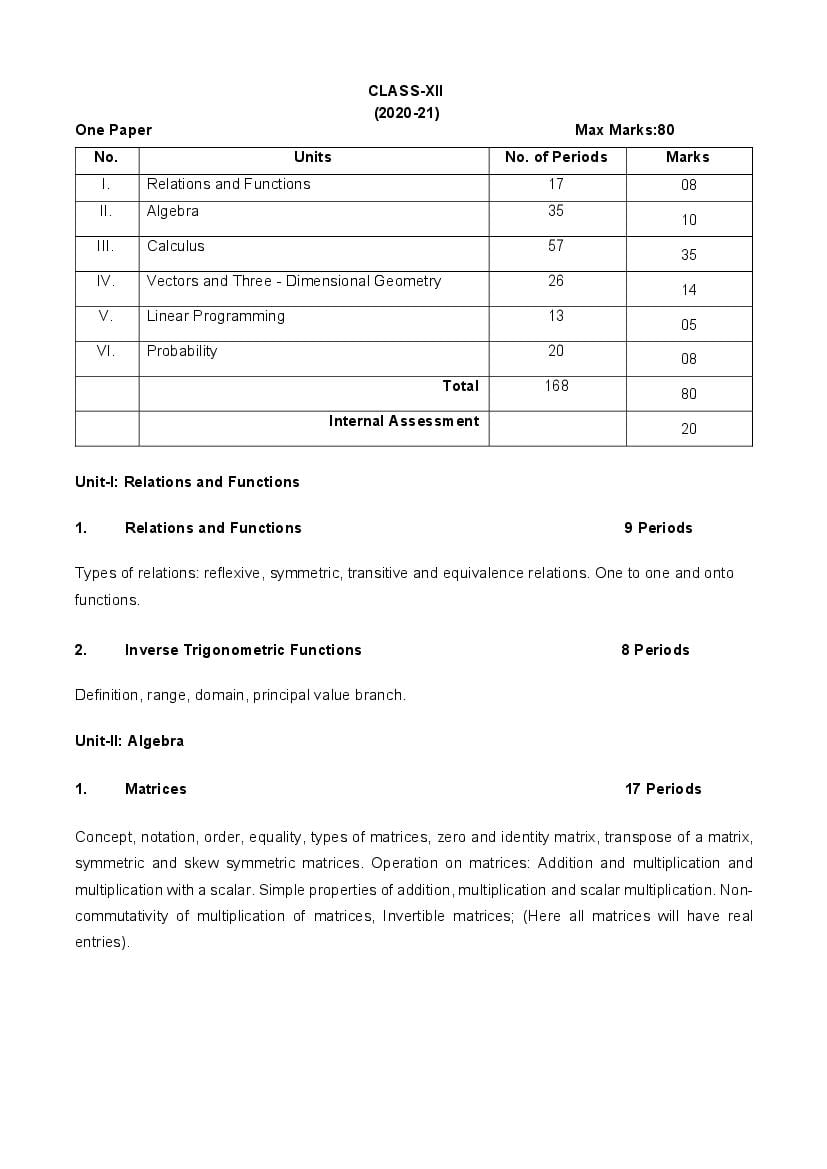
(2020-21)
One Paper Max Marks:80
No. Units No. of Periods Marks
I. Relations and Functions 17 08
II. Algebra 35
10
III. Calculus 57
35
IV. Vectors and Three - Dimensional Geometry 26
14
V. Linear Programming 13
05
VI. Probability 20
08
Total 168
80
Internal Assessment
20
Unit-I: Relations and Functions
1. Relations and Functions 9 Periods
Types of relations: reflexive, symmetric, transitive and equivalence relations. One to one and onto
functions.
2. Inverse Trigonometric Functions 8 Periods
Definition, range, domain, principal value branch.
Unit-II: Algebra
1. Matrices 17 Periods
Concept, notation, order, equality, types of matrices, zero and identity matrix, transpose of a matrix,
symmetric and skew symmetric matrices. Operation on matrices: Addition and multiplication and
multiplication with a scalar. Simple properties of addition, multiplication and scalar multiplication. Non-
commutativity of multiplication of matrices, Invertible matrices; (Here all matrices will have real
entries).
Page 2
Determinant of a square matrix (up to 3 x 3 matrices), minors, co-factors and applications of
determinants in finding the area of a triangle. Adjoint and inverse of a square matrix. solving system
of linear equations in two or three variables (having unique solution) using inverse of a matrix.
Unit-III: Calculus
1. Continuity and Differentiability 16 Periods
Continuity and differentiability, derivative of composite functions, chain rule, derivative of inverse
trigonometric functions, derivative of implicit functions. Concept of exponential and logarithmic functions.
Derivatives of logarithmic and exponential functions. Logarithmic differentiation, derivative of functions
expressed in parametric forms. Second order derivatives.
2. Applications of Derivatives 7 Periods
Applications of derivatives: increasing/decreasing functions, tangents and normals, maxima and
minima (first derivative test motivated geometrically and second derivative test given as a provable
tool). Simple problems (that illustrate basic principles and understanding of the subject as well as real-
life situations).
3. Integrals 15 Periods
Integration as inverse process of differentiation. Integration of a variety of functions by substitution, by
partial fractions and by parts, Evaluation of simple integrals of the following types and problems based
on them.
dx dx dx dx dx
, , ,
x ±a , x ±a √a − x ax + bx + c ax
px + q px + q
dx, dx, a ± x dx, x − a dx
ax + bx + c √ax bx + c
Fundamental Theorem of Calculus (without proof).Basic properties of definite integrals and evaluation
of definite integrals.
4. Applications of the Integrals 9 Periods
Applications in finding the area under simple curves, especially lines, parabolas; area of circles /ellipses
(in standard form only) (the region should be clearly identifiable).
Page 3
Definition, order and degree, general and particular solutions of a differential equation. Solution of
differential equations by method of separation of variables, solutions of homogeneous differential
equations of first order and first degree of the type: = 𝑓(y/x). Solutions of linear differential equation
of the type:
dy
+ py = q, where p and q are functions of x or constant.
dx
Unit-IV: Vectors and Three-Dimensional Geometry
1. Vectors 13 Periods
Vectors and scalars, magnitude and direction of a vector. Direction cosines and direction ratios of a
vector. Types of vectors (equal, unit, zero, parallel and collinear vectors), position vector of a point,
negative of a vector, components of a vector, addition of vectors, multiplication of a vector by a scalar,
position vector of a point dividing a line segment in a given ratio. Definition, Geometrical Interpretation,
properties and application of scalar (dot) product of vectors, vector (cross) product of vectors.
2. Three - dimensional Geometry 13 Periods
Direction cosines and direction ratios of a line joining two points. Cartesian equation and vector equation
of a line, coplanar and skew lines, shortest distance between two lines. Cartesian and vector equation
of a plane. Distance of a point from a plane.
Page 4
1. Linear Programming 13 Periods
Introduction, related terminology such as constraints, objective function, optimization, different types of
linear programming (L.P.) problems. graphical method of solution for problems in two variables, feasible
and infeasible regions (bounded), feasible and infeasible solutions, optimal feasible solutions (up to
three non-trivial constraints).
Unit-VI: Probability
1. Probability 20 Periods
Conditional probability, multiplication theorem on probability, independent events, total probability,
Bayes’ theorem, Random variable and its probability distribution.
Prescribed Books:
1) Mathematics Textbook for Class XI, NCERT Publications
2) Mathematics Part I - Textbook for Class XII, NCERT Publication
3) Mathematics Part II - Textbook for Class XII, NCERT Publication
4) Mathematics Exemplar Problem for Class XI, Published by NCERT
5) Mathematics Exemplar Problem for Class XII, Published by NCERT
6) Mathematics Lab Manual class XI, published by NCERT
7) Mathematics Lab Manual class XII, published by NCERT
Page 5
QUESTION PAPER DESIGN CLASS - XII
(2020 - 21)
Time: 3 hours Max. Marks: 80
%
S. Total
Typology of Questions Weightage
No. Marks
Remembering: Exhibit memory of previously learned material
by recalling facts, terms, basic concepts, and answers.
55
1 Understanding: Demonstrate understanding of facts and 44
ideas by organizing, comparing, translating, interpreting, giving
descriptions, and stating main ideas
Applying: Solve problems to new situations by applying
2 acquired knowledge, facts, techniques and rules in a different 20 25
way.
Analysing :
Examine and break information into parts by identifying
motives or causes. Make inferences and find evidence to
support generalizations
Evaluating:
Present and defend opinions by making judgments about
3 16 20
information, validity of ideas, or quality of work based on a set
of criteria.
Creating:
Compile information together in a different way by combining
elements in a new pattern or proposing alternative solutions
Total 80 100
1. No chapter wise weightage. Care to be taken to cover all the chapters
2. Suitable internal variations may be made for generating various templates keeping the overall
weightage to different form of questions and typology of questions same.
Choice(s):
There will be no overall choice in the question paper.
However, 33% internal choices will be given in all the sections
INTERNAL ASSESSMENT 20 MARKS
Periodic Tests ( Best 2 out of 3 tests conducted) 10 Marks
Mathematics Activities 10 Marks
Note: For activities NCERT Lab Manual may be referred
Page 6
Periodic Test is a Pen and Paper assessment which is to be conducted by the respective
subject teacher. The format of periodic test must have questions items with a balance mix,
such as, very short answer (VSA), short answer (SA) and long answer (LA) to effectively
assess the knowledge, understanding, application, skills, analysis, evaluation and synthesis.
Depending on the nature of subject, the subject teacher will have the liberty of incorporating
any other types of questions too. The modalities of the PT are as follows:
a) Mode: The periodic test is to be taken in the form of pen-papertest.
b) Schedule: In the entire Academic Year, three Periodic Tests in each subject may be
conducted as follows:
Test Pre Mid-term (PT-I) Mid-Term (PT-II) Post Mid-Term (PT-III)
Tentative Month July-August November December-January
This is only a suggestive schedule and schools may conduct periodic tests as pertheir
convenience. The winter bound schools would develop their own schedule with similar time
gaps between two consecutive tests.
c) Average of Marks: Once schools complete the conduct of all the three periodic tests,
they will convert the weightage of each of the three tests into ten marks each for identifying
best two tests. The best two will be taken into consideration and the average of the two
shall be taken as the final marks for PT.
d) The school will ensure simple documentation to keep a record of performance as
suggested in detail circular no.Acad-05/2017.
e) Sharing of Feedback/Performance: The students’ achievement in each test must be
shared with the students and their parents to give them an overview of the levelof learning
that has taken place during different periods. Feedback will help parents formulate
interventions (conducive ambience, support materials, motivation and morale-boosting)
to further enhance learning. A teacher, while sharing the feedback with student or parent,
should be empathetic, non- judgmental and motivating. It is recommended that the
teacher share best examples/performances of IA with the class to motivate all learners.
Page 7
Through out the year any 10 activities shall be performed by the student from the activities
given in the NCERT Laboratory Manual for the respective class ( XI or XII) which is
available on the link : http://www.ncert.nic.in/exemplar/labmanuals.htmla record of the
same may be kept by the student. An year end test on the activity may be conducted
The weightage are as under:
The activities performed by the student through out the year and record keeping
: 5 marks
Assessment of the activity performed during the year end test: 3 marks
Viva-voce : 2 marks
Document Details
| Board / Org | CBSE |
| Exam | Class 12 |
| Type | Syllabus |
| Pages | 7 |
| Updated | 22 Jul 2026 |