MAHA SET 2015 Question Paper 2 Earth Atmospheric Ocean _ Planetary Science
Finished viewing? Save it for later —
Download MAHA SET 2015 Question Paper 2 Earth Atmospheric Ocean _ Planetary Science (PDF · 16 pages)About MAHA SET 2015 Question Paper 2 Earth Atmospheric Ocean _ Planetary Science
MAHA SET 2015 Question Paper 2 Earth Atmospheric Ocean _ Planetary Science is available here for free download. Published by Maharashtra Exams for MAHA SET, this question paper can be viewed online or downloaded as a PDF (16 pages). Candidates preparing for MAHA SET can use MAHA SET 2015 Question Paper 2 Earth Atmospheric Ocean _ Planetary Science to understand the exam pattern, the type of questions asked, and the overall difficulty level.
Frequently Asked Questions
How can I download MAHA SET 2015 Question Paper 2 Earth Atmospheric Ocean _ Planetary Science?
Open this page and click the Download button to save MAHA SET 2015 Question Paper 2 Earth Atmospheric Ocean _ Planetary Science as a PDF. It is completely free on AglaSem Docs.
Is MAHA SET 2015 Question Paper 2 Earth Atmospheric Ocean _ Planetary Science free to download?
Yes. MAHA SET 2015 Question Paper 2 Earth Atmospheric Ocean _ Planetary Science can be viewed online and downloaded as a PDF free of cost on AglaSem Docs.
How many pages does MAHA SET 2015 Question Paper 2 Earth Atmospheric Ocean _ Planetary Science have?
MAHA SET 2015 Question Paper 2 Earth Atmospheric Ocean _ Planetary Science contains 16 pages, which you can read online or download together as a single PDF.
Where can I find more MAHA SET study material?
You can find more MAHA SET question papers, sample papers, syllabus, and answer keys on AglaSem Docs.
MAHA SET 2015 Question Paper 2 Earth Atmospheric Ocean _ Planetary Science – Text
Read the full text of this question paper below — useful to quickly search, copy and reference the content online without downloading the PDF.
📄 View text version (16 pages)
Page 1
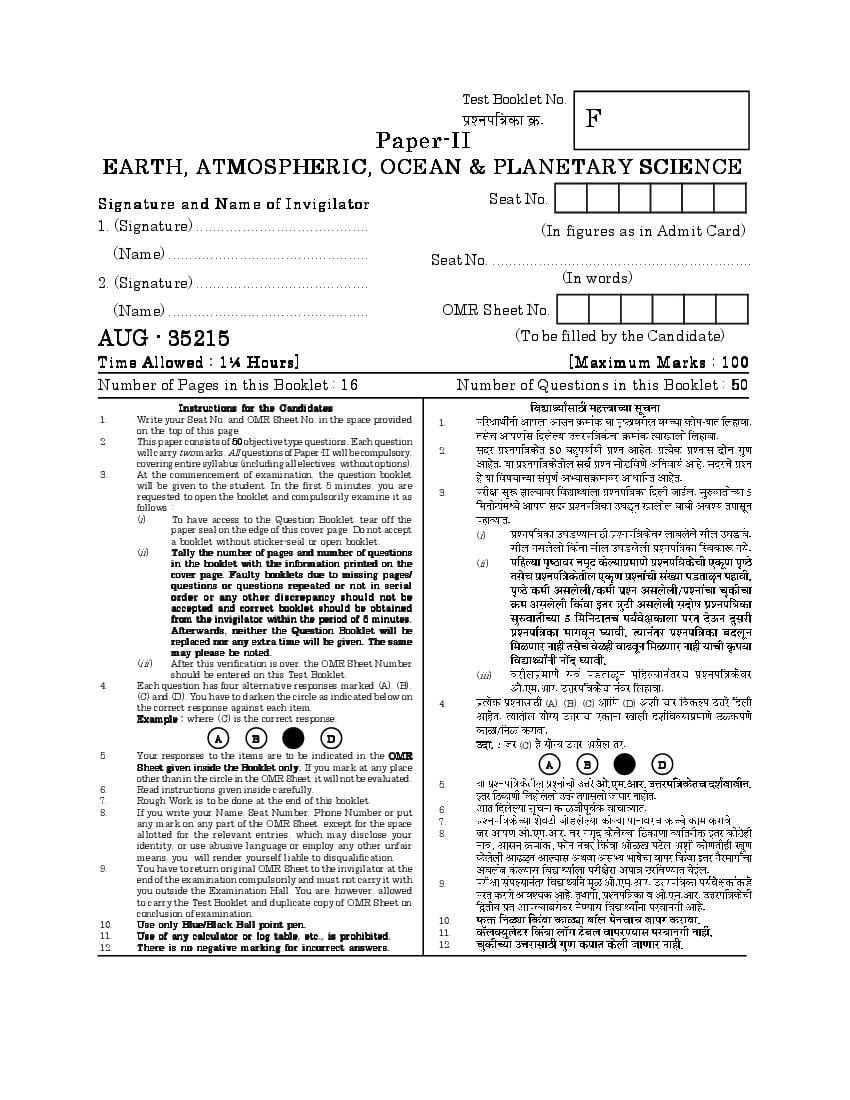
F
EARTH, ATMOSPHERIC, OCEAN & PLANETARY SCIENCE
Signature and Name of Invigilator Seat No.
1. (Signature) ......................................... (In figures as in Admit Card)
(Name) ................................................ Seat No. ..............................................................
2. (Signature) ......................................... (In words)
(Name) ................................................ OMR Sheet No.
AUG - 35215 (To be filled by the Candidate)
Time Allowed : 1¼ Hours] [Maximum Marks : 100
Number of Pages in this Booklet : 16 Number of Questions in this Booklet : 50
Instructions for the Candidates
1. Write your Seat No. and OMR Sheet No. in the space provided 1.
on the top of this page.
2. This paper consists of 50 objective type questions. Each question
will carry two marks. All questions of Paper-II will be compulsory, 2.
covering entire syllabus (including all electives, without options).
3. At the commencement of examination, the question booklet
will be given to the student. In the first 5 minutes, you are
requested to open the booklet and compulsorily examine it as 3.
follows :
(i) To have access to the Question Booklet, tear off the
paper seal on the edge of this cover page. Do not accept
(i)
a booklet without sticker-seal or open booklet.
(ii) Tally the number of pages and number of questions
in the booklet with the information printed on the (ii)
cover page. Faulty booklets due to missing pages/
questions or questions repeated or not in serial
o rder or any other discre pancy should not be
accepted and correct booklet should be obtained
from the invigilator within the period of 5 minutes.
Afterwards, neither the Question Booklet will be
replaced nor any extra time will be given. The same
may please be noted.
(iii) After this verification is over, the OMR Sheet Number
should be entered on this Test Booklet. (iii)
4. Each question has four alternative responses marked (A), (B),
(C) and (D). You have to darken the circle as indicated below on
the correct response against each item. 4. (A), (B), (C) (D)
Example : where (C) is the correct response.
A B D
(C)
5. Your responses to the items are to be indicated in the OMR
Sheet given inside the Booklet only. If you mark at any place A B D
other than in the circle in the OMR Sheet, it will not be evaluated.
5.
6. Read instructions given inside carefully.
7. Rough Work is to be done at the end of this booklet.
8. If you write your Name, Seat Number, Phone Number or put 6.
any mark on any part of the OMR Sheet, except for the space 7.
allotted for the relevant entries, which may disclose your 8.
identity, or use abusive language or employ any other unfair
means, you will render yourself liable to disqualification.
9. You have to return original OMR Sheet to the invigilator at the
end of the examination compulsorily and must not carry it with 9.
you outside the Examination Hall. You are, however, allowed
to carry the Test Booklet and duplicate copy of OMR Sheet on
conclusion of examination.
10. Use only Blue/Black Ball point pen. 10.
11. Use of any calculator or log table, etc., is prohibited. 11.
12. There is no negative marking for incorrect answers. 12.
Page 2
Page 3
Paper II
Time Allowed : 75 Minutes] [Maximum Marks : 100
Note : This Paper contains Fifty (50) multiple choice questions. Each question
carries Two (2) marks. Attempt All questions.
1. The primary process by which 3. Which of the following minerals has
nutrients in deep sea return to the
two different values of hardness in
surface water is :
different orientation ?
(A) Heating of surface water
(A) Quartz
(B) Upwelling
(B) Feldspar
(C) Down welling
(C) Fluorite
(D) Surfacing of deep dwelling
organism (D) Kyanite
2. The rock komatiite is identified on 4. Which one of the following minerals
the basis of its characteristic
has no cleavage ?
.............................. texture.
(A) Calcite
(A) Porphyritic
(B) Garnet
(B) Spherulitic
(C) Spenifex (C) Mica
(D) Orbicular (D) Kyanite
3 [P.T.O.
Page 4
8. The layer of loose, heterogeneous
achieved by :
weathered material lying on the top
(A) Only folding
of rocky hill slopes is :
(B) Only faulting
(C) Both folding and faulting (A) Soil
(D) Only erosion
(B) Weathered debris
6. The most abundant mineral of the
earth is : (C) Regolith
(A) Rutile
(D) Alluvium
(B) Anatage
9. On the global scale, hot deserts in
(C) Olivine
(D) Perovskite the southern hemisphere are found
7. In the direction of the transport, the on :
grain size of the sediment :
(A) Western parts of continents
(A) Increases
(B) Decreases (B) Eastern parts of continents
(C) Remains uniform
(C) Interior parts of continents
(D) First increases and then
decreases (D) Only on elevated cratonic areas
4
Page 5
inclined surface of the subducting
geophysical methods is widely used
plate, occur in :
in groundwater exploration ?
(A) Wadatti-Benioff zone
(A) Electrical induce polarization
(B) Seismo-Subduction zone
(C) Inclined epicentre zone (B) Electrical self-potential method
(D) Tomographic angular zone (C) Electrical resistivity method
11. A saturated permeable geological
(D) Seismic refraction method
rock formation that can transmit
13. The Hadley Circulation involves
large quantities of water under
normal hydraulic gradient is ascending motion near the :
called :
(A) Sub-tropical Latitudes
(A) Aquifer
(B) Mid Latitudes
(B) Aquiclude
(C) Equator
(C) Aquitard
(D) Polar Latitudes
(D) Aquifuse
5 [P.T.O.
Page 6
forces in the atmosphere ?
these cloud types come under high
(A) Coriolis force and Centrifugal
clouds ?
force
(A) Cumulus, Stratocumulus,
(B) Pressure gradient force,
Stratus
Gravitational force and
Frictional force (B) Cirrus, Cirrostratus,
(C) Pressure gradient force, Cirrocumulus
Gravitational force and Coriolis
(C) Cirrus, Stratus, Altocumulus
force
(D) Stratocumulus, Altocumulus,
(D) Gravitational force, Pressure
Stratus
gradient force, Coriolis force and
Centrifugal force 17. The value of Standard Atmospheric
15. Which of the following is not a Pressure at mean sea level is :
green-house gas ?
(A) 1013.25 hPa
(A) Carbon dioxide
(B) 950.13 hPa
(B) Ozone
(C) 990.25 hPa
(C) Argon
(D) Methane (D) 100.25 hPa
6
Page 7
(A) Feldspar Group
geomagnetic field is because of :
(B) Epidote Group
(A) Differential rotation of core
(C) Amphibole Group
(B) Anticlockwise rotation of the
(D) Pyroxene Group
earth
21. The movement of material is
‘rotational’ in case of :
(C) Pole to equator geomagnetic
(A) Rock-topple
variation
(B) Rock-slide
(D) Equatorial geomagnetic field
(C) Rock-fall
19. A part of the Mid-atlantic ridge
(D) Rock-slump
exposed above the sea-level is in :
22. Plasticity Index is calculated by
formula :
(A) North America
(A) Liquid limit – Plastic limit
(B) Canada
(B) Liquid limit/Plastic limit
(C) Iceland
(C) Plastic limit – Shrinkage limit
(D) Africa (D) Plastic limit/Shrinkage limit
7 [P.T.O.
Page 8
tillite and fanglomerate essentially atmosphere has a value of :
lies in :
(A) 1.8 deg km–1
(A) Clast size
(B) 4.8 deg km–1
(B) Nature of matrix
(C) 6.8 deg km–1
(C) Environment of deposition
(D) 9.8 deg km–1
(D) Age
26. The trace element, that discriminates
24. In the curve-matching technique if
plume and arc sources is :
1 > 2 > 3, the curve type is :
(A) Nb
(A) ‘Q’ type
(B) Sr
(B) ‘H’ type
(C) ‘A’ type (C) Ba
(D) ‘K’ type (D) Th
8
Page 9
is : System are :
(A) 5.52 gm/cm3 (A) Antecedent
(B) 8.52 gm/cm3 (B) Consequent
(C) 3.83 gm/cm3 (C) Obsequent
(D) 6.28 gm/cm3 (D) Subsequent
28. The gossan deposits are commonly 30. Major period of sedimentation in
formed due to : deep sea fan is during :
(A) Replacement (A) Sea level high stand
(B) Contact metasomatism (B) Sea level low stand
(C) Magmatic differentiation (C) Inter-glacials
(D) Supergene sulphide enrichment (D) Mountain building
9 [P.T.O.
Page 10
33. Palana lignite is in :
water at an angle to blowing wind
(A) Uttar Pradesh
on the ocean surface in northern
hemisphere is referred to : (B) Bihar
(A) Thermohaline circulation
(C) Rajasthan
(B) Longshore current
(D) Gujarat
(C) Ekman transport
34. Important toxic pollutants in
(D) Upwelling
groundwater are :
32. Marine transgression in Cauvery
basin occurred in :
(A) Cr, Cd, Mg
(A) Cenomanian
(B) Na, K, Ca
(B) Barremian
(C) Au, Ag, Pb
(C) Berriasian
(D) Valanginian (D) Mg, Fe, Mn
10
Page 11
(A) Vindhyans in :
(B) Deccan Volcanism
(A) Permian
(C) Bundelkhand Gneiss
(B) Jurassic
(D) Gondwanas
(C) Eocene
36. Bode’s law states that :
(D) Pliocene
(A) Each planet is roughly twice as
far from the sun as its closest 38. The continent-continent collision
neighbourhood between Indian and Eurasian plates
(B) Each planet is far from sun in was initiated at about :
the logarithmic sequence
(A) 10 Ma
(C) Distance of planet from sun is
(B) 25 Ma
square of its radius
(C) 55 Ma
(D) Radius of planet is square root
of its mass (D) 155 Ma
11 [P.T.O.
Page 12
depends on detecting the : Mid-oceanic ridge segment are
(A) Magnetic susceptibility of ore observed in :
body
(A) East Pacific rise
(B) Chemical composition of ores
(B) Indian Ocean rise
(C) Structure of ore deposits
(C) Mid-Atlantic ridge
(D) Anomalies in the earth’s
(D) Central Indian Ocean ridge
magnetic field
42. The gravity anomaly across the
40. The deformation processes in the
mountain chain is strongly negative
upper crust are chiefly controlled
due to :
by :
(A) Lithospheric melting
(A) Ductile processes
(B) Low density root zone
(B) Brittle processes
(C) Ductile-Brittle processes (C) Elevated Moho
(D) Plastic-deformational processes (D) High density root zone
12
Page 13
(A) Ferricrete often used as roofing stone ?
(B) Alcrete
(A) Cuddapah slabs
(C) Calcrete
(B) Basalt
(D) Silcrete
(C) Dolerite
44. In some materials the strain does
(D) Laterite
not reach a stable value immediately
after application of stress, but rises 46. The monument “Gateway of India”
gradually to a stable value. Such
is built of :
materials are called :
(A) Marble
(A) Plastic
(B) Limestone
(B) Anelastic
(C) Basalt
(C) Ductile
(D) Brittle (D) Granite
13 [P.T.O.
Page 14
(A) Heterotrophs (A) Maharashtra
(B) Karnataka
(B) Autotrophs
(C) Rajasthan
(C) Decomposers
(D) Orissa
(D) Carnivorous
50. Which one of the following era
48. Laddervein, boxwork and cavity
represents the longest time
filling structures are common in :
interval ?
(A) Hydrothermal deposits
(A) Precambrian
(B) Magmatic segregation
(B) Palaeozoic
(C) Magmatic differentiation
(C) Mesozoic
(D) Evaporitic deposits (D) Cenozoic
14
Page 15
15 [P.T.O.
Page 16
16
Document Details
| Board / Org | Maharashtra Exams |
| Exam | MAHA SET |
| Type | Question Paper |
| Pages | 16 |
| Updated | 30 Apr 2026 |