aglasem.com
Schools Admission Mock Test Playground
ClassChoose class
StateSelect state

CBSE Class 10 Marking Scheme 2022 for Carnatic Music Percussion Term 2
Get here latest CBSE Class 10 Marking Scheme 2022 for Carnatic Music Percussion for Term 2 examination. It will help you check your answers after solving CBSE Sample Papers to prepare well for the Carnatic Music Percussion Term 2 examination. You can also download Term 2 Class 10 Carnatic Music Percussion Marking Scheme 2022 PDF. More Detail
CBSE Class 10 Marking Scheme 2022 for Carnatic Music Percussion Term 2 - Page 1 of 2

About CBSE Class 10 Marking Scheme 2022 for Carnatic Music Percussion Term 2

CBSE Class 10 Marking Scheme 2022 for Carnatic Music Percussion Term 2 is available here for free download. Published by CBSE for Class 10, this marking scheme can be viewed online or downloaded as a PDF (2 pages). Candidates preparing for Class 10 can use CBSE Class 10 Marking Scheme 2022 for Carnatic Music Percussion Term 2 to understand the exam pattern, the type of questions asked, and the overall difficulty level.

Frequently Asked Questions

How can I download CBSE Class 10 Marking Scheme 2022 for Carnatic Music Percussion Term 2?

Open this page and click the Download button to save CBSE Class 10 Marking Scheme 2022 for Carnatic Music Percussion Term 2 as a PDF. It is completely free on AglaSem Docs.

Is CBSE Class 10 Marking Scheme 2022 for Carnatic Music Percussion Term 2 free to download?

Yes. CBSE Class 10 Marking Scheme 2022 for Carnatic Music Percussion Term 2 can be viewed online and downloaded as a PDF free of cost on AglaSem Docs.

How many pages does CBSE Class 10 Marking Scheme 2022 for Carnatic Music Percussion Term 2 have?

CBSE Class 10 Marking Scheme 2022 for Carnatic Music Percussion Term 2 contains 2 pages, which you can read online or download together as a single PDF.

Where can I find more Class 10 study material?

You can find more Class 10 question papers, sample papers, syllabus, and answer keys on AglaSem Docs.

CBSE Class 10 Marking Scheme 2022 for Carnatic Music Percussion Term 2 – Text

Read the full text of this marking scheme below — useful to quickly search, copy and reference the content online without downloading the PDF.

📄 View text version (2 pages)

Page 1

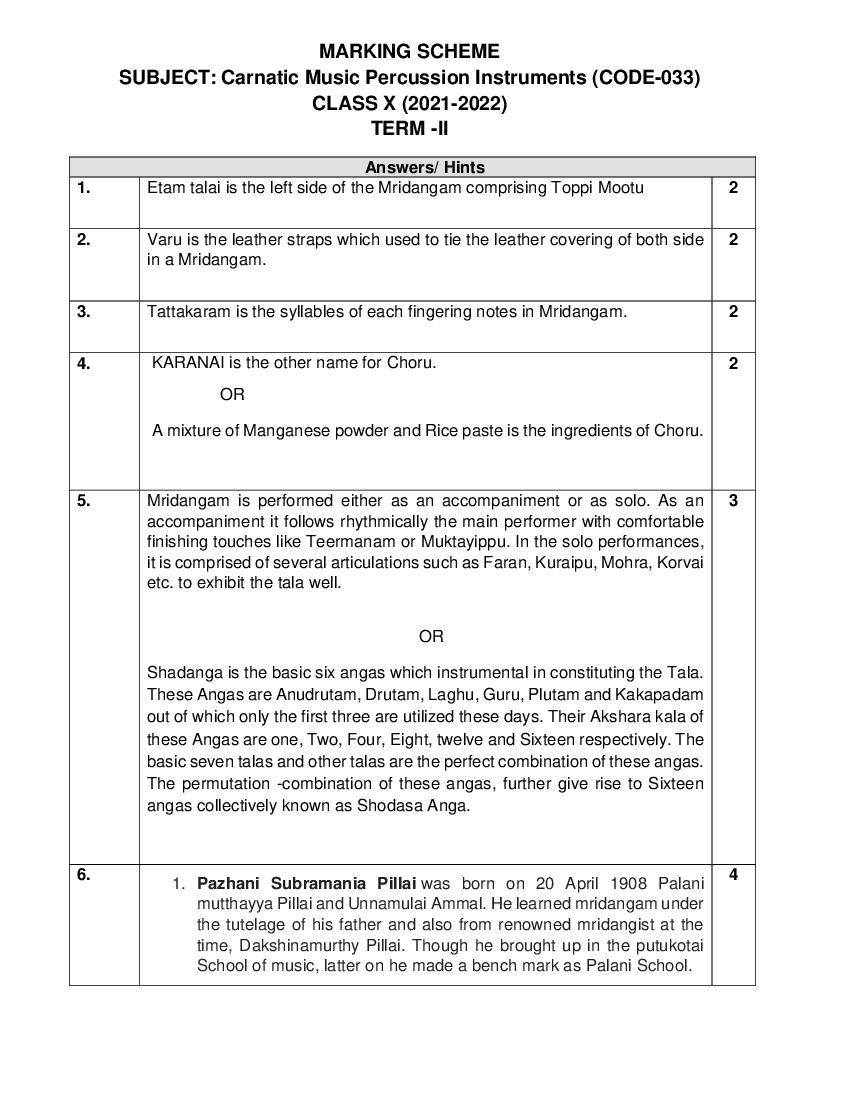
MARKING SCHEME SUBJECT: Carnatic Music Percussion Instruments (CODE-033) CLASS X (2021-2022) TERM -II Answers/ Hints 1. Etam talai is the left side of the Mridangam comprising Toppi Mootu 2 2. Varu is the leather straps which used to tie the leather covering of both side 2 in a Mridangam. 3. Tattakaram is the syllables of each fingering notes in Mridangam. 2 4. KARANAI is the other name for Choru. 2 OR A mixture of Manganese powder and Rice paste is the ingredients of Choru. 5. Mridangam is performed either as an accompaniment or as solo. As an 3 accompaniment it follows rhythmically the main performer with comfortable finishing touches like Teermanam or Muktayippu. In the solo performances, it is comprised of several articulations such as Faran, Kuraipu, Mohra, Korvai etc. to exhibit the tala well. OR Shadanga is the basic six angas which instrumental in constituting the Tala. These Angas are Anudrutam, Drutam, Laghu, Guru, Plutam and Kakapadam out of which only the first three are utilized these days. Their Akshara kala of these Angas are one, Two, Four, Eight, twelve and Sixteen respectively. The basic seven talas and other talas are the perfect combination of these angas. The permutation -combination of these angas, further give rise to Sixteen angas collectively known as Shodasa Anga. 6. 4 1. Pazhani Subramania Pillai was born on 20 April 1908 Palani mutthayya Pillai and Unnamulai Ammal. He learned mridangam under the tutelage of his father and also from renowned mridangist at the time, Dakshinamurthy Pillai. Though he brought up in the putukotai School of music, latter on he made a bench mark as Palani School.

Page 2

While Palani would highlight the different parts of the song such as "Eduppus" of Pallavi, Anupallavi, and charanam with sufficient emphasis, he would rather follow the mood and trend of the song rather play the "Prayogas" of the songs themselves. This mode of playing gave a wholesomeness to the song renderings rather than the "Starts and stops" that would otherwise have arisen. His Sarvalaghu was the spontaneous flow of "Nadais", "Sollus", and "Sollukkatus" rather than any patternised formats. The Sarvalaghu used to be "Amorphous" rather than "Crystalline". Occasionally when certain arithmetic combinations arose, they too were spontaneous and blended seamlessly into the scheme of things. He specialized in "Vallinam" and "Mellinam" strokes in even the smallest passages. In layman's language these are Hard and Soft Strokes. His playing gave the effect of his indulging in a musical conversation with the main artist throughout the tenure of the concert. In his Solo interludes-"Thani Avarthanams"- he displayed both intellectual and aesthetic aspects in equal measure which pleased all sections of the audience but he never played to the gallery. Subrahmanya Pillai left the mortal coil in the year 1962.

Document Details

Board / OrgCBSE
ExamClass 10
TypeSolution
Pages2
Languageenglish
Updated30 Apr 2026