CBSE Class 10 Marking Scheme 2022 for Carnatic Music Vocal Term 2
Finished viewing? Save it for later —
Download CBSE Class 10 Marking Scheme 2022 for Carnatic Music Vocal Term 2 (PDF · 3 pages)About CBSE Class 10 Marking Scheme 2022 for Carnatic Music Vocal Term 2
CBSE Class 10 Marking Scheme 2022 for Carnatic Music Vocal Term 2 is available here for free download. Published by CBSE for Class 10, this marking scheme can be viewed online or downloaded as a PDF (3 pages). Candidates preparing for Class 10 can use CBSE Class 10 Marking Scheme 2022 for Carnatic Music Vocal Term 2 to understand the exam pattern, the type of questions asked, and the overall difficulty level.
Frequently Asked Questions
How can I download CBSE Class 10 Marking Scheme 2022 for Carnatic Music Vocal Term 2?
Open this page and click the Download button to save CBSE Class 10 Marking Scheme 2022 for Carnatic Music Vocal Term 2 as a PDF. It is completely free on AglaSem Docs.
Is CBSE Class 10 Marking Scheme 2022 for Carnatic Music Vocal Term 2 free to download?
Yes. CBSE Class 10 Marking Scheme 2022 for Carnatic Music Vocal Term 2 can be viewed online and downloaded as a PDF free of cost on AglaSem Docs.
How many pages does CBSE Class 10 Marking Scheme 2022 for Carnatic Music Vocal Term 2 have?
CBSE Class 10 Marking Scheme 2022 for Carnatic Music Vocal Term 2 contains 3 pages, which you can read online or download together as a single PDF.
Where can I find more Class 10 study material?
You can find more Class 10 question papers, sample papers, syllabus, and answer keys on AglaSem Docs.
CBSE Class 10 Marking Scheme 2022 for Carnatic Music Vocal Term 2 – Text
Read the full text of this marking scheme below — useful to quickly search, copy and reference the content online without downloading the PDF.
📄 View text version (3 pages)
Page 1
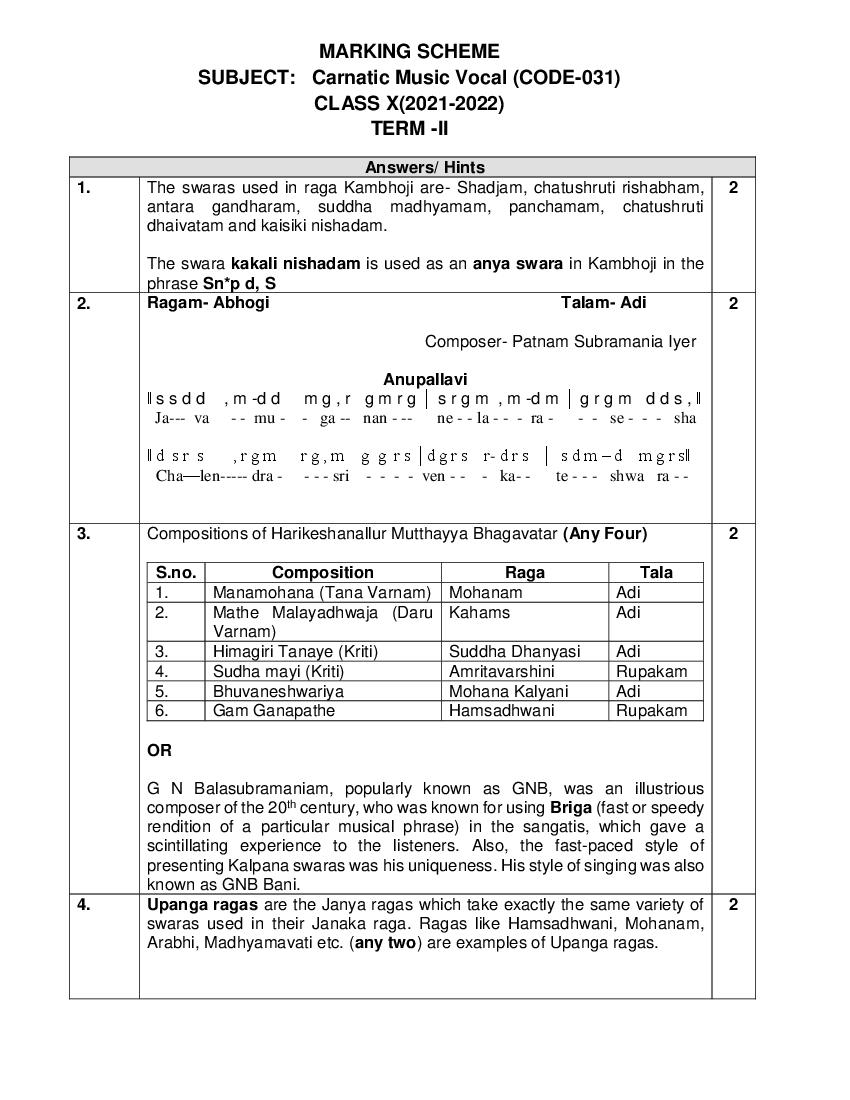
SUBJECT: Carnatic Music Vocal (CODE-031)
CLASS X(2021-2022)
TERM -II
Answers/ Hints
1. The swaras used in raga Kambhoji are- Shadjam, chatushruti rishabham, 2
antara gandharam, suddha madhyamam, panchamam, chatushruti
dhaivatam and kaisiki nishadam.
The swara kakali nishadam is used as an anya swara in Kambhoji in the
phrase Sn*p d, S
2. Ragam- Abhogi Talam- Adi 2
Composer- Patnam Subramania Iyer
Anupallavi
ǁ s s d d , m -d d m g , r g m r g │ s r g m , m -d m │ g r g m d d s , ǁ
Ja--- va - - mu - - ga -- nan - -- ne - - la - - - ra - - - se - - - sha
ǁd sr s ,rgm r g , m g g r s │d g r s r- d r s │ s d m – d m g r sǁ
Cha—len----- dra - - - - sri - - - - ven - - - ka- - te - - - shwa ra - -
3. Compositions of Harikeshanallur Mutthayya Bhagavatar (Any Four) 2
S.no. Composition Raga Tala
1. Manamohana (Tana Varnam) Mohanam Adi
2. Mathe Malayadhwaja (Daru Kahams Adi
Varnam)
3. Himagiri Tanaye (Kriti) Suddha Dhanyasi Adi
4. Sudha mayi (Kriti) Amritavarshini Rupakam
5. Bhuvaneshwariya Mohana Kalyani Adi
6. Gam Ganapathe Hamsadhwani Rupakam
OR
G N Balasubramaniam, popularly known as GNB, was an illustrious
composer of the 20th century, who was known for using Briga (fast or speedy
rendition of a particular musical phrase) in the sangatis, which gave a
scintillating experience to the listeners. Also, the fast-paced style of
presenting Kalpana swaras was his uniqueness. His style of singing was also
known as GNB Bani.
4. Upanga ragas are the Janya ragas which take exactly the same variety of 2
swaras used in their Janaka raga. Ragas like Hamsadhwani, Mohanam,
Arabhi, Madhyamavati etc. (any two) are examples of Upanga ragas.
Page 2
from the variety of swaras taken by their Janaka ragas, one or more swaras
pertaining to other varieties are also used. These swaras are known as
Bhasganga swara or Anya swara. Some examples of Bhasahnga ragas are-
Bilahari, Ananda Bhairavi, Bhairavi, Kambhoji etc. (any two)
5. Bhoota Sankhya is an interesting tool to remember facts by associating 3
ordinary words which directly or indirectly indicate some numerical values.
Sometimes, syllables without any distinct meaning are also used to signify
certain numbers. In Carnatic music, Bhoota sankhya is primarily used in the
names of 12 Chakras of the 72 Melakarta Scheme like Indu (1), Netra (2),
Agni (3) etc.
Further, syllables like Pa, Sri, Go, Bhu, Ma and Sha are used to indicate the
six melas within each chakra.
Similarly, the syllables Ra, Ri and Ru used for the three varieties of
rishabham such as Suddha rishabham (Ra), Chatushruti rishabham (Ri) and
Shadshruti Rishabham (Ru) is also an example of Bhoota Sankhya. The
same pattern is followed for other swaras as well. For instance - Ga, Gi, Gu,
Ma, Mi, Dha, Dhi, Dhu, Na, Ni and Nu
OR
Katapayadi Sutra is used to calculate the numeric value of a given word by
separating each letter of that word and finding out its corresponding number.
In order to find out the serial number of a mela in the 72 Melakarta Scheme,
the first two letters of the name of the mela are taken and then their
corresponding numeric value is found out by referring to the Katapayadi
Chart. The resultant two-digit number if placed in the reverse order, will give
the serial number of that mela.
For example, to find out the serial number of the mela Hanumatodi, the first
two letters ‘Ha’ and ‘Na’ are taken. Then, we get the numbers 8 for the letter
Ha and 0 for the letter Na. Now, by reversing their order, i.e., 08, the serial
number of Hanumatodi would be derived.
6. A Kriti is the most popular musical form prevalent in Carnatic music in the 4
present times. It generally consists of three sections namely, Pallavi,
Anupallavi and Charanam. There are certain Kritis which have more than
one charanam in it. Further, there is another variety of kriti, wherein the an
anga called Samashthi Charanam is used, which replaces both anupallavi
and Charanam.
There are some other elements which add beauty to a Kriti. They are as
follow:
Decorative anagas in a Kriti (Any Four)
Page 3
composition.
Chitta Swara- A set of swara passages usually extending upto two or more
avartas in a tala is known as chitta swara. These are generally rendered after
the anupallavi and charana part.
Swara Sahitya- It is very similar to a chitta swara but for the difference that
an appropriate sahitya is also composed which corresponds to the swaras
passages, wherein the swara part is rendered after the anupallavi and the
sahitya is sung after the charanam.
Solkattu Swara- This is another variation of chitta swara, wherein, along
with the swara passages some jatis (rhythmic syllables) are also used.
Madhyamakala Sahitya- This lyrical passage in the composition is
composed in a tempo which is slightly quicker than the original tempo of the
composition. Thus, it is called Madhyamakala Sahitya. It generally occurs
after the anupallavi or charana or both and very rarely after the Pallavi.
Swarakshara- This is a Shabdalankara wherein the swara syllable exactly
matches with the particular letter of the sahitya.
Yati- It is a typical kind of arrangement of swaras or beautiful combination of
words which forms a particular pattern. The different types of yatis are- sama,
vishama, gopuccha, srotovaha, mridanga and damaru, each representing a
specific shape or pattern.
Yamakam- It is a beautifying element wherein the same word is used in a
composition multiple times but with different meanings at every instance.
Document Details
| Board / Org | CBSE |
| Exam | Class 10 |
| Type | Solution |
| Pages | 3 |
| Language | english |
| Updated | 30 Apr 2026 |