CBSE Class 12 Question Paper 2022 Solution Sociology
Finished viewing? Save it for later —
Download CBSE Class 12 Question Paper 2022 Solution Sociology (PDF · 7 pages)About CBSE Class 12 Question Paper 2022 Solution Sociology
CBSE Class 12 Question Paper 2022 Solution Sociology is available here for free download. Published by CBSE for Class 12, this solution can be viewed online or downloaded as a PDF (7 pages). Candidates preparing for Class 12 can use CBSE Class 12 Question Paper 2022 Solution Sociology to understand the exam pattern, the type of questions asked, and the overall difficulty level.
Frequently Asked Questions
How can I download CBSE Class 12 Question Paper 2022 Solution Sociology?
Open this page and click the Download button to save CBSE Class 12 Question Paper 2022 Solution Sociology as a PDF. It is completely free on AglaSem Docs.
Is CBSE Class 12 Question Paper 2022 Solution Sociology free to download?
Yes. CBSE Class 12 Question Paper 2022 Solution Sociology can be viewed online and downloaded as a PDF free of cost on AglaSem Docs.
How many pages does CBSE Class 12 Question Paper 2022 Solution Sociology have?
CBSE Class 12 Question Paper 2022 Solution Sociology contains 7 pages, which you can read online or download together as a single PDF.
Where can I find more Class 12 study material?
You can find more Class 12 question papers, sample papers, syllabus, and answer keys on AglaSem Docs.
CBSE Class 12 Question Paper 2022 Solution Sociology – Text
Read the full text of this solution below — useful to quickly search, copy and reference the content online without downloading the PDF.
📄 View text version (7 pages)
Page 1
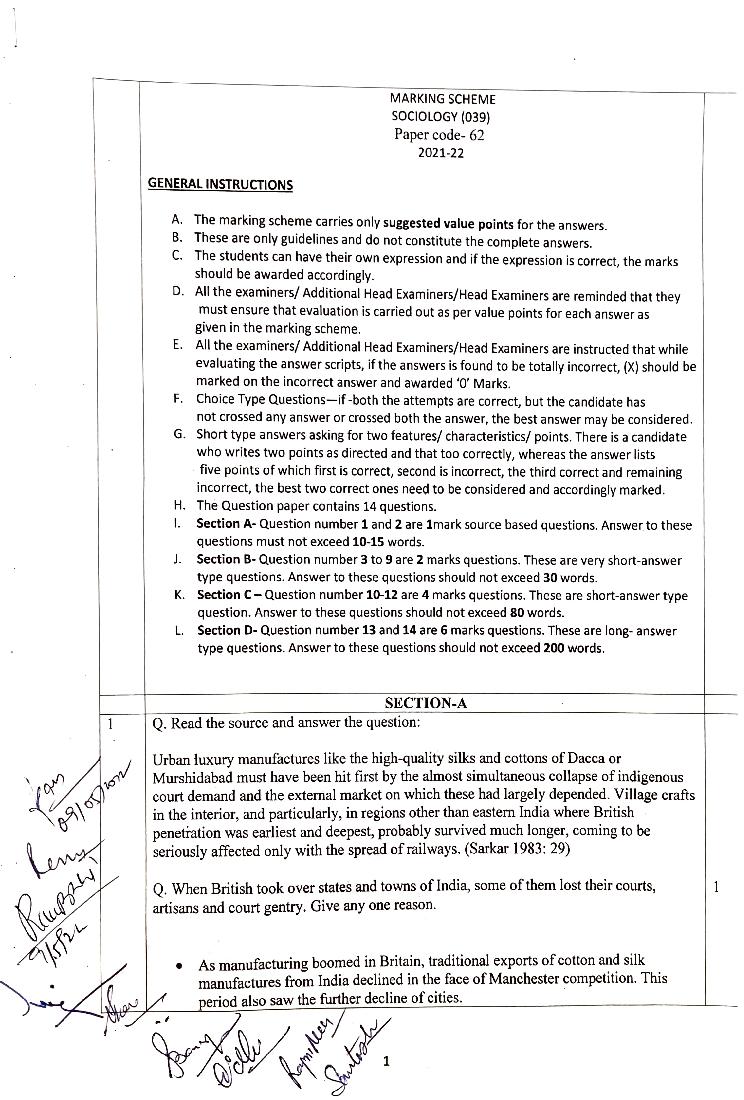
SOCiOLOGY (039)
Paper code- 62
2021-22
GENERAL INSTRUCTIONS
A. The marking scheme carries only
suggested value points for the answers.
B. These are only guidelines and do not constitute the
complete
answers.
C. The students can have their own expression and if the expression is correct, the marks
should be awarded accordingly.
D. All the examiners/ Additional Head Examiners/Head Examiners are reminded that
they
must ensure that evaluation is carried out as per value points for each answer as
given in the marking scheme.
E. All the examiners/ Additional Head Examiners/Head Examiners are instructed that while
evaluating the answer scripts,if the answers is found to be totally incorect,(X) should be
marked on the incorrect answer and awarded'0 Marks.
F. Choice Type Questions--if -both the attempts are correct, but the candidate has
not crossed any answer or crossed both the answer, the best answer may be considered.
G. Short type answers asking for two features/ characteristics/ points. There is a candidate
who writes two points as directed and that too correctly, whereas the answer lists
five points of which first is correct, second is incorrect, the third correct and remaining
incorrect, the best two correct ones need to be considered and accordingly marked.
H. The Question paper contains 14 questions.
.Section A-Question number 1 and 2 are 1mark source based questions. Answer to these
questions must not exceed 10-15 words.
J. Section B- Question number 3 to 9 are 2 marks questions. These are very short-answer
type questions. Answer to these questions should not exceed 30 words.
K. Section C-Question number 10-12 are 4 marks questions. These are short-answer type
question. Answer to these questions should not exceed 80 words.
L. Section D-Question number 13 and 14 are 6 marks questions. These are long- answer
type questions. Answer to these questions should not exceed 200 words.
SECTION-A
Q. Read the source and answer the question:
Urban iuxury manufactures like the high-quality silks and cottons of Dacca or
Murshidabad must have been hit first by the almost simultaneous collapse of indigenous
court demand and the external market on which these had largely depended. Village crafts
in the interior, and particularly, in regions other than eastern India where British
penetration was earliest and deepest, probably survived much longer, coming to be
w
seriously affected only with the spread of railways. (Sarkar 1983: 29)
Q. When British took over states and towns of India, some of them lost their courts,
artisans and court gentry. Give any one reason.
As manufacturing boomed in Britain, traditional exports of cotton and silk
manufactures from India declined in the face of Manchester competition. This
also saw thefurther decline of cities.
period
Page 2
Masulipatnam. Towns like Thanjavur, Dhaka and Murshidabad lost their courts
and as a result artisans
and their court gentry.
De-industrialization
Read the source and
answer the
(Any one)
question:
ways of thinking ...John Stuart Mill's essay "On Liberty' soon after its publication
Decame a text in Indian colleges. Indians came to know about Magna Carta, and the
strugglé for liberty and equality in Europe and America.
Q.Mention the kind of Westernization being referred to in the given source.
This kind of westernisation being referred to is emergence of a westernised sub-
cultural pattern through a minority section of Indians who first came in contact 2
with western culture.
This included the sub culture of Indian intellectuals who not only 2
adopted many
cognitive patterns, or ways of thinking, and styles of life, but supported its
expansion.
3A
SECTION-B
Many of our cultural practices and patterns can be traced to our agrarian background.
Structural and cultural changes are closely inter-related. Most of the
year festivals in
different regions of India celebrate the main harvest season.
Q. There is a close relationship between agriculture and culture". Give one reason to
support the given statement.
The nature and practice of agriculture varies
greatly across the different regions of |T
the country.
These variations are reflected in the different regional cultures. One can say there
is a close connection between agriculture and culture.
(any one)
3B Q. Name any two agriculture related festivals. /2
Pongal, Bihu, Baisakhi, and Ugadi or any other relevant festival.
(Any two0).
K
2
Page 3
directed against the state and takes the form of demanding changes in state policy or
practice. Spontaneous, disorganised protest cannot be called a social movement.
Q. Write any two features of a social movement. /2
+
.Shared objective and ideologies,
Leadership,
sustained collective action,
Organisation.
4B
(any two)
Q. Give an example of a Dalit Movement.
Satnami Movement ofthe Chamars,
Adi Dharma Movement,
.The Mahar Movement,
. Anti-Brahminical movement
Jatavas Movement.
(any one)
Q. "There is a vital difference between the empire building of pre-capitalist times and that
of capitalist times". What is this difference?
Pre-capitalist Capitalist
1. Outright pillage Directly interfere toensure greatest profit +
2. Conquerors benefitted from their Policies were geared towards the
domination by exactinga continuous strengthening and expansion of British
flow of tribute. capitalism.
3. They did not interfere with the Interference in all sectors- Economy, polity|
economic base. and so on.
(any one difference)
Q. "Sanskritisation seems to justify a model that rests on inequality and exclusion". Give
6 two reasons to support this statement.
. I t appears to suggest that to believe in pollution and purity of groups of people is
justifiable or all right.
Therefore, to be able to look down on some groups just as the 'upper castes
looked down on the lower castes', is a mark of privilege. In society where such a
world-view exists, imagining an equal society becomes difficult.
(Any other relevant point)
u w
A
Page 4
7.
significant differences. State any two differences.
that the upper caste, middle
TOr Some the concerns were confined to the problems
class women and men faced.
For others the injustices suffered by the discriminated castes were central
questions.
For some social evils had emerged because of a decline of the true spirit of
Hinduism.
F o r others caste and gender oppression was intrinsic to the religion.
For e.g., Sati was opposed by the Brahmo samaj.
(Any two)
8A |Q. What are Redemptive or Transformatorysocial movements? Give one example. 1+
A redemptive social movement aims to bring about a change in the personal
consciousness and actions of its individual members.
Example- People in the Ezhava community in Kerala were led by Narayana Guru
to change their social practices.
(or any other relevant example)
OR
8B What is meant by Reformist social movements? Give one
example.
Reformist social movements strive to change the existing social and political
arrangements through gradual, incremental steps.
Example- The 1960s movement for the reorganisation of Indian states on the basis
of language and the recent Right to Information campaign are examples of
reformist movements.
(or any other relevant example)
Q. "For Indian nationalists, the issue of economic exploitation under colonial rule was a
central issue".
How did Indian nationalists promote industrialization in the
early years of independence?
Indian nationalists saw rapid industrialisation of the economy as the path towards
both growth and social equity.
Development of heavy and machine-making industries, expansion of the public
sector, mixed economy and holding of a large cooperative sector were considered
very important.
10 SECTION-C
Q. How did commercialisation of agriculture lead to circulation of labour?
A
A 4
Page 5
of between labourers or
As 'traditional' bonds patronage
labour increased in
1x
demand for agricultural
broke down, and as the seasonal 4
prosperous Green Revolutionregions such as the Punjab.
thousands of workers circulate
A pattern of seasonal migration
emerged in which
where there is more
between their home villages
and more prosperous areas
demand for labour and higher wages.
drought-prone and less productive
regions.
from
Migrant workers come mainly
are more easily exploited.
migrant workers as they
Wealthy farmers often prefer and Haryana, or on brick
kilns in U.P or any
Labours work on farms in Punjab
sites and cities.
other construction
(Any other relevant point)
worker takes a different pattern.
Explain this pattern.
Job recruitment as a factory
11A | Q. mistris and 1x
contractors or jobbers known as 4
Many workers got their jobs through
were themselves workers.
but because
communities as the workers,
regions and
They came from the
same
bossed over the workers.
theyhad the owner's backing, they
on the worker.
community-related pressures
T h e mistri also put
and both management
jobber has come down,
Nowadays, the importance ofthe their own people.
unions play a role in recruiting
and
to their children.
can pass on their jobs
also expect that they
Many workers substitute for regular permanent
badli workers who
Many factories employ
leave.
Workers who are on
(any four)
OR
scientific management took
What shift from
'Scientific management' system.
Explain
11B 1980s?
place in the
invented a new system in
the
Frederick Winslow Taylor 3+
An American called
called 'Scientific Management".
1890s, which he
into its smallest repetitive elements,
work was broken down
Under his system, all
workers.
and divided between
to fulfil a certain target
with the help of stopwatches and had
Workers were timed
every day.
the assembly line.
further speeded up by
the introduction of
Production was
1/9
Page 6
I n the 1980s, there was
shift from this system of direct
an attempt to
Control to indirect
control, where workers are supposed to motivate and
monitor themselves.
12 Q.Mention the positive and
negative aspects of 'contract farming system. 2+
Positive aspects- 2
Provide financial
security to farmers,
company identifies the crop to be grown,
provides the seeds and other
also the inputs, as well as the know-how and often
working capital.
The farmer is assured
of a market because the
will purchase the company guarantees that it
produce at a predetermined fixed price.
Negative aspects- (any two)
Contract farming caters
it primarily to the
production of elite items,
usually requires high doses of fertilisers
sustainable and pesticides not ecologically
makes indigenous
It leads to knowledge of agriculture irrelevant.
greater financial insecurity as the farmers
the company for their become dependent on
livelihood.
13A (any two0
SECTION-D
Q. What is the difference between a
strike and a lockout? Discuss the
Bombay Textile Mills of 1982. famous strike of
Strike: In a strike, workers do
not go to work.
Lock Out: In a lockout the
coming. management shuts the gate and prevents workers from
The Bombay Textile strike of
Datta Samant, and affected
1982, which was led by the trade union
nearly a quarter of a million leader, Dr.
workers and their families.
Women workers
participated
conflict between their role as aactively
in the strike.
However, they experienced a
towards their families and children. participant in the strike and their
responsibility
.
The workers wanted better
wages and also wanted the right to form their
union. own
Members of the RMMS played a role in
work. breaking the strilke by bringing
people to
Nearly one lakh workers lost their jobs and went
back to their
casual labour, others moved to smaller
towns. villages, or took up
(any four)
6
Page 7
of the economy. Explain by giving
an example.
Q. Home based work is an important part
manufacture of lace, zari or brocade, carpets,
bidis,
Home-based work includes the
agarbattis and many such products.
and children.
w o r k is mainly done by
women
finished product.
materials and also picks up the
A n agent provides raw number of pieces
basis depending on the
Home workers are paid on piece-rate
made. For e.g., Bidi industry.
13B
Bidi Industry: the forest
tender leaves and selling it to
D o n e in forested villages by plucking
contractor.
department or private contractors.
Government auctions the leaves to
Bidi factory owners
leaves to home-based workers.
Contractor supplies tobacco and manufacturers who
product
finished and sells them to the
Contractor picks up the
-Distributors Wholesalers.
brand labels
-
puts its
(any six)
the
movements? Explain the above using
14. Q. Are ecological
movements new or old social
Chipko movement as an example.
movements. 1+
as new social
movements can be considered
Ecological
started in the
The Chipko Movement,
an example of the ecological movement,
Himalayan foothills.
contractors came to cut down
the trees, villagers,
When government forest
forward to hug the trees to prevent
large number of women, stepped
including
their being felled. 5
necessities.
firewood, fodder and other daily
All of them relied on the forest get
to
the
livelihood needs of poor villagers against
This conflict placed the
revenues from selling
timber.
government's desire to generate of profit. Along with
was pitted against the economy
The economy of subsistence
Movement also raised the issue of
this issue of social inequality, the Chipko
ecological sustainability.
Movement also expressed the resentment
of hill villagers
In addition, the Chipko seemed indifferent
distant government headquartered in the plains that
against a
and hostile to their concerns.
about economy, ecology and political representation
underlay the
So, concerns
Chipko Movement.
(any five)
K u 8 - 4
Mrs Karuna Verma
2 2 ho
Principal/Coordinator
Sociology (039) S e g o
Document Details
| Board / Org | CBSE |
| Exam | Class 12 |
| Type | Solution |
| Pages | 7 |
| Updated | 22 Jul 2026 |