CBSE Class 12 Question Paper 2024 Solution Physical Education
Finished viewing? Save it for later —
Download CBSE Class 12 Question Paper 2024 Solution Physical Education (PDF · 14 pages)About CBSE Class 12 Question Paper 2024 Solution Physical Education
CBSE Class 12 Question Paper 2024 Solution Physical Education is available here for free download. Published by CBSE for Class 12, this solution can be viewed online or downloaded as a PDF (14 pages). Candidates preparing for Class 12 can use CBSE Class 12 Question Paper 2024 Solution Physical Education to understand the exam pattern, the type of questions asked, and the overall difficulty level.
Frequently Asked Questions
How can I download CBSE Class 12 Question Paper 2024 Solution Physical Education?
Open this page and click the Download button to save CBSE Class 12 Question Paper 2024 Solution Physical Education as a PDF. It is completely free on AglaSem Docs.
Is CBSE Class 12 Question Paper 2024 Solution Physical Education free to download?
Yes. CBSE Class 12 Question Paper 2024 Solution Physical Education can be viewed online and downloaded as a PDF free of cost on AglaSem Docs.
How many pages does CBSE Class 12 Question Paper 2024 Solution Physical Education have?
CBSE Class 12 Question Paper 2024 Solution Physical Education contains 14 pages, which you can read online or download together as a single PDF.
Where can I find more Class 12 study material?
You can find more Class 12 question papers, sample papers, syllabus, and answer keys on AglaSem Docs.
CBSE Class 12 Question Paper 2024 Solution Physical Education – Text
Read the full text of this solution below — useful to quickly search, copy and reference the content online without downloading the PDF.
📄 View text version (14 pages)
Page 1
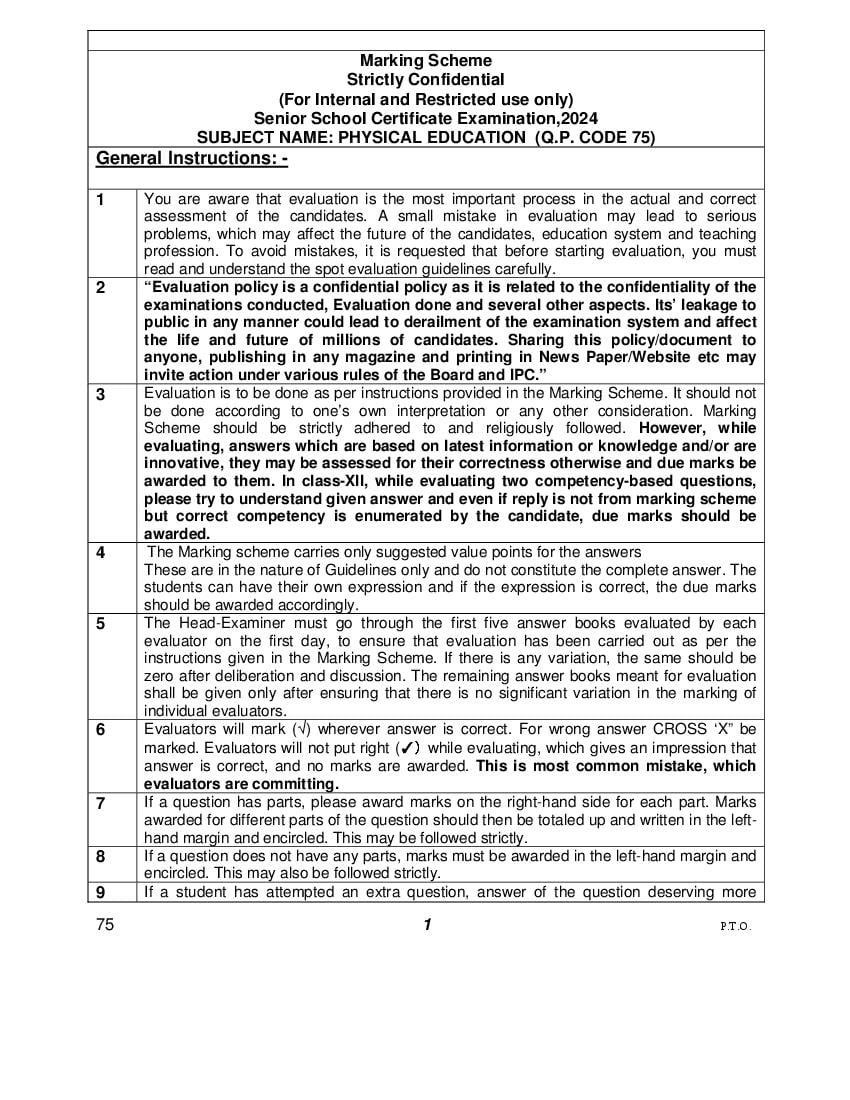
Strictly Confidential
(For Internal and Restricted use only)
Senior School Certificate Examination,2024
SUBJECT NAME: PHYSICAL EDUCATION (Q.P. CODE 75)
General Instructions: -
1 You are aware that evaluation is the most important process in the actual and correct
assessment of the candidates. A small mistake in evaluation may lead to serious
problems, which may affect the future of the candidates, education system and teaching
profession. To avoid mistakes, it is requested that before starting evaluation, you must
read and understand the spot evaluation guidelines carefully.
2 “Evaluation policy is a confidential policy as it is related to the confidentiality of the
examinations conducted, Evaluation done and several other aspects. Its’ leakage to
public in any manner could lead to derailment of the examination system and affect
the life and future of millions of candidates. Sharing this policy/document to
anyone, publishing in any magazine and printing in News Paper/Website etc may
invite action under various rules of the Board and IPC.”
3 Evaluation is to be done as per instructions provided in the Marking Scheme. It should not
be done according to one’s own interpretation or any other consideration. Marking
Scheme should be strictly adhered to and religiously followed. However, while
evaluating, answers which are based on latest information or knowledge and/or are
innovative, they may be assessed for their correctness otherwise and due marks be
awarded to them. In class-XII, while evaluating two competency-based questions,
please try to understand given answer and even if reply is not from marking scheme
but correct competency is enumerated by the candidate, due marks should be
awarded.
4 The Marking scheme carries only suggested value points for the answers
These are in the nature of Guidelines only and do not constitute the complete answer. The
students can have their own expression and if the expression is correct, the due marks
should be awarded accordingly.
5 The Head-Examiner must go through the first five answer books evaluated by each
evaluator on the first day, to ensure that evaluation has been carried out as per the
instructions given in the Marking Scheme. If there is any variation, the same should be
zero after deliberation and discussion. The remaining answer books meant for evaluation
shall be given only after ensuring that there is no significant variation in the marking of
individual evaluators.
6 Evaluators will mark (√) wherever answer is correct. For wrong answer CROSS ‘X” be
marked. Evaluators will not put right (✓
✓) while evaluating, which gives an impression that
answer is correct, and no marks are awarded. This is most common mistake, which
evaluators are committing.
7 If a question has parts, please award marks on the right-hand side for each part. Marks
awarded for different parts of the question should then be totaled up and written in the left-
hand margin and encircled. This may be followed strictly.
8 If a question does not have any parts, marks must be awarded in the left-hand margin and
encircled. This may also be followed strictly.
9 If a student has attempted an extra question, answer of the question deserving more
75 1 P.T.O.
Page 2
10 No marks to be deducted for the cumulative effect of an error. It should be penalized only
once.
11 A full scale of marks __________(example 0 to 80/70/60/50/40/30 marks as given in
Question Paper) has to be used. Please do not hesitate to award full marks if the answer
deserves it.
12 Every examiner has to necessarily do evaluation work for full working hours i.e., 8 hours
every day and evaluate 20 answer books per day in main subjects and 25 answer books
per day in other subjects (Details are given in Spot Guidelines).This is in view of the
reduced syllabus and number of questions in question paper.
13 Ensure that you do not make the following common types of errors committed by the
Examiner in the past:-
● Leaving answer or part thereof unassessed in an answer book.
● Giving more marks for an answer than assigned to it.
● Wrong totaling of marks awarded on an answer.
● Wrong transfer of marks from the inside pages of the answer book to the title page.
● Wrong question wise totaling on the title page.
● Wrong totaling of marks of the two columns on the title page.
● Wrong grand total.
● Marks in words and figures not tallying/not same.
● Wrong transfer of marks from the answer book to online award list.
● Answers marked as correct, but marks not awarded. (Ensure that the right tick mark
is correctly and clearly indicated. It should merely be a line. Same is with the X for
incorrect answer.)
● Half or a part of answer marked correct and the rest as wrong, but no marks awarded.
14 While evaluating the answer books if the answer is found to be totally incorrect, it should
be marked as cross (X) and awarded zero (0)Marks.
15 Any unassessed portion, non-carrying over of marks to the title page, or totaling error
detected by the candidate shall damage the prestige of all the personnel engaged in the
evaluation work as also of the Board. Hence, in order to uphold the prestige of all
concerned, it is again reiterated that the instructions be followed meticulously and
judiciously.
16 The Examiners should acquaint themselves with the guidelines given in the “Guidelines
for Spot Evaluation” before starting the actual evaluation.
17 Every Examiner shall also ensure that all the answers are evaluated, marks carried over to
the title page, correctly totaled and written in figures and words.
18 The candidates are entitled to obtain photocopy of the Answer Book on request on
payment of the prescribed processing fee. All Examiners/Additional Head Examiners/Head
Examiners are once again reminded that they must ensure that evaluation is carried out
strictly as per value points for each answer as given in the Marking Scheme.
75 2
Page 3
a. The marking scheme carries only suggested value point for the answers.
b. These are only guidelines and do not constitute the complete answer.
c. The student can have their own expression and if the expression is correct, the marks be
awarded accordingly
d. The candidates would be permitted to obtain a photocopy of the answer book on request on
payment of the prescribed processing fee. All evaluator /Additional head examiners/Head
examiners are once again reminded that they must ensure that evaluation is carried out as
per value point for each answer as given in the marking scheme.
e. All Head examiners/Additional head examiners/Evaluators are instructed that while
evaluating the answer book if the answer found to be totally incorrect, (X) should be
marked on the incorrect answer and awarded ‘0’ marks
75 3 P.T.O.
Page 4
Q.NO ANSWER MAR
KS
1. (c) Suryabhedan Pranayama 1
2. (c) 1989 1
3. (c) Roughage 1
4. (a) Both Assertion (a) and Reason (r) are true and Reason (r) is the 1
correct explanation of the Assertion (a).
5. (c) I-2, II-4, III-1, IV-3 1
6. (a) Both Assertion (a) and Reason (r) are true and Reason (r) is the 1
correct explanation of the Assertion (a).
7. (c) Endurance 1
8. (d) Higher centre of gravity 1
9. (b) Self-Centered 1
10. (c) Explosive strength 1
11. (c) To promote health and fitness 1
12. (c) 3 – 4 year 1
13. (d) Shalbhasana 1
For visually impaired Candidates
(b) Shavasana
14. (d) International Committee of Sports for the Deaf 1
15. (c) 18⋅5 – 24⋅9 1
16. (c) 6 inches 1
17. (a) Cognitive 1
18. (c) lower body flexibility 1
For visually impaired Candidates
(c) arm curl test
SECTION B
19. Describe the second-class lever with suitable example from sports. 2
Ans. Second Class lever: It has the load resistance between the fulcrum and
the force. So, there is always mechanical advantage as force arm is
always greater than resistance arm.
75 4
Page 5
a jump/pushing against starting
ing blocks in sprints
(or any other relevant example)
20. Enlist four test items of Jhonson
Jhonson-Metheny test of motor educability. ½x4
Ans. I. Front Roll II. Back Roll
III. Jumping Half-Turns IV. Jumping Full-Turns
21. Write a short on ‘Menarche’. 2
Ans. -First
First menstruation cycle of a girl
-Point of sexual maturity of girl
-Average age for a girl to get her first period ranges from 8-15yrs.age.
(Or any other relevant description
description)
22. Enlist four asanas those help to control asthma. ½×4
Ans. Tadasana, Urdhwahastottansana, Uttan Mand Mandukasana, Ushtrasana,
Vakrasana, Matsyasana, Gomukhasana, Dhanurasana
Dhanurasana, Bhujangasana
(any
any four asana
asanas out of the above mentioned asanas)
23. Write any two advantages of physical activities for children with 1+1
special Needs. (CWSN)
Ans. Advantages of physical activ
activities for children with special needs:
1.Physical benefits
2.Fun and recreation
3.Improved emotional health
4.Active lifestyle
5.Behavioural benefits
6.Increased independence
7.Psychological benefits
8.Improvement
Improvement in cognitive and intellectual ability
9.Increase
Increase in sleep and appetite
10.Improvement in social skill
(any 2 relevant advantages)
24. Mention any two types of friction by giving suitable examples from 1+1
sports.
Ans. Types of Friction:
Static friction:Weightlifting,Holding
,Holding the parallel bar
75 5 P.T.O.
Page 6
Rolling friction: Rolling of the football, cricket ball,tennis ball
Air friction: Riding a bicycle, skydiving
Water friction: Swimming in water, diving
(any 2 types with relevant example)
SECTION C
25. Mr. X performs the Harvard step test for 275 seconds and his pulse 1+2
in 1-1.5 min after exercise was 100. Write the formula of fitness
index score for Harvard step test and calculate the fitness index
score of Mr.X.
Harvard step test fitness index score:
Ans.
Duration of exercise = 275 seconds pulse count of 1–1⋅5 min after
exercise = 100
Formula = Duration of the exercise in seconds × 100/5⋅5 × pulse count
of 1–1⋅5 min after exercise
=(
275 × 100 ) / ( 5 ⋅ 5 × 100 )
= 27500 / 550 = 50
26. Comment on the concept of the talent identification and talent 1½
development. +1½
Ans. Talent Identification: Recognizing participants with the potential at an
earlier age to become elite performers in the future. For the talent
identification process Physiological, Physical Fitness, Psychological, and
Technical Components are taken into consideration. For the
identification, various methods such as drills, test batteries, electronic
gadgets, parameters, standard norms, performance and other techniques
are adopted.
Talent Development: Providing athletes with a suitable learning
environment to accelerate or realize their potential. It is a complete
systematic, scientific and long-term process.
27. Explain the responsibilities of any one committee during sports 1½
competition. +1½
Ans. Committees during sport competition
1.Reception committee
2.First aid committee
3.Refreshment committee
4.Technical committee
5. Media reporting committee
6. Announcement committee
7. Ground and equipment committee
75 6
Page 7
9. Finance committee
10.Boarding and loading committee
(Explanation of any 2 from the above /relevant committees)
28. Explain the procedure and benefits of any one asana for back pain. 2+1
Ans. Following are the asanas beneficial for back pain:
Tadasana, Vakrasana, Sarala Matsyendrasana,
Urdhwahastottansana,Ardh Chakrasana, Ushtrasana, Bhujangasana,
Gomukhasana, Bhadrasana, Makarasana
(Writethe procedure and benefits of any one, of the above mentioned
asanas – the figs. given for reference)
29. Write short note of Female Athlete Triad. 3
Ans. Female athlete triad
1.Eating disorders (Low Energy Availability)
Eating disorders are mainly of two types:
Anorexia nervosa
Anorexia nervosa is one type of eating disorder in which a person
severely limits the amount of food he or she eats to prevent weight gain
or lose weight.
Bulimia nervosa
Bulimia nervosa is an eating disorder in which a person eats a large
amount of food in a short amount of time and gets rid of the food
consumed. This may be done by vomiting or taking laxatives.
2.Amenorrhea (Disruption of Menstrual and Endocrine Function)
Long absence of no menstrual periods is called amenorrhea. It is the state
75 7 P.T.O.
Page 8
absence of menstrual cycle for three or more months.
There are two main types of amenorrhea:
Primary amenorrhea. When the first menstrual bleeding at puberty
does not start by the age 15 years.
Secondary amenorrhea. When normal menstrual bleeding stops for 3
months or more.
3.Osteoporosis (Loss of Bone Mineral Density)
This is the condition when bones lose minerals such as calcium, more
quickly than the body can replace them leading to a loss of bone
thickness (bone density). Any bone can be affected by osteoporosis but
the most common sites are the hip, spine, wrist, upper arm, forearm or
ribs.
(Explain all 3)
30. Describe any three physiological changes due to ageing. 1+1+1
Ans. Physiological changes due to ageing: -
1.Changes in metabolism and body composition
2.Changes in respiratory system
3.Changes in brain and nervous system
4. Changes in digestive system
5. Changes in excretory system
6. Changes in sensory organs
7. Changes in endocrine system
8. Decline in muscle strength
9. Diminishes memory
10.Decrease in cardiovascular function,
11.Loss of bone density
12.Decrease in body mass
13.Decrease in mobility
(Explain any 3 points out of the above mentioned point, or any other
relevant points)
SECTION D (Case study based )
31. a) As per the above table in _____event, there is no participation 4 ×1=
of special child 4
Ans. Long Jump
b) Participation of student with disabilities in regular physical
education classes is known as ____________
Ans. Inclusion/ Adaptive Physical Education .
Enlist any two strategies to make physical activities accessible for
75 8
Page 9
Ans. Any two strategies from the following: (½ X 2=01)
To Create Specific Environment
To assess physical and mental ability
To assess the interest of child
Plan for different strategies for instruction
Modified Rules
Use of modified equipment
Plan activity as per need
Plan for implementation from easy to difficult
Extra Care or Concern for safety
Plan for additional support of parents and trained assistants
c) Motto of special Olympics is________________
“Let me win. But if I cannot win, let me be brave in the attempt.”
Ans. (OR) “Joy and Happiness for all the children of the world.”
OR
d) The motto of Paralympic is __________
Ans. “Spirit in motion.”
For Visually Impaired
Write short notes on “Paralympic” and “Special Olympic”.
Paralympics
The Paralympic Games is a periodic series of international multisport 2+2=4
events involving athletes with a range of disabilities. These were held for
the first time in1960 in Rome. They are held immediately after the
respective summer and winter Olympic games. The international
Paralympics Committee governs all Paralympics games. The
Paralympics athletes compete in six different disability groups-
Amputee, cerebral palsy, visual impairment, spinal cord injuries,
intellectual disability and ‘Les autres’ i.e. Dwarfism
(or any other relevant points.)
Special Olympic
Eunice Kennedy Shriver, founder of Special Olympics, was a pioneer in
the worldwide struggle for rights and acceptance for people with
intellectual disabilities
The first special Olympic games were held in July 1968 at Chicago.
They were recognized by IOC in 1988.Special Olympic is the world’s
largest sports event for children and adult with intellectual and physical
disability comprising of 5 million participants from unified sports partner
from 172 countries. These games provide opportunities to develop
fitness, demonstrate courage and participate in competition and
experience joy. The special Olympic world games are organized with
interval of two years alternatively as summer and winter games.
(Or any other relevant information)
75 9 P.T.O.
Page 10
Ans. Transverse fracture 4
(b) When a bone breaks diagonally as shown in image-2,it is
known as _________.
Ans. Oblique fracture
(c) _________fracture occur when the broken ends of the bones
are jammed together by the force of the injury.
Ans. Impacted fracture
(d) In which type of fracture bone is broken, splinted, or crushed
into number of pieces?
Comminuted fracture
Ans.
For Visually Impaired candidates only
Describe types of fractures. (Any four)4 ×1= 4
Stress Fracture— Stress fractures are tiny cracks in a bone
Green stick Fracture-- A fracture in a soft bone, in which the bone bends.
Oblique Fracture-- Oblique fracture occurs when a bone is broken at an
angle/diagonally.
Impacted Fracture-- An impacted fracture occurs when the force of the
injury jams the broken ends of the bone together.
Comminuted Fracture-- A comminuted fracture is one in which the
broken ends of the bone are shattered into many pieces.
Transverse Fracture -- Transverse fracture occurs when the bone is
broken perpendicular to its length.
(Explain any 4 fractures from the above mentioned fractures)
33. a) According to the above fixture total number of round will be 4 ×1=
_____ 4
Ans. 4 (four)
b) As shown in the fixture if the winner team plays least number
of matches, then which number of team is the winner?
Ans. Serial no 15
c) What is the formula to calculate number of matches in a
knockout tournament?
Ans. No of matches =N-1 where N=Number of teams
d) If 16 teams are participating in a knockout tournament, then
how many byes will be given to draw a knockout fixture?
Ans.
If the number of participating team is 16, the answer will be 0(zero) byes
If the number of participating team is 19, the answer will be 13 byes
(OR)
d) What is the formula for calculating total number of byes in a
knockout tournament?
Ans. No. of byes = (Next higher Power of 2– Number of Teams)
75 10
Page 11
How ‘Sports day’ and ‘Health Run’ contribute to spread health
awareness and harmony? Explain. 2+2=4
Sports day
Ans. Modern day challenges and needs of today in education give emphasis
on other aspects rather than academics for all round development of
students. With this objective in mind, each school celebrates sports day
as a mark of focus on physical and mental health awareness. It
encourages leadership qualities, management and co-ordination among
students, teachers and other staff members. Participation in Sports day is
an ongoing process to provide recreation, generate awareness and
development of ethical values.
Health Run
The health runs are conducted by various Social, Govt., Non-Govt.
Organisations, Health and Sports departments to create awareness about
health and fitness.
SECTION E
34. What do you understand by Aggression in sports? Explain any 2 1+2+2
types of aggression by giving suitable example from sports.
Ans. Aggression is a type of behaviour aimed at causing physical or
psychological harm to another person.
or
The term aggression refers to a range of behaviour that can result in both
physical and psychological harm to one self, others or objects in the
environment.
(any other relevant definition)
Types of Aggression:
1. Instrumental Aggression: This type of aggression is necessary to
achieve performance goals and is displayed in a planned manner. The
purpose of this aggression is not to cause harm to the opponent but to
achieve one’s goals.
For example, in Football, the player moves ahead and snatches the ball
from the opponent with great aggression to score a goal and not to harm
the opponent. This type of aggression is visible in contact games such as
Wrestling, Kabaddi and Boxing, aggressive attack can help the player to
win.
2. Hostile Aggression: In this type of aggression, the purpose is to cause
physical or psychological harm. This aggression is usually caused as a
reaction to someone’s action. The main aim is to injure the opponent in
order to be able to win. In this type of aggression, the person is biased
75 11 P.T.O.
Page 12
For example, in the game of Kabaddi, after catching the raider, the
players try to inflict injury upon him or in a game of hockey or football,
hitting with the stick or kicking purposely to make the other person fall,
displays hostile aggression.
3. Assertive behaviour: Assertive behaviour can also be called
aggression, when a player uses it to improve sports performance. These
are forceful behaviour not intended to injure the opponent and are
within the rules of the games. The intention is to establish dominance
rather than harm.
Example: A rugby player using aggression to tackle his opponent to win
the ball.
(explain any 2 types)
35. What is balanced diet? What is the significance of pre and post 1+2+2
competition meals for an athlete? Explain.
Ans. A Balanced diet consists of all the essential food elements i.e. Proteins,
Carbohydrates, Vitamins, Fats, minerals and water in correct proportion.
OR
A Balanced diet contains an adequate amount of all the nutrients
required by the body to grow, remain healthy and be disease free.
(any other relevant definition)
Importance of pre competition meals for an athlete
1.The focus is to fuel up muscle glycogen stores to provide /obtain
energy. Therefore, meal should have moderate proteins, low fat, low
fibre and high carbohydrate containing food.
2. Proper hydration is must to control fatigue, hunger.
3. It should be light to provide athlete a comfortable gastro intentional
state for sports performance.
4. Pre competitive meal should be taken about 2-4 hour before
competition.
5. New food/food with known allergies should be avoided.
Importance of post competition meals for an athlete
1. The main focus is on recovery of body and reduce chances of injury.
2. Fluids lost during competition have to be replenished.
3. Carbohydrates store i.e. muscle glycogen have to be refilled.
4. Electrolytes i.e. sodium, potassium chloride lost during competition
have to be recovered.
5. Within two hour of completion of event a balanced meal including
carbohydrates and good quality proteins should be eaten by the athlete.
75 12
Page 13
factors affecting projectile trajectory in sports.
Ans. A projectile is a force that acts under the influence of gravity and air
resistance. When any object is projected in the air, these force result into
a curved or parabolic path, known as projectile trajectory.
Factors that affect projectile trajectory:
1.Angle of projection- When it is 45 degree, maximum horizontal
distance is achieved
2. Initial velocity – The horizontal range depends on initial velocity.
Greater the initial velocity applied on the projectile during release,
greater horizontal distance is achieved.
3. Gravity –It is the force of attraction exerted by the earth.
The greater the weight of an object, the greater is the influence of
gravity upon it. Gravitational pull stops the upward movement of an
object resulting into decreased height of projectile.
4. Air resistance –Surface area, speed, surface of object and mass of
object all have an impact on air resistance.
5. Spin- It changes the path of projectile. The amount and direction of
spin directly affects the distance that projectile travels because the air
pressure acts on the ball.
(Or any other relevant point)
37. What is Endurance? Explain any two types of Endurance in the 1+2+2
basis of duration of the activity with suitable example from sports.
Ans. Endurance is the ability of the body to sustain a physical activity for
longer duration of time.
Or
Endurance is the ability of resist fatigue.
Or
The result of physiological capabilities of an individual to sustain
movement over a period of time.
(any other relevant definition)
Following are the types of endurance on the basis of duration of activity:
1. Speed Endurance: This is the ability to resist fatigue in cyclic
activities that last up to 45 seconds. The classic example of this
endurance type is a 400 m sprint in track and field. This type of
endurance is majorly dependent on the power and capacity to produce
energy.
2. Short-term Endurance: This ability is needed for activities lasting
from 45 seconds to about 2 minutes. The most appropriate example for
75 13 P.T.O.
Page 14
on speed endurance and strength endurance.
3. Medium-term Endurance: Medium-term endurance is needed to resist
fatigue in activities lasting from 2 minutes to about 11 minutes. The
most common example of this type is 1500 m and 3000 m run and 100
m rowing. As in short- term endurance, this type of endurance also
depends on speed and strength endurance, but to a limited extent.
4. Long-term Endurance: This type of endurance is needed for activities
that last for more than 11 minutes. This type of endurance is required in
events like marathons, cross-country, etc.
(Any two types)
75 14
Document Details
| Board / Org | CBSE |
| Exam | Class 12 |
| Type | Solution |
| Pages | 14 |
| Updated | 30 Apr 2026 |