CBSE Class 12 Question Paper 2024 Solution Political Science
Finished viewing? Save it for later —
Download CBSE Class 12 Question Paper 2024 Solution Political Science (PDF · 16 pages)About CBSE Class 12 Question Paper 2024 Solution Political Science
CBSE Class 12 Question Paper 2024 Solution Political Science is available here for free download. Published by CBSE for Class 12, this solution can be viewed online or downloaded as a PDF (16 pages). Candidates preparing for Class 12 can use CBSE Class 12 Question Paper 2024 Solution Political Science to understand the exam pattern, the type of questions asked, and the overall difficulty level.
Frequently Asked Questions
How can I download CBSE Class 12 Question Paper 2024 Solution Political Science?
Open this page and click the Download button to save CBSE Class 12 Question Paper 2024 Solution Political Science as a PDF. It is completely free on AglaSem Docs.
Is CBSE Class 12 Question Paper 2024 Solution Political Science free to download?
Yes. CBSE Class 12 Question Paper 2024 Solution Political Science can be viewed online and downloaded as a PDF free of cost on AglaSem Docs.
How many pages does CBSE Class 12 Question Paper 2024 Solution Political Science have?
CBSE Class 12 Question Paper 2024 Solution Political Science contains 16 pages, which you can read online or download together as a single PDF.
Where can I find more Class 12 study material?
You can find more Class 12 question papers, sample papers, syllabus, and answer keys on AglaSem Docs.
CBSE Class 12 Question Paper 2024 Solution Political Science – Text
Read the full text of this solution below — useful to quickly search, copy and reference the content online without downloading the PDF.
📄 View text version (16 pages)
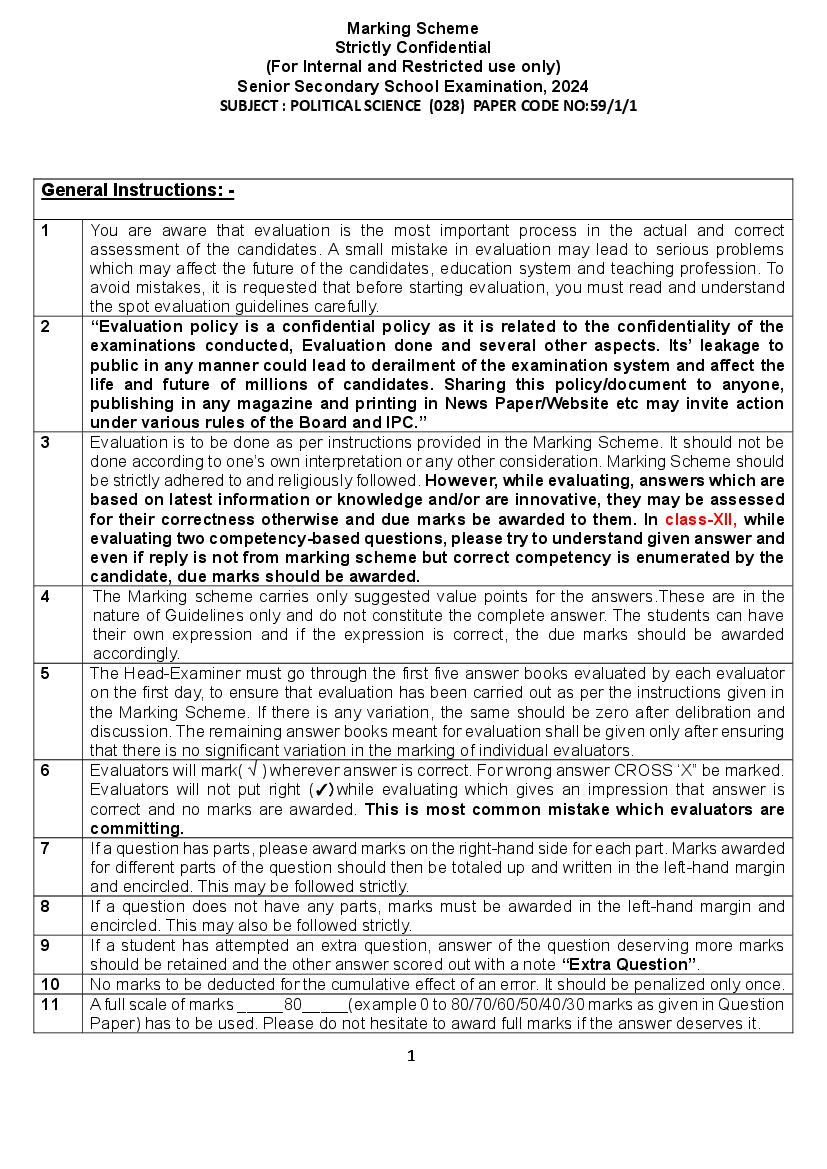
Page 1
1 You are aware that evaluation is the most important process in the actual and correct
assessment of the candidates. A small mistake in evaluation may lead to serious problems
which may affect the future of the candidates, education system and teaching profession. To
avoid mistakes, it is requested that before starting evaluation, you must read and understand
the spot evaluation guidelines carefully.
2 “Evaluation policy is a confidential policy as it is related to the confidentiality of the
examinations conducted, Evaluation done and several other aspects. Its’ leakage to
public in any manner could lead to derailment of the examination system and affect the
life and future of millions of candidates. Sharing this policy/document to anyone,
publishing in any magazine and printing in News Paper/Website etc may invite action
under various rules of the Board and IPC.”
3 Evaluation is to be done as per instructions provided in the Marking Scheme. It should not be
done according to one’s own interpretation or any other consideration. Marking Scheme should
be strictly adhered to and religiously followed. However, while evaluating, answers which are
based on latest information or knowledge and/or are innovative, they may be assessed
for their correctness otherwise and due marks be awarded to them. In class-XII, while
evaluating two competency-based questions, please try to understand given answer and
even if reply is not from marking scheme but correct competency is enumerated by the
candidate, due marks should be awarded.
4 The Marking scheme carries only suggested value points for the answers.These are in the
nature of Guidelines only and do not constitute the complete answer. The students can have
their own expression and if the expression is correct, the due marks should be awarded
accordingly.
5 The Head-Examiner must go through the first five answer books evaluated by each evaluator
on the first day, to ensure that evaluation has been carried out as per the instructions given in
the Marking Scheme. If there is any variation, the same should be zero after delibration and
discussion. The remaining answer books meant for evaluation shall be given only after ensuring
that there is no significant variation in the marking of individual evaluators.
6 Evaluators will mark( √ ) wherever answer is correct. For wrong answer CROSS ‘X” be marked.
Evaluators will not put right (✓)while evaluating which gives an impression that answer is
correct and no marks are awarded. This is most common mistake which evaluators are
committing.
7 If a question has parts, please award marks on the right-hand side for each part. Marks awarded
for different parts of the question should then be totaled up and written in the left-hand margin
and encircled. This may be followed strictly.
8 If a question does not have any parts, marks must be awarded in the left-hand margin and
encircled. This may also be followed strictly.
9 If a student has attempted an extra question, answer of the question deserving more marks
should be retained and the other answer scored out with a note “Extra Question”.
10 No marks to be deducted for the cumulative effect of an error. It should be penalized only once.
11 A full scale of marks _____80_____(example 0 to 80/70/60/50/40/30 marks as given in Question
Paper) has to be used. Please do not hesitate to award full marks if the answer deserves it.
1
Page 2
day and evaluate 20 answer books per day in main subjects and 25 answer books per day in
other subjects (Details are given in Spot Guidelines).
13 Ensure that you do not make the following common types of errors committed by the Examiner
in the past:- Giving more marks for an answer than assigned to it.
● Wrong totaling of marks awarded on an answer.
● Wrong transfer of marks from the inside pages of the answer book to the title page.
Wrong question wise totaling on the title page.
● Leaving answer or part thereof unassessed in an answer book.
●
● Wrong totaling of marks of the two columns on the title page.
● Wrong grand total.
● Marks in words and figures not tallying/not same.
● Wrong transfer of marks from the answer book to online award list.
● Answers marked as correct, but marks not awarded. (Ensure that the right tick mark is
correctly and clearly indicated. It should merely be a line. Same is with the X for incorrect
answer.)
● Half or a part of answer marked correct and the rest as wrong, but no marks awarded.
14 While evaluating the answer books if the answer is found to be totally incorrect, it should be
marked as cross (X) and awarded zero (0)Marks.
15 Any un assessed portion, non-carrying over of marks to the title page, or totaling error detected
by the candidate shall damage the prestige of all the personnel engaged in the evaluation work
as also of the Board. Hence, in order to uphold the prestige of all concerned, it is again reiterated
that the instructions be followed meticulously and judiciously.
16 The Examiners should acquaint themselves with the guidelines given in the “Guidelines for
spot Evaluation” before starting the actual evaluation.
17 Every Examiner shall also ensure that all the answers are evaluated, marks carried over to the
title page, correctly totaled and written in figures and words.
18 The candidates are entitled to obtain photocopy of the Answer Book on request on payment of
the prescribed processing fee. All Examiners/Additional Head Examiners/Head Examiners are
once again reminded that they must ensure that evaluation is carried out strictly as per value
points for each answer as given in the Marking Scheme.
2
Page 3
s ot
Question No. 1 to 12 are Multiple Choice type questions carrying 1 mark each. 12 × 1 = 12
1. The 1
(A) formal (B) confrontationist
(C) cooperative (D)provocative
Ans (C) Cooperative P- 1
20,I
2. Which one of the following countries is not a founder-member of ASEAN ? 1
(A) Singapore (B) Thailand
(C) Myanmar (D) Indonesia
Ans (C) Myanmar P- 1
20,I
3. Which one of the following countries is not 1
(A) Bangladesh (B) China
(C) Bhutan (D) Maldives
Ans (B) China P- 1
30,I
4. Arrange the following rulers of Pakistan in the chronological order as per the 1
period of their rule :
(i) General Zia-ul-Haq
(ii) Benazir Bhutto
(iii) General Musharraf
(iv) Zulfikar Ali Bhutto
Choose the correct option.
(A) (iv), (i), (ii), (iii)
(B) (i), (iii), (ii), (iv)
(C) (iv), (iii), (ii), (i)
(D) (i), (ii), (iii), (iv)
Ans (A) (iv), (i), (ii), (iii) P- 1
32,I
5. Which one of the following is not considered as a new source of threat to 1
security ?
(A)Terrorism (B) Hijacking of planes
(C) Use of drones (D) War
3
Page 4
71,I
6. Assertion (A) : An alliance is a coalition of states that coordinate their actions to 1
deter or defend against military attack.
Reason (R) : Countries form alliances to increase their effective power
relative to another country or alliance. Options :
(A) Both Assertion (A) and Reason (R) are true and Reason (R) is the
correct explanation of the Assertion (A).
(B) Both Assertion (A) and Reason (R) are true, but Reason (R) is not the
correct explanation of the Assertion (A).
(C) Assertion (A) is false, but Reason (R) is true.
(D) Assertion (A) is true, but Reason (R) is false.
Ans (A) Both Assertion (A) and Reason (R) are true and Reason (R) is the correct P- 1
explanation of the Assertion (A). 66,I
7. There was considerable unease in Indo-US relations during the 1950s because : 1
(A) India had a growing partnership with the Soviet Union.
(B) The Soviet Union invaded Hungary.
(C) India was not a member of NATO.
(D) India was a founder member of NAM.
Ans (A)India had a growing partnership with the Soviet Union. P- 1
58,II
8. Which one of the following was not a major objective of Jawaharlal Nehru’s 1
foreign policy?
(A) To preserve the hard-earned sovereignty of India.
(B) To protect the territorial integrity of India.
(C) To make India a nuclear power.
(D) To promote rapid economic development.
Ans (C) To make India a nuclear power. P- 1
57,II
9. Identify the false statement from the following related to Lal Bahadur Shastri. 1
(A) He worked as the General Secretary of the Congress Party till
1966.
(B) He was in the Union Cabinet for a short period of three years.
(C) He resigned from the Union Cabinet taking responsibility for a Railway
accident.
4
Page 5
Ans (A) Or (B) Both be taken as correct answer. P- 1
74,II
10. Which of the following problems did India face before the 4th general elections? 1
(i) Failure of monsoon
(ii) Food crisis
(iii) Heavy rainfall
(iv) Depletion of foreign exchange reserves
Choose the correct option.
(A) (i), (ii) (B) (iii), (iv)
(C) (i), (ii), (iv) (D) (ii), (iii), (iv)
Ans. (C) (i), (ii), (iv) P- 1
77,II
11. Arrange the following Prime Ministers of India in the chronological order as 1
per their period of rule :
(i) H.D. Deve Gowda
(ii) Chandra Shekhar
(iii) P.V. Narsimha Rao
(iv) V.P. Singh
Choose the correct option.
(A) (i), (ii), (iv), (iii) (B) (iii), (iv), (ii), (i)
(C) (i), (ii), (iii), (iv) (D) (iv), (ii), (iii), (i)
Ans. (D) (iv), (ii), (iii), (i) P- 1
143,
II
12. Match List-I with the List-II and choose the correct option : 1
List-I List-II
1. Clear majority in the 17th (i) National Front Government
Lok Sabha
2. Implementation of the (ii) United Front Government
recommendations of the Mandal Commission
3. Prime Minister H.D. Deve (iii) United Progressive
Gowda Alliance Government
5
Page 6
Singh
Options :
(A) 1-(iv), 2-(i), 3-(ii), 4-(iii)
(B) 1-(i), 2-(ii), 3-(iii), 4-(iv)
(C) 1-(iv), 2-(iii), 3-(ii), 4-(i)
(D) 1-(i), 2-(iv), 3-(ii), 4-(iii)
Ans. (A) 1-(iv), 2-(i), 3-(ii), 4-(iii) P- 1
156,
149
143
II
SECTION – B
13. Explain any two factors that are responsible for Pakistan’s failure in building a 2
stable democracy.
Ans. Factors responsible for Pakistan’s failure: P- 2x1= 2
(i) The social dominance of military, clergy and land owning aristocracy. 33,I
(ii) Pakistan’s conflict with India has made the promilitary groups more powerful.
(iii)The lack of genuine international support for democratic rule in Pakistan has
further encouraged the dominance of military.
Or any other relevant point ( any two)
14. Highlight any two features of the Constitution of Bangladesh. 2
Ans. Features of the Constitution of Bangladesh 2x1= 2
(i)Secularism P-
(ii)Democracy 35,I
(iii)Socialism
(any two)
15. State any two advantages of international organisations like the UNO. 2
Ans. Advantages of international organisations: P- 2x1= 2
(i) They help in matters of war and peace. 46,I
(ii) They also help countries cooperate to create better living conditions for all.
Or any other relevant point
16. Who was the main architect of the Second Five Year Plan ? What did the Second 2
Five Year Plan stress upon ?
Ans. (i) The Second Five Year Plan was drafted under the leadership of P- 2x1= 2
P.C.Mahalanobis. 51,
(ii) It stressed on heavy industries. II
17. Explain the meaning of the term ‘defection’ in politics. 2
6
Page 7
joins another party, it is called defection. 81,
II
18. Explain any two changes that came in Indian politics after 2014 as compared to 2
the period 1989 to 2014.
Ans. (i) 2014 onwards BJP alone got a clear majority. However, during 1989-2014 P- 2x1= 2
no single party got a clear majority on its own. 141,
(ii) During period 1989-2014, regional parties played a crucial role in forming II
government at Centre but 2014 onwards regional parties continued to be in
power at the Centre inspite of a clear majority by a single party. In this case
it is BJP.
SECTION – C
19.
4
(a) Assess the economic importance of the European Union.
OR
4
(b)
Analyse the role of the European Union as a supranational organisation with the
help of examples.
Ans.
(a) Economic importance of the European Union : P-
17,I 2x2= 4
(i) The European Union is the world’s second largest economy, next to that
of the U.S.A.
(ii) Its share of world trade is much larger than that of the United States.
(iii) Its economic power gives it influence over its closest neighbours as well
as in Asia and Africa.
(iv) It also functions as an important bloc in international economic
organisations such as WTO etc.
Or any other relevant point (Any Two)
OR
(i) The European Union is considered as superanational organization because it
(b) has its own flag, anthem, founding date and currency. P- 2+2= 4
(ii) It also has some form of a common forum and security policy in its dealing 18,I
with other nation.
(iii) As a superanational organization, the European Union is able to the intervene in
economic, political and social areas. But in many areas, its members have their own
foreign relations and defence policies that are often at odds with each other.
(iv) Britain’s Prime Minister, Tony Blair was America’s partner in the Iraq invasion.
(v)Similarly many of the European Union’s newer members made up the US led
‘coalition of the willing’ whereas Germany and France opposed the American policy.
(Any Two)
7
Page 8
permanent members of the UN Security Council. 4
Ans. Criteria for new members they should be a:
(i) Major economic power
(ii) Major military power P-
(iii) Substantial contributor to the UN budget 53,I 4x1= 4
(iv) Big population
(v) Respect for human rights and democracy
or any another criterion (Any four)
21.
(a) What is the primary goal of human security ? Explain the difference between 4
the narrow and broad concepts of human security.
OR
(b) Explain the security challenges faced by the newly independent countries of Asia 4
and Africa.
Ans.
(a) (i) The primary goal of human security is the protection of individuals. P-
(ii) Narrow concept : It focuses on violent threats to individuals or the protection of 71,I 1+1½ 4
communities and individuals from internal violence. +1½=
(iii) Broad Concept: Proponents of this concept argue that the threat agenda should
include hunger, disease and natural disaster because these kill far more people than
war. It encompasses economic security and threats to human dignity;
OR
(b) The challenges faced by the newly independent countries.
(i) They faced the prospect of military conflict with their neighbouring countries. P- 2x2= 4
(ii) They had to worry about internal military conflicts like in Pakistan, Bangladesh. 68,
(iii) Many newly independent countries came to fear their neighbours even more I
than they feared the US or the soviet Union or the formal colonial power.
(iv) Many of them quarrel over borders and territories or control of people and
population. Etc.
(v) Many of them are worried about threats from separatist movements to form
independent countries.
(vi) Sometimes, the external and internal threats merge when a neighbor might
instigate and internal separatist movement.
(Any four)
22. Keeping in mind the crucial role of politics in a democracy, which route did our 4
national leaders decide to take in the newly independent India ? Explain any
two points.
Ans. (i) Our leaders were very conscious of the critical role of politics.
(ii) They did not see politics as a problem; they saw it as a way of solving the
problems. P- 2x2= 4
(iii) Every society needs to decide how it will govern and regulate itself. 27,II
8
Page 9
(v) There are different groups with different and conflicting aspirations.
(vi) How do we resolve these differences? Democratic politics is an answer to these
questions.
(vii) While competition and power are the two most visible things about politics, the
purpose of political activity is, and should be, deciding and pursuing public
interest .
This is the route our leaders decided to take.
(Any two points)
23. Highlight the role of Jawaharlal Nehru in the foreign policy of India. 4
Ans. Role of Jawaharlal Nehru in the foreign policy of India.
Jawaharlal Nehru played a very important role in making the foreign policy of
India. All his efforts were aimed at: P- 4x1= 4
(i) protecting territory integrity 57,II
(ii) promoting rapid economic development
(iii) preserving the hard earned sovereignty
(iv) achieving the objectives through the strategy of non-alignment.
Or any other relevant point (Any four points)
SECTION – D 3×4= 12
24. Read the following passage carefully and answer the questions that follow : 4×1 4
Globalisation is a multi-dimensional concept. It has various manifestations, =
and these must be adequately distinguished. It is wrong to assume that
globalisation has only one dimension, just as it would also be mistaken to
assume that it is a purely cultural phenomenon. The impact of globalisation is
multi-dimensional; it affects some societies more than others and it is important
to avoid drawing general conclusions about the impact of globalisation without
paying sufficient attention to specific contexts.
(i) Which one of the following is not a dimension of globalisation ?
(A) Political (B) Ethical
(C) Cultural (D) Economic
(ii) Which one of the following statements related to globalisation is not
correct ?
(A) The technological advances do help a lot in the flow of ideas, capital,
commodities and people.
(B) Globalisation affects the cultures of different countries.
(C) It affects all over the world equally.
(D) When major economic events take place, their impact is felt at the
global level.
(iii) Globalisation as a concept does not deal with which one of the following
?
(A) Flow of ideas (B) Flow of capital
9
Page 10
(iv) The impact of globalisation is vastly ___________.
(A) even (B) uneven
(C) discriminatory (D) regional
Ans. (24.1) (B) Ethical P-
(24.2) (C) It affects all over the world equally 102, 4 1= 4
(24.3) (C) Flow of rivers I
(24.4) (B) Uneven
25. In the given political outline map of India (on page 17), four States have been 4 1 4
marked as and . Identify these States on the basis of the =
information given below and write their correct names in your answer-book along
with the respective serial number of the information used and the concerned
alphabets given in the map as per the following format :
(i) The State related to former Prime Minister Chaudhary Charan
Singh.
Serial number of the Concerned alphabet given in
Name of the State
information used the map
(i)
(ii)
(iii)
(iv)
(ii) The State to which former Deputy Prime Minister Jagjivan Ram
belonged.
(iii) The State where the Naxalites were very active.
(iv) A State where the Congress party could not win even a single seat in
the Lok Sabha elections in 1977.
10
Page 11
4x1= 4
Sr. no. of the information Concerned Name of Countries/State (P-
used Alphabet given in 94)II
the map
(i) D Uttar Pradesh
(ii) B Bihar
(iii) C West Bengal
(iv) A Haryana
Note : The following questions are for the Visually Impaired Candidates 4 1= 4
only, in lieu of Q. No. 25 :
(25.1) Name the State where the Naxalites were very active.
(25.2) Name the State to which former Prime Minister Chaudhary
Charan Singh belonged.
(25.3) Name a State from where the Congress Party could win only one
seat in the 1977 Lok Sabha elections.
(25.4)
in 1974 -75.
Note : - Answers for the Visually Impaired Candidates in lieu of Q.No. 25 P- 4 1= 4
25.1 West Bengal 94,
25.2 Uttar Pradesh 95,II
25.3 Rajasthan Or Madhya Pradesh (any one)
25.4 Gujarat
26. The given cartoon is related to the era of coalition governments. Study the
cartoon and answer the questions that follow : 4
11
Page 12
2=
(i) Identify and name the leader who is holding the
(ii) Which political party organizes the ‘Rath Yatra’?
(iii) Identify and name any two Prime Ministers shown in the cartoon who led
the coalition governments.
Ans. (i) L.K. Advani P- 1+1+2 4
(ii) Bharatiya Janata Party 136, =
(iii) V.P.Singh and Chandra Shekhar II
Note : The following questions are for the Visually Impaired Candidates only, in 2+1+ 4
lieu of Q. No. 26 : 1=
(26.1) Which coalition government decided to implement the
recommendations of the Mandal Commission and why ?
(26.2) Name the first Non-Congress Prime Minister of India.
(26.3) Name the Prime Minister who headed a coalition government from May
1996 to June 1996.
Note : Answer for the Visually Impaired Candidates only P- 2+1+
26.1 •National Front Government headed by V.P Singh 145 1= 4
•It decided to implement the recommendation of the Mandal Commission
to shape the politics of OBCs.
26.2 Morarji Desai
26.3 H.D. Deve Gowda
SECTION – E
27.
(a) “ India’s realtions with Russia are embedded in a history of trust and 6
common interests.” Support the statement with any three appropriate
arguments.
OR
(b) Analyse any three effects of shock therapy after the disintegration of the Soviet 6
Union.
Ans.
(a) Indo-Russian relations are embedded in a history of trust and common interests:
12
Page 13
collective response, greater regionalism, negotiated settlements of 12,1
international conflicts, an independent foreign policy for all countries, 3, I
decision-making through bodies like the UN, etc.
(ii) India stands to benefit from its relationship with Russia on issues like
Kashmir, energy supplies, sharing information on international
terrorism.
(iii)Since India is an oil-importing nation, Russia is very important to us.
(iv) Russia has repeatedly come to the assistance of India.
(v) Russia is important for India’s nuclear energy.
Or any other relevant point (Any three)
OR
(b) Effects of Shock Therapy :
(i) Each of the affected countries was required to make a total shift to P- 8
a capitalist economy. I
(ii)Private ownership was to be the dominant pattern of ownership of 3 2=
property. 6
(iii) Privatisation of state assets and corporate ownership patterns
were to be immediately brought in.
(iv)Collective farms were to be replaced by private farming and
capitalism in agriculture.
(v)This transition ruled out any alternate or ‘third way’ other than the
state–controlled socialism or capitalism.
Or any other relevant points ( any three)
28.
(a) Explain any three environmental concerns in global politics which no single 6
government can address.
OR
6
(b)
Ans. Global concerns related to environment :
(a) (i) •Throughout the world, cultivable area is barely expanding any more.
• Existing land is losing fertility. P- 3 2 = 6
• Grasslands have been overgrazed and fisheries, overharvested. 82, I
• Water bodies have suffered extensive depletion and pollution.
– All this has severely restricted food production.
(ii) According to the Human Development Report 2016 by UNDP, 663 million
people in developing countries have no access to sanitation resulting
in the death of more than three million children every year.
(iii) Natural forests are being cut down and people are being displaced. The loss
of biodiversity continues due to the distruction of habitat in areas
which are rich in species.
13
Page 14
stratosphere(commonly known as Ozone hole) poses a real threat to
ecosystems and human health.
(v)Coastal pollution too is increasing globally due to land-leased activities.
(Any three)
(b)
OR
• There was a differences in the approach to environment between the
P- 6
countries of the North and the South.
87, I
• The developed countries of the North want to discuss the environmental
issue as it stands now and want everyone to be equally responsible for
ecological conservation.
• The countries of South felt that degradation in the environment is the
creation of developed countries. So, they should take more responsibility.
• This argument was accepted in the Rio Declaration of 1992.
• As per this principle, all countries should act to protect the climate on the
basis of equality and in accordance with their common but differentiated
responsibility.
(Assess as a whole)
29.
(a) Describe any three major challenges that independent India faced immediately 6
after independence.
OR
(b) Describe the role played by Mahatma Gandhi to reduce communal violence that 6
erupted in many parts of India at the time of the partition in 1947.
Ans. Basic challenges India faced after independence :
(a) (i) To shape a nation that was united yet accommodative of the diversity of the
country. The partition of the country appeared to prove everyone’s worst fear. 3 2= 6
There were serious questions about the future of India. Would India survive as a P- 4
unified country ? How was integration of the territory of India to be achieved ? II
(ii)The second challenge was to establish democracy. India has adopted
representative democracy based on the parliamentary form of government. The
challenge was to develop democratic practices in accordance with the
Constitution.
(iii)Another challenge was to ensure the development and well being of the entire
society and not only of some sections. This development has to be based on the
principle of equality and special protection to socially disadvantaged groups and
religious and cultural communities.
OR
(b) Role played by Mahatma Gandhi to reduce communal violence :
• Mahatma Gandhi did not participate in any of the Independence Day
celebrations because of the riots and violence between the Hindus and
Muslims.
14
Page 15
troubled times. So, his presence in Calcutta greatly improved the situation.
As a result, Independence Day in Calcutta was celebrated in a spirit of
communal harmony.
• As the communal harmony was short lived, the riots between the Hindus
and the Muslim erupted again, Gandhiji had to resort to a fast to bring
peace.
• Since large scale violence had erupted in Delhi also, Gandhiji shifted to
6 6
Delhi. Various factors and policies of the government made Gandhiji sad
P-
and depressed. So, once again, he went on a fast which proved to be his last
12 II
fast in January 1948. But the effect was dramatic. Communal tension and
violence reduced. Muslims could now safely returned to their homes.
• Although some people did not like Gandhiji’s actions, he continued to
meet everyone during his prayer meetings. He continued with his struggle
for non-violence justice and tolerance.
(To be assessed as a whole)
30. 6
(a) Analyse any three reasons for the movement against outsiders in Assam from
1979 to 1985.
OR
(b) “ Regional aspirations are very much a part of democratic politics.” Justify the
statement. 6
Ans. Reasons for the movement against outsiders :
(a) (i) The Assamese suspected that huge numbers of Bengali Muslims were
affecting their culture. P- 3 2= 6
(ii)They also suspected the outsiders as encroachers on resources like land, 129
employment and political power. II
(iii)The outsiders were being favoured by some politicians to get their votes to
win election.
Or any other relevant point (any three)
OR
(b) (i)In a democracy it is very common to raise regional demands. Expression of
regional issues is not an aberration or an abnormal phenomenon.
(ii)Agitation to get the demands fulfilled are also part of democracy.
(iii) It is the duty of the government to accommodate such demands and get
them solved through negotiation.
(iv) A country like India has a lot of diversity and differences. P- 3 2= 6
131,
(v) The expression of the demands and differences pacifies the anger of the
II
people.
(vi) In democracy, power-sharing is very significant. So, different regions may
ask for a separate state or autonomy.
Therefore, efforts should be made to pacify and fulfill the justified needs of every
region.
Or any other relevant point (Any three)
15
Page 16
Document Details
| Board / Org | CBSE |
| Exam | Class 12 |
| Type | Solution |
| Pages | 16 |
| Updated | 30 Apr 2026 |