CBSE Class 12 Textile Chemical Processing Question Paper 2020
Finished viewing? Save it for later —
Download CBSE Class 12 Textile Chemical Processing Question Paper 2020 (PDF · 7 pages)About CBSE Class 12 Textile Chemical Processing Question Paper 2020
CBSE Class 12 Textile Chemical Processing Question Paper 2020 is available here for free download. Published by CBSE for Class 12, this question paper can be viewed online or downloaded as a PDF (7 pages). Candidates preparing for Class 12 can use CBSE Class 12 Textile Chemical Processing Question Paper 2020 to understand the exam pattern, the type of questions asked, and the overall difficulty level.
Frequently Asked Questions
How can I download CBSE Class 12 Textile Chemical Processing Question Paper 2020?
Open this page and click the Download button to save CBSE Class 12 Textile Chemical Processing Question Paper 2020 as a PDF. It is completely free on AglaSem Docs.
Is CBSE Class 12 Textile Chemical Processing Question Paper 2020 free to download?
Yes. CBSE Class 12 Textile Chemical Processing Question Paper 2020 can be viewed online and downloaded as a PDF free of cost on AglaSem Docs.
How many pages does CBSE Class 12 Textile Chemical Processing Question Paper 2020 have?
CBSE Class 12 Textile Chemical Processing Question Paper 2020 contains 7 pages, which you can read online or download together as a single PDF.
Where can I find more Class 12 study material?
You can find more Class 12 question papers, sample papers, syllabus, and answer keys on AglaSem Docs.
CBSE Class 12 Textile Chemical Processing Question Paper 2020 – Text
Read the full text of this question paper below — useful to quickly search, copy and reference the content online without downloading the PDF.
📄 View text version (7 pages)
Page 1
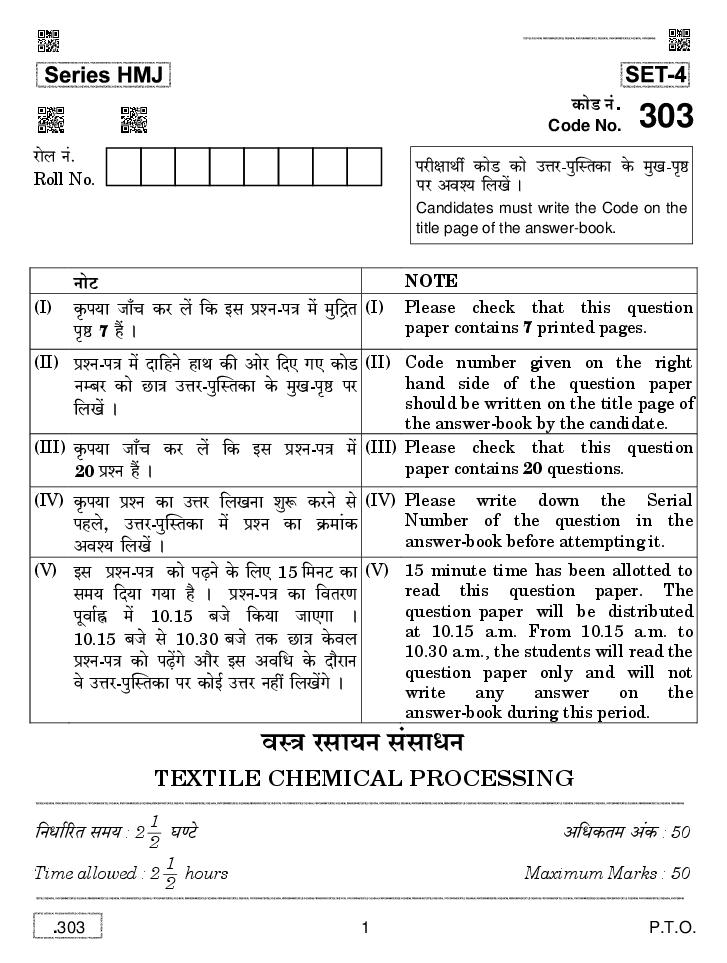
Code No. 303
amob Z§. narjmWu H$moS >H$mo CÎma-nwpñVH$m Ho$ _wI-n¥ð
Roll No. >na Adí` {bIo§ &
Candidates must write the Code on the
title page of the answer-book.
ZmoQ> NOTE
(I) H¥$n`m Om±M H$a b| {H$ Bg àíZ-nÌ _o§ _w{ÐV (I) Please check that this question
n¥ð> 7 h¢ & paper contains 7 printed pages.
(II) àíZ-nÌ _| Xm{hZo hmW H$s Amoa {XE JE H$moS (II) Code number given on the right
>Zå~a H$mo N>mÌ CÎma-nwpñVH$m Ho$ _wI-n¥ð> na hand side of the question paper
{bI| & should be written on the title page of
the answer-book by the candidate.
(III) H¥$n`m Om±M H$a b| {H$ Bg àíZ-nÌ _| (III) Please check that this question
>20 àíZ h¢ & paper contains 20 questions.
(IV) H¥$n`m àíZ H$m CÎma {bIZm ewê$ H$aZo go (IV) Please write down the Serial
nhbo, CÎma-nwpñVH$m _| àíZ H$m H«$_m§H$ Number of the question in the
Adí` {bI| & answer-book before attempting it.
(V) Bg àíZ-nÌ H$mo n‹T>Zo Ho$ {bE 15 {_ZQ >H$m (V) 15 minute time has been allotted to
g_` {X`m J`m h¡ & àíZ-nÌ H$m {dVaU read this question paper. The
nydm©• _| 10.15 ~Oo {H$`m OmEJm & question paper will be distributed
10.15 ~Oo go 10.30 ~Oo VH$ N>mÌ Ho$db at 10.15 a.m. From 10.15 a.m. to
10.30 a.m., the students will read the
àíZ-nÌ H$mo n‹T>|Jo Am¡a Bg Ad{Y Ho$ Xm¡amZ question paper only and will not
do CÎma-nwpñVH$m na H$moB© CÎma Zht {bI|Jo & write any answer on the
answer-book during this period.
dñÌ agm`Z g§gmYZ
TEXTILE CHEMICAL PROCESSING
{ZYm©[aV g_` : 2 12 KÊQ>o A{YH$V_ A§H$ : 50
1
Time allowed : 2 hours Maximum Marks : 50
2
.303 1 P.T.O.
Page 2
{ZåZ{b{IV {ZX}em| H$mo ~hþV gmdYmZr go n{‹T>E Am¡a CZH$m g™Vr go nmbZ H$s{OE :
(i) Bg àíZ-nÌ _| 20 àíZ em{_b h¢ &
(ii) àíZ-nÌ Xmo IÊS>m| _| {d^m{OV h¡ &
IÊS> H$
~hþ{dH$ënr` àíZ /[aº ñWmZ ^[aE /grYo àíZ : Hw$b 12 àíZ em{_b h¢ Omo
1 – 1 A§H$ Ho$ h¢ & BZ_| go {H$Ýht 10 àíZm| Ho$ CÎma Xr{OE &
A{V bKw-CÎmar` àíZ : BZ_| Hw$b 7 àíZ em{_b h¢, àË`oH$ àíZ 2 A§H$ H$m h¡ &
BZ_| go {H$Ýht 5 àíZm| Ho$ CÎma Xr{OE &
bKw-CÎmar` àíZ : BZ_| Hw$b 7 àíZ em{_b h¢, àË`oH$ àíZ 3 A§H$ H$m h¡ & BZ_| go
{H$Ýht 5 àíZm| Ho$ CÎma Xr{OE &
IÊS> I
XrK©-CÎmar` /{Z~ÝYmË_H$ àíZ : BZ_| Hw$b 5 àíZ em{_b h¢, àË`oH$ àíZ 5 A§H$ H$m h¡ &
BZ_| go {H$Ýht 3 àíZm| Ho$ CÎma Xr{OE &
(iii) Ohm± gå^d hmo, AnZo CÎmam| H$mo {M{ÌV H$s{OE &
IÊS> H$
1. [aº$ ñWmZm| H$s ny{V© C{MV eãXm| go H$s{OE ({H$Ýht Xg) : 110=10
(i) àma§{^H$ n[agÁOm __________ (H$m~m}ZmBqµOJ/Ob AdamoYH$) 1
(ii) ñH$m°[a¨J ____________ (NaOCl/NaOH) 1
(iii) C^ao V§Vw ___________ (g¡Z\$moamBµOoeZ/qgqOJ) 1
(iv) \¡$bo hþE dñÌ H$s a§JmB© __________ ({OJa/qdM) 1
(v) D$Z H$s a§JmB© ___________ (gë\$a/Eo{gS>) 1
(vi) gyVr dñÌm| H$s a§JmB© ___________ ({S>ñng©/S>mBaoŠQ>) 1
(vii) OWF H$m AW© h¡ ____________ (Am°Z doQ> Am°\$ \¡$~[aH$/AmonZ {dS²>W \¡$~[aH$) 1
(viii) S>mBaoŠQ> N>nmB© ____________ (amoba/amoQ>ar ñH«$sZ) 1
(ix) N>nmB© noñQ> gm_J«r ___________ (hmBS´>mogë\$mBQ>/hmBJ«moñH$mo{nH$ nXmW©) 1
(x) {d{eîQ> H¡$b|S>[a¨J _________ (E_amBqµOJ/_m°B[a¨J) 1
(xi) nmM©_|Q>mBµOoeZ _________ (gmÝÐ H2SO4/VZw H2SO4) 1
(xii) EñWo{Q>H$ d _________ n[agÁOmE± (\§$ŠeZb/âbwAmoamoH$m~©Z) 1
.303 2
Page 3
Read the following instructions very carefully and strictly follow them :
(i) This question paper contains 20 questions.
(ii) The question paper is divided into two sections.
SECTION A
Multiple choice questions / Fill in the blanks/Direct questions :
contains total 12 questions of 1 mark each. Answer any 10 questions.
Very short answer type questions : contains total 7 questions of
2 marks each. Answer any 5 questions.
Short answer type questions : contains total 7 questions of 3 marks
each. Answer any 5 questions.
SECTION B
Long answer / Essay type questions : contains total 5 questions of 5 marks
each. Answer any 3 questions.
(iii) Illustrate your answers wherever possible.
SECTION A
1. Fill in the blanks with suitable words (Any ten) : 110=10
(i) Preparatory finish ___________ (Carbonizing/Water resistant) 1
(ii) Scouring ______________ (NaOCl/NaOH) 1
(iii) Protruding fibres __________ (Sanforization/Singeing) 1
(iv) Open width fabric dyeing __________ (Jigger/Winch) 1
(v) Dyeing of wool ___________ (Sulphur/Acid) 1
(vi) Dyeing of cotton fabrics ___________ (Disperse/Direct) 1
(vii) OWF stands for __________ (On Weight of Fabric/Open Width
Fabric) 1
(viii) Direct printing __________ (Roller/Rotary Screen) 1
(ix) Print paste ingredient ____________ (Hydrosulphite/Hygroscopic
agent) 1
(x) Special calendering __________ (Emerising/Moireing) 1
(xi) Parchmentisation ___________ (Conc. H2SO4/Dil. H2SO4) 1
(xii) Aesthetic and ___________ finishes (Functional/Fluorocarbon) 1
.303 3 P.T.O.
Page 4
2. Xmo àH$ma H$s qgqOJ (Singeing) H$m Zm_ {b{IE & 2
3. E½µOm°eZ (Exhaustion) nXmW© (aoMZ H$_©H$) H$m H$m`© ~VmBE & 2
4. gë’$a (Sulphur) a§Jm| na {Q>ßnUr {b{IE & 2
5. EµOmoBH$ (Azoic) a§Jm| Ho$ Cn¶moJ Ho$ Xmo bm^ ~VmBE & 2
6. ~m{Q>H$ (Batik) N>nmB© {H$g e¡br H$m CXmhaU h¡ ? Bg N>nmB© e¡br _| {H$g nXmW© H$m
Cn`moJ {H$`m OmVm h¡ ? 2$
7. Z¡qnJ (Napping) H$mo g_PmBE & 2
8. S>¡Ho$Q>mBqµOJ (Decatising) Ho$ bú` na boI {b{IE & 2
bKw-CÎmar¶ àíZ (H$moB© nm±M) : 35=15
9. H$ƒo aoe_ _| nmB© OmZo dmbr EH$ Aew{Õ d Cgo hQ>mZo H$s {d{Y ~VmBE & 3
10. {MÌ g{hV qdM (Winch) a§JmB© _erZ na boI {b{IE & 3
11. âbm°H$ (Flock) N>nmB© na boI {b{IE & 3
12. N>nmB© Ho$ {bE ñH«$sZ (Screen) H¡$go V¡`ma H$s OmVr h¡ ? 3
13. hmW go ãbm°H$ (Block) N>nmB© Ho$ Š`m bm^ d gr_mE± h¢ ? 3
14. A{½Z-AdamoYH$ n[agÁOm Ho$ {bE Cn`moJ {H$E OmZo dmbo agm`Zm| Ho$ Zm_ Š`m h¢ ? Eogo
dñÌm| Ho$ Xmo CXmhaU Xr{OE & 3
15. AmYmanyU© d {d{eîQ> n[agÁOm H$m A§Va d àË`oH$ EH$-EH$ CXmhaU Xr{OE & 3
.303 4
Page 5
2. Name the two types of Singeing. 2
3. State the role of an Exhaustion agent. 2
4. Write a note on Sulphur dyes. 2
5. State two advantages of using Azoic dyes. 2
6. Of which style of printing is Batik an example ? Which substance is used
in this style of printing ? 2
7. Explain ‘Napping’. 2
8. Write a note on the purpose of Decatising. 2
Short Answer Type Questions (Any five) : 35=15
9. State one impurity found in raw silk and its removal method. 3
10. Write a note on Winch Dyeing Machine with a diagram. 3
11. Write a note on Flock Printing. 3
12. How is a screen prepared for printing ? 3
13. What are the advantages and limitations of hand-block printing ? 3
14. What are the names of chemicals used to impart flame-repellant
finishes ? Give two examples of such fabrics. 3
15. State the difference between Basic and Special finishes with one example
of each. 3
.303 5 P.T.O.
Page 6
XrK©-CÎmar¶ àíZ (H$moB© VrZ) : 5×3=15
16. ‘g©amBµOoeZ (Mercerization) Ho$ bm^ d H$aZo H$s {d{Y H$mo {dñVma _| g_PmBE & 5
17. ñH$m°[a¨J (Scouring) Š`m| Am¡a H¡$go H$s OmVr h¡ ? 5
18. ãbrqMJ (Bleaching) V¡`mar H$s à{H«$`m H$m _hÎdnyU© ^mJ Š`m| _mZm OmVm h¡ ? Bgo H$aZo
Ho$ {bE à`wº$ nXmWm] Ho$ Zm_ ~VmBE & 5
19. gyVr dñÌm| na S>mBaoŠQ> (Direct) a§J M‹T>mZo H$s {d{Y H$m dU©Z H$s{OE & 5
20. aoe_ na Eo{gS> (Acid) a§J H¡$go bJmE OmVo h¢ ? g_PmBE &$ 5
.303 6
Page 7
Long Answer Type Questions (Any three) : 5×3=15
16. Explain the advantages and method of mercerization in detail. 5
17. Why and how is scouring carried out ? 5
18. Why is bleaching considered an important part of a preparatory process ?
Name substances used for carrying it out. 5
19. Describe the method of applying direct dyes on cotton fabrics. 5
20. How are Acid Dyes applied on silk ? Explain. 5
.303 7 P.T.O.
Document Details
| Board / Org | CBSE |
| Exam | Class 12 |
| Type | Question Paper |
| Pages | 7 |
| Updated | 22 Jul 2026 |