MAHA SET 2019 Question Paper 2 Commerce
Finished viewing? Save it for later —
Download MAHA SET 2019 Question Paper 2 Commerce (PDF · 40 pages)About MAHA SET 2019 Question Paper 2 Commerce
MAHA SET 2019 Question Paper 2 Commerce is available here for free download. Published by Maharashtra Exams for Maharashtra State Eligibility Test, this question paper can be viewed online or downloaded as a PDF (40 pages). Candidates preparing for Maharashtra State Eligibility Test can use MAHA SET 2019 Question Paper 2 Commerce to understand the exam pattern, the type of questions asked, and the overall difficulty level.
Frequently Asked Questions
How can I download MAHA SET 2019 Question Paper 2 Commerce?
Open this page and click the Download button to save MAHA SET 2019 Question Paper 2 Commerce as a PDF. It is completely free on AglaSem Docs.
Is MAHA SET 2019 Question Paper 2 Commerce free to download?
Yes. MAHA SET 2019 Question Paper 2 Commerce can be viewed online and downloaded as a PDF free of cost on AglaSem Docs.
How many pages does MAHA SET 2019 Question Paper 2 Commerce have?
MAHA SET 2019 Question Paper 2 Commerce contains 40 pages, which you can read online or download together as a single PDF.
Where can I find more Maharashtra State Eligibility Test study material?
You can find more Maharashtra State Eligibility Test question papers, sample papers, syllabus, and answer keys on AglaSem Docs.
MAHA SET 2019 Question Paper 2 Commerce – Text
Read the full text of this question paper below — useful to quickly search, copy and reference the content online without downloading the PDF.
📄 View text version (40 pages)
Page 1
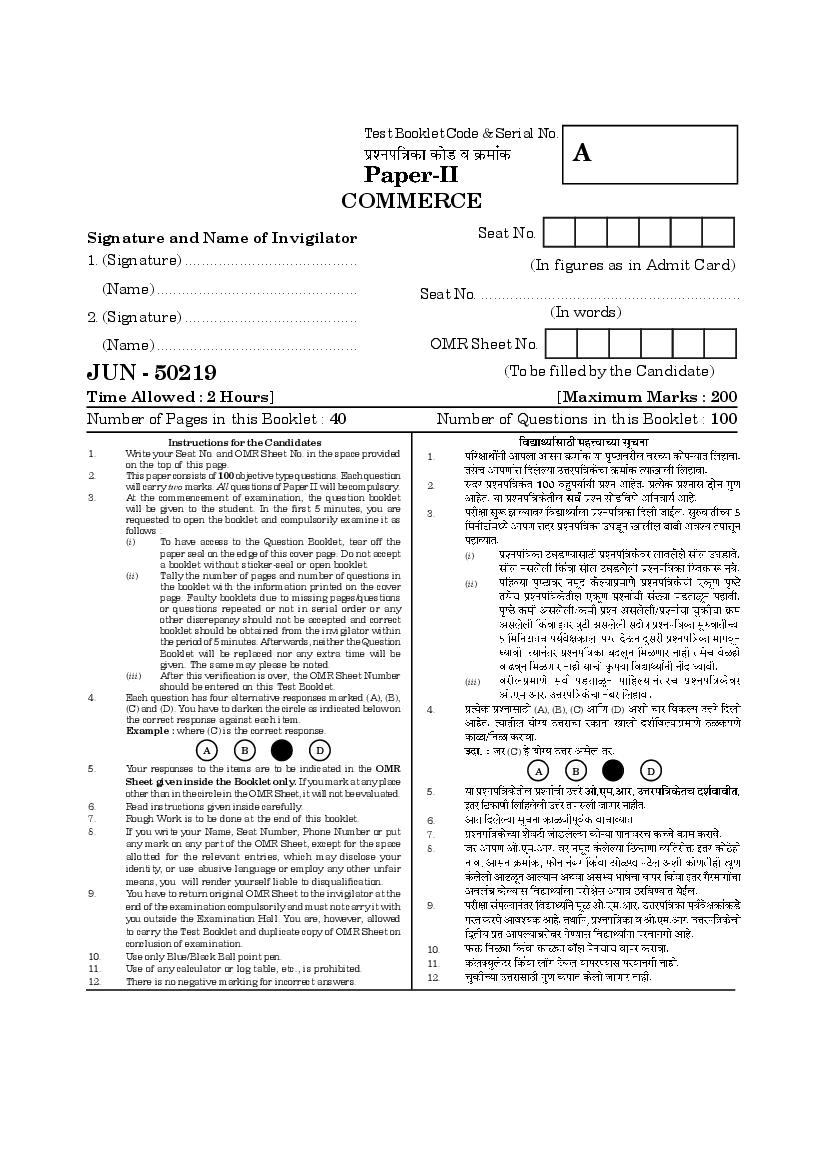
A
COMMERCE
Signature and Name of Invigilator Seat No.
1. (Signature) ......................................... (In figures as in Admit Card)
(Name) ................................................ Seat No. ..............................................................
2. (Signature) ......................................... (In words)
(Name) ................................................ OMR Sheet No.
JUN - 50219 (To be filled by the Candidate)
Time Allowed : 2 Hours] [Maximum Marks : 200
Number of Pages in this Booklet : 40 Number of Questions in this Booklet : 100
Instructions for the Candidates
1. Write your Seat No. and OMR Sheet No. in the space provided 1.
on the top of this page.
2. This paper consists of 100 objective type questions. Each question
will carry two marks. All questions of Paper II will be compulsory. 2.
3. At the commencement of examination, the question booklet
will be given to the student. In the first 5 minutes, you are 3.
requested to open the booklet and compulsorily examine it as
follows :
(i) To have access to the Question Booklet, tear off the
paper seal on the edge of this cover page. Do not accept (i)
a booklet without sticker-seal or open booklet.
(ii) Tally the number of pages and number of questions in
the booklet with the information printed on the cover (ii)
page. Faulty booklets due to missing pages/questions
or questions repeated or not in serial order or any
other discrepancy should not be accepted and correct
booklet should be obtained from the invigilator within
the period of 5 minutes. Afterwards, neither the Question
Booklet will be replaced nor any extra time will be
given. The same may please be noted.
(iii) After this verification is over, the OMR Sheet Number
(iii)
should be entered on this Test Booklet.
4. Each question has four alternative responses marked (A), (B),
(C) and (D). You have to darken the circle as indicated below on 4. (A), (B), (C) (D)
the correct response against each item.
Example : where (C) is the correct response.
A B D (C)
5. Your responses to the items are to be indicated in the OMR A B D
Sheet given inside the Booklet only. If you mark at any place
other than in the circle in the OMR Sheet, it will not be evaluated. 5.
6. Read instructions given inside carefully.
7. Rough Work is to be done at the end of this booklet. 6.
8. If you write your Name, Seat Number, Phone Number or put 7.
any mark on any part of the OMR Sheet, except for the space
8.
allotted for the relevant entries, which may disclose your
identity, or use abusive language or employ any other unfair
means, you will render yourself liable to disqualification.
9. You have to return original OMR Sheet to the invigilator at the
end of the examination compulsorily and must not carry it with 9.
you outside the Examination Hall. You are, however, allowed
to carry the Test Booklet and duplicate copy of OMR Sheet on
conclusion of examination.
10.
10. Use only Blue/Black Ball point pen.
11.
11. Use of any calculator or log table, etc., is prohibited.
12. There is no negative marking for incorrect answers. 12.
Page 2
Page 3
Paper II
II
Time Allowed : 120 Minutes] [Maximum Marks : 200
Note : This Paper contains Hundred (100) multiple choice questions. Each question
carrying Two (2) marks. Attempt All questions.
(100) (2)
1. ..................... is a mechanism to reduce 1.
price risk inherent in open position.
(A) Swap
(A)
(B) Hedging
(B)
(C) Customised contract
(C)
(D) Squaring off
(D)
2. The theory of mercantilism is based
2.
on :
(A) Gold
(A)
(B) Dollar
(B)
(C) Use of money
(C)
(D) Exchange of goods for goods (D)
3 [P.T.O.
Page 4
demerit of the MNCs ?
(A) MNCs may destroy competition
(A)
and acquire monopoly powers.
(B) MNCs retard growth of
(B)
employment in the home
country.
(C)
(C) MNCs provide means of
integrating national economies.
(D) Through transfer pricing (D)
MNCs avoid taxes in the home
country.
4. Balance of trade balances the
4.
exports and imports of ....................
trade of a country.
(A)
(A) Invisible
(B)
(B) Merchandise
(C) Industrial (C)
(D) Agricultural (D)
4
Page 5
form of counter trade ?
(A) Buy back
(A)
(B) Compensation deal
(B)
(C) Counter purchase
(C)
(D) Purchase on credit
(D)
6. Usually balance of payments
6.
accounts the transactions of a
country for :
(A) Five years (A)
(B) Two years (B)
(C) One year (C)
(D) Ten years
(D)
7. The key factor for attracting FDI
7.
is :
(A) Interest rates existing for a
(A)
country
(B)
(B) Entry/Exit policies
(C) Purchasing power (C)
(D) All of the above (D)
5 [P.T.O.
Page 6
Regional Co-operation (SAARC)
was established on December, 1985
in ......................... city.
(A)
(A) Islamabad
(B)
(B) Kathmandu
(C)
(C) Dhaka
(D)
(D) New Delhi
9.
9. Which of the following is not the type
of tariff reduction mechanism under
agreement on agriculture (AOA) ?
(A)
(A) Amber box subsidy
(B)
(B) Blue box subsidy
(C)
(C) Green box subsidy
(D) Purple box subsidy (D)
10. Which one of the following is not 10.
economic factor to cause disequili-
brium in the balance of payments ?
(A) Development disequilibrium (A)
(B) Social disequilibrium (B)
(C) Structural disequilibrium (C)
(D) Cyclical disequilibrium (D)
6
Page 7
expected solution over the
limitations of ........................ .
(A)
(A) Assets and liability
(B)
(B) Income and expenses
(C)
(C) Realisation concept
(D)
(D) Money measurement concept
12.
12. Which of the following industries
does not use the process costing ?
(A) Oil refineries (A)
(B) Distilleries (B)
(C) Sugar (C)
(D) Aircraft manufacturing (D)
13. When prices show a rising trend, 13.
which one of the following methods
of inventory valuation will result in
lower income and lower valuation of
inventory ?
(A) FIFO
(A) FIFO
(B) LIFO (B) LIFO
(C) Simple average method (C)
(D) Weighted average method (D)
7 [P.T.O.
Page 8
` 80,000, Depreciation ` 15,000 and ` 15,000
decrease in debtors ` 25,000. What ` 25,000
is the cash flow from operating
activities ?
(A) ` 55,000
(A) ` 55,000
(B) ` 40,000
(B) ` 40,000
(C) ` 1,20,000
(C) ` 1,20,000
(D) ` 65,000
(D) ` 65,000
15.
15. At the time of consolidation issue
of bonus shares by subsidiary
company out of capital profit
will ........................ . (A)
(A) Decrease cost of control (B)
(B) Increase cost of control (C)
(C) Increase holding ratio (D)
(D) Have no effect on cost of control
16.
16. The sweat shares are allotted
to ........................ .
(A) Investors (A)
(B) Employees (B)
(C) Vendors (C)
(D) Promoters (D)
8
Page 9
(A) The shareholders in the general
meeting (A)
(B) The Central Government (B)
(C) The Registrar of Companies (C)
(D) The Board of Directors (D)
18. Employee benefits to employees in 18.
financial statements are recognised
as per ........................ .
(A) Indian AS-1 (A) Indian AS-1
(B) Indian AS-9 (B) Indian AS-9
(C) Indian AS-6 (C) Indian AS-6
(D) Indian AS-19 (D) Indian AS-19
19. X and Y share profits and losses in 19.
the ratio of 2 : 1. They take Z as 2: 1
a partner and the new profit sharing
ratio becomes 3 : 2 : 1. Z brings 3 : 2 : 1 ` 4,500
` 4,500 as premium for goodwill.
What will be the value of firm’s
goodwill ?
(A) ` 4,500 (A) ` 4,500
(B) ` 18,000 (B) ` 18,000
(C) ` 27,000 (C) ` 27,000
(D) ` 24,000 (D) ` 24,000
9 [P.T.O.
Page 10
Auditing ?
(A)
(A) Vouching
(B)
(B) Verification
(C)
(C) Valuation
(D)
(D) Internal check
21.
21. Which of the following is not the
basic economic problem ?
(A)
(A) What to produce ?
(B)
(B) How to produce ?
(C)
(C) What to consume ?
(D)
(D) For whom to produce ?
22.
22. The ..................... effect of a change
in price is negative for superior
goods.
(A)
(A) Price
(B) Income (B)
(C) Substitution (C)
(D) Inflation (D)
10
Page 11
to each others, then indifference
curves are ......................... .
(A) Right angled
(A)
(B) Left angled
(B)
(C) Convex to origin
(D) Downward sloping (C)
24. X : Long run average cost curve is (D)
flat U-shaped.
24. (LRAC)
Y : It is called an envelope curve.
U
(A) Only X is correct
(B) Only Y is correct
(A)
(C) Both X and Y are correct
(D) Both X and Y are incorrect (B)
25. Which of the following is not a fixed (C)
cost ?
(D)
(A) Payment of interest on
borrowed capital 25.
(B) Charges for fuel and electricity (A)
(C) Depreciation charges on (B)
equipments and buildings
(C)
(D) Contractual rent for equipment
or building (D)
11 [P.T.O.
Page 12
structure is the demand curve of the
market represented by the demand
curve of the firm ?
(A)
(A) Monopolistic competition
(B)
(B) Perfect competition
(C)
(C) Monopoly
(D)
(D) Oligopoly
27.
27. X : The extra expenditure incurred
by a firm on competitive
advertisement is selling cost.
Y : There are several wastes under
monopolistic competition.
(A) Only X is correct (A)
(B) Only Y is correct (B)
(C) Both X and Y are correct (C)
(D) Both X and Y are incorrect
(D)
28. This is not a feature of monopolistic
28.
competition :
(A)
(A) Product differentiation
(B)
(B) Free entry and exit
(C)
(C) Selling cost
(D) Interdependence (D)
12
Page 13
Group-A
(w) Monopolistic competition (w)
(x) Price rigidity (x)
(y) Dumping (y)
(z) Collusion (z)
Group-B
(i) Sale of goods at varying prices (i)
in foreign and domestic market.
(ii) Edward Chamberlin. (ii)
(iii) Firms working together in price (iii)
determination.
(iv) Paul Sweezy. (iv)
Codes :
(A) (w)-(ii) (x)-(iii) (y)-(i) (z)-(iv) (A) (w)-(ii) (x)-(iii) (y)-(i) (z)-(iv)
(B) (w)-(iv) (x)-(ii) (y)-(i) (z)-(iii) (B) (w)-(iv) (x)-(ii) (y)-(i) (z)-(iii)
(C) (w)-(ii) (x)-(iv) (y)-(i) (z)-(iii) (C) (w)-(ii) (x)-(iv) (y)-(i) (z)-(iii)
(D) (w)-(iv) (x)-(i) (y)-(iii) (z)-(ii) (D) (w)-(iv) (x)-(i) (y)-(iii) (z)-(ii)
30. Who among the following has not 30.
contributed to the theory of games ?
(A) J. Von Neumann (A)
(B) Oskar Morgenstern (B)
(C) John Nash (C)
(D) Robert Samuelson (D)
13 [P.T.O.
Page 14
(A) Operating leverage (A)
(B) Financial leverage (B)
(C) Combined leverage (C)
(D) Working capital leverage
(D)
32. DCF technique of Capital Budgeting
32.
does not include the following :
(A) NPV (Net Present Value)
(A)
(B) P.I. (Profitability Index)
(B)
(C) IRR (Internal Rate of Return)
(C)
(D) ARR (Average Rate of Return)
(D)
33. A firm has a cash dividend of ` 42
33.
per share and an average growth
` 42
rate of 5% per annum in cash
dividend. The required rate of 5%
return is 12% per annum. Find the 12%
present value of the share :
(A) ` 600 (A) ` 600
(B) ` 294 (B) ` 294
(C) ` 500 (C) ` 500
(D) ` 650 (D) ` 650
14
Page 15
to :
(A) Real rate + Risk premium – (A) + –
Inflation
(B) + +
(B) Real rate + Risk premium +
Inflation
(C) – +
(C) Real rate – Risk Premium +
Inflation
(D)
(D) Real rate
35.
35. SDRs are :
(A) International reserve assets (A)
(B) US currency (B)
(C) Crawling peg (C)
(D)
(D) ADR
36.
36. Domestic currency tends to
depreciate owing to :
(A)
(A) Lowering of inflation rate
(B)
(B) Constant inflation rate
(C)
(C) High inflation rate
(D) No inflation rate (D)
15 [P.T.O.
Page 16
(A) Going for a forward contract
(A)
(B) Going for a future contract
(B)
(C) Going for a backward contract
(C)
(D) A position to cover a future
payables receivable position (D)
38. Multilateral Investment Guarantee
38.
Agency (MIGA) covers :
(A) Political risk
(A)
(B) Commercial risk
(B)
(C) Management risk
(C)
(D) Exchange risk
(D)
39. At operating Break-even Point
39.
which of the following is true ?
(A) Sales revenue just covers the
(A)
fixed cost
(B) Sales revenue is just equal to (B)
revenue variable cost
(C) Fixed cost is same as that of (C)
variable cost
(D) EBIT is zero (D)
16
Page 17
a firm can increase its value and
reduce the overall cost of capital by
increasing the proportion of ...............
in its capital structure.
(A) Debt (A)
(B) Equity (B)
(C) Preference shares (C)
(D) Retained earnings (D)
41. If each observation in a group is 41. 5
increased by 5, then the arithmetic
mean will ....................... .
(A) 5
(A) Increase by 5
(B)
(B) Not change
(C) 5
(C) Decrease by 5
(D)
(D) Decrease or increase depending
upon the observations
42. X = 100, x = 10, Y = 200,
42. If X = 100, x = 10, Y = 200, y = 15,
y = 15, then : (A) (X) = (Y)
(A) C.V. (X) = C.V. (Y)
(B) (X) > (Y)
(B) C.V. (X) > C.V. (Y)
(C) (X) < (Y)
(C) C.V. (X) < C.V. (Y)
(D) (X) = 1.5
(D) C.V. (X) = 1.5 C.V. (Y) (Y)
17 [P.T.O.
Page 18
and exhaustive events of such
that P(A) = 2P(B), then P(A) = ......... P(A) = 2P(B) P(A) = .........
(A) 0 (A) 0
(B) 1/3 (B) 1/3
(C) 2/3 (C) 2/3
(D) 1 (D) 1
44. A company can complete the job in 44.
time with probability 0.8. Suppose 0.8
5 jobs are assigned then the 5
probability that all the jobs will be
completed in time is ....................... .
(A) 5 × 0.8 (A) 5 × 0.8
(B) 0.8 (B) 0.8
(C) 1 (C) 1
(D) (0.8)5 (D) (0.8)5
45. In systematic sampling the samples 45.
drawn ........................ .
(A) Are not overlapping (A)
(B) May be overlapping (B)
(C) Are non-random in nature (C)
(D) Are not proper representative (D)
18
Page 19
hypothesis is a region of .................
(A) H0
(A) Rejection for H0
(B) Rejection for H1 (B) H1
(C) Acceptance for H0
(D) Acceptance for H1 (C) H0
47. We use Mann-Whitney U test for
testing equality of means of two (D) H1
populations if .................... .
(A) The samples are from normal 47.
populations with unknown U
variances.
(A)
(B) The samples are from non-
normal populations.
(B)
(C) The samples are from normal
(C)
populations with known
variances.
(D)
(D) The samples are unequal in
size. 48.
48. If the two regression lines are x + 2y = 5
x + 2y = 5 and 2x + 3y = 8
2x + 3y = 8 x y
then the means of x and y are :
(A) –3, 4 (A) –3, 4
(B) 2, 4 (B) 2, 4
(C) 1, 2 (C) 1, 2
(D) 2, 1 (D) 2, 1
19 [P.T.O.
Page 20
mean 20 and variance 64, then 20 64
P(X > 20) = ........................ . P(X > 20) = ........................
(A) 0 (A) 0
(B) 20/64 (B) 20/64
(C) 0.5 (C) 0.5
(D) 1 (D) 1
50. Arrange the following steps in 50.
research in appropriate order :
(a) Hypothesis testing (a)
(b) Drawing a sample (b)
(c) Determining the size of sample (c)
(d) Conduct the survey (d)
(e) Decide the sampling method (e)
(A) a, b, c, d, e (A) a, b, c, d, e
(B) b, c, a, d, e (B) b, c, a, d, e
(C) e, c, b, d, a (C) e, c, b, d, a
(D) d, e, a, b, c (D) d, e, a, b, c
51. Another term used for 360 degree 51. 360
appraisal and feedback is :
(A) Multirater (A)
(B) Complete appraisal (B)
(C) Internal and external appraisal (C)
(D) Periodic assessment (D)
20
Page 21
the-job training method.
(A) Apprenticeship (A)
(B) Simulation (B)
(C) Coaching (C)
(D) Intership (D)
53. ..................... suggests that
53.
managerial knowledge may be
transferred from one country to
another and from another within the
same country.
(A)
(A) Universality of Management
(B)
(B) Scientific Management
(C)
(C) Professional Management
(D)
(D) Administrative Management
54.
54. ..................... is used to evolve
behavioural description of a job.
(A) Critical Incident Technique
(A)
(B) Position Analysis Questionnaire/
Technique
(B)
(C) Task inventory Analysis
Technique (C)
(D) Method Analysis (D)
21 [P.T.O.
Page 22
physical location, management of
buildings and equipments.
(A) Ad hoc Planning (A)
(B) Formal Planning (B)
(C) Standing Planning (C)
(D) Physical Planning (D)
56. ....................... is a technique for
56.
planning and controlling complex
projects and for scheduling the
resources required for such projects.
(A) Complexities Analysis
(A)
(B) Network Analysis
(B)
(C) Financial Analysis
(C)
(D) Internal Analysis
(D)
57. ..................... signifies all out efforts
57.
for increase in production, creation
of spirit of mutual trust and develop
scientific attitude towards problem
solving.
(A) Time study (A)
(B) Mental Revolution (B)
(C) Motion study (C)
(D) Works study (D)
22
Page 23
between union and management in
the absence of any third party is
widely designated as .................... .
(A) Adjudication (A)
(B) Arbitration (B)
(C) Collective bargaining (C)
(D) Conciliation (D)
59. Which one of the following is not 59.
the factor that affects the span of
control ? (A)
(A) Similarities of functions (B)
(B) Geographical closeness of
employees (C)
(C) Capacity of subordinates (D)
(D) Delegation 60. (off the
60. ......................... is not off the job job)
training method. (A)
(A) Vestibule (B)
(B) Simulation (C)
(C) Business games (D)
(D) Special assignments
23 [P.T.O.
Page 24
of human errors, technical faults,
infrastructure breakdown and faulty
systems ?
(A) Exchange risk (A)
(B) Settlement risk (B)
(C) Gap risk
(C)
(D) Operational risk
(D)
62. In case of ....................... debentures,
62.
the investors are given the option
to convert their investment in the
form of equity shares of the
company.
(A)
(A) Fully convertible
(B)
(B) Partly convertible
(C)
(C) Non-convertible
(D) Optionally convertible (D)
63. ......................... are the persons legally 63.
permitted to deal in or handle
transactions related to foreign
exchange as per FEMA 1999.
(A) Underwriters (A)
(B) Authorised persons (B)
(C) Taraniwala (C)
(D) Joggers (D)
24
Page 25
system which provides transmission
of financial messages, certifying the
authenticity, across the globe
between members.
(A) RTGS
(A) RTGS
(B) NEFT
(B) NEFT
(C) SWIFT (C) SWIFT
(D) FINFAST (D) FINFAST
65. Bank should classify an account as
65.
NPA only if the interest charged
during any quarter is not serviced
fully within ..................... from the end
of quarter.
(A) 90 days
(B) 180 days
(A) 90
(C) 360 days
(D) 450 days (B) 180
66. ......................... is an indirect (C) 360
instrument of credit control used by
the RBI to meet day to day liquidity (D) 450
mismatches in the system and check
66.
volatility in the short-term money
market.
(A) Credit monitoring arrangement
(CMA)
(B) Liquidity adjustment facility
(A)
(LAF)
(C) Credit authorization scheme (B)
(CAS)
(C)
(D) Market stabilization scheme
(MSS) (D)
25 [P.T.O.
Page 26
name of X, Y and Z should be paid
on the death of X :
(A) To the legal representative of X (A)
(B) To Y and Z (B)
(C)
(C) To Y or Z
(D)
(D) To the legal representative of X,
Y and Z
68.
68. The main purpose of insurance is :
(A) Compensate the loss
(A)
(B) Provide security
(B)
(C) Share the losses of few people
(C)
among many
(D) Indemnification
(D)
69. Secondary financing of bills or credit 69.
portfolio already financed by banks
or institutions as a support to
primary financers is termed as .........
(A) Refinance (A)
(B) Supplementary finance (B)
(C) Counter finance (C)
(D) Demand based finance (D)
26
Page 27
will result in interest rate risk of
...................... type.
(A) Basic risk
(A)
(B) Yield curve risk
(B)
(C) Embedded option risk
(C)
(D) Mismatch risk
(D)
71. Functions of physical supply
include : 71.
(A) Buying, Assembling, Selling
(A)
(B) Transportation, Storage
(C) Standardisation, Grading, (B)
Packaging, Labelling (C)
(D) Transport, Grading and Storage (D)
72. .......................... method of pricing
72.
strategies assumes that sales and
profits are independent of costs, but
are dependent on the demand.
(A)
(A) Break-even pricing
(B) Market based pricing (B)
(C) Competition oriented pricing (C)
(D) Affordability based pricing (D)
27 [P.T.O.
Page 28
73.
service marketing, a marketer
chooses to charge low price for a
basic service to attract customers but
every extra service above basic is
charged additionally high.
(A) Differential pricing (A)
(B) Discount pricing
(B)
(C) Diversionary pricing
(C)
(D) High price maintenance pricing
(D)
74. In the case of some market leaders,
the companies are very highly 74.
respected that the channel members
are proud to be associated with them
is known as ....................... .
(A)
(A) Reward power
(B)
(B) Coercive power
(C) Expert power (C)
(D) Referent power (D)
75. ...................... describes how and 75.
where information gets into
memory.
(A)
(A) Memory retrieval
(B)
(B) Memory reconstructive
(C) Memory encoding (C)
(D) Memory decoding (D)
28
Page 29
specific brand once will not accept
a substitute is ........................ .
(A) Brand recognition
(B) Brand insistence (A)
(C) Brand preference (B)
(D) Brand loyalty (C)
77. ......................... is one of the additional (D)
factor hindering new proudcer 77.
development, which suggest
companies must aim their new
products at smaller market segments
and this can mean lower sales and
profits for each product.
(A) Shortage of important ideas in (A)
certain areas
(B) Social and governmental (B)
constraints
(C)
(C) Fragmental markets
(D)
(D) Cost of development
78.
78. Rising sales at increasing rate is
witnessed in ..................... .
(A) Maturity stage (A)
(B) Growth stage (B)
(C) Introduction stage (C)
(D) Decline stage (D)
29 [P.T.O.
Page 30
where the parent company grants
another independent company the
right to do business in a prescribed
manner.
(A)
(A) Franchising
(B)
(B) Contract manufacturing
(C)
(C) Strategic alliance
(D)
(D) Licencing
80. Customer satisfaction is no longer 80.
good enough to survive in today’s
competitive market. What is needed
is ......................... .
(A)
(A) Customer orientation
(B)
(B) Customer retention
(C)
(C) Building customer relationship
(D)
(D) Customer delight
81.
81. Section ........................ of Indian
Contract Act, 1872 defines contract
as an agreement enforcible by law.
(A) 2(h) (A) 2
(B) 2(b) (B) 2
(C) 2(e) (C) 2
(D) 2(d) (D) 2
30
Page 31
Goods and Service Tax Act, 2017
deals with ........................ . (A)
(A) Input tax credit
(B)
(B) Time and value of supply
(C)
(C) Levy and collection of tax
(D)
(D) Administration
83.
83. What is the time limit to get the
information concerning with the life
and liberty of a person as per RTI
Act, 2005 ?
(A) 24
(A) 24 Hours
(B) 48
(B) 48 Hours
(C) 5
(C) 5 Days
(D) 10
(D) 10 Days
84.
84. As per section 24 of IPR Act, the
term of copyright in Posthumous
works is ............................ years.
(A) 30 (A) 30
(B) 40 (B) 40
(C) 10 (C) 10
(D) 60 (D) 60
31 [P.T.O.
Page 32
registration certificate ?
(A) One year (A)
(B) Ten years (B)
(C) Validity till it is cancelled (C)
(D) Five years (D)
86. Match the following groups : 86.
Group-I -I
(i) Trade Mark Act (i)
(ii) Copyright Act (ii)
(iii) Patent Act (iii)
(iv) Design Act (iv)
Group-II -II
(a) Year 1999 (a) 1999
(b) Year 1957 (b) 1957
(c) Year 1970 (c) 1970
(d) Year 2000 (d) 2000
(A) (a-i), (b-ii), (c-iii), (d-iv) (A) (a-i), (b-ii), (c-iii), (d-iv)
(B) (a-iv), (b-iii), (c-ii), (d-i) (B) (a-iv), (b-iii), (c-ii), (d-i)
(C) (a-ii), (b-i), (c-iv), (d-iii) (C) (a-ii), (b-i), (c-iv), (d-iii)
(D) (a-iii), (b-iv), (c-i), (d-ii) (D) (a-iii), (b-iv), (c-i), (d-ii)
32
Page 33
Competition Act, 2002 deals with
goods.
(A) 2(i)
(A) 2(i)
(B) 2(a)
(B) 2(a)
(C) 2(b)
(C) 2(b)
(D) 2(h)
(D) 2(h)
88.
88. Which of the following is not an
example of termination of agency by
operation of law ?
(A) Agreement (A)
(B) Expiry of time (B)
(C) Death of either party (C)
(D) Dissolution of company (D)
89. As per the Right to Information Act, 89.
2005 first appeal shall be disposed
off by the first appellate authority
within ........................ days from the
date of its receipt.
(A) 40
(A) 40 Days
(B) 30 Days (B) 30
(C) 60 Days (C) 60
(D) 50 Days (D) 50
33 [P.T.O.
Page 34
have at least two members as per (LLP)
section ..................... of LLP Act, 2008.
(A) 14
(B) 13 (A) 14
(C) 16 (B) 13
(D) 6 (C) 16
91. Which of the following is not an (D) 6
‘Agricultural Income’ under Income 91.
Tax Act, 1961 ?
(A) Sale of replanted trees (A)
(B) Income from growing flowers (B)
and creepers
(C) Salary of partner from a firm (C)
engaged in agricultural operations
(D) Income from supply of water (D)
from a tank in agricultural land
34
Page 35
to Canada for the first time for the
purpose of employment on 10th
May, 2018. He came back to India
on 19th Nov., 2018. His residential
status for the assessment year
2019-20 will be :
(A) Resident (A)
(B) Non-resident (B)
(C) Resident but not ordinarily (C)
resident
(D)
(D) Foreign citizen
93.
93. Which of the following allowances
is not taxable in the hands of
employee ? (A)
(A) City compensatory allowance (B)
(B) Tiffin allowance (C)
(C) Dearness allowance (D)
(D) Allowance from UNO in India
35 [P.T.O.
Page 36
be taxable as income from house
property ?
(A)
(A) Letting of farm house
(B)
(B) Letting of an office building
(C)
(C) Letting of open plot for running
petrol pump
(D)
(D) Sub-letting of house
95.
95. Mr. Anil is carrying on manufacturing
business of engineering goods. His
data regarding machinery used for
business is as follows :
Date Particulars Amount
1-4-18 15,00,000
1-4-18 Opening W.D.V. 15,00,000
30-9-18 3,00,000
30-9-18 Machinery sold at 3,00,000
` 2,50,000
(Book value ` 2,50,000)
10-11-18 6,00,000
10-11-18 New Machinery purchased 6,00,000
Depreciation u/s 32 of Income Tax 1961 32
Act, 1961 will be :
(A) ` 2,85,000 (A) ` 2,85,000
(B) ` 2,25,000 (B) ` 2,25,000
(C) ` 2,33,500 (C) ` 2,33,500
(D) ` 4,27,000 (D) ` 4,27,000
36
Page 37
‘unpaid statutory liability’ at the end
of previous year u/s 43-B of the
Income Tax Act, 1961 ?
(A)
(A) G.S.T.
(B)
(B) Interest on term loan from
scheduled bank
(C)
(C) Provision for gratuity
(D)
(D) Interest on cash credit from a
small cooperative bank
97.
97. Profit on transfer of whole
undertaking as a going concern as
a slum sale after five years of setting
up of a business is taxable as :
(A) Short-term capital gain (A)
(B) Long-term capital gain (B)
(C) Income from business (C)
(D) Income from other sources (D)
37 [P.T.O.
Page 38
house property at Pune ` 18,00,000 23 , 2017 ` 18,00,000
on 23rd April, 2017, which was
purchased by him on 11th April, 11 , 2014 ` 9,70,000
2014 for ` 9,70,000. Value opted for
stamp duty purpose was ` 26,40,000. ` 26,40,000
On June 16, 2017, he purchased a 16 , 2017
house at Kolhapur for ` 10,00,000
` 10,00,000
for the purpose of residence of his
daughter. What will be the capital
2018-19
gain taxable in his hand for the
assessment year 2018-19. C.I. for
2017-18 272
F.Y. 2017-18 was 272 :
(A) ` 3,05,133
(A) ` 3,05,133
(B) ` 8,30,000
(B) ` 8,30,000
(C) NIL
(C)
(D) ` 16,70,000
(D) ` 16,70,000
99. Maximum deduction for medical
expenditure on the health of senior 99. 2019-20
citizen person, if mediclaim
insurance is not paid on his health,
for A.Y. 2019-20 is :
(A) ` 25,000 (A) ` 25,000
(B) ` 30,000 (B) ` 30,000
(C) ` 50,000 (C) ` 50,000
(D) Actual expenditure incurred (D)
38
Page 39
company purchased goods from Jems
Ltd., U.K., an associated enterprise ` 3,000
at ` 3,000 per piece. The following
arm’s length prices have been
determined by the most appropriate
method :
Situation Price 1 2890
1 2890 2 3050
2 3050 3 2700
3 2700
4 2940
4 2940
The arm length price assuming
international transaction is not in
respect of wholesale trading will be :
(A) ` 3,000
(A) ` 3,000
(B) ` 2,895
(B) ` 2,895
(C) ` 3,050
(C) ` 3,050
(D) ` 2,940 (D) ` 2,940
39 [P.T.O.
Page 40
40
Document Details
| Board / Org | Maharashtra Exams |
| Exam | Maharashtra State Eligibility Test |
| Type | Question Paper |
| Pages | 40 |
| Updated | 30 Apr 2026 |