MAHA SET 2015 Question Paper 2 Public Administration
Finished viewing? Save it for later —
Download MAHA SET 2015 Question Paper 2 Public Administration (PDF · 24 pages)About MAHA SET 2015 Question Paper 2 Public Administration
MAHA SET 2015 Question Paper 2 Public Administration is available here for free download. Published by Maharashtra Exams for MAHA SET, this question paper can be viewed online or downloaded as a PDF (24 pages). Candidates preparing for MAHA SET can use MAHA SET 2015 Question Paper 2 Public Administration to understand the exam pattern, the type of questions asked, and the overall difficulty level.
Frequently Asked Questions
How can I download MAHA SET 2015 Question Paper 2 Public Administration?
Open this page and click the Download button to save MAHA SET 2015 Question Paper 2 Public Administration as a PDF. It is completely free on AglaSem Docs.
Is MAHA SET 2015 Question Paper 2 Public Administration free to download?
Yes. MAHA SET 2015 Question Paper 2 Public Administration can be viewed online and downloaded as a PDF free of cost on AglaSem Docs.
How many pages does MAHA SET 2015 Question Paper 2 Public Administration have?
MAHA SET 2015 Question Paper 2 Public Administration contains 24 pages, which you can read online or download together as a single PDF.
Where can I find more MAHA SET study material?
You can find more MAHA SET question papers, sample papers, syllabus, and answer keys on AglaSem Docs.
MAHA SET 2015 Question Paper 2 Public Administration – Text
Read the full text of this question paper below — useful to quickly search, copy and reference the content online without downloading the PDF.
📄 View text version (24 pages)
Page 1
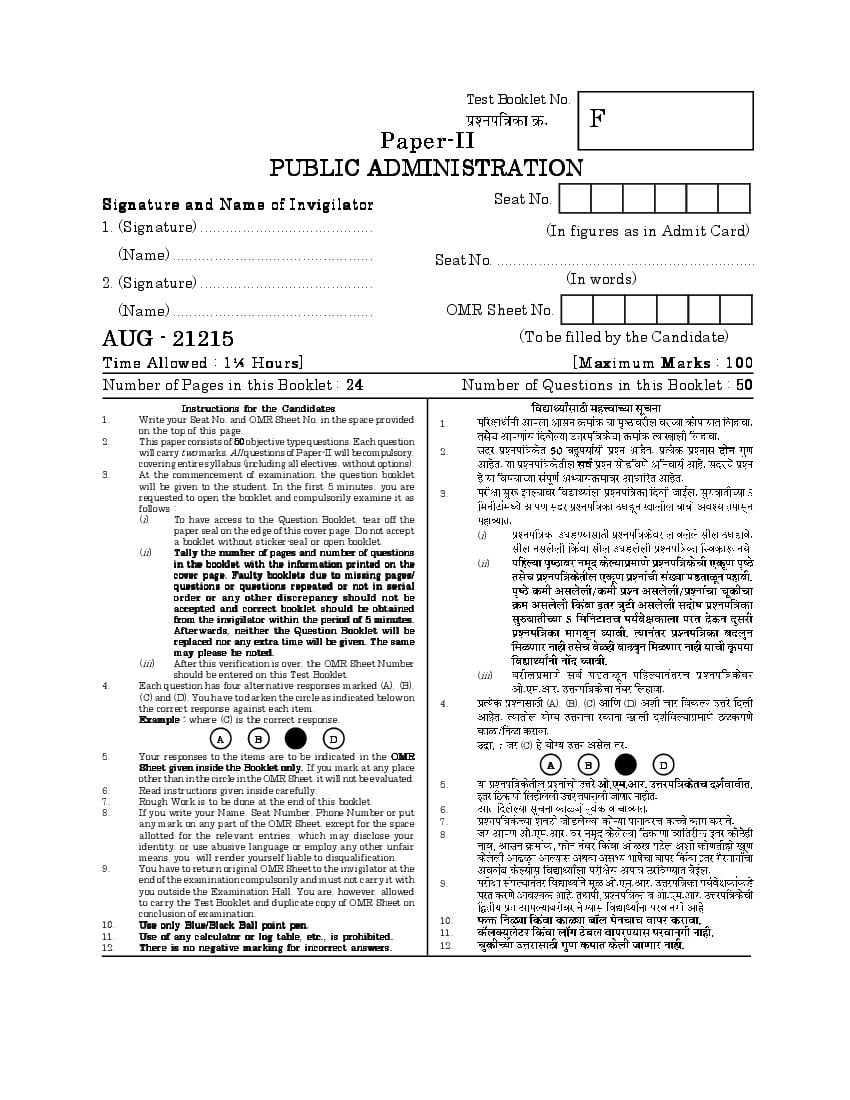
F
PUBLIC ADMINISTRATION
Signature and Name of Invigilator Seat No.
1. (Signature) ......................................... (In figures as in Admit Card)
(Name) ................................................ Seat No. ..............................................................
2. (Signature) ......................................... (In words)
(Name) ................................................ OMR Sheet No.
AUG - 21215 (To be filled by the Candidate)
Time Allowed : 1¼ Hours] [Maximum Marks : 100
Number of Pages in this Booklet : 24 Number of Questions in this Booklet : 50
Instructions for the Candidates
1. Write your Seat No. and OMR Sheet No. in the space provided 1.
on the top of this page.
2. This paper consists of 50 objective type questions. Each question
will carry two marks. All questions of Paper-II will be compulsory, 2.
covering entire syllabus (including all electives, without options).
3. At the commencement of examination, the question booklet
will be given to the student. In the first 5 minutes, you are
requested to open the booklet and compulsorily examine it as 3.
follows :
(i) To have access to the Question Booklet, tear off the
paper seal on the edge of this cover page. Do not accept (i)
a booklet without sticker-seal or open booklet.
(ii) Tally the number of pages and number of questions
in the booklet with the information printed on the (ii)
cover page. Faulty booklets due to missing pages/
questions or questions repeated or not in serial
o rder or any other discre pancy should not be
accepted and correct booklet should be obtained
from the invigilator within the period of 5 minutes.
Afterwards, neither the Question Booklet will be
replaced nor any extra time will be given. The same
may please be noted.
(iii) After this verification is over, the OMR Sheet Number
should be entered on this Test Booklet. (iii)
4. Each question has four alternative responses marked (A), (B),
(C) and (D). You have to darken the circle as indicated below on
the correct response against each item. 4. (A), (B), (C) (D)
Example : where (C) is the correct response.
A B D
(C)
5. Your responses to the items are to be indicated in the OMR
Sheet given inside the Booklet only. If you mark at any place A B D
other than in the circle in the OMR Sheet, it will not be evaluated.
5.
6. Read instructions given inside carefully.
7. Rough Work is to be done at the end of this booklet.
8. If you write your Name, Seat Number, Phone Number or put 6.
any mark on any part of the OMR Sheet, except for the space 7.
allotted for the relevant entries, which may disclose your 8.
identity, or use abusive language or employ any other unfair
means, you will render yourself liable to disqualification.
9. You have to return original OMR Sheet to the invigilator at the
end of the examination compulsorily and must not carry it with 9.
you outside the Examination Hall. You are, however, allowed
to carry the Test Booklet and duplicate copy of OMR Sheet on
conclusion of examination.
10. Use only Blue/Black Ball point pen. 10.
11. Use of any calculator or log table, etc., is prohibited. 11.
12. There is no negative marking for incorrect answers. 12.
Page 2
Page 3
Paper II
II
Time Allowed : 75 Minutes] [Maximum Marks : 100
Note : This paper contains Fifty (50) multiple choice questions. Each question
carrying Two (2) marks. Attempt All questions.
(50) (2)
1. According to whom Administration 1.
can be defined as activities of groups
cooperating to accomplish common
goals’ ?
(A)
(A) E.A. Nigro
(B)
(B) H. Simon
(C) L.D. White (C)
(D) Waldo (D)
2. According to whom ‘‘Public 2.
Administration is policy execution
and policy formation, it is
bureaucracy and it is public’’ ?
(A)
(A) Paul Appleby
(B) Ferrel Heady (B)
(C) James Fesler (C)
(D) McGregor (D)
3 [P.T.O.
Page 4
similarity between public and
private administration ?
(A) Principle of marginal return (A)
(B) Principle of external financial
(B)
control
(C)
(C) Principle of profit
(D) Principle of uniformity (D)
4. Central theme of New Public 4.
Administration is :
(A)
(A) Decentralisation
(B)
(B) Productivity
(C)
(C) Humanism
(D) Cost-effectiveness (D)
5. ‘Public Administration includes the 5.
operations of only the executive
branch of Government.’ This view
is attributed to :
(A)
(A) F.W. Taylor
(B)
(B) L.D. White
(C) L.D. White and Luther Gulick (C)
(D) Luther Gulick (D)
4
Page 5
Administration is a science was
challenged by :
(A)
(A) Robert Dahl
(B)
(B) C.I. Barnard
(C)
(C) L. Urwick
(D) F.W. Willoughby (D)
7. In its approach ‘Arthshastra’ 7.
is :
(A) Idealistic (A)
(B) Philosophical (B)
(C) Prescriptive (C)
(D) Empirical (D)
5 [P.T.O.
Page 6
8.
of the following is not a function of
Leadership ?
(A) Manipulation of means
(A)
(B) Stimulation of coordinated
action (B)
(C) Defence of institutional
(C)
integrity
(D) Motivation (D)
9. The functions of staff agencies do not 9.
include :
(1) Coordination (1)
(2) Planning (2)
(3) Execution (3)
(4) Supervision (4)
(5) Housekeeping (5)
Choose the correct answer :
(A) (1), (2) and (5) (A) (1), (2) (5)
(B) (3) and (5) (B) (3) (5)
(C) (2), (3) and (5) (C) (2), (3) (5)
(D) (3) and (4) (D) (3) (4)
6
Page 7
10.
does not uphold :
(A) Cross-cultural administration (A)
(B) Theory building in
(B)
administration
(C) Adoption of normative (C)
approaches to administration
(D) Practical application of
knowledge to administration (D)
11. The word ‘Sala’ comes from : 11.
(A) English (A)
(B) Sanskrit (B)
(C) Spanish (C)
(D) German (D)
7 [P.T.O.
Page 8
correct answer from the codes given
below :
I II
List I List II
(a) (1)
(a) Written constitution (1) Britain
(b) (2)
(b) Unitary constitution (2) USA
(c) (3)
(c) Unwritten constitution (3) India
(d ) (4)
(d) Federal constitution (4) France
Codes :
(a) (b) (c) (d)
(a) (b) (c) (d)
(A) (2) (1) (4) (3)
(A) (2) (1) (4) (3)
(B) (4) (1) (3) (2) (B) (4) (1) (3) (2)
(C) (3) (4) (1) (2) (C) (3) (4) (1) (2)
(D) (3) (1) (4) (2) (D) (3) (1) (4) (2)
13. Ecological approach originated from 13.
the application of :
(A) Systems theory (A)
(B) Behavioural theory (B)
(C) Elite theory (C)
(D) Motivational theory (D)
8
Page 9
Government in the USA is :
(A) The Mayor Council Plan
(A)
(B) The Commission Plan
(B)
(C) The City Manager Plan
(C)
(D) The Mayor Administration
Plan (D)
15. The characteristic of administration 15.
of UK is :
(A) Dominance of specialists (A)
(B) Merit-based recruitment (B)
(C) Pre-entry training (C)
(D) Administrative law (D)
16. Bureaucracy in development 16.
administration needs to be :
(A) Conservative (A)
(B) Responsive (B)
(C) Generalist (C)
(D) Rigid (D)
9 [P.T.O.
Page 10
(A) Mobility (A)
(B) Commercialization (B)
(C) Specific functions (C)
(D) Opinion formation (D)
18. Development administration in 18.
India is closely interwoven with :
(A) Revenue administration (A)
(B) Police Administration (B)
(C) Panchayati Raj (C)
(D) Bureaucracy (D)
19. Development as modernization 19.
approach was adopted by :
(A) D. Apter (A)
(B) Fred Riggs (B)
(C) G. Almond (C)
(D) S. Rudolph (D)
10
Page 11
developing countries are influenced
by :
(A)
(A) Politician
(B)
(B) Bureaucracy
(C) Social scientist (C)
(D) People (D)
21. In developing countries ............
21.
influences decision content.
(A) Departmental committees
(A)
(B) Legislative committees
(B)
(C) Interest groups
(C)
(D) Commercial Lobbies
(D)
11 [P.T.O.
Page 12
transfer of Government of India from
the control of company to the crown,
was passed ?
(A) 1842
(A) 1842
(B) 1858
(B) 1858
(C) 1773 (C) 1773
(D) 1784 (D) 1784
23. Government of India Act 1919 was 23. 1919
the first step towards setting up
of :
(A)
(A) Central Rule in India
(B)
(B) Public Service Commission
(C) Planning Commission (C)
(D) Local-self Government
(D)
12
Page 13
involved is of estimated budget :
(A) 1/3 (A) 1/3
(B) 1/4 (B) 1/4
(C) 1/6 (C) 1/6
(D) 1/10 (D) 1/10
25. India adopted Whitley Councils on 25.
the recommendation of :
(A) ARC-I (A) -I
(B) First Pay Commission (B)
(C) Second Pay Commission (C)
(D) Third Pay Commission (D)
26. It prevents illegal assumption of a 26.
public office :
(A) Injunction (A)
(B) Quo warranto (B)
(C) Mandamus (C)
(D) Prohibition (D)
13 [P.T.O.
Page 14
considered by :
(A) President (A)
(B) Finance Minister (B)
(C) Cabinet (C)
(D) Special Cabinet Committee (D)
28. Which state in India pioneered in 28.
introducing Lokayukta ?
(A) Rajasthan (A)
(B) Orissa (B)
(C) M.P. (C)
(D) Maharashtra (D)
29. Which of the following recommended 29.
complete fan on the strike of Civil
Servants ?
(A) -I
(A) ARC-I
(B)
(B) Gorwala Report
(C)
(C) First Pay Commission
(D)
(D) Second Pay Commission
14
Page 15
qualification for election to
Panchayat Raj Institutions has been
made mandatory ?
(A)
(A) Kerala
(B)
(B) Rajasthan
(C) Madhya Pradesh (C)
(D) Bihar (D)
31. New pattern of Civil Service 31.
Examination benefited most :
(A) English medium candidates
(A)
(B) Hindi medium candidates
(B)
(C) Regional language candidates
(C)
(D) Northern language
candidates (D)
15 [P.T.O.
Page 16
influential in developing countries.
Reason (R) : Political struggle in
(R) :
developing countries is not secular.
Answer the question by using the
codes given below :
Codes :
(A) Both (A) and (R) are true and
(R) is the correct explanation of (A) (A) (R)
(A)
(R) (A)
(B) Both (A) and (R) are true but
(B) (A) (R)
(R) is not the correct
(R) (A)
explanation of (A)
(C) (A) is true but (R) is false (C) (A) (R)
(D) (A) is false but (R) is true (D) (A) (R)
33. In Parliament, the CAG’s report is 33.
looked into by :
(A) Committee of the Whole House (A)
(B) Public Accounts Committee (B)
(C) Estimate Committee (C)
(D) Committee on Assurances (D)
16
Page 17
will be :
(A) 42 (A) 42
(B) 43 (B) 43
(C) 44 (C) 44
(D) 45 (D) 45
35. The theoretical goal of social 35.
research is :
(A) Problem solution (A)
(B) Programme evaluation (B)
(C) Theory verification (C)
(D) Planning change (D)
36. Case studies are types of : 36.
(A) Survey study (A)
(B) Inter-relationship study (B)
(C) Casual-comparative studies (C)
(D) Developmental studies (D)
17 [P.T.O.
Page 18
sampling in marketing researches
is :
(A)
(A) Random system
(B)
(B) Stratified random system
(C)
(C) Quota sampling
(D) Proportionate random sampling (D)
38. Content analysis, as a qualitative 38.
technique, aims at :
(A) Objective information (A)
(B) Subjective information (B)
(C) Time frequency (C)
(D) Duration of event (D)
18
Page 19
the basis for sampling is known
as :
(A)
(A) Sample
(B)
(B) Sampling frame
(C)
(C) Target population
(D) Sampling unit (D)
40. The Central Welfare Board was 40.
founded in which year ?
(A) 1950 (A) 1950
(B) 1953 (B) 1953
(C) 1956 (C) 1956
(D) 1959 (D) 1959
19 [P.T.O.
Page 20
mainly concern with :
(A) Education (A)
(B) Vocational training (B)
(C) Malnutrition (C)
(D) Scholarships (D)
42. Which of the following is not a 42.
Public Undertaking ?
(A) BHEL (A)
(B) SAIL (B)
(C) GAIL (C)
(D) TISCO (D)
43. The priority sector under Industrial 43. 1991
Policy 1991 was :
(A) Agriculture (A)
(B) Industry (B)
(C) Essential infrastructure (C)
(D) Export (D)
20
Page 21
44.
resulted in :
(A)
(A) More Government Control over
PSUs
(B) Creation of more ‘Navratna’ (B)
companies
(C)
(C) Merger of private companies in
public sector
(D)
(D) Expansion of Public Sector
45. In which country the consideration 45.
of expenditures and tax measures is
not coordinated ?
(A)
(A) USA
(B)
(B) UK
(C)
(C) India
(D)
(D) France
21 [P.T.O.
Page 22
Government is related to :
(A) Lord Mayo’s Resolution (A)
(B) Lord Ripon’s Resolution (B)
(C) Royal Commission (C)
(D) Diarchial Scheme (D)
47. The 64th Constitutional Amendment 47.
Bill in Lok Sabha in 1989 was in 1989 64
response to recommendation of :
(A) G.V.K. Rao Committee (A)
(B) Ashok Mehta Committee (B)
(C) L.M. Singhavi Committee (C)
(D) K. Santhanam Committee (D)
48. Reservation of women at Panchayat 48.
Level ensures mainly :
(A) Economic Welfare (A)
(B) Gender Equality (B)
(C) Participation in Public Life (C)
(D) Social empowerment (D)
22
Page 23
Mandal system ?
(A) Ashok Mehta Committee (A)
(B) Balwant Ray Mehta Committee (B)
(C) Singhavi Committee (C)
(D) ARC (D)
50. Match the following list and choose 50. I II
the correct answer from the codes
given below :
I II
List I List II
(Village (State)
(a) (1)
Functionaries )
(b) (2)
( a ) Lekhpal (1) Gujarat
(b) Talathi (2) Tamil Nadu (c ) (3)
(c) Karnam (3) Maharashtra (d ) (4)
( d) Patel (4) Uttar Pradesh
Codes :
(a) (b) (c) (d)
(a) (b) (c) (d)
(A) (4) (3) (2) (1)
(A) (4) (3) (2) (1)
(B) (3) (4) (2) (1) (B) (3) (4) (2) (1)
(C) (4) (3) (2) (1) (C) (4) (3) (2) (1)
(D) (2) (3) (4) (1) (D) (2) (3) (4) (1)
23 [P.T.O.
Page 24
24
Document Details
| Board / Org | Maharashtra Exams |
| Exam | MAHA SET |
| Type | Question Paper |
| Pages | 24 |
| Updated | 30 Apr 2026 |