MAHA SET 2018 Question Paper 2 Management
Finished viewing? Save it for later —
Download MAHA SET 2018 Question Paper 2 Management (PDF · 16 pages)About MAHA SET 2018 Question Paper 2 Management
MAHA SET 2018 Question Paper 2 Management is available here for free download. Published by Maharashtra Exams for Maharashtra State Eligibility Test, this question paper can be viewed online or downloaded as a PDF (16 pages). Candidates preparing for Maharashtra State Eligibility Test can use MAHA SET 2018 Question Paper 2 Management to understand the exam pattern, the type of questions asked, and the overall difficulty level.
Frequently Asked Questions
How can I download MAHA SET 2018 Question Paper 2 Management?
Open this page and click the Download button to save MAHA SET 2018 Question Paper 2 Management as a PDF. It is completely free on AglaSem Docs.
Is MAHA SET 2018 Question Paper 2 Management free to download?
Yes. MAHA SET 2018 Question Paper 2 Management can be viewed online and downloaded as a PDF free of cost on AglaSem Docs.
How many pages does MAHA SET 2018 Question Paper 2 Management have?
MAHA SET 2018 Question Paper 2 Management contains 16 pages, which you can read online or download together as a single PDF.
Where can I find more Maharashtra State Eligibility Test study material?
You can find more Maharashtra State Eligibility Test question papers, sample papers, syllabus, and answer keys on AglaSem Docs.
MAHA SET 2018 Question Paper 2 Management – Text
Read the full text of this question paper below — useful to quickly search, copy and reference the content online without downloading the PDF.
📄 View text version (16 pages)
Page 1
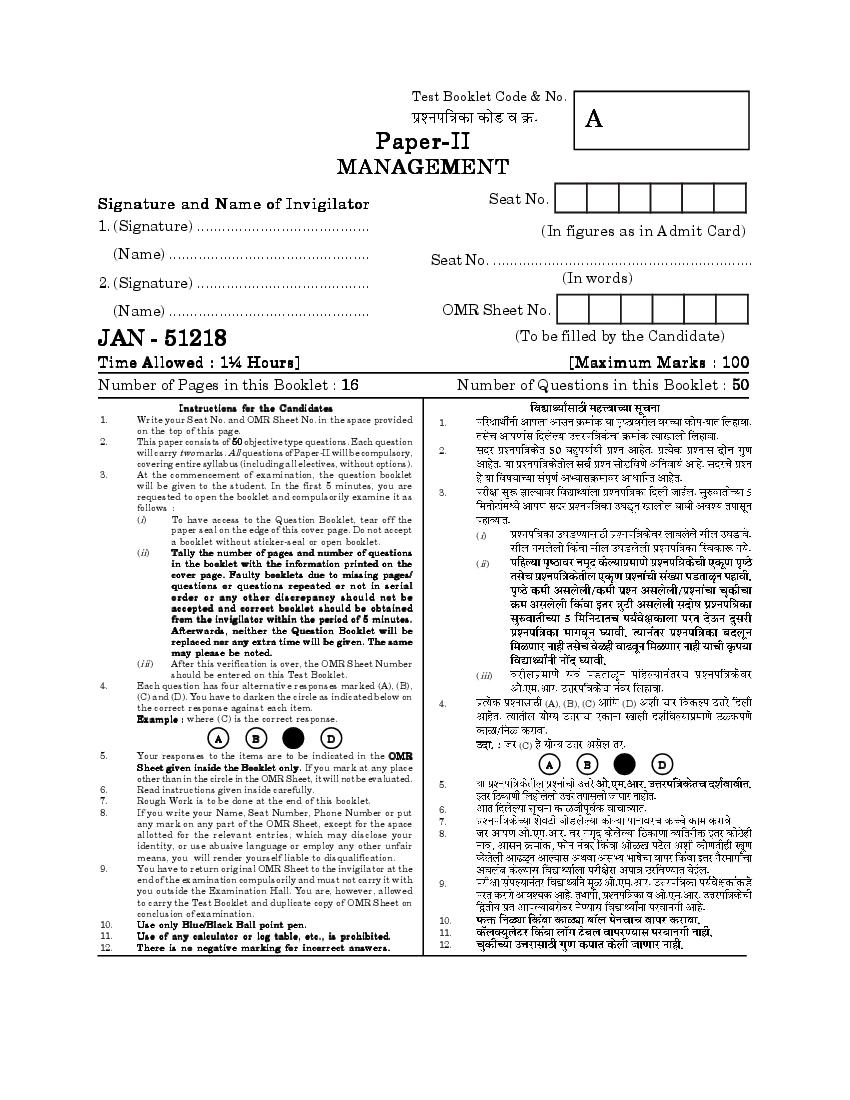
A
Paper-II
MANAGEMENT
Signature and Name of Invigilator Seat No.
1. (Signature) ......................................... (In figures as in Admit Card)
(Name) ................................................ Seat No. ..............................................................
2. (Signature) ......................................... (In words)
(Name) ................................................ OMR Sheet No.
JAN - 51218 (To be filled by the Candidate)
Time Allowed : 1¼ Hours] [Maximum Marks : 100
Number of Pages in this Booklet : 16 Number of Questions in this Booklet : 50
Instructions for the Candidates
1. Write your Seat No. and OMR Sheet No. in the space provided 1.
on the top of this page.
2. This paper consists of 50 objective type questions. Each question
will carry two marks. All questions of Paper-II will be compulsory, 2.
covering entire syllabus (including all electives, without options).
3. At the commencement of examination, the question booklet
will be given to the student. In the first 5 minutes, you are
requested to open the booklet and compulsorily examine it as 3.
follows :
(i) To have access to the Question Booklet, tear off the
paper seal on the edge of this cover page. Do not accept
(i)
a booklet without sticker-seal or open booklet.
(ii) Tally the number of pages and number of questions
in the booklet with the information printed on the (ii)
cover page. Faulty booklets due to missing pages/
questions or questions repeated or not in serial
o rder or any other discre pancy should not be
accepted and correct booklet should be obtained
from the invigilator within the period of 5 minutes.
Afterwards, neither the Question Booklet will be
replaced nor any extra time will be given. The same
may please be noted.
(iii) After this verification is over, the OMR Sheet Number
should be entered on this Test Booklet. (iii)
4. Each question has four alternative responses marked (A), (B),
(C) and (D). You have to darken the circle as indicated below on
the correct response against each item. 4. (A), (B), (C) (D)
Example : where (C) is the correct response.
A B D
(C)
5. Your responses to the items are to be indicated in the OMR
Sheet given inside the Booklet only. If you mark at any place A B D
other than in the circle in the OMR Sheet, it will not be evaluated.
5.
6. Read instructions given inside carefully.
7. Rough Work is to be done at the end of this booklet.
8. If you write your Name, Seat Number, Phone Number or put 6.
any mark on any part of the OMR Sheet, except for the space 7.
allotted for the relevant entries, which may disclose your 8.
identity, or use abusive language or employ any other unfair
means, you will render yourself liable to disqualification.
9. You have to return original OMR Sheet to the invigilator at the
end of the examination compulsorily and must not carry it with 9.
you outside the Examination Hall. You are, however, allowed
to carry the Test Booklet and duplicate copy of OMR Sheet on
conclusion of examination.
10. Use only Blue/Black Ball point pen. 10.
11. Use of any calculator or log table, etc., is prohibited. 11.
12. There is no negative marking for incorrect answers. 12.
Page 2
Page 3
Paper II
Time Allowed : 75 Minutes] [Maximum Marks : 100
Note : This Paper contains Fifty (50) multiple choice questions. Each question
carries Two (2) marks. Attempt All questions.
1. When the total product (TP) is at 3. As per theory of production, by
its highest level, the corresponding increasing the quantity of labor by
marginal product (MP) is : one unit, the firm can give up 2 units
(A) Highest of capital and still continues to
(B) Falling produce the same level of output, the
(C) Negative marginal rate of technical
(D) Zero substitution (MRTS) is :
2. As per the neoclassical production (A) 4
theory, the economically meaningful
(B) 1
region of production is marked by
which feature of the following ? (C) 2
(A) Total product rising, marginal (D) 1/2
product falling but is above
4. The marginal fixed cost of production
zero.
is always :
(B) Total product and marginal
product both rising. (A) Zero
(C) Total product and marginal (B) Rising
product are at the highest level.
(C) Falling
(D) Average product and marginal
(D) Initially rising and then falling.
product, both are rising.
3 [P.T.O.
Page 4
described by A. H. Maslow in correct
U-shaped, except :
sequence :
(A) MC curve
(1) Self-actualization need
(B) AC curve
(2) Social belongingness need
(C) AFC curve
(3) Physiological need
(D) AVC curve
(4) Esteem need
6. The way in which people come to
(5) Security need
understand the cause of other and
their own behaviour, is described by
the process : (A) 1, 2, 3, 4, 5
(A) Consensus process (B) 5, 4, 2, 3, 1
(B) Attribution process (C) 3, 5, 2, 4, 1
(C) Consistency process (D) 5, 4, 3, 1, 2
(D) Expectancy process 9. Which of the following is the correct
7. The ability that involves viewing the match ?
organization as a whole and (A) Need Hierachy theory—D.C. Mc
applying planning and thinking Clelland
ability is :
(B) Two-factor Theory—A. H.
(A) Technical skill Maslow
(B) Interpersonal skill (C) E.R.G. Theory—Alderfer
(C) Communication skill (D) Need Achievement Theory—
(D) Conceptual skill Herzberg
4
Page 5
10. It is believed that the labour groups
influenced either by behaviour
are becoming more demanding and
exhibited by the ratee during the
aware of their rights. Therefore their
early stages of the review period or
demands can not be ignored. Timely
by outcomes or behour exhibited by
and periodical acts of labour welfare
the ratee near the end of the review
can appease the workers is belief of
period is known as :
the following theory :
(A) Rater Effect
(A) The Public Relation Theory
(B) Primacy and Recency Effect
(B) The Philanthropic Theory
(C) Halo Effect
(C) The Trusteeship Theory
(D) Status Effect
(D) Placating Theory
13. If employee is paid on the basis of
11. The practice of replacing narrowly
number of jobs he or she is capable
defined job descriptions with broader
of doing or on the depth of his or
categories of related jobs is known
her knowledge then it is :
as :
(A) Determining Grade
(A) Job Replacement
(B) Pay Review System
(B) Job Redesigning
(C) Skill-based pay system
(C) Job Execution
(D) Job-based pay system
(D) Job Banding
5 [P.T.O.
Page 6
choosing the individual who is best zero the project should be accepted.
suited to a particular position and
(A) Internal rate of return
to the organization from a group of
potential applicants :
(B) Profitability index
(A) Recruitment
(C) Net present value
(B) Staffing
(D) Modified internal rate of return
(C) Enrollment
17. Which of the following would not
(D) Selection
improve the current ratio ?
15. Which of the following is the
(A) Borrow short-term to finance
judgmental error in the process of
additional fixed assets
perpetual interpretation ?
(B) Issue long-term debt to buy
(A) Stereotyping error
inventory
(B) Halo effect (C) Sell common stock to reduce
current liabilities
(C) Similarity error
(D) Sell fixed assets to reduce
(D) Perpetual defence accounts payable
6
Page 7
number of equity shares outstanding
value of shares and therefore equity
to get book value per share.
capital is not free of cost.
(A) Net Profit
(B) Gross Profit (A) Face value
(C) Net Worth
(B) Dividends
(D) Net Income
(C) Redemption value
19. Sales – Variable Costs – EBIT =
.................................
(D) Book value
(A) EBT
22. A company's costs take two
(B) Financial leverage
(C) Fixed cost forms. .................. are costs that do not
(D) Operating leverage vary with production or sales
20. revenue.
Average Annual profits after taxes
?= Average Investment
×100
(A) Fixed
(A) Payback period
(B) Variable
(B) Profitability Index
(C) Average rate of return (C) Adjusted
(D) Internal rate of return (D) Attributed
7 [P.T.O.
Page 8
infrequently, which are used
of building a brand ?
repeatably and which involve a
(A) Plan and implement brand reasonably high level of consumer
risk :
marketing programs
(A) Impulse goods
(B) Manage the brand through its (B) Luxury goods
(C) Non-durable goods
life cycle
(D) Durable goods
(C) Calculate existing brand equity 26. While solving a transportation
problem by applying Vogel's
(D) Identify and establish brand approximation method to a profit
maximisation problem, row and
values and positioning strategy
column penalties are determined
24. Unlike physical goods, services are by :
(A) Finding the smallest unit cost
produced and ..........................
in each row or column
simultaneously. (B) Finding the difference between
the two highest unit costs in
(A) launched each row and column
(C) Finding the difference between
(B) consumed
the two lowest unit costs in each
(C) created row and column.
(D) Finding the largest unit cost in
(D) maximized
each row or column.
8
Page 9
variables is ................... reliable than
causes ........................ samples.
by attributes.
(A) between
(A) Less
(B) within
(B) Less than
(C) among
(C) More
(D) inside
(D) More than
28. If better is the quality of the product
30. The ....................... is a plan for the
........................ is the sample size production of individual end
required. items.
(A) Larger (A) JIT
(B) MRP II
(B) Smaller
(C) MRP
(C) Medium
(D) MPS
(D) Minute
9 [P.T.O.
Page 10
(A) cannot be used in nominal
(A) is between –1 to 1
distribution
(B) is always greater than 1
(B) is non-directional
(C) is directional
(C) is between –2 to 2
(D) is based on normal distribution
(D) is between 0 and 1
only
32. The person who ensures that 34. ...................... is a subset of data
systems are developed on time,
warehouse.
within budget and with acceptable
quality is a : (A) OLAP
(A) Minister of Finance
(B) Data Mart
(B) Project Manager
(C) Intelligent Agent
(C) System Builder
(D) Data Entry Operator (D) Relational Database
10
Page 11
not have a consistent strategy, but
statement ?
they are interested in guerilla
(A) Type II error is also known as
warfare.
error
(A) Defenders
(B) Type II error depends upon side
(B) Prospectors
of population.
(C) Analysers
(C) Type II error occurs when one
(D) Reactors
rejects a true hypothesis
38. In BCG matrix, problem children
(D) Type II errors do not exists are the products having ...................
36. ..................... is the difference between growth rate and .................... relative
market share.
the prospective customer's
evaluation of all the benefits and all (A) Low growth, relative high
market share
the costs of an offering and perceived
alternatives (B) Low growth, relative low market
share
(A) Perceived usefulness
(C) High growth, relative low
(B) Failure avoidance rate
market share
(C) Report rating (D) High growth, relative high
(D) Customer perceived value market share
11 [P.T.O.
Page 12
entrepreneurial mode of strategic that has been over used is a
decision-making involves decisions .........................
made by :
(A) Strategic decision
(A) Single person
(B) Programmed decision
(B) Group of persons
(C) Organizational decision
(C) Board of directors
(D) Departmental decision
(D) Production executives
42. Which of the following is described
40. The policies evolved by an as a person's right to live in a
organization for growth and healthy environment, regardless of
management is termed as race, nationality, income gender or
.......................... age ?
(A) Business strategy (A) Environmental Fairness
(B) Functional strategy (B) Environmental Leadership
(C) Corporate strategy (C) Environmental Equality
(D) Innovative strategy (D) Meaningful Involvement
12
Page 13
'Stakeholder' means which of the
community in which we operate."
following ?
This is :
(A) All those parties which the
company does business with
(A) Ethical Code
(B) All those interested in working
(B) Legal Rule
for the company
(C) Legal Act (C) All those who have an interest
in the company
(D) Political and Social Code
(D) Board of Directors of the
44. Socially responsible behaviour : company
46. Amit works for a company that
(A) never leads to improved
considers its mandate to reduce
financial performance worldwide illiteracy. Profits are
distributed between shareholders
(B) has adverse impact on
and literacy programs. This
stakeholders business is a .........................
(A) Non-profit Enterprise
(C) is in a firm's self-interest
(B) Social Venture
(D) results in ill-will from the
(C) Social Enterprise
community
(D) Social Entrepreneur
13 [P.T.O.
Page 14
results are the four levels in
(A) Expected value of a bad decision evaluating the management
(B) Expected loss from a bad program. This system of evaluation
is called :
decision
(A) Taylor system
(C) Difference between actual pay-
off and optimal pay-off (B) Kirkpatrick's model
(D) Regret from not having made (C) Werther & Devis Method
(D) Armstrong's method
a decision
50. The Small Industries Development
48. Psychological approach of
Bank of India (SIDBI) was
entrepreneurship deals with : established in ......................... as a
wholly owned subsidiary of
(A) Profit motive
.....................
(B) Performance motive (A) 1969, RBI
(B) 1990, RBI
(C) Achievement motive
(C) 1990, IDBI
(D) Status motive
(D) 1969, IDBI
14
Page 15
15 [P.T.O.
Page 16
16
Document Details
| Board / Org | Maharashtra Exams |
| Exam | Maharashtra State Eligibility Test |
| Type | Question Paper |
| Pages | 16 |
| Updated | 30 Apr 2026 |