MAHA SET 2015 Question Paper 2 Environmental Sciences
Finished viewing? Save it for later —
Download MAHA SET 2015 Question Paper 2 Environmental Sciences (PDF · 16 pages)About MAHA SET 2015 Question Paper 2 Environmental Sciences
MAHA SET 2015 Question Paper 2 Environmental Sciences is available here for free download. Published by Maharashtra Exams for Maharashtra State Eligibility Test, this question paper can be viewed online or downloaded as a PDF (16 pages). Candidates preparing for Maharashtra State Eligibility Test can use MAHA SET 2015 Question Paper 2 Environmental Sciences to understand the exam pattern, the type of questions asked, and the overall difficulty level.
Frequently Asked Questions
How can I download MAHA SET 2015 Question Paper 2 Environmental Sciences?
Open this page and click the Download button to save MAHA SET 2015 Question Paper 2 Environmental Sciences as a PDF. It is completely free on AglaSem Docs.
Is MAHA SET 2015 Question Paper 2 Environmental Sciences free to download?
Yes. MAHA SET 2015 Question Paper 2 Environmental Sciences can be viewed online and downloaded as a PDF free of cost on AglaSem Docs.
How many pages does MAHA SET 2015 Question Paper 2 Environmental Sciences have?
MAHA SET 2015 Question Paper 2 Environmental Sciences contains 16 pages, which you can read online or download together as a single PDF.
Where can I find more Maharashtra State Eligibility Test study material?
You can find more Maharashtra State Eligibility Test question papers, sample papers, syllabus, and answer keys on AglaSem Docs.
MAHA SET 2015 Question Paper 2 Environmental Sciences – Text
Read the full text of this question paper below — useful to quickly search, copy and reference the content online without downloading the PDF.
📄 View text version (16 pages)
Page 1
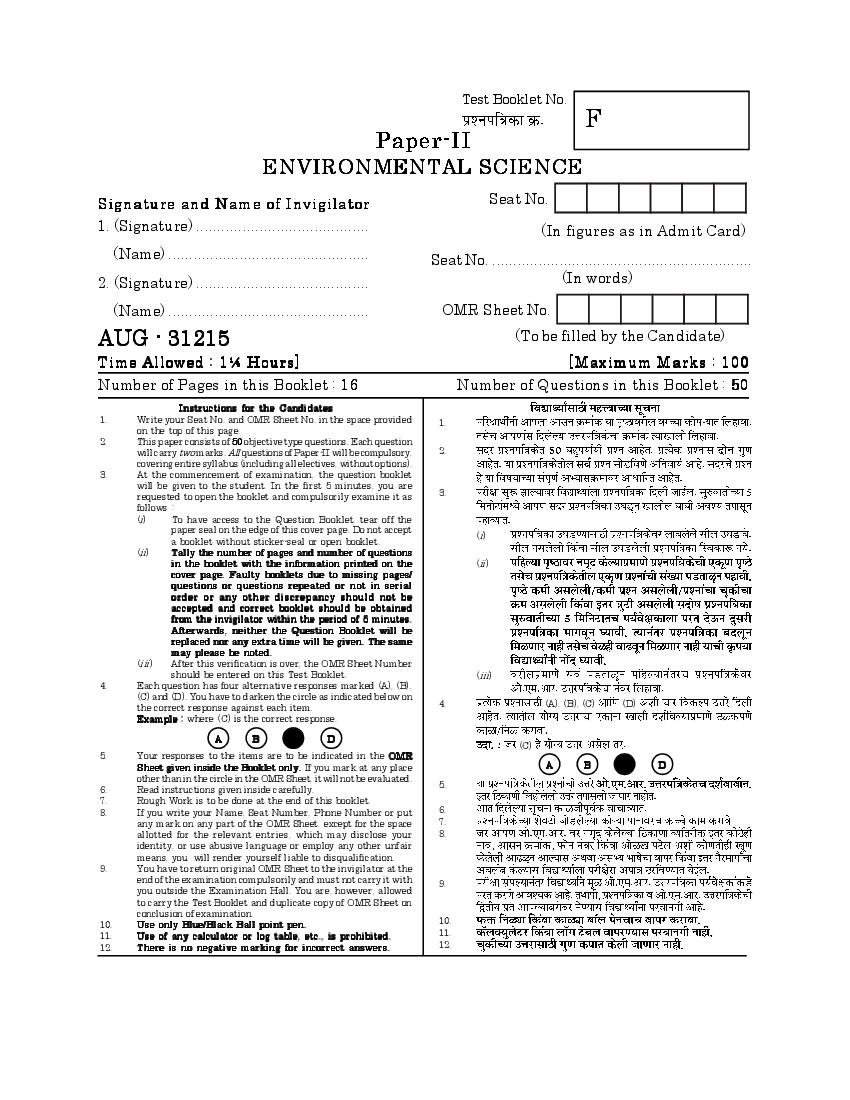
F
ENVIRONMENTAL SCIENCE
Signature and Name of Invigilator Seat No.
1. (Signature) ......................................... (In figures as in Admit Card)
(Name) ................................................ Seat No. ..............................................................
2. (Signature) ......................................... (In words)
(Name) ................................................ OMR Sheet No.
AUG - 31215 (To be filled by the Candidate)
Time Allowed : 1¼ Hours] [Maximum Marks : 100
Number of Pages in this Booklet : 16 Number of Questions in this Booklet : 50
Instructions for the Candidates
1. Write your Seat No. and OMR Sheet No. in the space provided 1.
on the top of this page.
2. This paper consists of 50 objective type questions. Each question
will carry two marks. All questions of Paper-II will be compulsory, 2.
covering entire syllabus (including all electives, without options).
3. At the commencement of examination, the question booklet
will be given to the student. In the first 5 minutes, you are
requested to open the booklet and compulsorily examine it as 3.
follows :
(i) To have access to the Question Booklet, tear off the
paper seal on the edge of this cover page. Do not accept
(i)
a booklet without sticker-seal or open booklet.
(ii) Tally the number of pages and number of questions
in the booklet with the information printed on the (ii)
cover page. Faulty booklets due to missing pages/
questions or questions repeated or not in serial
o rder or any other discre pancy should not be
accepted and correct booklet should be obtained
from the invigilator within the period of 5 minutes.
Afterwards, neither the Question Booklet will be
replaced nor any extra time will be given. The same
may please be noted.
(iii) After this verification is over, the OMR Sheet Number
should be entered on this Test Booklet. (iii)
4. Each question has four alternative responses marked (A), (B),
(C) and (D). You have to darken the circle as indicated below on
the correct response against each item. 4. (A), (B), (C) (D)
Example : where (C) is the correct response.
A B D
(C)
5. Your responses to the items are to be indicated in the OMR
Sheet given inside the Booklet only. If you mark at any place A B D
other than in the circle in the OMR Sheet, it will not be evaluated.
5.
6. Read instructions given inside carefully.
7. Rough Work is to be done at the end of this booklet.
8. If you write your Name, Seat Number, Phone Number or put 6.
any mark on any part of the OMR Sheet, except for the space 7.
allotted for the relevant entries, which may disclose your 8.
identity, or use abusive language or employ any other unfair
means, you will render yourself liable to disqualification.
9. You have to return original OMR Sheet to the invigilator at the
end of the examination compulsorily and must not carry it with 9.
you outside the Examination Hall. You are, however, allowed
to carry the Test Booklet and duplicate copy of OMR Sheet on
conclusion of examination.
10. Use only Blue/Black Ball point pen. 10.
11. Use of any calculator or log table, etc., is prohibited. 11.
12. There is no negative marking for incorrect answers. 12.
Page 2
Page 3
Paper II
Time Allowed : 75 Minutes] [Maximum Marks : 100
Note : This Paper contains Fifty (50) multiple choice questions. Each question
carries Two (2) marks. Attempt All questions.
3. Production of wealth and providing
1. The clouds and the weather systems
jobs for human society without
are mostly observed in which part degrading the environment is
of the atmosphere ? termed as :
(A) Sustainable economy
(A) Troposphere
(B) Green revolution
(B) Ionosphere (C) Environmental conservation
(D) Community
(C) Mesosphere
4. The mean annual temperature of
(D) Exosphere two stations at different elevation,
located at the same latitude, both
2. The flux of radiation from black body
away from the coast will be :
is directly proportional to :
(A) Higher for the station with
higher elevation
(A) T
(B) Lower for the station with
(B) T 4 lower elevation
(C) Same for the two stations
(C) T 2
(D) Lower for the station with
(D) 1/T higher elevation
3 [P.T.O.
Page 4
7. Which of the following is correct form
to 500 km above the earth surface
is characterised by : of Bragg’s equation ?
(A) Steady decreasing temperature n
(A) = 2d sin
with height from mesosphere
(B) Steady temperature increase (B) n = sin
with height from mesopause
(C) n – = 2d sin
(C) Constant temperature along
with increasing height from sin
(D) n =
2d
stratosphere
(D) Steady temperature increase 8. Which of the following is the correct
with height from stratosphere
equation for Gibbs’ energy ?
6. 25 mg of KCl is dissolved in
100 mL of water. What will be its (A) G = H – T S
concentration in PPM ?
(B) G = H + T S
(A) 0.25
(B) 2.5 H
(C) G = – S
T
(C) 25
S
(D) G = H –
(D) 250 T
4
Page 5
which of the following ? dead organic plant and animal
(A) Kidney matter are known as :
(B) Teeth (A) Detrivores
(C) Brain
(B) Autotrophs
(D) Heart
(C) Heterofeeders
10. Which of the following elements
(D) Chemotrophs
cannot be determined using
12. The Gaia hypothesis was proposed
Flame Atomic Absorption Spectro-
by :
photometer ?
(A) Swaminathan
(A) Iodine
(B) Maurice Strong
(B) Potassium
(C) Zinc (C) Brutland
(D) Copper (D) James Lovelock
5 [P.T.O.
Page 6
is observed in : (A) Functional attribute of
(A) Temperate grasslands organism
(B) Tropical rain forest (B) Morphological attribute of
(C) Coniferous forest organism
(D) Alpine forest (C) Biomass of organism
14. How the biological oxygen demand (D) Biochemical properties of
gets affected with the increased organism
presence of organic matter in 16. Geopressurized have huge potential
water ? reserves of :
(A) It increases (A) Petroleum
(B) It decreases (B) Oil shale
(C) It remains unchanged (C) Natural gas
(D) It first increases, then decreases (D) Kerosene
6
Page 7
(A) Valuation of mineral resources areas with winds exceeding at
least :
(B) Assessment of land for a
specific purpose (A) 15 kts
(C) Assessment of land market of (B) 20 kts
an area (C) 27 kts
(D) Evaluation of biodiversity (D) 33 kts
18. Onset of South West Monsoon over 20. Nearly .................... of the annual
the Indian subcontinent occurs rainfall over Indian subcontinent
generally during the month of : occurs during S.W. Monsoon.
(A) July (A) 50%
(B) May (B) 70%
(C) June (C) 80%
(D) April (D) 95%
7 [P.T.O.
Page 8
which of the following locations or
Biomass Energy conversion system.
regions :
(A) Pyrolytic (Thermal) gasifier
(A) Off-shore
(B) Heat extractor
(B) Lands
(C) Electrical cutter
(C) High altitude
(D) Kerosene stove (D) Deserts
22. Which of the following is an example 24. Solar energy in the infrared range
is about ...................% of the total
of perpetual source of energy ?
solar.
(A) Nuclear energy
(A) 50
(B) Fossil fuel
(B) 46
(C) Biomass energy
(C) 60
(D) Wind energy (D) 40
8
Page 9
8 hours means 100% noise dose, a
................... of the Sun.
person being subjected to a noise of
(A) Outer layer
96 dB for 4 hours is having an
(B) Middle part exposure to noise dose of :
(C) Central region (A) 50%
(B) 100%
(D) Outer Edge
(C) 200%
26. Which one of the following is a
(D) 150%
primary as well as secondary
28. The soil erosion that occurs due to
pollutant ?
overgrazing by cattle is :
(A) NO
(A) Gully erosion
(B) CH4
(B) Rill erosion
(C) CO 2
(C) Sheet erosion
(D) H2S (D) Soil mulching
9 [P.T.O.
Page 10
29. To maintain constant inflow of
proponents are required to furnish
effluent for treatment of wastewater
NOC from ............................. for
there is a unit known as : environmental appraisal.
(A) Central Pollution Control
(A) Sedimentation tank
Board
(B) Preclarifier
(B) Ministry of Environment and
Forest
(C) Equalization tank
(C) State Pollution Control Board
(D) Anaerobic digester
(D) State Government
30. Which of the following acids is 32. Which of the following is not an
objective of EIA ?
associated with soil ?
(A) Risk analysis and disaster
(A) Acetic acid
management
(B) Nitric acid (B) Recycling and reduction of
waste
(C) Hydrochloric acid
(C) Risk reduction
(D) Humic acid (D) Assessment of funds spent
10
Page 11
Karnataka State is related to : identification is based on the
(A) Protection of trees ................... of relationships in
(B) Protest against the use of Environmental systems.
plastics (A) Simple Web
(C) Movement for water conservation
(B) Food Chain
(D) Protection of rivers and streams
(C) Complex Web
34. Chairperson or the Vice-Chairperson
(D) Energy Web
of National Environment Tribunal
36. The name of the World Commission
shall be appointed after consultation
on Environment and Development
with :
is :
(A) Prime Minister
(A) Zakaria Commission
(B) Minister of Environment and
Forests (B) Brundtland Commission
(C) Chief Justice of India (C) Planning Commission
(D) Governor of State (D) Mitchel Resource Commission
11 [P.T.O.
Page 12
of State Advisory Board for the
without any treatment into any
wildlife is provided in :
water body may result into :
(A) The Biodiversity (Conservation)
(A) Destruction of toxicants
Act, 2006
(B) Spread of drug resistant
(B) The Forest (Conservation) Act,
microbes
1980
(C) Development of nitrogen (C) The Wildlife (Protection) Act,
fixtures 1972 (Amended in 91)
(D) Stabilization of phosphate (D) The Indian Forest Act, 1927
40. Infectious wastes among hospital
38. The three ‘R’ of waste management
wastes are normally collected in the
hierarchy are :
containers having .................... colour.
(A) Regain, Recycle and Resend
(A) Yellow
(B) Reuse, Reimburse and Regain
(B) Black
(C) Reduce, Reuse and Recycle
(C) White
(D) Reduce, Redox and Reoxidation (D) Blue
12
Page 13
sampling is :
hypothesis to be rejected, the value
(A) Random sampling
of t-statistic for degrees of freedom
(B) Stratified sampling
> 30 and 95% confidence limit should
(C) Cluster sampling
be approximately :
(D) Correlation
(A) > 2
42. The average length of stay in a
hospital is useful for planning. The (B) < 2
following is the distribution of the
(C) < 1
length of stay in a hospital :
Days Prob. (D) > 1
2 .05 44. According to Gaussian Plume model
3 .20 for a point source, the ground level
4 .40 concentration is :
5 .20
(A) Proportional to source strength
6 .15
(B) Inversely proportional to height
The average length of stay is :
of the stack
(A) 3.3
(C) Proportional to wind speed
(B) 4.0
(C) 4.2 (D) Inversely proportional to
(D) 4.7 mixing height
13 [P.T.O.
Page 14
equal to :
(A) Pyranometer
(A) arithmetic mean
(B) Thermocouple
(B) geometric mean
(C) 2(median) – mean (C) Photocell
(D) 3(median) – 2(mean) (D) Anemometer
46. Which of the following conventions
49. Conservation of Western Ghats is
is related to protection and
imperative from the viewpoint of :
conservation of Wetlands ?
(A) Vienna Convention (A) Historic importance
(B) Basel Convention (B) Rich biodiversity
(C) Ramsar Convention
(C) Tourism potential
(D) CITES
(D) Mineral deposits
47. Ethics is a :
50. Agenda 21 which is known as
(A) Developed tool to control
human activities blueprint for sustainable
(B) Adopted social legislation development was the outcome of :
for controlling human
(A) UN Conference on Human
environmental activities
Environment
(C) Term that guides one to moral
behaviour, which is basic to (B) UN Johannesburg Summit
distinguishing ‘right from
(C) UN Conference on Environment
wrong’
and Development
(D) Adopted social regulation for
controlling humans activities (D) UNDP-Report on Environment
14
Page 15
15 [P.T.O.
Page 16
16
Document Details
| Board / Org | Maharashtra Exams |
| Exam | Maharashtra State Eligibility Test |
| Type | Question Paper |
| Pages | 16 |
| Updated | 30 Apr 2026 |