Finished viewing? Save it for later —
Download CBSE Class 12 Question Paper 2024 Solution Sociology English (PDF · 11 pages)About CBSE Class 12 Question Paper 2024 Solution Sociology English
CBSE Class 12 Question Paper 2024 Solution Sociology English is available here for free download. Published by CBSE for Class 12, this solution can be viewed online or downloaded as a PDF (11 pages). Candidates preparing for Class 12 can use CBSE Class 12 Question Paper 2024 Solution Sociology English to understand the exam pattern, the type of questions asked, and the overall difficulty level.
Frequently Asked Questions
How can I download CBSE Class 12 Question Paper 2024 Solution Sociology English?
Open this page and click the Download button to save CBSE Class 12 Question Paper 2024 Solution Sociology English as a PDF. It is completely free on AglaSem Docs.
Is CBSE Class 12 Question Paper 2024 Solution Sociology English free to download?
Yes. CBSE Class 12 Question Paper 2024 Solution Sociology English can be viewed online and downloaded as a PDF free of cost on AglaSem Docs.
How many pages does CBSE Class 12 Question Paper 2024 Solution Sociology English have?
CBSE Class 12 Question Paper 2024 Solution Sociology English contains 11 pages, which you can read online or download together as a single PDF.
Where can I find more Class 12 study material?
You can find more Class 12 question papers, sample papers, syllabus, and answer keys on AglaSem Docs.
CBSE Class 12 Question Paper 2024 Solution Sociology English – Text
Read the full text of this solution below — useful to quickly search, copy and reference the content online without downloading the PDF.
📄 View text version (11 pages)
Page 1
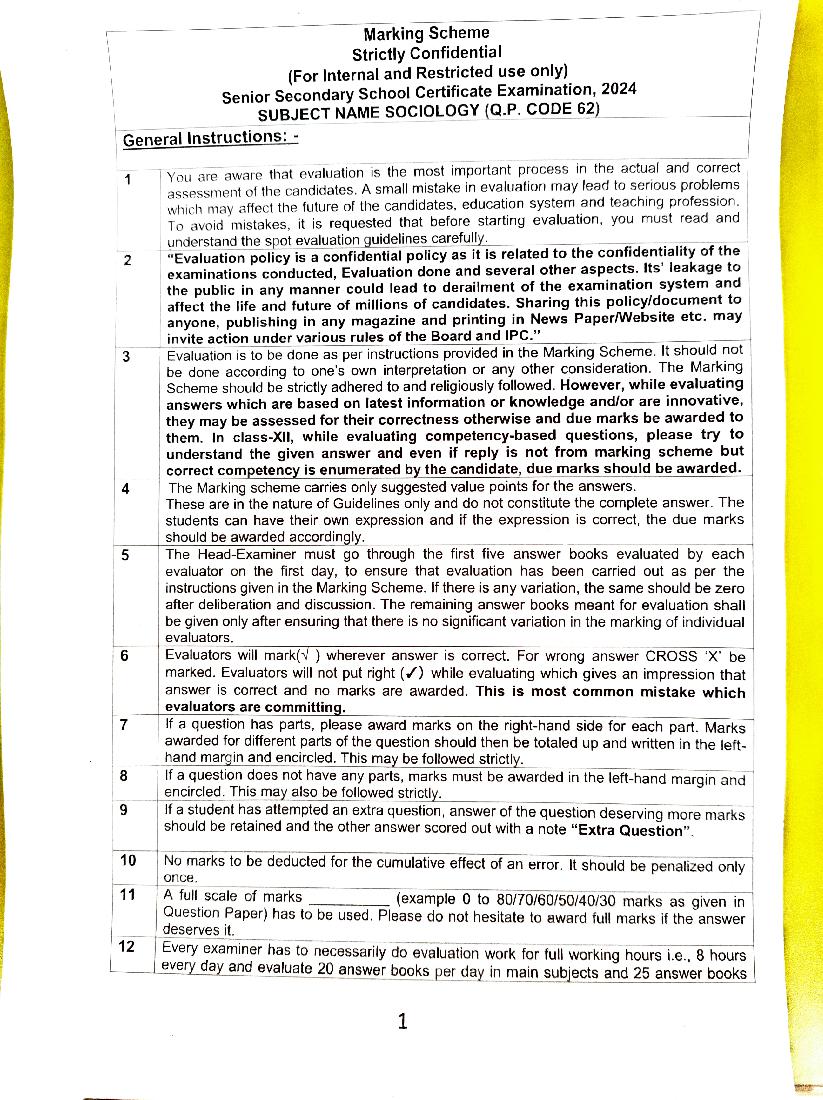
StrictlyConfidential
(For Internal and Restricted use only)
Senior Secondary School Certificate Examination, 2024
SUBJECT NAME SOCIOL0GY (Q.P. CODE 62)
General Instructions: -
actual and correct
1 You are aware that evaluation is the most important process in the
problems
assessment of the candidates. A small mistake in evaluation may lead to serious
profession.
which may affect the future of the candidates, education system and teaching
and
To avoid mistakes, it is requested that before starting evaluation, you must read
understand the spot evaluation guidelines carefully.
2
"Evaluation policy is a confidential policy as it is related to the confidentiality of the
examinations conducted, Evaluation done and several other aspects. Its' leakage to
and
the public in any manner could lead to derailment of the examination system
affect the life and future of millions of candidates. Sharing this policy/document to
anyone, publishing in any magazine and printing in News Paper/Website etc. may
invite action under various rules of the Board and IPC.'
3 Evaluation is to be done as per instructions provided in the Marking Scheme. It should not
be done according to one's own interpretation or any other consideration. The Marking
Scheme should be strictly adhered to and religiously followed. However, while evaluating
answers which are based on latest information or knowledge andlor are innovative,
they may be assessed for their correctness otherwise and due marks be awarded to
them. In class-XIl, while evaluating competency-based questions, please try to
understand the given answer and even if reply is not from marking scheme but
correct competency is enumerated by the candidate, due marks should be awarded.
4 The Marking scheme carries only suggested value points for the answers.
These are in the nature of Guidelines only and do not constitute the complete answer. The
students can have their own expression and if the expression is correct, the due marks
should be awarded accordingly.
5 The Head-Examiner must go through the first five answer books evaluated by each
evaluator on the first day, to ensure that evaluation has been carried out as per the
instructions given in the Marking Scheme. If there is any variation, the same should be zero
after deliberation and discussion. The remaining answer books meant for evaluation shall
be given only after ensuring that there is no significant variation in the marking of individual
evaluators.
6 Evaluators will mark(v ) wherever answer is correct. For wrong answer CROSS X' be
marked. Evaluators will not put right (/) while evaluating which gives an impression that
answer is correct and no marks are awarded. This is most common mistake which
evaluators are committing.
7 Ifa question has parts, please award marks on the right-hand side for each part. Marks
awarded for different parts of the question should then be totaled up and written in the left
hand margin and encircled. This may be followed strictly.
If a question does not have any parts, marks must be awarded in the left-hand margin and
encircled. This may also be followed strictly.
9 If a student has attempted an extra question, answer of the question deserving more marks
should be retained and the other answer scored out with a note Extra Question".
10 No marks to be deducted for the cumulative effect of an error. It should be penalized only
once.
11 A full scale of marks (example 0to 80/70/60/50/40/30 marks as given in
Question Paper) has to be used. Please do not hesitate to award full marks if the answer
deserves it.
12 Every examiner has to necessarily do evaluation work for full working hours i.e., 8 hours
every day and evaluate 20 answer books per day in main subjects and 25 answer books
1
Page 2
syllabus and number of questions in question paper.
13 Ensure that you do not make the following common types of errors committed by the
Examiner in the past: -
Leaving answer or part thereof unassessed in an answer book.
Giving more marks for an answer than assigned to it.
Wrong totaling of marks awarded on an answer.
Wrongtransfer of marks from the inside pages of the answer book to the title page.
Wrong question wise totalingon the title page.
Wrong totaling of marks of the two columns on the title page.
Wrong grand total.
Marks in words and figures not tallying/not same.
Wrong transfer of marks from the answer book to online award list.
Answers marked as correct, but marks not awarded. (Ensure that the right tick mark is
correctly and clearly indicated. It should merely be a line. Same is with the X for
incorrect answer.)
Half or a part of answer marked correct and the rest as wrong, but no marks awarded.
14 While evaluating the answer books if the answer is found to be totally incorrect, it should be
marked as cross (X)and awarded zero (0) Marks.
15 Any unassessed portion, non-carrying over of marks to the title page, or totaling error
detected by the candidate shall damage the prestige of all the personnel engaged in the
evaluationwork as also of the Board. Hence, in order to uphold the prestige of all concerned.
it is again reiteratedthat the instructions be followed meticulously and judiciously.
16 The Examiners should acquaint themselves with the guidelines given in the "Guidelines for
Spot Evaluation" before starting the actual evaluation.
17 Every Examiner shallalso ensure that allthe answers are evaluated, marks carried over to
the title page, correctly totaled andwritten in figures and words.
18 The candidates are entitled to obtain a photocopy of the Answer Book on request on
payment of the prescribed processing fee. All Examiners/Additional Head Examiners/Head
Examiners are once again reminded that they must ensure that evaluation is carried out
strictly as per value points for each answer as given in the Marking Scheme.
2
Page 3
MARKING SCHEME
SOCIOLOGY
SECTION A
1 A 1
1
3 1
1
1
6 D 1
7 1
1
B 1
10 1
11 D 1
12 1
13 A 1
14 A
15 C 1
16 1
SECTION B
17
(a) How is agriculture becoming more commercialised? 2
'Agriculturalextension' agents have been replaced in the villages
by agents of seed, fertiliser, and pesticide companies. These
agents are sole source of information for farmers about new
seeds or cultivation practices. These agents have an interest in
selling their products which indicates that agriculture is
becoming more commercialised.
(Any other relevant point)
OR
(b) A recently launched scheme is an effort of the Indian
Government in this direction. Name the scheme. What is the
positive outcome of these schemes?
Scheme - Deen Dayal Upadhyaya Gram JyotiYojana.
The overall outcome was not only to transform the rural
economy and agriculture, but also the agrarian structure and the
rural society itself.
3
Page 4
of India floated many schemes. Name two schemes. What is the
positive outcome of these schemes?
MUDRA
1. Atmanirbhar Bharat
1
Make in lndia
(any two)
Positive Outcomes:
-For creating economic potential amongst the demographic
dividend of India.
-These schemes are helpful to people of the marginalised
sections of the society like SC, ST, and OBCs.
(any one)
19 Differentiate between social change and social movement.
Social Change: 1
It is continuous and ongoing
1
Social Movement:
It is directed towards some specific goals.
20
Contract farming has sociological significance. Give two points to 1+1
support this statement.
-Disengages many people from the production process.
-It makes their own indigenous knowledge of agriculture
irrelevant.
-It caters primarily to the production of elite items like flowers,
fruits, etc.
-It is not ecologically sustainable
(Any two)
21
Mention the features of "The Mines Act, 1952". 1+1
-Specifies the maximum number of hours aperson can be made
towork in aweek.
-Need to pay overtime for any extra hours worked.
-Safety rules
(Any two)
4
Page 5
Sometimes societies can experience a 'negative growth rate'. 1
What is negative growth rate. Name two countries that have
experienced it
Negative growth rate implies that fertility level is below the 1
replacement level.
e.g. Japan, Russia,Italy and Eastern Europe
(Any two countries)
23
The development activity of the states andthe growth of private
industry affected caste indirectly. State any two ways in which 1+1
this is evident.
-Speeding up and intensification of economic change.
-It created all kinds of new jobs for which there were no caste
rules.
-Urbanisation and collective living in cities made it difficult for
the caste-segregated patterns of social interaction to survive.
-Modern educated Indians attracted to the liberal ideas of
individualism and meritocracy abandoned the more extreme
caste practices.
-Industrialisation leads to greater equality, at least in some
spheres. For example, caste distinctions do not matter anymore
on trains, buses or in cyber cafes.
-Even as social inequalities are reducing, economic or income
inequality is growing in the world. Often social inequality and
income inequality overlap, for example, in the domination of
upper caste men in well-paying professions like medicine, law or
journalism.
(Any two) (Any other relevant point)
24 (a) Write any two features of community identity.
-It is Ascriptive. 1+1
-It is based on birth and belonging rather than on some form of
acquired qualification or accomplishment.
-Deep sense of security and satisfaction.
-Universal
-Accidental and unconditional.
(Any two)
OR
5
Page 6
It is rooted in India's diversity of languages, cultures, tribes and
religions. Itisencouraged by the geographical concentration of
these identity markers in particular regions and fuelled by a
sense of regional deprivation.
25
Studies have shown how diverse family forms are found in
1+1
different societies. With regard to rules of residence, write two
forms of family.
Matrilocal - The newly married couple stays with the woman's
parents.
Patrilocal - The couple lives with the man's parents.
SECTION C
26
Based on the above passage, justify with four reasons why this
idea of tribes having remained untouched is untrue.
1+1+1+1
-Adivasis were not always the oppressed groups - there were
several Gond kingdoms in Central India such as that of Garha
Mandla or Chanda.
-Many of the so-called Rajput kingdoms of Central and Western
India actually emerged through a process of stratification among
adivasi communities themselves.
-Adivasis often exercised dominance over the plains people
through their capacity to raid them, and through their services as
local militias.
-They also occupied a special trade niche, trading forest produce,
salt and elephants.
-Morever, the capitalist economy's drive to exploit forest
resources and minerals and to recruit cheap labour has brought
tribal societies in contact with mainstream society a long time
ago.
(Any four)
27
(a) British colonialism is still a complex part of our lives.
How?
1+1+1+1
-We have a parliamentary and a legal system, apolice and
educational system built very much on the British model.
6
Page 7
We havebread-omlette' and 'cutlets' as menu offered in many
roadside eateries and canteens.
-A very popular manufacturer of biscuits is actually named after
Britain.
-Many school uniforms include neck- ties.
(Any four) (Any other relevant point)
OR
(b) With the help of four examples, show how the impact of
English language has been many sided and paradoxical in India.
-English is not only widely used in India, but we now have an
impressive body of literary writings by Indians in English.
1+1+1+1
-This knowledge of English has given Indians an edge in the
global market.
-English continues to be amark of privilege.
-Not knowing English is a disadvantage that tells in the job
market.
-Knowledge of English may open doors of opportunities that
were formerly closed for traditionally deprived communities like
Dalits.
(Any four)
28
Explain any two social reform movements that addressed the
women's question. 2+2
Raja Ram Mohan Roy in Bengal led the anti-Sati
campaign.
1. He established Brahmo Samaj in 1828.
2. He undertook campaign against Sati-the first women's
issue.
3. His ideas represented a mix of western rationality and
assertion of Indian traditionality.
Ranade :
1. Ranade's writings: The Texts of Hindu Law on the Lawfulness
of the Remarriage of Widows, and 'Vedic Authorities for Widow
Marriage', elaborated the shastric sanction for remarriage of
widows .
7
Page 8
Presidency.
Jyotiba Phule:
1. Founded the Satyashodhak Samaj, emphasis on 'truth
seeking'.
2. Attacked caste and gender discrimination.
Sir Syed Ahmed Khan:
1. He started reform movement in Islam.
2. He wanted girls to be educated within the
precincts of their home.
3. He sought a curriculum that included instructions
in religious principles, training in the arts of
housekeeping, handicrafts and rearing of children.
(Any two Reformers)
29
Mention some of the common features central to the public
perception of disability' all over the world. 1+1+1+1
1. Disability isunderstood asa biological given.
2. Whenever a disabled person is confronted with problems,
it is taken for granted that the problems originate from
his/her impairment.
3. The disabled person isseen as a victim.
4. It is supposed to be linked with the disabled individual's
self-perception.
5. The very idea of disability suggests that they are in need
of help.
(Any four)
SECTION C
30
Which sociologist coined the term 'Sanskritisation'? Differentiate
between Sanskritisation and de-Sanskritisation.
() M.N. Srinivas 1
(ii) Sanskritisation refers to a processwhereby members of an
usually middle or lower caste attempt to raise their own 3
social status by adopting the ritual, domestic and social
practices of a caste of higher status.
8
Page 9
castes were dominant, it was their influence that was
stronger. For example, in the third quarter of 19th century
the Persian influence was the dominant one.
31 Explain two land revenue administrative systems introduced by the
British in colonial India. 2+2
When the British colonised India, many areas were ruled by the local
zamindars. They granted property rights to the zamindars. Zamindars
were given more control over land than before. Result of zamindari
system was agricultural production stagnated or declined during much
of the period of British rule. This was because they extracted heavy
land revenue from cultivators.
Raiyatwari system of land settlement, raiyat means cultivator in
Telugu. In this system, the 'actual cultivators' (who were themselves
often landlords and not cultivators) rather than zamindars were
responsible for paying the tax. Burden of taxation was less and
cultivators had more incentive to invest in agriculture.
(any other relevant system like Mahalwari)
32
Despite the increasing size of the services sector, India still is
largely an agricultural country. Give reasons. 1+1+1+1
1. Very few people in India have access to secure jobs.
2. Even the small number in regular salaried employment
become insecure due to the rise in contract labour.
3. Government employment is coming down.
4. The majority of India's people live in rural areas (69 per cent,
according to the 2011 Census).
5. They make their living from agriculture or related occupations.
6. This means that agricultural land is the most important productive
resource for a great many Indians.
7. Land is not just a 'means of production' nor just a 'form of
property'.
8. Agriculture is not just a form of livelihood. It is also a way of life.
9. Many of our cultural practices and patterns can be traced to our
agrarian backgrounds.
(Any 4)
SECTION D
33 (a) What is meant by demographic dividend? 2
Demographic Dividend -It implies an increase in the
proportion of workers relative to non-workers in the 2
population.
(b) Based on the data given in the above table, compare the data of
the years 1961 and 2026 and state your inferences. 2
9
Page 10
as compared witlh 1961.
The ratio of workingpopulation (15-60) is projected to increase
from 1961 to 2026.
(c) A falling dependency ratio can be a source of economicgrowth
and prosperity. State how.
Alarger proportion of working people relative to non-workers,
leads to economic growth and prosperity.
(For candidates with Visual Impairment answer same as Q33)
34 (a) Write any two examples of Dalit Movement.
1. Satnami Movement of the Chamars in the Chhattisgarh
plains in eastern Madhya Pradesh. 1+1
2. Adi Dharma Movement in Punjab
3. Mahar Movement in Maharashtra
4. The socio-political mobilisation amongthe Jatavs of Agra.
5. The Anti-Brahmin Movement in South India.
(Any two examples)
(b) Discuss the various issues highlighted by the Dalit
1+1+1+1
Movements.
-Economic exploitation
-Political oppression
-Struggle for recognition as fellow human beings.
- Struggle for self-confidence
-Space for self-determination
-Struggle for abolishment of stigmatization
-Struggle to be touched.
(Any four)
35 1*6
Anation is apeculiar sort of community that is easy to describe
but hard to define. Why?
10
Page 11
cultural,historical and political institution.
(b) It is hard to come up with any defining features that a nation
must pOSseSs.
(c)For every possible criterion there are exceptions and counter
examples.
(d) For example, there are many nations that do not share a
single common language, religion, ethnicity and so on.
(e) On the other hand, there are many languages, religions or
ethnicities thatare shared across nations.
() But this does not lead to the formation of a single unified nation of
say all English speakers or of all Buddhists
(Any other relevant example)
11
Document Details
| Board / Org | CBSE |
| Exam | Class 12 |
| Type | Solution |
| Pages | 11 |
| Updated | 30 Apr 2026 |