MAHA SET 2018 Question Paper 2 Mathematical Science
Finished viewing? Save it for later —
Download MAHA SET 2018 Question Paper 2 Mathematical Science (PDF · 28 pages)About MAHA SET 2018 Question Paper 2 Mathematical Science
MAHA SET 2018 Question Paper 2 Mathematical Science is available here for free download. Published by Maharashtra Exams for Maharashtra State Eligibility Test, this question paper can be viewed online or downloaded as a PDF (28 pages). Candidates preparing for Maharashtra State Eligibility Test can use MAHA SET 2018 Question Paper 2 Mathematical Science to understand the exam pattern, the type of questions asked, and the overall difficulty level.
Frequently Asked Questions
How can I download MAHA SET 2018 Question Paper 2 Mathematical Science?
Open this page and click the Download button to save MAHA SET 2018 Question Paper 2 Mathematical Science as a PDF. It is completely free on AglaSem Docs.
Is MAHA SET 2018 Question Paper 2 Mathematical Science free to download?
Yes. MAHA SET 2018 Question Paper 2 Mathematical Science can be viewed online and downloaded as a PDF free of cost on AglaSem Docs.
How many pages does MAHA SET 2018 Question Paper 2 Mathematical Science have?
MAHA SET 2018 Question Paper 2 Mathematical Science contains 28 pages, which you can read online or download together as a single PDF.
Where can I find more Maharashtra State Eligibility Test study material?
You can find more Maharashtra State Eligibility Test question papers, sample papers, syllabus, and answer keys on AglaSem Docs.
MAHA SET 2018 Question Paper 2 Mathematical Science – Text
Read the full text of this question paper below — useful to quickly search, copy and reference the content online without downloading the PDF.
📄 View text version (28 pages)
Page 1
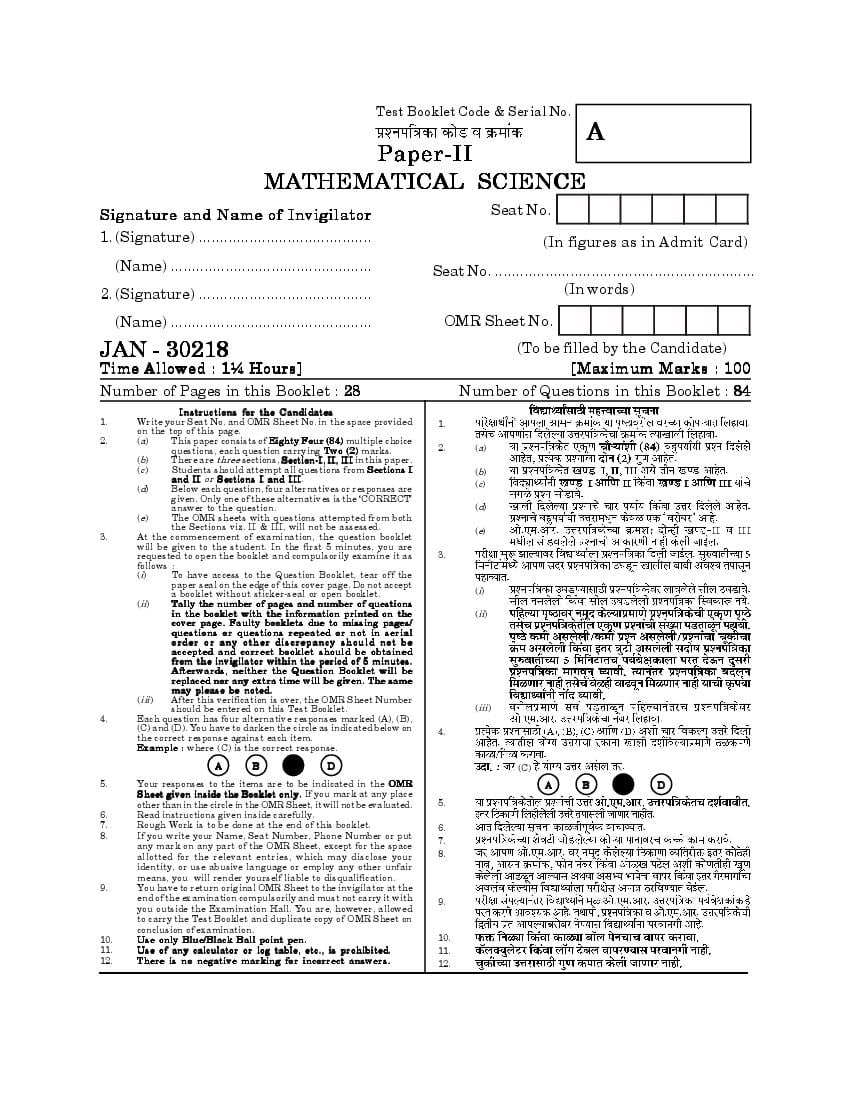
A
MATHEMATICAL SCIENCE
Signature and Name of Invigilator Seat No.
1. (Signature) ......................................... (In figures as in Admit Card)
(Name) ................................................ Seat No. ..............................................................
2. (Signature) ......................................... (In words)
(Name) ................................................ OMR Sheet No.
JAN - 30218 (To be filled by the Candidate)
Time Allowed : 1¼ Hours] [Maximum Marks : 100
Number of Pages in this Booklet : 28 Number of Questions in this Booklet : 84
Instructions for the Candidates
1. Write your Seat No. and OMR Sheet No. in the space provided 1.
on the top of this page.
2. (a) This paper consists of Eighty Four (84) multiple choice
questions, each question carrying Two (2) marks. 2. (a)
(b) There are three sections, Section-I, II, III in this paper.
(c) Students should attempt all questions from Sections I (b)
and II or Sections I and III.III (c) I II I III
(d) Below each question, four alternatives or responses are
given. Only one of these alternatives is the ‘CORRECT’
answer to the question. (d)
(e) The OMR sheets with questions attempted from both
the Sections viz. II & III, will not be assessed. (e) II III
3. At the commencement of examination, the question booklet
will be given to the student. In the first 5 minutes, you are
requested to open the booklet and compulsorily examine it as 3.
follows :
(i) To have access to the Question Booklet, tear off the
paper seal on the edge of this cover page. Do not accept
a booklet without sticker-seal or open booklet. (i)
(ii) Tally the number of pages and number of questions
in the booklet with the information printed on the (ii)
cover page. Faulty booklets due to missing pages/
questions or questions repeated or not in serial
o rder or any other discre pancy should not be
accepted and correct booklet should be obtained
from the invigilator within the period of 5 minutes.
Afterwards, neither the Question Booklet will be
replaced nor any extra time will be given. The same
may please be noted.
(iii) After this verification is over, the OMR Sheet Number
should be entered on this Test Booklet. (iii)
4. Each question has four alternative responses marked (A), (B),
(C) and (D). You have to darken the circle as indicated below on 4.
the correct response against each item.
Example : where (C) is the correct response.
A B D (C)
5. Your responses to the items are to be indicated in the OMR A B D
Sheet given inside the Booklet only. If you mark at any place
other than in the circle in the OMR Sheet, it will not be evaluated. 5.
6. Read instructions given inside carefully.
7. Rough Work is to be done at the end of this booklet. 6.
8. If you write your Name, Seat Number, Phone Number or put
7.
any mark on any part of the OMR Sheet, except for the space
allotted for the relevant entries, which may disclose your 8.
identity, or use abusive language or employ any other unfair
means, you will render yourself liable to disqualification.
9. You have to return original OMR Sheet to the invigilator at the
end of the examination compulsorily and must not carry it with 9.
you outside the Examination Hall. You are, however, allowed
to carry the Test Booklet and duplicate copy of OMR Sheet on
conclusion of examination.
10. Use only Blue/Black Ball point pen. 10.
11. Use of any calculator or log table, etc., is prohibited. 11.
12. There is no negative marking for incorrect answers. 12.
Page 2
Page 3
Paper II
Time Allowed : 75 Minutes] [Maximum Marks : 100
Note : Attempt all questions either from Sections I & II or from Sections
I & III only. The OMR sheets with questions attempted from both
the Sections viz. II & III, will not be assessed.
Section I : Q. Nos. 1 to 16, Section II : Q. Nos. 17 to 50,
Section III : Q. Nos. 51 to 84.
Section I 3. The modulus and argument of
6 1
1. The sequence a n = (–1) n + 1 i are :
n2
has : 1 5
(A) ,
2 4
(A) no limit point
1 3
(B) one limit point (B) ,
2 4
(C) two limit points
(C) 2,
(D) more than two limit points 4
2. The series : 1 7
(D) ,
2 4
x3 x5 x7
x ......., | x| 1 dz
3 5 7
4. is :
z2 1
represents the function :
(A) 2 i
(A) tan–1 x
(B) tan x (B) 0
(C) sin–1 x (C) 4 i
(D) log (1 + x) (D) i
3 [P.T.O.
Page 4
n × n real skew symmetric matrices,
1 1 1 then dim V =
1
A = 1 2
, (A) n2 – n
3
2 4
1 (B) n – 1
n(n 1)
(C)
2
where = e2 i/3, then A2 =
n(n 1)
(D)
2
(A) I
7. If
1 2 3
(B) A
A= 0 3 2 ,
0 6 4
1 0 0
(C) 0 0 1 then the rank of the matrix AAt
is :
0 1 0
(A) 1
0 1 0 (B) 2
(D) 1 0 0 (C) 3
0 0 1 (D) 0
4
Page 5
8. Matrix
F(x),
1 3 2 0 ; x 0
x
A= 0 4 2 ; 0 x 2
F x 4
3
0 3 1 ; 2 x 3
4
1 ; x 3
is similar to :
Which of the following statements
is correct ?
1 1 0
1 2
(A) P[X = 2] = , P[X = 3] =
0 1 0 3 3
(A)
1
0 0 2 (B) f(x) = ; 0 x < 3
3
1
(C) P[X = 2] = P[X = 3] =
1 0 0 2
(D) f(x) = 1; 0 < x < 1
0 1 0 10. Let X be a discrete r.v. with the
(B)
following pmf :
0 0 2
k; x 0, j; j 1, 2, ..... n
P[X = x] =
1 0 0 0 ; otherwise
Let Y = X2, then, P[Y = 4] is :
0 2 0
(C) 1
(A) 2n 1
0 0 2
2
(B) n
1
1 0 0
n
0 2 1 (C) 2n
1
(D)
2
0 0 2 (D) 2n 1
5 [P.T.O.
Page 6
12. Let X be a r.v. such that variance
with pdf f(x1, x2) given by :
1
of X is . Then, an upper bound for
f(x1, x2) = 2
P[|X – FX| > 1] as given by the
1
1 x1 x2 x12 x22 ; | x1 | 1 and | x2 | 1
4
0 ; otherwise
Chebychev’s inequality is :
Then, the characteristic function of
X1 is : 1
(A)
4
sin t
(A)
t
1
(B)
2
cos t
(B)
t
(C) 1
sin t
(C)
t2
3
t (D)
(D) 4
sin t
6
Page 7
14. The problem :
with mean 1 and variance 1. Define
the events :
Max. : Z = 3x1 + 2x2
A = {–2 < X < 1}, Subject to :
x1 – x2 1,
B = {–1 < X < 1},
x1 + x2 3
C = {0 < X < 2}.
x1, x2 0
Which of the following statements
has :
is correct ?
(A) Feasible solution
(A) P(C) < P(B) < P(A)
(B) Optimum solution
(B) P(A) = P(B) < P(C)
(C) Feasible but not optimum
(C) P(A) = P(B) = P(C) solution
(D) Unbounded solution
(D) P(B) < P(A) < P(C)
7 [P.T.O.
Page 8
S = x1 , x2 : 3 x12 2 x22 6 17. Let :
is a : f(x) = e–1/x if x > 0
= 0 if x 0,
(A) Concave
(A) f(x) is not continuous
(B) Not concave
(B) f(x) is continuous but not C1
(C) Convex
(C) f(x) is C1 but not C
(D) Not convex
(D) f(x) is C but not analytic
16. If the set of feasible solutions of the
system AX = B, X 0, is a convex z
18. The Taylor series for 2 around
z 1
polyhedron, then at least one of the
0 is :
extreme points gives a/an :
(A) z + z3 + z5 + .......
(A) Unbounded solution
z3 z5
(B) z – + – .......
3! 5!
(B) Bounded but not optimal
(C) z – z3 + z5 – .......
(C) Optimal solution
z3 z5
(D) Infeasible solution (D) z – + – .......
3 5
8
Page 9
is not true ?
1 1
0
2 2
(A) Every closed and bounded
0 1 0
subset of a matric space is
1 1
0 compact
2 2
(B) Every compact subset of a
represents :
metric space is closed and
(A) rotation by angle /4 around
bounded
x-axis
(B) rotation by angle /2 around (C) A closed subset of a compact set
y-axis is compact
(C) rotation by angle /4 around
(D) Cartesian product of compact
y-axis
sets is compact
(D) rotation by angle /8 around
z-axis 22. The function f(x) = |x|3, x R
20. Let V denote vector space of n × n is :
real matrices, having zero trace.
Then dim V = (A) continuous but not
(A) n – 1 differentiable
(B) n2 – 1 (B) differentiable but not c1
(C) n2 – n
(C) of class c2
n(n 1)
(D) (D) of class c3
2
9 [P.T.O.
Page 10
26. The function f(x) defined as :
(A) f ( x ) is continuous but not
uniformly continuous f(x) = 0, if x is irrational
(B) f(x) is uniformly continuous but = 1, if x is rational,
not Lipschitz
is :
(C) f(x) is Lipschitz and uniformly
continuous (A) Continuous on R
(D) f(x ) is neither Lipschitz nor
(B) Continuous at rational points
uniformly continuous
24. Total variation of the function : (C) Continuous at irrational points
x3 (D) Discontinuous at all points of R
f(x) = – x, x [2, 3]
3
27. sin (x + iy) is equal to :
is :
(A) 16/3 (A) sin x sin y + i cos x cos y
(B) 17/3
(B) sin x cosh y + i cos x sinh y
(C) 0
(D) 13/3 (C) sin x cos y + i cos x sin y
log x (D) sin x sinh y + i cos x cosh y
25. The maximum value of ,
x
x > 0 is : 28. Which of the following complex
(A) e numbers are collinear ?
1
(B) (A) 1 + 2i, 2 + 5i, 4 + 11i
e
1 (B) 1 – i, 2 + i, 1 + i
(C) e +
e
(C) i, –1 + 2i, 3 + 4i
1
(D) + e (D) 0, –3 + i, 7 + 8i
e
10
Page 11
f(z) is also bounded if and only if :
D, then f z dz 0 for each
C
(A) f(z) is a polynomial function piecewise differentiable closed curve
(B) f ( z ) is the reciprocal of a C in D if and only if :
polynomial function
(A) f is identically zero
(C) f(z) is a polynomial in sin z and
(B) f is a polynomial function on D
cos (z)
(C) f is a periodic function on D
(D) f(z) is a constant
(D) f is an analytic function on D
30. Which of the following complex
sin z
functions has a pole at z = 0 ? 32. The value of dz is :
z
|z| 1
3
(A) f(z) = e1/z (A) 2 i
1
(B) f(z) = sin (B) 0
z
1 z 2 z3 (C) 2
(C) f(z) = 4 7
z z
(D) f(z) = z3 + 7z + 1 (D) –2 i
11 [P.T.O.
Page 12
such that an = identity, then which
not have identity ?
of the following statements is
(A) The ring of homomorphisms of true ?
a vector space to itself (A) The order of G is finite
(B) The ring of automorphisms of (B) The order of the element a
is n
a vector space to itself
(C) Every subgroup of G of order
(C) The ring of n × n upper
n contains a
triangular matrices over R
(D) The order of a is finite and
(D) The ring of polynomials P0[R
R] divides n
vanishing at origin 36. Let G be a group of order n and
H = {a G|a = a–1}, then which
34. Let m be an even positive integer.
of the following is true ?
What is the product of all mth roots
(A) If the cardinality of H is odd
of unity in C ?
then n is odd
(A) 1 (B) The cardinality of H divides n
(B) –1 (C) If the cardinality of H is even
then n is odd
(C) i
(D) The cardinality of H is a power
(D) –i of two
12
Page 13
n elements, then which of the A is same as minimum polynomial
following values of n is possible : which reads as (x – 1)3 (x – 4), then
the Jordan canonical form of A
(A) n = 13
is :
(B) n = 9
1 1 0 0
(C) n = 10
0 1 0 0
(D) n = 15
(A)
38. Let F be a field with 128 elements, 0 0 1 0
then which of the following is
0 0 0 4
true ?
(A) F has a subfield with 8 1 1 0 0
elements
0 1 0 0
(B) F has no proper non-prime (B)
0 0 4 0
subfield
(C) Such a field F does not exist 0 0 0 4
(D) F has a subfield with 32 1 1 0 0
elements
0 1 1 0
39. Let T be a linear operator defined (C)
on vector space V. If there exists 0 0 1 0
v V such that v, Tv, ......., Tn – 1v
0 0 0 4
are linear independent vectors and
dim V = n, then : 1 1 0 0
(A) T is invertible
0 1 0 0
(B) T is nilpotent (D)
0 0 1 1
(C) T is diagonalizable
(D) for T 0 0 0 0 4
13 [P.T.O.
Page 14
on a vector space V; T : V | V. and :
If dim ker T > 0, then : 1 2 3
(A) 0 is an eigenvalue of T A= 4 5 6 ,
(B) T is invertible 7 8 9
(C) T is nilpotent then the rank of PA is :
(D) Im T = V (A) 1
42. If T(x1, x2) = (–x2, x1), then matrix (B) 2
representation of T in the ordered
(C) 3
basis {(1, 1)t; (1, –1)t} is :
(D) Depends upon matrix P
0 1
(A) 44. If A is a 2 × 2 real matrix with
1 0
trace zero and determinant 1, then
0 1
(B) the eigenvalues of A are :
1 0
(A) real and distinct
0 1
(C)
1 0 (B) real and repeated
1 0 (C) complex with non-zero real part
(D)
0 1 (D) purely imaginary
14
Page 15
45. The partial differential equation :
by eliminating the arbitrary
constants A and from :
x2uxx – 2xyuxy + y2uyy + xux + yuy = 0
y = Ae– t sin ( t + )
is :
is :
(A) is hyperbolic if x > 0, y > 0 d2 y dy
(A) 2 +( 2+ 2)y = 0
dt2 dt
(B) is hyperbolic on R2
d2 y dy
(B) 2t + ( 2 – 2)y = 0
dt2 dt
(C) is elliptic on R2
d2 y dy
(C) 2 t +( 2+ 2)y = 0
(D) is parabolic on R2 dt2 dt
d2 y dy
46. The Pfaffian differential equation : (D) 2 t + ( 2– 2)y = 0
dt2 dt
X · dr = P(x, y, z) dx + Q(x, y, z) dy 48. Let 1, 2 be linearly independent
solutions of the linear differential
+ R(x, y, z) dz = 0 equation :
y + a1y + a2y = 0,
is integrable if :
where a1, a2 are constants, then the
(A) X · X Wronskian W( 1, 2) is constant if
0
and only if :
(B) X · curl X 0 (A) a1 = 0
(B) a1 0
(C) X · curl X 0
(C) a2 = 0
(D) X · X 0 (D) a2 0
15 [P.T.O.
Page 16
51. The mean height of 10000 children
(x3 + xy4) dx + 2y3 dy = 0
of age 6 years is 41.26" and the
standard deviation is 2.24". Then the
will become exact on multiplication
odds against the possibility that the
by : mean of a random sample of 100 is
greater than 41.7" is :
2
(A) ex
(A) 1 : 39
(B) ex (B) 39 : 1
(C) 1 : 40
(C) e–x
(D) 40 : 1
2
(D) ex + x 52. Which of the following statements
i s correct about a regression model ?
50. The differential equation : (A) Residual sum of squares reduces
with every new term added in
Y(4) + sin xy = 0
the model.
(A) has exactly 4 linearly (B) Residual sum of squares reduces
with new term added in the
independent solutions model provided the response
variable is dependent on the
(B) has at most 4 linearly new term.
independent solutions (C) Residual sum of squares
increases with the new term
(C) has less than 4 linearly added in the model.
independent solutions (D) Residual sum of squares
increases with the new term
(D) has more than 4 linearly added in the model provided the
response variable is correlated
independent solutions with the new term.
16
Page 17
Let {An} be a sequence of events
independent random variables.
such that P(An) = 1 for each n 1.
Define the -field :
Then P An
n 1 F= Xn, Xn 1 , ........ .
n 1
(A) Zero
(B) One Suppose A fe. Then, which of the
(C) Infinity following statements is more
(D) Not defined appropriate ?
54. Let X be a zero-mean unit variance (A) P(A) = 0
Gaussian random variable. Define
(B) P(A) = 1
the random variable Y as :
(C) P(A) = P(AC)
X if |X|
Y=
(D) P(A) = 0 or P(A) = 1
X if |X|
56. If X is a positive random variable
is some positive real number.
What is the distribution of X + Y ? with probability density function f(x),
(A) Gaussian (0, 1) then X–1 has probability density
function :
(B) Gaussian (0, 2)
(C) Not Gaussian, but having (A) 1/f(x)
a distribution which is
(B) f(1/x)
discontinuous at origin
(C) 1/x2 f(1/x)
(D) Not Gaussian, but a continuous
distribution (D) 1/x f(1/x)
17 [P.T.O.
Page 18
m and n degrees of freedom) and Y
variables with distribution function
is F(n, m), given that P[X c] = a
F(x). Then, P(X1 X2) is :
1!
then P " Y is :
$ c #%
(A) 1/3
(A) a
(B) 2/3
(B) 1
(C) 1/2 a
(C)
2
(D) 3/2 (D) 1 – a
60. If X is distributed as Binomial
58. Let X be a r.v. with U(– , ). The
(n, p), 0 < p < 1, then :
distribution of Y = X2 is :
(A) –X is distributed B(–n, p)
(A) U(0, )
(B) n – X is distributed B(n, 1 – p)
(B) U(0, 2)
(C) X – k is distributed B(n – k, p),
y½
(C) f(y) = ; 0 < y < when k is constant
2
1 1
(D) f(y) = (2 ) y–½; 0 < y < 2 (D) is distributed as B n,
X p
18
Page 19
63. Let X1, X2, .......... Xn be a random
r.v.’s such that :
sample from Poisson distribution
e xx 1
f(x) = ; x > 0, > 0
with parameter ). Then covariance
e y y& 1
f(y) = ; y > 0, & > 0 between X and (X1 – X2) is :
&
X
The distribution of is : (A) 1/2
X+Y
(A) Beta ( , &)
(B) 1
(B) Gamma ( + &, 1)
(C) Beta ( ' ' &, ' ' &) (C) –1
(D) Gamma ( &, 1)
62. Let X1, X2, .......... Xn be iid r.v.’s (D) 0
from an exponential distribution
with mean . Then the distribution 64. Based on a random sample of size
n
n from N(*, 2), where * is known
of X1 given T = ( 1
Xi
and variance is unknown, sufficient
n 3
n 2 t x1
(A) ; 0 < x1 < t statistic for * is :
tn 2
n 1
(B)
n t x1
t n
; 0 < x1 < t (A) (X i
n 1 t x1
n 2 (B) ( X ,( X
2
i i
(C) ; 0 < x1 < t
tn 1
(C) X n
n 1
n· t x1
(D) n
, tn
; 0 < x1 < t (D) (X 2
i
19 [P.T.O.
Page 20
sample of size n from Poisson sample of size n from U(0, ). Define
distribution with mean ). The log T1 = X(n) and T2 = X n . Then :
likelihood function L()|x1, x2, ..... xn)
(A) T1 is UMVUE and T2 is not
is :
unbiased estimator for
(A) constant in )
(B) T2 is UMVUE for /2
(B) monotonic function of )
n 1 n 1
(C) concave function of ) (C)
n
T1 – 2T2 and
n
T1
(D) convex function of ) are correlated
66. Let X be a Bernoulli r.v. with n 1 n 1
(D) T1 – 2T2 and T1
parameter . Suppose we wish n n
to test H 0 : = 1/3 against are uncorrelated
H1 : = 2/3, based on random 68. Let X1, X2, .........., Xn be a random
sample of size 1. Then : sample observed from exponential
(A) there exists infinitely many distribution with location parameter
most powerful tests of size 0.05 . For testing H0 : = 0 against
H1 : > 0, the UMP test rejects
(B) there exists unique non-
H0, if :
randomized most powerful test
of size 0.05 (A) X > C
(B) X(1) > C
(C) there exists unique randomized
most powerful test of size 0.05 (C) X(n) > C
(D) the most powerful test rejects (D) + (Xi – X(1)) > C
H0, if X = 0 is observed where C is to be chosen suitably.
20
Page 21
between the variables X1 and X2 that number of customers visiting on
after eliminating the linear effect of week days followed a Binomial
X3, then which of the following are distribution. Which one of the
correct ? following techniques can be used to
(1) –1 r12.3 1 test the hypothesis at a given level
(2) 2 + 2 + 2 – 2r r r
r12 r13 r23 1 of significance ?
12 13 23
(3) 2
r12.3 = b12.3 b21.3, where b’s are (A) Test of significance of mean
partial regression coefficients (B) Test of significance of difference
(A) (1) and (2) only of means
(B) (1) and (3) only (C) Chi-square test as a test of
(C) (2) and (3) only goodness-of-fit
(D) (1), (2) and (3) (D) Correlation analysis
21 [P.T.O.
Page 22
with 2 = 4, in order to test the on two attributes A and B :
null hypothesis * = * 0 against A1 A2
B1 10 20
H1 : * = *1, where *1 > *0 based
B2 30 40
on a random sample of size n ,
What is the value of ,2 for testing
the value of K such that X > K
the independence of the attributes
provides a critical region of size
A and B ?
= 0.05 is :
(A) *0 (A) 0.645
1.645 n
(B) *0 3.290 n (B) 0.794
(C) *0 1.96 n (C) 0.812
(D) *0 3.92 n (D) 0.853
22
Page 23
74. In an ANOVA for an experimental
of men (M) and women (W), lined
design involving 3 treatments and
up to purchase tickets for a rock
concert :
10 observations per treatment, if
MWMWMMMWMWMMMWWMMMMWW
SSE = 399.6, then the estimated
MWMMMWMMMWWW
What is the expected value of runs variance of error term is :
for testing the hypothesis that the
(A) 133.2
arrangement is random ?
(A) 14.92 (B) 87.8
(B) 15.88
(C) 66.6
(C) 16.76
(D) 14.8
(D) 18.20
23 [P.T.O.
Page 24
determined by the economic order systems, which of the following
quantity, the re-order costs relationships is not true ?
component is : 1
(A) Ws = Wq +
*
(A) equal to the holding cost
(B) Ls = )Ws
component
(C) Lq = )Wq
(B) greater than the holding cost
(D) Ls = Lq + 1/)
component
(C) less than the holding cost 78. For any primal problem and its
component dual :
(D) either greater or less than the (A) optimal value of objective
holding cost component function is same
76. Gantt chart is used to solve the : (B) primal will have an optimal
(A) Job sequencing problems solution iff dual does
(B) Inventory problems (C) both primal and dual can not
(C) Replacement problems be infeasible
(D) All of the above (D) optimal solution does not exist
24
Page 25
player in a game always selects the
correlation coefficient between pairs
same strategy is known as :
of units that are in the same
(A) saddle point
systematic sample and if -wsy = 0,
(B) equilibrium point
then :
(C) both (A) and (B)
(A) Systematic sampling is as
(D) none of the above
efficient as SRSWOR
80. The number of non-negative
(B) Systematic sampling is more
variables in a basic feasible solution
efficient than SRSWOR
to a m × n transportation problem
is : (C) Systematic sampling is as
(A) m + n – 1 efficient as SRSWR but less
efficient than SRSWOR
(B) mn
(C) m + n (D) Systematic sampling is more
(D) m + n + 1 efficient than SRSWR
25 [P.T.O.
Page 26
probability that a specified unit is
and x 4 from blocks 1, 2, 3, 4
included in the sample is :
respectively so that the design is
1
(A)
N
BIBD :
n
(B)
N
Block 1 : A, B, C, x1
1
(C) N
Cn
Block 2 : A, x2, C, E
1
(D) N N 1
Block 3 : A, B, D, x3
83. In a 25 factorial design in block of
Block 4 : A, x4, D, E
8 plots each, total number of
interaction confounded with blocks Block 5 : B, C, D, E
is :
(A) x1 = B, x2 = E, x3 = C, x4 = D
(A) 2
(B) x1 = D, x2 = B, x3 = E, x4 = C
(B) 7
(C) x1 = C, x2 = D, x3 = B, x4 = E
(C) 3
(D) x1 = E, x2 = C, x3 = D, x4 = B
(D) 4
26
Page 27
27 [P.T.O.
Page 28
28
Document Details
| Board / Org | Maharashtra Exams |
| Exam | Maharashtra State Eligibility Test |
| Type | Question Paper |
| Pages | 28 |
| Updated | 30 Apr 2026 |