MAHA SET 2015 Question Paper 2 Law
Finished viewing? Save it for later —
Download MAHA SET 2015 Question Paper 2 Law (PDF · 20 pages)About MAHA SET 2015 Question Paper 2 Law
MAHA SET 2015 Question Paper 2 Law is available here for free download. Published by Maharashtra Exams for Maharashtra State Eligibility Test, this question paper can be viewed online or downloaded as a PDF (20 pages). Candidates preparing for Maharashtra State Eligibility Test can use MAHA SET 2015 Question Paper 2 Law to understand the exam pattern, the type of questions asked, and the overall difficulty level.
Frequently Asked Questions
How can I download MAHA SET 2015 Question Paper 2 Law?
Open this page and click the Download button to save MAHA SET 2015 Question Paper 2 Law as a PDF. It is completely free on AglaSem Docs.
Is MAHA SET 2015 Question Paper 2 Law free to download?
Yes. MAHA SET 2015 Question Paper 2 Law can be viewed online and downloaded as a PDF free of cost on AglaSem Docs.
How many pages does MAHA SET 2015 Question Paper 2 Law have?
MAHA SET 2015 Question Paper 2 Law contains 20 pages, which you can read online or download together as a single PDF.
Where can I find more Maharashtra State Eligibility Test study material?
You can find more Maharashtra State Eligibility Test question papers, sample papers, syllabus, and answer keys on AglaSem Docs.
MAHA SET 2015 Question Paper 2 Law – Text
Read the full text of this question paper below — useful to quickly search, copy and reference the content online without downloading the PDF.
📄 View text version (20 pages)
Page 1
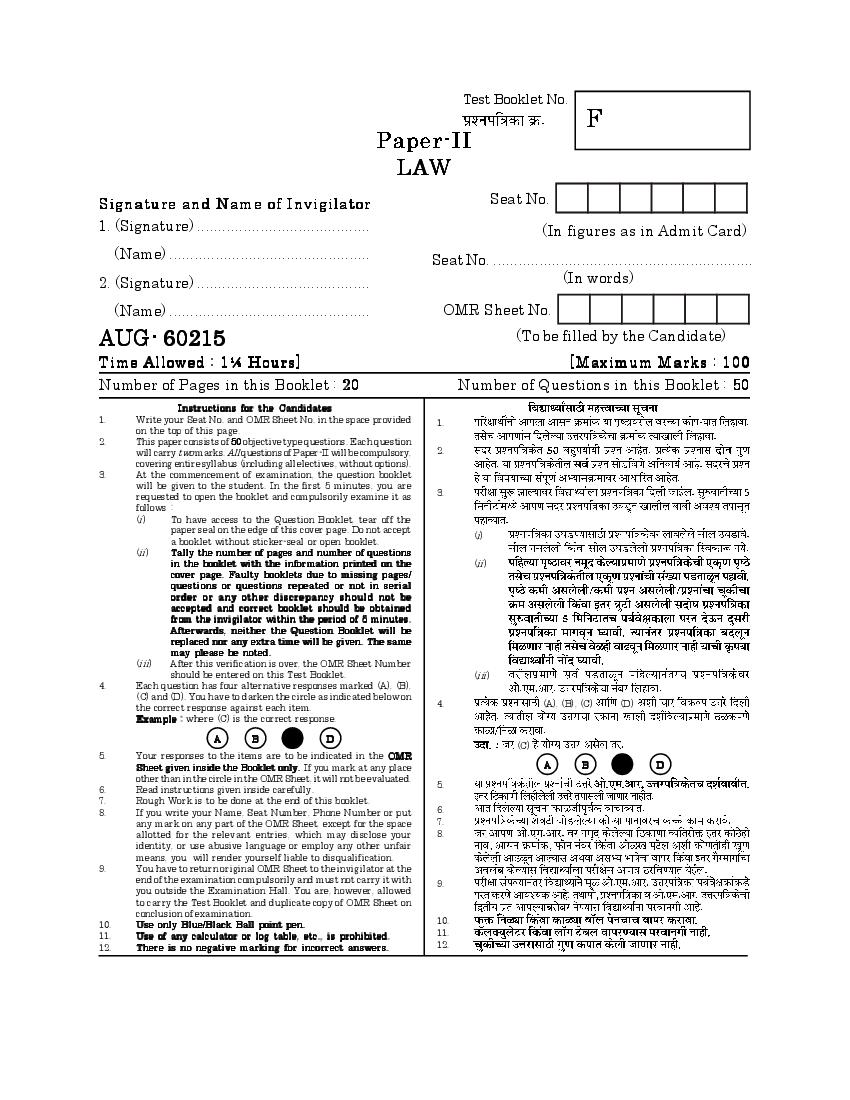
F
LAW
Signature and Name of Invigilator Seat No.
1. (Signature) ......................................... (In figures as in Admit Card)
(Name) ................................................ Seat No. ..............................................................
2. (Signature) ......................................... (In words)
(Name) ................................................ OMR Sheet No.
AUG- 60215 (To be filled by the Candidate)
Time Allowed : 1¼ Hours] [Maximum Marks : 100
Number of Pages in this Booklet : 20 Number of Questions in this Booklet : 50
Instructions for the Candidates
1. Write your Seat No. and OMR Sheet No. in the space provided 1.
on the top of this page.
2. This paper consists of 50 objective type questions. Each question
will carry two marks. All questions of Paper-II will be compulsory, 2.
covering entire syllabus (including all electives, without options).
3. At the commencement of examination, the question booklet
will be given to the student. In the first 5 minutes, you are
requested to open the booklet and compulsorily examine it as 3.
follows :
(i) To have access to the Question Booklet, tear off the
paper seal on the edge of this cover page. Do not accept
(i)
a booklet without sticker-seal or open booklet.
(ii) Tally the number of pages and number of questions
in the booklet with the information printed on the (ii)
cover page. Faulty booklets due to missing pages/
questions or questions repeated or not in serial
o rder or any other discre pancy should not be
accepted and correct booklet should be obtained
from the invigilator within the period of 5 minutes.
Afterwards, neither the Question Booklet will be
replaced nor any extra time will be given. The same
may please be noted.
(iii) After this verification is over, the OMR Sheet Number
should be entered on this Test Booklet. (iii)
4. Each question has four alternative responses marked (A), (B),
(C) and (D). You have to darken the circle as indicated below on
the correct response against each item. 4. (A), (B), (C) (D)
Example : where (C) is the correct response.
A B D
(C)
5. Your responses to the items are to be indicated in the OMR
Sheet given inside the Booklet only. If you mark at any place A B D
other than in the circle in the OMR Sheet, it will not be evaluated.
5.
6. Read instructions given inside carefully.
7. Rough Work is to be done at the end of this booklet.
8. If you write your Name, Seat Number, Phone Number or put 6.
any mark on any part of the OMR Sheet, except for the space 7.
allotted for the relevant entries, which may disclose your 8.
identity, or use abusive language or employ any other unfair
means, you will render yourself liable to disqualification.
9. You have to return original OMR Sheet to the invigilator at the
end of the examination compulsorily and must not carry it with 9.
you outside the Examination Hall. You are, however, allowed
to carry the Test Booklet and duplicate copy of OMR Sheet on
conclusion of examination.
10. Use only Blue/Black Ball point pen. 10.
11. Use of any calculator or log table, etc., is prohibited. 11.
12. There is no negative marking for incorrect answers. 12.
Page 2
Page 3
Paper II
Time Allowed : 75 Minutes] [Maximum Marks : 100
Note : This paper contains Fifty (50) multiple choice questions, each question
carrying Two (2) marks. Attempt All questions.
1. The observation by the Supreme 2. “X” was dismissed from the service
as a result of the findings of a
Court that “The Law in Article 13(2) departmental enquiry by the
of the Constitution includes every Competent Authority. He was
prosecuted under Provisions of the
branch of law, statutory, Prevention of Corruption Act, 1988.
Whether this tantamount to “Double
constitutional etc. and hence, if an
jeopardy” as envisaged under Article
amendment to the Constitution took 20(2) ?
(A) It is a double jeopardy
away or abridged the fundamental
(B) It is not double jeopardy as the
rights of the citizens, the departmental proceedings
operate on a different plane
amendment would be void was held and not prosecution
(C) “X” has been harassed twice by
in :
holding departmental
(A) Keshavananda Bharati Case proceedings as well as
prosecution under Prevention
(B) Minerva Mills Case of Corruption Act, 1988
(D) “X” cannot be prosecuted under
(C) Golaknath’s Case the Prevention of Corruption
Act due to the departmental
(D) Som Prakash Vs. Union of India enquiry
3 [P.T.O.
Page 4
5. The Constitution of India embodies
Constitution of India aims to
secure : the Parliamentary form of
(A) Fundamental Rights to all Government, because :
individuals
(A) the President, the Head of the
(B) Fundamental Rights to citizens
of India Executive is answerable to
(C) Dignity of individual and unity Parliament
and integrity of the nation
(B) the Prime Minister, the Head of
(D) Security of service to
government servant the Cabinet is accountable to
4. India is a sovereign, because :
Parliament
(A) of its supremacy in deciding
matters internal as well as (C) the Council of Ministers is res-
external interest of the country
ponsible to Lok Sabha and
(B) it contains more than 300
Rajya Sabha
Articles
(C) it has promises for justice (D) the Council of Ministers is
(D) it has government for the collectively responsible to the
people, by the people and of the
Lok Sabha
people
4
Page 5
8. Which Jurist observed that
matched ?
(A) Republic : Head of the state is
“Jurisprudence is as big as law—
h e r e d i t a r y
monarch
and bigger” ?
(B) Sovereign : Constitution rests
on the people’s will
(A) T Hermon W. Arnold
(C) Democratic : Constitution does
not recognize legal
supremacy of (B) Lord Radcliffe
another country
(D) Secular : State is without (C) Karl Lle Wellyn
religion of its own
7. Which one of the following is a (D) Professor Platt
Directive Principle of State Policy
under the Constitution of India ?
9. Ratio decidendi and Obiter dicta
(A) Protection and improvement of
environment and safeguarding
constitute as sources of :
of forest and wildlife
(B) To value and preserve the rich
(A) Custom
heritage of Indian composite
culture
(C) To strive for development of (B) Precedent
scientific temper, humanism
and spirit of equity and reform (C) Legislation
(D) To protect life and personal
liberty of the people of India (D) Treaties
5 [P.T.O.
Page 6
11. How many theories of punishment
Legal Rights and Duties, Salmond
observed that “A wrong is simply a
are there in Legal Theory ?
wrong act—an act contrary to the
role of right and justice.
(A) Five
Assertion (A) : A wrong may be
described in the largest sense, as (B) Six
anything done or omitted contrary
to legal duty. (C) Four
Reason (R) : Duty, right and
(D) Three
wrong are not separate or divisible
heads of legal rules and events.
12. Who was the author of the work
Codes :
(A) Both (A) and (R) are correct, (R) ‘Justice in Robes” ?
is the correct explanation of (A)
(A) Salmond
(B) Both (A) and (R) are correct, (R)
is not the correct explanation
(B) Dworkin
of (A)
(C) (A) is correct and (R) is wrong
(C) Austin
(D) (A) is not correct and (R) is
correct (D) Hanskelsen
6
Page 7
13. In which case, Justice Hidayatullah
is not a law.
observed : “No doubt, the law
Reason (R) : It lacks determinate
declared by this Court (Supreme
superior political authority to enforce
Court of India) binds courts in India,
its rules. Using the codes below give
but it should always be remembered
the correct answer.
that this court does not enact” ?
Codes :
(A) Rajeswar Prasad Vs. State of
(A) Both (A) and (R) are true but
West Bengal
(R) is not the correct
(B) Balkrishna Rao Vs. Haji explanation of (A)
Abdulla Sait (B) Both (A) and (R) are true and
(C) Maneka Gandhi Vs. Union of (R) is the correct explanation
of (A)
India
(C) (A) is false, but (R) is true
(D) Graham Bell Vs. State of West
Bengal (D) (A) is true, but (R) is false
7 [P.T.O.
Page 8
applied in International law was on :
laid down in : (A) 10th October, 1945
(A) West Rand Central Gold (B) 16th October, 1945
Mining Company Ltd. Vs. R. (C) 20th October, 1945
(B) Yugoslavia Vs. United Sates of (D) 24th October, 1945
America
18. The International Centre for
(C) Anglo-Iranian Oil Co. Ltd. Vs. Settlement of Investment Disputes
S.U. POR (ICSID) was established in the
(D) Appleby Vs. U.K. year :
(A) 1965
16. Which of the following statements
is correct ? (B) 1966
(A) De facto recognition of a foreign (C) 1967
government is as conclusively (D) 1968
binding, while it lasts, as
19. What was the theme of the 50th
de jure recognition
anniversary of the adoption of the
(B) De facto recognition of a foreign Universal Declaration of Human
government is conclusive Rights ?
(C) De facto recognition of a foreign (A) Human Rights for Progress
government is always equal to (B) All Human Rights for all
de jure recognition
(C) Universal brotherhood
(D) De facto recognition of a foreign
(D) Unite together for Human
government has no legal effects
Rights
8
Page 9
21. When divorce is initiated by the wife
and with the help of codes given
below, point out the correct and husband consents to it, such
explanation :
divorce is known as......................
Assertion (A) : The Dayabhaga
School of Hindu Law prevails in
under the Muslim Law.
Bengal, Assam, Tripura, Manipur,
Mizoram, Arunachal Pradesh and
(A) Khul or Khula
Meghalaya but in rest of India, it
is the Mitakshara School which has
(B) Mubaraa or Mubarrat
its sway.
Reason (R) : The Mitakshara (C) Talak-i-tafweez
School never prevails in the
Dayabhaga School jurisdiction on all (D) Talak-ul-bidda
those matters on which the
Dayabhaga is silent. 22. Which of the following is a void
Codes :
marriage under Muslim Law ?
(A) Both (A) and (R) are true but
(R) is not a correct explanatory (A) Mut’ah
of (A)
(B) Both (A) and (R) are true and (B) Batil
(R) is a correct explanatory of
(A) (C) Nikah
(C) (A) is true but (R) is false
(D) Fasid
(D) (A) is false but (R) is true
9 [P.T.O.
Page 10
Divorce Act, non-resumption of (A) Judicial separation
cohabitation after an order of (B) Restitution of conjugal rights
separate maintenance for a period (C) Annulment which differs from
talaq and other forms of
of..........................entitles the innocent
dissolution of marriage in legal
party to sue for divorce.
structure and its effects
(A) Three months (D) Dissolution of marriage at the
instance of the wife
(B) Six months
26. In which case it was held that the
(C) Nine months
parties to an agreement must intend
(D) One year to create legal obligations in order
to make it a valid contract ?
24. Which one of the following is not an
(A) Taylor Vs. Portington (1855)
approved form of marriage as per the
All. E.R. 128
ancient Hindu Law ?
(B) Balfour Vs. Balfour (1919)2 K.B.
(A) Prajapatya 571
(B) Gandharva (C) Shuppu Ammal Vs.
Subramaniyam (1909) ILR 33
(C) Brahma
Mad 238
(D) Arsha (D) Both (A) and (B)
10
Page 11
27. Which of the following is/are true
est condito defendentis” refers to :
about a valid consideration ?
(A) No action arises out of a base
(A) Must be from the Promisee only
cause
(B) May be past, present or future
(B) Where there is equal guilt, the
consideration defendant is in a better position
(C) Must be adequate to the (C) Personal cause of action dies
promise with the person itself
(D) Both (A) and (B) (D) What a person does for another,
he does himself
28. The Indian Contract Act defines
30. Which of the following relationship
‘Consideration’ under which
usually raise a presumption of
Section ?
undue influence ?
(A) Section 12
(A) Guardian and ward
(B) Section 2(d) (B) Doctor and Patient
(C) Section 15 (C) Trustee and beneficiary
(D) Section 2(J) (D) All (A), (B) and (C)
11 [P.T.O.
Page 12
remedy is a common law action for
(A) Damages are payable to punish
unliquidated damages and which is
a person for breach of contract
not exclusively the breach of a
(B) Damages are payable to
contract or breach of trust or others
compensate the person for
merely equitable obligation.”
special losses
The above definition is given by :
(C) Damages are payable to put
(A) Salmond
the parties in a situation as if
(B) Paton
the contract is not broken
(C) Winfield
(D) Damages are to be nominal
(D) H.L.A. Hart
32. A general offer or offer to the world
at large does not make it necessary 34. Which of the following is not a
libel ?
on the part of the acceptor to
communicate his acceptance. This is (A) Defamatory matter in writing or
well explained in : printing
(A) Carlil Vs. Carbolic Smoke Ball (B) Defamatory matter in the form
Company of video film
(B) Dunlop Newmatic Tyre Co Vs. (C) Defamatory matter in the form
Selfridge Co. of picture
(C) Balfour Vs. Balfour (D) Defamatory matter in the form
of public speech
(D) Donogue Vs. Stevenson
12
Page 13
35. Tort of conspiracy occur, when :
(A) Both parties have contributed
(A) Two or more persons combine to the negligence equally
(B) Only one party is negligent but
to injure a third party by any
the other has not taken the due
means care
(C) One party is negligent resulting
(B) Two or more persons combine
in injury while the other has
to injure a third party by taken due care
(D) Lack of care is equal on both
unlawful means
sides
(C) Two or more persons knowing 37. In which of the following cases is the
occupier liable for negligence ?
each other injure a third party
(A) Keeping watchdog which has
independently by unlawful the habit of biting
(B) Fixing broken glass pieces on
means
the top of the wall
(D) Two or more persons combine (C) Setting spring guns in the
premises to prevent trespass
to injure a third party by lawful
(D) Constructing a compound wall
means to prevent trespass
13 [P.T.O.
Page 14
intending to protect :
(A) Against the abuse of legal incompetent defendant violates due
proceedings
process. Therefore a defendant may
(B) Right of the police to prosecute
the criminal not be put to trial unless he has
(C) The accused against police
sufficient present ability to consult
excess
(D) The police from civil proceedings his lawyer with a reasonable degree
39. Which of the following statements
of rational understanding and a
is correct with respect to the
definition of ‘Offence” as prescribed rational as well as factual
u/s 40 of IPC ?
(A) “Offence” denotes a thing made understanding of the proceeding
punishable and prohibited by
against him.”
Indian Penal Code only
(B) “Offence” denotes a thing made
The above principle has been
punishable and prohibited by
IPC but does not cover the incorporated under which of the
offences punishable under any
Sections of Indian Penal Code ?
special or local law
(C) “Offence” denotes a thing made
(A) Section 80
punishable under the IPC or
under any special or local law
(B) Section 82
(D) “Offence” denotes anything
which has been done against (C) Section 84
public policy, public safety or
harmful to society (D) Section 86
14
Page 15
judgements has the Supreme Court
person who feels himself in eminent
given the accuse the benefit of
danger may use his right to private
private defence vide S. 100(1) of IPC
defence. However under any case,
after scrutinizing the various cases
the right to private defence can’t be set out principles emerged through
used under IPC : different cases ?
(A) Rudul Sah Vs. State of Bihar
(A) If it is against the person who
AIR 1983 S.C.1086
is under intoxication
(B) Sharadbhai Jivanlal Vaniya Vs.
(B) If it is against the child below State of Gujrat AIR 2012 S.C.
the age of 7 years 925
(C) Darshan Singh Vs. State of
(C) If there is a time to recourse the
Punjab AIR 2010 S.C. 1212
public authority
(D) Suchita Srivastava Vs.
(D) If it is against the insane Chandigarh Administration
person AIR 2010 S.C. 499
15 [P.T.O.
Page 16
he is going to murder ‘G’. ‘S’ statements is not correct with respect
messages back to ‘M’ that ‘You may to Section 497 of IPC.
do whatever you wish.’ (A) It confers upon the husband the
Subsequently ‘M’ killed ‘G’. right to prosecute the adulterer
In the present case, which of the but does not confer any right
upon the wife to prosecute the
following statements will sustain ?
women, with whom her
(A) ‘S’ can’t be held guilty of
husband has committed
instigating ‘M’
adultery
(B) ‘S’ can be held guilty of inciting/
(B) It does not confer any right on
instigating ‘M’ to kill ‘G’
the wife to prosecute the
(C) ‘S’ can be held guilty of inciting/ husband who has committed
instigating ‘M’ if he had been adultery with another woman
aware about the fighting
(C) It does not apply in case where
between ‘M’ and ‘G’ husband has sexual relations
(D) ‘S’ can’t be held guilty because with an unmarried woman
mobile messages are not (D) It does not apply in the cases
considered as mode of where adultery has been
incitement or instigating committed with married woman
someone. who is not Indian citizen
16
Page 17
45. The Industrial Disputes
following :
(Amendment) Bill, 2009 seeks to (A) Dispute between workmen and
workmen
provide inter alia for .................
(B) Dispute between employers and
employers
(A) Direct access for the workman
(C) Dispute between employers and
to the labour court or tribunal non-workmen
(D) Dispute between employers and
in case of disputes arising out workmen
47. Read Assertion (A) and Reason (R)
of Section 2A of the Industrial
and with the help of codes given
Disputes Act, 1947 below, point out the correct
explanation :
(B) Expanding the scope of Assertion (A) : Section 17 of the
Trade Unions Act, 1926 provides for
qualifications of presiding immunity from criminal conspiracy.
Reason (R) : Such immunity is
officers of labour court or
extended not only to the registered
trade union but also to its office
tribunals under Sections 7 and
bearers and members as all are
7A of the Industrial Disputes capable of conspiring.
Codes :
Act, 1947
(A) Both (A) and (R) are correct
(C) Both (A) and (B) (B) Both (A) and (R) are incorrect
(C) (A) is false but (R) is true
(D) Neither (A) nor (B)
(D) (A) is true but (R) is false
17 [P.T.O.
Page 18
48. The Industrial Disputes (Central)
observed that a ‘gherao’ is not an
offence as such mentioned in the
Rules, 1957 under Rule 39 Indian Penal Code. But it is an act
indulged by labour against the
contemplates that the number of management and where it is
accompanied by confinement,
representatives of the workmen on restraint or other offences under the
criminal law of the land, the fact that
works committee shall not be less it is done by members of a trade
union, and used as an instrument
of collective bargaining, gives rise to
than the number of representatives
no special treatment or exemption
from liability under the law.
of the employer and further that the
(A) Bharat Kumar Vs. State of
Kerala
total number of members shall not (B) Jay Engineering Works Vs.
State of West Bengal
exceed : (C) Coir Board Ernakulam, Kerala
Vs. Indira Devi P.S.
(D) Bharat Petroleum Corporation
(A) 10
Ltd Vs. Maharashtra General
Kamgar Union
(B) 30 50. “Last come first go” rule is applicable
in the case of :
(A) Lockout
(C) 20
(B) Retrenchment
(C) Transfer of Undertaking
(D) 14 (D) Closure
18
Page 19
19 [P.T.O.
Page 20
20
Document Details
| Board / Org | Maharashtra Exams |
| Exam | Maharashtra State Eligibility Test |
| Type | Question Paper |
| Pages | 20 |
| Updated | 30 Apr 2026 |