Rajasthan Board Class 12 Question Paper 2020 Physics
Finished viewing? Save it for later —
Download Rajasthan Board Class 12 Question Paper 2020 Physics (PDF · 12 pages)About Rajasthan Board Class 12 Question Paper 2020 Physics
Rajasthan Board Class 12 Question Paper 2020 Physics is available here for free download. Published by Rajasthan Board for Class 12, this question paper can be viewed online or downloaded as a PDF (12 pages). Candidates preparing for Class 12 can use Rajasthan Board Class 12 Question Paper 2020 Physics to understand the exam pattern, the type of questions asked, and the overall difficulty level.
Frequently Asked Questions
How can I download Rajasthan Board Class 12 Question Paper 2020 Physics?
Open this page and click the Download button to save Rajasthan Board Class 12 Question Paper 2020 Physics as a PDF. It is completely free on AglaSem Docs.
Is Rajasthan Board Class 12 Question Paper 2020 Physics free to download?
Yes. Rajasthan Board Class 12 Question Paper 2020 Physics can be viewed online and downloaded as a PDF free of cost on AglaSem Docs.
How many pages does Rajasthan Board Class 12 Question Paper 2020 Physics have?
Rajasthan Board Class 12 Question Paper 2020 Physics contains 12 pages, which you can read online or download together as a single PDF.
Where can I find more Class 12 study material?
You can find more Class 12 question papers, sample papers, syllabus, and answer keys on AglaSem Docs.
Rajasthan Board Class 12 Question Paper 2020 Physics – Text
Read the full text of this question paper below — useful to quickly search, copy and reference the content online without downloading the PDF.
📄 View text version (12 pages)
Page 1
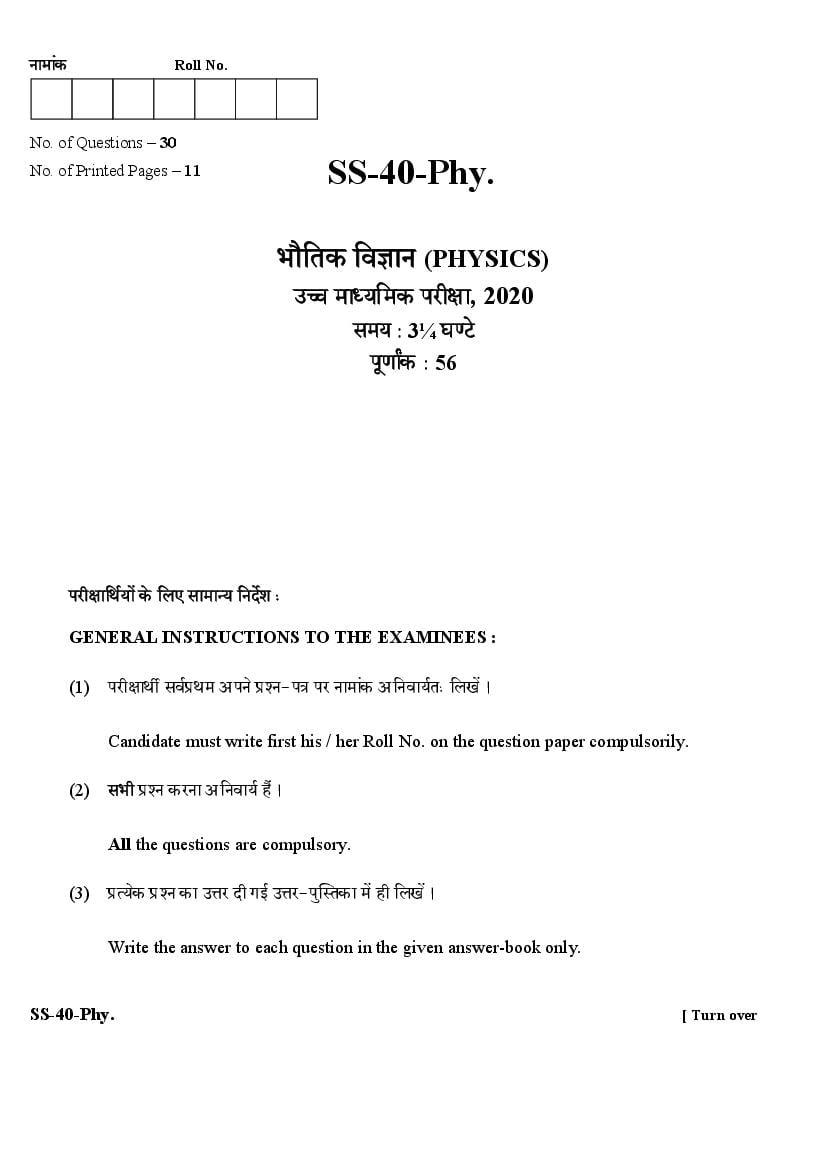
No. of Questions – 30
No. of Printed Pages – 11 SS-40-Phy.
(PHYSICS)
, 2020
3¼
56
GENERAL INSTRUCTIONS TO THE EXAMINEES :
(1) -
Candidate must write first his / her Roll No. on the question paper compulsorily.
(2)
All the questions are compulsory.
(3) -
Write the answer to each question in the given answer-book only.
SS-40-Phy. [ Turn over
Page 2
(4) ,
For questions having more than one part, the answers to those parts are to be written
together in continuity.
(5) -
//
If there is any error / difference / contradiction in Hindi & English versions of the
question paper, the question of Hindi version should be treated valid.
(6)
1 – 13 1
14 – 24 2
25 – 27 3
28 – 30 4
Section Q. Nos. Marks per question
A 1-13 1
B 14-24 2
C 25-27 3
D 28-30 4
(7) 21 27 30
There are internal choices in Question Nos. 21 and 27 to 30.
(8)
Use of calculator is not allowed in the examination.
SS-40-Phy.
Page 3
–
SECTION – A
1.
Write the definition of dielectric constant of a medium. 1
2. ?
Why do we get balancing point in the middle of the meter bridge generally ? 1
3.
Write the name of any two rules to find the direction of magnetic field. ½+½=1
4. ?
What is diamagnetic substances ? 1
5.
Define magnetic flux. 1
SS-40-Phy. [ Turn over
Page 4
6.
In the given figure, write a point showing the resonant state. 1
7. ?
What do you understand by scattering of light ? 1
8. ?
What was the main objective of Davisson and Germer experiment. 1
SS-40-Phy.
Page 5
9.
Write Heisenberg’s uncertainty principle. 1
10.
Write the function of coolant used in nuclear reactor. 1
11. XOR
Draw symbolic diagram of XOR gate. 1
12.
Draw block diagram of a communication system. 1
13. ?
What is nanotechnology ? 1
-
SECTION – B
14. 0.30 m
10–6 C/m
(me = 9.0 × 10⁻³¹ kg, e = 1.6 × 10⁻¹⁹ C)
An electron is moving around an infinite linear charge in circular path of diameter
0.30 m. If linear charge density is 10–6 C/m, then calculate the speed of an electron. 2
(me = 9.0 × 10⁻³¹ kg, e = 1.6 × 10⁻¹⁹ C)
SS-40-Phy. [ Turn over
Page 6
15. 30 V 7.5 A
10 12
Three resistors are connected in parallel. The electric current 7.5 A is flowing in this
combination from a battery of emf 30 V. If the values of two resistors are 10 and 12
then find the value of third resistor. 2
16. ()
()
(a) Write Kirchhoff’s second law.
(b) Draw a circuit diagram for comparison of emf of two primary cells with the help of
potentiometer. 1+1=2
17. () M1 M2
() ?
(a) The magnetic moment of two bar magnets are M1 and M2. If angle between them is
then write the value of resultant magnetic moment.
(b) Soft iron is used in making electro-magnets. Why ? 1+1=2
SS-40-Phy.
Page 7
18. 25 cm
4 3
(nw = 3, ng = 2)
Focal length of a convex lens in air is 25 cm. If it is immersed in water, then calculate the
4 3
focal length of the lens. (nw = , ng = ) 2
3 2
19.
Write any two differences between diffraction and interference of light. 1+1=2
20. - ?
Why photo-electric effect cannot be explained on the basis of wave theory of light ?
Write any two reasons. 1+1=2
21. 50 Hz 0.707
V = 50 sin 314 t V I = 10 sin 314 t + 4A
(i) (ii)
SS-40-Phy. [ Turn over
Page 8
The power factor of a coil is 0.707 at frequency 50 Hz. If frequency is doubled, then
calculate the power factor of coil. 2
OR
The voltage and current in an a.c. circuit are V = 50 sin 314 t V and I = 10 sin 314 t + A
4
respectively. Calculate : (i) Wattless current and (ii) Root mean square voltage. 1+1=2
22. - ‘D’
235
92 D –
D1
D2
D3 D4
D4
A radioactive nucleus ‘D’ is decaying in the following way :
235
92 D – decay D2
decay D1 decay D3
decay D4
Determine the atomic number and mass number of D4. 1+1=2
23. ? -
What is intrinsic semiconductor and extrinsic semiconductor ? Write an example of each
semiconductor. 1+1=2
24. 10 V 2 V
The maximum and minimum amplitude for an amplitude modulated wave are 10 V and
2 V respectively. Calculate the modulation index. 2
SS-40-Phy.
Page 9
–
SECTION – C
25.
e = eo sin t ‘e’ ‘t’
Obtain an expression for the induced emf e = eo sin t generated due to the rotational
motion of the rectangular coil in the uniform magnetic field. Draw a graph between
induced emf ‘e’ and time ‘t’. 2+1=3
26. - n = 3
Explain Bohr’s second postulate with the help of De-Broglie’s hypothesis. Draw a stationary
wave model of an electron for orbit n = 3. 2+1=3
27. P-N ? ( )
,
? NPN ,
What is P-N junction diode ? Draw a circuit diagram of the zener diode as a voltage
regulator (voltage stabilizer). Write its working also. 1+1+1=3
OR
What is amplification ? Draw a circuit diagram of NPN transistor as a common emitter
amplifier. Write its working also. 1+1+1=3
SS-40-Phy. [ Turn over
Page 10
–
SECTION – D
28. (r, )
?
Define electric potential. Obtain an expression of electric potential due to an electric
dipole at any point (r, ). Draw necessary diagram. 1+2+1=4
OR
What is capacitor ? Derive an expression of capacitance of the spherical capacitor. Draw
necessary diagram. 1+2+1=4
29. ,
?
1.432
Describe the construction of suspended coil galvanometer, draw labelled diagram of it.
Prove that current flowing in the coil of galvanometer is directly proportional to the
deflection generated in the coil. 1+2+1=4
OR
What is Helmholtz coils ? Prove that the value of a uniform magnetic field obtained in
the Helmholtz coil is 1.432 times the magnetic field generated by each coil at its centre.
Draw necessary graph also. 1+2+1=4
SS-40-Phy.
Page 11
30. ?
?
What is Presbyopia ? Describe the construction and working of reflecting telescope.
Draw necessary ray diagram. 1+2+1=4
OR
What is wave front ? Explain laws of refraction of light on the basis of Huygens wave
theory. Draw necessary ray diagram. 1+2+1=4
____________
SS-40-Phy. [ Turn over
Page 12
SS-40-Phy.
Document Details
| Board / Org | Rajasthan Board |
| Exam | Class 12 |
| Type | Question Paper |
| Pages | 12 |
| Updated | 22 Jul 2026 |