CBSE Class 10 Marking Scheme 2022 for NCC Term 2
Finished viewing? Save it for later —
Download CBSE Class 10 Marking Scheme 2022 for NCC Term 2 (PDF · 9 pages)About CBSE Class 10 Marking Scheme 2022 for NCC Term 2
CBSE Class 10 Marking Scheme 2022 for NCC Term 2 is available here for free download. Published by CBSE for Class 10, this marking scheme can be viewed online or downloaded as a PDF (9 pages). Candidates preparing for Class 10 can use CBSE Class 10 Marking Scheme 2022 for NCC Term 2 to understand the exam pattern, the type of questions asked, and the overall difficulty level.
Frequently Asked Questions
How can I download CBSE Class 10 Marking Scheme 2022 for NCC Term 2?
Open this page and click the Download button to save CBSE Class 10 Marking Scheme 2022 for NCC Term 2 as a PDF. It is completely free on AglaSem Docs.
Is CBSE Class 10 Marking Scheme 2022 for NCC Term 2 free to download?
Yes. CBSE Class 10 Marking Scheme 2022 for NCC Term 2 can be viewed online and downloaded as a PDF free of cost on AglaSem Docs.
How many pages does CBSE Class 10 Marking Scheme 2022 for NCC Term 2 have?
CBSE Class 10 Marking Scheme 2022 for NCC Term 2 contains 9 pages, which you can read online or download together as a single PDF.
Where can I find more Class 10 study material?
You can find more Class 10 question papers, sample papers, syllabus, and answer keys on AglaSem Docs.
CBSE Class 10 Marking Scheme 2022 for NCC Term 2 – Text
Read the full text of this marking scheme below — useful to quickly search, copy and reference the content online without downloading the PDF.
📄 View text version (9 pages)
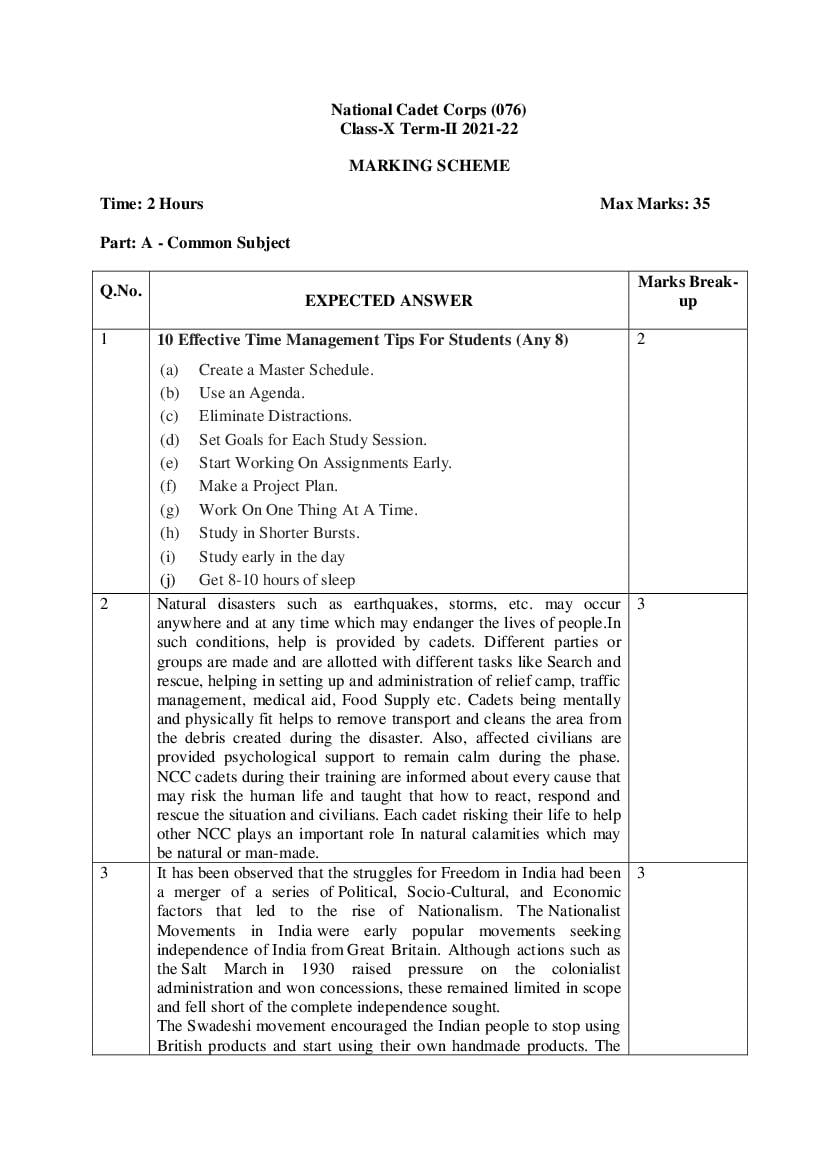
Page 1
Class-X Term-II 2021-22
MARKING SCHEME
Time: 2 Hours Max Marks: 35
Part: A - Common Subject
Marks Break-
Q.No.
EXPECTED ANSWER up
1 10 Effective Time Management Tips For Students (Any 8) 2
(a) Create a Master Schedule.
(b) Use an Agenda.
(c) Eliminate Distractions.
(d) Set Goals for Each Study Session.
(e) Start Working On Assignments Early.
(f) Make a Project Plan.
(g) Work On One Thing At A Time.
(h) Study in Shorter Bursts.
(i) Study early in the day
(j) Get 8-10 hours of sleep
2 Natural disasters such as earthquakes, storms, etc. may occur 3
anywhere and at any time which may endanger the lives of people.In
such conditions, help is provided by cadets. Different parties or
groups are made and are allotted with different tasks like Search and
rescue, helping in setting up and administration of relief camp, traffic
management, medical aid, Food Supply etc. Cadets being mentally
and physically fit helps to remove transport and cleans the area from
the debris created during the disaster. Also, affected civilians are
provided psychological support to remain calm during the phase.
NCC cadets during their training are informed about every cause that
may risk the human life and taught that how to react, respond and
rescue the situation and civilians. Each cadet risking their life to help
other NCC plays an important role In natural calamities which may
be natural or man-made.
3 It has been observed that the struggles for Freedom in India had been 3
a merger of a series of Political, Socio-Cultural, and Economic
factors that led to the rise of Nationalism. The Nationalist
Movements in India were early popular movements seeking
independence of India from Great Britain. Although actions such as
the Salt March in 1930 raised pressure on the colonialist
administration and won concessions, these remained limited in scope
and fell short of the complete independence sought.
The Swadeshi movement encouraged the Indian people to stop using
British products and start using their own handmade products. The
Page 2
in 1905 and continued up to 1908. The Swadeshi movement which
was a part of the Indian freedom struggle was a successful economic
strategy to remove the British empire and improve economic
conditions in India. The Swadeshi movement soon stimulated local
enterprise in many areas. After Lord Curzon announced the partition
of Bengal in 1905, there was massive opposition from the people of
Bengal. Initially, the partition plan was opposed through press
campaign. The total follower of such techniques led to the boycott of
British goods. The British swiftly responded to the Quit India
Movement with mass detentions. Over 100,000 arrests were made,
mass fines were levied and demonstrators were subjected to public
flogging. Hundreds of civilians were killed in violence many shot by
the police army. The Quit India Movement turned out to be not very
successful and only lasted until 1943.
OR
Bal GangadharTilak 1.5 + 1.5 = 3
Bal GangadharTilak was born on 22 July 1856, in a middle class
family in Ratnagiri, a small coastal town in southwestern
Maharashtra. His father, GangadharShastri, was a noted Sanskrit
scholar and school teacher at Ratnagiri. Tilak was a brilliant student
and also very good in mathematics. Since his childhood, Tilak had an
intolerant attitude towards injustice and he was truthful and straight
forward in nature. After graduating from Deccan College, Pune in
1877, Tilak cleared the LLB from the Elphinston College, Mumbai.
Later, he helped found a school that laid emphasis on nationalism.
Mohandas Karamchand Gandhi
Mohandas Karamchand Gandhi was born on 02 October 1869 at
Porbandar which is in the present day Gujarat. His father,
Karamchand Gandhi, was a Dewan or Prime Minister of Porbandar.
His mother, Putlibai, was a very religious lady and left a deep
impression on Gandhi's mind. He was a mediocre student and was
excessively shy and timid. He married at the age of thirteen to
Kasturbai. Later on in his life, Gandhi denounced the custom of child
marriage and termed it as cruel. After schooling, he joined the
Samaldas College in Bhavnagar.
4 The various types of fire extinguishers are: 1+1+1=3
1. Soda acid extinguisher: These are used for extinguishing fires
involving ordinary combustible material, where the cooling effect
is achieved by water or solution containing large percentage of
water. They are conical/cylindrical in shape.
2. Foam type or Dry chemical powder extinguisher: They contain
dry chemicals or solution and are exclusively meant for
extinguishing fires involving inflammable liquids such as oils,
fats or grease, where blanketing the fire to isolate it from Oxygen
(Air) is required.
3. CTC Carbon dioxide and dry chemical extinguishers: They
contain chemicals, either liquid, gas or dry, and are mainly used
to fight fires involving ‘live’ electrical equipment etc. where, the
Page 3
importance.
5 Corruption: Corruption erodes trust, weakens democracy, hampers 2
economic development and further exacerbates inequality, poverty,
social division and the environmental crisis. Exposing corruption and
holding the corrupt to account can only happen if we understand the
way corruption works and the systems that enable it. Corruption can
happen anywhere: in business, government, the courts, the media,
and in civil society, as well as across all sectors from health and
education to infrastructure and sports.
6 a) Trafficking: Human Trafficking is the recruitment, 2
transportation, transfer, harboring or receipt of people (Any one)
through force, fraud or deception, with the aim of exploiting
them for profit. Men, women and children of all ages and
from all backgrounds can become victims of this crime,
which occurs in every region of the world. The traffickers
often use violence or fraudulent employment agencies and
fake promises of education and job opportunities to trick and
coerce their victims.
b) Child abuse: Child abuse is not just physical violence
directed at a child. It is any form of maltreatment by an adult,
which is violent or threatening for the child. This includes
neglect. When child abuse occurs in the home and the abuser
is, for example, the child’s parent or care-giver, this is a form
of domestic violence. But children are sometimes abused by
other adults on whom they are dependent, such as day nursery
workers, teachers and sports coaches.
Sometimes abuse is intentional, but not always. If parents or
caregivers are no longer able to cope with caring for the child, this
can result in dysfunctional behavior and abuse.
7 Creative thinking: Creative thinking refers to using abilities and soft 3
skills to come up with new solutions to problems. These are
techniques used to look at the issue from different and creative
angles, using the right tools to assess it and develop a plan. The focus
on creativity and innovation is important because most problems
might require approaches that have never been created or tried
before.
8 a) Team Work: A team is a group of people who work together 3
toward a common goal. Teams have defined membership (Any one)
(which can be either large or small) and a set of activities to
take part in. People on a team collaborate on sets of related
tasks that are required to achieve an objective. Each member is
responsible for contributing to the team, but the group as a
whole is responsible for the team’s success.
b) Personality development: Personality development is about
building your capacities, nurturing your talent, enhancing new
skill sets, working on your weaknesses, and transforming them
into strengths. ou, as an individual, have unique skill sets.
Page 4
development enables you to harness your strengths. Focusing
on individual personality development adds to your
capabilities and helps your dreams and aspirations turn into a
reality.
9 The various safety tips when you are out for rock climbing are: 4
a) Always check harness
b) Always check knots
c) Always wear a helmet
d) Always check the rope and belay device
e) Always use a long rope – The climbing rope should reach the
anchors and lower back down on a sport route or to
f) Always pay attention – Keep notice of the instructions of the
leader. Never divert your attention to mobile or other
distractions.
g) Always bring enough gear – Keep extra gears for emergency
use.
h) Always climb with the rope over your leg – This is important,
otherwise you can hit your head.
i) Always properly clip the rope – Avoid back clipping, where
the rope runs front to back. Carabiner gate should face
opposite your direction of travel.
j) Always use safe anchors – Keep atleast 3 anchors. Always
use a locking carabiner
Section-B
Specialized Subject (Army)
Marking Scheme Class X
Max Marks-10
10 (a)Knoll 0.5X4=2
(b) Spur
(c) Col or Saddle
(d) Ridge
11 Conventional signs are symbols used to represent certain artificial or natural 1+1=2
features/objects on the map.
Temple : Railway line :
OR
Magnetic Variation is the difference between True North and Magnetic North. The 1+1=2
amount of magnetic variation depends on two factors - time and place.
12 (a) Distance is overestimated when:- 3
(i) Light is bad.
(ii) The sun is shining in the observer’s eye.
Page 5
(iv) Looking through a valley of narrow lane e.g. Street.
(v) Lying down.
(b) Distance is underestimated when:-
(i) The light is bright or the sun is shining from behind the observer.
(ii) The object is large in relation to its surrounding.
(iii) There is some dead ground between observer and the object.
(iv) Looking uphill.
13 There are two types of cover. They are:- 1+2=3
(a) Cover from view.
(b) Cover from fire.
Cover from View - A person is concealed only from view and not from fire. Example
- A person behind a bush or moving in tall grass.
Cover from Fire - This means that the concealed person is protected both from view
and fire of weapon.
Example – A person moving in a nullah or on the other side of a high ground.
OR
(a) A Section is the smallest sub unit of an Infantry Battalion and is capable of 1.5X2=3
undertaking independent task. It consists of ten persons who are organized in
Rifle group and Support Group.
(b) Some of the field signals that can be used at night are:-
(i) Pre decided signals on a walkie talkie.
(ii) Clicks by fingers or by tounge.
(iii) Whistle by the mouth.
(iv) Use of colour light.
(v) Use of blacked out torch.
(vi) Firing of weapon.
Section-B
Specialized Subject (Air Force)
Marking Scheme Class X
Max Marks-10
10 The invisible and odorless gas which we breathe, which sustains life and 1+1=2
produces an infinite variety of phenomena is what we call air. The envelope of air
surrounding the earth and extending to great heights is the atmosphere where vast
physical processes occur, giving rise to the ever-changing weather phenomena.
Different layers of atmosphere are:
(a) Troposphere
(b) Stratosphere
(c) Mesosphere
Page 6
11 Air is a mechanical mixture of a variety of gases. The main constituents of this 1+1=2
mixture are nitrogen and oxygen, accounting for almost 99% of the whole, with
roughly three parts of nitrogen to one part of oxygen. There are small amounts or
traces of other gases.
The percentage of composition of dry air by volume is in the proportions as
under: -
Nitrogen - 78.09 %
Oxygen - 20.95 %
Argon - 0.93 %
Carbon dioxide - 0.03 %
OR
The clouds may be defined as a visible aggregate of minute particles of water in 2
the free air. Ice or clouds both are formed by the cooling of masses of damp air,
generated by upward motion and its accompanying expansion with a fall of
pressure.
12 The aims of including aero modeling in the NCC curriculum are to increase 3
awareness about Air related issues in the youth of our country. The aero modeling
provides an earnest approach to the understanding of an otherwise highly
technical subject, i.e., aerodynamics. The air-minded aero modeler of today is the
potential aircraft designer of tomorrow.
13 Aero models are classified according to the role and utility of the particular type. 1+2=3
These are static models, gliders, control line models, and RC models.
The four different types of Aero-Models are: -
(a) Static models
(b) Control line models
(c) Radio Control (RC) models
(d) Gliders
OR
(a) Screwdriver 0.5X6=3
(b) Hand drill
Page 7
(d) Pliers
(e) Knives with different blades
(f) Different kind of saw
(g) Files
(h) Soldering irons
(i) RC set (Transmitter, Receiver, Servos) etc
Section-B
Specialized Subject (Navy)
Marking Scheme Class X
Max Marks-10
1. Various Types of Charts. 1+1=2
(a) Navigational Chart.
(b) Ship`s boat charts.
(c) Routing charts.
(d) Magnetic charts.
(e) Ocean sounding charts.
(f) LD charts (lattice Decca).
(g) Astronomical charts and diagrams.
Instruments required for chart work
a) Dividers
b) Compass
c) Parallel Ruler
d) Protractor
e) squares
2. Chart Scales. Charts are generally published in three different scales, they are:- 1+1=2
(a) Small Scale Charts. These are charts covering a very vast area and the
information such as sounding, lights etc. are not given in detail. These charts are
generally used for passage planning and never should be used for navigation.
(b) Medium Scale Charts. These charts are used for passage. The information for
navigation including dangers is clearly shown on these charts. These charts cover
Page 8
(c) Large Scale Charts. These charts are generally of harbours and their
approaches. These charts contain all information’s required for precise
navigation. These charts cover an area of 5 – 7NM.
OR
Radar. Radio aided Direction and ranging i.e. with the help of radio waves, the 2
direction and range of objects are obtained. This Instrument is Used for
Navigation.
3. A ship may not always be berthed alongside when in harbor. It is at times 2+1=3
required to lay at anchorage for which knowledge of anchor work is essential.
Handling of anchor is an essential seamanship evolution and forms a must know
aspect of any seaman.
Anchor and cable are used to hold a ships position in water. The cable is designed
to act as a spring with the anchor holding it secured to the bottom of the sea. The
size and type of Anchors and cables depend on the tonnage and type of ship.
Purpose of Anchor. Anchor is a hook, attached to a length of chain or rope called
a cable, by which a ship or a boat can be held temporarily to the sea bed in a
comparatively shallow water.
Parts of an Anchor.
(a) Anchor Ring.
(b) Anchor Shackle.
(c) Shank.
(d) Fluke.
(e) Pea or Bill.
4. Give Way Together. This is the order to start pulling and it is obeyed together by 1+2=3
the whole crew.
Precautions while pulling. The following precautions must be taken when going
for boat pulling:-
(a) Ensure the boat is clear of water.
(b) Adequate number of oars & crutches are taken including spare.
(c) Life jacket is worn by all the crew.
(d) Check the boat plug is firmly secured.
(e) First aid kit is carried.
(f) Loud hailer, drinking water, sufficient ropes, bailer, anchor, life buoy and boat
Page 9
(g) Only swimmers and physically fit should participate.
(h) Knowledge of local weather and tidal conditions.
(i) Rudder, tiller & towing bollard should be properly secured.
OR
Parts of Whaler. Apron, Back board, Badge block, Benches, Bilge, Bilge rails, 1/2X6=3
Bottom board, Bow, Canopy, Capping, Drop keel, Cleats, Crutches, Deck Eyes,
Floors, Floor board, Garboard strake, Grating, Gudgeon & pintails, Gunwale,
Hog, Keel, Keelson, Mast step & clamp, Pillars, Planking, Plug, Ringbolts,
Rowlocks, Rubbers, Rudder, Stem, Stern post, Stern sheet, Stretcher, Tabernacle,
Thwarts, Timbers, Wash strake
.
Document Details
| Board / Org | CBSE |
| Exam | Class 10 |
| Type | Solution |
| Pages | 9 |
| Language | english |
| Updated | 09 Jun 2026 |