MAHA SET 2018 Question Paper 3 Physical Science
Finished viewing? Save it for later —
Download MAHA SET 2018 Question Paper 3 Physical Science (PDF · 28 pages)About MAHA SET 2018 Question Paper 3 Physical Science
MAHA SET 2018 Question Paper 3 Physical Science is available here for free download. Published by Maharashtra Exams for MAHA SET, this question paper can be viewed online or downloaded as a PDF (28 pages). Candidates preparing for MAHA SET can use MAHA SET 2018 Question Paper 3 Physical Science to understand the exam pattern, the type of questions asked, and the overall difficulty level.
Frequently Asked Questions
How can I download MAHA SET 2018 Question Paper 3 Physical Science?
Open this page and click the Download button to save MAHA SET 2018 Question Paper 3 Physical Science as a PDF. It is completely free on AglaSem Docs.
Is MAHA SET 2018 Question Paper 3 Physical Science free to download?
Yes. MAHA SET 2018 Question Paper 3 Physical Science can be viewed online and downloaded as a PDF free of cost on AglaSem Docs.
How many pages does MAHA SET 2018 Question Paper 3 Physical Science have?
MAHA SET 2018 Question Paper 3 Physical Science contains 28 pages, which you can read online or download together as a single PDF.
Where can I find more MAHA SET study material?
You can find more MAHA SET question papers, sample papers, syllabus, and answer keys on AglaSem Docs.
MAHA SET 2018 Question Paper 3 Physical Science – Text
Read the full text of this question paper below — useful to quickly search, copy and reference the content online without downloading the PDF.
📄 View text version (28 pages)
Page 1
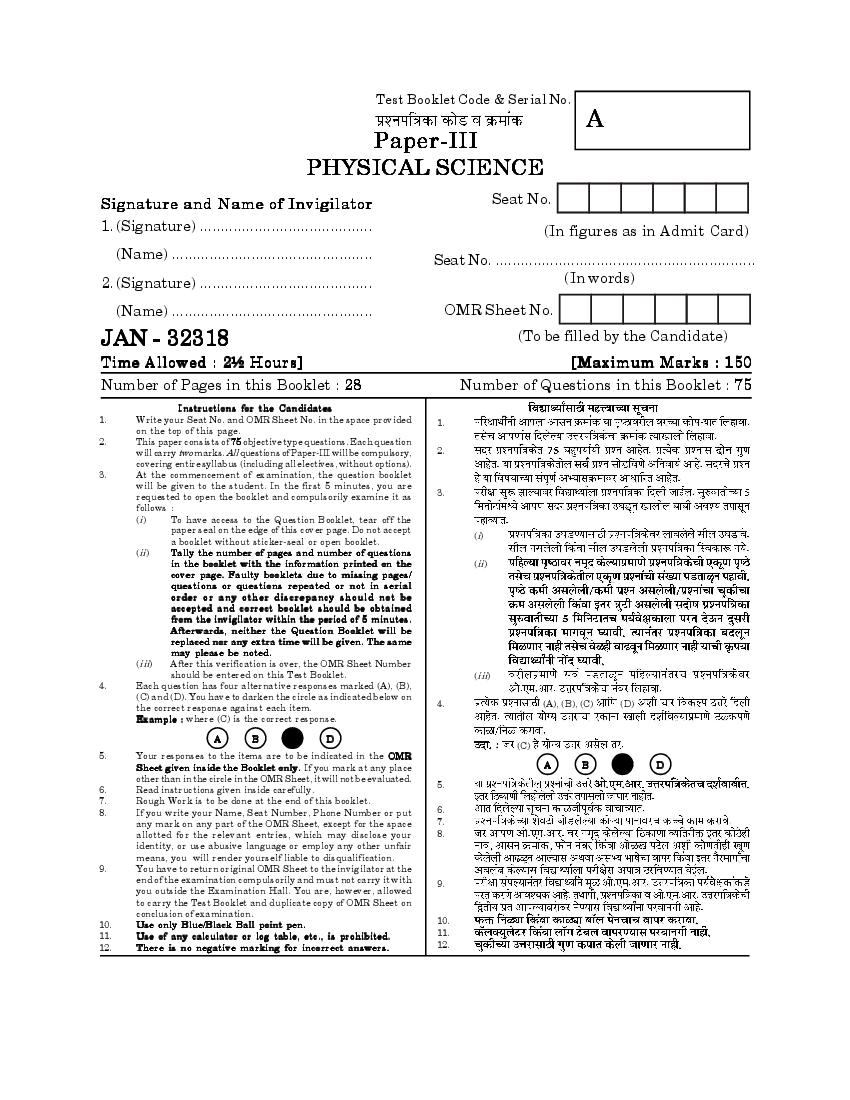
A
PHYSICAL SCIENCE
Signature and Name of Invigilator Seat No.
1. (Signature) ......................................... (In figures as in Admit Card)
(Name) ................................................ Seat No. ..............................................................
2. (Signature) ......................................... (In words)
(Name) ................................................ OMR Sheet No.
JAN - 32318 (To be filled by the Candidate)
Time Allowed : 2½ Hours] [Maximum Marks : 150
Number of Pages in this Booklet : 28 Number of Questions in this Booklet : 75
Instructions for the Candidates
1. Write your Seat No. and OMR Sheet No. in the space provided 1.
on the top of this page.
2. This paper consists of 75 objective type questions. Each question
will carry two marks. All questions of Paper-III will be compulsory, 2.
covering entire syllabus (including all electives, without options).
3. At the commencement of examination, the question booklet
will be given to the student. In the first 5 minutes, you are
requested to open the booklet and compulsorily examine it as 3.
follows :
(i) To have access to the Question Booklet, tear off the
paper seal on the edge of this cover page. Do not accept
(i)
a booklet without sticker-seal or open booklet.
(ii) Tally the number of pages and number of questions
in the booklet with the information printed on the (ii)
cover page. Faulty booklets due to missing pages/
questions or questions repeated or not in serial
o rder or any other discre pancy should not be
accepted and correct booklet should be obtained
from the invigilator within the period of 5 minutes.
Afterwards, neither the Question Booklet will be
replaced nor any extra time will be given. The same
may please be noted.
(iii) After this verification is over, the OMR Sheet Number
should be entered on this Test Booklet. (iii)
4. Each question has four alternative responses marked (A), (B),
(C) and (D). You have to darken the circle as indicated below on
the correct response against each item. 4. (A), (B), (C) (D)
Example : where (C) is the correct response.
A B D
(C)
5. Your responses to the items are to be indicated in the OMR
Sheet given inside the Booklet only. If you mark at any place A B D
other than in the circle in the OMR Sheet, it will not be evaluated.
5.
6. Read instructions given inside carefully.
7. Rough Work is to be done at the end of this booklet.
8. If you write your Name, Seat Number, Phone Number or put 6.
any mark on any part of the OMR Sheet, except for the space 7.
allotted for the relevant entries, which may disclose your 8.
identity, or use abusive language or employ any other unfair
means, you will render yourself liable to disqualification.
9. You have to return original OMR Sheet to the invigilator at the
end of the examination compulsorily and must not carry it with 9.
you outside the Examination Hall. You are, however, allowed
to carry the Test Booklet and duplicate copy of OMR Sheet on
conclusion of examination.
10. Use only Blue/Black Ball point pen. 10.
11. Use of any calculator or log table, etc., is prohibited. 11.
12. There is no negative marking for incorrect answers. 12.
Page 2
Page 3
Paper III
Time Allowed : 2½ Hours] [Maximum Marks : 150
Note : This paper contains Seventy Five (75) multiple choice questions. Each
question carries Two (2) marks. Attempt All questions.
1. Given that Fourier integral repre- 1 1 1
2. The series 1 + + …
sentation for the function 2s 3s 4s
0 if | x| 1 (A) Converges for all values of s
f(x) =
1 if | x| 1 (B) Converges for s > 1
(C) Converges for s < 0
2 cos x sin
is f(x) = d (D) Diverges for all values of s
0
3. The eigen values of an anti-
Which of the following options is Hermitian matrix are :
correct ?
(A) Real positive
cos x sin (B) Real negative
(A) d
0 (C) Purely imaginary
/ 2 if 0 x 1 (D) Have non-zero real part
/ 4 if x 1 4. The radius of convergence of the
0 if x 1
(2n) !
series (z – 3i)n is :
( n !) 2
sin n 0
(B) d
0 (A) Infinity
sin
1
d (B)
(C) 2
4
0
(C) 2
cos x sin 1
(D) d 0
(D)
0 4
3 [P.T.O.
Page 4
d 2 x dx
equation – + x = 0 : and V1 and V2 be subspaces of V
dt2 dt
which are 3-dimensional each. Then
(A) will tend to as t
the dimension of V1 V2 is :
(B) will tend to – as t
(A) 3
(C) will tend to 0 as t
(B) 0
(D) will oscillate with finite
(C) 1
amplitude for all t
(D) 2
6. For a simple harmonic oscillator the
probability of finding the particle, 8. A man jumps from a height in a deep
if the measurement is made at pool of water. If the net frictional
random time, is inversely propor- force of water F is proportional to the
tional to the speed. If the amplitude instantaneous speed V of the man,
of oscillation is A, the probability of i.e., F = kV; what is the terminal
finding the particle is : velocity of the man ? The mass of
the man is m.
(A) Maximum close to ± A
(A) mg / k
(B) Maximum at zero
(B) 2 mg/k
(C) Constant on closed interval
1
[– A, A] (C) mg/k
2
3
(D) Maximum at ± A/2 (D) mg/k
2
4
Page 5
9. Consider a system comprising of sun,
freedom, the Poisson’s bracket [xi, pj]
earth and moon. What is the orbit
is :
of moon around sun ?
(A) Zero
(A) ellipse (B) ij
(B) elliptical spiral (C) ij jkpk
(D) – ij
(C) preceding ellipse
12. A block of mass m slides down an
(D) cycloid
inclined plane at constant speed,
10. The degree of freedom of a simple from initial rest position at height
h above the ground. The angle of
pendulum whose point of support is
inclination is and coefficient of
constrained to move on inner surface
kinetic friction is . The energy
of a hollow sphere are : dissipated by friction by the time the
mass reaches the ground is :
(A) 2
(A) Zero
(B) 3
(B) mgh
(C) 4
(C) mgh/
(D) 5 (D) mgh
5 [P.T.O.
Page 6
14. A point charge q is placed at z = a
stationary boat of mass M gets off
on the z-axis. There is an infinite
the boat by jumping to the left in
an exact horizontal direction.
grounded conducting plane at z = 0.
Immediately after the jump, the
What is the total electrostatic
boat is observed to be moving to the
right at speed v. How much total energy stored ?
work did the man do ? (Neglect
q2
(A)
8 0 a
friction)
1 – q2
(A) Mv2 (B)
2 8 0 a
1
(B) mv2
2 q2
(C)
16 0 a
1
(C) (M + m)v2
2
– q2
1 M2 (D)
(D) M v2 16 0 a
2 m
6
Page 7
15. A point charge q is placed at a
current I is placed along x-axis. The
corner of a cube of side-length l.
Cartesian coordinates of points P
The electric flux through one of the
and Q are (0, 0, – 3) and (3, 0, 6)
cube faces not passing through the
respectively. If BP and BQ are the
charge q is : magnetic fields at the points P and
Q respectively, then :
ql2
(A)
0
(A) BP 2BQ
q
(B)
3 0
(B) BP – 2BQ
q
(C)
6 0 (C) BP 4BQ
q
(D) (D) BP – 4BQ
24 0
7 [P.T.O.
Page 8
permittivity of the conducting
perfect conducting material are held
material are such that angular
parallel to each other with finite
frequency of the electromagnetic
separation between them. In the gap
g
wave is much smaller than
| |
g region, an electromagnetic radiation
i.e., << · The phase difference
| |
between the fields E and B is so introduced that it strikes the
associated with the electromagnetic plates with angle of incidence . The
wave passing through the material
energy propagates with the speed :
is :
(A) c cos
(A) Zero
c
(B) cos
(B) /4
(C) c sin
(C) /2
c
(D) (D) sin
8
Page 9
21. If a particle has the wave function
formed by circulating sinusoidal
current in a circular loop in the xz- = e ikz, the z-component of its
plane, with center at origin. Consider
angular momentum is :
this as a perfect dipole. Power
radiated by the dipole is minimum (A) k
along :
(B) Zero
(A) x-axis
(B) y-axis (C) i k
(C) z-axis
(D) – i k
(D) x x zz
20. Which of the following operator 22. The fourth excited state wave
commutes with Hamiltonian of one-
function of a one-dimensional infinite
di m en si on al osci l l at or . x and Px are
position and momentum operators, square well has.........nodes.
a and a + are annihilation and
(A) Three
creation operators :
(A) a (B) Four
(B) a+
(C) Five
(C) Px
(D) a+a (D) Six
9 [P.T.O.
Page 10
23. A particle is represented by a plane
oscillator in ground state is subjected
wave in position space. Its wave to time dependent perturbation
V(t) = 0 for t < 0; V(t) = xe–at for
function in momentum space is : t > 0. The probability that the
system is in third excited state at
(A) a delta function t = is :
(A) 1/3
(B) a plane wave
(B) 1
(C) Zero
(C) a Gaussian function
(D) e–a/3
(D) a Lorentzian function 26. Two identical blocks of a metal with
heat capacity C are initially at
24. Consider two spin 1/2 particles temperatures T1 and T2, (T1 < T2).
They are brought in thermal
having spin angular momentum contact. When the system reaches
equilibrium the change in entropy
operators s1 and s2 . The expecta-
would be :
tion value of the product s1 · s2 in
(T1 T2 )2
(A) C ln
T1T2
the singlet state is :
(T1 T2 )2
–3 2 (B) C ln
(A) 4T1T2
8
3 2 T1T2
(B) (C) C ln
8 (T1 T2 )2
(C) 1 2
(T1 T2 )2
(D) Zero (D) C ln
2T1T2
10
Page 11
an ideal gas from volume V1 to 4V1
of N identical spin – 1/2 particles in while keeping contact with a heat
one-dimensional box of length L, the reservoir of temperature T. The heat
drawn from the reservoir is equal
Fermi wave number is : to :
N (A) 2NkBT ln 2
(A) kF =
L (B) NkBT ln 2
(C) –2NkBT ln 2
N
(B) kF = (D) –NkBT ln 2
2L
30. The partition function of a two-
N dimensional oscillator whose energy
(C) kF =
2L En n = ( n x + ny + 1) , n x =
x y
N 0, 1, 2, …; ny = 0, 1, 2, …, is :
(D) kF =
L
2k T
e B
28. A system consists of two indistin- (A) 2
2k T
guishable bosons. Each particle can e B –1
occupy only two energy levels E =
k T
e B
and E = 2 . The canonical (B) 2
2k T
partition function for the system e B –1
is :
k T
e B
(C)
(A) Z = e–4 + e–3 + e–2 2
k T
e B –1
(B) Z = e–6
k T
(C) Z = e–3 e B
(D) 2
(D) Z = e–9 2k T
e B 1
11 [P.T.O.
Page 12
subdivided into two subsystems 1 depicts the practical pumping chart
and 2, which are connected such that of a Rotary pump having a pumping
internal energy and particles may speed of 100 L/min ?
be exchanged and volume of the two
remain constant. Under this (A)
condition the minimum value of the
d U1
quantity is given by (here
d N1
’s and T’s are the respective (B)
chemical potential and temperature) :
1T2 – 2 T1
(A)
T2 – T1
(C)
1T2 2 T1
(B)
T2 – T1
1T2 – 2 T1
(C)
T2 T1
(D)
(D) 1T2 2 T1
T1 T2
12
Page 13
operates under forward bias ?
highest resolving power in the
(A) Zener diode visible region of electromagnetic
(B) Tunnel diode spectrum ?
(C) Photodiode (A) Triangular prism
(D) Light emitting diode
(B) Constant deviation prism
34. An AC bridge of De-Sauty’s is used
(C) Grating
to measure the capacitance. A
supply of 450 Hz is used. The bridge (D) Fabry-Perot etalon
is balanced when C2 = 0·5 F. The
36. An X-ray diffraction pattern of
values of R1, R2, R3 and R4 are 0·5,
cubic crystal of lattice parameter
5, 1000 and 2000 ohms respectively.
What is the value of C1 ? a = 3·16 Å is obtained using a mono-
chromatic X-ray beam of wavelength
1·54 Å. The first line is obtained
at = 20·3. The Miller indices (hkl
value) of the corresponding
diffracting plane is :
(Note : sin 20·3 = 0·34,
sin 40·6 = 0·64)
(A) 110
(A) 0·5 F
(B) 1·0 F (B) 200
(C) 5·0 F (C) 100
(D) 0·2 F (D) 220
13 [P.T.O.
Page 14
X-ray diffractometer arising from following OP-Amp configuration is :
non-monochromatic beam can be
written as :
(A) d sin
1
(B)
d cos
(C) 2
1
(D) (A)
d sin
38. In the following circuit, if
RL = RC = 10 k , then the value
of Vo will be :
(B)
(C)
(A) 4·55 V
(B) 2·5 V
(D)
(C) 1·0 V
(D) Zero
14
Page 15
following tuned-collector oscillator is
6 MHz. If the value of the tuned
circuit capacitor increased by 50%,
the new resonant frequency of the
oscillator will be around :
The output voltage Vout will be :
(A) 100 mV
(B) 200 mV
(A) 3 MHz
(B) 6·98 MHz
(C) 300 mV
(C) 4·89 MHz
(D) 500 mV
(D) 5·89 MHz
15 [P.T.O.
Page 16
42. In the following Zener regulator
converter is driven by 500 kHz clock
circuit, the current through Zener
frequency. The conversion time is :
diode Iz is equal to :
(A) 256 sec
(B) 512 sec
(C) 1024 sec
(D) 2048 sec
44. In a frequency modulation network,
the carrier swing is 240 kHz. If the
(A) 4 mA
modulation signal frequency is kHz,
the modulation index of the F.M.
(B) 6 mA carrier will be :
(A) 10
(C) 8 mA (B) 12
(C) 14
(D) 10 mA
(D) 16
16
Page 17
47. Using Boolean equation, the output
operation of magnetron is one where
in the phase shift between the
‘Y’ of the network shown below is
electric fields of adjacent cavities is :
equal to :
(A) /4
(B) /2
(C)
(D) 3/2
46. A ‘D’ Flip-Flop has the following data
(A) X 0X1X2…Xn + X1X2.......Xn
sheet : Information setup time = 5 nsec;
hold time = 10 nsec; propagation
+ X2X3.......Xn + Xn
time = 15 nsec.
The output will change after the (B) X0X1 + X2X3 + ....... + Xn–1Xn
clock edge in a period of :
(C) X0 + X1 + X2 + ....... + Xn
(A) 5 nsec
(B) 10 nsec (D) X0X1X3.......Xn–1 + X2X3X5
(C) 15 nsec
.......Xn–1 + Xn–2Xn–1 + Xn
(D) 20 nsec
17 [P.T.O.
Page 18
48. For a singlet state of electronic
Raman spectra and rotational
system, the Landé splitting factor Raman spectra are :
will be equal to : (A) = 0, ±1 and I = 0, ±1
respectively
(A) 3/2
(B) = ±1 and J = 0, ±1
(B) 5/2 respectively
(C) = ±1 and J = 0, ±2
(C) 1/2
respectively
(D) 1 (D) = 0, ±1 and J = 0, ±2
respectively
49. The orbital angular momentum of
51. Consider a source which emits
a single 2s electron is (h is the radiation of 500 nm wavelength.
Planck’s constant) : The linewidth of the emitted
radiation is 1 nm. The coherence
(A) h/2 length | lc | is :
(A) 2·5 m
(B) h/4
(B) 250 m
(C) h 2 / 2
(C) 1·0 m
(D) Zero (D) 100 m
18
Page 19
oscillation frequency e of HCl
orbital in Fe2+ ion (atomic number
molecule, considered as an an-
of Fe is 26) is not equal to that of
harmonic oscillator, is equal to 2990
the total number of : cm–1. If the anharmonicity constant
xe is equal to 0·01, then the first
(A) p electrons in Ne atom (Atomic
absorption line will be obtained at :
number 10)
(A) 2990 cm–1
(B) d electrons in Fe atom
(B) 29·90 cm–1
(C) p electrons in Cl– ion (Atomic (C) 2886 cm–1
number 17) (D) 2960 cm–1
(D) s electrons of Mg (Atomic 55. The possible values of j and mj for
a single d electron system would be :
number 12)
5 3
53. The shortest wavelength observed in (A) j = 2, 1 and mj = and
2 2
Paschen back series of hydrogen 5 3
(B) j = and and
2 2
spectra is (RH = 10967757·6 m– 1)
5 3 1 –1 –3 – 5
mj = , , , , ,
(A) 7800 Å 2 2 2 2 2 2
(C) j = 3 and 2 and
(B) 7349 Å mj = 3, 2, 1, 0, – 1, – 2, – 3
(C) 9546 Å 5 3
(D) j = and and
2 2
(D) 8205 Å mj = 5, 3, 1, – 1, – 3, – 5
19 [P.T.O.
Page 20
is sensitive to isotopic substitution of dimension of a mono-atomic 2D
atoms in the molecule. If the ratio square crystal are given by kF and
of the rotational constant B of L. If each atom is contributing one
13C16O to the constant B of 12C16O electron to the Fermi gas, the size
of the primitive cell is :
is 0·956; and if the first rotational line
for 12 C 16 O is observed at 3·84 2
(A)
kF2
cm –1 , that for 13 C 16 O will be
observed at : (B)
kF2
(A) 4·79 cm–1 L
(C)
kF
(B) 2·89 cm–1
2L
(C) 3·87 cm–1 (D)
kF
(D) 3·67 cm–1 59. The ratio of skin depth in copper
57. Which of the following cubic at 1 kHz to that at 100 MHz is
structure is most loosely packed ? approximately :
(A) Simple (A) 3
(B) Body centered (B) 30
(C) Face centered (C) 300
(D) Diamond (D) 3000
20
Page 21
for electrons assumed to be
bility above Neel temperature
essentially free in two dimensions is
has a form :
proportional to :
2c
(A) =
T
(A) E1/2
(B) = 2c(T + )
(B) E° i.e. independent of energy
2c
(C) =
(C) E–1/2 T–
(D) E –1 (D) = 2c(T – )
61. In an allowed band of semiconductor 63. According to Hund’s rule, the value
the effective mass m* of the electron
of total angular momentum J is S
is infinite :
when :
(A) at the bottom of energy band
(A) shell is less than half full
(B) at the top of energy band
(B) shell is more than half full
(C) in the middle of the energy
(C) shell is just half full
band
(D) never (D) shell is completely full
21 [P.T.O.
Page 22
66. A rare gas inter-atomic potential is
diamagnets with susceptibility in
CGS units to be : A B
given by U(r) = – , where A
r12 r6
(A) –1/4
and B are material parameters.
(B) 10–6
(C) 106 What is the spring constant for
(D) 4
displacement of atoms in the
65. Quartz and Barium titanate are
piezoelectric. The correct statement harmonic limit, if the given
from below is :
equilibrium separation r0 is 1 au :
(A) Both Quartz and Barium
titanate are ferroelectric
(A) 156A – 42B
(B) Quartz is ferroelectric but
Barium titanate is not
(B) 42A – 156B
(C) Barium titanate is ferroelectric
but Quartz is not (C) 12A – 6B
(D) Neither Quartz nor Barium
(D) – 12A + 6B
titanate are ferroelectric
22
Page 23
observed that the fission fragments
induced by bombarding neutrons on
decay by emission of negatively
13C target.
charged beta particles and attain
13 C 1n 10 Be 4 He Q
6 0 4 2
state of stable nuclei.
The mass are given below in a.m.u. The reason for emission of negatively
[one amu = 931.494 MeV]. The charged beta particles is that the
fission fragments :
threshold energy of the reaction is :
(A) have different mass numbers
(A) 3·04 MeV
and high values of spins
(B) 4·13 MeV
(B) are rich in protons
(C) 6·511 MeV
(C) emit prompt neutrons
(D) 8·83 MeV (D) are rich in neutrons
23 [P.T.O.
Page 24
that of 27Al nucleus, then the ratio
energy is released in addition to the
of the nucleon number of nucleus A
emission of fission fragments. In
to that of 27Al nucleus will be :
fission, the energy is released
(A) 16
because :
(B) 8
(A) the binding energy of each
(C) 40
fission fragment is greater than
(D) 14
that of U-235 nucleus
70. The radioactive 210
84 Po
emits alpha
particles through the following (B) the binding energy of each
decay process :
fission fragment is smaller than
210 Po 206Pb 4 He
84 82 2 that of U-235 nucleus
(Alpha Particle)
(C) the sum of the binding energies
The height of the potential barrier
of the fission fragments is equal
experienced by the alpha particle
to the binding energy of U-235
emitted from radioactive nuclei
210 Po is equal to : nucleus
84
(A) 26 MeV (D) the difference in the binding
(B) 40 MeV energies of the fission fragments
(C) 80 MeV is equal to the binding energy
(D) 42 MeV of U-235 nucleus
24
Page 25
72. Energetic particle K– interacts with
+ + n K° + P
proton and induces the following
is examined on the basis of
reaction
conservation laws of charge, Baryon
P + K– – + K0 + K+ + + + –
number, strangeness and third
component of Isospin. It is observed
By assigning strangeness number to
that the reaction cannot be induced
all other particles, the estimated
due to non-conservation of the :
strangeness of – particle is :
(A) Charge and strangeness
(A) +3 (B) Baryon number and charge
(C) Third component of Isospin and
(B) –3
Baryon number
(C) +2
(D) Strangeness and third com-
(D) –2 ponent of Isospin
25 [P.T.O.
Page 26
74. An excited nucleus decayed from an
shell model, the labelled energy
energy level having spin and parity
states and the corresponding
of 3+ to another energy level having nucleon number, starting from the
lowest to higher energy levels are
spin and parity of O+ by emitting
as follows :
a beta particle. The above beta-
(i) 1s1/2 – 2 Nucleons
decay has the prominent decay mode (ii) 1p3/2 – 4 Nucleons
of : (iii) 1p1/2 – 2 Nucleons
(iv) 1d5/2 – 6 Nucleons
(A) First Forbidden-Gamow-Teller
The estimated groundstate spins of
transition 27 and 11 B nuclei are :
13 Al 5
1 27 Al 3
(B) Second Forbidden-Gamow- (A) 115 B and 13
2 2
3 27 Al 5
Teller transition (B) 115 B and 13
2 2
5 27 Al 1
(C) Allowed Fermi transition (C) 115 B and 13
2 2
11 27 Al 7
(D) Allowed Gamow-Teller transition (D) 115 B and 13
2 2
26
Page 27
27 [P.T.O.
Page 28
28
Document Details
| Board / Org | Maharashtra Exams |
| Exam | MAHA SET |
| Type | Question Paper |
| Pages | 28 |
| Updated | 30 Apr 2026 |