HP Board Class 12 Model Question Paper 2022 Chemistry Term 2
Finished viewing? Save it for later —
Download HP Board Class 12 Model Question Paper 2022 Chemistry Term 2 (PDF · 4 pages)About HP Board Class 12 Model Question Paper 2022 Chemistry Term 2
HP Board Class 12 Model Question Paper 2022 Chemistry Term 2 is available here for free download. Published by Himachal Pradesh Board for Class 12, this sample paper can be viewed online or downloaded as a PDF (4 pages). Candidates preparing for Class 12 can use HP Board Class 12 Model Question Paper 2022 Chemistry Term 2 to understand the exam pattern, the type of questions asked, and the overall difficulty level.
Frequently Asked Questions
How can I download HP Board Class 12 Model Question Paper 2022 Chemistry Term 2?
Open this page and click the Download button to save HP Board Class 12 Model Question Paper 2022 Chemistry Term 2 as a PDF. It is completely free on AglaSem Docs.
Is HP Board Class 12 Model Question Paper 2022 Chemistry Term 2 free to download?
Yes. HP Board Class 12 Model Question Paper 2022 Chemistry Term 2 can be viewed online and downloaded as a PDF free of cost on AglaSem Docs.
How many pages does HP Board Class 12 Model Question Paper 2022 Chemistry Term 2 have?
HP Board Class 12 Model Question Paper 2022 Chemistry Term 2 contains 4 pages, which you can read online or download together as a single PDF.
Where can I find more Class 12 study material?
You can find more Class 12 question papers, sample papers, syllabus, and answer keys on AglaSem Docs.
HP Board Class 12 Model Question Paper 2022 Chemistry Term 2 – Text
Read the full text of this sample paper below — useful to quickly search, copy and reference the content online without downloading the PDF.
📄 View text version (4 pages)
Page 1
Class 12Th
Subject Chemistry
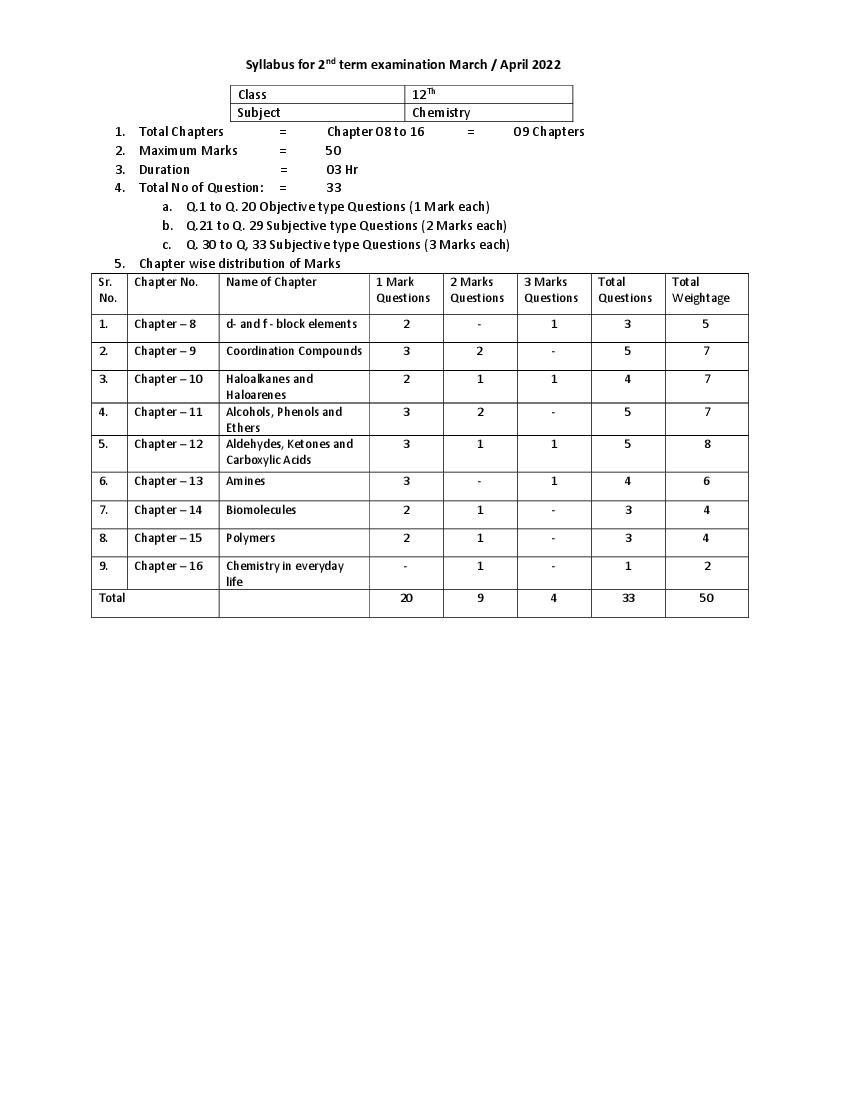
1. Total Chapters = Chapter 08 to 16 = 09 Chapters
2. Maximum Marks = 50
3. Duration = 03 Hr
4. Total No of Question: = 33
a. Q.1 to Q. 20 Objective type Questions (1 Mark each)
b. Q.21 to Q. 29 Subjective type Questions (2 Marks each)
c. Q. 30 to Q, 33 Subjective type Questions (3 Marks each)
5. Chapter wise distribution of Marks
Sr. Chapter No. Name of Chapter 1 Mark 2 Marks 3 Marks Total Total
No. Questions Questions Questions Questions Weightage
1. Chapter – 8 d- and f - block elements 2 - 1 3 5
2. Chapter – 9 Coordination Compounds 3 2 - 5 7
3. Chapter – 10 Haloalkanes and 2 1 1 4 7
Haloarenes
4. Chapter – 11 Alcohols, Phenols and 3 2 - 5 7
Ethers
5. Chapter – 12 Aldehydes, Ketones and 3 1 1 5 8
Carboxylic Acids
6. Chapter – 13 Amines 3 - 1 4 6
7. Chapter – 14 Biomolecules 2 1 - 3 4
8. Chapter – 15 Polymers 2 1 - 3 4
9. Chapter – 16 Chemistry in everyday - 1 - 1 2
life
Total 20 9 4 33 50
Page 2
Model Question Paper
Second Term Examination, March / April 2022
Class – 12
Duration – 03:00 Hr Chemistry M.M.: 50
Instructions: i) All questions are compulsory.
ii) While answering your Questions, you must indicate on your Answer-book the same Question
No. as appearing in your Question Paper.
iii) Internal choices are given in some questions.
iv) Question No. 1 to 20 carry 1mark each, Question No. 21 to 29 carry 2 marks each and
Question No. 30 to 33 carry 3 marks each.
v) Make neat and clean diagrams where required.
Q.1 The d block elements belong to (1)
a) 2 Group to 12 Group b) 3 Group to 11 Group
d) 4 Group to 12 Group d) 3 Group to 12 Group
Q.2 The relative ease of dehydration of alcohols follows the following order: (1)
a) Tertiary < Secondary < Primary b) Primary < Secondary < Tertiary
c) Secondary > Primary > Tertiary c) Secondary < Primary < Tertiary
Q.3 Which of the following is prepared by Gabriel Phthalimide reaction (1)
a) Primary Aromatic Amines b) Secondary Amines
c) Aliphatic Primary Amines c) Tertiary Amines
Q.4 which of the following is correct with respect to [Mn(CN)]2- (1)
a) It is dsp2 hybridized, square planer b) It is d2sp3 hybridised, Octahedral
c) It is sp3d2 hybridized, Octahedral d) It is sp2d2 hybridised, square planer
Q.5 Alkyl halides react with which of the following metal in dry ether to give hydrocarbons containing double the
number of carbon atoms present in halide. (1)
a) K b) Na
c) Zn d) Mg
Q.6 Three important reagents are required for the conversion of propyne to Acetone. Identify which of the
following is not among three? (1)
a) HgSO4 b) Zink Dust
c) H2SO4 d) Water
Q.7 The protein responsible for blood clotting is
a) Albumins (b) Globulins
(c) Fibroin (d) Fibrinogen
Q.8 Amines play important role in survival of human life. Naturally they are found in (1)
a) Vitamins b) Proteins
c) Alkaloids d) All of these
Page 3
a) Phosphorous b) Sulphur
c) Nitrogen d) Carbon
Q.10 When reaction is carried out between two different aldehydes or Ketones in basic medium, is called (1)
a) Complex Aldol Condensation b) Cannizzaro Reaction
c) Rosenmund Reaction d) Cross Aldol Condensation
Q.11 Complete the following reaction: (1)
CH3CH2CH=CH2 + HBr ⎯⎯⎯⎯⎯ ……………………………
Q.12 The oxidation Number of Cobalt in K[Co(CO)4] is ……………………… (1)
Q.13 …………………… enzyme used for the conversion of C6H12O6 to Ethyl Alcohol. (1)
Q.14 What is the IUPAC name of the coordination compound [Pt (NH3)2Cl (NO2)] …………… (1)
Q.15 The monomer unit of Teflon is …………………… (1)
Q.16 Which reaction is used to prepare - halo Acid …………………………… (1)
Q.17 The source of Nitrogen in Gabriel synthesis reaction of Amine is …………………………. (1)
Q.18 How many d electrons are there on Fe2+………………………… (1)
Q.19 The Scientific name of Vitamin E is …………………… (1)
Q.20 Groups like cyanides and nitrites possess two nucleophilic centres and are called …………… (1)
Q.21 Oxidation of Ketone involves carbon – carbon bond cleavage. Explain the formation of product on oxidation
of 2,5-dimethylhexean-3-one and give its name? (2)
Q.22 What is meant by the stability of a coordination compound in solution? Name the factors which govern
stability of the complex. (2)
Q.23 Although phenoxide ion has more number of resonating structures than carboxylate ion, carboxylic acid is a
stronger acid than phenol. Why? (2)
Q.24 Haloalkanes undergo nucleophilic substitution whereas haloarenes undergo electrophilic substitution.
Explain. (2)
Q.25 a) Define Essential amino acids
b) Define Enzyme (1,1)
OR
a) Write any two functions of Carbohydrates in plants?
b) Differentiate between DNA and RNA on the basis of base they contain? (1,1)
Q.26 Arrange the following in decreasing order of acidic strength. Give explanation for the arrangement:
3 – nitrophenol, 3,5-dinitrophenol, 2,4,6-trinitrophenol. (2)
OR
Explain the reaction of phenol with dilute nitric acid at 298K. Write equation. (2)
Q.27 a) What are the monomeric repeating units of Nylon-6 and Nylon-6,6?
Page 4
Q.28 a) Draw the figure to show the splitting of d- orbitals in an octahedral crystal field?
b) Aqueous copper sulphate solution (blue in colour) gives a bright green solution with aqueous
potassium chloride. Explain (1,1)
Q.29 a) What do you mean by denaturation of Proteins?
b) What are the products of hydrolysis of sucrose? (1,1)
Q.30 a) What are interstitial Compounds?
b) What is meant by disproportionation of an oxidation state? Give example (1,2)
Q.31 a) Explain why dilute Sulphuric acid is added in nitration of phenol?
b) Alkyl halides, though polar, are immiscible with water.
c) How will you convert Chlorobenzene to biphenyl? (1,1,1)
OR
a) Give reasons why the presence of nitro group (-NO2) at ortho or para positions increases the
reactivity of haloarenes towards nucleophilic substitution reactions.
b) Grignard’s reagents should be prepared under anhydrous conditions.
c) How will you convert Aniline to Bromobenzene? (1,1,1)
Q.32 Describe the following:
a) Cross Aldol Condensation
b) Decarboxylation (1½, 1½)
OR
a) Friedel – Crafts Acylation
b) Aldol Condensation Reaction (1½, 1½)
Q.33 Illustrate the following reaction with suitable example:
a) Hofmann’s bromamide reaction
b) Sandmeyer’s Reaction (1½, 1½)
OR
How will you carry out the following conversions?
a) Ethanoic Acid to methanamine
b) Nitrobenzene to benzoic acid (1½, 1½)
Document Details
| Board / Org | Himachal Pradesh Board |
| Exam | Class 12 |
| Type | Sample Paper |
| Pages | 4 |
| Updated | 30 Apr 2026 |