Karnataka SSLC Answer Key April 2019 Mathematics English Medium
Finished viewing? Save it for later —
Download Karnataka SSLC Answer Key April 2019 Mathematics English Medium (PDF · 40 pages)About Karnataka SSLC Answer Key April 2019 Mathematics English Medium
Karnataka SSLC Answer Key April 2019 Mathematics English Medium is available here for free download. Published by Karnataka Board for Class 10, this answer key can be viewed online or downloaded as a PDF (40 pages). Candidates preparing for Class 10 can use Karnataka SSLC Answer Key April 2019 Mathematics English Medium to understand the exam pattern, the type of questions asked, and the overall difficulty level.
Frequently Asked Questions
How can I download Karnataka SSLC Answer Key April 2019 Mathematics English Medium?
Open this page and click the Download button to save Karnataka SSLC Answer Key April 2019 Mathematics English Medium as a PDF. It is completely free on AglaSem Docs.
Is Karnataka SSLC Answer Key April 2019 Mathematics English Medium free to download?
Yes. Karnataka SSLC Answer Key April 2019 Mathematics English Medium can be viewed online and downloaded as a PDF free of cost on AglaSem Docs.
How many pages does Karnataka SSLC Answer Key April 2019 Mathematics English Medium have?
Karnataka SSLC Answer Key April 2019 Mathematics English Medium contains 40 pages, which you can read online or download together as a single PDF.
Where can I find more Class 10 study material?
You can find more Class 10 question papers, sample papers, syllabus, and answer keys on AglaSem Docs.
Karnataka SSLC Answer Key April 2019 Mathematics English Medium – Text
Read the full text of this answer key below — useful to quickly search, copy and reference the content online without downloading the PDF.
📄 View text version (40 pages)
Page 1
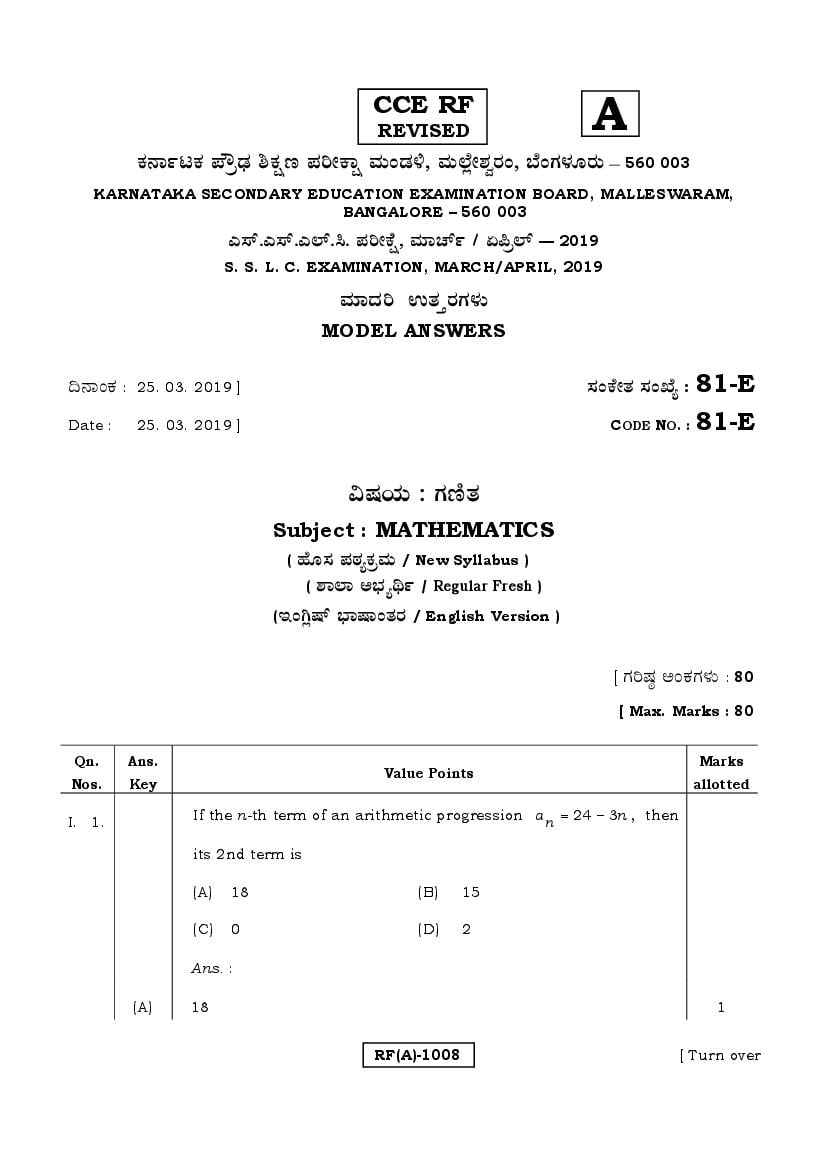
REVISED A
O⁄´¤%lO⁄ ÆË√v⁄ ÃO⁄–y Æ⁄¬fiO¤– »⁄flMs⁄ÿ, »⁄fl≈Ê«fiÀ⁄ ¡⁄M, ∑ÊMV⁄◊⁄‡¡⁄fl — 560 003
KARNATAKA SECONDARY EDUCATION EXAMINATION BOARD, MALLESWARAM,
BANGALORE – 560 003
G—È.G—È.G≈È.“. Æ⁄¬fiOÊ⁄–, »⁄·¤^È% / HØ√≈È — 2019
S. S. L. C. EXAMINATION, MARCH/APRIL, 2019
»⁄·¤•⁄¬ D}⁄ °¡⁄V⁄◊⁄fl
MODEL ANSWERS
¶´¤MO⁄ : 25. 03. 2019 ] —⁄MOÊfi}⁄ —⁄MSÊ¿ : 81-E
Date : 25. 03. 2019 ] CODE NO. : 81-E
…Œ⁄æ⁄fl : V⁄{}⁄
Subject : MATHEMATICS
(‘ʇ—⁄ Æ⁄p⁄¿O⁄√»⁄fl / New Syllabus )
( À¤≈¤ @∫⁄¥¿£% / Regular Fresh )
(BMW«ŒÈ ∫¤Œ¤M}⁄¡⁄ / English Version )
[ V⁄¬Œ⁄r @MO⁄V⁄◊⁄fl : 80
[ Max. Marks : 80
Qn. Ans. Marks
Nos. Key allotted
I. 1. If the n-th term of an arithmetic progression a n = 24 − 3n , then
its 2nd term is
(A) 18 (B) 15
(C) 0 (D) 2
(A) 18 1
RF(A)-1008 [ Turn over
Page 2
Qn. Ans. Marks
Nos. Key allotted
2.
The lines represented by 2x + 3y – 9 = 0 and 4x + 6y – 18 = 0
are
(A) Intersecting lines
(B) Perpendicular lines to each other
(C) Parallel lines
(D) Coincident lines
(D) Coincident lines 1
3.
A straight line which passes through two points on a circle is
(A) a chord (B) a secant
(C) a tangent (D) the radius
(B) a secant 1
4.
If the area of a circle is 49π sq.units then its perimeter is
(A) 7 π units (B) 9 π units
(C) 14 π units (D) 49 π units
(C) 14 π units 1
5.
“The product of two consecutive positive integers is 30.” This can
be expressed algebraically as
(A) x ( x + 2 ) = 30 (B) x ( x – 2 ) = 30
(C) x ( x – 3 ) = 30 (D) x ( x + 1 ) = 30
(D) x ( x + 1 ) = 30 1
RF(A)-1008
Page 3
Qn. Ans. Marks
Nos. Key allotted
6. If a and b are any two positive integers then HCF ( a, b ) ×
LCM ( a, b ) is equal to
(A) a+b
(B) a–b
(C) a×b
(D) a ÷ b
(C) a×b 1
7. The value of cos 48° – sin 42° is
1
(A) 0 (B)
4
1
(C) (D) 1
2
(A) 0 1
8. If P ( A ) = 0·05 then P ( A ) is
(A) 0·59
(B) 0·95
(C) 1
(D) 1·05
(B) 0·95 1
RF(A)-1008 [ Turn over
Page 4
Qn. Marks
Nos. allotted
II. Answer the following : 6×1=6
( Question Numbers 9 to 14, give full marks to direct answers )
9. The given graph represents a pair of linear equations in two variables.
Write how many solutions these pair of equations have.
one or unique 1
10. 17 = 6 × 2 + 5 is compared with Euclid’s Division lemma a = bq + r,
then which number is representing the remainder ?
5 1
11. Find the zeroes of the polynomial P ( x ) = x 2 − 3 .
x2 − 3 = 0
(x + 3) (x − 3) = 0
x = + 3, x = − 3 ½+½
Direct answer give full marks. 1
RF(A)-1008
Page 5
Qn. Marks
Nos. allotted
12. Write the degree of the polynomial P ( x ) = 2x 2 − x 3 + 5 .
3 1
13. Find the value of the discriminant of the quadratic equation
2x 2 − 4x + 3 = 0 .
b 2 − 4ac ½
= ( − 4 )2 − 4 × 2 × 3
= 16 – 24
= –8 ½ 1
14. Write the formula to calculate the curved surface area of the frustum
of a cone.
π l ( r1 + r 2 )
1
III. 15. Find the sum of first twenty terms of Arithmetic series 2 + 7 + 12 + ...
using suitable formula. 2
a=2 d = 7–2=5 n = 20
n
Sn = [ 2a + ( n − 1 ) d ] ½
2
20
S 20 = [ 2 × 2 + ( 20 – 1 ) × 5 ] ½
2
= 10 [ 4 + 19 × 5 ]
= 10 × 99 ½
S 20 = 990 ½
2
RF(A)-1008 [ Turn over
Page 6
Qn. Marks
Nos. allotted
16. In Δ ABC, AD ⊥ BC and AD 2 = BD × CD . Prove that
AB 2 + AC 2 = ( BD + CD )2 . 2
In Δ ABD
AB 2 = AD 2 + BD 2 ... (i) ½
In Δ ADC
AC 2 = AD 2 + CD 2 ... (ii) ½
(i) + (ii)
AB 2 + AC 2 = 2AD 2 + BD 2 + CD 2
½
Put AD 2 = BD × CD
AB 2 + AC 2 = 2BD . CD + BD 2 + CD 2
½
AB 2 + AC 2 = ( BD + CD )2 2
RF(A)-1008
Page 7
Qn. Marks
Nos. allotted
17.
In Δ ABC, DE || BC. If AD = 5 cm, BD = 7 cm and AC = 18 cm, find
the length of AE. 2
OR
In the given figure if PQ || RS, prove that Δ POQ ~ Δ SOR.
In Δ ABC, DE || BC
AD AE
∴ = ½
AB AC
5 AE
= ½
12 18
RF(A)-1008 [ Turn over
Page 8
Qn. Marks
Nos. allotted
5
× 18 = AE ½
12
15
AE = 2
AE = 7·5 cm ½ 2
Note : Alternate method give marks.
OR
In Δ POQ and Δ SOR
P = S ( Alternate angles )
Q = R ( Alternate angles ) 1½
POQ = ROS ( V.O.A. )
( A.A. criterion )
Δ POQ ~ Δ SOR. ½ 2
18.
Solve the following pair of linear equations by any suitable method : 2
x+y = 5
2x – 3y = 5.
Substitution method :
x+y = 5 ... (i)
2x – 3y = 5 ... (ii)
x+y = 5
y = 5–x ½
RF(A)-1008
Page 9
Qn. Marks
Nos. allotted
Substitute the value of y in equation (ii) we get
2x – 3 ( 5 – x ) = 5 ½
2x – 15 + 3x = 5
5x – 15 = 5
5x = 5 + 15
5x = 20
20
x =
5
x = 4 ½
Substituting the value of x in equation (i)
x+y = 5
4+y = 5
y = 5–4
y=1 ½ 2
Elimination method :
x+y = 5
x+y = 5 ... (i) × 2
2x – 3y = 5 ... (ii)
2x + 2y = 10 ... iii
2x – 3y = 5 ... ii ½
(–) (+) (–) (iii) — (ii)
5y = 5
5
y = y = 1 ½
5
Substitute the value of y in equation (i)
x+y = 5 ½
x+1 = 5
x = 5–1
x = 4 ½
RF(A)-1008 [ Turn over
Page 10
Qn. Marks
Nos. allotted
Cross multiplication method :
x y 1
1 –5 1 1 ½
–3 –5 2 –3
x y 1
= = ½
− 5 − 15 − 10 + 5 −3−2
x y 1
= =
− 20 −5 −5
x 1
=
− 20 −5
– 5x = – 20
− 20
x =
−5
x = 4 ½
y 1
= −
−5 5
– 5y = – 5
−5
y =
−5
y = 1 ½ 2
19. In the figure, ABCD is a square of side 14 cm. A, B, C and D are the
centres of four congruent circles such that each circle touches
externally two of the remaining three circles. Find the area of the
shaded region. 2
RF(A)-1008
Page 11
Qn. Marks
Nos. allotted
Area of the shaded region =
Area of square – 4 × area of quadrant ½
Area of a square = ( side ) 2
= ( 14 ) 2
Area of the square = 196 cm 2 ½
1
Area of a quadrant = πr 2
4
1
4 × Area of quadrant = 4 × πr 2 ½
4
1 22
= 4× × × 72
4 7
4 × Area of quadrant = 22 × 7
= 154 cm 2
Area of shaded region = 196 – 154
Area of shaded region = 42 cm 2 ½ 2
Alternate method :
Area of the shaded region =
Area of a square – 4 × area of quadrant ½
Area of a square = ( side ) 2
= ( 14 ) 2
Area of the square = 196 cm 2 ½
θ
Area of a quadrant = × πr 2
360 o
90o 22
4 × area of a quadrant = 4 × × ×7×7
360o 7
= 154 cm 2 ½
Area of shaded region = 196 – 154
Area of shaded region = 42 cm 2 . ½ 2
Note : Any alternate method marks can be given.
[ Area of shaded region = Area of a square – Area of a circle ]
RF(A)-1008 [ Turn over
Page 12
Qn. Marks
Nos. allotted
20. Draw a circle of radius 4 cm and construct a pair of tangents such
that the angle between them is 60°. 2
Angle between the radius = 180° – 60° = 120° ½
Circle — ½
Radii — ½
Tangents — ½ 2
21. Find the co-ordinates of point which divides the line segment joining
the points A ( 4, – 3 ) and B ( 8, 5 ) in the ratio 3 : 1 internally. 2
Let P ( x, y ) be the required point
⎛ m x +m x m1 y 2 + m2 y1 ⎞
( x, y ) = ⎜ 1 2 2 1, ⎟ 1
⎜ m1 + m2 m1 + m2 ⎟
⎝ ⎠
⎛ mx + nx my 2 + ny1 ⎞
OR ( x, y ) = ⎜ 2 1, ⎟
⎜ m +n m +n ⎟
⎝ ⎠
RF(A)-1008
Page 13
Qn. Marks
Nos. allotted
⎛ 3 × ( 8 ) + ( 4 ) 3 × ( 5 ) + 1× ( − 3 ) ⎞
= ⎜⎜ , ⎟⎟ ½
⎝ 3 +1 3 +1 ⎠
⎛ 24 + 4 15 − 3 ⎞
= ⎜⎜ , ⎟⎟
⎝ 4 4 ⎠
⎛ 28 12 ⎞
= ⎜⎜ , ⎟
⎝ 4 4 ⎟⎠
( x, y ) = ( 7, 3 ) ½ 2
22. Prove that 3 + 5 is an irrational number. 2
Let us assume 3 + 5 is a rational number
p
3+ 5 = where p, q ∈ z , q ≠ 0 ½
q
p
5 = −3
q
Rearranging this equation
p − 3q
5 = ½
q
p − 3q
Since p and q are integers we get is rational ½
q
So 5 is rational.
But this contradicts the fact that 5 is rational
∴ 3+ 5 is irrational ½ 2
23. The sum and product of the zeroes of a quadratic polynomial
P ( x ) = ax 2 + bx + c are – 3 and 2 respectively. Show that b + c = 5a.
2
RF(A)-1008 [ Turn over
Page 14
Qn. Marks
Nos. allotted
Let α and β are the zeroes of the quadratic polynomial P ( x )
α+β = –3 ½
b
− = –3
a
– b = – 3a
b = 3a ... (i) ½
αβ = 2
c
= 2
a
c = 2a ... (ii) ½
(i) + (ii) gives
b + c = 3a + 2a
b + c = 5a. ½ 2
24. Find the quotient and the remainder when P ( x ) = 3x 3 + x 2 + 2x + 5
is divided by g ( x ) = x 2 + 2x + 1 . 2
3x – 5
x 2 + 2x + 1 ) 3x 3 + x 2 + 2x + 5 (
3x 3 + 6x 2 + 3x 1
(–) (–) (–)
– 5x2 – x + 5
– 5 x 2 – 10x – 5
(+) (+) (+)
9x + 10
Quotient = 3x – 5 ½
Remainder = 9x + 10 ½ 2
RF(A)-1008
Page 15
Qn. Marks
Nos. allotted
25. Solve 2x 2 − 5x + 3 = 0 by using formula. 2
Comparing the equation with
ax 2 + bx + c = 0
a=2 b = –5 c = 3
−b ± b 2 − 4ac
x = ½
2a
−( −5 )± ( − 5 )2 − 4 × 2 × 3
x = ½
2×2
5± 25 − 24
x =
4
5± 1
x =
4
5 ±1
x =
4
5 +1 5 −1
x = , x = ½
4 4
6 4
x = x =
4 4
3
x = x = 1 ½
2 2
26. The length of a rectangular field is 3 times its breadth. If the area of
the field is 147 sq.m, find its length and breadth. 2
Let the breadth be x
∴ Length = 3x ½
A = l×b
147 = 3x × x ½
147 = 3 x 2
147
x2 =
3
RF(A)-1008 [ Turn over
Page 16
Qn. Marks
Nos. allotted
x 2 = 49
x = ± 49
x = ± 7 ½
∴ Breadth ( x ) = 7 cm
Length ( 3x ) = 3 × 7 = 21 cm ½ 2
27. 12
If sin θ = , find the values of cos θ and tan θ. 2
13
OR
If 3 tan θ = 1 and θ is acute, find the value of sin 3θ + cos 2θ.
½
AB 2 = AC 2 + BC 2
132 = 122 + BC 2
169 = 144 + BC 2
BC 2 = 169 – 144
BC 2 = 25 BC = 25
BC = 5 ½
BC 5
cos θ = = ½
AC 13
AC 12
tan θ = = ½
BC 5 2
OR
RF(A)-1008
Page 17
Qn. Marks
Nos. allotted
3 tan θ = 1
1
tan θ = ½
3
tan θ = tan 30°
θ = 30°
sin 3θ = sin 3 × 30° = sin 90° = 1
1
cos 2θ = cos 2 × 30° = cos 60° = 1
2
1 1
sin 3θ + cos 2θ = 1 + =1
2 2
3
sin 3θ + cos 2θ = ½
2 2
⎛ 1 + cos θ ⎞
28. Prove that ⎜⎜ ⎟⎟ = ( cosec θ + cot θ ) 2 . 2
⎝ 1 − cos θ ⎠
⎛ 1 + cos θ ⎞
L.H.S. = ⎜⎜ ⎟⎟
⎝ 1 − cos θ ⎠
( 1 + cos θ ) ( 1 + cos θ )
= × ½
( 1 − cos θ ) ( 1 + cos θ )
( 1 + cos θ )2
=
12 − cos 2 θ
( 1 + cos θ )2
= ½
sin 2 θ
2
⎛ 1 + cos θ ⎞
= ⎜⎜ ⎟⎟
⎝ sin θ ⎠
2
⎛ 1 cos θ ⎞
= ⎜⎜ + ⎟⎟ ½
⎝ sin θ sin θ ⎠
1 + cos θ
= ( cosec θ + cot θ ) 2 = R.H.S. ½
1 − cos θ 2
Any alternative method, marks can be awarded.
RF(A)-1008 [ Turn over
Page 18
Qn. Marks
Nos. allotted
29. A cubical die numbered from 1 to 6 are rolled twice. Find the
probability of getting the sum of numbers on its faces is 10. 2
n ( S ) = 36 ½
n ( A ) = { ( 5, 5 ) ( 4, 6 ) ( 6, 4 ) } = 3 ½
n(A)
P(A) = ½
n (S )
3
= ½
36 2
30. The radii of two circular ends of a frustum of a cone shaped dustbin
are 15 cm and 8 cm. If its depth is 63 cm, find the volume of the
dustbin. 2
r 1 = 15 cm r 2 = 8 cm h = 63 cm
1
Volume of dustbin ( V ) = π h ( r 12 + r 2
2 + r1r 2 ) ½
3
1 22
= × × 63 ( 15 2 + 8 2 + 15 × 8 ) ½
3 7
= 66 ( 225 + 64 + 120 ) ½
= 66 × 409
Volume of dustbin ( V ) = 26994 cm 3 . ½ 2
RF(A)-1008
Page 19
Qn. Marks
Nos. allotted
IV. 31. Prove that “the lengths of tangents drawn from an external point to a
circle are equal”. 3
OR
In the given figure PQ and RS are two parallel tangents to a circle with
centre O and another tangent AB with point of contact C intersecting
PQ at A and RS at B. Prove that AOB = 90°.
½
Data : O is the centre of the circle P is an external point
PQ and PR are the tangents ½
To prove : PQ = PR ½
RF(A)-1008 [ Turn over
Page 20
Qn. Marks
Nos. allotted
Construction : OQ, OR and OP are joined ½
Proof : In Δ POQ and Δ POR
PQO = PRO ( Radius drawn at the point of
contact is perpendicular to the tangent )
hyp OP = hyp OP ( Common side )
OQ = OR ( Radii of same circle )
∴ Δ POQ ≡ Δ POR ( R.H.S. theorem ) ½
∴ PQ = PR ½ 3
Alternate method :
½
Proof : We are given a circle with centre O a point P lying
outside the circle and two tangents PQ and PR on the circle
from P. ½
We are required to prove that PQ = PR ½
For this we join OP, OQ and OR.
Then OQP and ORP are right angles because these are
angles between the radii and tangents. ½
RF(A)-1008
Page 21
Qn. Marks
Nos. allotted
According to theorem 4·1 they are right angles
Now in right triangles angles OQP and ORP
OQ = OR ( Radii of same circle ) ½
OP = OP ( common )
Therefore Δ OQP = Δ ORP ( R.H.S. )
This gives PQ = PR. ½ 3
OR
Let OAB = x
∴ OAX = x
OBA = y ½
OBY = y
PQ || RS
∴ XAB + YBA = 180°
2x + 2y = 180° 1
2 ( x + y ) = 180°
180 o
x+y =
2
x + y = 90°
RF(A)-1008 [ Turn over
Page 22
Qn. Marks
Nos. allotted
In Δ AOB
OAB + OBA + AOB = 180° 1
x + y + AOB = 180°
90° + AOB = 180° ( Q x + y = 90° )
AOB = 180° – 90°
AOB = 90° ½ 3
32. Calculate the median of the following frequency distribution table : 3
Class-interval Frequency ( f i )
1—4 6
4—7 30
7 — 10 40
10 — 13 16
13 — 16 4
16 — 19 4
∑ f i = 100
OR
Calculate the mode for the following frequency distribution table.
Class-interval Frequency ( f i )
10 — 25 2
25 — 40 3
40 — 55 7
55 — 70 6
70 — 85 6
85 — 100 6
∑ f i = 30
RF(A)-1008
Page 23
Qn. Marks
Nos. allotted
Class-interval Frequency Cumulative frequency
1—4 6 6
4—7 30 36
½
7 — 10 40 76
10 — 13 16 92
13 — 16 4 96
16 — 19 4 100
n 100
= = 50
2 2
Lower limit of median class l = 7
C.F. of class preceding median class c. f. = 36 1
Frequency of median class f = 40
Class size h = 3
⎡ n ⎤
⎢ −c f ⎥
Median = l + ⎢ 2 ⎥ ×h ½
⎢ f ⎥
⎢⎣ ⎥⎦
⎡ 50 − 36 ⎤
= 7+ ⎢ ⎥ ×3 ½
⎣ 40 ⎦
⎡ 14 ⎤
= 7+ ⎢ ⎥ ×3
⎣ 40 ⎦
21
= 7 +
20
= 7 + 1·05
Median = 8·05 ½ 3
OR
Lower limit l = 40
Frequency of modal class f1 = 7
Frequency of preceding modal class f0 = 3
RF(A)-1008 [ Turn over
Page 24
Qn. Marks
Nos. allotted
Succeeding modal class f2 = 6
Class size h = 15 1
⎡ f1 − f 0 ⎤
Mode = l + ⎢ ⎥ ×h ½
⎢ 2f 1 − f 0 − f 2 ⎥
⎣ ⎦
⎡ 7−3 ⎤
= 40 + ⎢ ⎥ × 15 ½
⎣ 14 − 6 − 3 ⎦
⎡ 4 ⎤
= 40 + ⎢ ⎥ × 15
⎣ 5 ⎦
4
= 40 + × 15 ½
5
= 40 + 12
Mode = 52 ½ 3
33.
During the medical check-up of 35 students of a class, their weights
were recorded as follows. Draw a less than type of ogive for the given
data : 3
Weight ( in kg ) Number of
students
Less than 38 0
Less than 40 3
Less than 42 5
Less than 44 9
Less than 46 14
Less than 48 28
Less than 50 32
Less than 52 35
RF(A)-1008
Page 25
Qn. Marks
Nos. allotted
Number of Students
Weight in kg
x and y axis scale — ½
Plotting points — 1½
Drawing graph — 1 3
Note : Scale, x-axis, y-axis can be changed.
34. The seventh term of an Arithmetic progression is four times its second
term and twelfth term is 2 more than three times of its fourth term.
Find the progression. 3
OR
RF(A)-1008 [ Turn over
Page 26
Qn. Marks
Nos. allotted
A line segment is divided into four parts forming an Arithmetic
progression. The sum of the lengths of 3rd and 4th parts is three
times the sum of the lengths of first two parts. If the length of fourth
part is 14 cm, find the total length of the line segment.
a 7 = T7 = 4 ( T2 ) a 2
½
a + 6d = 4 ( a + d )
a + 6d = 4a + 4d
6d – 4d = 4a – a
2d = 3a ... (i) ½
a12 = T12 = 3T 4 ( a 4 ) + 2
a + 11d = 3 ( a + 3d ) + 2
a + 11d = 3a + 9d + 2
11d – 9d = 3a – a + 2
2d = 2a + 2 ... (ii) ½
substituting (i) in (ii)
3a = 2a + 2
3a – 2a = 2
a = 2 ½
2d = 3a
2d = 3 × 2
2d = 6
6
d =
2
d = 3 ½
RF(A)-1008
Page 27
Qn. Marks
Nos. allotted
∴ The required sequence
a, a+d, a + 2d
2, 2 + 3, 2+2×3
The required sequence 2, 5, 8 ..... ½ 3
OR
Let the four parts of the line segment be
a – 3d, a – d, a + d, a + 3d ½
According to the data
( a + d + a + 3d ) = 3 ( a – 3d + a – d )
2a + 4d = 3 ( 2a – 4d ) ½
2 ( a + 2d ) = 3 × 2 ( a – 2d )
a + 2d = 3a – 6d
2d + 6d = 3a – a
2a = 8d
8d
a =
2
a = 4d ½
a + 3d = 14 ½
4d + 3d = 14
7d = 14
14
d =
7
d = 2
a = 4d
a = 4×2
a = 8 ½
RF(A)-1008 [ Turn over
Page 28
Qn. Marks
Nos. allotted
∴ Length of the line segment =
= a – 3d + a – d + a + d + a + 3d
= 4a
= 4 × 8 = 32 cm. ½ 3
Note : Any alternate method marks can be given.
35. The vertices of a Δ ABC are A ( – 3, 2 ), B ( – 1, – 4 ) and C ( 5, 2 ).
If M and N are the mid-points of AB and AC respectively, show that
2 MN = BC. 3
OR
The vertices of a Δ ABC are A ( – 5, – 1 ), B ( 3, – 5 ), C ( 5, 2 ). Show
that the area of the Δ ABC is four times the area of the triangle formed
by joining the mid-points of the sides of the triangle ABC.
⎛ x + x 2 y1 + y 2 ⎞
Co-ordinates of M = ⎜ 1 , ⎟
⎜ 2 2 ⎟
⎝ ⎠
⎛ −1− 3 −4+2 ⎞
= ⎜⎜ , ⎟⎟
⎝ 2 2 ⎠
Co-ordinates of M = ( – 2, – 1 ) 1
⎛ 5−3 2+2 ⎞
Co-ordinates of N = ⎜⎜ , ⎟
⎝ 2 2 ⎟⎠
⎛ 2 4 ⎞
= ⎜⎜ , ⎟
⎝ 2 2 ⎟⎠
Co-ordinates of N = ( 1, 2 )
Length of MN = ( x 2 − x1 )2 + ( y 2 − y1 )2 ½
RF(A)-1008
Page 29
Qn. Marks
Nos. allotted
= ( 1 + 2 )2 + ( 2 + 1 )2
= 32 + 32 ½
= 9+9 = 18
= 9×2 = 3 2
MN = 3 2
Length of BC = ( x 2 − x1 )2 + ( y 2 − y1 )2
= ( 5 + 1 )2 + ( 2 + 4 )2
= 62 + 62
= 36 +36
= 72
= 36 × 2
BC = 6 2 ½
2MN = 2 × 3 2
= 6 2
∴ 2MN = BC ½ 3
OR
RF(A)-1008 [ Turn over
Page 30
Qn. Marks
Nos. allotted
( x1 , y1 ) = ( − 5 , − 1 ) , ( x 2 , y2 ) = ( 3 , − 5 ) , ( x 3 , y3 ) = ( 5 , 2 )
Area of triangle ABC =
1
= [ x ( y − y 3 ) + x 2 ( y 3 − y1 ) + x 3 ( y1 − y 2 ) ]
2 1 2
1
= [ − 5 ( − 5 − 2 ) + 3 ( 2 +1 ) + 5 ( − 1 + 5 ) ] ½
2
1
= [ −5×( − 7 )+ 3×3 + 5×4]
2
1
= [ 35 + 9 + 20 ]
2
1
= × 64 ½
2
Area of Δ ABC = 32 sq.units
⎛ x + x2 y1 + y 2 ⎞
Co-ordinates of D = ⎜ 1 , ⎟
⎜ 2 2 ⎟
⎝ ⎠
⎛ − 5 + 3 −1− 5 ⎞
= ⎜⎜ , ⎟⎟
⎝ 2 2 ⎠
⎛ −2 −6 ⎞
= ⎜⎜ , ⎟
⎝ 2 2 ⎟⎠
Co-ordinates of D = ( – 1, – 3 )
RF(A)-1008
Page 31
Qn. Marks
Nos. allotted
⎛ 3+5 −5+2 ⎞
Co-ordinates of E = ⎜⎜ , ⎟⎟
⎝ 2 2 ⎠
⎛ 8 −3 ⎞
= ⎜⎜ , ⎟
⎝ 2 2 ⎟⎠
⎛ −3 ⎞
Co-ordinates of E = ⎜⎜ 4 , ⎟
⎝ 2 ⎟⎠
⎛ −5+5 −1+ 2 ⎞
Co-ordinates of F = ⎜⎜ , ⎟⎟ 1
⎝ 2 2 ⎠
⎛ 0 1 ⎞
= ⎜⎜ , ⎟
⎝ 2 2 ⎟⎠
⎛ 1 ⎞
Co-ordinates of F = ⎜⎜ 0 , ⎟
⎝ 2 ⎟⎠
⎛ 3 ⎞ ⎛ 1 ⎞
( x1 , y1 ) = ( − 1, − 3 ) ( x 2 , y 2 ) = ⎜ 4 , − ⎟ ( x 3 , y3 ) = ⎜ 0 , ⎟
⎝ 2 ⎠ ⎝ 2 ⎠
Area of Δ DEF =
1 ⎡ ⎛ −3 1 ⎞ ⎛ 1 ⎞ ⎛ 3 ⎞⎤
= ⎢ − 1 ⎜⎜ − ⎟⎟ + 4 ⎜⎜ + 3 ⎟⎟ + 0 ⎜⎜ − 3 + ⎟⎟⎥
2 ⎢ ⎝ 2 2 ⎠ ⎝ 2 ⎠ ⎝ 2 ⎠⎥
⎣ ⎦
1 ⎡ 7 ⎤
= ⎢ −1× ( − 2 ) + 4 × +0⎥ ½
2 ⎣ 2 ⎦
1
= [ 2 + 14 ]
2
1
= × 16
2
Δ DEF = 8 sq. units
∴ Area of Δ ABC = 4 × area of Δ DEF
32 = 4 × 8 ½
32 = 32 3
Note : Any alternate method can be given marks.
RF(A)-1008 [ Turn over
Page 32
Qn. Marks
Nos. allotted
36. Construct a triangle with sides 5 cm, 6 cm and 7 cm and then
7
construct another triangle whose sides are of the corresponding
5
sides of the first triangle. 3
Constructing given triangle 1
Drawing acute angle line and dividing into 7 parts ½
Drawing parallel lines ( one pair ) ½
Drawing parallel line ( another pair ) ½
Triangle A l BC l ½ 3
RF(A)-1008
Page 33
Qn. Marks
Nos. allotted
V. 37. Find the solution of the following pairs of linear equation by the
graphical method : 4
2x + y = 6
2x – y = 2
2x + y = 6
y = 6 – 2x
x 0 1 2
y 6 4 2
2x – y = 2
y = 2x – 2
x 0 1 2
y –2 0 2
Tables — 2
Drawing or Plotting 2 straight lines — 1
Identifying Intersecting straight line points and answer — 1 4
Note : Any two points can be taken for each equation.
RF(A)-1008 [ Turn over
Page 34
Qn. Marks
Nos. allotted
38. The angles of elevation of the top of a tower from two points at a
distance of 4 m and 9 m from the base of the tower and in the same
straight line with it are complementary. Find the height of the tower.
4
RF(A)-1008
Page 35
Qn. Marks
Nos. allotted
½
Let AB be tower
ACB = x°
∴ ADB = 90° – x ½
In Δ ABC
AB
tan x =
BC
AB
tan x = ... (i) ½
4
In Δ ADB
AB
tan ( 90° – x ) =
9
AB
cot x = ... (ii) ½
9
(i) × (ii)
AB AB
tan x × cot x = × 1½
4 9
1 AB 2
tan x × =
tan x 36
AB 2
1 =
36
AB 2 = 36
AB = ± 36 AB = ± 6
∴ Height of the tower AB = 6 m. ½ 4
Note : C and D can be taken on the same side of AB.
Alternate method :
AB 1 AB 1 AB
cot x = = =
9 tan x 9 AB 9
4
4 AB
= AB 2 = 36 AB = ± 6
AB 9
AB = 6 m.
RF(A)-1008 [ Turn over
Page 36
Qn. Marks
Nos. allotted
39. The bottom of a right cylindrical shaped vessel made from metallic
sheet is closed by a cone shaped vessel as shown in the figure. The
radius of the circular base of the cylinder and radius of the circular
base of the cone each is equal to 7 cm. If the height of the cylinder is
20 cm and height of cone is 3 cm, calculate the cost of milk to fill
completely this vessel at the rate of Rs. 20 per litre. 4
OR
A hemispherical vessel of radius 14 cm is fully filled with sand. This
sand is poured on a level ground. The heap of sand forms a cone
shape of height 7 cm. Calculate the area of ground occupied by the
circular base of the heap of the sand.
Volume of the vessel is equal to
Volume of the cylinder – Volume of cone ½
Volume of the cylinder = π r 2 h ½
22
= × 7 2 × 20
7
Volume of the cylinder = 3080 cm 3 ½
RF(A)-1008
Page 37
Qn. Marks
Nos. allotted
1
Volume of the cone = πr 2 h ½
3
1 22
= × × 72 × 3
3 7
Volume of the cone = 154 cm 3 ½
Volume of vessel = Volume of cylinder – volume of cone
= 3080 – 154
= 2926 cm 3 ½
2926
= = 2·926 litres. ½
1000
∴ Cost of milk to fill this vessel at the rate of Rs. 20 per litre
= 2·926 × 20
= 58·520
= Rs. 58·520 ½ 4
OR
2
Volume of the hemisphere = πr 3 ½
3
1
Volume of the cone = πr 2 h ½
3
Hemisphere Cone
r = 14 cm h = 7 cm.
Volume of hemisphere = Volume of cone
2 1
πr 3 = πr 2 h ½
3 3
2 × ( 14 ) 3 = r 2 × 7
2 × ( 14 )3
r2 =
7
2 × 14 × 14 × 14
= 1
7
r 2 = 196 × 4
r 2 = 784
RF(A)-1008 [ Turn over
Page 38
Qn. Marks
Nos. allotted
r = 784
r = 28 cm
∴ The area occupied by the circular base of the heap of the sand
on the ground = πr 2 ½
22
= × ( 28 )2
7
22
= × 28 × 28 ½
7
= 2464 cm 2 ½ 4
40. Prove that “the ratio of the areas of two similar triangles is equal to the
square of the ratio of their corresponding sides”. 4
½
Data : Δ ABC ~ Δ PQR ½
Area of Δ ABC BC 2
To prove : = ½
Area of Δ PQR QR 2
Construction : Draw AM ⊥ BC and PN ⊥ QR ½
Proof : In Δ AMB and Δ PQN
ABM = PQN ( Data )
AMB = PNQ = 90° ( Construction )
Δ AMB ~ Δ PQN ½
AM AB
∴ = A.A criteria
PN PQ
BC AB
But = Data
QR PQ
AB BC
∴ = ½
PQ QR
RF(A)-1008
Page 39
Qn. Marks
Nos. allotted
1
Area of Δ ABC × BC × AM
= 2 ½
Area of Δ PQR 1
× QR × PN
2
BC AM
= ×
QR PN
BC BC ⎡ AM BC ⎤
= × , ⎢ PN = QR ⎥
QR QR ⎣ ⎦
BC 2
=
QR 2
Area of Δ ABC BC 2
∴ = ½
Area of Δ PQR QR 2 4
Alternate method :
½
Data : We are given two triangles ABC and PQR such that
Δ ABC ~ Δ PQR ½
We need to prove that
2 2 2
ar ( ABC ) ⎛ AB ⎞ ⎛ BC ⎞ ⎛ CA ⎞
= ⎜⎜ ⎟⎟ = ⎜⎜ ⎟⎟ = ⎜⎜ ⎟⎟ ½
ar ( PQR ) ⎝ PQ ⎠ ⎝ QR ⎠ ⎝ RP ⎠
For finding areas of two triangles
Draw altitudes AM and PN of the triangles ½
1
ar ( ABC ) BC × AM
Now = 2
ar ( PQR ) 1
QR × PN
2
BC AM
= × ... (i) ½
QR PN
RF(A)-1008 [ Turn over
Page 40
Qn. Marks
Nos. allotted
Now in Δ ABM and Δ PQN
B = Q ( As Δ ABC ~ Δ PQR )
M = N ( each is of 90° )
Δ ABM ~ Δ PQN ( A. A. criterion ) ½
AM AB
Therefore = ... (ii)
PN PQ
Also Δ ABC ~ Δ PQR ( given )
AB BC CA
= = ... (iii) ½
PQ QR RP
ar ( ABC ) AB AM
Therefore = ×
ar ( PQR ) PQ PN
From (i) and (iii)
AB AB
= × ( from (i) and (iii) )
PQ PQ
2
⎛ AB ⎞
= ⎜⎜ ⎟⎟
⎝ PQ ⎠
Now using (iii) we get
2 2 2
ar ( ABC ) ⎛ AB ⎞ ⎛ BC ⎞ ⎛ CA ⎞
= ⎜⎜ ⎟⎟ = ⎜⎜ ⎟⎟ = ⎜⎜ ⎟⎟ ½
ar ( PQR ) ⎝ PQ ⎠ ⎝ QR ⎠ ⎝ RP ⎠ 4
RF(A)-1008
Document Details
| Board / Org | Karnataka Board |
| Exam | Class 10 |
| Type | Answer Key |
| Pages | 40 |
| Updated | 09 Jun 2026 |