HP Board Class 11 Syllabus 2024 Business Study
Finished viewing? Save it for later —
Download HP Board Class 11 Syllabus 2024 Business Study (PDF · 6 pages)About HP Board Class 11 Syllabus 2024 Business Study
HP Board Class 11 Syllabus 2024 Business Study is available here for free download. Published by Himachal Pradesh Board for Class 11, this syllabus can be viewed online or downloaded as a PDF (6 pages). Candidates preparing for Class 11 can use HP Board Class 11 Syllabus 2024 Business Study to understand the exam pattern, the type of questions asked, and the overall difficulty level.
Frequently Asked Questions
How can I download HP Board Class 11 Syllabus 2024 Business Study?
Open this page and click the Download button to save HP Board Class 11 Syllabus 2024 Business Study as a PDF. It is completely free on AglaSem Docs.
Is HP Board Class 11 Syllabus 2024 Business Study free to download?
Yes. HP Board Class 11 Syllabus 2024 Business Study can be viewed online and downloaded as a PDF free of cost on AglaSem Docs.
How many pages does HP Board Class 11 Syllabus 2024 Business Study have?
HP Board Class 11 Syllabus 2024 Business Study contains 6 pages, which you can read online or download together as a single PDF.
Where can I find more Class 11 study material?
You can find more Class 11 question papers, sample papers, syllabus, and answer keys on AglaSem Docs.
HP Board Class 11 Syllabus 2024 Business Study – Text
Read the full text of this syllabus below — useful to quickly search, copy and reference the content online without downloading the PDF.
📄 View text version (6 pages)
Page 1
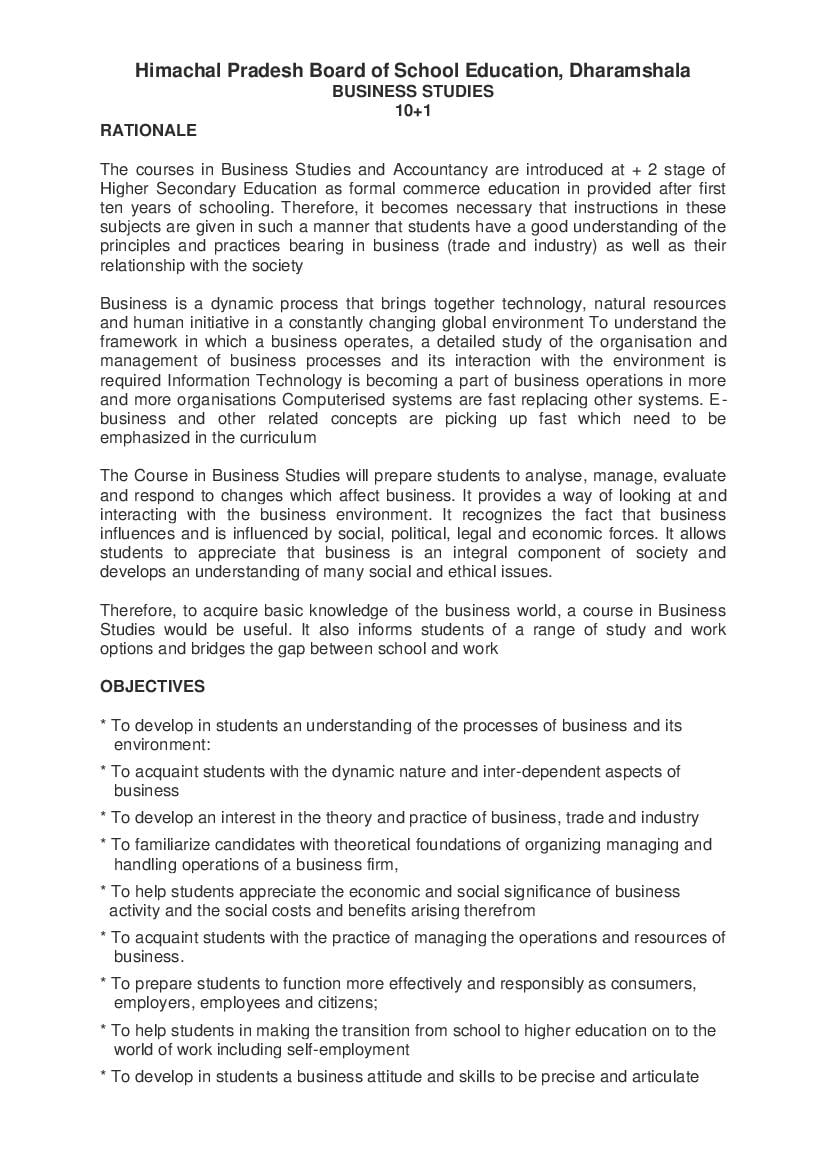
BUSINESS STUDIES
10+1
RATIONALE
The courses in Business Studies and Accountancy are introduced at + 2 stage of
Higher Secondary Education as formal commerce education in provided after first
ten years of schooling. Therefore, it becomes necessary that instructions in these
subjects are given in such a manner that students have a good understanding of the
principles and practices bearing in business (trade and industry) as well as their
relationship with the society
Business is a dynamic process that brings together technology, natural resources
and human initiative in a constantly changing global environment To understand the
framework in which a business operates, a detailed study of the organisation and
management of business processes and its interaction with the environment is
required Information Technology is becoming a part of business operations in more
and more organisations Computerised systems are fast replacing other systems. E-
business and other related concepts are picking up fast which need to be
emphasized in the curriculum
The Course in Business Studies will prepare students to analyse, manage, evaluate
and respond to changes which affect business. It provides a way of looking at and
interacting with the business environment. It recognizes the fact that business
influences and is influenced by social, political, legal and economic forces. It allows
students to appreciate that business is an integral component of society and
develops an understanding of many social and ethical issues.
Therefore, to acquire basic knowledge of the business world, a course in Business
Studies would be useful. It also informs students of a range of study and work
options and bridges the gap between school and work
OBJECTIVES
* To develop in students an understanding of the processes of business and its
environment:
* To acquaint students with the dynamic nature and inter-dependent aspects of
business
* To develop an interest in the theory and practice of business, trade and industry
* To familiarize candidates with theoretical foundations of organizing managing and
handling operations of a business firm,
* To help students appreciate the economic and social significance of business
activity and the social costs and benefits arising therefrom
* To acquaint students with the practice of managing the operations and resources of
business.
* To prepare students to function more effectively and responsibly as consumers,
employers, employees and citizens;
* To help students in making the transition from school to higher education on to the
world of work including self-employment
* To develop in students a business attitude and skills to be precise and articulate
Page 2
UNITS
PART A: FOUNDATIONS OF BUSINESS
1. Nature and Purpose of Business
2. Forms of Business Organisations
3. Private, Public and Global Enterprises
4. Business Services
5. Emerging Modes of Business
6. Social Responsibility of Business and Business Ethics
PART B: CORPORATE ORGANIZATION, FINANCE AND TRADE
7. Formation of a company
8. Sources of Business Finance
9. Small Business
10. Internal Trade
11. International Business
PART C: PROJECT WORK (PRACTICAL)
12. Record of Project and Viva
PART A: FOUNDATIONS OF BUSINESS
Unit 1: Nature and Purpose of Business
* Concept and characteristics of business
* Business, profession and employment - distinctive features
* Objectives of business - economic and social role of profit in business
* Classification of business activities Industry and Commerce
* Industry - types primary, secondary, tertiary.
* Commerce. Trade and Auxiliaries.
* Business risk - nature and causes.
UNIT 2 : FORMS OF BUSINESS ORGANISATIONS
* Sole Proprietorship Joint Hindu Family Business-meaning, features, merits and
limitations
* Partnership-meaning, types, registration, merits, limitations, types of partners.
* Cooperative Societies-types, merits and limitations.
* Company: Private Ltd. Public Ltd.- merits, limitations;
* Choice of form of business organizations
* Starting a business-Basic factors.
Page 3
* Private Sector and Public Sector.
* Forms of organising public sector enterprises
* Departmental Undertaking
* Statutory Corporation
* Government Company
* Changing role of public sector
* Global Enterprises (Multinational Companies) meaning and features, joint ventures-
meaning, benefits
Unit 4 : Business Services
* Nature and types of Business services-Banking Insurance Transportation, Ware
housing, Communication
* Banking-types of Banks, Functions of Commercial banks, E-banking
* Insurance-principles, types life, fire and marine
* Postal and Telecom services
* Warehousing types and functions.
UNIT-5 EMERGING MODES OF BUSINESS
* E-Business-Meaning, scope and benefits. Resources required for successful e-
business implementation, On-line transactions, payment mechanism, security and
safety of business transactions
* Outsourcing-concept, need and scope.
Unit 6: Social Responsibility of Business and Business Ethics
* Concept of social responsibility
* Case for Social responsibility
* Responsibility towards owners, investors) employees, consumers, government,
community and public in general
* Business and environmental protection
* Business ethics concept and elements
Part-B : CORPORATE ORGANISATION, FINANCE AND TRADE
Unit 7: Formation of a Company
* Stages in the formation of a company
* Promotion
* Incorporation, and
* Commencement of business
Unit 8: Sources of Business Finance
* Nature and significance
* Owner's funds and borrowed funds
Page 4
- Equity and Preference shares
- Global Depository Receipt, American Depository Receipt
- Debentures and Bonds
- Retained Profits
- Public deposits
- Loan from Financial Institutions
- Loans from commercial Banks
- Trade Credit
Unit 9: Small Business
* Small Scale Industry: Tiny Sector, cottage and rural industry:
* Role of small business in rural India,
* Problems of small business in India
* Government Assistance and Special Schemes for Industries in rural, backward and
hilly areas
Unit 10: Internal Trade.
* Meaning and types of internal trade wholesale and retail:
* Services of a wholesaler and a retailer,
* Types of Retail Trade :
- Itinerant retailers and fixed shops.
- Departmental store, super market malls, chain store, mail order business,
consumer's cooperative store
- Automatic Vending Machine.
* Role of Chamber of Commerce and Industry in promotion of internal.
Unit 11 : International Business.
* Nature, Importance and complexities involved in International Business
* Ways of entering into international Business Export-Import Procedures and
documentation Foreign Trade Promotion Organizational support and incentives,
Nature and importance of Export Processing Zonel special Economic Zone:
International Trade Institutions and Agreement WTO, UNCTAD, World Bank, IMF
PART-C
Unit-12 : Project Work (Practical)
SUGGESTIVE/ILLUSTRATIVE PROJECTS
Any one of the following:
(i) Find out from local sample business unit (s) the various objectives they pursue
(ii) Problems of setting up and running business units.
(iii) Enquiry into the ethics of running business through questionnaires
(iv) Survey of quality of bank services in the local branch office
(v) Study of postal and courier mail services.
Page 5
savings schemes, etc.
(vi) Survey of the popularity of credit cards issued by different banks.
(viii) Study the profile of a sole trader/partnership commenting on the nature and
working of business.
(ix) Study of a Joint Hindu family business
(x) Study of the working of any cooperative society.
(xi) Study of a small business unit regarding source of finance
(xii) Nature of different traders (like hawkers and pedlars in a specific locality) in
issue of goods, capital investment, turnover.
(xii) Study of weekly bazaar in a locality
(xiv) Study of franchise retail store.
(xv) Study of export/import of any article
(xvi) Problems of women entrepreneurs in business.
(xvii) Waste/garbage disposal.
(xvill) Study of pavement trade.
(xix) Prepare a scrapbook and collect articles on the changing role of public sector
and any other topics related to the syllabus.
Marks may be suitably distributed over the different parts of the Project Report (1)
Objectives (2) Methodology (3) Conclusions findings and suggestions (4) Viva.
Business Studies
11th
Unit Wise Distribution of Marks
Unit No. Particulars Marks Assigned
PART A: FOUNDATIONS OF BUSINESS
1 Nature and Purpose of Business 06
2 Forms of Business Organisations 07
3 Private, Public and Global Enterprises 06
4 Business Services 07
5 Emerging Modes of Business 05
6 Social Responsibility of Business and Business Ethics 04
Sub Total 35
PART B: CORPORATE ORGANIZATION, FINANCE AND TRADE
7 Formation of a company 05
8 Sources of Business Finance 07
9 Small Business 03
10 Internal Trade 04
11 International Business 06
Sub Total 25
Grand Total 60
Page 6
Sr. Name of Unit 1 Mark 2 Marks 3 Marks 4 Marks 5 Marks Total
No MCQ Question Question Question Question
Question
1 Nature and Purpose of Business 1 1 1 - - 6
2 Forms of Business 2 - - - 1 7
Organisations (Internal
Choice)
3 Private, Public and Global 1 1 1 - - 6
Enterprises
4 Business Services 1 1 - 1 - 7
(Internal
Choice)
5 Emerging Modes of Business 1 - - 1 - 5
(Internal
Choice)
6 Social Responsibility of 1 - 1 - - 4
Business and Business Ethics
7 Formation of a Company 1 - - 1 - 5
(Internal
Choice)
8 Sources of Business Finance 1 1 - 1 - 7
(Internal
Choice)
9 Small Business 1 1 - - - 3
10 Internal Trade 1 - 1 - 1 4
(Choice)
11 International Business 1 - - - 1 6
Total 1x12=12 2x5=10 3x4=12 4x4=16 5x2=10 60
Blue Print of MCQ
Sr. No. Type of Questions No. of Questions
1 Concept based/Direct 5
2 Match the columns 2
3 Case study/statement 1
4 Assertion & Reasoning 1
5 Miscellaneous understanding & Knowledge based 3
Total No. of Questions 12
Document Details
| Board / Org | Himachal Pradesh Board |
| Exam | Class 11 |
| Type | Syllabus |
| Pages | 6 |
| Updated | 22 Jul 2026 |