HP Board Class 11 Syllabus 2024 Economics
Finished viewing? Save it for later —
Download HP Board Class 11 Syllabus 2024 Economics (PDF · 7 pages)About HP Board Class 11 Syllabus 2024 Economics
HP Board Class 11 Syllabus 2024 Economics is available here for free download. Published by Himachal Pradesh Board for Class 11, this syllabus can be viewed online or downloaded as a PDF (7 pages). Candidates preparing for Class 11 can use HP Board Class 11 Syllabus 2024 Economics to understand the exam pattern, the type of questions asked, and the overall difficulty level.
Frequently Asked Questions
How can I download HP Board Class 11 Syllabus 2024 Economics?
Open this page and click the Download button to save HP Board Class 11 Syllabus 2024 Economics as a PDF. It is completely free on AglaSem Docs.
Is HP Board Class 11 Syllabus 2024 Economics free to download?
Yes. HP Board Class 11 Syllabus 2024 Economics can be viewed online and downloaded as a PDF free of cost on AglaSem Docs.
How many pages does HP Board Class 11 Syllabus 2024 Economics have?
HP Board Class 11 Syllabus 2024 Economics contains 7 pages, which you can read online or download together as a single PDF.
Where can I find more Class 11 study material?
You can find more Class 11 question papers, sample papers, syllabus, and answer keys on AglaSem Docs.
HP Board Class 11 Syllabus 2024 Economics – Text
Read the full text of this syllabus below — useful to quickly search, copy and reference the content online without downloading the PDF.
📄 View text version (7 pages)
Page 1
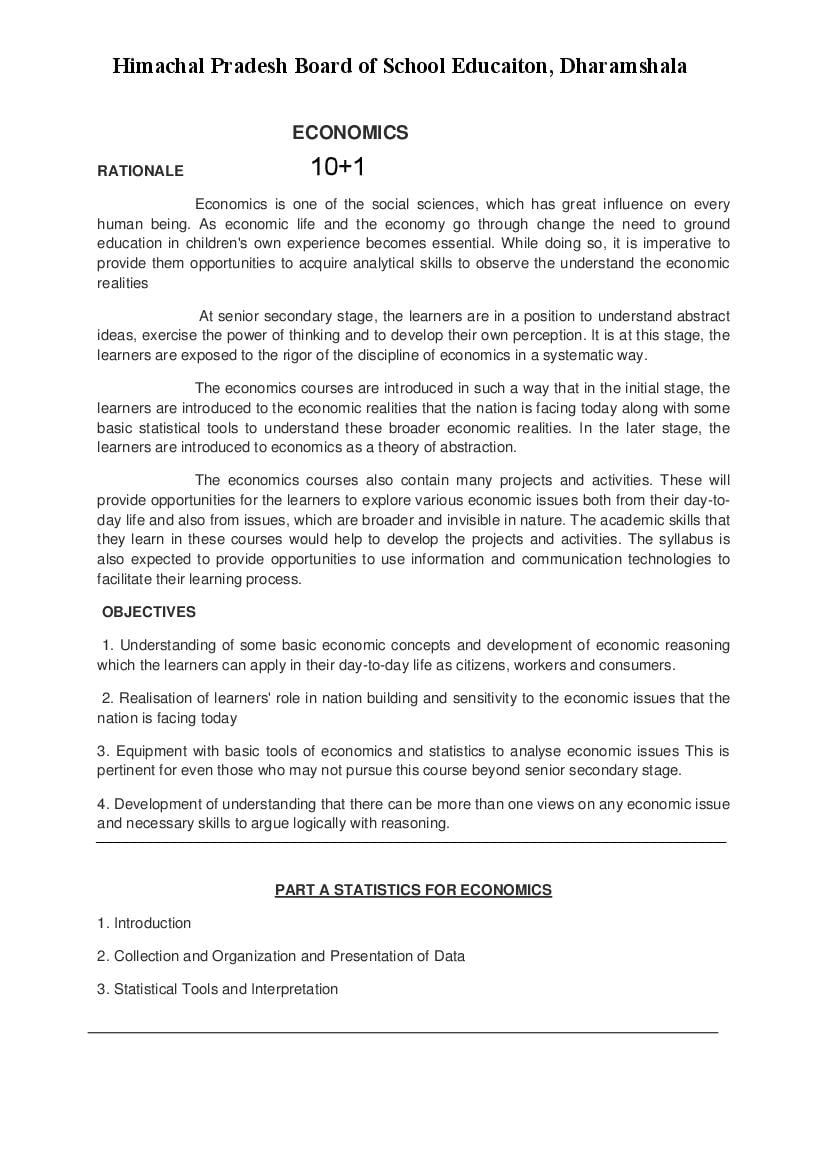
4. ECONOMICS +1 (HPBOSE)
RATIONALE 10+1
Economics is one of the social sciences, which has great influence on every
human being. As economic life and the economy go through change the need to ground
education in children's own experience becomes essential. While doing so, it is imperative to
provide them opportunities to acquire analytical skills to observe the understand the economic
realities
At senior secondary stage, the learners are in a position to understand abstract
ideas, exercise the power of thinking and to develop their own perception. It is at this stage, the
learners are exposed to the rigor of the discipline of economics in a systematic way.
The economics courses are introduced in such a way that in the initial stage, the
learners are introduced to the economic realities that the nation is facing today along with some
basic statistical tools to understand these broader economic realities. In the later stage, the
learners are introduced to economics as a theory of abstraction.
The economics courses also contain many projects and activities. These will
provide opportunities for the learners to explore various economic issues both from their day-to-
day life and also from issues, which are broader and invisible in nature. The academic skills that
they learn in these courses would help to develop the projects and activities. The syllabus is
also expected to provide opportunities to use information and communication technologies to
facilitate their learning process.
OBJECTIVES
1. Understanding of some basic economic concepts and development of economic reasoning
which the learners can apply in their day-to-day life as citizens, workers and consumers.
2. Realisation of learners' role in nation building and sensitivity to the economic issues that the
nation is facing today
3. Equipment with basic tools of economics and statistics to analyse economic issues This is
pertinent for even those who may not pursue this course beyond senior secondary stage.
4. Development of understanding that there can be more than one views on any economic issue
and necessary skills to argue logically with reasoning.
PART A STATISTICS FOR ECONOMICS
1. Introduction
2. Collection and Organization and Presentation of Data
3. Statistical Tools and Interpretation
Page 2
4. Development Policies and Experience (1947-90)
5. Economic Reforms since 1991
6. Current Challenges facing Indian Economy
7. Development experience of India-A 7 comparison with neighbors
PART A : STATISTICS FOR ECONOMICS
In this course, the learners are expected to acquire skills in collection organization and
presentation of quantitative and qualitative information pertaining to various simple economic
aspects systematically It also intends to provide some basic statistical tools to analyze, interpret
any economic information and draw appropriate inferences. In this process, the learners are
also expected to understand the behavior of various economic data. Periods 8
Unit 1: Introduction
What is Economics?
Meaning, scope and importance of statistics in Economics
Unit 2: Collection, Organization and Presentation of data
Collection of data-sources of data-primary and secondary, how basic data is collected; methods
of collecting data; Some important sources of secondary data Census of India and National
Sample Survey Organization.
Organization of Data : Meaning and types of variables Frequency Distribution.
Presentation of Data : Tabular Presentation and Diagrammatic Presentation of Data ()
Geometric forms (bar diagrams and pie diagrams), (i) Frequency diagram (histogram, polygon
and ogive) and (iii) Arithmetic line graphs (time series graph)
Unit 3: Statistical Tools and Interpretation
(For all the numerical problems and solutions, the appropriate economic interpretation may be
attempted. This means, the students need to solve the problems and provide interpretation for
the results derived)
Measures of Central Tendency-mean (simple and weighted, median and mode.
Measures of Dispersion-absolute dispersion (range, quartile deviation, mean deviation and
standard deviation), relative dispersion (co-efficient of quartile deviation, co-effecient of mean
deviation, co-efficient of variation); Lorenz Curve : Meaning and its application
Correlation-meaning, scatter diagram; Measures of correlation-Karl Pearson's method (two
variables ungrouped data) Spearman's rank correlation
Introduction to Index Numbers -meaning, types-wholesale price index consumer price index and
index to industrial production, uses of index numbers; Inflation and index numbers
Page 3
Unit 4: Development Policies and Experience (1947-90)
A brief introduction of the state of Indian economy on the eve of independence
Common goals of Five Year Plans.
Main features, problems and policies of agriculture (institutional aspects and new agricultural
strategy, etc.) industry (industrial licensing, etc.) and foreign trade
Unit 5: Economic Reforms since 1991
Need & main features-liberalization, globalization and privatization An appraisal of LPG policies.
Unit 6: Current challenges facing Indian Economy:
Poverty -absolute and relative Main programmes for poverty alleviation : A critical assessment;
Rural development : Key issues-credit and marketing-role of cooperatives; agricultural
diversification; alternative farming-organic farming.
Human Capital Formation:
How people become resource Role or human capital In economic development, Growth of
Education Sector in India
Employment : Growth, informalisation and other issues : Problems and policies
Infrastructure: Meaning-and Types Case Studies Energy and Health problems and Policies -a
critical assessment;
Sustainable Economic Development:
Meaning: Effects of Economic Development on Resources and Environment
Unit 7: Development Experience of India:
A comparison with neighbors India and Pakistan India and China
Issues : Growth, Population Sectoral development and other developmental indicators
Page 4
Subject : Economics Class: XI ( Regular )
Annual (Theory) Session : 2022-23
Time: 3 hours Max marks: 80
Unit Marks distribution
Wise Distribution of Marks
Unit No. Particulars Marks
assigned
Part-1 Statistics for Economics
1 Introduction 3
Chapter -1: Concept of Economics and significance of
Statistics in Economics
2 Collection, organisation and Presentation of data 12
Chapter -2 : Collection of Data
Chapter -3 : Census and Sample Methods of collection of
data
Chapter -4 : Organisation of Data
Chapter -5 : Presention of Data- Textual and Tabular
Presentation
Chapter -6 : Diagrammatic Presentation of Data : Bar
Diagrams and Pie Diagrams
Chapter -7 : Frequency Diagrams : Histogram, Polygon and
Ogive
Chapter -8 : Arithmetic Line-graph or Time Series Graphs
3 Statistical Tools and interpretation 25
Chapter -9 : Measures of Central Tendency- Arithmetic Mean
Chapter -10 : Measures of Central Tendency- Median and
Mode
Chapter -11 : Measures of Disperson
Chapter -12 : Correlation
Chapter -13 : Index Numbers
4 Part-2 Indian Economic Development 8
Development policies and experience
Chapter -1 :Indian Economy of the eve of independence
Chapter -2 : Econimic planning in india : Common goals of
five year Plans and Development Strategies till 1991
Chapter -2 : Features Problems and Policies of Agriculture
Chapter -4 : Features Problems and Policies of Industry
Chapter -5 : Foreign Trade - Features Problems and Policies
5 Economic reforms since 1991 6
Chapter -6 : Economic reforms since 1991 or New Economic
Page 5
6 Current challenges facing Indian Economy 20
Chapter -7 : Poverty
Chapter -8 : Rural Development: Issues relating to credit
marketing , agricultural diversification and organic farming.
Chapter -9 : Human capital formation
Chapter -10 : The employment problem
Chapter -11 : Infrastructure
Chapter -12 : Sustainable Economic Development
7 Development Experience of India – A comparison with 6
neighbours
Chapter -13 : Development experience of india: A
comparison with Pakistan and China
The Annual theory paper will be of eighty (80) marks
Himachal Pradesh Board of school Education, Dharamshala
Page 6
Annual (Theory) Session : 2022-23
Time: 3 hours Max marks: 80
Blue of
Design Print
Question Paper (Blue Print)
Name of 1 mark 2 marks 3 marks 4 marks 5 marks Total
the questio question question question question Mark
unit ns s s s s s
(MCQ)
Introduction 1 1 -- -- -- 03
Collection, 2 2 2 -- -- 12
organisation
and
Presentation
of data
Statistical 5 1 1 -- 3 25
Tools and
interpretatio
n
Development 1 1 -- -- 1 08
policies and
experience
Economic 1 1 1 --
reforms since 06
1991
Current 5 1 1 -- 2 20
challenges
facing Indian
Economy
Development 1 1 1 -- --- 06
experience of
india A
comparison
with
neighbours
Total Marks 1*16=16 2*8=16 3*6=18 ----- 5*6=30 80
Himachal Pradesh Board of school Education, Dharamshala
Page 7
Theory Session: 2022-23
Blue Print of MCQ
S. No. Type of question No. of questions
1 Concept based /Direct 6
2 Numerical Based ( Application and Skill based) 2
3 Match the columns 2
4 Case study/comprehensions/statement 2
5 Assertion and reasoning 2
6 Diagram/graph/ interpretation --
7 Miscellaneous 2
(Understanding and knowledge based
Total no. of questions 16
Each MCQ carries 1 mark only
No internal choice be given in the MCQ section
Himachal Pradesh Board of school Education, Dharamshala
Prescribed Books:
1- vFkZ'kkL= esa lkaf[;dh fg0iz0 Ldwy f'k{kk cksMZ }kjk izdkf'krA
2- Hkkjrh; vFkZO;oLFkk dk fodkl fg0iz0 Ldwy f'k{kk cksMZ }kjk izdkf'krA
3. Statistics for Economics NCERT Publication
4. Indian Economic Development NCERT Publication
Document Details
| Board / Org | Himachal Pradesh Board |
| Exam | Class 11 |
| Type | Syllabus |
| Pages | 7 |
| Updated | 22 Jul 2026 |