HP Board Class 11 Syllabus 2024 English
Finished viewing? Save it for later —
Download HP Board Class 11 Syllabus 2024 English (PDF · 5 pages)About HP Board Class 11 Syllabus 2024 English
HP Board Class 11 Syllabus 2024 English is available here for free download. Published by Himachal Pradesh Board for Class 11, this syllabus can be viewed online or downloaded as a PDF (5 pages). Candidates preparing for Class 11 can use HP Board Class 11 Syllabus 2024 English to understand the exam pattern, the type of questions asked, and the overall difficulty level.
Frequently Asked Questions
How can I download HP Board Class 11 Syllabus 2024 English?
Open this page and click the Download button to save HP Board Class 11 Syllabus 2024 English as a PDF. It is completely free on AglaSem Docs.
Is HP Board Class 11 Syllabus 2024 English free to download?
Yes. HP Board Class 11 Syllabus 2024 English can be viewed online and downloaded as a PDF free of cost on AglaSem Docs.
How many pages does HP Board Class 11 Syllabus 2024 English have?
HP Board Class 11 Syllabus 2024 English contains 5 pages, which you can read online or download together as a single PDF.
Where can I find more Class 11 study material?
You can find more Class 11 question papers, sample papers, syllabus, and answer keys on AglaSem Docs.
HP Board Class 11 Syllabus 2024 English – Text
Read the full text of this syllabus below — useful to quickly search, copy and reference the content online without downloading the PDF.
📄 View text version (5 pages)
Page 1
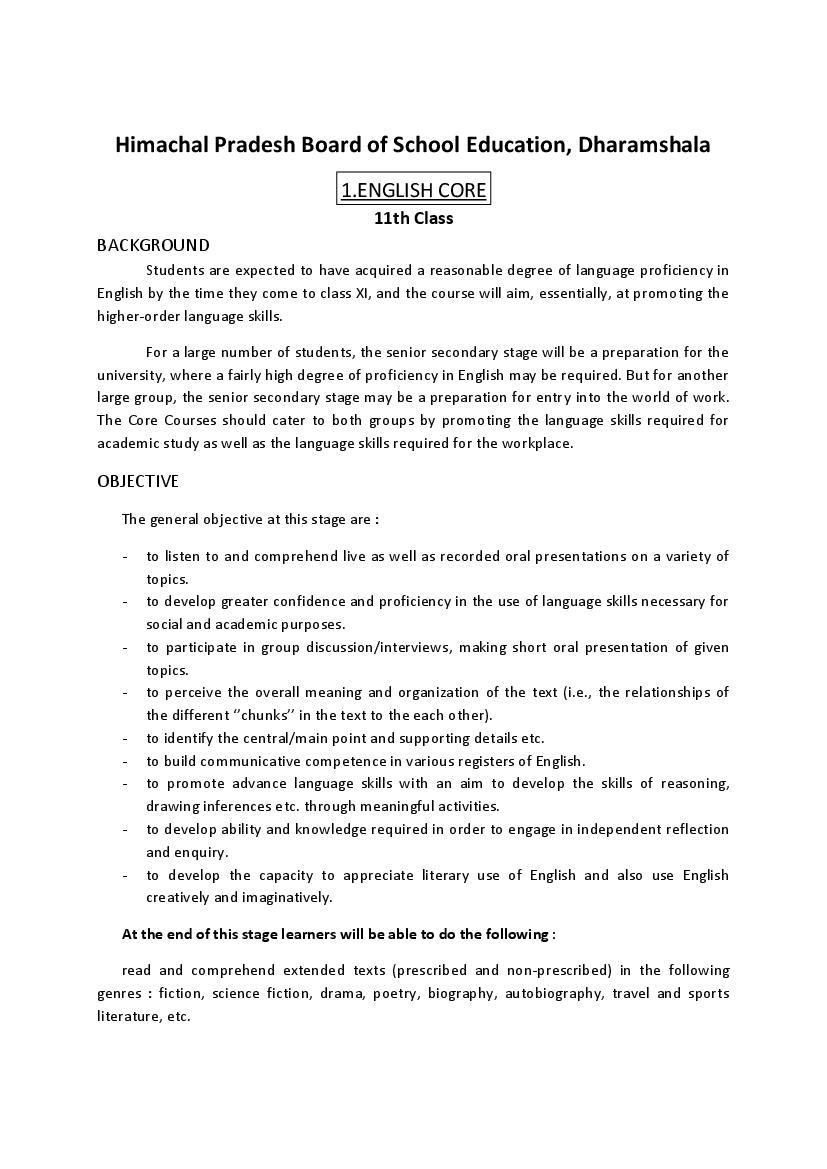
1.ENGLISH CORE
11th Class
BACKGROUND
Students are expected to have acquired a reasonable degree of language proficiency in
English by the time they come to class XI, and the course will aim, essentially, at promoting the
higher-order language skills.
For a large number of students, the senior secondary stage will be a preparation for the
university, where a fairly high degree of proficiency in English may be required. But for another
large group, the senior secondary stage may be a preparation for entry into the world of work.
The Core Courses should cater to both groups by promoting the language skills required for
academic study as well as the language skills required for the workplace.
OBJECTIVE
The general objective at this stage are :
- to listen to and comprehend live as well as recorded oral presentations on a variety of
topics.
- to develop greater confidence and proficiency in the use of language skills necessary for
social and academic purposes.
- to participate in group discussion/interviews, making short oral presentation of given
topics.
- to perceive the overall meaning and organization of the text (i.e., the relationships of
the different ‘’chunks’’ in the text to the each other).
- to identify the central/main point and supporting details etc.
- to build communicative competence in various registers of English.
- to promote advance language skills with an aim to develop the skills of reasoning,
drawing inferences etc. through meaningful activities.
- to develop ability and knowledge required in order to engage in independent reflection
and enquiry.
- to develop the capacity to appreciate literary use of English and also use English
creatively and imaginatively.
At the end of this stage learners will be able to do the following :
read and comprehend extended texts (prescribed and non-prescribed) in the following
genres : fiction, science fiction, drama, poetry, biography, autobiography, travel and sports
literature, etc.
Page 2
unseen texts)
- understand and respond to lectures, speeches, etc.
- write expository/argumentative essays of 250-500 words, explaining or developing a
topic, arguing a case, etc.
- write formal/informal letters and applications for different purposes.
- write items related to the workplace (minutes, memoranda, notices, summaries,
reports; filling up of forms, preparing CVs, e-mail messages etc.)
- taking/making notes from reference materials, recorded talks etc.
LANGUAGE ITEMS
The Core Course should draw upon the language items suggested for classes IX-X and
develop deeper into their usage and functions. Particular attention may, however, be given to
the following areas of grammar:
- The uses of different tense forms for different kinds of narration (e.g. media, commentaries,
reports, programmer, etc)
- The use of passive forms in scientific and innovative writings.
- Converting one kind of sentence/clause into a different kind of structure of well as other items
to exemplify stylistic variations in different discourses
- Modal auxiliaries – used based on semantic considerations.
METHODS AND TECHNIQUES
The techniques used for teaching should promote habits of self-learning and reduce
dependence on the teacher. In general, we recommend a multi-skill, learner-centred, activity based
approach, of which there can be many variations. The core classroom activity is likely to be that of silent
reading of prescribed/selected texts for comprehension, which can lead to other forms of language
learning activities such as role play, dramatization, group discussion, writing, etc. although many such
activities could be carried out without the preliminary use of textual material. It is important that
students be trained to read independently and intelligently, interacting actively with texts, with the use
of reference materials (dictionaries, thesauruses, etc.) where necessary. Some pre-reading activity will
generally be required, and the course books should suggest suitable activities, leaving teachers free to
devise other activities when desired. So also, the reading of texts should be followed by post reading
activities. It is important to remember that every text can generate different readings. Students should
be encouraged to interpret texts in different ways.
Group and pair activities can be resorted to when desired, but many useful language activities
can be carried out individually.
In general, teachers should encourage students to interact actively with texts and with each
other. Oral activity (group discussion, etc.) should be encouraged.
Page 3
(SESSION 2022-23)
SUBJECT - ENGLISH
Time : 3 hours M.M. : 80
SECTION A
1. Reading SKILLS
A. Unseen Passage
B. Note Making (17)
SECTION B
2. Writing Skills
A. Factual description
(Events or incidence, a Report or a Process)
B. Letter Writing
(i) Business Letters
(ii) Letters of application
(iii) Personal letters
(iv) Letters to Editor
C. Long Composition (16)
SECTION C
3. Grammar
1. Determiners
2. Modals
3. Tenses
4. Common errors
5. Re-ordering of words (10)
Page 4
4. LITERATURE: HORNBILL (POETRY)
1. A Photograph
2. The Laburnum Top
3. The Voice of the Rain
4. Childhood
(8)
5. Father to Son (8)
HORNBILL (PROSE)
1. The Portrait of a Lady
2. We’re Not Afraid to Die…. If We Can All be Together
3. Discovering Tut: The Saga Continues
4. Landscape of the Soul
5. The Ailing Planet: The Green Movement’s Role
6. The Browning Version
7. The Adventure
8. Silk Road (17)
SNAPSHOT(SUPPLEMENTARY READER)
1. The summer of the Beautiful White Horse
2. The Address
3. Ranga's Marriage
4. Albert Einstein at school
5. Mother's Day
6. The Ghat of the onlyworld
7. Birth
8. The Tale of Melon City (12)
Prescribe Books :
1. Flemingo - Published by H.P. Board of School Education, Dharamshala.
2. Vistas - Published by H.P. Board of School Education, Dharamshala.
Page 5
10+1
English
There would be four Section A,B,C & D
Section A (Consists of ; Reading Skill) 17 Marks
Question No. 1 : Comprehension of unseen passage:
It will be of 10 Marks'
Part (a) = MCQs = 7 Marks
10 Marks
Part (b) = Synonyms/Antonyms = 1 x 3 = 3
Question No. 2: Note Making
(a) Making Notes = 4 Marks
7 Marks
(b) Words meaning = 3 Marks
Section A will be of 17 Marks
Section B (Writing Skill) 16 Marks
Question No. 3: Short Composition = 4 Marks
Question No. 4: Letter writing = 6 Marks
Question No. 5: Longer composition = 06 Marks
Section B will be of 16 Marks
Section C (Grammar) 10 Marks
Question No. 6: Do as Directed = 4 Marks
Question No.7: Editing Task = 4 Marks
Question No. 8: Re-order of sentences = 02 Marks
Section C will be of 10 Marks
Section D (Literature) 37 Marks
Question No.9: Reference to the context of the stanzas
of Poem 1 X 4 = 4 Marks
08 Marks
Question No. 10: (a) Two MCQs = 1 x2 = 2 Marks
(b) One Question is about 20 words = 2 Marks
Prose (Hornbill)
Question No. 11: (a) There will be five MCQs from the lessons : 1 x 5 = 5 Marks
(b) One word or one sentence Answer of five questions 1 x 5 = 5 Marks
Question No. 12: One out of two long answer question about (120 words)
It will be of 7 Marks
Total Marks from Hornbill : Poetry = (4 + 4) 08 Marks
Prose = 5 + 5 + 7 = 17 Marks
Total = 25 Marks
Book (Snapshots)
Question No. 13: One out of two, long answer question is about (120 words)
It will be of 5 Marks
Question No. 14: (a) MCQs = 1 x 2 = 2 Marks
(b) Two out of three questions is about 30 words = 2.5 x 2= 5 Marks
Total = 12 Marks
Document Details
| Board / Org | Himachal Pradesh Board |
| Exam | Class 11 |
| Type | Syllabus |
| Pages | 5 |
| Updated | 22 Jul 2026 |