HP Board Class 11 Syllabus 2024 Biology
Finished viewing? Save it for later —
Download HP Board Class 11 Syllabus 2024 Biology (PDF · 4 pages)About HP Board Class 11 Syllabus 2024 Biology
HP Board Class 11 Syllabus 2024 Biology is available here for free download. Published by Himachal Pradesh Board for Class 11, this syllabus can be viewed online or downloaded as a PDF (4 pages). Candidates preparing for Class 11 can use HP Board Class 11 Syllabus 2024 Biology to understand the exam pattern, the type of questions asked, and the overall difficulty level.
Frequently Asked Questions
How can I download HP Board Class 11 Syllabus 2024 Biology?
Open this page and click the Download button to save HP Board Class 11 Syllabus 2024 Biology as a PDF. It is completely free on AglaSem Docs.
Is HP Board Class 11 Syllabus 2024 Biology free to download?
Yes. HP Board Class 11 Syllabus 2024 Biology can be viewed online and downloaded as a PDF free of cost on AglaSem Docs.
How many pages does HP Board Class 11 Syllabus 2024 Biology have?
HP Board Class 11 Syllabus 2024 Biology contains 4 pages, which you can read online or download together as a single PDF.
Where can I find more Class 11 study material?
You can find more Class 11 question papers, sample papers, syllabus, and answer keys on AglaSem Docs.
HP Board Class 11 Syllabus 2024 Biology – Text
Read the full text of this syllabus below — useful to quickly search, copy and reference the content online without downloading the PDF.
📄 View text version (4 pages)
Page 1
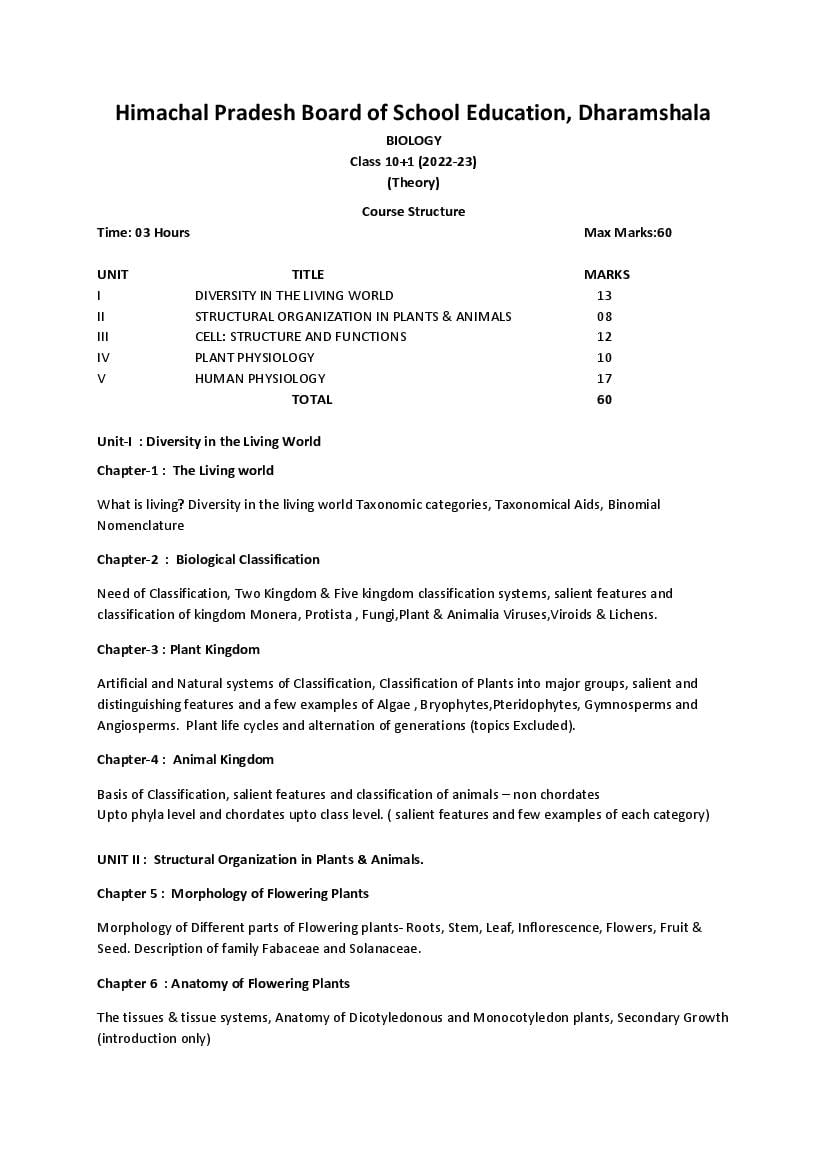
BIOLOGY
Class 10+1 (2022-23)
(Theory)
Course Structure
Time: 03 Hours Max Marks:60
UNIT TITLE MARKS
I DIVERSITY IN THE LIVING WORLD 13
II STRUCTURAL ORGANIZATION IN PLANTS & ANIMALS 08
III CELL: STRUCTURE AND FUNCTIONS 12
IV PLANT PHYSIOLOGY 10
V HUMAN PHYSIOLOGY 17
TOTAL 60
Unit-I : Diversity in the Living World
Chapter-1 : The Living world
What is living? Diversity in the living world Taxonomic categories, Taxonomical Aids, Binomial
Nomenclature
Chapter-2 : Biological Classification
Need of Classification, Two Kingdom & Five kingdom classification systems, salient features and
classification of kingdom Monera, Protista , Fungi,Plant & Animalia Viruses,Viroids & Lichens.
Chapter-3 : Plant Kingdom
Artificial and Natural systems of Classification, Classification of Plants into major groups, salient and
distinguishing features and a few examples of Algae , Bryophytes,Pteridophytes, Gymnosperms and
Angiosperms. Plant life cycles and alternation of generations (topics Excluded).
Chapter-4 : Animal Kingdom
Basis of Classification, salient features and classification of animals – non chordates
Upto phyla level and chordates upto class level. ( salient features and few examples of each category)
UNIT II : Structural Organization in Plants & Animals.
Chapter 5 : Morphology of Flowering Plants
Morphology of Different parts of Flowering plants- Roots, Stem, Leaf, Inflorescence, Flowers, Fruit &
Seed. Description of family Fabaceae and Solanaceae.
Chapter 6 : Anatomy of Flowering Plants
The tissues & tissue systems, Anatomy of Dicotyledonous and Monocotyledon plants, Secondary Growth
(introduction only)
Page 2
Animal Tissues- Their types & functions Morphology, anatomy and functions of different system of
Earthworm, Cockroach & Frog.
UNIT III : Cell Structure & Functions
Chapter 8 : Cell: The Unit of Life
Cell as the basic unit of life, Cell Theory, structure of Prokaryotic & Eukaryotic cell, Plant & Animal cell,
Cell Membrane, Cell wall, cell organelles- structure & function, endo membrane system , endoplasmic
reticulum, golgi body, lysosomes, vacuoles , mitochondria, ribosome, plastids, cytoskeleton, cilia &
flagella, centrioles and nucleus (cultrastructure & functions), Micro bodies.
Chapter 9 : Biomolecules
Chemical constituents of living cells ,primary and secondary metabolites , biomolecules, structure and
functions of carbohydrates , proteins, lipids and nucleic acids, nature of bonds linking a monomer in a
polymer , concept of metabolism , metabolic basis for living, the living state, Enzymes, Enzyme- nature ,
mode of action factors affecting enzyme activity, their classification & nomenclature .
Chapter 10 : Cell cycle & cell division
Cell cycle & its phases, mitosis meiosis division with elaborate diagrams and their significance.
UNIT IV : Plant Physiology
Chapter 11 : Transport in Plants
Means of transport, Plant water Relations, Long Distance Transport of water Transpiration, Uptake and
Transport of Mineral Nutrients, Phloem transport. Mass Flow hypothesis (excluded)
Chapter 12 : Mineral Nutrition
Macro and Micronutrients & their role in plant growth & development, Process of Biological Nitrogen
fixation. Nitrogen Cycle (excluded).
Chapter 13 : Photosynthesis in Higher Plants
Importance of Photosynthesis- its site, pigments involved in the process, Light, Reaction. The Electron
Transport Chain, Cyclic & Non cyclic Photophosphorylation, Chemiosmotic Hypothesis , The Calvin Cycle
, ETS Pathway , Photorespiration, Factors affecting photosynthesis .
Chapter 14 : Respiration in Plants
Cellular Respiration- Glycolysis, fermentation (anaerobic) TCA cycle, ETS & Oxidative Phosphorylation
(Aerobic), Respiratory Balance Sheet, Amphibolic Pathway, Respiratory Quotient .
Chapter 15 : Plant Growth & Development
Growth, Phases of Growth, Growth Rates, Differentiation, Dedifferentiation & Redifferentiation
processes in a plant cell. Various Plant Growth Regulators – [ auxins, gibberellins, cytokinines , ethylene
Page 3
examples.
UNIT V : Human Physiology
Chapter 16 : Digestion and Absorption
Digestive System – Alimentary Canal & Digestive gland, Process of Digestion of carbohydrates proteins,
fats & nucleic acids
Absorption of Digested Food.
Disorders of Digestive system.
Chapter 17 : Breathing and Exchange of Gases
Respiratory Organs, Mechanism of Breathing,
Exchange & Transport of Respiratory Gases, Regulation of Respiration, Respiratory Volumes, Disorders
of Respiratory System.
Chapter 18 : Body fluids & Circulation
Blood- its composition & functions, Blood Groups, Coagulation of Blood, Lymph and its functions,
Human Circulatory System, Structure of Human Heart , Cardiac cycle, EGC, Double circulation,
Regulation of cardiac activity, Disorders of circulatory system .
Chapter 19 : Excretory Products and their Elimination
Modes of Excretion - Ureo/Urico / Ammonotelism, Human Excretory System – Structure & function.
Process of Urine formation, Function of Tubules, Counter Current Mechanism (Mechanism of
concentration of the filtrate).
Regulation of Kidney Functions, Micturition, Role of other organs in excretion, Disorders of Excretory
system.
Chapter 20 : Locomotion & Movement
Types of movements – ciliary, flagellar & muscular.
Muscles – Structure of Skeletal Muscles, Structure of Contractile Proteins , Mechanism of Muscle
Contraction, Skeletal System & its functions. Joints – Their types & example, Disorders of Muscular &
Skeletal Systems
Chapter 21 : Neural control & coordination
Neural system, Human Neural System. CNS & PNS
Neuron - Structural & functional unit of neural system.
Generation & Conduction of Nerve Impulse.
CNS- Its components & their functions,
Structure of Eye & Ear.
Chapter 22 : Chemical Coordination and Integration
Endocrine glands and Hormones, Human Endocrine System – Hypothalamus Pituitary, Pineal, Thyroid,
Parathyroid, Thymus, Adrenal, Pancreas, Gonads (Testis & Ovary)
Hormones of Heart, Kidney & GIT, Mechanism of Hormone Action, Disorders related to hypo & hyper
activity of various hormones.
Page 4
Theory session 2022-23
Class 10+1 ( Regular)
Time: 3 hours Blue Print Maximum Marks : 60
Sr. Name of Unit 1 Mark 2 Mark 3 Mark 4 Mark Total
No. Question(MCQ) Questions Questions Questions Marks
1 Diversity in the 04 03 01 - 13
Living World (Internal Choice
in any one
Questions)
2 Structural 01 02 01 - 08
Organization in (Internal
Plants & Animals Choice)
3 Cell Structure and 01 02 01 01 12
Functions (Internal
Choice)
4 Plant Physiology 02 02 - 01 10
(Internal (Internal
Choice) Choice)
5 Human Physiology 04 01 01 02 17
(Internal
Choice)
Break up of total 30 12 10 04 04
Questions
Total Marks 1x12=12 2x10=20 3x4=12 4x4=16 60
Blue Print of MCQ
Sr. No. Name of Unit No. of Questions
1 Concept Based/Direct 4
2 Assertion and Reason 2
3 Understanding based and Knowledge based 4
4 Diagram Based Questions 2
Total 12
Each MCQ carries 1 mark only
No internal choice n the MCQ section
Prescribed Books
Biology Published by HPBOSE Dharamshala
Document Details
| Board / Org | Himachal Pradesh Board |
| Exam | Class 11 |
| Type | Syllabus |
| Pages | 4 |
| Updated | 22 Jul 2026 |