MAHA SET 2015 Question Paper 2 Mathematical Sciences
Finished viewing? Save it for later —
Download MAHA SET 2015 Question Paper 2 Mathematical Sciences (PDF · 28 pages)About MAHA SET 2015 Question Paper 2 Mathematical Sciences
MAHA SET 2015 Question Paper 2 Mathematical Sciences is available here for free download. Published by Maharashtra Exams for MAHA SET, this question paper can be viewed online or downloaded as a PDF (28 pages). Candidates preparing for MAHA SET can use MAHA SET 2015 Question Paper 2 Mathematical Sciences to understand the exam pattern, the type of questions asked, and the overall difficulty level.
Frequently Asked Questions
How can I download MAHA SET 2015 Question Paper 2 Mathematical Sciences?
Open this page and click the Download button to save MAHA SET 2015 Question Paper 2 Mathematical Sciences as a PDF. It is completely free on AglaSem Docs.
Is MAHA SET 2015 Question Paper 2 Mathematical Sciences free to download?
Yes. MAHA SET 2015 Question Paper 2 Mathematical Sciences can be viewed online and downloaded as a PDF free of cost on AglaSem Docs.
How many pages does MAHA SET 2015 Question Paper 2 Mathematical Sciences have?
MAHA SET 2015 Question Paper 2 Mathematical Sciences contains 28 pages, which you can read online or download together as a single PDF.
Where can I find more MAHA SET study material?
You can find more MAHA SET question papers, sample papers, syllabus, and answer keys on AglaSem Docs.
MAHA SET 2015 Question Paper 2 Mathematical Sciences – Text
Read the full text of this question paper below — useful to quickly search, copy and reference the content online without downloading the PDF.
📄 View text version (28 pages)
Page 1
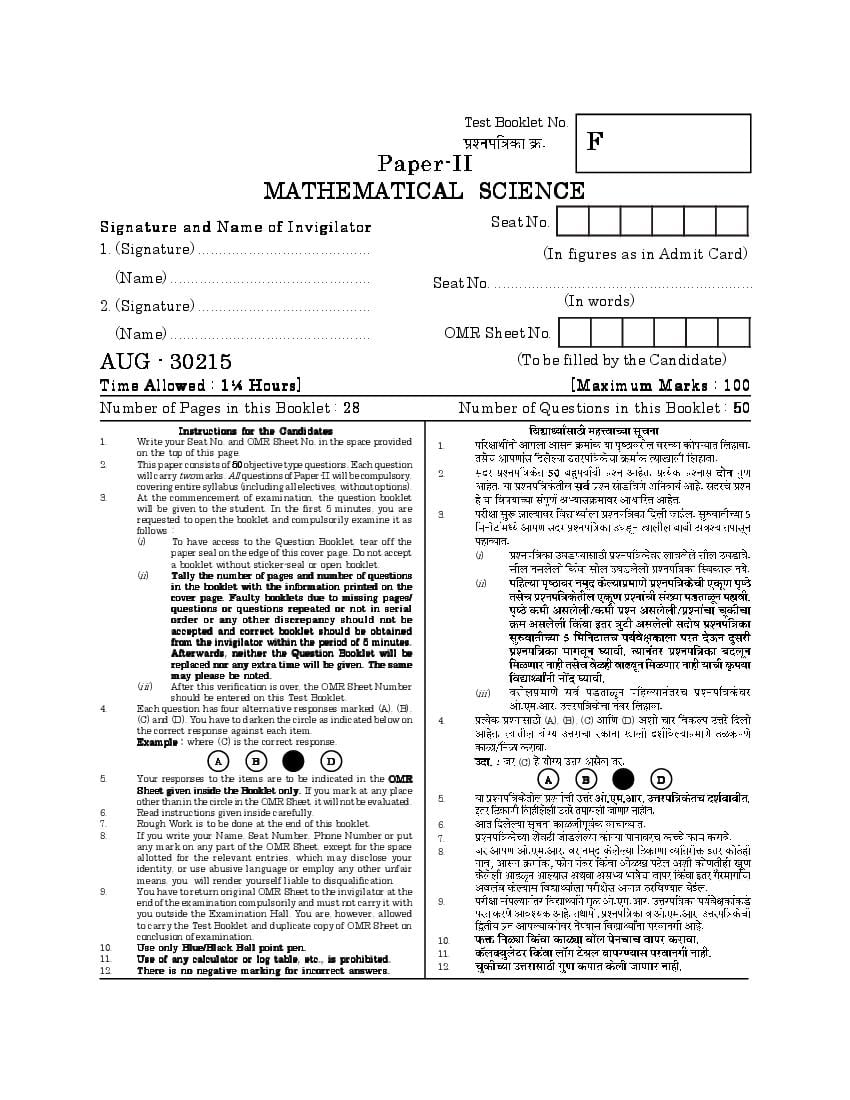
F
MATHEMATICAL SCIENCE
Signature and Name of Invigilator Seat No.
1. (Signature) ......................................... (In figures as in Admit Card)
(Name) ................................................ Seat No. ..............................................................
2. (Signature) ......................................... (In words)
(Name) ................................................ OMR Sheet No.
AUG - 30215 (To be filled by the Candidate)
Time Allowed : 1¼ Hours] [Maximum Marks : 100
Number of Pages in this Booklet : 28 Number of Questions in this Booklet : 50
Instructions for the Candidates
1. Write your Seat No. and OMR Sheet No. in the space provided 1.
on the top of this page.
2. This paper consists of 50 objective type questions. Each question
will carry two marks. All questions of Paper-II will be compulsory, 2.
covering entire syllabus (including all electives, without options).
3. At the commencement of examination, the question booklet
will be given to the student. In the first 5 minutes, you are
3.
requested to open the booklet and compulsorily examine it as
follows :
(i) To have access to the Question Booklet, tear off the
paper seal on the edge of this cover page. Do not accept (i)
a booklet without sticker-seal or open booklet.
(ii) Tally the number of pages and number of questions
in the booklet with the information printed on the (ii)
cover page. Faulty booklets due to missing pages/
questions or questions repeated or not in serial
o rder or any other discre pancy should not be
accepted and correct booklet should be obtained
from the invigilator within the period of 5 minutes.
Afterwards, neither the Question Booklet will be
replaced nor any extra time will be given. The same
may please be noted.
(iii) After this verification is over, the OMR Sheet Number
should be entered on this Test Booklet. (iii)
4. Each question has four alternative responses marked (A), (B),
(C) and (D). You have to darken the circle as indicated below on 4. (A), (B), (C) (D)
the correct response against each item.
Example : where (C) is the correct response.
A B D (C)
5. Your responses to the items are to be indicated in the OMR A B D
Sheet given inside the Booklet only. If you mark at any place
other than in the circle in the OMR Sheet, it will not be evaluated. 5.
6. Read instructions given inside carefully.
7. Rough Work is to be done at the end of this booklet. 6.
8. If you write your Name, Seat Number, Phone Number or put 7.
any mark on any part of the OMR Sheet, except for the space
8.
allotted for the relevant entries, which may disclose your
identity, or use abusive language or employ any other unfair
means, you will render yourself liable to disqualification.
9. You have to return original OMR Sheet to the invigilator at the
end of the examination compulsorily and must not carry it with 9.
you outside the Examination Hall. You are, however, allowed
to carry the Test Booklet and duplicate copy of OMR Sheet on
conclusion of examination. 10.
10. Use only Blue/Black Ball point pen.
11.
11. Use of any calculator or log table, etc., is prohibited.
12. There is no negative marking for incorrect answers. 12.
Page 2
Page 3
Paper II
Time Allowed : 75 Minutes] [Maximum Marks : 100
Note : This Paper contains Fifty (50) multiple choice questions, each question
carrying Two (2) marks. Attempt All questions.
1. Let f : R R and g : [a, b] R 2. Let {an} be a sequence of positive
be defined as f(x) = x2 x R and numbers. Which of the following is
g(x) = x2 x [a, b]. Then : true ?
(A) f and g both are uniformly an
(A) Convergence of implies
n
continuous the convergence of an
(B) f is uniformly continuous and g an
(B) Convergence of implies
n
is continuous
the convergence of an
(C) f is continuous and g is
(C) Convergence of an implies the
uniformly continuous an
convergence of
n
(D) f and g both are continuous but
(D) Convergence of an implies the
not uniformly continuous an
convergence of
n
3 [P.T.O.
Page 4
n = 1, 2, 3...... , then {Sn} converges T : R3 R 4 be such that
to : T(1, 0, 0) = (1, 2, 0, 4), T(0, 1, 0) =
(2, 0, –1, –3), T(0, 0, 1) = (0, 0, 0, 0).
(A) 2
Then :
(B) 2 2 (A) T(x, y, z) = (x + 2y, – x, y, 4x + 3y)
(B) T(x, y, z) = (x + 2y, 2x, –y, 4x – 3y)
(C) 2 2
(C) T(x, y, z) = (x – 2y, – x, y, 4x + 3y)
(D) 2
(D) T(x, y, z) = (x – 2y, x, –y, –4x – 3y)
4. The interval of convergence of the 6. Dimension of the vector space 2 =
( 1)n n 2 x n {( x , y )| x and y are complex
series n 5 is :
n 1 5 n
numbers} over the field of reals
(A) (–5, 5] is :
(A) 4
(B) [–5, 5]
(B) 2
(C) [–5, 5)
(C) 3
(D) (–5, 5) (D) 1
4
Page 5
R) be the vector space of all 9. If P(D|F) > P(E|F) and P(D| F ) >
continuous real functions over R.
P(E| F ), then the relation between
Then which of the following sets is
P(D) and P(E) is :
linearly independent in C(R
R) ?
(A) P(D) < P(E)
(A) {1, cos 2x, sin2 x}
(B) P(D) = P(E)
(B) {1, ex, e2x}
(C) P (D) < P(E)
(C) {1, x2 – 2x + 1, x2, (x – 2)2}
(D) P(D) > P(E)
(D) {1, log(1 + |x|), log((1 + |x|)2)} 10. Let X be a degenerate random
variable such that P(X = 2) = 1. Then
8. Which of the following is a subspace
of the vector space C[a, b] ? which of the following statements is
true ?
(A) {f C[a, b] | f(a) = 1}
(A) EX = 1, V(X) = 2
b
(B) {f C[a, b] | f (x) d x 0}
a
(B) EX = 2, V(X) = 1
a b
(C) f C[a, b] | f 1
2 (C) EX = 2, V(X) = 0
(D) {f C[a, b] | f(0) = 0} (D) EX = 2, Variance does not exist
5 [P.T.O.
Page 6
applied to the distribution if it is :
linear programming problem is a :
(A) Any distribution regardless of
(A) Concave set
its shape
(B) Non-empty set
(B) Normal
(C) Exponential (C) Bounded set
(D) Gamma (D) Convex set
12. Let X1, X2 be iid rvs with common 14. In graphical solution method of
pmf
LPP, the redundant constraint is
1
P[X = ±1] = . Let X3 = X1X2.
2 one :
Then which of the following
(A) Which forms the boundary of
statements is correct ?
feasible region
(A) X1, X2 and X3 are mutually
independent (B) Which does not form boundary
(B) X1, X2 and X3 are pairwise of feasible region
independent but not mutually
(C) Which does not optimize the
independent
objective function
(C) EX1 = EX2 = EX3 = 1
(D) Which optimizes the objective
(D) X1, X2 and X3 are not mutually
function
independent
6
Page 7
LPP, if two constraints do not
a metric ?
intersect in the positive quadrant of
(A) d ( x , y ) = Min {| x |, | y |},
the graph, then :
x, y R
(A) one of the constraints is
(B) d(x, y) = |x2 – y2|, x, y R
redundant
(C) d(x, y) = |x3 – y3|, x, y C
(B) the solution is infeasible
1 1
(C) the solution is unbounded (D) d(x, y) = , x, y R\{0}
x y
(D) the solution is optimum Or
16. Which of the following is the optimal Which of the following statements
solution to the LPP of maximizing is true, if y = –3x – 7 is the line of
z = x1 + 2x2 regression of y on x ?
subject to (A) The y-intercept is 7
x1 – x2 < 1 (B) The value of y is expected to
x1 + x2 > 3 decrease by 3 when x increases
x1, x2 > 0 by 4 units
(A) (4, 3) (C) The slope of the line is 3
(B) (2, 1) (D) The value of y is expected to
(C) Unbounded solution decrease by 3 when x increases
(D) Infeasible solution by 1 unit
7 [P.T.O.
Page 8
is : perfect set in R2 ?
(A) Connected and complete (A) The set of complex numbers
(B) Compact
(B) The set of all complex numbers
(C) Compact and connected z such that |z| < 1
(D) Complete but not connected
(C) The set of all complex numbers
Or z such that |z| > 1
The simplest linear regression model (D) Q × Q, where Q is the set of
is y = + X + , where is a
rational numbers
random variable with mean µ = 0
2 = 2 . Let X*
Or
and variance
denote a particular value of the The lines of regression of Y on X and
independent variable X. Which of X on Y are given as X + 2Y – 5 = 0
the following statements is true and 2X + 3Y = 8. Then the mean
regarding the variance of Y when values of X and Y respectively
X = X* ? are :
2 2
(A) y| x * (A) 1 and 2
2 2
(B) y| x * x* (B) 2 and 1
2 2
(C) y| x* x* (C) 2 and 5
2 2 2
(D) y| x * (D) 2 and 3
8
Page 9
1
x sin x (0, 1) as a subset of not of bounded variation on !0, " ?
x # 2$
R. Then : (A) f(x) = sin 2x
(A) A is closed (B) f(x) = sin x + cos x
(B) A is compact (C) f(x) = sin (cos 2x)
(C) A is connected
(D) f(x) = x2 sin 2
x
(D) A is not bounded
Or
Or
If P1 and P2 are two probability
Let A and B be any two events in
measures defined on a measurable
a probability space such that
space (%, F ), then which of the
P(Ac B) = 0.2, P(Bc A) = 0.1,
following statements cannot be true
P(A B) = 0.4. Which of the
always ?
following statements is correct ?
(A) P1(A) = P2(A) for some A F
(A) P(A) = 0.3
(B) P1(A) = 0 & P2(A) = 0
(B) P(Ac Bc) = 0.6
(C) Both (A) and (B)
(C) P(A B) = 0.7
(D) P1(A) > P2(A) A F
(D) P(B) = 0.5
9 [P.T.O.
Page 10
discrete metric on R, respectively. Then which of the following is
D efi n e I = ( R, u) R, d) as I(x)
(R true ?
= x for all x R. Then :
(A) All the functions X, Y and Z are
(A) I is bounded random variables
(B) I is not continuous (B) Only X and Y are random
(C) I is continuous but not variables
uniformly continuous (C) Only X is random variable
(D) I is uniformly continuous (D) Only Y is random variable
Or 23. Let z and w be any two complex
Consider a measurable space (%, F) numbers. Then which of the
where % = {1,2, 3, 4}, A = {1, 2} and following is not true ?
F = {', A, A c , %} and define (A) |zw| = |z| |w|
functions : (B) z w z w
X(() = 1 ( % (C) |z| + |w| < |z + w|
0 if ( A z | z|
) ,w +0
Y(() = (D)
w | w|
)1 if ( * A
10
Page 11
Which of the following statements Characteristic function of X is
is not true ? '(u) then characteristic function of
1 b + cX is :
(A) E(X + Y)2 > {EX2 + EY2}
2
(A) eib'(–uc)
(B) If X is integrable, then |X| is
also integrable (B) eiu'(ub)
(C) E(X) may not exist (C) eiub'(uc)
(D) Moments of even order always (D) 1– eiub'(uc)
exist
25. Let C be the circle |z| = 1. Then the
24. The number of zeros of z7 – 4z3 + 2z 3
dz
value of the integral 2
C z 2z 5
z + 1 which lie in the interior of the
is :
unit circle |z| = 1 is :
(A) –1 – 2i
(A) 7
(B) –1 + 2i
(B) 1
(C) 0
(C) 3
(D) 2 + 3i
(D) 0
11 [P.T.O.
Page 12
function. Then :
A random sample of 15 people is
(A) f is absolutely continuous and
taken from a population in which
of bounded variation on [a, b]
40% favour a particular political
(B) f is absolutely continuous and
stand. What is the probability that
not of bounded variation on
exactly 6 individuals in the sample
[a, b]
favour this political stand ?
(C) f is of bounded variation but not
(A) 0.5000
absolutely continuous on [a, b]
(B) 0.4000
(D) f is neither absolutely
(C) 0.2066
continuous nor of bounded
(D) 0.1600 variation on [a, b]
12
Page 13
A business evaluates a proposed
One of the effects of flooding a lake
venture as follows. It stands to make
is that mercury is leached from the
a profit of Rs. 10,000 with
probability 3/20, to make a profit of soil, enters the food chain, and
Rs. 5,000 with probability 9/20, to contaminates the fish. Suppose that
break even with probability 1/4, and the concentration of mercury in an
to incur a loss of Rs. 5,000 with
individual fish follows an aproximate
probability 3/20. The expected profit
normal distribution with a mean of
is :
0.25 ppm and a standard deviation
(A) Rs. 3,000
of 0.08 ppm. Fish are safe to eat if
(B) Rs. 3,250
the mercury level is below 0.30 ppm.
(C) Rs. 10,000
What proportion of fish would be safe
(D) Rs. 15,000
to eat ?
27. T h e v al u e of l og(2 – 3 i) is :
(A) 23%
(A) log 13 i arc tan (3/2)
(B) 63%
(B) log 13 i[ – arc tan (3/2)]
(C) log 13 i arc tan (3/2) (C) 73%
(D) log 13 i[ – arc tan (3/2)] (D) 27%
13 [P.T.O.
Page 14
C and f : G C is differentiable with
Then :
f '(z) = 0 for all z in G. Then :
(A) G need not be abelian
(A) f strictly increasing
(B) G is cyclic
(B) f is not bounded
(C) G is abelian but not cyclic
(C) f is not constant
(D) f is constant (D) G has at least one proper
subgroup
Or
Or
A professional basketball player
sinks 80% of his foul shots in the Marks in a chemistry test follow a
long run. If he gets 100 shots during normal distribution with a mean of
a season, then the probability that 65 and a standard deviation of 12.
he sinks 75 and 90 shots (inclusive Approximately what percentage of
of both) is approximately given the students would score below
by : 50 ?
(A) P[–1.25 < Z < 2.50] (A) 22%
(B) P[–1.125 < Z < 2.625] (B) 11%
(C) P[–1.375 < Z < 2.375] (C) 15%
(D) P[–1.375 < Z < 2.635] (D) 18%
14
Page 15
Let X1, X2, ....... Xn be a random
where p is a prime. Then :
sample from N(µ, 2), where , and
(A) if pk|O(G) and H is a subgroup
2 are unknown. Then which of the
of G of order pk, then H is cyclic following statements is not correct ?
(A) ( Xi, X12) is jointly sufficient
(B) for every integer i such that
for (,- 2)
pi|O(G), G has a subgroup of
(B) X is sufficient for µ and S2 is
order pi
sufficient for 2
(C) G has a normal subgroup of
(C) (X, S 2 ) is jointly sufficient for
(µ, 2)
order p
(D) if 2 is known, then
X is
(D) if k is largest integer such that
sufficient for µ and (Xi – µ0)2
pk|O(G), then G has a normal
is sufficient for 2 if µ = µ is
0
subgroup of order pk
known
15 [P.T.O.
Page 16
32. Which of the following is false ?
homomorphisms from the group Z8
into the group Z20 is :
(A) Every PID is UFD
(A) 8
(B) 1 (B) Every UFD is Euclidean
(C) 4
(D) 0 domain
Or
(C) Every Euclidean domain is
Let X1, X2, ....., Xn be a random
sample from Poisson distribution UFD
with parameter .. Then T = Xi is
sufficient for .. The distribution of (D) Every Euclidean domain is PID
X1 given T = t is :
t 1
x1
1
t x1
Or
(A) x1
1 ; x1 = 0, 1,
n n
If X1, X2 are distributed as B(n, p),
2 ......n
n .
x1
.
n x1 n known and 0 < p < 1, the number
(B) x1
1 ; x1 = 0,
n n
of unbiased estimators of p is :
1, 2, ......n
1
x1
1
t x1 (A) 2
t
(C) x1
1 ; x1 = 0, 1,
n n
(B) infinity
2, ......t
x1 n x1
n 1 1 (C) 4
(D) 1 ; x1 = 0,
x1 . .
1, 2 ......n (D) 6
16
Page 17
trivial centre ? '(2) = 3 is a group homomorphism.
Then :
(A) A non-abelian simple group
(A) '(1) = 1
(B) A group of order prime
(B) '(1) = 2
(C) A group of order p3 where p is
(C) '(1) = 0
prime
(D) '(1) = 4
(D) The group of non-singular n × n
Or
matrices over R
For a large n (> 30), the confidence
Or 2)
interval for mean µ of a N(µ,
distribution when 2 known, is :
Let X1, X2, ...... Xn be a random
sample from U(/, / + 1). The number 2 2
(A) ! X Z ,X Z "
of maximum likelihood estimators of #! 1
2
n 1
2
n $"
/ is :
(B) ! X Z ,X Z "
!# 1
2 n 1
2 n "$
(A) Infinity
2 2
(B) 2 (C) ! X Z ,X Z "
#! 2 n 2 n $"
(C) 5
(D) ! X Z ,X Z "
(D) 7 #! 2 n 2 n $"
17 [P.T.O.
Page 18
35. Let V be the set of all n × n skew-
is the characteristic polynomial of a
symmetric matrices over R. Then V matrix that is not invertible ?
is a real vector space of dimension : (A) x3 + 2x – x + 1
(B) x3 + x
n (n 1)
(A)
2 (C) x4 + x3 – 2x2 + 5
n (n 1) (D) (x + 1) (x – 2) (x + 2)
(B)
2
Or
(C) n 2 Let X1, ......, X n1 and Y1, ....., Yn2 be
(D) n2 – n two independent random samples
from two normally distributed
Or populations with parameters (µ1,
2 2
Let X1, X2, ......, Xn be iid rvs from 1 ) and (µ2, 2 ) respectively. Then
the null distribution of the usual test
U(0, /). Then which of the following
statistic for testing the equality of
statements is true ? Let 2 2
1 and 2 , when µ1 and µ2 are
X(n) = Ma x Xi unknown, is :
i
(A) Standard normal
(A) X (n ) is consistent estimator
(B) F-distribution with (n1 – 1,
for /
n2 – 1) degrees of freedom
(B) X(n) is unbiased estimator for / (C) t with n1 + n2 – 2 degrees of
freedom
(C) X(n) is not sufficient for /
(D) square of Chi-square random
(D) X(n) is not maximum likelihood variable with n1 + n2 –1 degrees
estimator of / of freedom
18
Page 19
polynomials of degree atmost n with
is false ?
real coefficients. Then its dimension
(A) Consider vector space C over C.
is :
Then for any scalars , ; .1
(A) n – 1
+ .i = 0 if and only if = 0
(B) n
(C) n + 1 and = 0.
(D) n 2
(B) The set M = {f C[0, 1] | f 1
2
Or
= 0} is a subspace of the real
In 2×2 contingency table to test
independence of two attributes, if vector space C[0, 1].
only one of the cell frequency is less
(C) Let V(F) be any vector space.
than 5, then :
Then for any a F and for any
(A) Pooling of cell frequencies is
vector x V; x 0 if and
used to carry out the test
(B) Fisher’s correction is used to only if = 0 or x 0
carry out the test
(D) The class of all polynomials with
(C) Yates’ correction is used to carry
real coefficients is a real vector
out the test
space.
(D) The test cannot be carried out
19 [P.T.O.
Page 20
A test for testing H0 against H1 is If the form of the distribution from
called level test if :
which the sample is drawn, is known
(A) size of the test does not exceed
completely except the unknown
parameter /, which of the following
(B) size of the test is exactly equal
statements is true ?
to
(A) MLE, the maximum likelihood
(C) the hypothesis of the test is
simple hypothesis estimator of / exists only if
(D) the test is unbiased support of the random variable
39. Let u and v be vector spaces of is free from /
dimensions m and n, respectively.
(B) MLE of / exists only if / is a
Then dimension of the space
real valued parameter
Hom(v, u) is :
(A) m + n (C) MLE of / exists only if the
(B) nm distribution belongs to the
exponential family
(C) m n
(D) mn (D) MLE of / always exists
20
Page 21
equation r – 2s + t = cos (2x + 3y)
(y – z)p + (z – x)q = x – y
is :
is :
(A) cos (2x + 3y)
(A) '(x2 – y2 – z2, x – y – z) = 0
(B) sin (2x + 3y)
(B) '(x + y + z, x2 + y2 + z2) = 0
(C) '(xyz, x2 + y2 + z2) = 0 (C) – cos (2x + 3y)
(D) '(x + y + z, x2 + y2 + z2) = 0 (D) – sin (2x + 3y)
Or Or
A single observation from N(µ, 1) In probability sampling, all units
resulted in 2.33. It is decided to test get :
the hypothesis that H 0 : µ = 0
(A) always unequal chances to be
against H1 : µ > 0 using this single
selected
observation. What will be the
p-value in this case ? (B) always an equal chance to be
(A) 0.05 selected
(B) 0.95 (C) a chance to be included in the
(C) 0.99 sample
(D) 0.01 (D) always selected using SRSWOR
21 [P.T.O.
Page 22
2 2
0 z 0 z (1 + y2)dx = (tan–1 y – x)dy
2 2
0
0x 0y
is :
is :
tan 1 y
(A) x = tan–1 y – 1 + c e
(A) u = y – x, v = y – x2
1
(B) y tan 1 x c e tan x
(B) u = y + x, v = y – x2 1
1
(C) u = y – x, v = y2 + x (C) x tan 1 y c e tan y
1
(D) u = y + x, v = y – x (D) y tan 1 x c e tan x
Or Or
Sampling error : In SRSWOR of size n from a
(A) arises because of wrongly population of size N, the number of
reported data
distinct samples which will contain
(B) arises due to mistakes made by
a specific population unit is :
field workers
N–1
(A) n 1
(C) increases with increase in
sample size N
(B) n
(D) may arise due to non-
N
representativeness of the (C) n 1
samples and the inadequacy of
(D) n !
sample size
22
Page 23
equation y" + 2y' + (1 – x)y = 0 such
estimator of population mean based
that y1(0) = 0, y'1(0) = 1, y2(0) = 1,
on stratified random sample is :
y'2(0) = 1, then the value of the
L
1 1
Wronskian W(y1, y2) on R is : (A) V(Yst ) = s h2 w h2
h 1 nh Nh
(A) –1
L
1 1
(B) 0 (B) V(Yst ) = s h2 ch2
h 1 nh Nh
(C) 1
L
1 1
(D) 2 (C) V(Yst ) = s2w 2
h 1 Nh nh h h
Or
L
1 1
In stratified sampling with stratum (D) V(Yst ) = s 2N 2
h 1 Nh nh h h
sizes N 1 = 800, N 2 = 300 and
Or
stratum variances s12 = 144, s22 =
If there are n jobs to be performed,
400, under Neyman allocation, the
n1 one at a time, on each of m
ratio of sample sizes n is given by :
2 machines, the possible sequences
8 would be :
(A)
5
8 (A) (n!)m
(B)
3
(B) (m!)n
3
(C)
4 (C) (n)m
3
(D) (D) (m)n
8
23 [P.T.O.
Page 24
then the discounted value (d) of all expected number of customers in the
future costs associated with the system are (Here µ service rate and
policy of replacing the item after n . arrival rate) :
years is given by : ,
(A) L = , .
(A) Dn = c/(1 + d)n
. ,
(B) L =
.
(B) Dn = c/(1 + dn)
.
(C) L = , .
(C) Dn = c/(1 – d)n
.
(D) Dn = c/(1 – dn) (D) L = ,(, .)
Or Or
In Latin square design, there What is the error degrees of freedom
are : in Latin square design (assuming
there are p treatments) :
(A) Four sources of variability
(A) (P – 1)
(B) Three sources of variability
(B) P2 – 1
(C) One source of variability
(C) (P – 2) (P – 1)
(D) Two sources of variability
(D) P – 2
24
Page 25
primal problem is
choose the statement which is not
Maximize Z = px1 + 2x2
Subject to correct :
x1 + x2 < q
x1 – x2 < 2 (A) The ui + vj – Cij value of an
x1, x2 > 0 unoccupied cell indicates the net
and the corresponding dual problem
change in cost of re-allocating
is
Minimize Z* = 3w1 + 2(2 one unit through the route
Subject to
involved
w1 + w2 > 4
w1 – w2 > r (B) Any of m + n – 1 number of
w1, w2 > 0
occupied cells would allow
(A) (4, 1, 3)
(B) (3, 4, 2) determining whether a given
(C) (2, 4, 3) solution is optimum or not
(D) (4, 3, 2)
Or (C) The maximum quantity that
In 22 factorial design, let A and
can be re-allocated in a closed
B be two factors each having
two levels each with single path is equal to the minimum
replication and interaction effect quantity in the cells bearing
is included. Then error degrees
negative sign
of freedom is :
(A) 1 (D) In time minimization problem,
(B) 2
the cost Cij is replaced by the
(C) 3
(D) 0 unit time tij
25 [P.T.O.
Page 26
Or following is not correct ?
(A) The constant value, if added to
each element of the pay off
In BIBD, the number of blocks matrix to formulate the given
problem as an LPP, should be
substracted from the value of
is :
the game, determined from the
solution to the LPP
(A) greater than or equal to (B) Every two person zero sum
game cannot be represented by
a pair of LPP’s with primal dual
number of plots relationship
(C) Any two person game can be
formulated and solved as an
(B) greater than or equal to LPP
(D) In a 2×n and m×2 game, each
number of treatments of the players can mix at most
two strategies if the multiple
optimum solutions do not
exist
(C) less than or equal to number of
Or
plots In BIBD, if the number of
treatments is equal to the number
of plots in a block, then BIBD :
(D) less than or equal to number of (A) reduces to CRD
(B) reduces to RBD
treatments (C) reduces to LSD
(D) reduces to Graeco LSD
26
Page 27
27 [P.T.O.
Page 28
28
Document Details
| Board / Org | Maharashtra Exams |
| Exam | MAHA SET |
| Type | Question Paper |
| Pages | 28 |
| Updated | 30 Apr 2026 |