CBSE Class 12 Commercial Arts Question Paper 2019
Finished viewing? Save it for later —
Download CBSE Class 12 Commercial Arts Question Paper 2019 (PDF · 5 pages)About CBSE Class 12 Commercial Arts Question Paper 2019
CBSE Class 12 Commercial Arts Question Paper 2019 is available here for free download. Published by CBSE for Class 12, this question paper can be viewed online or downloaded as a PDF (5 pages). Candidates preparing for Class 12 can use CBSE Class 12 Commercial Arts Question Paper 2019 to understand the exam pattern, the type of questions asked, and the overall difficulty level.
Frequently Asked Questions
How can I download CBSE Class 12 Commercial Arts Question Paper 2019?
Open this page and click the Download button to save CBSE Class 12 Commercial Arts Question Paper 2019 as a PDF. It is completely free on AglaSem Docs.
Is CBSE Class 12 Commercial Arts Question Paper 2019 free to download?
Yes. CBSE Class 12 Commercial Arts Question Paper 2019 can be viewed online and downloaded as a PDF free of cost on AglaSem Docs.
How many pages does CBSE Class 12 Commercial Arts Question Paper 2019 have?
CBSE Class 12 Commercial Arts Question Paper 2019 contains 5 pages, which you can read online or download together as a single PDF.
Where can I find more Class 12 study material?
You can find more Class 12 question papers, sample papers, syllabus, and answer keys on AglaSem Docs.
CBSE Class 12 Commercial Arts Question Paper 2019 – Text
Read the full text of this question paper below — useful to quickly search, copy and reference the content online without downloading the PDF.
📄 View text version (5 pages)
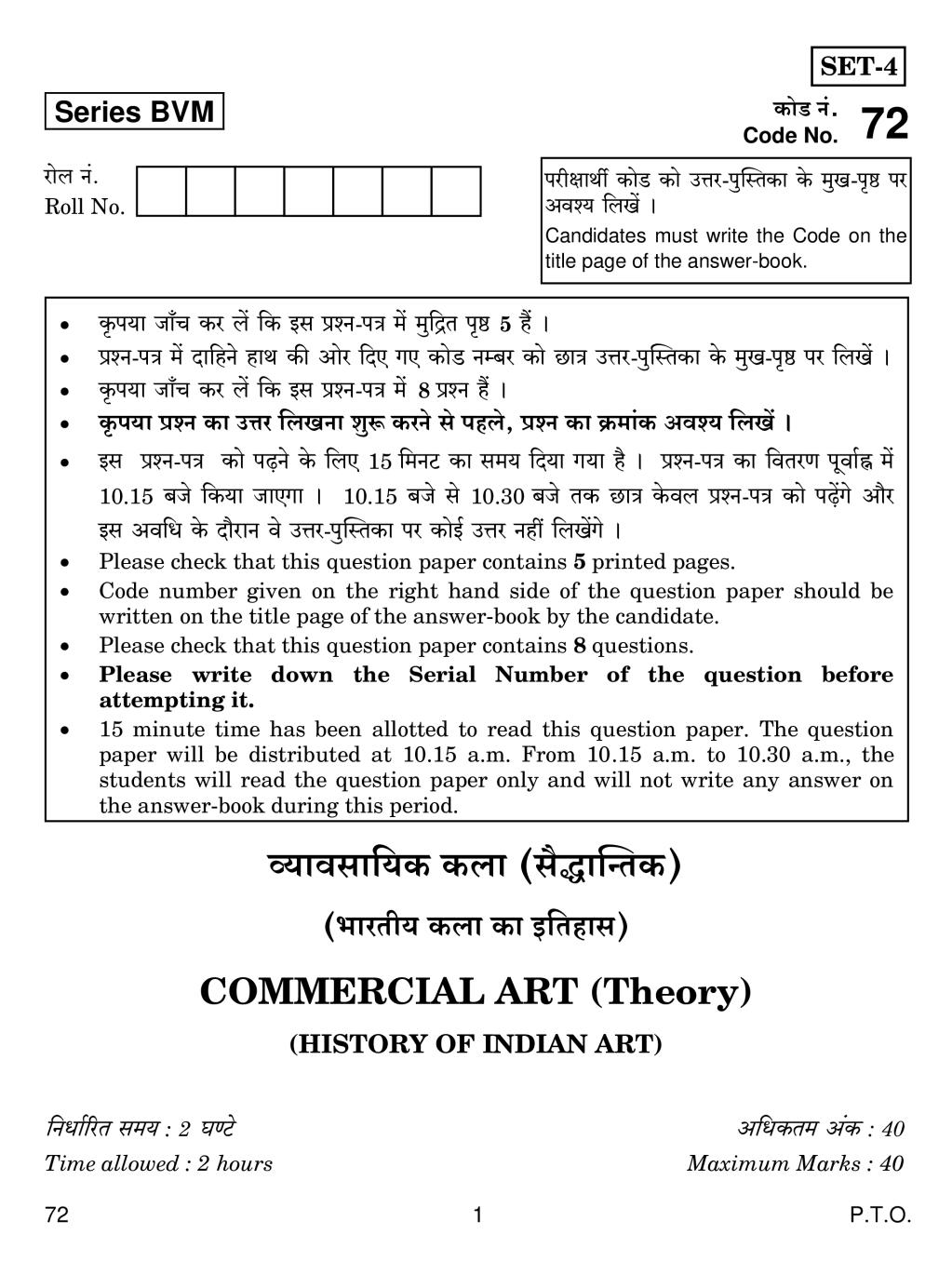
Page 1
Series BVM H$moS> Z§.
Code No. 72
amob Z§. narjmWu H$moS >H$mo CÎma-nwpñVH$m Ho$ _wI-n¥ð >na
Roll No. Adí` {bIo§ &
Candidates must write the Code on the
title page of the answer-book.
H¥$n`m Om±M H$a b| {H$ Bg àíZ-nÌ _o§ _w{ÐV n¥ð> 5 h¢ &
àíZ-nÌ _| Xm{hZo hmW H$s Amoa {XE JE H$moS >Zå~a H$mo N>mÌ CÎma-nwpñVH$m Ho$ _wI-n¥ð> na {bI| &
H¥$n`m Om±M H$a b| {H$ Bg àíZ-nÌ _| >8 àíZ h¢ &
H¥$n`m àíZ H$m CÎma {bIZm ewê$ H$aZo go nhbo, àíZ H$m H«$_m§H$ Adí` {bI| &
Bg àíZ-nÌ H$mo n‹T>Zo Ho$ {bE 15 {_ZQ >H$m g_` {X`m J`m h¡ & àíZ-nÌ H$m {dVaU nydm©• _|
10.15 ~Oo {H$`m OmEJm & 10.15 ~Oo go 10.30 ~Oo VH$ N>mÌ Ho$db àíZ-nÌ H$mo n‹T>|Jo Am¡a
Bg Ad{Y Ho$ Xm¡amZ do CÎma-nwpñVH$m na H$moB© CÎma Zht {bI|Jo &
Please check that this question paper contains 5 printed pages.
Code number given on the right hand side of the question paper should be
written on the title page of the answer-book by the candidate.
Please check that this question paper contains 8 questions.
Please write down the Serial Number of the question before
attempting it.
15 minute time has been allotted to read this question paper. The question
paper will be distributed at 10.15 a.m. From 10.15 a.m. to 10.30 a.m., the
students will read the question paper only and will not write any answer on
the answer-book during this period.
ì`mdgm{`H$ H$bm (g¡ÕmpÝVH$)
(^maVr` H$bm H$m B{Vhmg)
COMMERCIAL ART (Theory)
(HISTORY OF INDIAN ART)
{ZYm©[aV g_` : 2 KÊQ>o A{YH$V_ A§H$ : 40
Time allowed : 2 hours Maximum Marks : 40
72 1 P.T.O.
Page 2
(i) g^r AmR> àíZ A{Zdm`© h¢, {OZHo$ A§H$ g_mZ h¢ &
(ii) àíZ g§»`m 1 d 2 H$m àË`oH$ CÎma bJ^J 200 eãXm| _| VWm àíZ g§»`m 3, 4 d 5 H$m
àË`oH$ CÎma bJ^J 100 eãXm| _| {b{IE & àíZ g§»`m 6, 7 d 8 dñVw{Zð> àH$ma Ho$ h¢ &
General Instructions :
(i) All the eight questions are compulsory, which carry equal marks.
(ii) Answers to be written for question nos. 1 and 2 in about 200 words each
and for question nos. 3, 4 and 5 in about 100 words each. Question nos. 6,
7 and 8 are objective type.
1. AnZo nmR>çH«$_ _| gpå_{bV {ZåZ{b{IV g_H$mbrZ (AmYw{ZH$) ^maVr` H$bmH¥${V`m| _| go
{H$gr EH$ Ho$ gm¢X`© d¡^d H$m _yë`m§H$Z `Wm{d{Y gm¢X`© _mnXÊS>m| Ho$ AmYma na Cn`wº$
CXmhaUm| g{hV {dñVmanyd©H$ H$s{OE : 5
(A) {JÕ (EH$ {MÌ)
(~) ^±da (EH$ N>mnm-{MÌ)
(g) gÝWmb n[adma (EH$ _y{V©-{eën)
Evaluate the aesthetic grandeur of any of the following contemporary
(modern) Indian artworks included in your course of study duly based on
the aesthetic parameters and explain in detail with suitable examples :
(a) The Vulture (a painting)
OR
(b) Whirlpool (a graphic-print)
OR
(c) Santhal Family (a sculpture)
72 2
Page 3
H$s{OE & 5
Describe the origin and development of the Rajasthani or the Pahari
School of Miniature Painting.
3. {ZåZ{b{IV _wµJb AWdm XpŠIZr bKw-{MÌm| _| go {H$gr EH$ _| {H$Z _mZdr`
OrdZ-_yë`m| VWm _Zmo^mdm| H$mo Xem©`m J`m h¡ ? g§jon _| g_PmBE : 5
(A) H$~ra Am¡a a¡Xmg (_wµJb e¡br)
(~) hµOaV {ZµOm_wÔrZ Am¡{b`m Am¡a A_ra Iwgamo (XpŠIZr e¡br)
Which are the human life-values and emotions shown in any of the
following Mughal or Deccani miniature-paintings ? Explain in short :
(a) Kabir and Raidas (Mughal School)
OR
(b) Hazrat Nizamuddin Auliya and Amir Khusro (Deccani School)
4. ~§Jmb e¡br Ho$ {ZåZ{b{IV {MÌm| _| go {H$gr EH$ H$s g§`moOZ ì`dñWm na EH$
g_rjmË_H$ {Q>ßnUr `Wm{d{Y gm¢X`© _mnXÊS>m| Ho$ AmYma na {b{IE : 5
(A) `mÌm H$m AÝV
(~) AOw©Z H$m `wÕ go {daº$ hmoZm
Write a critical note on the compositional arrangement of any the
following painters of the Bengal School duly based on the aesthetic
parameters :
(a) Journey’s End
OR
(b) Arjuna Detach From War
72 3 P.T.O.
Page 4
g§~Õ H$bmH¥${V H$s nhMmZ H$s{OE, {Og_| {ZåZ{b{IV {deofVmE± g_m{dîQ> hm| Am¡a CÝh|
Cg H$bmH¥${V _| VXZwgma g_PmBE : 5
(A) `m{_Zr am` Ûmam ~ZmE JE {MÌm| _| BH$hao AJ«Vb, M_H$Vo a§J, bhaXma dH«$ VWm
{d{^Þ a§Jm| H$s _moQ>r n{Å>`m± CZHo$ bmoH$-H$bm go à^m{dV hmoZo H$m g§Ho$V
h¡ &
(~) am_qH$H$a d¡O Ho$ _y{V©-{eënm| _| CZHo$ Mmam| Amoa Ho$ gab bmoH$m| Ho$ dmñV{dH$
H$îQ>-nyU© OrdZ H$m H$Qw> gË` n[ab{jV hmoVm h¡ &
(g) Ho$. bú_m Jm¡S> Ho$ N>mnm-{MÌm| _| _mZdr` g§doXZmAm| Am¡a àH¥${V go Jhao Ow‹S>md H$m
àH$Q>rH$aU hþAm h¡ &
Identify any one relevant contemporary (modern) Indian artwork
included in your course of study comprising of the following features and
explain them in that artwork accordingly :
(a) In the paintings of Jamini Roy the single frontal plane, glowing
colours, flowing curves and bold strips of different colours are
indicative of the influence of folk-art.
OR
(b) The bitter truth of the real painful life of the simple folks around
him is revealed in the sculptures by Ramkinker Vaij.
OR
(c) The graphic-prints of K. Laxma Goud express human emotions and
deep attachment with nature.
6. AnZo nmR>çH«$_ _| gpå_{bV {ZåZ{b{IV bKw-{MÌm| _| go àË`oH$ Ho$ H$bmH$ma H$m Zm_
~VmBE : 5
(A) H¥$îU Pybo na (~rH$mZoa Cn-e¡br)
(~) amYm (~Ur-R>Ur) ({H$eZJ‹T> Cn-e¡br)
(g) _mê$-am{JZr (_odm‹S> Cn-e¡br)
(X) H¥$îU Jmo{n`m| Ho$ g§J (~gmohbr Cn-e¡br)
(`) Z§X, `emoXm Am¡a H¥$îU Hw$Qw>på~`m| Ho$ gmW d§¥XmdZ OmVo hþE (H$m±J‹S>m Cn-e¡br)
72 4
Page 5
included in your course of study :
(a) Krishna on Swing (Bikaner Sub-School)
(b) Radha (Bani-Thani) (Kishangarh Sub-School)
(c) Maru-Ragini (Mewar Sub-School)
(d) Krishna with Gopis (Basohli Sub-School)
(e) Nand, Yashoda and Krishna with Kinsmen going to Vrindavana
(Kangra Sub-School)
7. AnZo nmR>çH«$_ _| gpå_{bV _wµJb e¡br Ho$ VrZ VWm XpŠIZr e¡br Ho$ Xmo bKw-{MÌm| Ho$
erf©H$ ~VmBE, Omo AmnH$s ÑpîQ> _| _hÎdnyU© h¢ & 5
Mention the titles of three miniature-paintings of the Mughal School and
two of the Deccani School included in your course of study, which are
important in your view.
8. ^maVr` amîQ´>r` ÜdO _| à`wº$ {ZåZ{b{IV _| go àË`oH$ H$m Š`m àVrH$mË_H$ AW© h¡ ? 5
(A) ^maV Ho$g[a`m a§J
(~) ídoV a§J
(g) ^maV ham a§J
(X) AemoH$-MH«$
(`) AemoH$-MH«$ _| 24 Vr{b`m± (Aao)
What is symbolized by each of the following, used in the Indian National
Flag ?
(a) India Saffron Colour
(b) White Colour
(c) India Green Colour
(d) Ashokan Wheel (Chakra)
(e) 24 spokes in the Ashokan Wheel (Chakra)
72 5 P.T.O.
Document Details
| Board / Org | CBSE |
| Exam | Class 12 |
| Type | Question Paper |
| Pages | 5 |
| Updated | 30 Apr 2026 |