MAHA SET 2019 Question Paper 2 Education
Finished viewing? Save it for later —
Download MAHA SET 2019 Question Paper 2 Education (PDF · 40 pages)About MAHA SET 2019 Question Paper 2 Education
MAHA SET 2019 Question Paper 2 Education is available here for free download. Published by Maharashtra Exams for MAHA SET, this question paper can be viewed online or downloaded as a PDF (40 pages). Candidates preparing for MAHA SET can use MAHA SET 2019 Question Paper 2 Education to understand the exam pattern, the type of questions asked, and the overall difficulty level.
Frequently Asked Questions
How can I download MAHA SET 2019 Question Paper 2 Education?
Open this page and click the Download button to save MAHA SET 2019 Question Paper 2 Education as a PDF. It is completely free on AglaSem Docs.
Is MAHA SET 2019 Question Paper 2 Education free to download?
Yes. MAHA SET 2019 Question Paper 2 Education can be viewed online and downloaded as a PDF free of cost on AglaSem Docs.
How many pages does MAHA SET 2019 Question Paper 2 Education have?
MAHA SET 2019 Question Paper 2 Education contains 40 pages, which you can read online or download together as a single PDF.
Where can I find more MAHA SET study material?
You can find more MAHA SET question papers, sample papers, syllabus, and answer keys on AglaSem Docs.
MAHA SET 2019 Question Paper 2 Education – Text
Read the full text of this question paper below — useful to quickly search, copy and reference the content online without downloading the PDF.
📄 View text version (40 pages)
Page 1
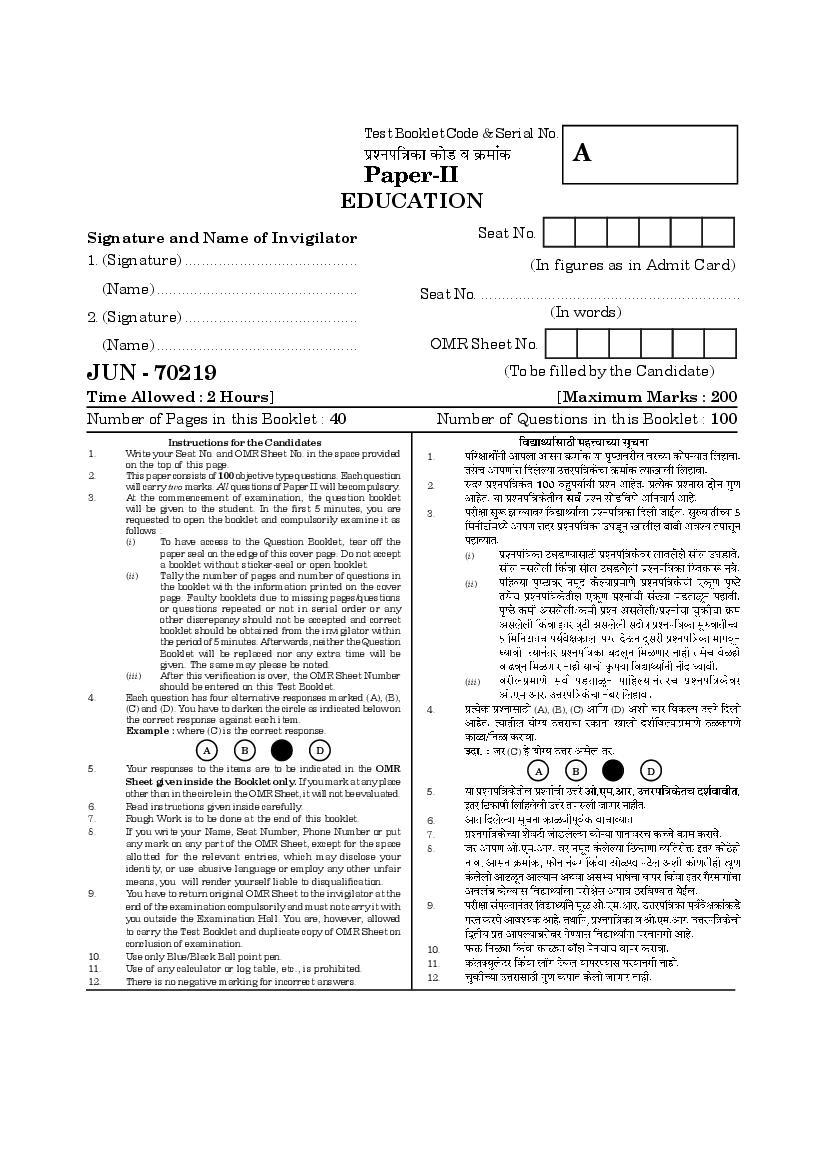
A
EDUCATION
Signature and Name of Invigilator Seat No.
1. (Signature) ......................................... (In figures as in Admit Card)
(Name) ................................................ Seat No. ..............................................................
2. (Signature) ......................................... (In words)
(Name) ................................................ OMR Sheet No.
JUN - 70219 (To be filled by the Candidate)
Time Allowed : 2 Hours] [Maximum Marks : 200
Number of Pages in this Booklet : 40 Number of Questions in this Booklet : 100
Instructions for the Candidates
1. Write your Seat No. and OMR Sheet No. in the space provided 1.
on the top of this page.
2. This paper consists of 100 objective type questions. Each question
will carry two marks. All questions of Paper II will be compulsory. 2.
3. At the commencement of examination, the question booklet
will be given to the student. In the first 5 minutes, you are 3.
requested to open the booklet and compulsorily examine it as
follows :
(i) To have access to the Question Booklet, tear off the
paper seal on the edge of this cover page. Do not accept (i)
a booklet without sticker-seal or open booklet.
(ii) Tally the number of pages and number of questions in
the booklet with the information printed on the cover (ii)
page. Faulty booklets due to missing pages/questions
or questions repeated or not in serial order or any
other discrepancy should not be accepted and correct
booklet should be obtained from the invigilator within
the period of 5 minutes. Afterwards, neither the Question
Booklet will be replaced nor any extra time will be
given. The same may please be noted.
(iii) After this verification is over, the OMR Sheet Number
(iii)
should be entered on this Test Booklet.
4. Each question has four alternative responses marked (A), (B),
(C) and (D). You have to darken the circle as indicated below on 4. (A), (B), (C) (D)
the correct response against each item.
Example : where (C) is the correct response.
A B D (C)
5. Your responses to the items are to be indicated in the OMR A B D
Sheet given inside the Booklet only. If you mark at any place
other than in the circle in the OMR Sheet, it will not be evaluated. 5.
6. Read instructions given inside carefully.
7. Rough Work is to be done at the end of this booklet. 6.
8. If you write your Name, Seat Number, Phone Number or put 7.
any mark on any part of the OMR Sheet, except for the space
8.
allotted for the relevant entries, which may disclose your
identity, or use abusive language or employ any other unfair
means, you will render yourself liable to disqualification.
9. You have to return original OMR Sheet to the invigilator at the
end of the examination compulsorily and must not carry it with 9.
you outside the Examination Hall. You are, however, allowed
to carry the Test Booklet and duplicate copy of OMR Sheet on
conclusion of examination.
10.
10. Use only Blue/Black Ball point pen.
11.
11. Use of any calculator or log table, etc., is prohibited.
12. There is no negative marking for incorrect answers. 12.
Page 2
Page 3
Paper II
II
Time Allowed : 120 Minutes] [Maximum Marks : 200
Note : This Paper contains Hundred (100) multiple choice questions. Each question
carrying Two (2) marks. Attempt All questions.
(100) (2)
1. The book ‘Education for Critical 1.
Consciousness’ is written by :
(A) Mary Wollstonecraft (A)
(B) Nel Noddings (B)
(C) Swami Vivekananda (C)
(D) Paulo Freire (D)
2. ‘Hinyana’ is also known as : 2.
(A) Vajrayana (A)
(B) Theravada (B)
(C) Tantra
(C)
(D) Suktta
(D)
3. Social change is a term used to
3.
describe......................
(A) Variation in any aspect of school
(A)
management
(B) Modification in teaching and
learning methods (B)
(C) Variation and modification in
social interaction or social (C)
organisation
(D) Modification in curriculum (D)
3 [P.T.O.
Page 4
according to Jainism is.............
(A) Moksha (A)
(B) Bhakti (B)
(C) Nirvana
(C)
(D) Keval Dnyan
(D)
5. The book ‘Education of Man’ was
5.
written by.......................
(A) Sartre
(A)
(B) Plato
(B)
(C) Froebel
(C)
(D) Rousseau
(D)
6. According to Rousseau who provides
6.
a fencing around the soul of the
child ?
(A)
(A) Father
(B) Mother (B)
(C) Society (C)
(D) Teacher (D)
4
Page 5
the aims of education are............
(A) Emotional and materialistic (A)
(B) Spiritual and materialistic (B)
(C) Emotional and Spiritual
(C)
(D) Spiritual and indirect
(D)
8. In Islam Ulum Aqliyya deals with
8.
the study of..........................
(A) Languages and fine arts
(A)
(B) Philosophy and physical
(B)
sciences
(C)
(C) Psychology and Philosophy
(D)
(D) Psychology and social sciences
9.
9. ‘The Challenge to Care in Schools’—
This book was written by :
(A) Swami Dayananda (A)
(B) Sri Aurobindo (B)
(C) Nel Noddings (C)
(D) Mahatma Gandhi (D)
5 [P.T.O.
Page 6
should be vocational in character.
(A) Realism
(A)
(B) Pragmatism
(C) Naturalism (B)
(D) Idealism (C)
11. To inculcate protection and
(D)
consolidation of democracy through
education is one of the objectives 11.
of....................................
(A) Yashpal Committee’s Report
(2009)
(A) (2009)
(B) National Policy of Education
(1986-1992) (B) (1986-
(C) Kothari Education Commission 1992)
(1964-66)
(C) (1964-66)
(D) National Knowledge Commission
(D) (2007)
(2007)
6
Page 7
the burden of the school bags should
be reduced at the primary level.
(A) Kothari Education Commission
(A) (1964-66)
(1964-66)
(B) Yashpal Committee’s Report (B) (2009)
(2009)
(C) (1986-
(C) National Policy of Education 1992)
(1986-1992)
(D) (2007)
(D) National Knowledge Commission
(2007). 13. (signaling theory)
13. According to signaling theory...........
(A) There is reflection of correlation (A)
between education and
unobserved ability
(B)
(B) There is no effect of education
on politics
(C)
(C) There is no relation between
education and social status
(D) There is correlation between (D)
education and politics
7 [P.T.O.
Page 8
14.
through the use of.....................related
to politics.
(A) Criteria
(B) Indicators
(A)
(C) Measures
(D) Issues (B)
15. Education for SC/ST and OBC
(C)
universal access to education
was to be ensured and adequate (D)
incentives were to be given to
15. SC/ST OBC
children particularly the girls was
recommended by.............................
(A) National Commission on
Teachers (1999)
(B) National Policy of Education (A) (1999)
(1992)
(B) (1992)
(C) Kothari Education Commission
(1964-66) (C) (1964-66)
(D) Yashpal Committee Report
(D) (2009)
(2009)
8
Page 9
Indian vernacular languages for the
benefit of student’s and teachers.
This was emphasised in......................
(A) Wood’s Dispatch (A)
(B) Macaulay’s Minutes (B)
(C) Adam’s Report (C)
(D) Manro’s document
(D)
17. In...........................decisions taken by
17.
the ruler are to be propagated and
to be imposed on students by
teacher.
(A) Autocracy
(A)
(B) Aristocracy
(B)
(C) Monarchy
(C)
(D) Dictatorship
(D)
18. ........................believe that most people
18.
can be reasonable and that teachers
need to use teaching methods that
build and support the ability to
rationalize and use their intelligence.
(A) Liberalism (A)
(B) Secularism (B)
(C) Individualism (C)
(D) Conservatism (D)
9 [P.T.O.
Page 10
establishment of the Commissions/
Committees given below :
Kothari Education Commission (KEC),
(KEC), Yashpal Committee (YC), (YC), (JVC),
Justice Verma Committee (JVC),
(NKC)
National Knowledge Commission
(NKC) (A) KEC, JVC, YC, NKC
(A) KEC, JVC, YC, NKC
(B) KEC, NKC, YC, JVC
(B) KEC, NKC, YC, JVC
(C) KEC, YC, NKC, JVC
(C) KEC, YC, NKC, JVC
(D) JVC, KEC, NKC, YC (D) JVC, KEC, NKC, YC
20. The execution of education policy 20.
into action is called as....................
(A) Formation of education policy
(A)
(B) Analysis of education policy
(C) Documentation of education (B)
policy
(C)
(D) Implementation of education
policy (D)
10
Page 11
different things then he is at...............
as per Piaget’s theory.
(A) Pre-conceptual stage (A)
(B) Intuitive stage (B)
(C) Concrete operational stage
(C)
(D) Formal operational stage
(D)
22. .............................. is the one of
22.
the determinant of individual
differences.
(A)
(A) Attitude
(B)
(B) Interest
(C)
(C) Personality
(D)
(D) Hormones
23.
23. .......................... stage is not
enumerated by Erikson in his
psycho-social theory of development.
(A) Trust versus mistrust (A)
(B) Autonomy versus shame (B)
(C) Humour versus anger (C)
(D) Initiative versus guilt (D)
11 [P.T.O.
Page 12
following is not the component of
tacit knowledge :
(A)
(A) Managing self
(B) Managing others (B)
(C) Managing career (C)
(D) Managing imaginations (D)
25. Students are punished when they
25.
don’t do homework, so they do
homework. This change of behaviour
is called.......................
(A) Discriminated punishment (A)
learning
(B)
(B) Punishment learning
(C)
(C) Escape learning
(D)
(D) Active avoidance learning
26.
26. In Clarke Hull’s Theory, Need,
Habit strength, incentive motivation
and.........................are the most
important terms are used.
(A)
(A) Stimulus
(B)
(B) Response
(C)
(C) Drive
(D) Performance (D)
12
Page 13
learning.................... is the first stage
of learning.
(A) Chain learning
(A)
(B) Signal learning
(B)
(C) Concept learning
(C)
(D) Verbal associative learning
(D)
28. According to Ginzberg’s theory
28.
second stage in the vocational
development of an individual
is................stage.
(A) No choice (A)
(B) Fantancy (B)
(C) Trial and error (C)
(D) Stabilization
(D)
29. The main aim of educational
29.
guidance is........................
(A) Pupil development
(A)
(B) To solve the problem of schools
(B)
(C) For ease in transaction of
curriculum (C)
(D) To improve school standard (D)
13 [P.T.O.
Page 14
vocational counselling.
(A) Individual (A)
(B) Vocation
(B)
(C) Skills required for vocation
(C)
(D) Interest of an individual
(D)
31. Teaching is not a profession because
31.
there is..........................
(A) No oath
(A)
(B) No professional organization
which controls teacher’s (B)
behaviour
(C) No provision for getting money (C)
by using skills acquired
(D) No social service (D)
32. To provide extension services
32.
department to teacher education
colleges is one of the functions
of......................
(A) NCTE
(A) NCTE
(B) NCERT
(B) NCERT
(C) SBTE (C) SBTE
(D) SCERT (D) SCERT
14
Page 15
education suggested by NCTE are
competency, commitment and...........
(A) Progress (A)
(B) Attitude (B)
(C) Quality
(C)
(D) Performance
(D)
34. In the course, where all the college
34.
teachers only from same subject
attends the course, said course is
called................................
(A)
(A) Refresher course
(B)
(B) Orientation course
(C)
(C) Summer institutes
(D)
(D) Faculty development programme
35. Need of pre-service teacher 35.
education was firstly recommended
by..................................
(A) Kothari Commission (A)
(B) Radhakrishnan Commission (B)
(C) Mudaliar Commission (C)
(D) Chattopadhyaya Commission (D)
15 [P.T.O.
Page 16
without the co-operation and active
participation of teachers’. This is the
statement made .........................
Commission
(A)
(A) Kothari
(B)
(B) Radhakrishnan
(C)
(C) Delor
(D) Mudaliar (D)
37. In behaviouristic model of teacher 37.
education more stress is given
on.........................
(A) Theory building (A)
(B) Skill development (B)
(C) Value development (C)
(D) Attitude development
(D)
38. As a.................., an educator is in a
38.
position to profess substantive beliefs
about the meaning and value of
education.
(A) Expert (A)
(B) Resource person (B)
(C) Professional (C)
(D) Counsellor (D)
16
Page 17
responsibility of learning towards
the students and make them active
participants of learning process
is.............................
(A)
(A) Role play
(B)
(B) Peer teaching
(C)
(C) Flip methodology
(D)
(D) Brainstorming
40.
40. A teaching process where teachers
think over their teaching practices,
analysing how some thing was
taught and how the practice might
be improved or changed for better
learning outcomes is.......................
(A) Reflective teaching (A)
(B) Resourceful teaching (B)
(C) Creative teaching (C)
(D) Flipped teaching (D)
17 [P.T.O.
Page 18
41.
curriculum evaluation is called
.....................
(A) Interactive Evaluative Model (A)
(B) Summative Evaluation Model (B)
(C) Formative Evaluation Model
(C)
(D) Responsive Evaluation Model
(D)
42. Which statement of the following is
not true ? 42.
(A) Curriculum is a dynamic (A)
process
(B)
(B) Curriculum is knowledge
arranged systematically for
progressive acquisition (C)
(C) Curriculum is the summary of
textbooks
(D)
(D) Curriculum is not confined to
certain subjects only
18
Page 19
idealists..........................
(A) Emphasize on the logical
(A)
divisions of subject-matter
(B)
(B) Advocate vocational subjects to
be included
(C) Attach a higher importance to (C)
humanities than physical and
biological sciences
(D)
(D) Give importance to only
44.
literature
44. In any university the curriculum is
approved by......................
(A) Academic Council (A)
(B) Management Council (B)
(C) Board of Studies (C)
(D) University Senate (D)
45. In any university the responsibility 45.
of curriculum development belongs
to.........................
(A)
(A) Subject Teacher Association
(B)
(B) Academic Council
(C) Management Council (C)
(D) Board of Studies (D)
19 [P.T.O.
Page 20
its original Latin word means...........
(A) Path of knowledge
(B) Path of success
(A)
(C) Path of competition
(B)
(D) Path of running
(C)
47. ....................are the main elements of
any curriculum. (D)
(A) Objectives, content, teaching
47.
methods, evaluation
(B) Content, evaluation, teaching
aids (A)
(C) Planning, assignment, content (B)
(D) Teaching units, questions, (C)
assignments, support material
(D)
48. In case of curriculum which of the
following is not desirable ?
48.
(A) Curriculum should be learner-
centered
(B) Curriculum should be flexible (A)
(C) Curriculum should be based on (B)
textbooks
(C)
(D) Curriculum should be changed
from time to time. (D)
20
Page 21
of...................................
(A) Changing teaching methods (A)
(B) Changing evaluation pattern (B)
(C) Changing educational objectives (C)
(D) Changing needs of time (D)
50. A curriculum whose structure allows 50.
for topics or skills to be repeated each
time in more detail or depth is called
the............................
(A) Repeated curriculum (A)
(B) Revised curriculum (B)
(C) Reinforcing curriculum (C)
(D) Spiral curriculum (D)
51. The purpose of................... research is 51.
improving a product or process
testing of theoretical concepts in
actual problem situation.
(A) Fundamental (A)
(B) Applied (B)
(C) Historical (C)
(D) Ex-post facto (D)
21 [P.T.O.
Page 22
research problem is......................
(A) Conceptual definition (A)
(B) Logical definition (B)
(C) Operational definition (C)
(D) Idealistic definition (D)
53. The elaborate form of research title 53.
is.............................
(A) Statement (A)
(B) Hypothesis (B) (Hypothesis)
(C) Objectives (C)
(D) Assumptions (D) (Assumptions)
54. Analysis of the collected data 54.
depends on..............................
(A) Hypotheses formulated (A)
(B) Number of categories into which (B)
data has been classified
(C) Statistical techniques available (C)
(D) Objectives stated (D)
22
Page 23
when :
(i)
(i) It is interesting and subjective.
(ii)
(ii) It is new and adds something
to knowledge.
(iii)
(iii) It has utility and relevance.
(iv) It is objective.
(iv)
(A) (i), (ii) and (iii)
(A) (i), (ii) (iii)
(B) (ii), (iii) and (iv)
(B) (ii), (iii) (iv)
(C) (i), (iii) and (iv)
(C) (i), (iii) (iv)
(D) (i), (ii) and (iv)
(D) (i), (ii) (iv)
56. An application of descriptive
56.
method based upon a longitudinal
consideration of recorded data
indicating the past and present
situation and what is likely to
happen in future is.......................
(A) Historical study (A)
(B) Case study (B)
(C) Trend study (C)
(D) Activity analysis (D)
23 [P.T.O.
Page 24
computing standard deviations are (squared deviation)
always taken from.......................
(A) Percentage (A)
(B) Mean (B)
(C) Median (C)
(D) Percentile rank (D)
58. Tippet table refers to...................... 58. (Tippet)
(i) Table of random digits.
(i)
(ii) Table used in sampling
methods. (ii)
(iii) Table used in statistical (iii)
investigation.
(iv) Table used in Logarithm. (iv)
(A) (i) and (iv) (A) (i) (iv)
(B) (ii) and (iv) (B) (ii) (iv)
(C) (ii), (iii) and (iv) (C) (ii), (iii) (iv)
(D) (i), (ii) and (iii) (D) (i), (ii) (iii)
24
Page 25
on certain characteristics or (attributes)
attribute of the objects is..................
(A) Nominal scale
(A)
(B) Ordinal scale
(B)
(C) Interval scale
(C)
(D) Ratio scale
(D)
60. A type of qualitative narrative 60.
design is.............................
(A) Autobiography (A)
(B) Poetic inquiry (B) (Poetic inquiry)
(C) Anthropology (C)
(D) Grounded theory (D) (Grounded theory)
61.
61. In........................system of interaction
analysis there is recording of
classroom events, construction and
interpretation of Interaction Matrix.
(A) Knowles (A) (Knowles)
(B) Krathwohl (B) (Krathwohl)
(C) Galloway (C) (Galloway)
(D) Anderson (D) (Anderson)
25 [P.T.O.
Page 26
element of pedagogical analysis ?
(A) Content analysis (A)
(B) Selection of evaluation devices (B)
(C) Selection of teaching methods (C)
(D) Data analysis (D)
63. A student’s score on Criterion 63.
Referenced Test is best used
to provide information about
student’s.............
(A) Mastery of a defined body of (A)
content
(B) Performance in comparison to (B)
peers in a given area
(C) Potential to achieve in a (C)
specified subject area
(D) Readiness for a particular grade (D)
level
64. .......................almost always improves 64.
learning and performance.
(A) Increased feedback (A)
(B) Decreased feedback (B)
(C) Learning feedback (C)
(D) Performance feedback (D)
26
Page 27
example of reflective writing
assignment ?
(A)
(A) Classroom notes
(B)
(B) Learning diary
(C)
(C) Peer review
(D)
(D) Reflective notes
66.
66. Classroom interactions can be
appropriately assessed by...................
(A) Questionnaire (A)
(B) Observation schedule (B)
(C) Interview (C)
(D) Test (D)
67. According to Anderson and
67.
Krathwohl taxonomy of cognitive
domain........................is at highest
level.
(A)
(A) To evaluate
(B) To synthesize (B)
(C) To create (C)
(D) To comprehend (D)
27 [P.T.O.
Page 28
understanding level of learning
includes both..........................
(A) Memory and insight (A)
(B) Creativity and intelligence (B)
(C) Creativity and aptitude (C)
(D) Memory and creativity (D)
69. Identify missing level from Dave’s 69.
psychomotor domain taxonomy :
Imitation, Manipulation, Precision
......................, naturalisation.
(A) Articulation
(A)
(B) Creation
(B)
(C) Comprehension
(C)
(D) Attention
(D)
70. An adult student’s strength,
weaknesses, knowledge and skills 70.
prior to instruction is assessed
by......................
(A) Summative assessment (A)
(B) Formative assessment (B)
(C) Diagnostic assessment (C)
(D) Interim assessment (D)
28
Page 29
offered by distance education to the
learner.
(A)
(A) Pace
(B)
(B) Medium
(C)
(C) Eligibility
(D) Time (D)
72. Branching programme of 72.
programmed learning is more useful
in..............................
(A)
(A) Concept knowing
(B)
(B) Concept formation
(C)
(C) Concept comparison
(D) Concept criticism (D)
73. Davies has presented the four steps, 73.
namely planning of teaching,
organization of teaching, leading of
teaching and........................for
teaching technology.
(A)
(A) Evaluation of teaching
(B)
(B) Controlling of teaching
(C) Reinforcement of teaching (C)
(D) Administration of teaching (D)
29 [P.T.O.
Page 30
hunter in a jungle using computer
programme is an example of................
type of computer assisted instruction
(CAI).
(A) Information Instruction (A)
(B) Drill and Practice (B)
(C) Simulation Instruction (C)
(D) Problem Solving (D)
75. Asynchronous learning is based 75. (Asynchronous)
on......................... theory.
(A) Behaviourist
(B) Cognitive (A)
(C) Constructivist (B)
(D) Gestalt (C)
76. The changes in the effective domain (D)
of the behaviour of the learner’s like 76.
interest, habits and attitude can be
effectively brought with the help of
the......................... approach.
(A) Hardware (A)
(B) Software (B)
(C) System (C)
(D) Multimedia (D)
30
Page 31
e-learning specifically for ................
type of learners.
(A) Slow learners
(A)
(B) Advance learners
(B)
(C) Disabled learners
(C)
(D) Hyperactive learners
(D)
78. For managing virtual
communication, teacher makes 78.
circles of students, this is a
characteristic of.......................social
networking site.
(A) Facebook (A)
(B) Twitter (B)
(C) Google+
(C)
(D) Word Press
(D)
79. ......................is characteristic of online
79.
library.
(A) Lower maintenance cost
(A)
(B) Maximum physical space for
storage (B)
(C) Less fees (C)
(D) Easiness in reading (D)
31 [P.T.O.
Page 32
online survey.
(A) Decrease in response rates (A)
(B) Maximum reliability (B)
(C) Difficult to data gathering
(C)
(D) Flexibility of design
(D)
81. Main function of Educational
81.
Administration is..........................
(A) Planning
(A)
(B) Organizing
(B)
(C) Supervising
(C)
(D) Controlling
(D)
82. Critical Path Method (CPM) is used
82. (CPM)
in Educational Administration for
the management of.......................
(A) Predictable activities
(A)
(B) Unpredictable activities
(B)
(C) P r e d ic t a b l e -u np re di ct a b le
activities (C)
(D) Predesigned activities (D)
32
Page 33
leadership ....................... basic
principle is included.
(A) Different motivational drivers (A)
(B) Same personality quality (B)
(C) Equal motivational drivers (C)
(D) No individual differences (D)
84. Charismatic leadership approach is 84.
centered in an........................ability.
(A) Immoral (A)
(B) Charm and persuade (B)
(C) Destructive (C)
(D) Apathetic (D)
85. The book, ‘Fortune at the Bottom of 85.
the Pyramid’ is written by the
management theorist........................
(A) Hersey (A)
(B) Edwards Deming (B)
(C) Walter Shewart (C)
(D) C.K. Pralhad (D)
33 [P.T.O.
Page 34
all members of an organization
participate in improving.....................
(A) Processes, product
(A)
(B) Processes, product, services
(B)
(C) Processes, product, services and
(C)
culture
(D) Processes, services and products. (D)
87. The three step model of change was 87.
developed by........................
(A) Fiedler (A)
(B) C.K. Pralhad (B)
(C) Edwards Deming
(C)
(D) Kurt Lewin
(D)
88. ........................is attributed with
88.
developing the scientific
management principles.
(A) Elton Mayo (A)
(B) Robert Owens (B)
(C) Frank Gilbirth (C)
(D) Frederich Taylor (D)
34
Page 35
successfully implemented by............
company.
(A)
(A) Toyota
(B)
(B) Honda
(C)
(C) Suzuki
(D)
(D) Volkswagon
90.
90. The concept of ‘Cost of Quality’ was
first described by........................
(A)
(A) Milton Friedman
(B)
(B) Armand V. Feigenbaum
(C)
(C) Friedrich Hayek
(D)
(D) Douglass North
91.
91. Persons with Disabilities Act, 1995
made provision for inclusion
of.................... in schools.
(A) Playground (A)
(B) Mid-day Meals (B)
(C) Facility of Ramps (C)
(D) Health cleck-up (D)
35 [P.T.O.
Page 36
IQ score of mild mentally retarded
children is between.......................
(A) 70-79 (A) 70-79
(B) 80-89
(B) 80-89
(C) 59-69
(C) 59-69
(D) 49-59
(D) 49-59
93. The objective of Inclusive Education
93.
is...........................
(A) To promote constantly the local
(A)
cultures and contents of various
communities of the society
(B) To uncover and minimize
(B)
barriers to learning
(C) To provide technology base
facilities (C)
(D) To change attitudes, (D)
behaviours, teaching methods
curricular and environments to
meet.
36
Page 37
based on the premise..................
(A) That all learners can experience
(A)
difficulties in school
(B) A few learners can experience
difficulties in school (B)
(C) Children with specific
disabilities have difficulties in
(C)
school
(D) Children with mental
(D)
retardation have more
difficulties in school
95. Braille language is used 95.
in.....................
(A)
(A) School for the dumb
(B)
(B) School for the blind
(C)
(C) School for the deaf
(D)
(D) School for the mentally retarded
37 [P.T.O.
Page 38
women with disabilities is.................
(A) Housing (A)
(B) Protection against exploitation (B)
and abuse
(C)
(C) Employable skills
(D)
(D) Basic education
97.
97. A child who has unusual difficulty
in understanding oral instruction
may have the following impairment :
(A) Cerebral Palsy
(A)
(B) Visual impairment
(B)
(C) Intellectual disability
(C)
(D) Hearing impairment
(D)
98. Orthopaedically handicapped
students should be ideally 98.
accommodated in..................school.
(A) General (A)
(B) Open (B)
(C) Special (C)
(D) Integrated (D)
38
Page 39
inclusion of Health check-up in
schools.
(A) Persons with Disabilities Act, (A)
1995 1995
(B) Rehabilitation Council of India (B)
Act, 1992 1992
(C) The Juvenile Justice Act, 1986 (C) 1986
(D) Reformatory School Act, 1977 (D) 1977
100. Neeta always forgets to add the 100.
carry over digit while doing addition.
This is a feature of......................
(A) Dyspraxia (A) (Dyspraxia)
(B) Dyslexia (B) (Dyslexia)
(C) Dyscalculia (C) (Dyscalculia)
(D) Dysgraphia (D) (Dysgraphia)
39 [P.T.O.
Page 40
40
Document Details
| Board / Org | Maharashtra Exams |
| Exam | MAHA SET |
| Type | Question Paper |
| Pages | 40 |
| Updated | 30 Apr 2026 |