Kerala CEE LLM 2023 Question Paper with Answers
Finished viewing? Save it for later —
Download Kerala CEE LLM 2023 Question Paper with Answers (PDF · 20 pages)About Kerala CEE LLM 2023 Question Paper with Answers
Kerala CEE LLM 2023 Question Paper with Answers is available here for free download. Published by CEE Kerela for CEE Kerala LLM, this question paper can be viewed online or downloaded as a PDF (20 pages). Candidates preparing for CEE Kerala LLM can use Kerala CEE LLM 2023 Question Paper with Answers to understand the exam pattern, the type of questions asked, and the overall difficulty level.
Frequently Asked Questions
How can I download Kerala CEE LLM 2023 Question Paper with Answers?
Open this page and click the Download button to save Kerala CEE LLM 2023 Question Paper with Answers as a PDF. It is completely free on AglaSem Docs.
Is Kerala CEE LLM 2023 Question Paper with Answers free to download?
Yes. Kerala CEE LLM 2023 Question Paper with Answers can be viewed online and downloaded as a PDF free of cost on AglaSem Docs.
How many pages does Kerala CEE LLM 2023 Question Paper with Answers have?
Kerala CEE LLM 2023 Question Paper with Answers contains 20 pages, which you can read online or download together as a single PDF.
Where can I find more CEE Kerala LLM study material?
You can find more CEE Kerala LLM question papers, sample papers, syllabus, and answer keys on AglaSem Docs.
Kerala CEE LLM 2023 Question Paper with Answers – Text
Read the full text of this question paper below — useful to quickly search, copy and reference the content online without downloading the PDF.
📄 View text version (20 pages)
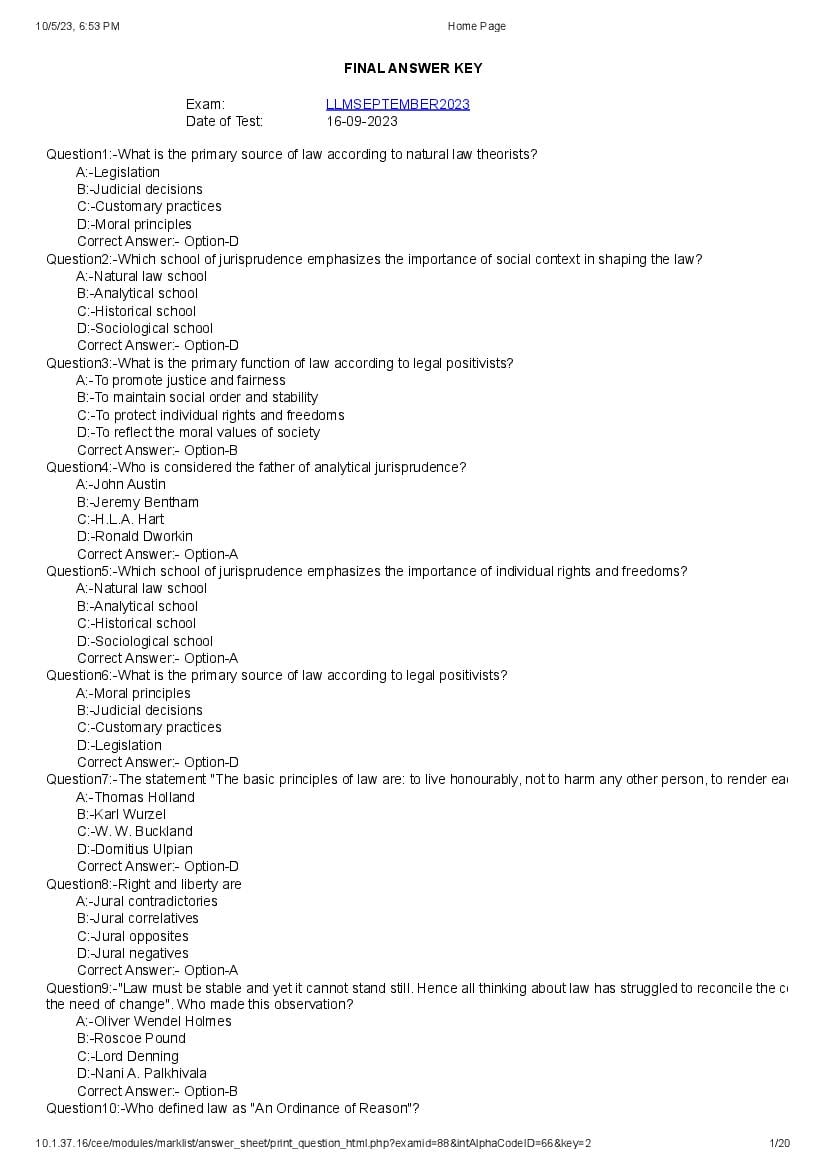
Page 1
Exam: LLMSEPTEMBER2023
Date of Test: 16-09-2023
Question1:-What is the primary source of law according to natural law theorists?
A:-Legislation
B:-Judicial decisions
C:-Customary practices
D:-Moral principles
Question2:-Which school of jurisprudence emphasizes the importance of social context in shaping the law?
A:-Natural law school
B:-Analytical school
C:-Historical school
D:-Sociological school
Question3:-What is the primary function of law according to legal positivists?
A:-To promote justice and fairness
B:-To maintain social order and stability
C:-To protect individual rights and freedoms
D:-To reflect the moral values of society
Question4:-Who is considered the father of analytical jurisprudence?
A:-John Austin
B:-Jeremy Bentham
C:-H.L.A. Hart
D:-Ronald Dworkin
Question5:-Which school of jurisprudence emphasizes the importance of individual rights and freedoms?
A:-Natural law school
B:-Analytical school
C:-Historical school
D:-Sociological school
Question6:-What is the primary source of law according to legal positivists?
A:-Moral principles
B:-Judicial decisions
C:-Customary practices
D:-Legislation
Question7:-The statement "The basic principles of law are: to live honourably, not to harm any other person, to render eac
A:-Thomas Holland
B:-Karl Wurzel
C:-W. W. Buckland
D:-Domitius Ulpian
Question8:-Right and liberty are
A:-Jural contradictories
B:-Jural correlatives
C:-Jural opposites
D:-Jural negatives
Question9:-"Law must be stable and yet it cannot stand still. Hence all thinking about law has struggled to reconcile the co
the need of change". Who made this observation?
A:-Oliver Wendel Holmes
B:-Roscoe Pound
C:-Lord Denning
D:-Nani A. Palkhivala
Question10:-Who defined law as "An Ordinance of Reason"?
10.1.37.16/cee/modules/marklist/answer_sheet/print_question_html.php?examid=88&intAlphaCodeID=66&key=2 1/20
Page 2
B:-St. Augustine
C:-Immanuel Kant
D:-St. Assissi
Question11:-"Law is sacred to the bourgeois, for it is enacted for his benefit. But the working man knows that the law is a
and when he is not compelled to do so he never appeals to the law". This exposition of the Marxist Jurisprudence was by-
A:-Karl Marx
B:-V.I. Lenin
C:-Friedrich Engles
D:-G.W.F.Hegel
Question12:-A decision that is not binding, but may be considered by other judges in deciding future cases is called a ___
A:-Binding precedent
B:-Declaratory precedent
C:-Persuasive precedent
D:-Obiter dictum
Question13:-Which legal theory emphasizes the perspective that "law is the practice of courts"?
A:-Naturalist theory
B:-Realist theory
C:-Formalist theory
D:-Analytical theory
Question14:-What does the term "Animus possidendi" mean in legal terminology?
A:-The intention to transfer ownership
B:-The intention to abandon property
C:-The intention to possess
D:-The intention to dispossess
Question15:-Who is credited with propounding the theory of Utility?
A:-Jeremy Bentham
B:-Immanuel Kant
C:-Karl Marx
D:-Thomas Hobbes
Question16:-Who propounded the thesis that jurisprudence is a social engineering?
A:-John Austin
B:-H.L.A. Hart
C:-Roscoe Pound
D:-Jeremy Bentham
Question17:-According to John Austin, what is the relationship between law and sanction?
A:-Law is the command of the sovereign backed by sanction
B:-Sanction is the command of the sovereign backed by law
C:-Law and sanction are unrelated concepts
D:-Law is the fear of punishment backed by sanction
Question18:-According to Savigny's theory, what is the fundamental concept regarding the origin and development of law
A:-Law is a result of deliberate legislation by the government
B:-Law emerges from judicial decisions and precedents.
C:-Law is an expression of the collective will of the people.
D:-Law is influenced by political and historical developments
Question19:-Which school of jurisprudence emphasizes the importance of custom as a source of law over other sources?
A:-Natural law school
B:-Legal positivism
C:-Historical school
D:-Legal realism
Question20:-What is the main purpose of codification in the context of law?
A:-To create new laws that address modern issues.
10.1.37.16/cee/modules/marklist/answer_sheet/print_question_html.php?examid=88&intAlphaCodeID=66&key=2 2/20
Page 3
C:-To systematically arrange and organize laws and rules.
D:-To simplify legal language for academic purposes.
Question21:-Which of the following approaches to the study of jurisprudence starts with a generalization in light of which t
A:-Comparative Approach
B:-Historical Approach
C:-Emperical approach
D:-Apriori Approach
Question22:-How does the Ratio Decidendi differ from Obiter Dicta?
A:-The Ratio Decidendi is essential to the decision and has binding authority, while Obiter Dicta are not essential to t
B:-The Ratio Decidendi is not essential to the decision and does not have binding authority, while Obiter Dicta are es
authority
C:-The Ratio Decidendi and Obiter Dicta are both essential to the decision and have binding authority
D:-The Ratio Decidendi and Obiter Dicta are both not essential to the decision and do not have binding authority
Question23:-According to the ___________ Theory of Law propounded by Hans Kelsen, law is a system of coercive norm
of a generally accepted or basic norm
A:-Natural
B:-Positivist
C:-Realist
D:-Pure
Question24:-According to Dennis Lloyd, if students read only one book in full it should be "The Concept of Law" written by
A:-H.L.A. Hart
B:-Ronald Dworkin
C:-Oliver Holmes
D:-John Rawls
Question25:-Which of the following is the renowned treatise on compartive law authored by Montesquieu?
A:-The Morality of Law
B:-The Spirit of the Laws
C:-The Theory of Justice
D:-The Social Contract
Question26:-“Untouchability is abolished and its practice in any form is forbidden” is the essence of which of the following
A:-Article 14
B:-Article 15
C:-Article 16
D:-Article 17
Question27:-Article 18 of the Indian Constitution gives the provision of ‘Abolition’ of Titles’. Which of the following are the p
A:-No title, not being a military or academic distinction, shall be conferred by the state
B:-No citizen of India shall accept any title from any foreign state
C:-No person who is not a citizen of India shall, while he holds any office of profit or trust under the State, accept wit
any foreign state
D:-All of above
Question28:-Which of the following Articles of the Indian Constitution provides ‘Protection of certain rights regarding freed
A:-Article 18 (2)
B:-Article 14
C:-Article 19
D:-Article 20
Question29:-Fundamental Rights under Article 19 of the Indian Constitution are conferred on:
A:-Indian citizens
B:-All persons living within Indian Territory
C:-Indian citizens and Persons of Indian Origin
D:-All of above
Question30:-Which of the following statements regarding nature of the rights that are guaranteed by Article 19 of the India
10.1.37.16/cee/modules/marklist/answer_sheet/print_question_html.php?examid=88&intAlphaCodeID=66&key=2 3/20
Page 4
office, or the privileges of a chamber of the legislation.
II. Article 19 of the Indian Constitution refers to what are known as natural or common law rights as distinguished from rig
exercised subject to conditions imposed by it.
III. Article 19 of the Indian Constitution does not include the right to life.
A:-I and II
B:-II and III
C:-I and III
D:-I, II and III
Question31:-In determining the substantive reasonableness, the Court has to take into consideration various factors. Whi
order to adjudge the restriction to be ‘reasonable’?
A:-The restriction must have a rational connection with the object sought to be achieved by the law
B:-The restriction imposed must not be in excess of the mischief sought to be prevented or the object sought to be a
C:-Both (A) and (B)
D:-Neither (A) nor (B)
Question32:-In legal terminology, a court that is responsible for maintaining a permanent and official record of its proceed
A:-Court of Chronicles
B:-Court of Archives
C:-Court of Records
D:-Court of Testimonies
Question33:-Which of the following is not a fundamental duty of a citizen of India as per Article 51A of the Constitution?
A:-To abide by the Constitution and respect its ideals and institutions
B:-To protect and improve the natural environment
C:-To safeguard public property and to abjure violence
D:-To pay taxes regularly and honestly
Question34:-The Seventh Schedule to the Constitution lists which of the following?
A:-Matters in respect of which Municipalities have been endowed powers
B:-Provisions as to administration and control of Scheduled Areas and Scheduled Tribes
C:-Subject matter allocation between Union & States.
D:-Constitututionally recognised languages
Question35:-Which of the following is not a feature of Part IXB of the Constitution relating to cooperatives?
A:-It provides for a maximum number of directors in a cooperative society
B:-It provides for a fixed term of five years for the board of directors of a cooperative society
C:-It provides for a reservation of one seat for the Scheduled Castes or the Scheduled Tribes and two seats for wom
society
D:-It provides for a compulsory audit of the accounts of a cooperative society by the Comptroller and Auditor Genera
Question36:-In which of the following ways can Indian citizenship be lost?
A:-Renunciation.
B:-Compulsory termination.
C:-Seclusion of territory.
D:-All the above.
Question37:-The seventh freedom 'right to acquire, hold and dispose of property' given in Article19 (1) (f) was deleted by
A:-the Constitution (First Amendment) Act, 1951.
B:-the Constitution (Forty Second Amendment) Act, 1976.
C:-the Constitution (Forty Fourth Amendment) Act, 1978.
D:-the Constitution (Twenty Amendment) Act, 1971
Question38:-"No person accused of any offence shall be compelled to be a witness against himself."
Which article of the Constitution gives protection against self incrimination?
A:-Article 20 (1).
B:-Article 20 (2).
C:-Article 20 (3).
D:-Article 21.
10.1.37.16/cee/modules/marklist/answer_sheet/print_question_html.php?examid=88&intAlphaCodeID=66&key=2 4/20
Page 5
consideration for elections for same is based on
A:-1971 Census.
B:-1981 Census.
C:-1991 Census.
D:-2001 Census.
Question40:-"Government of India may sue or be sued by the name of the Union of India and the Government of a State
specified in
A:-Article 298.
B:-Article 299.
C:-Article 300.
D:-Article 301
Question41:-Which Article of the Constitution mandates all authorities, civil and judicial, to act in aid of the Supreme Cour
A:-Article 141
B:-Article 144
C:-Article 142
D:-Article 143
Question42:-Which of the following articles of the Indian Constitution deals with the promotion of international peace and
A:-Article 36
B:-Article 43
C:-Article 48
D:-Article 51
Question43:-In which Amendment of the U.S. Constitution was the "Due Process of Law" clause was first incorporated?
A:-V Amendment
B:-VIII Amendment
C:-XI Amendment
D:-XIV Amendment
Question44:-According to the provision stated in Article 236 of the Constitution of India, which among the following is not
A:-Judge of a City Civil Court
B:-Chief judge of a Small Cause Court
C:-Chief Presidency Magistrate
D:-District Magistrate
Question45:-Which Amendment of the Constitution has reduced the voting age from 21 years to 18 years in respect of ele
Legislative Assemblies of every State?
A:-The Constitution (61st Amendment) Act, 1988
B:-The Constitution (62nd Amendment) Act, 1989
C:-The Constitution (63rd Amendment) Act, 1989
D:-The Constitution (64th Amendment) Act, 1990
Question46:-How many languages are recognised by Constitution of India in its Eighth Schedule?
A:-14
B:-22
C:-35
D:-18
Question47:-Writ of Mandamus cannot be issued, where a fundamental right is infringed by
A:-A statute
B:-A statutory order
C:-An Executive Order
D:-A private body
Question48:-Which one of the following is not a course open to the Governor to whom a Money Bill passed by the State L
A:-The Governor may assent
B:-The Governor may withhold assent
C:-The Governor may reserve the Bill for consideration by the President
D:-The Governor may return the Bill to the House for reconsideration
10.1.37.16/cee/modules/marklist/answer_sheet/print_question_html.php?examid=88&intAlphaCodeID=66&key=2 5/20
Page 6
A:-Golak Nath v. State of Punjab (1967)
B:-Kesavanand Bharati v. State of Kerala (1973)
C:-Indira Gandhi v. Raj Narain (1975)
D:-Maneka Gandhi v. Union of India (1978)
Question50:-Which of the following statements is correct about article 321 of the Indian Constitution?
A:-It empowers Parliament to provide for additional functions of the Union Public Service Commissions as respects t
B:-It empowers the President to provide for additional functions of the Union Public Service Commission as respects
C:-It empowers the Supreme Court to provide for additional functions of the Union Public Service Commission as res
D:-It empowers the Election Commission to provide for additional functions of the Union Public Service Commission
Question51:-Draft of Indian Penal Code was drafted and submitted to the then Goverment by the Law Commission chaire
A:-Thomas Babington Macaulay
B:-Henry Sumner Maine
C:-James Fitzjames Stephen
D:-John Romilly
Question52:-Section 82 of IPC provides that nothing is an offence which is done by a child under:
A:-Six years of age
B:-Seven years of age
C:-Nine years of age
D:-Ten years of age
Question53:-A instigates B to murder C. B refuses to do so. State the liability of A and B.
A:-A and B are liable to be convicted
B:-Only A is liable to be convicted as an abettor
C:-Only B ia liabled to be convicted
D:-Neither A and B are liable to be convicted
Question54:-The maxim ‘Actus non facit rea nisi mens sit rea’ means:
A:-A guilty act alone is not enough, there must also be a guilty mind
B:-The act itself defines guilt, regardless of intent
C:-Mens rea is not necessary if the act is clearly criminal
D:-Intent can be inferred solely from the act itself
Question55:-Punishment for dacoity is provided under which Section of the Indian Penal Code?
A:-Section 393
B:-Section 395
C:-Section 392
D:-Section 394
Question56:-"Crime is an act or default which tends to the prejudice of the community, and forbidden by law on pain of pu
definition was given by
A:-Henry Maine
B:-Glenville Williams
C:-Ian Macleod
D:-Arthur Osborn
Question57:-Under what circumstances can a police officer use "all means necessary" to effect an arrest?
A:-Whenever the person being arrested is suspected of a serious offense
B:-If the arrest is being made on a habitual offender
C:-If the person is accused of a non-bailable offense
D:-When the person resists the arrest or attempts to evade it
Question58:-What action can be taken if an accused objects to further proceedings before the Magistrate who has taken
A:-The accused's objection is ignored, and the proceedings continue as usual.
B:-The accused is compelled to attend the proceedings.
C:-The case is transferred to another Magistrate specified by the CJM
D:-The accused is immediately acquitted of all charges.
Question59:-What is the maximum term of imprisonment that can be passed as a sentence in a conviction under summar
10.1.37.16/cee/modules/marklist/answer_sheet/print_question_html.php?examid=88&intAlphaCodeID=66&key=2 6/20
Page 7
B:-3 months
C:-12 months
D:-9 months
Question60:-According to Section 180 of the Code of Criminal Procedure, where an offence, which is related to another o
A:-Only by a Court within the local jurisdiction where the first-mentioned offence was committed
B:-Only by a Court within the local jurisdiction where the second offence was committed
C:-By a Court within the local jurisdiction where either of the acts was done
D:-By a Court within the local jurisdiction of the accused's residence
Question61:-In the case of Kedar Nath Singh v. State of Bihar (1962), the Supreme Court held that Section 124A of the IP
A:-Unconstitutional and violates the freedom of speech and expression
B:-Constitutional and does not violate the freedom of speech and expression
C:-Constitutional but only applies to acts that incite violence or public disorder against the government
D:-Unconstitutional but can apply to acts that incite violence or public disorder against the government
Question62:-Criminal intimidation by anonymous communication is punished under
A:-Section 503, IPC
B:-Section 506, IPC
C:-Section 505, IPC
D:-Section 507, IPC
Question63:-Word, gesture or act intended to insult the modesty of a woman is an offence under
A:-Section 508, IPC
B:-Section 509, IPC
C:-Section 353, IPC
D:-Section 354, IPC
Question64:-The Constitutional validity of which Section of the Indian Penal Code was challenged in Soumithri Vishnu v. U
A:-Section 497
B:-Section 498 A
C:-Section 494
D:-Section 304 B
Question65:-Which Section of Indian Penal Code, 1860 punishes printing or publishing the name or any matter disclosing
A:-Section 216A
B:-Section 225B
C:-Section 225A
D:-Section 228A
Question66:-Virsa Singh v. state of Punjab (AIR 1958 SC 465) has become locus classicus for the applicability of which c
1860?
A:-(First) That the provocation is not sought or voluntarily provoked by the offender as an excuse for killing or doing h
B:-(Secondly) —That the provocation is not given by anything done in obedience to the law, or by a public servant in
servant
C:-(Thirdly) —That the provocation is not given by anything done in the lawful exercise of the right of private defence
D:-None of the above
Question67:-Conspiracy to commit offences punishable for Waging or attempting to wage or abetting against Governmen
Indian Penal Code?-
A:-Section 124
B:-Section 121
C:-Section 121A
D:-Section 124A
Question68:-Defence of Insanity under Section 84 of Indian Penal Code requires
A:-Pyschological Insanity
B:-Medical Insanity
C:-Legal Insanity
D:-Moral Insanity
Question69:-In the case of Vishaka v. State of Rajasthan (1997), the Supreme Court addressed the issue of:
10.1.37.16/cee/modules/marklist/answer_sheet/print_question_html.php?examid=88&intAlphaCodeID=66&key=2 7/20
Page 8
B:-Custodial deaths and the use of excessive force by the police
C:-Sexual harassment of women at workplaces and guidelines to prevent it
D:-Hate speech and its limitations under freedom of speech
Question70:-In the landmark case of Navtej Singh Johar v. Union of India (2018), the Supreme Court of India:
A:-Decriminalized homosexuality by striking down Section 377 of the IPC
B:-Upheld the constitutional validity of Section 377 of the IPC
C:-Reintroduced Section 377 with stricter penalties
D:-Invalidated Section 497 of the IPC, dealing with adultery
Question71:-In criminal proceedings, which party is responsible for carrying the burden of proof?
A:-The defendant
B:-The judge
C:-The prosecution
D:-The jury
Question72:-What does the term "Affray" refer to in the context of the Indian Penal Code (IPC)?
A:-Unauthorized entry into a private property
B:-Spreading false rumors to incite violence
C:-Public fighting causing fear or disturbance of peace
D:-Defamation through written or printed words
Question73:-According to the Indian Penal Code (IPC), "grievous hurt" may be any hurt which endangers life or which cau
__________ in severe bodily pain, or unable to follow his ordinary pursuits.
A:-Thirty days
B:-Twenty days
C:-Fifteen days
D:-Ten days
Question74:-What does the legal principle "Nemo punitur pro aliento delicto" signify?
A:-Individuals can be punished for crimes committed by others under certain circumstances.
B:-No person can be punished for a crime by any other.
C:-The punishment for a crime can be transferred to a different jurisdiction.
D:-Only serious crimes are subject to legal punishment.
Question75:-Under which of the following circumstances can a police officer arrest any person without a warrant?
A:-When the person has been concerned in any cognizable offence
B:-When the person has in his possession without lawful excuse, any implement of house-breaking
C:-When the person has been proclaimed as an offender by order of the State Government
D:-All of the above
Question76:-Which of the following is NOT a factor that vitiates free consent under the Indian Contract Act, 1872?
A:-Coercion
B:-Undue influence
C:-Fraud
D:-Mistake of law
Question77:-Which of the following is NOT an essential element of a valid contract?
A:-Offer and acceptance
B:-Lawful Consideration
C:-Capacity to contract
D:-Registration and stamping
Question78:-How many parties are involved in a contract of indemnity and a contract of guarantee respectively?
A:-2 and 2
B:-2 and 3
C:-3 and 2
D:-3 and 3
Question79:-What is the meaning of "privity of contract"?
A:-The state of a contract being legally unenforceable.
10.1.37.16/cee/modules/marklist/answer_sheet/print_question_html.php?examid=88&intAlphaCodeID=66&key=2 8/20
Page 9
C:-The principle that only persons, who are parties to a contract, can sue and be sued upon the contract.
D:-The requirement that a contract must involve a third to be considered valid.
Question80:-What is a contingent contract?
A:-A contract that is automatically terminated if any of its terms are breached
B:-A contract where both parties agree to cancel the agreement at any time
C:-A contract is not enforceable until a future event happens or does not happen
D:-A contract that involves multiple parties from different jurisdictions
Question81:-What is an indemnity contract?
A:-A contract where both parties agree to share profits and losses equally.
B:-A contract in which one party agrees to compensate the other for any loss or damage they may incur.
C:-A contract where parties exchange goods or services without any monetary consideration.
D:-A contract that is automatically terminated if any party breaches its terms.
Question82:-When two parties exchange identical offers in ignorance at the time of each other’s offer the offer’s are called
A:-Express offer
B:-Implied offer
C:-Counter offer
D:-Cross offer
Question83:-What does the legal principle "Nudo Pacto Non Oritur Action" mean?
A:-An agreement must be in writing to be enforceable
B:-A contract without consideration is not enforcable
C:-Contracts made by minors are voidable
D:-Verbal contracts are not legally binding
Question84:-What happens to ownership of the goods in a bailment situation?
A:-Ownership is transferred to the bailee.
B:-Ownership remains with the bailor.
C:-Ownership is shared between the bailor and the bailee.
D:-Ownership is transferred to a neutral third party
Question85:-In a general agency relationship, what is the scope of authority for the agent?
A:-Limited to a specific transaction
B:-Limited to acts connected with a particular trade or business
C:-Unlimited to perform all acts for the principal
D:-Limited to acts that are legal and agreeable as per law
Question86:-Which of the following statements is false about misrepresentation under Indian contract law?
A:-Misrepresentation is defined under section 18 of the Indian Contract Act, 1872.
B:-Misrepresentation is a form of fraud committed by a party with intent to deceive another party.
C:-Misrepresentation can be a positive assertion of a fact that is not true, though the person making it believes it to b
D:-Misrepresentation can make the contract voidable at the option of the aggrieved party.
Question87:-Which of the following is not an example of consideration in contract law?
A:-Money
B:-Services
C:-Promise to act
D:-Promise to sue
Question88:-Which of the following is an example of a jus in personam?
A:-A right to claim ownership of a property
B:-A right to sue for damages for breach of contract
C:-A right to enjoy a public park
D:-A right to vote in an election
Question89:-The leading case on Breach of Contract is:
A:-Hadley v. Baxendale
B:-Tin v. Hoffman
C:-Nash v. Inman
10.1.37.16/cee/modules/marklist/answer_sheet/print_question_html.php?examid=88&intAlphaCodeID=66&key=2 9/20
Page 10
Question90:-According to Section 30 of the Indian Contract Act, 1872, agreements by way of wager are:
A:-Void
B:-Valid
C:-Unenforceable
D:-Valid only if they involve tangible assets
Question91:-Akash offers to sell his car to Bharat for Rs. 100,000. Bharat replies, "I will buy your car for Rs. 90,000." Is B
A:-Yes, it is a valid acceptance.
B:-No, it is not a valid acceptance because Bharat has not accepted the full offer.
C:-No, it is not a valid acceptance because Bharat has made a counter offer.
D:-It is not possible to say without more information.
Question92:-Which of the following is not an essential of valid acceptance?
A:-Acceptance should be communicated by the offeree to the offeror.
B:-Acceptance should be conditional and qualified.
C:-Acceptance should be made in some usual and reasonable manner
D:-Acceptance should be made while the offer is still subsisting.
Question93:-Which legal scholar provided the definition: "Consideration is the price for which the promise of the other is b
enforceable."
A:-William Blackstone
B:-John Locke
C:-Sir Frederick Pollock
D:-Thomas Hobbes
Question94:-Which section of the Information Technology Act of 2000 has recognized the validity of e-contracts in India?
A:-Section 10-A
B:-Section 11-A
C:-Section 12-A
D:-Section 13-A
Question95:-Which of the following persons is not competent to contract according to Section 11 of the Indian Contract Ac
A:-A person who has attained the age of 18 years.
B:-A person who is suffering from a mental disorder.
C:-A convict who is undergoing prison term.
D:-All of the above.
Correct Answer:-Question Cancelled
Question96:-Which of the following is NOT a condition for undue influence?
A:-A person is in a position to dominate the will of others
B:-A person obtains an unfair advantage
C:-A person uses physical force or threats
D:-None of the above
Question97:-Which constitutional provision provides guidelines for the execution of contracts by Union of India and States
A:-Article 208
B:-Article 242
C:-Article 299
D:-Article 302
Question98:-What concept was dealt in the case of Cundy v Lindsay (1878) in English contract law?
A:-Fraud
B:-Mistake as to identity
C:-Mistake as to nature of transaction
D:-Coercion
Question99:-According to Section 26 of the Indian Contract Act, every agreement in restraint of the marriage of any perso
A:-Void
B:-Voidable
C:-Enforceable
D:-Illegal
10.1.37.16/cee/modules/marklist/answer_sheet/print_question_html.php?examid=88&intAlphaCodeID=66&key=2 10/20
Page 11
A:-A company contracts to purchase goods at a set price, but the market prices rise unexpectedly.
B:-A person rents a vacation home but decides not to go due to personal reasons.
C:-An event management company contracts with a venue for an event, but a new law bans gatherings of that size.
D:-A business contracts for a marketing campaign but faces financial losses due to poor economic conditions.
Question101:-Which of the following is not a source of international law according to Article 38 of the Statute of the Intern
A:-International treaties
B:-International resolutions
C:-International custom
D:-General principles of law
Question102:-Which of the following is an example of a jus cogens norm in international law?
A:-The prohibition of genocide
B:-The principle of self-determination
C:-The obligation to extradite fugitives
D:-The duty to cooperate in good faith
Question103:-Which of the following is NOT a criterion for statehood under the Montevideo Convention?
A:-The capacity to enter into relations with other states
B:-A permanent population
C:-A democratically elected government
D:-A defined territory
Question104:-Which of the following is a supplementary rule of treaty interpretation under the Vienna Convention on the L
A:-The context of the treaty
B:-The Ordinary meaning of the terms
C:-The object and purpose of the treaty
D:-Principles of international law
Question105:-Which of the following is a characteristic of soft law in International Law?
A:-It is legally binding on the parties
B:-It is derived from customary international law
C:-It is expressed in non mandatory terms
D:-It is enforced by judicial or arbitral tribunals
Question106:-Which of the following is a function of the UN Security Council under the UN Charter?
A:-To maintain international peace and security
B:-To elect the judges of the International Court of Justice
C:-To promote human rights and cooperation
D:-To admit new members to the United Nations
Question107:-What is the maximum breadth of the territorial sea that a coastal state can claim under UNCLOS?
A:-3 nautical miles
B:-12 nautical miles
C:-24 nautical miles
D:-200 nautical miles
Question108:-Which of the following is NOT a type of jurisdiction under international law?
A:-Territorial jurisdiction
B:-Nationality jurisdiction
C:-Universal jurisdiction
D:-Exclusive jurisdiction
Question109:-Which of the following is a mode of acquiring territory under international law?
A:-Cession
B:-Occupation
C:-Prescription
D:-All of the above
Question110:-Which of the following is not a requirement for granting asylum under the 1951 Refugee Convention?
10.1.37.16/cee/modules/marklist/answer_sheet/print_question_html.php?examid=88&intAlphaCodeID=66&key=2 11/20
Page 12
B:-The person must have been persecuted in the past.
C:-The person must be unable or unwilling to avail themselves of the protection of their own government.
D:-The person must be persecuted on the grounds of race, religion, nationality, political opinion, or membership in a
Question111:-Which of the following statements is true about the registration and ratification of International treaties?
A:-Registration under UN and ratification by parties are both required for a treaty to enter into force
B:-Registration under UN and ratification by parties are both optional for a treaty to enter into force
C:-Registration under UN is required, but ratification by parties is optional for a treaty to enter into force
D:-Registration under UN is optional, but ratification by parties is required for a treaty to enter into force
Question112:-What is territory that is governed by multiple sovereign powers who have formally agreed to share duties w
zones called?
A:-Condominium
B:-Federation
C:-Confederation
D:-Protectorate
Question113:-Which theory of state recognition holds that a state becomes an international person only after it is recogniz
A:-Declaratory theory
B:-Constitutive theory
C:-Effectiveness theory
D:-Collective theory
Question114:-Which of the following is not a characteristic of de facto recognition of statehood?
A:-It is a provisional recognition of statehood.
B:-It is a primary step to de jure recognition.
C:-It is a permanent and legal recognition as a state.
D:-It is a non-committal act of acknowledging a new state.
Question115:-A State may exercise jurisdiction over an alien who commits an act outside its territory, which is deemed pre
principle is known as the:
A:-Principle of State Immunity
B:-Principle of Comity
C:-Principle of Territoriality
D:-Protective Principle
Question116:-What are the two conditions that may allow temporary stoppages during passage through the territorial sea
A:-Distress or force majeure
B:-Trade or tourism
C:-Diplomacy or security
D:-Research or exploration
Question117:-Which circumstance of state succession involves a situation where a part of the State decides to withdraw f
A:-Decolonization
B:-Dismemberment
C:-Secession
D:-Annexation
Question118:-What are the three forms of reparation for an internationally wrongful act?
A:-Restitution, compensation, or satisfaction
B:-Restitution, apology, or sanctions
C:-Compensation, mediation, or arbitration
D:-Satisfaction, deterrence, or prevention
Question119:-What legal principle allows a State that initially did not recognize the jurisdiction of the Court to subsequentl
entertain a case?
A:-Ex proprio motu jurisdiction
B:-Jurisdiction by estoppel
C:-Territorial jurisdiction
D:-Forum prorogatum
Question120:-What is the term that Austin uses to describe international law instead of true law?
10.1.37.16/cee/modules/marklist/answer_sheet/print_question_html.php?examid=88&intAlphaCodeID=66&key=2 12/20
Page 13
B:-Negative morality
C:-Positive legality
D:-Negative legality
Question121:-Which of the following is not a feature of administrative law?
A:-It regulates the relationship between the state and its citizens
B:-It provides remedies for the violation of rights by public authorities
C:-It lays down the principles of natural justice and fair hearing
D:-It deals with the formation and dissolution of the government
Question122:-Which of the following is an example of delegated legislation in India?
A:-The Constitution of India
B:-The Indian Penal Code
C:-The Central Civil Services (Conduct) Rules
D:-The Code of Civil Procedure
Question123:-Which of the following is a writ issued by a court to quash an illegal order or action of a public authority?
A:-Habeas corpus
B:-Mandamus
C:-Certiorari
D:-Prohibition
Question124:-In administrative law, what term describes the situation where an authority appears to use its granted powe
achieve a different, unauthorized objective?
A:-Non application of Mind
B:-Irrationality
C:-Error of Law
D:-Colourable Exercise of Power
Question125:-Which of the following is a doctrine that limits the scope of judicial review of administrative actions?
A:-Doctrine of separation of powers
B:-Doctrine of legitimate expectation
C:-Doctrine of natural justice
D:-Doctrine of political question
Question126:-Which legal principle is encapsulated by Dicey's Rule of Law?
A:-The supremacy of parliamentary legislation over any other form of law.
B:-The authority of the executive branch to create regulations without legislative approval.
C:-The concept that administrative agencies can interpret and apply laws at their discretion.
D:-The doctrine that all individuals are subject to the same law, regardless of their status.
Question127:-Which of the following is a statutory body that investigates complaints against public authorities in India?
A:-The Central Vigilance Commission
B:-The Central Bureau of Investigation
C:-The Lokpal and Lokayuktas
D:-All of the above
Correct Answer:-Question Cancelled
Question128:-Which of the following is a constitutional body that advises the President on matters relating to the appointm
A:-Union Public Service Commission
B:-Administrative Reforms Commission
C:-Central Administrative Tribunal
D:-Central Vigilance Commission
Question129:-Which of the following is a landmark case that established the doctrine of basic structure of the Constitution
A:-Kesavananda Bharati v. State of Kerala
B:-Indira Gandhi v. Raj Narain
C:-Minerva Mills v. Union of India
D:-S.P. Gupta v. Union of India
Question130:-Which of the following is a recent amendment to the Right to Information Act, 2005 that changed the tenure
in India?
10.1.37.16/cee/modules/marklist/answer_sheet/print_question_html.php?examid=88&intAlphaCodeID=66&key=2 13/20
Page 14
B:-The Right to Information (Amendment) Act, 2018
C:-The Right to Information (Amendment) Act, 2017
D:-The Right to Information (Amendment) Act, 2016
Question131:-Which of the following statements is NOT one of the meanings of the Rule of Law according to Dicey?
A:-Supremacy of law
B:-Equality before law
C:-Predominance of legal spirit
D:-Separation of powers
Question132:-What is the principle embodied by the Latin maxim "Delegatus non protest delegare"?
A:-A delegate can further delegate his power without any limitations.
B:-A delegate's powers can only be delegated to another delegate of equal authority.
C:-A delegate cannot further delegate his power to another entity.
D:-A delegate can delegate his powers only to the executive branch of government.
Question133:-What term describes the situation when a judge refuses to submit to a superior court's judgment and attem
subsequent proceedings?
A:-Judicial Independence
B:-Judicial Activism
C:-Judicial Restraint
D:-Judicial Obstinacy
Question134:-What legal concept refers to when a statutory authority exercises discretion for an objective other than the o
may be quashed?
A:-Improper Purpose
B:-Mala-fide Exercise
C:-Oblique Motive
D:-Alien and Irrelevant Ground
Question135:-Which of the following statements is true about the Wednesbury principle?
A:-It allows the court to override an administrative decision if it is found to be malafide
B:-It allows the court to review an administrative decision if it is irrational or beyond the actions of a reasonable man.
C:-It allows the court to review an administrative decision if it violates any law or constitutional provision.
D:-It allows the court to review an administrative decision if it is disproportionate or excessive.
Question136:-Which of the following is true about character of the jurisdiction of high courts in India to entertain writ petitio
A:-It is a matter of right for any petitioner.
B:-It is an appellate power exercised over administrative actions.
C:-It is a supervisory power that is discretionary in nature.
D:-It is based on the interpretation of laws by the petitioner.
Question137:-What was the primary issue involved in the case of Ram Jawayya Kapur vs. State of Punjab?
A:-The constitutional validity of the President’s Rule
B:-The extent and scope of the executive power of the Union and the States
C:-The protection of the fundamental rights related to religion
D:-The separation of powers between the judiciary and the legislature
Question138:-Which theory of administrative law emphasizes the necessity of strict judicial control over executive actions
administrative discretion, with the goal of protecting individual rights?
A:-Green Light Theory
B:-Blue Light Theory
C:-Red Light Theory
D:-Amber Light Theory
Question139:-In the case of A.K. Kraipak v. Union of India, what proposition was put forward regarding administrative func
A:-Administrative functions should be exempt from legal scrutiny
B:-Administrative functions are inherently immune from judicial review
C:-Administrative functions should adhere to the principles of natural justice
D:-Administrative functions should be solely based on executive discretion
Question140:-Which of the following is NOT a quasi-judicial body in India?
10.1.37.16/cee/modules/marklist/answer_sheet/print_question_html.php?examid=88&intAlphaCodeID=66&key=2 14/20
Page 15
B:-Comptroller and Auditor General of India
C:-Income Tax Appellate Tribunal
D:-National Consumer Disputes Redressal Commission
Question141:-Which section of the Indian Companies Act of 2013 defines a company as a corporate body formed under t
A:-Section 2 (20)
B:-Section 2 (21)
C:-Section 2 (22)
D:-Section 2 (23)
Question142:-Which class of companies is required to have at least 2 independent directors ?
A:-All unlisted companies
B:-Public companies with paid-up share capital of Rs. 10 crore or more.
C:-Public companies with a turnover of Rs. 10 crore or more.
D:-Public companies with paid-up share capital of Rs. 100 crore or more.
Question143:-Which of the following statements is correct in the context of the threshold limit for Corporate Social Respon
A:-Net worth of the company to be Rs 50 crore or more
B:-Turnover of the company to be Rs 100 crore or more
C:-Net profit of the company to be Rs 50 crore or more
D:-Net profit of the company to be Rs 5 crore or more
Question144:-Which document contains the name, address, objects, capital and liability of a company and is required to b
time of incorporation?
A:-Memorandum of association
B:-Articles of association
C:-Certificate of incorporation
D:-Prospectus
Question145:-Which document contains the rules and regulations for the internal management and conduct of a company
Companies along with the memorandum of association?
A:-Memorandum of association
B:-Articles of association
C:-Certificate of incorporation
D:-Prospectus
Question146:-What does "significant influence" mean in the context of an "Associate Company" under the Companies Ac
A:-Control over at least 20% of the associate company's share capital
B:-Control of or participation in business decisions under an agreement
C:-Both (1) and (2)
D:-Neither (1) or (2)
Question147:-The concept of Constructive Notice implies that:
A:-Company documents are confidential and not accessible to the public.
B:-Documents shared only with regulatory authorities.
C:-Members of the public are assumed to be familiar with the contents of registered company documents.
D:-Company documents are only accessible to those directly involved in the company's management.
Question148:-According to the Companies Act, a promoter may be held liable for any untrue statement in a prospectus. W
A:-The liability of the promoter is unlimited and extends to all shareholders and investors.
B:-The liability of the promoter is limited to the original allottee of shares or debentures who subscribed based on the
C:-The liability of the promoter is applicable only if the prospectus is signed by the promoter.
D:-The liability of the promoter is solely determined by the court, and there are no specific limitations.
Question149:-Which type of resolution requires the votes cast in favour of the resolution to be not less than three times th
A:-Ordinary resolution
B:-Special resolution
C:-Resolution requiring special notice
D:-Resolution by circulation
Question150:-Which authority is responsible for administering and enforcing the provisions of the Indian Companies Act o
10.1.37.16/cee/modules/marklist/answer_sheet/print_question_html.php?examid=88&intAlphaCodeID=66&key=2 15/20
Page 16
B:-Securities and Exchange Board of India
C:-Reserve Bank of India
D:-Ministry of Commerce and Industry
Question151:-What is the minimum requirement for having Independent Directors in a listed public company?
A:-At least 1/4th of the total number of directors.
B:-At least 1/3rd of the total number of directors.
C:-At least 1/2nd of the total number of directors.
D:-At least 2 independent Directors.
Question152:-Which rule states that courts generally do not intervene in matters of a company's internal administration?
A:-Rule of Fair Play
B:-Rule of Majority Control
C:-Rule of Foss v. Harbottle
D:-Rule of Minority Protection
Question153:-What is the significance of the Chairman's role during a voting process by show of hands?
A:-The Chairman casts the deciding vote in case of a tie.
B:-The Chairman must personally tally the votes.
C:-The Chairman determines the order of voting.
D:-The Chairman's vote carries double weight.
Question154:-What is the minimum paid-up capital required for the registration of a Private Limited Company and a Public
A:-Private Limited Company: Rs.5,00,000/-, Public Limited Company: Rs.1,00,000/-
B:-Private Limited Company: Rs.1,00,000/-, Public Limited Company: Rs.5,00,000/-
C:-Private Limited Company: Rs.10,00,000/-, Public Limited Company: Rs.1,00,000/-
D:-Private Limited Company: Rs.1,00,000/-, Public Limited Company: Rs.10,00,000/-
Question155:-The maximum period at a time for which an individual can be appointed as Managing Director (MD) in a co
A:-10 years
B:-3 years
C:-5 years
D:-7 years
Question156:-As per Section 96 of the Companies Act, 2013, what is the maximum permissible time gap between two co
A:-12 months
B:-15 months
C:-18 months
D:-24 months
Question157:-According to the concession theory, how does a corporation acquire its legal personality?
A:-Through the functions of the State
B:-Through its shareholders' personal attributes
C:-Through its operational activities
D:-Through contractual agreements
Question158:-What is a document that is issued by a company acknowledging the money borrowed it
A:-Debenture certificate
B:-Share certificate
C:-Promissory note
D:-Bill of exchange
Question159:-Once a Company registers its prospectus offering for subscription its securities with the Registrar of Compa
be issued according to regulations?
A:-30 days of its registration.
B:-60 days of its registration.
C:-90 days of its registration.
D:-120 days of its registration.
Question160:-Which theory suggests that a corporation's legal personality is a representation of the intentions and action
A:-Fiction theory
10.1.37.16/cee/modules/marklist/answer_sheet/print_question_html.php?examid=88&intAlphaCodeID=66&key=2 16/20
Page 17
C:-Realist theory
D:-Bracket theory
Question161:-Which rule of interpretation of statutes was applied by the court in R v Harris?
A:-Literal rule
B:-Mischief rule
C:-Golden rule
D:-Harmonious rule
Question162:-Which of the following statements best describes the rule of noscitur a sociis?
A:-The meaning of a word or phrase should be determined by its ordinary and natural meaning.
B:-The meaning of a word or phrase should be determined by the intention of the legislature or the parties.
C:-The meaning of a word or phrase should be determined by the words with which it is associated in the context.
D:-The meaning of a word or phrase should be determined by the purpose and object of the statute or contract.
Question163:-What is the rule of interpretation that gives the words of a statute their natural and ordinary meaning?
A:-Literal rule
B:-Golden rule
C:-Mischief rule
D:-Harmonious rule
Question164:-What is the main principle behind the Ejusdem Generis rule of interpretation?
A:-The statute's words should be interpreted according to their plain meaning.
B:-General words should be given their widest possible meaning.
C:-Specific words should be given a broader interpretation to cover similar things.
D:-General words should be interpreted narrowly to match the specific words that accompany them.
Question165:-What is the primary purpose of the Expressio Unius Est Exclusio Alterius rule in statutory interpretation?
A:-To expand the scope of a statute by including related matters.
B:-To restrict the scope of a statute by excluding specific matters not mentioned.
C:-To ensure consistency in the application of legal principles.
D:-To provide judges with the discretion to interpret statutes as they see fit.
Question166:-What does the legal principle "Rule of Lenity" entail in criminal law interpretation?
A:-The court should always interpret criminal statutes in favor of the prosecution to ensure justice is served
B:-The court should always interpret criminal statutes in favor of the defendant to avoid potential unfairness
C:-The court should interpret ambiguous criminal statutes in favor of the government to maintain law and order
D:-The court should resolve any ambiguity in a criminal statute in favor of the defendant as criminal laws should prov
Question167:-The purposive construction rule highlights that there should be shift from literal construction ____________
A:-When the statute is lengthy and complex.
B:-When the legislative intent is vague.
C:-When an approach of judicial restraint is undertaken
D:-When literal construction leads to absurd outcomes
Question168:-What is the key difference between a Perpetual Statute and a Temporary Statute?
A:-Perpetual statutes are those that have a fixed duration, while temporary statutes remain in force indefinitely.
B:-Perpetual statutes only apply to certain geographical areas, while temporary statutes apply nationwide.
C:-Perpetual statutes can only be repealed by the legislature, while temporary statutes can be repealed by executive
D:-Perpetual statutes have no fixed duration while temporary statutes have a specified duration
Question169:-Which of the following statements about statutory presumptions is correct?
A:-Statutory presumptions always result in absurd or unreasonable outcomes
B:-Statutory presumptions arise from theoretical and practical principles of the law.
C:-Statutory presumptions are absolute rules that cannot be challenged
D:-Statutory presumptions are only applicable in criminal cases
Question170:-What is the primary aim of the Mischief Rule in statutory interpretation?
A:-To strictly adhere to the literal meaning of the statute's words.
B:-To give judges the authority to make lawmaking decisions.
C:-To determine intent of a statute by focusing on its historical context and purpose.
10.1.37.16/cee/modules/marklist/answer_sheet/print_question_html.php?examid=88&intAlphaCodeID=66&key=2 17/20
Page 18
Question171:-Which of the following is not an essential element of tort?
A:-Wrongful act or omission
B:-Legal damage or injury
C:-Malice or intention
D:-Remedy
Question172:-What does the maxim "volenti non fit injuria" mean?
A:-No one can recover for a voluntarily accepted risk that results in injury.
B:-Injuries are only recognized if caused by negligence.
C:-One's consent can never be used as a defense in a legal case.
D:-Harm caused unintentionally is not considered a legal injury.
Question173:-........... are words, which appear innocent, but have a latent defamatory meaning.
A:-Libel
B:-Slander
C:-Innuendo
D:-None of the above
Question174:-Unliquidated damages mean:
A:-Damage to something solid.
B:-Damage caused by a firm which has gone in liquidation.
C:-Damage to a firm in the hands of receivers.
D:-Damage which has not been previously determined or fixed.
Question175:-Which of the following is not a general defence in tort?
A:-Act of God
B:-Necessity
C:-Contributory negligence
D:-Vicarious liability
Question176:-What does the principle of "res ipsa loquitur" mean?
A:-The burden of proof rests on the plaintiff to prove negligence.
B:-Let the buyer beware.
C:-The thing speaks for itself.
D:-A wrongful act does not confer any right.
Question177:-Which of the following is not an essential element of negligence?
A:-Duty of care
B:-Breach of duty
C:-Proximate cause
D:-Remoteness of damage
Question178:-Which of the following is not a defence to negligence?
A:-Contributory negligence
B:-Volenti non fit injuria
C:-Assumption of risk
D:-Prescription
Question179:-In the case of Donoghue v. Stevenson (1932), the House of Lords established the principle of:
A:-Vicarious liability in employer-employee relationships
B:-Strict liability for defective products
C:-Intentional infliction of emotional distress
D:-The duty of care owed by manufacturers to consumers.
Question180:-Which of the following is not a tort committed against the person?
A:-Assault
B:-Battery
C:-False imprisonment
D:-Conversion
10.1.37.16/cee/modules/marklist/answer_sheet/print_question_html.php?examid=88&intAlphaCodeID=66&key=2 18/20
Page 19
A:-The real owner of the property
B:-The person who holds a power of attorney for the property
C:-The person who represents themselves as the owner to third parties
D:-The legal heir of the property owner
Question182:-Which of the following is not a mode of transfer of property under the Transfer of Property Act, 1882?
A:-Sale
B:-Gift
C:-Lease
D:-Inheritance
Question183:-What is the difference between vested and contingent interests in property?
A:-Vested interest is present and absolute, while contingent interest is future and conditional
B:-Vested interest is future and conditional, while contingent interest is present and absolute
C:-Vested interest is transferable, while contingent interest is not transferable
D:-Vested interest is not transferable, while contingent interest is transferable
Question184:-What is the rule of lis pendens incorporated under Section 52 of the Transfer of Property Act, 1882?
A:-No transfer of property can take place during the pendency of a suit or proceeding affecting that property
B:-Any transfer of property during the pendency of a suit or proceeding affecting the proprerty can take place except
terms as it may impose.
C:-Any transfer of property during the pendency of a suit or proceeding affecting that property is void and ineffective
D:-Any transfer of property during the pendency of a suit or proceeding affecting that property is valid and binding on
Question185:-What is the effect of a fraudulent transfer of property under Section 53 of the Transfer of Property Act, 1882
A:-It is voidable at the option of the creditor who is defrauded by the transfer
B:-It is void ab initio and cannot be ratified by the creditor who is defrauded by the transfer
C:-It is valid and enforceable unless challenged by the creditor who is defrauded by the transfer within three years
D:-It is valid and enforceable unless proved to be made with intent to defraud by the creditor who is defrauded by the
Question186:-Which of the following is not true about the essential elements of a valid gift under Section 122 of the Trans
A:-The transfer must be made voluntarily and without any consideration
B:-The donor must have the capacity to make a gift and the donee must be capable of accepting it
C:-The gift must be accepted by the donee or on his behalf during the lifetime of the donor
D:-The gift must be made by a notarized instrument in case of immovable property and by delivery of possession in c
Question187:-What are the rights and liabilities of a seller under Sections 55 and 56 of the Transfer of Property Act, 1882
A:-The seller has a right to receive the agreed price and convey title free from defects, and a liability to disclose laten
B:-The seller has a right to receive the agreed price and convey title free from encumbrances, and a liability to disclo
date
C:-The seller has a right to receive the agreed price and convey title free from encumbrances, and a liability to disclo
date
D:-The seller has a right to receive the agreed price and convey title free from defects, and a liability to disclose pate
Question188:-Which of the following scenarios best exemplifies an actionable claim as defined under Section 3 of the Tra
A:-Ownership of a piece of land and the associated rights.
B:-Possession of a car that has been leased to someone.
C:-A loan extended to a friend without a formal agreement.
D:-Ownership of a residential house that is currently rented out.
Question189:-Which of the following is not an essential element of a valid mortgage under Section 58 of the Transfer of P
A:-There must be a transfer of interest in specific immovable property
B:-The transfer must be for the purpose of securing the payment of money or the performance of an engagement
C:-The parties must be competent to contract and transfer property
D:-The property must be in the possession of the mortgagor
Question190:-Which of the following is not a type of mortgage recognized under Section 58 of the Transfer of Property Ac
A:-Simple mortgage
B:-Mortgage by conditional sale
C:-Reverse mortgage
D:-English mortgage
10.1.37.16/cee/modules/marklist/answer_sheet/print_question_html.php?examid=88&intAlphaCodeID=66&key=2 19/20
Page 20
A:-When a mortgagee redeems the property.
B:-When a mortgagor transfers their ownership to another party.
C:-When a third party offers to lend money to the mortgagor.
D:-When a mortgagee transfers the mortgage debt to another creditor.
Correct Answer:-Question Cancelled
Question192:-In case a trust under Indian Trusts Act, 1882 is created for two purposes, one lawful and the other unlawful,
A:-The entire trust becomes valid.
B:-The lawful part of the trust becomes void.
C:-The unlawful part of the trust becomes valid.
D:-The entire trust becomes void.
Question193:-What is the legal principle fundamental to the Doctrine of Election in property law?
A:-Allegans contraria non est audiendus
B:-Doctrine of Compensation
C:-Qui facit per alium facit per se
D:-Caveat emptor
Question194:-What is the key principle underlying the Doctrine of Transfer by ostensible owner?
A:-Doctrine of Estoppel
B:-Doctrine of Constructive Notice
C:-Doctrine of Direct Notice
D:-Doctrine of Good Faith
Question195:-What is an essential condition of a mortgage by conditional sale?
A:-The mortgagor must immediately hand over possession to the mortgagee.
B:-The mortgagor must repay the entire loan on the due date.
C:-The property is ostensibly sold but can be retransferred on repayment.
D:-The property is transferred absolutely without any conditions.
Question196:-What is a Right of Easement in property law?
A:-A servient right on one's own property.
B:-A dominant right on the property of another
C:-An exclusive right to sell a property.
D:-A right to build structures on public land.
Question197:-What is the key feature of a simple mortgage regarding possession of the property?
A:-Possession is delivered to the mortgagee.
B:-Possession is retained by the mortgagee.
C:-Possession remains with the mortgagor.
D:-Possession is transferred to the court.
Question198:-Which of the following is a right related to immovable property?
A:-Right of Royalty
B:-Right of Worship
C:-Promissory Notes
D:-Right of Way
Question199:-What is the purpose of a condition precedent in a legal context?
A:-It creates an absolute obligation
B:-It introduces uncertainty into contracts
C:-It establishes the legality of a contract
D:-It signifies the fulfillment of an inchoate title
Question200:-Which of the following is true about attestation in the Transfer of Property Act, 1882?
A:-Attestation is not required for the transfer of property.
B:-Attestation means that a person has signed the document by way of testimony of the fact that they saw it execute
C:-Attestation can only be valid if the witnesses were physically present at the time of execution of the document.
D:-Attestation is not necessary if the transfer was done with the free will of the executant.
10.1.37.16/cee/modules/marklist/answer_sheet/print_question_html.php?examid=88&intAlphaCodeID=66&key=2 20/20
Document Details
| Board / Org | Kerala CEE |
| Exam | CEE Kerala LLM |
| Type | Question Paper |
| Pages | 20 |
| Updated | 22 Jul 2026 |