MAHA SET 2015 Question Paper 2 Life Sciences
Finished viewing? Save it for later —
Download MAHA SET 2015 Question Paper 2 Life Sciences (PDF · 16 pages)About MAHA SET 2015 Question Paper 2 Life Sciences
MAHA SET 2015 Question Paper 2 Life Sciences is available here for free download. Published by Maharashtra Exams for MAHA SET, this question paper can be viewed online or downloaded as a PDF (16 pages). Candidates preparing for MAHA SET can use MAHA SET 2015 Question Paper 2 Life Sciences to understand the exam pattern, the type of questions asked, and the overall difficulty level.
Frequently Asked Questions
How can I download MAHA SET 2015 Question Paper 2 Life Sciences?
Open this page and click the Download button to save MAHA SET 2015 Question Paper 2 Life Sciences as a PDF. It is completely free on AglaSem Docs.
Is MAHA SET 2015 Question Paper 2 Life Sciences free to download?
Yes. MAHA SET 2015 Question Paper 2 Life Sciences can be viewed online and downloaded as a PDF free of cost on AglaSem Docs.
How many pages does MAHA SET 2015 Question Paper 2 Life Sciences have?
MAHA SET 2015 Question Paper 2 Life Sciences contains 16 pages, which you can read online or download together as a single PDF.
Where can I find more MAHA SET study material?
You can find more MAHA SET question papers, sample papers, syllabus, and answer keys on AglaSem Docs.
MAHA SET 2015 Question Paper 2 Life Sciences – Text
Read the full text of this question paper below — useful to quickly search, copy and reference the content online without downloading the PDF.
📄 View text version (16 pages)
Page 1
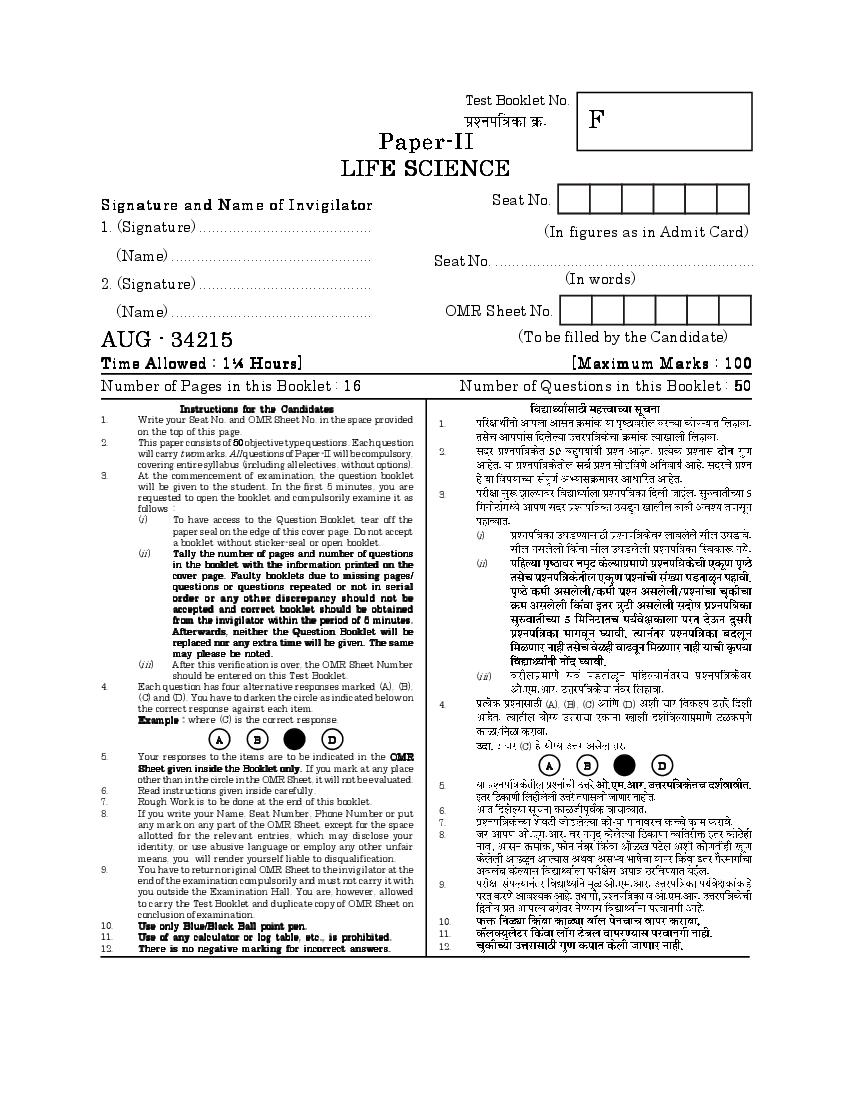
F
LIFE SCIENCE
Signature and Name of Invigilator Seat No.
1. (Signature) ......................................... (In figures as in Admit Card)
(Name) ................................................ Seat No. ..............................................................
2. (Signature) ......................................... (In words)
(Name) ................................................ OMR Sheet No.
AUG - 34215 (To be filled by the Candidate)
Time Allowed : 1¼ Hours] [Maximum Marks : 100
Number of Pages in this Booklet : 16 Number of Questions in this Booklet : 50
Instructions for the Candidates
1. Write your Seat No. and OMR Sheet No. in the space provided 1.
on the top of this page.
2. This paper consists of 50 objective type questions. Each question
will carry two marks. All questions of Paper-II will be compulsory, 2.
covering entire syllabus (including all electives, without options).
3. At the commencement of examination, the question booklet
will be given to the student. In the first 5 minutes, you are
requested to open the booklet and compulsorily examine it as 3.
follows :
(i) To have access to the Question Booklet, tear off the
paper seal on the edge of this cover page. Do not accept (i)
a booklet without sticker-seal or open booklet.
(ii) Tally the number of pages and number of questions
in the booklet with the information printed on the (ii)
cover page. Faulty booklets due to missing pages/
questions or questions repeated or not in serial
o rder or any other discre pancy should not be
accepted and correct booklet should be obtained
from the invigilator within the period of 5 minutes.
Afterwards, neither the Question Booklet will be
replaced nor any extra time will be given. The same
may please be noted.
(iii) After this verification is over, the OMR Sheet Number
should be entered on this Test Booklet. (iii)
4. Each question has four alternative responses marked (A), (B),
(C) and (D). You have to darken the circle as indicated below on
the correct response against each item. 4. (A), (B), (C) (D)
Example : where (C) is the correct response.
A B D
(C)
5. Your responses to the items are to be indicated in the OMR
Sheet given inside the Booklet only. If you mark at any place A B D
other than in the circle in the OMR Sheet, it will not be evaluated.
5.
6. Read instructions given inside carefully.
7. Rough Work is to be done at the end of this booklet.
8. If you write your Name, Seat Number, Phone Number or put 6.
any mark on any part of the OMR Sheet, except for the space 7.
allotted for the relevant entries, which may disclose your 8.
identity, or use abusive language or employ any other unfair
means, you will render yourself liable to disqualification.
9. You have to return original OMR Sheet to the invigilator at the
end of the examination compulsorily and must not carry it with 9.
you outside the Examination Hall. You are, however, allowed
to carry the Test Booklet and duplicate copy of OMR Sheet on
conclusion of examination.
10. Use only Blue/Black Ball point pen. 10.
11. Use of any calculator or log table, etc., is prohibited. 11.
12. There is no negative marking for incorrect answers. 12.
Page 2
Page 3
Paper II
Time Allowed : 75 Minutes] [Maximum Marks : 100
Note : This paper contains 50 multiple choice questions, each carrying
Two (2) marks. Attempt All questions.
1. Dosage compensation in mammals 2. Which one of the following is an
example of heterogametic females ?
is :
(A) Drosophila
(A) Heterochromatinisation of one
(B) Moths
X-chromosome in females
(C) Human
(B) Hyperactivation of single
(D) 7 O’clock plant
X-chromosome in males
3. Star shaped basic cell morphology
(C) Hyperactivation of Y-chromosome
have been observed in :
in males
(A) Protozoa
(D) Equalisation of transcription (B) Yeast
from both X and Y-chromosome (C) Eubacteria
in males (D) Algae
3 [P.T.O.
Page 4
typic determinant ? malignant growth of tumors depends
(A) Ig G1 on which of the following enzymes ?
(B) Ig G2 (A) Trypsin
(C) Ig G2m (B) Chymotrypsin
(D) Ig G3 (C) Lipase
5. Transport of molecules through a (D) Matrix metalloprotease
cell membrane down a concentration 7. Which one of the following proteins
gradient mediated by a membrane is MAP Kinase Kinase Kinase
transport protein is called as : (MAP KKK) ?
(A) Symporter (A) c-RAS
(B) Antiporter (B) GAP
(C) Uniporter (C) SoS
(D) Transporter (D) C-Raf
4
Page 5
compound releases maximum
component of membrane
amount of energy on hydrolysis ?
phospholipid, lecithin ?
(A) ATP
(A) Glycerol (B) 1, 3 bis-phosphoglycerate
(B) Choline (C) Creatine phosphate
(D) Phosphoenol pyruvate
(C) Sphingosine
11. During translation, formyl-
(D) Fatty acid
methionine and methionine, as an
initiator amino acid, is distinguished
9. Which shuttle is operated to get 32
from any internal methionine by :
ATP molecule after complete
(A) initiation codon versus internal
oxidation of glucose ?
codon
(A) Glycerol-3-phosphate (B) initiation factor versus
elongation factor
(B) Malate-aspartate
(C) small subunit of ribosome versus
(C) Pyruvate-malate
large subunit of ribosome
(D) Citrate-pyruvate (D) ATP versus GTP
5 [P.T.O.
Page 6
structure. (pH = 1.3) the amino acid glycine
exists in :
(A) -helix
+
(A) N H — CH2 — COO–
3
(B) loop
+
(B) N H — CH2 — COOH
3
(C) parallel -sheet
(C) NH2 — CH2 — COOH
(D) antiparallel -sheet
(D) NH2 — CH2 — COO–
13. What is the role of peptidoglycan ?
15. Among the following which is the
(A) extracellular adhesive
protein carrier molecule linking
(B) gives rigidity and strength to PS-II and PS-I in photosynthesis ?
exoskeletons
(A) Plastocyanin
(C) gives rigidity and strength to (B) Ferredoxin
cell envelope
(C) Pheophytin
(D) energy storage (D) Plastoquinone
6
Page 7
affinity for haemoglobin ?
is incorrect for normal cells ?
(A) Carbon monoxide
(A) Intracellular potential of only
(B) Carbon dioxide
the neurones is negative in
(C) Oxygen
comparison with the
(D) Nitrogen
extracellular potential
17. A precursor is converted by
(B) Extracellular potential is always
ultraviolet radiation into a molecule.
positive compared to the
The molecule is likely to be :
intracellular potential of all
(A) Vitamin C
cells
(B) Vitamin K
(C) Intracellular compartment
(C) Vitamin A
contains more of potassium
(D) Vitamin D
ions than the extracellular
18. The deglutition centre is located in
compartment
the :
(A) Lumbar spinal cord (D) Extracellular compartment
(B) Cerebral cortex contains more of sodium ions
(C) Medulla oblongata than the intracellular
compartment
(D) Lateral hypothalamus
7 [P.T.O.
Page 8
molecules formed in glucose
predominates in the population of an
oxidation according to the equation :
organism is called .......................
C6H12O6 + 6O2 — 6CO2 + 6H2O
come : allele.
(A) entirely from glucose
(A) Wild-type
(B) entirely from respiratory oxygen
(B) Recessive
(C) equally from respiratory
oxygen and glucose
(C) Multiple
(D) from glucose and respiratory
oxygen in 1 : 3 ratio (D) Epistatic
21. The control of cell elongation in the
23. Which of the following DNA
Arabidopsis hypocotyl by light and
gibberellic acid represents an sequences is present in telomeres of
example of :
human chromosomes ?
(A) secondary cross-regulation
(A) 5' TTA GGG 3'
(B) positive primary cross-
regulation
(B) 5' GGG TTA 3'
(C) negative primary cross-
regulation (C) 5' CCA GGG 3'
(D) Tertiary cross-regulation (D) 5' CCC AAT 3'
8
Page 9
24. RNA polymerase I is located
repaired by :
in .................... .
(A) Mismatch repair
(A) Nucleus
(B) Nucleotide excision repair
(B) Nucleolus (C) Base excision repair
(D) Direct repair
(C) Matrix
27. In somatic cell hybrid generation
(D) mtDNA involving use of human and chinese
hamster ovary cells :
25. Map distance between genes in a
(A) Human chromosomes get
genetic map is determined by :
eliminated
(A) Gene gap (B) Human chromosomes get
rearranged
(B) Rate of recombination between
(C) Chromosomes of chinese
genes
hamster ovary cells get
(C) Percent of independent eliminated
(D) Chromosomes of chinese
assortment
hamster ovary cells undergo
(D) Linkage relationship translocations
9 [P.T.O.
Page 10
(A) Trisomy of chromosome 13 geographic isolation and prevention
(B) Trisomy of chromosome 18 of gene flow is known as ...................
(C) Trisomy of chromosome 21 speciation.
(D) Robertsonian translocation (A) Sympatric
29. Constitutive heterochromatin is (B) Allelopatric
mostly :
(C) Allopatric
(A) Repetitive DNA
(D) Isopatric
(B) Devoid of repetitive sequence
32. How is extinction depicted in a
(C) Varies in different cell types
cladistic phylogenetic tree
(D) Express differently at different
diagram ?
developmental stages
(A) A branch splits
30. The centre of origin of groundnut
is : (B) A branch ends
(A) North-East Asia (C) A brach shifts along the
(B) South-East Asia X-axis
(C) South America (D) A branch shifts along the
(D) Brazil Y-axis
10
Page 11
experiment to prove origin of life.
most fit individual in an
They took gases NH3 and H2 along
evolutionary sense ?
with .................... .
(A) A tiger who is successful at
(A) N2 and H2O
capturing prey but has no
(B) H2O and CH4
cubs
(C) CO2 and N2
(B) A tiger who has ten cubs, (D) CH4 and N2
eight of which live to 35. In a population, balancing selection
adulthood is accomplished through successful
reproduction of :
(C) A tiger who overcomes a
(A) homozygous recessive
disease and lives to have three
individuals
cubs
(B) homozygous dominant
(D) A tiger who shows parental individuals
care for his cubs but only two (C) heterozygous individuals
live to adulthood (D) hemizygous individuals
11 [P.T.O.
Page 12
population only four percent of the decrease in :
individuals shows a recessive trait.
(A) Rainfall
What will be the frequency of
(B) Drought
carriers in the following
generation ? (C) Soil erosion
(A) 8% (D) Global warming
(B) 64% 39. Which of the following will ensure
(C) 16% diversity of wild flora ?
(D) 32% (A) Monoculture of forest plant
37. Eutrophication causes a reduction of species
...................... in the water body. (B) Polyculture of native plant
(A) Carbon dioxide species
(B) Oxygen (C) Introduction of new plant
(C) Nitrogen species
(D) Sulphur dioxide (D) Transplantation of trees
12
Page 13
40. The purpose of Rio Declaration on
known :
Environment and Development is to (A) For pelicans and other marine
birds
promote :
(B) As a transit area for migratory
ducks
(A) Wildlife protection around the
(C) For presence of a large number
world of peafowls
(D) As a breeding ground for
(B) Optimal utilization of
marine turtles
resources 42. Peroxylacetyl Nitrate (PAN) is a
product of :
(C) Sustainable development (A) Acid rain
(B) Chlorofluorocarbon + sulphur
around the world
dioxide
(D) Propagation of evergreen (C) Depletion of oxygen
(D) Synergistic effect of
forests in the tropics
photochemical smog
13 [P.T.O.
Page 14
45. Which of the following genes are
(A) Crocus sativus Linn. used in molecular systematics ?
(A) Nuclear ribosomal genes
(B) Curcuma longa Linn.
(B) House-keeping genes
(C) Cuminum cyminum Linn.
(C) Telomere genes
(D) Curculigo orchioides Gaertn. (D) Structural genes
46. If a structure in an organism
44. Which of the following has highest
evolves in different lineages, so that
percentage of endangered plant
it is possessed by several species
although it was not found in their
species ?
most recent common ancestors then
(A) Conifers
it exhibits :
(B) Cycads (A) Analogy
(B) Homology
(C) Cacti
(C) Epistemology
(D) Ferns
(D) Homoplasy
14
Page 15
maximum diversity of animals and in :
plants ? (A) Satellite DNA
(A) Coral reefs (B) Retrotransposons
(B) Mangroves (C) SNPs
(C) Tropical rain forest (D) Intron length
(D) Tundra 50. The most important cause of
48. Which of the following is not decrease in biodiversity on our
included under in-situ planet is :
conservation ? (A) Habitat destruction
(A) Tiger reserves (B) Habitat pollution
(B) National parks (C) Introduction of exotic species
(C) Botanical gardens (D) Over-exploitation of renewable
(D) Sanctuaries resources
15 [P.T.O.
Page 16
16
Document Details
| Board / Org | Maharashtra Exams |
| Exam | MAHA SET |
| Type | Question Paper |
| Pages | 16 |
| Updated | 30 Apr 2026 |