Kerala SET 2018 Feb Question Paper Philosophy
Finished viewing? Save it for later —
Download Kerala SET 2018 Feb Question Paper Philosophy (PDF · 14 pages)About Kerala SET 2018 Feb Question Paper Philosophy
Kerala SET 2018 Feb Question Paper Philosophy is available here for free download. Published by Kerala Exams for Kerala SET, this question paper can be viewed online or downloaded as a PDF (14 pages). Candidates preparing for Kerala SET can use Kerala SET 2018 Feb Question Paper Philosophy to understand the exam pattern, the type of questions asked, and the overall difficulty level.
Frequently Asked Questions
How can I download Kerala SET 2018 Feb Question Paper Philosophy?
Open this page and click the Download button to save Kerala SET 2018 Feb Question Paper Philosophy as a PDF. It is completely free on AglaSem Docs.
Is Kerala SET 2018 Feb Question Paper Philosophy free to download?
Yes. Kerala SET 2018 Feb Question Paper Philosophy can be viewed online and downloaded as a PDF free of cost on AglaSem Docs.
How many pages does Kerala SET 2018 Feb Question Paper Philosophy have?
Kerala SET 2018 Feb Question Paper Philosophy contains 14 pages, which you can read online or download together as a single PDF.
Where can I find more Kerala SET study material?
You can find more Kerala SET question papers, sample papers, syllabus, and answer keys on AglaSem Docs.
Kerala SET 2018 Feb Question Paper Philosophy – Text
Read the full text of this question paper below — useful to quickly search, copy and reference the content online without downloading the PDF.
📄 View text version (14 pages)
Page 1
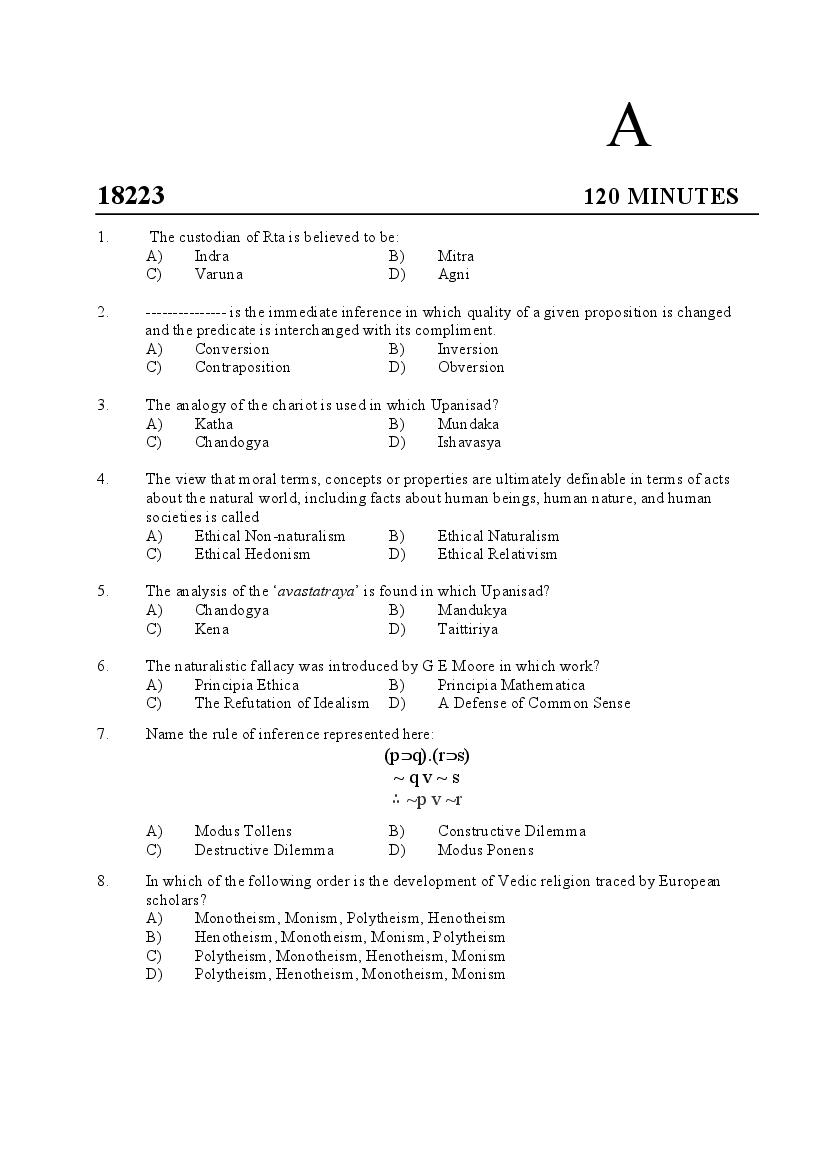
18223 120 MINUTES
1. The custodian of Rta is believed to be:
A) Indra B) Mitra
C) Varuna D) Agni
2. --------------- is the immediate inference in which quality of a given proposition is changed
and the predicate is interchanged with its compliment.
A) Conversion B) Inversion
C) Contraposition D) Obversion
3. The analogy of the chariot is used in which Upanisad?
A) Katha B) Mundaka
C) Chandogya D) Ishavasya
4. The view that moral terms, concepts or properties are ultimately definable in terms of acts
about the natural world, including facts about human beings, human nature, and human
societies is called
A) Ethical Non-naturalism B) Ethical Naturalism
C) Ethical Hedonism D) Ethical Relativism
5. The analysis of the ‘avastatraya’ is found in which Upanisad?
A) Chandogya B) Mandukya
C) Kena D) Taittiriya
6. The naturalistic fallacy was introduced by G E Moore in which work?
A) Principia Ethica B) Principia Mathematica
C) The Refutation of Idealism D) A Defense of Common Sense
7. Name the rule of inference represented here:
(p⊃q).(r⊃s)
~qv~s
∴ ~p v ~r
A) Modus Tollens B) Constructive Dilemma
C) Destructive Dilemma D) Modus Ponens
8. In which of the following order is the development of Vedic religion traced by European
scholars?
A) Monotheism, Monism, Polytheism, Henotheism
B) Henotheism, Monotheism, Monism, Polytheism
C) Polytheism, Monotheism, Henotheism, Monism
D) Polytheism, Henotheism, Monotheism, Monism
Page 2
A) Kumarila Bhatta B) Prabhakara
C) Apadeva D) Laugaksi Bhaskara
10. ‘The grasping of a sense does not with certainty warrant a corresponding nominatum’.
This view is expressed by:
A) Donald Davidson B) Bertrand Russell
C) G.E. Moore D) Gottlob Frege
11. Match the following:
a. Interactionism 1. Malebranche
b. Double aspect theory 2. Descartes
c. Pre-established harmony 3. Spinoza
d. Occasionalism 4. Leibniz
A) a-3, b-4, c-1, d-2 B) a-2, b-3, c-4, d-1
C) a-1, b-2, c-3, d-4 D) a-4, b-3, c-2, d-1
12. The concept of one predominant rasa (angirasa) as a new norm in kavya was introduced by:
A) Bharata B) Anandavardana
C) Abhinavagupta D) Vamana
13. The statement ‘The negation of the conjunction of two statements is logically equivalent to
the disjunction of their negations’ is called
A) Biconditionality B) De Morgan’s Theorem
C) Logical equivalence D) Paradox of material implication
14. When the biconditional that expresses the material equivalence of two statements is a
tautology, then the two statements are said to be
A) True propositions B) Contradictories
C) Identical D) Logically equivalent
15. Name the fallacy involved in the following argument:
All household pets are domestic animals.
No unicorns are domestic animals.
Therefore some unicorns are not household pets.
A) The existential fallacy
B) The fallacy of exclusive premises
C) The fallacy of drawing an affirmative conclusion from a negative premises
D) Fallacy of the undistributed middle
16. The commentary of the Brahmasutras entitled ‘Anu Bhasya’ was written by:
A) Ramanujacarya B) Madhvacarya
C) Bhaskaracarya D) Vallabhacarya
2
Page 3
was modeled on the social structure of:
A) Ancient Greece B) Roman civilization
C) Vedic civilization D) Jewish and Christian traditions
18. The ‘Tattvopaplavasimha’ is a text of ------ school.
A) Nyaya B) Advaita Vedanta
C) Visistadvaita Vedanta D) Carvaka
19. The book ‘The False Subtlety of the Four Syllogistic Figures’ was written by:
A) Irving Copi B) Bertrand Russell
C) Immanuel Kant D) John Stuart Mill
20. ‘Plurality must never be posited without necessity’ was the view held by:
A) Aristotle B) William of Ockham
C) St. Thomas Aquinas D) John Duns Scotus
21. Match the following:
a. Sāmkhya 1. Udyotakara
b. Nyāya 2. Isvarakrishna
c. Purva Mimāmsa 3. Madhusudana Saraswati
d. Advaita Vedānta 4. Prabhakara
A) a-2, b-1, c-4, d-3 B) a-1, b-2, c-3, d-4
C) a-4, b-3, c-2, d-1 D) a-3,b-1,c-4,d-2
22. ‘A class cannot dominate in modern conditions by merely advancing its own narrow
economic interests; neither can it dominate purely through force and coercion. Rather, it
must exert intellectual and moral leadership, and make alliances and compromises with a
variety of forces’. This view on hegemony was held by:
A) Antonio Gramsci B) Karl Marx
C) Louis Althusser D) Machiavelli
23. Name the fallacy involved in the following invalid argument:
All Russians were revolutionaries
All anarchists were revolutionaries
Therefore, all anarchists were Russians
A) Fallacy of four terms
B) Illicit process of the major term
C) Illicit process of the minor term
D) Fallacy of the undistributed middle
24. When an embryo created by Invitrofertilization (IVF) is implanted in a surrogate, it is
called:
A) Traditional surrogacy B) Gestational surrogacy
C) Artificial surrogacy D) Donor surrogacy
3
Page 4
terminally ill patient is called:
A) Active euthanasia B) Passive euthanasia
C) Involuntary euthanasia D) Non-voluntary euthanasia
26. Find out the correct sequence as expressed from the highest to the lowest of Plato’s
divided line:
A) Understanding, Thought, Conjecture, Belief
B) Understanding, Thought, Belief, Conjecture
C) Understanding, Belief, Thought, Conjecture
D) Understanding, Conjecture, Thought, Belief
27. Match the following:
a. Kant 1. Quantitative Hedonism
b. Bentham 2. Categorical Imperative
c. Bradley 3. Pragmatism
d. Dewey 4. My Station and Its Duties
A) a-4, b-3, c-2, d-1 B) a-1, b-2, c-3, d-4
C) a-2, b-1, c-4, d-3 D) a-3, b-4, c-2, d-1
28. Ideological practice consists of an assortment of institutions which include the family,
media, religious organizations, the educational system, as well as received ideas that they
propagate. All this taken together are referred to as
A) Hegemony B) Ideological state apparatus
C) State D) Repressive state apparatus
29 The capacity of speech and communication not simply to communicate but rather to act or
consummate an action, or to construct and perform an identity is called
A) Descriptivity B) Discourse C) Performativity D) Creativity
30. ‘Vedanta Parijata Sourabha’ is the work of:
A) Nimbarkacarya B) Vallabhacarya
C) Bhaskaracarya D) Sri Caitanya Mahaprabhu
31. The author of the Navya-Nyaya text ‘Padarthanirupana’ is:
A) Annambhatta B) Kesavamisra
C) Gangesa Upadhyaya D) Raghunatha Siromani
32. The twenty third Tirthankara in the Jain tradition is
A) Neminatha B) Parsvanatha
C) Rishabha Deva D) Vardhamana Mahavira
33. Which among the following is an AnusandhanaVākya?
A) Ayam Ātma Brahma B) Tattvamasi
C) Prajñānam Brahma D) Aham Brahmāsmi
4
Page 5
A) Samādhi Pāda B) Sādhana Pāda
C) Vibhuti Pāda D) Kaivalya Pāda
35. In a proposition when we change its quality and replace the predicate term by its
compliment we do which of the following?
A) Obversion B) Contraposition
C) Conversion D) Negation
36. In which work of Richard M Hare was the ethical theory of prescriptivism first
expounded?
A) Moral Thinking: Its Levels, Methods and Point
B) Essays in Ethical Theory
C) Essays on Political Morality
D) The Language of Morals
37. “The linguistic object is not defined by the combination of the written word and the spoken
word: the spoken alone constitutes the object. Language has an oral tradition that is
independent of writing.” This view was held by:
A) Jacques Derrida B) Ferdinand De Saussure
C) Noam Chomsky D) Claude Levi-Strauss
38. The author of ‘Ideas’ is:
A) Edmund Husserl B) Franz Brentano
C) Maurice Merleau-Ponty D) Johann Heinrich Lambert
39. Who among the following is not one of the co-founders of the journal ‘Les Temps
Modernes’?
A) Jean Paul Sartre B) Simone de Beauvoir
C) Albert Camus D) Maurice Merleau-Ponty
40. ‘It is impossible to derive an ‘ought’ from an ‘is’ by logic alone or in other words, that there
is no logical bridge over the gap between fact and value’. This statement is known as:
A) The Categorical Imperative B) Occam’s Razor
C) Russell’s Paradox D) Hume’s Law
41. ‘In a race, the quickest runner can never overtake the slowest, since the pursuer must first
reach the point whence the pursued started, so that the slower must always hold a lead’.
This statement of Zeno is called:
A) The dichotomy paradox
B) The arrow paradox
C) Paradox of Achilles and the Tortoise
D) None of these
5
Page 6
A) Jean-Francois Lyotard B) Michel Foucault
C) Richard Rorty D) Jean Baudrillard
43. If the major term of a categorical syllogism is distributed in the conclusion without
distributing in the major premise, it commits the fallacy of
A) Incomplete major B) Ambiguous major
C) Illicit major D) None of these
44. Who ascribed to God the status ‘thought-thinking-thought’?
A) Plato B) Aristotle
C) St. Thomas Aquinas D) John Duns Scotus
45. Who is the author of ‘The German Ideology’?
A) G.W.F. Hegel B) Immanuel Kant
C) Martin Heidegger D) Karl Marx
46. Match the following:
a. Sāmkhya 1. Monism
b. Nyāya 2. Realistic relativistic pluralism
c. Jainism 3. Dualism
d. Advaita Vedānta 4. Realistic pluralism
A) a-3, b-4, c-2, d-1 B) a-2, b-3, c-1, d-2
C) a-1, b-2, c-3, d-4 D) a-4, b-3, c-2, d-1
47. Identify the correct sequence in which evolution occurs as described by Sri Aurobindo
A) Mind, Illumined Mind, Higher Mind, Intuitive mind, Overmind, Supermind
B) Mind, Intuitive mind , Higher Mind, Overmind, Illumined Mind, Supermind
C) Mind, Higher Mind, Illumined Mind, Intuitive mind, Overmind, Supermind
D) Mind, Intuitive mind, Overmind, Illumined Mind, Higher Mind, Supermind
48. Identify the correct order of the five members of the Nyaya syllogism
A) Pratijña, Udāharana, Hetu, Upanaya, Nigamana
B) Pratijña, Nigamana, Hetu, Upanaya, Udāharana
C) Pratijña, Hetu, Upanaya, Udāharana, Nigamana
D) Pratijña, Hetu, Udāharana, Upanaya, Nigamana
49. Match for the following:
a. Advaita 1. Asadkaranavāda
b. Nyāya 2. Satkāryavāda
c. Sāmkhya 3. Asatkāryavāda
d. Buddhism 4. Sadkaranavāda
A) a-3, b-1, c-2, d-4 B) a-4, b-3, c-2, d-1
C) a-2, b-4, c-1, d-3 D) a-1, b-2, c-3, d-4
6
Page 7
A) Mantrās – Hymns
B) Brahmanās – Instructions for sacrifices
C) Āranyakās – Forest Treatises
D) Upanisads – Ritualism
51. The Nations that have legalized Voluntary Euthanasia are:
A) USA, UK and Switzerland
B) Switzerland, Germany and Spain
C) Belgium, Luxembourg and Netherlands
D) USA, Germany and France
52. The leader of the Chipko movement:
A) Vandana Shiva B) Baba Amte
C) Medha Patkar D) Sunderlal Bahuguna
53. Which principle of medical ethics is usually referred to as the ‘ethics of trust’?
A) Paternalism B) Informed Consent
C) Confidentiality D) Autonomy
54. ‘I will prescribe regimens for the good of my patients according to my ability and my
judgment and never do harm to anyone.’ Which principles of medical ethics are referred to
here?
A) Truth telling and Confidentiality
B) Beneficence and Non-malificence
C) Autonomy and Justice
D) Paternalism and Informed consent
55. Who coined the word ‘Medical Ethics’?
A) Peter Singer B) Hippocrates
C) Thomas Percival D) Van Rensselaer Potter
56. The fundamental paradox of hedonism articulated as ‘the more we seek pleasure, the
lesser we get it’ was pointed out by:
A) Henry Sidgwick B) George Bentham
C) J.S. Mill D) G.W.F. Hegel
57. Who among the following is NOT a proponent of Deontological Ethics?
A) Immanuel Kant B) W.D. Ross
C) C.D. Broad D) J.S. Mill
58. The author of the ‘Silent Spring’ is:
A) Arne Naess B) Aldo Leopold
C) Rachel Carson D) Warwick Fox
7
Page 8
A) Jacques Derrida B) Michel Foucault
C) Richard Rorty D) Jean Francois Lyotard
60. The point of intersection between two worlds inside man, that of spirit and that of nature, that
of God and that of animal, is
A) Joy B) Dread C) Guilt D) Gloom
61. The primary relationship of Dasien to the world is one of practical, personal involvement
called:
A) Being-unto-death B) Being-with-others
C) Care (Sorge) D) Being thus (Sosien)
62. The author of ‘Being and Time’ is:
A) Martin Heidegger B) Hans George Gadamer
C) Frederick Nietzsche D) Plato
63. The suspension of the natural attitude which includes all assumptions about existence and
causality which occur in the natural, scientific and common-sense explanation of events in
the physical world, is called:
A) Ideation B) Suspension of Disbelief
C) Intuition D) Epoche
64. ‘History can be reconstructed as a dialectical progression of structures of consciousness or
‘spirit’ embodied in particular historical societies’ was the view held by:
A) Karl Marx B) Lousie Althusser
C) G.W.F. Hegel D) Ludwig Feuerbach
65. ‘Transcendental Idealism’ is the philosophical standpoint of
A) Immanuel Kant B) G.W.F. Hegel
C) Plato D) T.H. Green
66. The only Anastikaya dravya according to Jainism is:
A) Akasa B) Pudgala C) Dharma D) Kala
67. ‘The notion of causation was born out of a psychological association of two successive
independent events’ was the theory held by:
A) John Locke B) George Berkeley
C) David Hume D) Rene Descartes
68. The existence of a world independent of the perceiving mind is asserted by
A) Idealism B) Realism C) Solipsism D) Nihilism
8
Page 9
1. The ontology of Māya is sadasadvilaksana
2. Advaita advocates Brahma parinamavada
3. Āvarana and Viksepa are the powers of Maya
4. Advaita accepts the theory of Satta traya
A) 1, 2, 3 are true but 4 is false
B) 1 and 4 are true but 2 and 3 are false
C) 1, 3 and 4 are true but 2 is false
D) 1, 2 and 4 are true but 3 is false
70. Find out the wrong pair
A) Locke – Empiricism B) Kant – Copernican revolution in philosophy
C) Hume – Idealism D) Berkeley – Esse est Percipii
71. Match the following:
a. Jainism 1. Pratityasamutpāda
b. Buddhism 2. Syādvada
c. Dvaita Vedānta 3. Satta traya
d. Advaita Vedānta 4. Pancabhedas
A) a-2, b-3, c-4, d-1 B) a-1, b-2, c-3, d-4
C) a-4, b-3, c-2, d-1 D) a-2, b-1, c-4, d-3
72. Match the following:
a. Thales 1. Number mysticism
b. Protagoras 2. Homo mensura
c. Empedocles 3. Water
d. Pythagoras 4. Atomism
A) a-1, b-2, c-3, d-4 B) a-4, b-3, c-2, d-1
C) a-2, b-4, c-1, d-3 D) a-3, b-2, c-4, d-1
73. Identify the incorrect pair
A) Bertrand Russell – Theory of descriptions
B) Ludwig Wiitgenstein – Theory of Language games
C) Logical Positivism – Picture Theory
D) Gottlob Frege – Sense and Reference
74. Match the following:
a. Contradictory statement form 1. p v ~p
b. Contigent statement form 2. p⊃q
c. Tautologous statement form 3. p ~p
d. Material implication statement form 4. p.q
A) a-1, b-2, c-3, d-4 B) a-3, b-4, c-1, d-2
C) a-3, b-1, c-4, d-2 D) a-4, b-3, c-2, d-1
9
Page 10
a. Demarcation between science and non-science 1. Gilbert Ryle
b. Speech act theory 2. Thomas Kuhn
c. Incommensurability thesis 3. J. L. Austin
d. Category Mistake 4. Karl Popper
A) a-3, b-4, c-1, d-2 B) a-2, b-1, c-4, d-3
C) a-4, b-3, c-2, d-1 D) a-4, b-2, c-3, d-1
76. The lecture ‘The Role of the University in the New Reich’ was delivered by:
A) Edmund Husserl B) Frederick Nietzsche
C) Martin Heidegger D) Hans George Gadamer
77. The second-order activity of investigating the concepts and methods of ethics, rather than
directly engaging with practical issues of what to do and how to behave, is called:
A) Ethical Formalism B) Theoretical ethics
C) Metaethics D) Ethical relativism
78. Which ethical theory was first presented in the book ‘The Meaning of Meaning’?
A) Emotivism B) Prescriptivism
C) Descriptivism D) Ethical Skepticism
79. The author of ‘Ethics and Language’ is:
A) Alasdair Macintyre B) R. M. Hare
C) C.L. Stevenson D) A. J. Ayer
80. “Consider what effects that might conceivably have practical bearings, we conceive the
object of our conception to have. Then, our conception of these effects is the whole of our
conception of the object”. These are the words of:
A) William James B) John Dewey
C) C. I. Lewis D) C. S. Peirce
81. Who is the author of ‘The Logical Syntax of Language’?
A) Rudolf Carnap B) Moritz Schilk
C) A J Ayer D) Ludwig Wittgenstein
82. ‘Dissertation on the Passions’ is the work of:
A) John Locke B) Thomas Hobbes
C) George Berkeley D) David Hume
83. Who among the following replaced the static conception of Nature by the dynamic or the
energetic view?
A) Rene Descartes B) G. W. Leibniz
C) Christian Wolff D) Benedict de Spinoza
10
Page 11
A) Supramentalization B) Psychicization
C) Spiritualization D) Evolution
85. Which work of Soren Kierkegaard is regarded as his magnum opus?
A) Fear and Trembling B) Philosophical Fragments
C) Either/Or D) Stages on Life’s Way
86. Which among the following is Husserl’s unfinished work?
A) The Crisis of the European Sciences
B) Cartesian Meditations
C) Logical Investigations
D) Experience and Judgment
87. What was the term coined by Karl Popper to describe his philosophy?
A) Verificationism B) Falsificationism
C) Critical Theory D) Critical Rationalism
88. The statement “A given argument is valid as a sequence of statements each of which is either
a premises of that argument or follows from preceding statements of the sequence by an
elementary valid argument, such that the last statement in the sequence is the conclusion of
the argument whose validity is proved” defines:
A) Conditional Proof B) Indirect Proof
C) Formal Proof of Validity D) Truth table technique
89. The contra positive of the proposition ‘Some noncitizens are not nonresidents’ is:
A) Some residents are not citizens
B) Some residents are citizens
C) Some citizens are residents
D) Some noncitizens are residents
90. An unscientific Induction based on points of resemblances are commonly referred as
A) Unsound reasoning B) Inductive reasoning
C) Analogical reasoning D) Ambiguous reasoning
91. The theory that there are certain theoretical and conceptual opposites, often arranged in a
hierarchy, which human logic has given to text, is called:
A) The theory of presuppositions
B) The theory of assumptions
C) The theory of contradictions
D) The theory of binary opposition
92. Which among the following is not a niyama according to Patanjali?
A) Sauca B) Tapas
C) Asteya D) Svadhyāya
11
Page 12
A) Elements of Semiology B) Serendipities: Language and Lunacy
C) Mythologies D) Criticism and Truth
94. The possibility that one may give up ownership of one’s labor, i.e., one’s capacity to
transform the world, is tantamount to being alienated from one’s own nature and this is
thus a spiritual loss, is called by Marx as:
A) Alienation B) Commodity fetishism
C) Subjugation D) Periodic crisis
95. The view that environmental problems are to be solved using science and technology is
called:
A) Earth Liberation B) Techno environmentalism
C) Biomechanism D) Technocentrism
96. The view that all living beings deserve respect and have an equal right to live and blossom, is
called:
A) Deep ecology B) Biocentism
C) Biospherical egalitarianism D) Geological egalitarianism
97. The view that whenever we decide what to do, we should perform the action that will
create the greatest net utility, is called:
A) Act utilitarianism B) Rule utilitarianism
C) Altruism D) Decision utilitarianism
98. ‘Athatho Brahma Jigñāsa’ is the first sutra of:
A) Mimamsa sūtrās B) Nyāya sūtrās
C) Yoga sūtrās D) Brahma sūtrās
99. The relationship of ‘aprtaksiddhi’ is mentioned in which of the following schools?
A) Sāmkhya B) Advaita Vedānta
C) Visistādvaita Vedanta D) Mimāmsa
100. Which Buddhist theory is demonstrated in the text ‘Milinda Panha’, in the form of a
dialogue between King Milinda (Menander) and Nagasena?
A) Ksanikavāda B) Nairātmyavāda
C) Pratityasamutpāda D) Nirvāna
101. Slokavarthika was composed by:
A) Kumarila Bhatta B) Prabhakara
C) Jaimini D) Murari Mishra
102. ‘Samjña samjñi sambanda jñanam’ is:
A) Pratyaksha B) Anumiti C) Upamiti D) Sabda
12
Page 13
A) Hetvabhasa B) Upamana
C) Paksadharmata D) Vyāpti
104. The performance of which type of karma does not bring merit, but its non-performance
leads to demerit?
A) Naimittika karma B) Nitya karma
C) Kāmya karma D) Prārabda karma
105. The author of ‘Religion of Man’ is:
A) Rabindranath Tagore B) Dr. S. Radhakrishnan
C) J. Krishnamurthy D) Swami Vivekananda
106. The first temple installation performed by Sri Narayana Guru was at:
A) Aruvikkara B) Aruvippuram
C) Kalavankodam D) Sivagiri
107. The theory which holds that there are no useful and exception free methodological rules
governing the progress of science and that the idea of the operation of science by fixed,
universal rules is unrealistic and detrimental to science itself is called:
A) Methodological pluralism B) Methodological anarchism
C) Epistemological pluralism D) Epistemological anarchism
108. Creative fidelity which involves a commitment to acts that draw the subject closer to
others and which involves receptivity to the views of others, was propounded by:
A) Jean Paul Sartre B) Gabriel Marcel
C) Albert Camus D) Soren Kierkegaard
109. Trace the wrong pair from the following:
A) A and O propositions – Contradictories
B) E and O propositions – Subalternation
C) A and E propositions – Contraries
D) A and I propositions – Subcontraries
110. Match the following:
a. Jivan Devata 1. Ramana maharshi
b. Jnana Vichara 2. Rabindranath Tagore
c. Sarvodaya 3. Mahatma Gandhi
d. Vedadhikaram 4. Chattampi Swamikal
A) a-4, b-3, c-2, d-1 B) a-2, b-3, c-4, d-1
C) a-2, b-1, c-3, d-4 D) a-1, b-2, c-4, d-3
13
Page 14
A) Darsanamala B) Advaita Deepika
C) Manisha Pancakam D) Municarya Pancakam
112. Which among the following is an evil custom that was stopped as a result of the efforts of
Sri Narayana Guru?
A) Madey Snana B) Garudan Thookam
C) Theemithi D) Thirandukuli
113. Pick the text that was not composed by Chattampi Swamikal:
A) Prachina Malayalam B) Prapancha Srishti
C) Keralathile Desa Namangal D) Nijananda Vilasom
114. Salokya, Sarupya, Samipya and Sayujya as four attainments of the devotee after death was
described by:
A) Ramanujacarya B) Sankaracarya
C) Vallabhacarya D) Madhvacarya
115. ‘Adhyāso nāma atasmin tad buddhih’ was the definition of illusion given by:
A) Gautama B) Sankaracarya
C) Prabhakara D) Kumarila Bhatta
116. Jñana laksana pratyasatti as a mode of perception was given by:
A) Nyāya B) Sāmkhya
C) Buddhism D) Advaita Vedanta
117. Upastha is one of the:
A) Karmendriyas B) Jnanendriyas
C) Tanmatras D) Mahabhutas
118. Which among the following is not a kind of relational absence?
A) Prāgabhāva B) Pradhvamsabhāva
C) Anyonyābhāva D) Atyānthabhāva
119. The doctrine that cognition has three factors and that every act of cognition
simultaneously reveals all the three (triputijana) was propounded by:
A) Kumarila Bhatta B) Prabhakara
C) Isvarakrishna D) Annambhatta
120. The magnum opus of Gangeshopadyaya that is regarded as the most important work of the
Navya-Nyaya school is:
A) Karikavali B) Tarkasangraha
C) Tattvacintamani D) Khandana khanda khadya
_______________________
14
Document Details
| Board / Org | Kerala Exams |
| Exam | Kerala SET |
| Type | Question Paper |
| Pages | 14 |
| Updated | 23 Oct 2026 |