Kerala SET 2018 Feb Question Paper Geology
Finished viewing? Save it for later —
Download Kerala SET 2018 Feb Question Paper Geology (PDF · 14 pages)About Kerala SET 2018 Feb Question Paper Geology
Kerala SET 2018 Feb Question Paper Geology is available here for free download. Published by Kerala Exams for Kerala SET, this question paper can be viewed online or downloaded as a PDF (14 pages). Candidates preparing for Kerala SET can use Kerala SET 2018 Feb Question Paper Geology to understand the exam pattern, the type of questions asked, and the overall difficulty level.
Frequently Asked Questions
How can I download Kerala SET 2018 Feb Question Paper Geology?
Open this page and click the Download button to save Kerala SET 2018 Feb Question Paper Geology as a PDF. It is completely free on AglaSem Docs.
Is Kerala SET 2018 Feb Question Paper Geology free to download?
Yes. Kerala SET 2018 Feb Question Paper Geology can be viewed online and downloaded as a PDF free of cost on AglaSem Docs.
How many pages does Kerala SET 2018 Feb Question Paper Geology have?
Kerala SET 2018 Feb Question Paper Geology contains 14 pages, which you can read online or download together as a single PDF.
Where can I find more Kerala SET study material?
You can find more Kerala SET question papers, sample papers, syllabus, and answer keys on AglaSem Docs.
Kerala SET 2018 Feb Question Paper Geology – Text
Read the full text of this question paper below — useful to quickly search, copy and reference the content online without downloading the PDF.
📄 View text version (14 pages)
Page 1
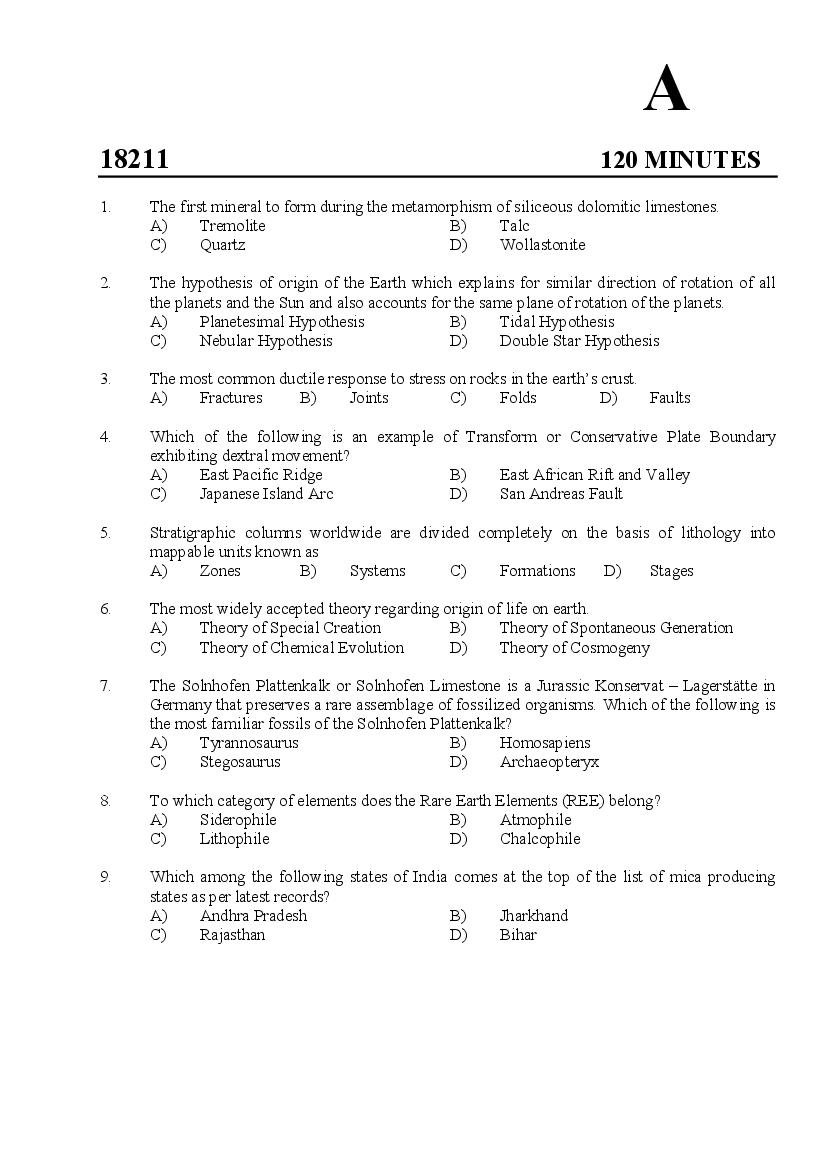
18211 120 MINUTES
1. The first mineral to form during the metamorphism of siliceous dolomitic limestones.
A) Tremolite B) Talc
C) Quartz D) Wollastonite
2. The hypothesis of origin of the Earth which explains for similar direction of rotation of all
the planets and the Sun and also accounts for the same plane of rotation of the planets.
A) Planetesimal Hypothesis B) Tidal Hypothesis
C) Nebular Hypothesis D) Double Star Hypothesis
3. The most common ductile response to stress on rocks in the earth’s crust.
A) Fractures B) Joints C) Folds D) Faults
4. Which of the following is an example of Transform or Conservative Plate Boundary
exhibiting dextral movement?
A) East Pacific Ridge B) East African Rift and Valley
C) Japanese Island Arc D) San Andreas Fault
5. Stratigraphic columns worldwide are divided completely on the basis of lithology into
mappable units known as
A) Zones B) Systems C) Formations D) Stages
6. The most widely accepted theory regarding origin of life on earth.
A) Theory of Special Creation B) Theory of Spontaneous Generation
C) Theory of Chemical Evolution D) Theory of Cosmogeny
7. The Solnhofen Plattenkalk or Solnhofen Limestone is a Jurassic Konservat – Lagerstätte in
Germany that preserves a rare assemblage of fossilized organisms. Which of the following is
the most familiar fossils of the Solnhofen Plattenkalk?
A) Tyrannosaurus B) Homosapiens
C) Stegosaurus D) Archaeopteryx
8. To which category of elements does the Rare Earth Elements (REE) belong?
A) Siderophile B) Atmophile
C) Lithophile D) Chalcophile
9. Which among the following states of India comes at the top of the list of mica producing
states as per latest records?
A) Andhra Pradesh B) Jharkhand
C) Rajasthan D) Bihar
Page 2
A) Grab sampling B) Trench sampling
C) Channel sampling D) Pit sampling
11. The first company to commercially explore the sea floor for massive sulphide deposits.
A) Neptune Minerals B) OceanflORE
C) DEME Group D) Nautilus Minerals
12. What are the areas of the electromagnetic spectrum where the atmosphere is transparent to
specific wavelengths called?
A) Adsorption windows B) Atmospheric windows
C) Absorption windows D) Resolution windows
13. The three R’s of utmost importance in order to save the environment.
A) Repair, Reassess, Retain B) Reserve, Retain, Reuse
C) Reduce, Recycle, Reuse D) Rebuild, React, Resolve
14. The mathematics of spatial relationships as connectivity among point, line and area objects in
the world of GIS is called
A) Topology B) Adjacency
C) Proximity D) Overlay
15. The number of primary lattices (P), body-centered lattices (I) and face centered lattices (CF)
of the unit cells in the 14 Bravais lattices are
A) P – 6, I – 3 and CF – 5 B) P – 7, I – 4 and CF – 3
C) P – 7, I – 3 and CF – 4 D) P – 6, I – 4 and CF – 4
16. Which of the following is the correct sequential order of arrangement of minerals according
to their increasing order of indices of refraction?
A) Corundum < Rutile < Zircon < Topaz < Gypsum
B) Gypsum < Topaz < Corundum < Zircon < Rutile
C) Zircon < Topaz < Gypsum < Rutile < Corundum
D) Rutile < Corundum < Gypsum < Topaz < Zircon
17. The dip of a fault is 90o and rake of the fault is 0o. For an observer standing on the fault and
looking in the strike direction, the type of fault is
A) Normal fault
B) Right-lateral strike slip fault
C) Left-lateral strike slip fault
D) Thrust or Reverse fault
18. The most powerful earthquake ever recorded.
A) 2004 Indian Ocean Earthquake
B) 1964 Alaska Earthquake
C) 1960 Valdivia Earthquake
D) 2011 Tohoku Earthquake
2
Page 3
choose the correct answer.
Plutonic Volcanic
a. Gabbro 1. Dacite
b. Granodiorite 2. Andesite
c. Peridotite 3. Latite
d. Monzonite 4. Komatite
e. Diorite 5. Basalt
A) a-2, b-4, c-2, d-1, e-3 B) a-5, b-3, c-1, d-2, e-4
C) a-2, b-5, c-1, d-4, e-3 D) a-5, b-1, c-4, d-3, e-2
20. The ‘Brazilian test’ refers to the
A) Triaxial Compression test on rocks B) Splitting Tension test on rocks
C) Beam Bending test on rocks D) Unconfined Compression test on rocks
21. The coefficient of permeability of an aquifer is commonly referred to as its
A) Transmissivity B) Specific yield
C) Hydraulic conductivity D) Storativity
22. The hydrochemical facies of fields 5 and 7 respectively in the Hill-Piper Trilinear diagram
for assessment of domestic water quality are
A) Calcium Chloride type and Magnesium bicarbonate type
B) Sodium chloride type and Magnesium bicarbonate type
C) Calcium chloride type and Sodium bicarbonate type
D) Magnesium bicarbonate type and Sodium chloride type
23. Fossil remains of which of the following organisms that lived during early Permian and
found solely in Southern Africa, provide one of the strongest evidences favouring the
Continental Drift Theory?
A) Lystrosaurus B) Stegosaurus C) Mesosaurus D) Mosasaurus
24. Which of the following is a Martian crater?
A) Huygen’s crater B) Ganymedia crater
C) Clavius crater D) Asgard crater
25. The Kiaman Reverse Superchron comes in which part of the Geomagnetic Polarity Time
Scale?
A) Cretaceous period B) Jurassic period
C) Ordovician period D) Permo-Carboniferous period
26. The coastline characterized by parallel inlets and long narrow hilly islands or mountain
ridges situated at some distance in the sea and running parallel to the coast.
A) Haff coastline B) Dalmatian coastline
C) Fjord coastline D) Ria coastline
27. The most spectacular authigenic deposits of the ocean floor.
A) Red clays B) Calcareous ooze
C) Manganese nodules D) Turbidites
3
Page 4
thermal events using common accessory minerals over a very wide geological range.
A) Fission-track dating B) Rubidium-Strontium dating
C) Samarium-Neodymium dating D) Uranium-Thorium-Lead dating
29. The spatial distribution of mineral deposits is known as
A) Paragenesis B) Paramorphogenesis
C) Grouping D) Zoning
30. Mineable accumulations of metallic ores of iron, copper, zinc, lead, gold and several others
associated with calc-silicate rocks are called
A) Greisen deposits B) Sedex deposits
C) Pneumatolytic deposits D) Skarn deposits
31. The main stratigraphic unit in terms of hydrocarbon potential forming the reservoir rocks in
the Ankleshwar oil-field.
A) Dadhar Formation of Oligocene age
B) Tarkeswar Formation of Miocene age
C) Cambay Shale Group of Palaeocene age
D) Ankleshwar Formation of Eocene age
32. The most popular type of drills employed in mineral exploration.
A) Diamond drills B) Rotary drills
C) Calyx drill D) Pneumatic drills
33. In which of the following underground coal mining methods the recovery is practically
100%?
A) Board and Pillar mining B) Longwall retreating mining
C) Longwall advance mining D) Horizon mining
34. The isotopes of which of the following elements have been useful as stratigraphic markers
for chemostratigraphy?
A) Oxygen B) Carbon
C) Sulphur D) Hydrogen
35. Dendrochronology and tree rings as a dating method was fully developed into a science
largely through the works of
A) H. C. Fritts B) M. G. L. Baillie
C) Leonardo da Vinci D) A. E. Douglass
36. OH 7, nicknamed ‘Johnny’s Child’, the type specimen of Homo habilis, was discovered in
1960 at
A) Lactoli, Tanzania
B) Olduvai Gorge, Tanzania
C) Java, Indonesia
D) Kleine Feldhofer Grotte, Germany
4
Page 5
the correct answer.
Ice Ages Time Span
a. Cryogenian 1. 2.58 Ma to present
b. Karoo 2. 450 Ma to 420 Ma
c. Quaternary 3. 360 Ma to 268 Ma
d. Huronian 4. 2.4 Ga to 2.1 Ga
e. Andean-Saharan 5. 720 Ma to 635 Ma
A) a-5, b-2, c-3, d-1, e-4 B) a-3, b-4, e-1, d-5, e-2
C) a-5, b-3, c-1, d-4, e-2 D) a-2, b-5, c-1, d-3, e-4
38. During which period did the brachiopods undergo their greatest differentiation with the
appearance of 14 new super families?
A) Ordovician B) Cambrian
C) Silurian D) Devonian
39. The oldest rock units in Kerala stratigraphy belong to the
A) Khondalite Group B) Wayanad Group
C) Charnockite Group D) Vengad Group
40. The first known aerial photograph was taken from a balloon in 1858 by French photographer
and balloonist
A) James Wallace Black B) Arthur Batut
C) Gasper Felix Tournachon D) Julius Neubronner
41. The Along-track scanner systems are also referred to as
A) Whisk-broom scanners B) Imaging spectroradiomaters
C) Hyperspectral scanners D) Pushbroom scanners
42. What does DBMS stand for?
A) Database Monitoring System B) Database Manufacturing System
C) Database Manipulating System D) Database Management System
43. Ozone layer depletion is mostly caused by
A) CO2 B) CFC C) MIC D) CCl4
44. The element not commonly found in a geological map.
A) Physical landscape features B) Contacts and faults
C) Strike and dip D) Map units – rock types and symbols
45. The most abundant sedimentary rocks.
A) Limestones B) Sandstones
C) Mudrocks D) Agglomerates
46. The coarse grained plutonic variety of calcitic carbonatite.
A) Sovite B) Gregoryite
C) Beforsite D) Alvikite
5
Page 6
A) Determination of oxidation states of iron.
B) Determination of lattice parameters and crystal structure.
C) Determination of chemical composition.
D) Determination of Al-Si distribution in minerals and glass.
48. Match the following crystal twins with the corresponding crystal systems and choose the
correct answer.
Crystal Twin Crystal System
a. Baveno twin 1. Triclinic system
b. Spinel twin 2. Tetragonal system
c. Albite twin 3. Monoclinic system
d. Aragonite twin 4. Isometric system
e. Cassiterite twin 5. Orthorhombic system
A) a-5, b-1, c-3, d-2, e-4 B) a-3, b-5, c-1, d-4, e-2
C) a-3, b-4, c-1, d-5, e-2 D) a-2, b-1, c-3, d-5, e-4
49. The most characteristic sedimentary suite of Alpine type orogenic belts:
A) Calcareous facies B) Shelly facies
C) Molasse facies D) Flysch facies
50. Which of the following principles of stratigraphy is fundamental to understanding not only
the relative age of rocks at a place, but also indicates the relative ages of the fossils they
contain?
A) Principal of Faunal Succession B) Principal of Lateral Continuity
C) Principal of Uniformitarianism D) Principle of Superposition
51. Which of the following is the correct Barrowian sequence of metamorphic zones from high
grade to low grade?
A) Staurolite zone → Sillimanite zone → Biotite zone → Kyanite zone → Chlorite zone
→ Garnet zone
B) Kyanite zone → Sillimanite zone → Garnet zone → Chlorite zone → Biotite zone
→ Staurolite zone
C) Sillimanite zone → Kyanite zone → Staurolite zone → Garnet zone → Biotite zone
→ Chlorite zone
D) Chlorite zone → Garnet zone → Biotite zone → Kyanite zone → Staurolite zone
→ Sillimanite zone
52. The world’s oldest known examples of fossil stromatolites are reported from:
A) Gunflint Chert, Minnesota, North America
B) Exuma Cays, Bahamas
C) Belingwe Greenstone Belt, Zimbabwe
D) Marble Bar, Pilbara, Western Australia
53. The system of classification of igneous rocks in which the constituent minerals of an igneous
rock are considered both chemically and quantitatively:
A) Rosenbuch’s classification B) Shand’s classification
C) CIPW classification D) IUGS classification
6
Page 7
A) Precession B) Polarity C) Eccentricity D) Obliquity
55. The typical primate fossil of Middle Siwalik:
A) Ramapithecus B) Sivapithecus
C) Sus D) Sugrivapithecus
56. Match the following Precambrian lithostratigraphic units of Indian stratigraphy with
corresponding Groups and choose the correct answer.
Formations Groups
a. Mochia Formation 1. Sausar Group
b. Mulaingiri Formation 2. Papaghni Group
c. Rohtas Formation 3. Udaipur Group
d. Vempalle Formation 4. Semri Group
e. Mansar Formation 5. Bababudan Group
A) a-4,b-5,c-1,d-3,e-2 B) a-5,b-3,c-1,d-2,e-4
C) a-2,b-4,c-5,d-1,e-3 D) a-3,b-5,c-4,d-2,e-1
57. Which one of the following statement is NOT correct?
A) The dip slip is the component of the net slip measured perpendicular to the dip of the
fault plane.
B) The throw of a fault is the vertical component of the dip separation measured in a
vertical section that is perpendicular to the strike of the fault.
C) Heave of a fault is the horizontal component of the dip separation.
D) Rake of a fault is the angle between a line and the strike line of the fault plane in
which it is found, measured on the plane.
58. The transform boundary between the Indian Plate and the Arabian Plate is called the
A) Central Indian Ridge B) Owen Fracture Zone
C) Southeast Indian Ridge D) Dead Sea Transform
59. Guniting and shotcreting are
A) Processes for de-silting of reservoirs.
B) Methods for keeping fractured rocks together in and around tunnel openings.
C) Processes of frost treatment of site rocks.
D) Processes of slope treatment and stabilization.
60. The equation representing the Ghyben-Herzberg relation.
( )
A) = ℎ B) = ℎ
( )
C) = ℎ D) = ℎ
( ) ( )
7
Page 8
hydraulic gradients indicate regions of ....................
A) Poor aquifer conditions with higher hydraulic conductivities.
B) Good aquifer conditions with lower hydraulic conductivities.
C) Good aquifer conditions with higher hydraulic conductivities.
D) Poor aquifer conditions with lower hydraulic conductivities.
62. The hypothesis which correlates the symmetric magnetic patterns seen on the sea floor with
geomagnetic field reversals.
A) Vine-Matthews hypothesis B) Wegner’s hypothesis
C) Heiskanen hypothesis D) Hess and Dietz hypothesis
63. The potentially useful indicator plant for diamond prospecting.
A) Ocimum centraliafricanum B) Eschscholzia mexicana
C) Pandanus candelabrum D) Equisetum arvense
64. The correct order of precipitation of the metallic sulphides in the zone of supergene
enrichment following the Schurmann’s law according to increasing solubility of metallic
sulphides.
A) Iron → Copper → Silver → Gold → Lead → Zinc
B) Lead → Zinc → Silver → Gold → Copper → Iron
C) Silver → Gold → Copper → Lead → Zinc → Iron
D) Copper → Lead → Zinc → Gold → Silver → Iron
65. The scintillation counters are preferred to GM counters especially in airborne surveys
because
A) they have high γ-ray detection efficiency.
B) they have high timing resolution.
C) they are more versatile and cost efficient.
D) they are insensitive to magnetic fields.
66. The mining method most suitable for steeply dipping ore bodies with strong walls:
A) Shrinkage stoping B) Timbered stoping
C) Breast stoping D) Open underhand stoping
67. The icy zone extending from about 30 to 35 AU from the Sun, beyond Neptune in the Solar
System where most of the dwarf planets and trillions of comets exist:
A) Jovian Belt B) Kuiper Belt
C) Oort Cloud Belt D) Orion Belt
68. The mismatch between the curves for the Earth’s core and pure iron in the variation graph of
density with depth requires the core to include which of the following elements that reduce
the overall density of the core?
A) Chalcophile elements B) Siderophile elements
C) Lithophile elements D) Atmophile elements
69. Which of the following classes of the Isometric System is NOT a hemihedral class?
A) Diploidal Class B) Gyroidal Class
C) Hextetrahedral Class D) Hexoctahedral Class
8
Page 9
A) Flaser bedding B) Convolute bedding
C) Herring bone cross bedding D) Graded bedding
71. Match the following models of landscape evolution with their concepts and choose the
correct answer.
Models Concepts
a. Gilbert’s Model 1. Morphological system
b. Penck’s Model 2. Step-like landscape evolution
c. King’s Model 3. Geographical cycle
d. Treppen Model 4. Pediplanation cycle
e. Davis Model 5. Dynamic Equilibrium Theory
A) a-3, b-5, c-4, d-1, e-2 B) a-5, b-4, c-1, d-2, e-3
C) a-4, b-3, c-5, d-1, e-2 D) a-5, b-1, c-4, d-2, e-3
72. The size grade of ‘granule’ in the Wentworth geometric grade scale.
A) 2 mm to 4 mm B) 1/16 mm to 1/256 mm
C) 4 mm to 64 mm D) 2 mm to 1/16 mm
73. Which of the following are the end members of the orthorhombic pyroxene series?
A) Diopside – Hedenbergite B) Enstatite – Augite
C) Diopside – Ferroaugite D) Enstatite – Orthoferrosilite
74. Regional dynamothermal metamorphism is related geographically as well as genetically to
A) large faults and overthrusts. B) large magmatic intrusions.
C) large orogenic belts. D) large geosynclines.
75. The type of earth satellite orbit in which the orbital plane is always near-polar and allows the
satellite to pass over a section of the Earth at the same time of the day.
A) Sun-synchronous orbit B) Geosynchronous orbit
C) Geostationary orbit D) Molniya orbit
76. Match the following lustres with the corresponding minerals and choose the correct answer.
Lustre Mineral
a. Sub-vitreous 1. Cassiterite
b. Adamantine 2. Calcite
c. Metallic 3. Amianthus
d. Pearly 4. Galena
e. Silky 5. Selenite
A) a-3, b-5, c-2, d-1, e-4 (B) a-3, b-4, c-1, d-5, e-2
C) a-5, b-1, c-3, d-4, e-2 (D) a-2, b-1, c-4, d-5, e-3
77. The measures or activities undertaken to reduce both the effect of a hazard and to reduce the
scale or intensity of a forthcoming disaster.
(A) Response B) Preparedness C) Recovery D) Mitigation
9
Page 10
Impact Assessment (EIA)?
A) Sustainability B) Integrity C) Utility D) Equality
79. The space segment of GPS consists of a constellation of how many satellites in how many
orbits?
A) 32 satellites in 8 orbits B) 21 satellites in 7 orbits
C) 24 satellites in 6 orbits D) 27 satellites in 9 orbits
80. Which of the following is not a ‘greenhouse gas’?
A) Nitrous oxide B) Hydrogen
C) Methane D) Carbon dioxide
81. The type of remote sensing characteristic of the 8 µm – 14 µm wavelength band.
A) Near Infrared Remote Sensing B) Visible Remote Sensing
C) Microwave Remote Sensing D) Thermal Remote Sensing
82. The slope of the straight line portion of the stress-strain diagram is called the
A) Bulk modulus of elasticity B) Fourier modulus
C) Shear modulus of elasticity D) Young’s modulus of elasticity
83. Ramsay’s classification of folds is based upon curvature of the inner and outer lines of a fold
and the behavior of dip isogons. In this classification the parallel folds and similar folds
belong respectively to
A) Class 1A and Class 1C B) Class 1B and Class 2
C) Class 1C and Class 3 D) Class 1A and Class 1B
84. The tectonites having a dominant planar fabric and generally indicating a flattening type of
strain.
A) S-tectonites B) P-tectonites C) L-tectonites D) SL-tectonites
85. Which of the following statement is NOT correct?
A) Stereographic net is used for plotting Beta diagram.
B) Equal area net is used to plot Pi diagram.
C) Beta diagram is plotted on equal area net.
D) Beta and Pi diagrams are used in the analysis of folds.
86. The island arc in which the Eurasian plate is the overlying plate and the Australian plate is
the subducting plate.
A) Ryukyu Islands B) Solomon Islands
C) Kuril Islands D) Sunda Islands
87. The properties of a building stone are given below. What is the building stone?
Mass density : 2500 – 26500 Kg/m3; Crushing strength : 100 – 2500 Kg/m2
Specific gravity : 2.6 to 2.8; Absorption : 0.5 % to 1.2 %
Porosity : Very low; Texture : Interlocking
Colour : Light coloured, variety of appealing colours; Polish: Perfect polish
A) Marble B) Sandstone C) Granite D) Gneiss
10
Page 11
I II
a. Hygrometer 1. Soil moisture
b. Lysimeter 2. Average depth of precipitation
c. Tensiometer 3. Groundwater level
d. Isohyet 4. Relative humidity
e. Pressure transducer 5. Evapo-transpiration
A) a-2, b-4, c-1, d-5, e-3 B) a-4, b-1, c-5, d-2, e-3
C) a-5, b-4, c-3, d-2, e-1 D) a-4, b-5, c-1, d-2, e-3
89. The most widely applied method of all surface geophysical methods for groundwater
investigations.
A) Gravity method B) Electrical Resistivity method
C) Seismic Refraction method D) Water witching method
90. Quite small eyeless trilobites characterized by strong similarity of cephalon and pygidium,
i.e., isophygous form, with two thoracic segments, complete lack of facial sutures and free
cheeks and highly specialized pygidium.
A) Agnostus B) Calymene C) Phacops D) Olenus
91. The Miller-Urey experiment was the first experiment regarding evolution of life to prove the
origin of life. The chemicals used in the experiment were
(A) H2O, CH4, NH3 and H2 B) CO2, SO2, O2 and CCl4
(C) H2CO3, Cl2, H2O2 and NO2 D) O2, SO2, HCL and H2SO4
92. Match the following forms of gastropod shells with corresponding example of gastropod and
choose the correct answer.
Form of shell Gastropod
a. Convolute 1. Planorbis
b. Cylindrical 2. Cypraea
c. Globular 3. Pleurotomaria
d. Trochiform 4. Natica
e. Discoidal 5. Voluta
A) a-3, b-1, c-5, d-2, e-3 B) a-2, b-5, c-4, d-3, e-1
C) a-5, b-3, c-1, d-4, e-2 D) a-5, b-4, c-1, d-3, e-2
93. The schist belts of Kolar and Hutti containing gold deposits belong to
A) Sargur Schist Complex B) Dharwar Supergroup
C) Cuddapah Supergroup D) Older Metamorphic Group
94. The two tectonic zones of the Himalayas viz., Central Crystalline Zone and Tethyan
Himalayan Zone are grouped into a single physiographic unit referred to as
A) Lesser Himalayas B) Trans Himalayas
C) Great Himalayas D) Outer Himalayas
95. The petrified angiosperm logs of which of the following were the first documented records of
any plant fossil in India in 1782?
A) Tipam Sandstone B) Warkalli Sandstone
C) Cuddalore Sandstone D) Satyavedu Sandstone
11
Page 12
from the oldest to the youngest?
A) Gilbert reversed → Brunhes normal → Matuyama reversed → Gauss normal
B) Gauss normal → Brunhes normal → Gilbert reversed → Matuyama reversed
C) Gilbert reversed → Gauss normal → Brunhes normal → Matuyama reversed
D) Gilbert reversed → Gauss normal → Matuyama reversed → Brunhes normal
97. The type of unconformity which suggest a period of long term uplift, weathering and erosion
of bedrock, until finally buried by the younger sedimentary units.
A) Disconformity B) Nonconformity
C) Paraconformity D) Angular unconformity
98. The term ‘Quaternary’ was first used in a geological context by
A) Charles Lyell B) Louis Agassiz
C) J. P. Desnoyers D) A. Von Morlot
99. The oldest glacial event that has left behind till sheets throughout northern Europe is the
A) Saalian Glaciation B) Weichselian Glaciation
C) Haslach Glaciation D) Elsterian Glaciation
100. The highest cascading waterfalls in India.
A) Jog Falls B) Kunchikal Falls
C) Nohkalikai Falls D) Meenmutty Falls
101. ‘Magnetic Polarity Reversals’ give evidence for
A) Plate tectonics B) Sea-floor spreading
C) Continental drift D) Evolution of geosynclines
102. The gravity correction which compensates for gravity’s decrease with distance from the
earth’s surface, i.e., proportional to the altitude or elevation.
A) Free-Air Correction B) Terrain Correction
C) Bouguer Plate Correction D) Latitude Correction
103. The major heat producing isotopes in the Earth.
A) K-40, U-238, U-235 and Th-232 B) Ra-226, Th-230, Sm-147 and Cd-113
C) Rb-87, Re-187, Pu-244 and Bi-209 D) Ca-40, Pt-195, Ta-180 and Eu-151
104. The type of secondary halos of dispersion typical for deposits of petroleum and natural gas
and radioactive ores.
A) Biogeochemical halos of dispersion B) Saline halos of dispersion
C) Mechanical halos of dispersion D) Gaseous halos of dispersion
105. Which among the following does not come in the list of important Gondwana coal fields of
India?
A) Umaria coal fields of Madhya Pradesh
B) Makum coalfields of Assam
C) Talchir coal fields of Orissa
D) Giridih coal fields of Jharkhand
12
Page 13
A) Ostracods B) Trilobites C) Cirripedians D) Arachnids
107. Which of the following is the fundamental chronostratigraphic unit of worldwide major rank?
A) Erathem B) Formation C) System D) Period
108. Which of the following is the correct order of evolution of horses from the Eocene times to
the modern horses?
A) Hippidion → Eohippus → Equus → Mesohippus → Parahippus → Hipparion
B) Eohippus → Mesohippus → Parahippus → Hipparion → Hippidion → Equus
C) Mesohippus → Parahippus → Eohippus → Hippidion → Hipparion → Equus
D) Eohippus → Hipparion → Parahippus → Mesohippus → Hippidion → Equus
109. Match the following Phylum/Class of organisms with the corresponding body parts and
choose the correct answer.
Phylum/Class Body parts
a. Echinoidea 1. Rhabdosome
b. Brachiopoda 2. Glabella
c. Graptolithina 3. Ambulacra
d. Trilobita 4. Fosette
e. Foraminifera 5. Crura
A) a-4, b-1, c-5, d-2, e-3 B) a-5, b-1, c-2, d-4, e-3
C) a-3, b-5, c-1, d-2, e-4 D) a-3, b-2, c-5, d-1, e-4
110. Which of the following plant fossils of Gondwana age is considered as an index fossil of the
Triassic?
A) Noeggerathiopsis B) Williamsonia
C) Glossopteris D) Dicroidium
111. The equivalents of the Lameta Beds of Narmada Valley in the Cauvery Basin.
A) Uttattur Formation B) Trichinopoly Formation
C) Ariyalur Formation D) Dalmiapuram Formation
112. In biostratigraphy the stratigraphic range of the rock unit between the first and last
appearance datum of a particular taxon in a local area is called
A) Telizone B) Acme zone C) Range zone D) Biozone
113. Match the following metamorphic facies with the corresponding diagnostic minerals and
choose the correct answer.
Metamorphic facies Diagnostic mineral
a. Eclogite facies 1. Actinolite
b. Zeolite facies 2. Omphacite
c. Greenschist facies 3. Lawsonite
d. Sanidinite facies 4. Tridymite
e. Blueschist facies 5. Laumontite
A) a-3, b-1, c-5, d-2, e-4 B) a-5, b-3, c-2, d-1, e-4
C) a-2, b-5, c-1, d-4, e-3 D) a-4, b-1, c-5, d-4, e-3
13
Page 14
recrystallization and representing remnants of pre-existing fold fabric or relative movement
between the growing porphyroblast and the groundmass result in
A) Migmatitic structure B) Maculose structure
C) Gneissic structure D) Helicitic structure
115. The codes of the highest category of mineral resources and the lowest category of mineral
resources respectively under the UNFC system are
A) (333) and (111) B) (121) and (333)
C) (111) and (334) D) (222) and (332)
116. Which one of the following is not a type of grinding machine used in ore dressing for finer
grinding?
A) Tumbling mills B) Hammer mills
C) Rod mills D) Ball mills
117. Which one of the following belongs to the category of undifferentiated meteorites?
A) Achondrites B) Irons C) Stony Irons D) Chondrites
118. Match the following Deep Sea Diving Vessels (DSDV) for exploring the ocean floor with
their corresponding countries of commissioning and choose the correct answer.
DSDV Country
a. Archimede 1. Russia
b. Trieste 2. France
c. Konsul 3. Japan
d. Kaiko 4. United States
e. Alvin 5. Switzerland
A) a-4, b-5, c-3, d-1, e-2 B) a-2, b-5, c-1, d-3, e-4
C) a-3, b-4, c-5, d-2, e-3 D) a-2, b-4, c-5, d-3, e-1
119. A soil consisting primarily of organic materials and common in wetlands:
A) Histosols B) Podzols
C) Chernozems D) Fluvisols
120. Which of the following statements regarding lunar rocks is INCORRECT?
A) Mare basalts constitute large portions of the lunar maria.
B) Lunar rocks range in age from about 3.16 billion years to 4.44 billion years.
C) High amount of volatiles and hydrated minerals are typical of the lunar rocks.
D) Lunar crustal rocks are characterized by high concentrations of anorthosite.
*****************
14
Document Details
| Board / Org | Kerala Exams |
| Exam | Kerala SET |
| Type | Question Paper |
| Pages | 14 |
| Updated | 23 Oct 2026 |