Kerala SET 2018 Feb Question Paper Psychology
Finished viewing? Save it for later —
Download Kerala SET 2018 Feb Question Paper Psychology (PDF · 16 pages)About Kerala SET 2018 Feb Question Paper Psychology
Kerala SET 2018 Feb Question Paper Psychology is available here for free download. Published by Kerala Exams for Kerala SET, this question paper can be viewed online or downloaded as a PDF (16 pages). Candidates preparing for Kerala SET can use Kerala SET 2018 Feb Question Paper Psychology to understand the exam pattern, the type of questions asked, and the overall difficulty level.
Frequently Asked Questions
How can I download Kerala SET 2018 Feb Question Paper Psychology?
Open this page and click the Download button to save Kerala SET 2018 Feb Question Paper Psychology as a PDF. It is completely free on AglaSem Docs.
Is Kerala SET 2018 Feb Question Paper Psychology free to download?
Yes. Kerala SET 2018 Feb Question Paper Psychology can be viewed online and downloaded as a PDF free of cost on AglaSem Docs.
How many pages does Kerala SET 2018 Feb Question Paper Psychology have?
Kerala SET 2018 Feb Question Paper Psychology contains 16 pages, which you can read online or download together as a single PDF.
Where can I find more Kerala SET study material?
You can find more Kerala SET question papers, sample papers, syllabus, and answer keys on AglaSem Docs.
Kerala SET 2018 Feb Question Paper Psychology – Text
Read the full text of this question paper below — useful to quickly search, copy and reference the content online without downloading the PDF.
📄 View text version (16 pages)
Page 1
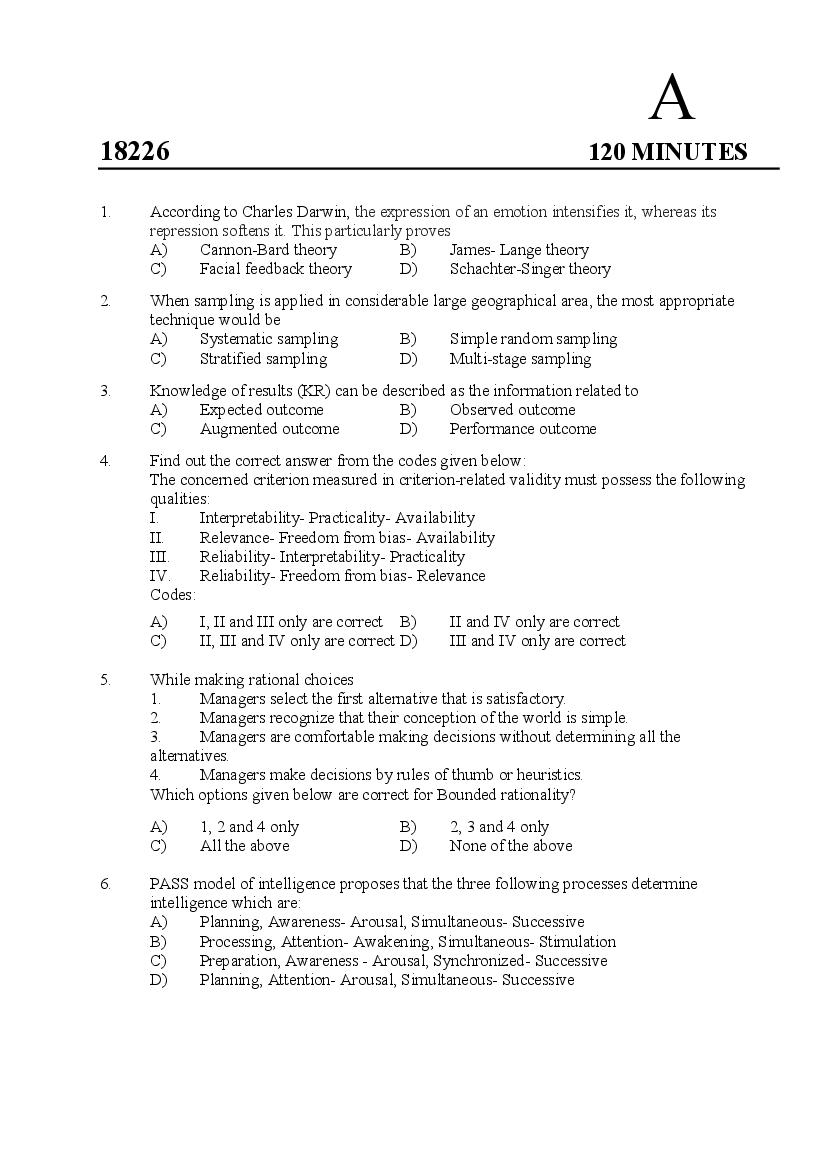
18226 120 MINUTES
1. According to Charles Darwin, the expression of an emotion intensifies it, whereas its
repression softens it. This particularly proves
A) Cannon-Bard theory B) James- Lange theory
C) Facial feedback theory D) Schachter-Singer theory
2. When sampling is applied in considerable large geographical area, the most appropriate
technique would be
A) Systematic sampling B) Simple random sampling
C) Stratified sampling D) Multi-stage sampling
3. Knowledge of results (KR) can be described as the information related to
A) Expected outcome B) Observed outcome
C) Augmented outcome D) Performance outcome
4. Find out the correct answer from the codes given below:
The concerned criterion measured in criterion-related validity must possess the following
qualities:
I. Interpretability- Practicality- Availability
II. Relevance- Freedom from bias- Availability
III. Reliability- Interpretability- Practicality
IV. Reliability- Freedom from bias- Relevance
A) I, II and III only are correct B) II and IV only are correct
C) II, III and IV only are correct D) III and IV only are correct
5. While making rational choices
1. Managers select the first alternative that is satisfactory.
2. Managers recognize that their conception of the world is simple.
3. Managers are comfortable making decisions without determining all the
alternatives.
4. Managers make decisions by rules of thumb or heuristics.
Which options given below are correct for Bounded rationality?
A) 1, 2 and 4 only B) 2, 3 and 4 only
C) All the above D) None of the above
6. PASS model of intelligence proposes that the three following processes determine
intelligence which are:
A) Planning, Awareness- Arousal, Simultaneous- Successive
B) Processing, Attention- Awakening, Simultaneous- Stimulation
C) Preparation, Awareness - Arousal, Synchronized- Successive
D) Planning, Attention- Arousal, Simultaneous- Successive
Page 2
codes given below:
List-I List-II
(Premise) (Experimental designs)
a. Two areas are selected and the dependent 1. Before-and after without control
variable is measured in both the areas for design
an identical time-period before the
treatment
b. Subjects are first divided into groups, 2. Latin square design
such that within each group the subjects
are relatively homogeneous in respect to
some selected variable.
c. A single test or group is selected and the 3. Before-and after with control
dependent variable is measured before its design
introduction of the treatment.
d. No treatment occurs more than once in 4. Randomized block design
any row or any one column
a b c d
A) 4 1 2 3
B) 3 4 1 2
C) 4 3 1 2
D) 2 3 1 4
8. Tendency to attribute negative outcomes to internal causes but positive outcomes to
external causes is called
A) Actor-observer effect B) Self-serving bias
C) Correspondent bias D) Fundamental attribution error
9. Forming of very negative impressions of persons who play up to their superiors but treat
subordinates with disdain and contempt.
A) Slime effect B) Self defeating pattern of attribution
C) Noncommon effect D) Impression management
10. Match List-I (Research contributions) with List-II (Learning theorists) and choose your
answer from the codes given below:
List-I List-II
(Research contributions) (Learning theorists)
a. Developed procedures to study conditioned taste 1. Tolman
aversion 2. John B Watson
b. Studied latent learning in rats 3. Ivan Pavlov
c. Studied rewarded aggressive behavior in children 4. Albert Bandura
d. Adopted a single subject design to instill fear in a
healthy baby
a b c d
A) 2 3 1 4
B) 4 1 2 3
C) 3 2 1 4
D) 3 1 4 2
2
Page 3
Possible motives for self -evaluation are
I. Self-presentation- Self- verification
II. Self enhancement- Self- verification
III. Self enhancement- Self-presentation
IV. Self-assessment- Self enhancement
A) II, III and IV only are correct B) II and IV only are correct
C) I, III and IV only are correct D) I and IV only are correct
12. Children begin to comprehend the importance of gender consistency between the ages
A) Four and seven B) Twelve and sixteen
C) Eight and twelve D) Eighteen and twenty one
13. Match List-I (Classical conditioning principles) with List-II (Criteria used) and choose the
right pair from the codes given below:
List-I List-II
(Classical conditioning principles) (Criteria used)
a. Physiological and emotional 1. Source of behaviour
b. Expectation that CS reliably predicts UCS 2. Responses conditioned
c. Associating two stimuli 3. Cognitive aspects
d. Elicited by stimulus 4. Basis of learning
A) a - 2, b - 3, c - 4, d - 1 B) a - 2, b - 4, c - 3, d -1
C) a - 1, b - 2, c - 3, d - 4 D) a -1, b - 3, c - 4, d - 2
14. Reminding people that they are part of larger groups to reduce intergroup discrimination is
known as:
A) Contact hypothesis B) Criss- cross categorization
C) Recategorization D) Melting pot
15. Find out the correct answer from the codes given below:
Basic principles of compliance are:
I. Friendship-Cohesiveness- Commitment
II. Coordination- Scarcity- Authority
III. Reciprocity- Consistency-Cohesiveness
IV. Coordination-Friendship- Commitment
A) I, III and IV only are correct B) II and IV only are correct
C) II, III and IV only are correct D) I and II only are correct
16. “All our present interpretations of the universe are subject to revision or replacement”.
This view of personality is put forward by
A) Rollo May B) Kurt Lewin
C) Julian B Rotter D) George Kelly
3
Page 4
A) Social categorization B) Reactance
C) Attitude polarization D) Biased assimilation
18. Hatha yoga indicates
A) The yoga of meditation B) The yoga of mind and body
C) The yoga of physical mastery D) The yoga of action
19. Find out the correct answer from the codes given below:
Developing measurement tools consists of
I. Formation of index- Concept development–Selection of indicators
II. Concept development – Selection of indicators - Specification of concept
dimensions
III. Specification of concept dimensions - Selection of indicators - Formation of
index
IV. Concept development –Specification of concept dimensions - Selection of
indicators
A) II and III only are correct B) III and IV only are correct
C) I, III and IV only are correct D) II and IV only are correct
20. An adult’s concern for and commitment to the well-being of future generations is known as:
A) Altruism B) Generativity
C) Moral integrity D) Belief in a just world
21. “It’s hard to stay angry if you smile” explains the technique of
A) Negative state relief B) Empathic joy
C) Incompatible response D) Catharsis
22. The model of personality which is developed in an attempt to understand “narcissistically
disturbed people” is by:
A) Heinz Kohut B) Margaret Mahler
C) Otto Kernberg D) George Klien
23. Experience of confusion or agitation that comes and goes repeatedly over the course of
several hours as the result of seizure-like activity or a brief blockage of the blood vessels
supplying your brain.
A) Retrograde amnesia B) Infantile amnesia
C) Transient global amnesia D) Antero grade amnesia
24. “The history of the personality is the personality” is defined by:
A) Erich Fromm B) Henry Murray
C) Alfred Adler D) Carl Jung
25. Functional neurological symptoms disorder is otherwise known as:
A) Illness anxiety disorder B) Somatic symptom disorder
C) Somatization disorder D) Conversion disorder
4
Page 5
Observational learning consists of:
I. Attention- Retention- Production
II. Attention- Synthesis- Motivation
III. Retention- Recognition- Production
IV. Attention-Production- Motivation
A) II, III and IV only are correct B) III and IV only are correct
C) I, III and IV only are correct D) I and IV only are correct
27. A type of conditioning in which there is no causal relation between the response and the
reinforce is referred as
A) Conceptual behavior B) Stimulus discrimination
C) Superstitious behaviour D) Secondary behaviour
28. Contribution of Ajzen and Fishbein to the field of attitude research is
A) Attitude-to-behaviour process model
B) Elaboration likelihood model
C) Theory of reasoned action
D) Theory of planned behaviour
29. This test has a series of cartoons with words inserted in ‘balloons’ above
A) Holtzman test B) Rorschach test
C) Rosenzweig test D) TAT
30. Meaning of yoga in Sanskrit is
A) to enlighten B) to join C) to self-realize D) to be aware
31. An exclusive concern with one’s own personal needs and welfare rather than with the
needs and welfare of others is
A) Individuation B) Self reference effect
C) Self enhancement D) Egoism
32. Some participants in assertiveness training programs who are just learning the techniques of
appropriate assertiveness may ‘overdo’ their new behaviors and come across as aggressive
rather than assertive. This is known as
A) Self determination B) Overcompensation
C) Aftercare D) Passivity
33. A short-lived event of destruction that affects dominant organisms in a community or
over a larger area is NOT
A) Wildfire B) Floods
C) A disease epidemic D) Air pollution
34. Helping patients prepare themselves in advance to handle stressful events successfully and
with a minimum of upset is
A) Meditation B) Stress inoculation
C) Cognitive restructuring D) Biofeedback therapy
5
Page 6
A) Explicit diagnostic criteria
B) Elimination of the term mental disorders as “reactions”
C) A multi axial diagnostic assessment system
D) Approach to be neutral with respect to the causes of mental disorders.
36. Mini-mental status examination test to measure cognitive impairment is initially developed
by:
A) Mossello B) Kurlowicz C) Folstein D) Goldman
37. An abrupt change in the brain that causes mental confusion and emotional disruption
among elder adults is:
A) Amnesia B) Delirium
C) Dementia D) Unspecific organic disorders
38. According to Erikson, “the unwise pretense of being wise” occurs in old age is suggested as:
A) Authoritism B) Negative identity
C) Impersonation D) Sapientism
39. Find out the answer from the codes given below:
Connectionist model of memory
I. Assumes that different patterns of activation account for the various cognitive
process
II. Cognitive processes occur in parallel, many at the same time
III. Tries to provide explanations at a more abstract, symbolic level
IV. Ideas are stored as a set of changes in instructions neurons send to each other
A) I, II and III only are correct B) I, II and IV only are correct
C) II, III and IV only are correct D) I, III and IV only are correct
40. All the following are characteristic features of sleep apnea EXCEPT
A) Airflow is blocked for 10 seconds or more
B) You feel very tired during the day
C) Airflow reduction of greater than 50% for 10 seconds or more
D) Muscles and soft tissues in the throat relax and collapse
41. An intense desire of a male to have a female body and other physical traits of a female and to
be accepted by others as a female is referred as
A) Body dysphoric disorder B) Gender dysphoria
C) Gender incongruence D) Sexual identity disorder
42. The suitable test for differences among the means of the populations by examining the
amount of variation within each of the samples, relative to the amount of variation
between the samples is:
A) Simple linear regression model
B) Analysis of variance
C) Chi-square test
D) Discriminant analysis
43. Six stages in the development of personality from infancy to late adolescence is proposed by:
A) Harry Stack Sullivan B) Erich Fromm
C) Karen Horney D) Winnicott
6
Page 7
A) RET B) CBT C) REBT D) Cognitive therapy
45. Memory can be prolonged by silently repeating a list of given words. This process is
called:
A) Free recall B) Rehearsal C) Cued recall D) Serial recall
46. Match List-I (Piagetian concepts) with List-II (Central features) and choose your answer
from the codes given below:
List-I List-II
(Piagetian concepts) (Central features)
a. Preoperational stage 1. Object permanence
b. Concrete operational stage 2. Testing hypotheses logically
c. Sensorimotor stage 3. Egocentrism
d. Formal operational stage 4. Conservation
a b c d
A) 4 3 1 2
B) 4 1 3 2
C) 3 4 1 2
D) 3 4 2 1
47. All the following are characteristic features of performance management EXCEPT
A) Develop clear job descriptions
B) Select appropriate people using a comprehensive employee selection process
C) Done in an annual appraisal meeting
D) Provide on-going coaching and feedback
48. Breakthrough kind of thinking that most people are familiar with which is relatively rare is
called:
A) Aha (eureka) experience B) Big C creativity
C) Personal creativity D) Small c creativity
49. There is no “self” in the sense of a permanent; integral autonomous being within an
individual existence, differentiates this doctrine from others
A) Theravada Buddhism B) Mahayana Buddhism
C) Vajrayana Buddhism D) Tantric Buddhism
50. The teacher's role is mediating the child's learning activity as they share knowledge
through social interaction is
A) Piagetian perspective B) Bruner’s perspective
C) Vygotskian perspective D) Freund’s perspective
51. According to Attenuation theory by Treisman, incoming information is subjected to
three kinds of analysis such as
A) Contextual, physical and semantic properties
B) Physical, informative and linguistic properties
C) Semantic, neural and linguistic properties
D) Physical, linguistic and semantic properties
7
Page 8
patterns in their DNA.
A) DNA profiling B) Brain mapping
C) Forensic DNA analysis D) DNA fingerprinting
53. Flashbacks of reliving the moment of trauma, bad dreams and scary thoughts in PTSD is:
A) Narrative memories B) Eye witness testimony
C) Intrusive memories D) Autobiographical memories
54. Point on a centimeter scale indicates
A) Interval scale B) Nominal scale
C) Ordinal scale D) Ratio scale
55. Match List-I (Theories of forgetting) with List –II (Propositions) and choose the answer
from the codes given below:
List-I List –II
(Theories of forgetting) (Propositions)
a. Consolidation theory 1. Very threatening or anxiety-provoking material is often
b. Repression unable to gain access to conscious awareness
c. Cue-dependent 2. The ability to remember can be disrupted by what we
forgetting have previously learned or by future learning
d. Interference 3. Information in memory cannot be accessed.
4. Forgetting occurs because information is not stored
properly in LTM
A) a - 1, b - 3, c - 2, d - 4 B) a - 4, b - 1, c - 3, d - 2
C) a - 3, b - 4, c - 2, d - 1 D) a - 4, b - 3, c - 1, d - 2
56. ---------- were more abundant in the posterior parts of the brain during meditation than
during simple relaxation
A) Beta waves B) Alpha waves
C) Delta waves D) Theta waves
57. Effective teaching has all the following principles EXCEPT
A) Give your students appropriate feedback
B) Involve your students learning from each other
C) Update technology based pedagogical methods
D) Evaluate the impact you are having on your students
58. The process of building mental representation of the world through direct interaction
according to Piaget is called
A) Metacognition B) Adaptation
C) Assimilation D) Construction
59. Which of the following is NOT an example of discrete variable?
A) Gender B) Religion
C) Socioeconomic status D) Age
8
Page 9
yields the simplest and most stable shape or form. This is proposed by:
A) Kahneman (1973) B) Deutsch & Deutsch (1963)
C) Norman (1968) D) Koffka (1935)
61. Given below are two statements, Assertion (A) and Reason (R). Indicate your answer
using the codes given below.
Assertion (A): Measurement should be precise and unambiguous in an ideal research study
Reason (R): Correct measurement depends on successfully meeting all the
possible sources of error in measurement
A) A and R are true and R is the correct explanation of A
B) A and R are true, but R is not the correct explanation of A
C) A is true, but R is false
D) A is false, but R is true
62. Sheetal is an employee at Techno park; Sheetal likes trekking; Therefore, all employees at
Techno park like trekking. This statement follows -------
A) Inductive reasoning B) Deductive reasoning
C) Abductive reasoning D) Causal reasoning
63. According to James- Lange theory of emotion
A) You smile and then feel happy
B) You feel happy and then smile
C) Your smile and feeling of happiness occur simultaneously
D) Mood disorders can be explained with this theory
64. Find out the correct answer from the codes given below:
An unstructured interview
I. Uses a set of predetermined questions
II. Interviewer is allowed freedom to ask questions
III. Central data collection technique in descriptive studies
IV. Commonly used in exploratory studies
A) I, II and III only are correct B) II and III only are correct
C) I and IV only are correct D) II and IV only are correct
65. Expected utility theory which concerns people's preferences with regard to choices that have
uncertain outcomes is a -------- model of decision making
A) Prescriptive B) Normative
C) Descriptive D) Proscriptive
66. Systematic desensitization follows
A) Operant conditioning B) Classical conditioning
C) Observational learning D) Simultaneous conditioning
67. Water jug experiments articulated by Luchins in 1940s measure
A) Perceptual style B) Mental set
C) Locus of control D) Handedness
9
Page 10
through
A) Theory of correspondent inference
B) Theory of causal attributions
C) Covariation theory
D) Regulatory focus theory
69. Charles Spearman developed two factor theory of intelligence as he was skeptical of -----
A) Factor analysis B) Pearson’s test
C) Regression D) Chi-square test
70. Author of the book ‘Frames of Mind’ is
A) Robert Sternberg B) Daniel Goleman
C) Howard Gardner D) Louis L Thurstone
71. -------- computes the probability of recall of each word as a function of the word’s
serial position in the original list.
A) Immediate recall experiment B) Free recall experiment
C) Chunking experiment D) Prompted recall experiment
72. ------- is an inherited, specific, stereotyped pattern of behaviour
A) Trait B) Motive C) Instinct D) Drive
73. The teacher should guide students the way of the knowledge as a ------- in learning
process is proposed by John Dewey.
A) Motivator B) Evaluator C) Supervisor D) Partner
74. --------- model allows discrepancies between the input and some previously stored
pattern while perceiving.
A) Prototype Matching B) Template Matching
C) Perceptual learning D) Featural Analysis
75. Mirror drawing apparatus manifests
A) Creativity B) Division of attention
C) Bilateral transfer D) Habit interference
76. Reservation policies in India is a form of
A) Equal Employment Opportunity
B) Multiculturalism
C) Affirmative Action
D) Sensitivity training
77. Delivering instructional content, often online, outside of the classroom is called
A) Massive open online course B) Flipped classroom
C) Rotation model of learning D) Learning by teaching
78. Among the approaches given below, the least deterministic approach to personality is:
A) Psychoanalytic approach B) Biological approach
C) Humanistic approach D) Behavioral approach
10
Page 11
from the codes given below:
List-I List –II
(Types of reasoning) (Assumptions)
a. Analogical reasoning 1. If A is part of C then B is a part of C
b. Linear syllogism 2. If A is true then B is true
c. Conditional syllogism 3. A is to B as C is to_____
d. Categorical syllogism 4. Kumar is not as tall as John
a b c d
A) 3 2 1 4
B) 1 2 4 3
C) 3 4 2 1
D) 2 4 3 1
80. Arrange the cognitive processes given below as in top down processing of attention
A) Comprehension, Feature processing, letter processing
B) Comprehension, phrase processing, feature processing
C) Feature processing, word processing, comprehension
D) Word processing, comprehension, feature processing
81. Match List-I (Type of study) with List-II (Research design) and choose your answer from
the codes given below:
List-I List-II
(Type of study) (Research design)
a. Purposive or judgement sampling 1. Observational design
b. Pre-planned design for analysis 2. Operational design
c. Unstructured instruments for collection of data 3. Sampling design
d. Advanced decisions about operational 4. Statistical design
procedures
a b c d
A) 4 3 2 1
B) 2 1 4 3
C) 3 2 1 4
D) 3 4 1 2
82. The theory of motivation which assumes that behavior results from conscious choices
among alternatives whose purpose is to maximize pleasure and minimize pain is
A) Activation theory B) Two factor theory
C) Expectancy theory D) Arousal theory
83. Augmented neural networks used to learn information about object categories from one or a
few training images are termed
A) Discovery learning B) Connectionism
C) Systematic behavior theory D) One shot learning
84. The tendency to attach less importance to one potential cause of some behavior when
other potential causes are also present
A) Augmenting B) Attributing C) Discounting D) Regulating
11
Page 12
using the codes given below.
Assertion (A): In factorial designs, the effects of varying more than one factor are to be
determined
Reason (R): In this design, the extraneous variable to be controlled by homogeneity is
called the control variable
A) A and R are true and R is the correct explanation of A
B) A and R are true, but R is not the correct explanation of A
C) A is true, but R is false
D) A is false, but R is true
86. The theory developed out of the motivational study on 200 accountants and engineers
employed by firms in and around Western Pennsylvania is
A) John Holland’s theory B) Herzberg’s theory
C) Murray’s theory D) Maslow’s theory
87. Find out the correct answer from the codes given below:
Testing of hypothesis include
I. Decision rule
II. Type I and II errors can be reduced simultaneously
III. Alternative hypothesis is the one which to be disproved
IV. Level of significance is the probability of Type I error
A) I and IV only are correct B) I, III and IV only are correct
C) II, III and IV only are correct D) II and IV only are correct
88. Iconic memory is studied through
A) Whole report technique B) Partial report technique
C) A and B D) None of the above
89. Nominal scales are commonly used in
A) Researches in behavioral science
B) Correlational design and survey research
C) Survey research and ex-post-facto research
D) Researches in physical science
90. The measure of an individual’s level of aspiration is calculated through
A) Deviation score B) Goal-discrepancy score
C) Barrier score D) Performance score
91. Usefulness of a test in closely relating to other measures of known validity is
A) Construct validity B) Predictive validity
C) Concurrent validity D) Content validity
12
Page 13
using the codes given below:
Assertion (A): The effect of punishment during imprinting is to enhance the
effectiveness of the imprinting experience
Reason (R): The critical period of imprinting experience distinguishes imprinting
from ordinary learning
A) A and R are true and R is the correct explanation of A
B) A and R are true, but R is not the correct explanation of A
C) A is true, but R is false
D) A is false, but R is true
93. The arousal level of introverts and extroverts are determined by:
A) Hippocampus B) Limbic system
C) Amygdala D) Ascending reticular activating system
94. Inability to detect changes to an object or scene, when one is given different views of that
object or scene is known as
A) Rod and frame illusion B) Change blindness
C) Change detection D) Zollner illusion
95. It is this part of personality which exist in all three levels of consciousness
A) Id B) Ego C) Superego D) Instinct
96. Given below are two statements, Assertion (A) and Reason (R). Indicate your answer
using the codes given below.
Assertion (A): Scaling is a procedure for assigning numbers to various degrees of
opinion/attitude
Reason (R): In scaling, numbers for measuring the distinctions of degree in the
attitudes/opinions are not assigned to individuals corresponding to their
scale-positions
A) A and R are true and R is the correct explanation of A
B) A and R are true, but R is not the correct explanation of A
C) A is true, but R is false
D) A is false, but R is true
97. Environmental forces that play a role in how psychogenic needs are displayed in behavior is
termed as
A) Incentives B) Rewards C) Drives D) Presses
98. Likert-type scale follows
A) Continuous rating B) Itemized rating
C) Graphic rating D) Verbal frequency
99. Students dependent on each other to succeed is
A) Learning by teaching B) Peer learning
C) Jigsaw D) Flip learning
13
Page 14
association can be carried out is known as:
A) Framing effect B) Availability heuristic
C) Representativeness heuristic D) Gambler’s fallacy
101. All the following are Noble Truths of Buddhism EXCEPT
A) dukkha B) anatta C) samudaya D) nirodha
102. Barrier score of an individual’s personality can be obtained through
A) Tomkins-Horn picture arrangement test
B) Thematic apperception test
C) Rorschach inkblot test
D) Holtzman inkblot test
103. Given below are two statements, Assertion (A) and Reason (R). Indicate your answer
using the codes given below.
Assertion (A): It is never safe to take secondary data at their face value
Reason (R): Secondary data means data which have already been collected and
analyzed by someone else
A) A and R are true and R is the correct explanation of A
B) A and R are true, but R is not the correct explanation of A
C) A is true, but R is false
D) A is false, but R is true
104. Which one condition does NOT share the feature of OCD more frequently in family
members of OCD patients?
A) Hypochondriasis B) Hair-Pulling Disorder (Trichotillomania)
C) Binge eating disorder D) Mental Retardation
105. Find out the correct answer from the codes given below:
Abraham Maslow’s theory of motivation is criticized as given below:
I. There may be overlap in need hierarchy
II. An individual’s behavior at any time is mostly guided by multiplicity of behaviour
III. Level of motivation may be static
IV. The need priority model may not apply at all times in all places
A) III and IV only are correct B) I, II and IV only are correct
C) II, III and IV only are correct D) I and IV only are correct
106. The method of using catharsis during hypnotic trance was replaced by Freud by
A) Interpretation B) Free association
C) Therapeutic transference D) Group analysis
107. The distance between the actual developmental level as determined by independent
problem solving and the level of potential development as determined through problem
solving under adult guidance, or in collaboration with more capable peers is not
A) Scaffolding B) Zone of proximal development
C) Self-regulating learning D) Cooperative learning
14
Page 15
through:
A) Illumination experiment
B) Mass interviewing programme
C) Relay assembly test room experiments
D) Bank wiring observation room experiment
109. Piaget described his area of research work as
A) Genetic epistemology B) Constructivism
C) Cognitive development D) Adaptation
110. Brain changes in persons with major depressive disorder is commonly NOT attributed to
A) Frontal lobe of the brain B) Pituitary gland
C) Hypothalamus D) Temporal lobe of the brain
111. Find out the correct answer from the codes given below:
Gagne’s theory of learning has the following progressive levels of cognitive processes
which outline instructional events
I. Reception- Selective perception- Reinforcement- Generalization
II. Selective perception- Expectancy- Generalization- Reinforcement
III. Reception- Semantic encoding- Selective perception - Expectancy
IV. Responding- Reinforcement- Retrieval - Generalization
A) I, III and IV only are correct B) II and IV only are correct
C) II, III and IV only are correct D) I and IV only are correct
112. Classic study done by Rosenthal and Jacobson (1968) for the self-conforming nature of
schemas prove:
A) Perseverance effect B) Self-fulfilling prophecies
C) Self-enhancement D) Self-presentation
113. People who are characterized by distrust cynicism, egocentricity and manipulative
leadership show:
A) Hypocrisy B) Narcissism
C) Machiavellianism D) Psychopathy
114. Given below are two statements, Assertion (A) and Reason (R). Indicate your answer
using the codes given below.
Assertion (A): We may reject null hypothesis when it is true
Reason (R): Null hypothesis is not the specific statement about the parameter
A) A and R are true and R is the correct explanation of A
B) A and R are true, but R is not the correct explanation of A
C) A is true, but R is false
D) A is false, but R is true
115. Stimulus intensity reduction theory of motivation is proposed by
A) Freud B) Hess C) Lorenz D) Tinbergen
15
Page 16
Reliability of a measurement scale can be improved by
I. By relying on an expert investigator’s observation
II. By carefully designed directions for measurement
III. By considering the economic and convenient aspects of the measurement
IV. By standardizing conditions under which measurements take place
A) II and IV only are correct B) I and II only are correct
C) I, II and IV only are correct D) I, II, and III only are correct
117. Match List-I (Assumptions) with List-II (Scale construction techniques) and choose your
answer from the codes given below:
List-I List-II
(Assumptions) (Scale construction techniques)
a. Intercorrelation of items 1. Arbitrary approach
b. Developed on adhoc basis 2. Consensus approach
c. Ranking of items with discriminating power 3. Factor scales
d. Panel of judges 4. Cumulative scales
a b c d
A) 3 1 2 4
B) 3 1 4 2
C) 3 2 4 1
D) 3 4 1 2
118. Implicit racial attitudes are measured through:
A) False consensus bias studies B) Robbers’ Cave experiment
C) Stanford prison experiment D) Bona fide pipeline technique
119. Find the odd one out:
A) Goodness of Fit- Principle of replication- Principle of randomization
B) Principle of repetition- Principle of replication- Principle of verifiability
C) Principle of verifiability- Principle of replication- Goodness of Fit
D) Principle of local control- Principle of replication- Principle of randomization
120. Your beliefs become your thoughts. Your thoughts become your words. Your words
become your actions. Your actions become your habits. Your habits become your values.
Your values become your destiny. This quote supports
A) Level of aspiration B) Self efficacy
C) Locus of control D) Optimism
______________________
16
Document Details
| Board / Org | Kerala Exams |
| Exam | Kerala SET |
| Type | Question Paper |
| Pages | 16 |
| Updated | 23 Oct 2026 |