Kerala SET 2018 Feb Question Paper Commerce
Finished viewing? Save it for later —
Download Kerala SET 2018 Feb Question Paper Commerce (PDF · 14 pages)About Kerala SET 2018 Feb Question Paper Commerce
Kerala SET 2018 Feb Question Paper Commerce is available here for free download. Published by Kerala Exams for Kerala SET, this question paper can be viewed online or downloaded as a PDF (14 pages). Candidates preparing for Kerala SET can use Kerala SET 2018 Feb Question Paper Commerce to understand the exam pattern, the type of questions asked, and the overall difficulty level.
Frequently Asked Questions
How can I download Kerala SET 2018 Feb Question Paper Commerce?
Open this page and click the Download button to save Kerala SET 2018 Feb Question Paper Commerce as a PDF. It is completely free on AglaSem Docs.
Is Kerala SET 2018 Feb Question Paper Commerce free to download?
Yes. Kerala SET 2018 Feb Question Paper Commerce can be viewed online and downloaded as a PDF free of cost on AglaSem Docs.
How many pages does Kerala SET 2018 Feb Question Paper Commerce have?
Kerala SET 2018 Feb Question Paper Commerce contains 14 pages, which you can read online or download together as a single PDF.
Where can I find more Kerala SET study material?
You can find more Kerala SET question papers, sample papers, syllabus, and answer keys on AglaSem Docs.
Kerala SET 2018 Feb Question Paper Commerce – Text
Read the full text of this question paper below — useful to quickly search, copy and reference the content online without downloading the PDF.
📄 View text version (14 pages)
Page 1
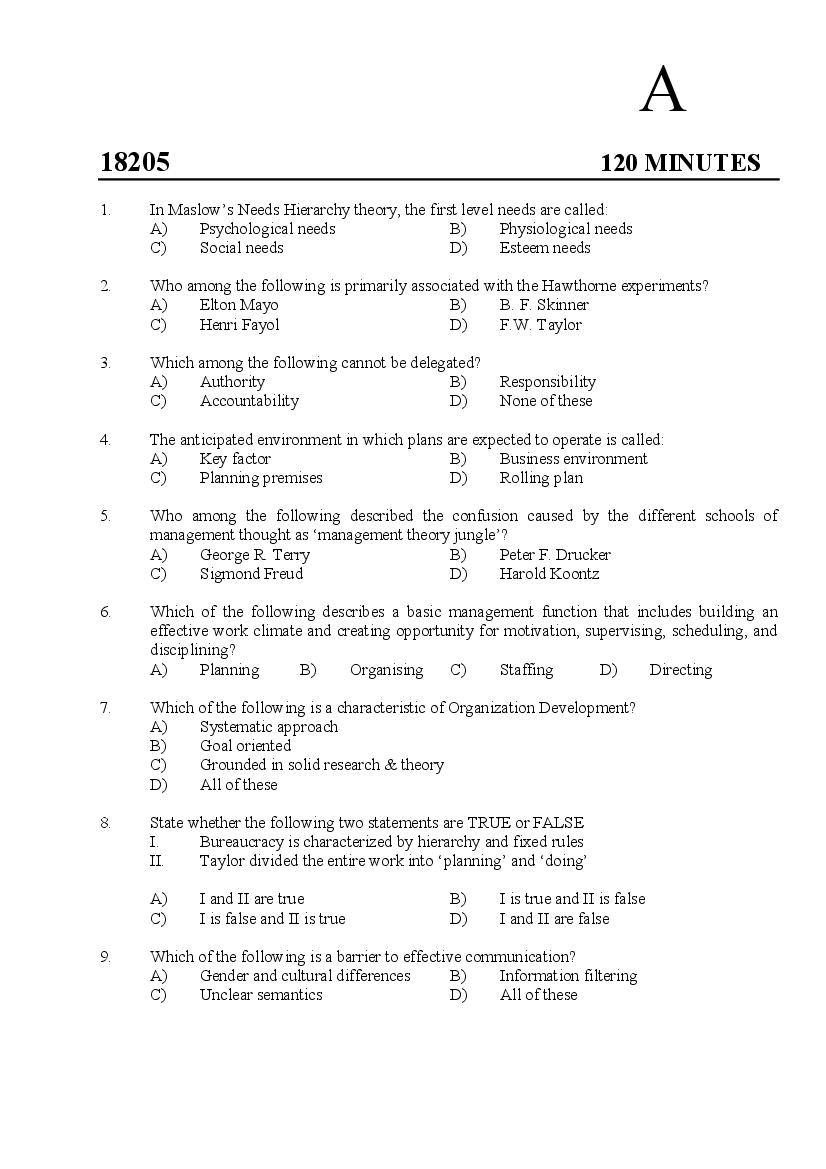
18205 120 MINUTES
1. In Maslow’s Needs Hierarchy theory, the first level needs are called:
A) Psychological needs B) Physiological needs
C) Social needs D) Esteem needs
2. Who among the following is primarily associated with the Hawthorne experiments?
A) Elton Mayo B) B. F. Skinner
C) Henri Fayol D) F.W. Taylor
3. Which among the following cannot be delegated?
A) Authority B) Responsibility
C) Accountability D) None of these
4. The anticipated environment in which plans are expected to operate is called:
A) Key factor B) Business environment
C) Planning premises D) Rolling plan
5. Who among the following described the confusion caused by the different schools of
management thought as ‘management theory jungle’?
A) George R. Terry B) Peter F. Drucker
C) Sigmond Freud D) Harold Koontz
6. Which of the following describes a basic management function that includes building an
effective work climate and creating opportunity for motivation, supervising, scheduling, and
disciplining?
A) Planning B) Organising C) Staffing D) Directing
7. Which of the following is a characteristic of Organization Development?
A) Systematic approach
B) Goal oriented
C) Grounded in solid research & theory
D) All of these
8. State whether the following two statements are TRUE or FALSE
I. Bureaucracy is characterized by hierarchy and fixed rules
II. Taylor divided the entire work into ‘planning’ and ‘doing’
A) I and II are true B) I is true and II is false
C) I is false and II is true D) I and II are false
9. Which of the following is a barrier to effective communication?
A) Gender and cultural differences B) Information filtering
C) Unclear semantics D) All of these
Page 2
instrumentality?
A) Equity theory B) Herzberg’s two factor theory
C) Vroom’s theory D) Alderfer’s ERG theory
11. State whether the following two statements are TRUE or FALSE
I. Leaders focus more on implementation oriented, short to mid-term predictable tasks
and technical detail.
II. Managers are more concerned with enterprise-wide, strategic and value added roles
and competencies.
A) I and II are true B) I is true and II is false
C) I is false and II is true D) I and II are false
12. An attempt to enhance employee motivation by changing work both horizontally and
vertically is called:
A) Job enrichment B) Job enlargement
C) Job extension D) Job rotation
13. Which among the following is NOT one of the forces in Porter’s Five Forces Model?
A) Potential entry of new competitors
B) Bargaining power of suppliers
C) Agreement among competing firms
D) Potential development of substitute products
14. Which of the following is NOT an advantage of the matrix structure?
A) Many channels of communication
B) Duplication of financial resources
C) Facilitates use of specialized personnel
D) Project objectives are clear
15. Specific courses of action which permits very little flexibility and freedom of interpretation
are called:
A) Procedures B) Rules C) Policies D) All of these
16. State whether the following two statements are TRUE or FALSE
I. Structure can and does influence strategy.
II. Structure can shape the choice of strategies.
A) I and II are true B) I is true and II is false
C) I is false and II is true D) I and II are false
17. Restructuring is also known as:
A) Downsizing B) Rightsizing
C) Delayering D) All of these
2
Page 3
I. Differentiation does not guarantee competitive advantage.
II. A primary reason for pursuing forward integration strategy is to gain low cost
leadership benefits.
A) I and II are true B) I is true and II is false
C) I is false and II is true D) I and II are false
19. Which of the following is NOT a feature of the Functional Organisational Structure?
A) Allows for rapid decision making
B) Accountability forced to the top
C) Minimises need for elaborate control system
D) Maximises career development
20. Which of the following is a benefit of having a clear vision and mission?
A) Provide direction
B) Achieve higher organizational performance
C) Achieve clarity of purpose
D) All of these
21. Which of the following is a component of the micro environment of business?
A) Special Interest Groups B) Suppliers
C) Labour Unions D) All of these
22. State whether the following two statements are TRUE or FALSE
I. Removal of Quantitative Restrictions does not mean duty free imports.
II. GATT was replaced by WTO.
A) I and II are true B) I is true and II is false
C) I is false and II is true D) I and II are false
23. A rise in FDI would bring in:
A) Better technology B) Increased productivity
C) More employment D) All of these
24. Economic planning is an essential feature of
A) Capitalist Economy B) Socialist Economy
C) Mixed Economy D) Dual Economy
25. The integration of economies, industries, markets, cultures and policy making around the
world is called:
A) Liberalisation B) Globalisation C) Privatisation D) All of these
26. State whether the following two statements are TRUE or FALSE
I. Quantitative restrictions are imposed by countries primarily to limit imports.
II. WTO covers trade in services and trade related aspects of intellectual property.
A) I and II are true B) I is true and II is false
C) I is false and II is true D) I and II are false
3
Page 4
A) To reduce fiscal deficit
B) To improve public finances
C) To reduce financial burden on the government
D) All of these
28. Which of the following is NOT a feature of mixed economy?
A) Classless society B) Dual objectives
C) Existence of economic planning D) Price mechanism
29. Which of the five year plan was based on the P. C. Mahalanobis model?
A) First five year plan
B) Second five year plan
C) Both first and second five year plans
D) None of these
30. Which of the following is NOT a dimension of Human Development Index?
A) Knowledge B) Standard of living
C) Social status D) Life expectancy
31. The structural reforms carried out in the country as part of macroeconomic reforms focused
on which of the following areas?
A) Financial sector B) Foreign trade and investment
C) Industrial licensing and regulation D) All of these
32. Human Development Index is prepared by which agency?
A) IMF B) World bank C) UNDP D) ADB
33. The total money value of all newly produced final goods and services in an economy in a
given year is called:
A) GDP B) GNI C) GNP D) GCC
34 Which among the following is a reason for promoting balanced regional development?
A) To promote large employment opportunities
B) To maintain political stability
C) To develop and conserve resources
D) All of these
35 Which of the following is NOT a feature of the Indian economy?
A) Chronic unemployment B) Disguised employment
C) Underemployment D) Full employment
36 Which of the following institutions was replaced by NITI Aayog?
A) Planning Board B) Planning Commission
C) Ministry of Planning D) National Sample Survey Organisation
4
Page 5
A) Decision making B) Models
C) DBMS D) Managers
38 State whether the following two statements are TRUE or FALSE
I. Physical data layout is best represented by internal schema.
II. Overall logical data description is best represented by external schema.
A) I and II are true B) I is true and II is false
C) I is false and II is true D) I and II are false
39. Match the following:
a Executive Support System 1 System concept
b Black box 2 Tactical level
c Programmable decisions 3 Planning
d. Cognitive Process 4 Structured
A) a-3, b-2, c-4, d-1 B) a-2, b-1, c-4, d-3
C) a-4, b-3, c-1, d-2 D) a-1, b-4, c-2, d-3
40 Characteristics of interest about data are termed as:
A) Entity B) Tuple C) Attribute D) Record
41. The assumption that the business will continue for a long time to come and it is not likely to
be liquidated in the near future is called:
A) Separate entity concept B) Accounting period concept
C) Money measurement concept D) Going concern concept
42. The phenomenon of a company issuing its shares at a value higher than its face value is
called:
A) Issue of shares at face value B) Issue of shares at a discount
C) Issue of shares at a premium D) None of these
43. IFRS is the acronym for:
A) Indian Financial Reporting Standards
B) Industrial Financial Reporting Society
C) International Financial Reporting Standards
D) Instant Funds Reporting Standards
44. Karthik and Co issued 20,000 debentures of ` 100 each at a discount of 4% redeemable after
5 years at a premium of 6%. Loss on issue of debentures will be
A) ` 1, 20,000 B) ` 3, 20,000 C) ` 2, 00,000 D) ` 80,000
45. State whether the following two statements are TRUE or FALSE
I. A company may purchase its own debentures.
II. Debenture holders are not members of the company.
A) I and II are true B) I is true and II is false
C) I is false and II is true D) I and II are false
5
Page 6
A) Absorption B) External reconstruction
C) Amalgamation D) All of these
47. Break-up value of a share can be determined by which of the following methods?
A) Net assets method B) Yield method
C) Stock exchange quotation D) NPV method
48. State whether the following two statements are TRUE or FALSE
I. A new company need not be formed in case of external reconstruction.
II. A new company has to be formed in the case of absorption.
A) I and II are true B) I is true and II is false
C) I is false and II is true D) I and II are false
49. Share premium money can be used for:
A) Payment of dividend B) Writing off goodwill
C) Issue of fully paid bonus shares D) All of these
50. If a share of ` 10, on which ` 6 has been paid, it can be reissued at the minimum price of:
A) ` 6 per share B) ` 4 per share
C) ` 10 per share D) None of these
51. What is the object of preparing a Trial balance?
A) To know the assets and liabilities of the firm
B) To check the arithmetical accuracy of the accounting entries
C) To find out the working capital deployed
D) None of these
52. Which of the following best describes single entry system?
A) Only debit aspect of each transaction is recorded
B) Only credit aspect of each transaction is recorded
C) Any one aspect of some transactions and both aspects of some transactions
D) One aspect of some transactions, both aspects of some transactions, while some
transactions are left unrecorded
53. ‘Discount on issue of shares’ belongs to which class of assets?
A) Current assets B) Contingent assets
C) Liquid assets D) Fictitious assets
54. State whether the following two statements are TRUE or FALSE
I. Capital expenditure is incurred for acquiring a new fixed asset.
II. Revenue expenditure is incurred for maintaining the existing fixed assets.
A) I and II are true B) I is true and II is false
C) I is false and II is true D) I and II are false
6
Page 7
A) To find out the profits
B) To find out the cash balance
C) To find out the asset position
D) To know the creditors and debtors
56. Cash discount is allowed on
A) Purchases B) Sales C) Prompt payment D) All of these
57. Match the following:
List I List II
a. Financial Statement Analysis 1. Debt collection period
b. ABC Analysis 2. Common Size profit and loss account
c. Fund Flow Analysis 3. Working Capital management
d. Management of Receivables 4. Inventory Control
Codes:
a b c d
A) 2 4 3 1
B) 1 2 3 4
C) 4 3 2 1
D) 2 3 4 1
58. To which account are ‘Preliminary Expenses’ transferred by the vendor company at the time
of absorption?
A) Purchasing Company’s Account B) Realisation Account
C) Equity Shareholders’ Account D) None of these
59. State whether the following two statements are TRUE or FALSE
I. Reconstruction necessarily involves liquidation of the company concerned.
II. The balance in the Share Premium Account can be transferred to Capital Reduction
Account.
A) I and II are true B) I is true and II is false
C) I is false and II is true D) I and II are false
60. Dividends are usually paid on:
A) Authorised capital B) Issued capital
C) Subscribed capital D) Paid up capital
61. A discrete distribution describing the results of a Bernoulli process is called:
A) Normal Distribution B) Binomial Distribution
C) Poisson Distribution D) None of these
7
Page 8
two means?
A) Chi-square & t test
B) Z test & Paired t test
C) ANOVA & Kruskal Wallis test
D) Mann- Whitney U test & Kolmogrov Smrinov test
63. Which among the following describes a range of values within which a population parameter
is likely to lie?
A) Interval estimate B) Probability distribution
C) Sampling error D) None of these
64. News boy problem is related to
A) Queuing problem B) Inventory problem
C) Replacement problem D) Linear Programming Problem
65. Probabilities revised using Bayes theorem is also known as:
A) Inverse probability B) Posterior probability
C) Prior probability D) Both A and B
66. The Poisson approximation to the binomial distribution will hold good in which of the
following cases?
A) n is less than or equal to 30 and p is less than or equal to 0.05
B) n is less than or equal to 30 and p is greater than or equal to 0.05
C) n is greater than or equal to 30 and p is greater than or equal to 0.05
D) n is greater than or equal to 30 and p is less than or equal to 0.05
67. State whether the following two statements are TRUE or FALSE
I. Internal validity of an experiment deals with the question of generalising the results of
the experiment.
II. History is a factor that affects the internal validity of an experiment.
A) I and II are true B) I is true and II is false
C) I is false and II is true D) I and II are false
68. Match the following:
a. Longitudinal design 1. Descriptive design
b. Solomons four group design 2. True experimental design
c. One shot case study 3. Executive summary
d. Research abstract 4. Quasi experimental design
A) a-2, b-1, c-3, d-4 B) a-4, b-2, c-1, d-3
C) a-3, b-2, c-4,d-1 D) a-1, b-3, c-2, d-4
69. The list of all the sources consulted by the researcher for conducting the research study is
called:
A) Footnotes B) Bibliography C) References D) All of these
8
Page 9
I. Hypotheses is essential in every research study
II. If a problem is well defined, the solution becomes evident
A) I and II are true B) I is true and II is false
C) I is false and II is true D) I and II are false
71. Which of the following is used in field experiments to isolate the effect of extraneous factors?
A) Experimental group B) Control group
C) Randomisation D) None of these
72. Which among the following is an attitude measurement scale?
A) Ordinal scale B) Likert scale
C) Ratio scale D) None of these
73. Which among the following criteria is used for decision making under risk?
A) Hurwicz criterion B) EOL criterion
C) Minimax criterion D) Maximax criterion
74. For what purpose is Fulkerson’s rule used?
A) Numbering events in a network
B) Overcoming degeneracy in transportation problem
C) Checking an assignment problem for optimality
D) For taking decisions under uncertainty
75. State whether the following two statements are TRUE or FALSE
I. Assignment problem is solved in iterations.
II. Transportation technique can also be used for solving maximization problems.
A) I and II are true B) I is true and II is false
C) I is false and II is true D) I and II are false
76. Match the following:
a. Network analysis 1. Vogel’s Approximation Method
b. Decision problem 2. Feasible region
c. Transportation problem 3. Floats
d. Linear Programming Problem 4. Expected Monetary Value
A) a-2, b-1, c-3, d-4 B) a-4, b-2, c-1, d-3
C) a-3, b-2, c-4, d-1 D) a-3, b-4, c-1, d-2
77. ------ approach involves delivering parts and materials as needed rather than being stockpiled
A) JIT B) MBO C) PERT D) CAD-CAM
78. In which type of constraint in an LPP is a surplus variable introduced?
A) Greater than or equal to type B) Less than or equal to type
C) Equal to type D) None of these
9
Page 10
A) The number of rows and columns in the table are different
B) The row totals and column totals are different
C) The aggregate of the row totals is different from the aggregate of the column totals
D) All of these
80. State whether the following two statements are TRUE or FALSE
I. Critical path is a chain of critical activities that connect the start node of the project to the
terminal node.
II. Earliest Start Time is the time required to complete an activity if everything goes well.
A) I and II are true B) I is true and II is false
C) I is false and II is true D) I and II are false
81. A firm has EBIT of ` 50,000. Market value of debt is ` 80,000 and overall capitalization rate
is 20%. Market value of firm under NOI Approach is:
A) ` 2, 50,000 B) ` 1, 70,000
C) ` 30, 000 D) ` 1, 30,000.
82. The difference between total current assets and total current liabilities is called:
A) Gross working capital B) Net working capital
C) Working capital ratio D) None of these
83. The process of using debt capital to augment the returns of the equity shareholders is called:
A) Trading on equity B) Operating leverage
C) Financial leverage D) Both A & C
84. Finance function includes:
A) Profit allocation decision B) Capital-mix decision
C) Short-term asset-mix decision D) All of these
85. State whether the following two statements are TRUE or FALSE
I. Optimum capital budget means the availability of funds to invest in all profitable
projects so that NPV is maximized.
II. The optimum capital budget can be determined by relating the expected returns of the
investment projects to the firm’s weighted marginal cost of capital schedule.
A) I and II are true B) I is true and II is false
C) I is false and II is true D) I and II are false
86. Under which approach the cost of debt and cost of equity are assumed to be independent to
the capital structure?
A) Traditional approach B) Net income approach
C) Net operating income approach D) None of these
87. Which among the following is NOT an assumption of the Gordon model?
A) Perpetual earnings B) Constant return
C) Constant retention D) External financing
10
Page 11
I. The cost of preference capital is a function of the dividend expected by investors.
II. The cost of equity capital is the rate of return on dividends foregone by equity
shareholders.
A) I and II are true B) I is true and II is false
C) I is false and II is true D) I and II are false
89. Investors who attach lower utility to increasing wealth are called:
A) Risk-seeking investors B) Risk-neutral investors
C) Risk-averse investors D) All of these
90. State whether the following two statements are TRUE or FALSE
I. If the firm uses more of short-term funds for financing both current and fixed assets,
its financing policy is considered aggressive and risky.
II. A balanced approach is to finance both permanent and temporary current assets by
short-term sources of finance.
A) I and II are true B) I is true and II is false
C) I is false and II is true D) I and II are false
91. State whether the following two statements are TRUE or FALSE
I. Conservatism as a feature of sound capital structure means employing no debt or small
amount of debt.
II. A firm is considered prudently financed if it is able to service its fixed charges under
any reasonably predictable adverse conditions.
A) I and II are true B) I is true and II is false
C) I is false and II is true D) I and II are false
92. Which among the following is a common approach to decide about a firm’s capital structure?
A) Valuation approach B) Cash flow approach
C) EBIT-EPS approach D) All of these
93. Which of the following is a non-conventional technique of handling risk in capital budgeting?
A) Payback B) Certainty equivalent
C) Risk-adjusted discount rate D) All of these
94. State whether the following two statements are TRUE or FALSE
I. The important aspect of dividend policy is to determine the amount of earnings to be
distributed to shareholders and the amount to be retained in the firm.
II. A high payout policy means more retained earnings and less current dividend.
A) I and II are true B) I is true and II is false
C) I is false and II is true D) I and II are false
11
Page 12
A) Maximising dividends to the shareholders
B) Maximising profits of the company
C) Maximising retained earnings of the company
D) Maximising the net present value of a course of action to shareholders
96. State whether the following two statements are TRUE or FALSE
I. Degree of operating leverage is defined as the percentage change in EPS due to a
given percentage change in EBIT.
II. Degree of financial leverage is defined as the percentage change in EBIT relative to a
given percentage change in sales.
A) I and II are true B) I is true and II is false
C) I is false and II is true D) I and II are false
97. A marketing plan is composed of three basic components namely
1. Objective 2. Procedure 3. Policies 4. Decision 5. Programme 6. Command
A) 1, 2 & 3 B) 1, 3 & 5 C) 1, 5 & 6 D) 1, 3 & 4
98. How many elements are there in the services marketing mix?
A) Four B) Five C) Six D) Seven
99. If the product’s performance exceeds the expectations of the customer, it is a case of:
A) Customer satisfaction B) Customer delight
C) Customer expectation D) None of these
100. Which among the following is the first step in the marketing process?
A) Designing the product B) Segmenting the market
C) Test marketing D) Identifying needs of customers
101. State whether the following two statements are TRUE or FALSE.
I. If a stores ledger is being maintained, there is no need to maintain bin card.
II. Periodical stock taking is an integral part of perpetual inventory system.
A) I and II are true B) I is true and II is false
C) I is false and II is true D) I and II are false
102. Which among the following is a method of measuring labour turnover?
A) Flex Rate Method B) Separation Rate Method
C) Replacement Rate Method D) All of these
103. Under which of the following incentives scheme is bonus equal to 30% of the time saved?
A) Halsey plan B) Halsey-Weir Premium System
C) Rowan plan D) Emerson’s Efficiency System
12
Page 13
I. Indirect expenses and overheads mean the same thing.
II. Interest is like other expenses and treated as part of costs.
A) I and II are true B) I is true and II is false
C) I is false and II is true D) I and II are false
105. Which of the following is NOT a method of apportionment of service department overheads
on reciprocal basis?
A) Depletion method B) Simultaneous Equation method
C) Trial and Error method D) Repeated Distribution method
106. Which of the following is NOT a characteristic of process costing?
A) The production is intermittent
B) The units produced are identical and standardized
C) The sequence of operation is specific
D) The product is homogenous
107. Which of the following is a method of apportioning joint costs to products?
A) Market Price method B) Points Value method
C) Physical Units method D) All of these
108. In which of the following industries is unit costing adopted?
A) Sugar mills B) Breweries
C) Collieries D) All of these
109. Which of the following is a discounted cash flow method of appraising investment proposals?
A) Accounting Rate of Return B) Internal Rate of Return
C) Machine Hour Rate D) Payback Period
110. The universal preference of man to receive money earlier rather than later and to pay money
later rather than earlier is called:
A) Liquidity preference of money B) Transaction motive of money
C) Exchange value of money D) Time value of money
111. State whether the following two statements are TRUE or FALSE
I. IRR and NPV methods always give the same result.
II. ARR is a discounted cash flow technique.
A) I and II are true B) I is true and II is false
C) I is false and II is true D) I and II are false
112. Assuming the current ratio to be 2:1, in which of the following cases, the ratio will improve
A) Payment to Creditors B) Purchase of plant for cash
C) Issue of new shares for cash D) Realisation from Debtors
13
Page 14
EBIT ` 1,60,000; Net profit after taxes ` 64,000; Sales ` 7,20,000; Total assets ` 8,00,000;
Owners equity ` 40,000; and Tax rate 50 %
113. What would be the return on assets of this company?
A) 10 % B) 12 % C) 14 % D) 20 %
114. What would be the assets turnover ratio of this company?
A) 0.5 times B) 0.9 times C) 1.3 times D) 1.9 times
115. What would be the returns on owners’ equity?
A) 13 % B) 15 % C) 16 % D) 19 %
116. Which of the following is NOT a source of working capital in a funds flow statement?
A) Payment of cash dividend B) Sale of non-current assets
C) Bank borrowings D) Issuance of equity shares
117. State whether the following two statements are TRUE or FALSE
I. A cash flow statement is similar to the funds flow statement except that it focuses
attention on cash instead of working capital
II. Increase in current liabilities decreases cash flow from operation while decrease in
current liabilities increases it
A) I and II are true B) I is true and II is false
C) I is false and II is true D) I and II are false
118. How is payout ratio calculated?
A) PAT/Net worth B) PAT/No. of shares
C) Market value of shares/EPS D) Dividend per share/EPS
119. If fixed cost are ` 40,000; Variable costs ` 2/unit; and Selling Price ` 10; what will be the
break-even point?
A) ` 50,000 B) ` 60,000
C) ` 75,000 D) ` 80,000
120. Which of the statement is not correct?
A) P/V ratio can be improved by reducing fixed cost
B) Contribution is also known as gross margin
C) P/V ratio can be improved by increasing the selling price
D) Margin of safety can be improved by reducing fixed cost
***************
14
Document Details
| Board / Org | Kerala Exams |
| Exam | Kerala SET |
| Type | Question Paper |
| Pages | 14 |
| Updated | 23 Oct 2026 |