HBSE Class 12 Sample Paper 2026 Answers Maths
Finished viewing? Save it for later —
Download HBSE Class 12 Sample Paper 2026 Answers Maths (PDF · 13 pages)About HBSE Class 12 Sample Paper 2026 Answers Maths
HBSE Class 12 Sample Paper 2026 Answers Maths is available here for free download. Published by Haryana Board for Class 12, this answer key can be viewed online or downloaded as a PDF (13 pages). Candidates preparing for Class 12 can use HBSE Class 12 Sample Paper 2026 Answers Maths to understand the exam pattern, the type of questions asked, and the overall difficulty level.
Frequently Asked Questions
How can I download HBSE Class 12 Sample Paper 2026 Answers Maths?
Open this page and click the Download button to save HBSE Class 12 Sample Paper 2026 Answers Maths as a PDF. It is completely free on AglaSem Docs.
Is HBSE Class 12 Sample Paper 2026 Answers Maths free to download?
Yes. HBSE Class 12 Sample Paper 2026 Answers Maths can be viewed online and downloaded as a PDF free of cost on AglaSem Docs.
How many pages does HBSE Class 12 Sample Paper 2026 Answers Maths have?
HBSE Class 12 Sample Paper 2026 Answers Maths contains 13 pages, which you can read online or download together as a single PDF.
Where can I find more Class 12 study material?
You can find more Class 12 question papers, sample papers, syllabus, and answer keys on AglaSem Docs.
HBSE Class 12 Sample Paper 2026 Answers Maths – Text
Read the full text of this answer key below — useful to quickly search, copy and reference the content online without downloading the PDF.
📄 View text version (13 pages)
Page 1
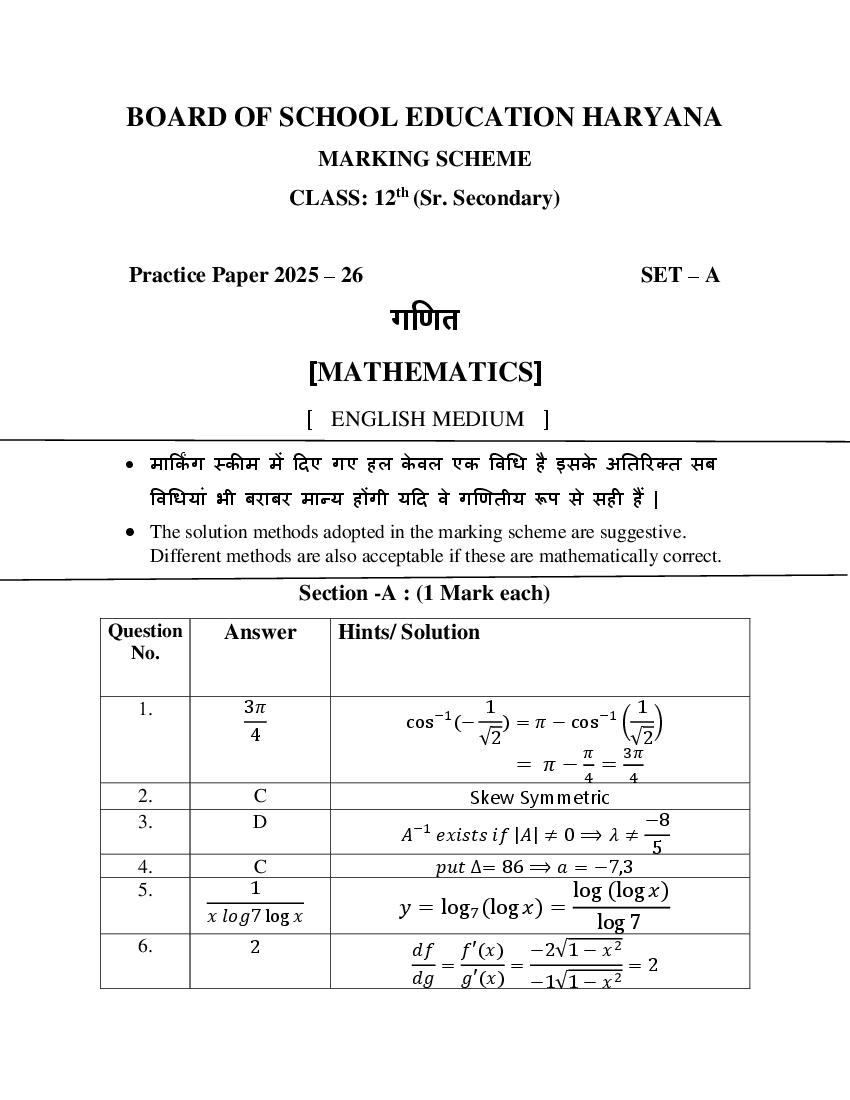
MARKING SCHEME
CLASS: 12th (Sr. Secondary)
Practice Paper 2025 – 26 SET – A
गणित
[MATHEMATICS]
[ ENGLISH MEDIUM ]
• मार्किंग स्कीम में दिए गए हल केवल एक ववधि है इसके अतिरिक्ि सब
ववधियाां भी बिाबि मान्य होंगी यदि वे गणििीय रूप से सही हैं |
• The solution methods adopted in the marking scheme are suggestive.
Different methods are also acceptable if these are mathematically correct.
Section -A : (1 Mark each)
Question Answer Hints/ Solution
No.
1. 3𝜋 1 1
cos −1 (− ) = 𝜋 − cos −1 ( )
4 √2 √2
𝜋 3𝜋
= 𝜋− =
4 4
2. C Skew Symmetric
3. D −8
𝐴−1 𝑒𝑥𝑖𝑠𝑡𝑠 𝑖𝑓 |𝐴| ≠ 0 ⟹ 𝜆 ≠
5
4. C 𝑝𝑢𝑡 ∆= 86 ⟹ 𝑎 = −7,3
5. 1 log (log 𝑥)
𝑥 𝑙𝑜𝑔7 log 𝑥 𝑦 = log 7 (log 𝑥) =
log 7
6. 2 𝑑𝑓 𝑓′(𝑥) −2√1 − 𝑥 2
= = =2
𝑑𝑔 𝑔′(𝑥) −1√1 − 𝑥 2
Page 2
𝑚𝑎𝑦 𝑏𝑒 𝑑𝑖𝑠𝑐𝑜𝑛𝑡𝑖𝑛𝑢𝑜𝑢𝑠 𝑎𝑡 𝑥
𝑓(𝑥)
= 0 ; 𝑎𝑙𝑙 𝑜𝑡ℎ𝑒𝑟 𝑎𝑟𝑒 𝑑𝑒𝑓𝑖𝑛𝑖𝑡𝑒𝑙𝑦 𝑐𝑜𝑛𝑡𝑖𝑛𝑢𝑜𝑢𝑠.
8. 10√3 𝑐𝑚2 /𝑠 𝑑𝐴 √3 𝑑𝑥 √3
= . 2𝑥. = . 10.2 = 10√3 𝑐𝑚2 /𝑠
𝑑𝑡 4 𝑑𝑡 2
9. B 1.𝑑𝑥 𝑠𝑖𝑛2 𝑥+𝑐𝑜𝑠 2 𝑥
∫ 𝑠𝑖𝑛2 𝑥.𝑐𝑜𝑠2 𝑥 = ∫ 𝑠𝑖𝑛2 𝑥.𝑐𝑜𝑠2𝑥 𝑑𝑥
∫(𝑠𝑒𝑐 2 𝑥 + 𝑐𝑜𝑠𝑒𝑐 2 𝑥)𝑑𝑥 = tan 𝑥 − 𝑐𝑜𝑡 𝑥 + 𝑐
10. D
𝑑𝑦 𝑥
= ⟹ ∫ 𝑦 𝑑𝑦 = ∫ 𝑥 𝑑𝑥
𝑑𝑥 𝑦
𝑦2 − 𝑥 2 = 𝑐
11. B Put sin 𝑥 = 𝑡 ⟹ cos 𝑥 𝑑𝑥 = 𝑑𝑡
12. 1 𝑑2𝑦
Since the highest power raised to is one.
𝑑𝑥 2
13. B ±(𝑎⃗ × 𝑏⃗⃗) 𝑎𝑟𝑒 𝑡ℎ𝑒 𝑠𝑒𝑡 𝑜𝑓 𝑡𝑤𝑜 𝑣𝑒𝑐𝑡𝑜𝑟𝑠 ⊥ 𝑏𝑜𝑡ℎ 𝑎⃗, 𝑏⃗⃗
14. D For reflection in XY-plane negate the z-coordinate.
15. A 𝑟⃗⃗⃗ = 𝑎⃗ + 𝜆𝑏⃗⃗ ; where
𝑎⃗ 𝑑𝑒𝑛𝑜𝑡𝑒𝑠 𝑡ℎ𝑒 𝑝𝑎𝑠𝑠𝑖𝑛𝑔 𝑝𝑜𝑖𝑛𝑡 𝑎𝑛𝑑 𝑏⃗⃗ denotes the
direction vector of the line.
16. B 𝑃(𝑡𝑤𝑜 ℎ𝑖𝑡𝑠) = 𝑃(𝐴)𝑃(𝐵)𝑃(𝐶′) +
𝑃(𝐴)𝑃(𝐵′)𝑃(𝐶) + 𝑃(𝐴′)𝑃(𝐵)𝑃(𝐶)
17. B 𝑑𝑦 3𝑡 𝑑 2 𝑦 3 𝑑𝑡 3
= ⟹ 2= . =
𝑑𝑥 2 𝑑𝑥 2 𝑑𝑥 4𝑡
18. 1 𝑓𝑜𝑟 𝑝𝑜𝑖𝑛𝑡 𝑜𝑓 𝑙𝑜𝑐𝑎𝑙 𝑚𝑖𝑛𝑖𝑚𝑎 𝑝𝑢𝑡 𝑓 ′ (𝑥) = 0
⟹ 𝑥 = 4 𝑎𝑛𝑑 𝑓 ′′ (𝑥) = +𝑣𝑒
Then f(4)=1=minimum value
19. D A is false as for mutually exclusive events
𝑃(𝐴⋂𝐵) = 0 𝑎𝑙𝑤𝑎𝑦𝑠 ; but R is true here.
20. A Both A and R are true and correct
explanation.
Page 3
SECTION – B (2×5=10)
21. Consider the corresponding eqn. system:
𝑥+𝑦 =8 3𝑥 + 5𝑦 = 15
x 0 8
y 8 0 x 5 0 1
y 0 3
1
No feasible region.
22(a). On multiplying first two ½
𝑥
[2𝑥 − 9 4𝑥 ] [ ] = [0]
8
2𝑥 2 + 23𝑥 = 0 ½
23
𝑥 = 0, −
2 1
OR
22(b). 1 0 1
1
Area of triangle= |6 0 1| 1
2
4 3 1
15
= 𝑠𝑞𝑢𝑎𝑟𝑒 𝑢𝑛𝑖𝑡𝑠 1
2
23(a).
𝑓 𝑤𝑖𝑙𝑙 𝑏𝑒 𝑐𝑜𝑛𝑡𝑖𝑛𝑢𝑜𝑢𝑠 𝑎𝑡 𝑥 = 3 𝑖𝑓
Page 4
2𝑠𝑖𝑛2 2𝑥
lim =𝑘
𝑥⟶0 8𝑥 2
sin 2𝑥 2
lim ( ) =𝑘
OR 𝑥⟶0 2𝑥 1
⟹𝑘=1
23(b). 𝑑𝑉 𝑑𝑥
𝑉 = 𝑥3 ⟹ = 3𝑥 2 = 9𝑥 2 1
𝑑𝑡 𝑑𝑡
𝑑𝑉
Put 𝑥 = 10 𝑐𝑚 ⟹ = 900 𝑐𝑚 /𝑠 3 1
𝑑𝑡
24. P (Exactly one of A, B is selected) = 0.6 (given)
P (A∩B′) + P (A′∩B) = 0.6 1
P (A) P (B′) + P (A′) P (B) = 0.6
⇒ (0.7) (1 – p) + (0.3) p = 0.6
⇒ p = 0.25 1
Thus the probability that B gets selected is 0.25
25. ∫ 𝑡𝑎𝑛2 𝑥. 𝑡𝑎𝑛2 𝑥. 𝑑𝑥 = ∫(𝑠𝑒𝑐 2 𝑥 − 1). 𝑡𝑎𝑛2 𝑥
1
2 2 2
= ∫ 𝑠𝑒𝑐 𝑥. 𝑡𝑎𝑛 𝑥. 𝑑𝑥 − ∫ 𝑠𝑒𝑐 𝑑𝑥 + ∫ 1𝑑𝑥
1 1
== 𝑡𝑎𝑛3 𝑥 − tan 𝑥 + 𝑥 + 𝑐
3
खंड – स
SECTION – C (3×6=18)
Page 5
1.5
𝟐𝟎 𝟒𝟓
O (0, 0), A (2, 0), B (0, 3) and C ( , ) are 0.5
𝟏𝟗 𝟏𝟗
the corner points of the feasible region.
Corner Point Value of Z Remarks
O(0,0) 0
A(2,0) 10
1
B(0,3) 9
C(20/19,45/19) 235/19 MAXIMUM
27(a). R is reflexive since (L1,L1) ∈ 𝑅
R is symmetric since if (L1,L2) ∈ 𝑅, then
1
(L2,L1) ∈ 𝑅
R is transitive since if (L1,L2) ∈ 𝑅, and 1
(L2,L3) ∈ 𝑅 then (L1,L3) ∈ 𝑅
⟹ R is transitive.
Set of all lines related to 𝑦 = 2𝑥 + 4 is given by 1
𝑦 = 2𝑥 + 𝑐
OR
27(b). Put 𝑥 = 𝑡𝑎𝑛𝜃 ⟹ 𝜃 = 𝑡𝑎𝑛−1 𝑥
√1+𝑥 2 −1 𝑠𝑒𝑐𝜃−1 1.5
Then 𝑡𝑎𝑛−1 = tan−1 ( )=
𝑥 tan 𝜃
−1 1−𝑐𝑜𝑠𝜃 𝜃 𝜃 1
= tan ( ) = tan−1 (tan ) = = tan−1 𝑥 1.5
𝑠𝑖𝑛𝜃 2 2 2
Page 6
the sale of all these books can be represented in the
form of matrix multiplication as: 1
(Total Amount )= 12[10 8 10][ 80 60 40 ] 1
=12[10×80+8×60+10×40]
=12[800+480+400] 1
=12[1680]=20160 𝑅𝑠.
29(a). 𝑦 = (tan−1 𝑥)2
𝑑 1½
⟹ 𝑦1 = 2 tan−1 𝑥 (tan−1 𝑥)
𝑑𝑥
1
𝑦1 = 2 tan−1 𝑥 .
1 + 𝑥2
(1 + 𝑥 2 ). 𝑦1 =2 tan−1 𝑥 1½
Diff . again we get the result.
OR 1−𝑥2
𝑦=log( ) = log (1-𝑥) + log(1 + 𝑥) − log (1 + 𝑥 2 ) 1
29(b). 1+x2
𝑑𝑦 −1 1 2𝑥
= + − 1
𝑑𝑥 1 − 𝑥 1 + 𝑥 1 + 𝑥 2
−4𝑥
=
1−𝑥 4 1
30. ∫ 𝑥 log 𝑥 𝑑𝑥 =
Integrating by parts: 1.5
2 2
𝑥 1 𝑥
⟹ log 𝑥 . − ∫ . 𝑑𝑥
2 𝑥 2
𝑥 log 𝑥 𝑥 2
2 1.5
⟹ − +𝑐
2 4
𝜋 1 𝜋
31. Here 𝑚 = 𝑐𝑜𝑠 = , 𝑛 = 𝑐𝑜𝑠 =0
4 √2 2
1
𝑙 2 + 𝑚2 + 𝑛2 = 1
1
𝑙=± 1
√2
𝑟⃗ = 𝑙𝑖̂ + 𝑚𝑗̂ + 𝑛𝑘̂
𝑟⃗ = ±3𝑖̂ + 3𝑗̂ 1
Page 7
SECTION – D (5×4=20)
𝜋 𝜋
32(a). 2 2 𝜋
∫ log sin 𝑥 𝑑𝑥 = ∫ log sin ( − 𝑥) 𝑑𝑥
0 0 2
𝜋
= ∫0 log cos 𝑥 𝑑𝑥
2 1
𝜋 𝜋
sin 2𝑥
2I=∫02 (log sin 𝑥 + log cos 𝑥 )𝑑𝑥 = ∫02 𝑙𝑜𝑔 ( ) 𝑑𝑥 1
2
𝜋
𝜋
2I= ∫02 sin 2𝑥 𝑑𝑥 - log 2
2
Put 2𝑥 = 𝑡 ⟹ 2𝑑𝑥 = 𝑑𝑡, 𝑤ℎ𝑒𝑛 𝑥 = 0, 𝑡 = 1
𝜋
0 ; 𝑤ℎ𝑒𝑛 𝑥 = , 𝑡 = 𝜋
2
1𝜋 𝜋
2I= ∫0 log sin 𝑡 𝑑𝑡 − log 2
2 2
𝜋
2 2 𝜋
= ∫0 log sin 𝑡 𝑑𝑡 − log 2 1
2 2
𝜋
2I=I- log 2
2 1
−𝜋
OR I= log 2
2
32(b). Given D.E. is of the form:
𝑑𝑦
+ 𝑃𝑦 = 𝑄 𝑤ℎ𝑒𝑟𝑒 𝑃 = −1, 𝑄 = cos 𝑥
𝑑𝑥
I.F. =𝑒 ∫ −1.𝑑𝑥 = 𝑒 −𝑥 1
Solution is :
𝑦𝑒 −𝑥 = ∫ 𝑒 −𝑥 cos 𝑥 𝑑𝑥 + 𝐶 1
Let I=∫ 𝑒 −𝑥 cos 𝑥 𝑑𝑥
= − cos 𝑥 𝑒 −𝑥 − ∫ 𝑠𝑖𝑛𝑥 𝑒 −𝑥 𝑑𝑥 1
I =− cos 𝑥 𝑒 −𝑥 + 𝑠𝑖𝑛𝑥 𝑒 −𝑥 − ∫ 𝑒 −𝑥 cos 𝑥 𝑑𝑥
𝑒 −𝑥 (sin 𝑥−cos 𝑥)
I= 1
2
Using this we get:
sin 𝑥 − cos 𝑥 1
𝑦=( ) + 𝐶𝑒 𝑥
2
Page 8
( According to question):
𝑥 + 𝑦 + 𝑧 = 7000
𝑥−𝑦 =0
5 8 17 1
𝑥+ 𝑦+ 𝑧 = 550
100 100 200
⟹ 10𝑥 + 16𝑦 + 17𝑧 = 110000
This system of equations can be written as:
𝐴𝑋 = 𝐵, 𝑤ℎ𝑒𝑟𝑒 जह ाँ
1 1 1 𝑥 7000
𝑦
𝐴 = [ 1 −1 0 ] , 𝑋 = [ ] , 𝐵 = [ 0 ]
10 16 17 𝑧 110000 1
⟹ |𝐴| = −8 ≠ 0
(Now):
𝐴11 = −17, 𝐴12 = −17, 𝐴13 = 26
𝐴21 = −1, 𝐴22 = 7, 𝐴23 = −6
1
𝐴31 = 1, 𝐴32 = 1, 𝐴33 = −2
−17 −1 1
𝑎𝑑𝑗 𝐴 = [−17 7 1]
26 −6 −2
(Thus):
−1
1 1 −17 −1 1
𝐴 = . 𝑎𝑑𝑗 𝐴 = [−17 7 1] 1
|𝐴| −8
26 −6 −2
(Since):
1 −17 −1 1
−1
7000
𝑋=𝐴 𝐵= [−17 7 1 ][ 0 ]
−8
26 −6 −2 110000
𝑥 1125
𝑋 = [𝑦] = [4750] 1
𝑧 4750
अथवा (OR)
1 1 1
OR Let = 𝑝, = 𝑞, = 𝑟
𝑥 𝑦 𝑧
33(b). The given system of equations can be written as:
𝐴𝑋 = 𝐵, 𝑤ℎ𝑒𝑟𝑒
Page 9
𝐴 = [4 −6 5 ] , 𝑋 = [ 𝑞 ] , 𝐵 = [ 1] 1
6 9 −20 𝑟 2
|𝐴| = 1200 ≠ 0
⟹ 𝐴−1 𝑒𝑥𝑖𝑠𝑡𝑠
Co-factors of A are :
𝐴11 = 75 , 𝐴12 = 110 , 𝐴13 = 72
𝐴21 = 150 , 𝐴22 = −100 , 𝐴23 = 0 1
𝐴31 = 75 , 𝐴32 = 30 , 𝐴33 = −24
75 150 75
⟹ 𝑎𝑑𝑗𝐴 = [110 −100 30 ]
72 0 −24 1
𝑎𝑑𝑗 𝐴 1 75 150 75
⟹ 𝐴−1 = = [110 −100 30 ]
|𝐴| 1200
72 0 −24
1 75 150 75 4
−1
⟹𝑋=𝐴 𝐵= [110 −100 30 ] [1]
1200 1
72 0 −24 2
1
2
1 600 1
⟹𝑋= [400] = ⁄3
1200
240 1
[ 5 ]
1 1 1
⟹ 𝑝 = , 𝑞 = , 𝑟 = ⟹ 𝑥 = 2, 𝑦 = 3, 𝑧 = 5
2 3 5 1
34(a) Comparing with 𝑟⃗ = 𝑎⃗ + 𝜆𝑏⃗⃗ we get 𝑎⃗1 , 𝑎⃗2 , 𝑏⃗⃗1 , ⃗⃗⃗⃗⃗
𝑏2 1
Now 𝑎⃗2 − 𝑎⃗1 = −10𝑖̂ − 2𝑗̂ − 3𝑘̂ 1
And
𝑖̂ 𝑗̂ 𝑘̂
𝑏⃗⃗1 × ⃗⃗⃗⃗⃗ 1
𝑏2 = |1 −2 2 | = 8𝑖̂ + 8𝑗̂ + 4𝑘̂
3 −2 −2
Page 10
(𝑏 ⃗⃗⃗⃗⃗
2 ).(𝑎 ⃗⃗2 −𝑎⃗⃗1 ) 1
Shortest Distance = | ⃗⃗1 ×𝑏 ⃗⃗⃗⃗⃗
|
|𝑏 2|
−108
= | | = 9 𝑢𝑛𝑖𝑡𝑠 1
12
OR
Rewrite the eqn of given line
34(b).
𝑥 𝑦−1 𝑧−2
= = = 𝑘 (𝑠𝑎𝑦)
1 2 3
Then arbitrary D(x,y,z) point on the line is
𝑥 = 𝑘 , 𝑦 = 2𝑘 + 1 , 𝑧 = 3𝑘 + 2
Let this point D is the foot of perpendicular on the line.
1
Now position vector from given point P (1,6,3) to Point
D is given by:
⃗⃗⃗⃗⃗⃗ = (𝑘 − 1 )𝑖̂ + (2𝑘 − 5)𝑗̂ + (3𝑘 − 1) 𝑘̂
𝑃𝐷
Now
Direction vector of line 𝑏⃗⃗ = 1𝑖̂ + 2𝑗̂ + 3𝑘̂
Here 𝑏⃗⃗ ⊥ 𝑃𝐷
⃗⃗⃗⃗⃗⃗ ⟹ 𝑏⃗⃗. 𝑃𝐷
⃗⃗⃗⃗⃗⃗ = 0
⟹ 𝑘 − 1 + 4𝑘 − 10 + 9𝑘 − 3 = 0
⟹ 14𝑘 − 14 = 0 1
⟹𝑘=1
So foot of perpendicular is:
D = (1 , 3, 5 )
Let 𝐸(𝑎 , 𝑏 , 𝑐 ) be the image of P(1,6,3) then D(1,3,5)
will be mid point of PE. 1
So by mid point formula :
𝑎+1 𝑏+6 𝑐+3
=1, =3, =5
2 2 2
⟹ 𝑎 = 1, 𝑏 = 0, 𝑐 = 7
So image of P = E (1,0,7) 1
Page 11
√(1 − 1)2 + (6 − 0)2 + (3 − 7)2 = √0 + 36 + 16 1
= √52 𝑢𝑛𝑖𝑡𝑠
35(a). Let S denotes the success(getting 6) and F
denotes the failure(not getting 6).
Thus P(S) = , P(F) =
1 5
1
6 6
P( A wins the first throw)= P(S) =
1
6
A gets the third throw ,when the first throw
1
by A and second throw by B results in
failures.
So, P(A wins in the third throw)=P(FFS) 1
5 2
=
5 5 1 1
× × = ( ) ×
6 6 6 6 6
Similarly
5 4
P( A wins in the fifth throw)= ( ) ×
1
6 6 1
Hence
5 2 5 4
P(A wins ) = + ( ) × + ( ) × + ⋯ … ..
1 1 1
6 6 6 6 6
1
1
= 6 6 6 5
25 = , 𝑃(𝐵) = 1 − =
1− 11 11 11
36
OR
35(b). Let E= the chosen coin is two headed
F= the chosen coin is biased
G = the chosen coin is unbiased
Then E,F,G are mutually exclusive and
exhaustive events. 1
P(E)=P(F)=P(G)=
1
3
Let A = the tossed coin shows head
Page 12
Using Bayes’ Theorem :
𝐴
𝑃(𝐸).𝑃( )
P(E/A) = 𝐸 4
𝐴 𝐴 𝐴 = 2
𝑃(𝐸).𝑃( )+𝑃(𝐹).𝑃( )+𝑃(𝐺).𝑃( ) 9
𝐸 𝐹 𝐺
खंड – ल
SECTION – E (4×3=12)
36. Here:
(a). Semi circular 1
(b). (−2,0) 𝑎𝑛𝑑 (2,0) 1
2 𝑥
(c). Area = ∫−2 √4 − 𝑥 2 𝑑𝑥 = [ √4 − 𝑥 2 +
2 2
4 𝑥 2
. sin−1 ]
2 2 −2
= 2𝜋 sq. units
37.
If AR= 𝑥 𝑚 ⟹ 𝐵𝑅 = (20 − 𝑥) 𝑚
(a) 1
(b) 𝑆(𝑥) = 𝑅𝑃2 +𝑅𝑄2 = 2𝑥 2 − 40𝑥 + 1140
Here co-eff. Of 𝑥 = −40 1
(c) Using second derivative test :
𝑜𝑛 𝑝𝑢𝑡𝑡𝑖𝑛𝑔 𝑆 ′ (𝑥) = 0 ⟹ 4𝑥 − 40 = 0 1
⟹ 𝑥 = 10
𝑆 ′′ (𝑥) = 4 = +𝑣𝑒 ⟹ 𝑥 = 10 𝑖𝑠 𝑎 𝑝𝑜𝑖𝑛𝑡 𝑜𝑓 𝑚𝑖𝑛𝑖𝑚𝑎.
𝐴𝑅 = 10 𝑚, 𝐵𝑅 = 10 𝑚 1
38. n(S)= 4 , n(J)= 3
(a) n(S).n(J) = 212 1
𝑁𝑜. 𝑜𝑓 𝑅𝑒𝑙𝑎𝑡𝑖𝑜𝑛𝑠 = 2
Page 13
(c) 𝑚!
Number of one one functions from S to J = (𝑚−𝑛)! ,
Where m= n(S)=4, n = n(J)=3
So
4!
Number of one one functions from S to J= (4−3)! = 24 2
Document Details
| Board / Org | Haryana Board |
| Exam | Class 12 |
| Type | Sample Paper |
| Pages | 13 |
| Updated | 24 Sep 2026 |