MAHA SET 2019 Question Paper 2 Geography
Finished viewing? Save it for later —
Download MAHA SET 2019 Question Paper 2 Geography (PDF · 48 pages)About MAHA SET 2019 Question Paper 2 Geography
MAHA SET 2019 Question Paper 2 Geography is available here for free download. Published by Maharashtra Exams for Maharashtra State Eligibility Test, this question paper can be viewed online or downloaded as a PDF (48 pages). Candidates preparing for Maharashtra State Eligibility Test can use MAHA SET 2019 Question Paper 2 Geography to understand the exam pattern, the type of questions asked, and the overall difficulty level.
Frequently Asked Questions
How can I download MAHA SET 2019 Question Paper 2 Geography?
Open this page and click the Download button to save MAHA SET 2019 Question Paper 2 Geography as a PDF. It is completely free on AglaSem Docs.
Is MAHA SET 2019 Question Paper 2 Geography free to download?
Yes. MAHA SET 2019 Question Paper 2 Geography can be viewed online and downloaded as a PDF free of cost on AglaSem Docs.
How many pages does MAHA SET 2019 Question Paper 2 Geography have?
MAHA SET 2019 Question Paper 2 Geography contains 48 pages, which you can read online or download together as a single PDF.
Where can I find more Maharashtra State Eligibility Test study material?
You can find more Maharashtra State Eligibility Test question papers, sample papers, syllabus, and answer keys on AglaSem Docs.
MAHA SET 2019 Question Paper 2 Geography – Text
Read the full text of this question paper below — useful to quickly search, copy and reference the content online without downloading the PDF.
📄 View text version (48 pages)
Page 1
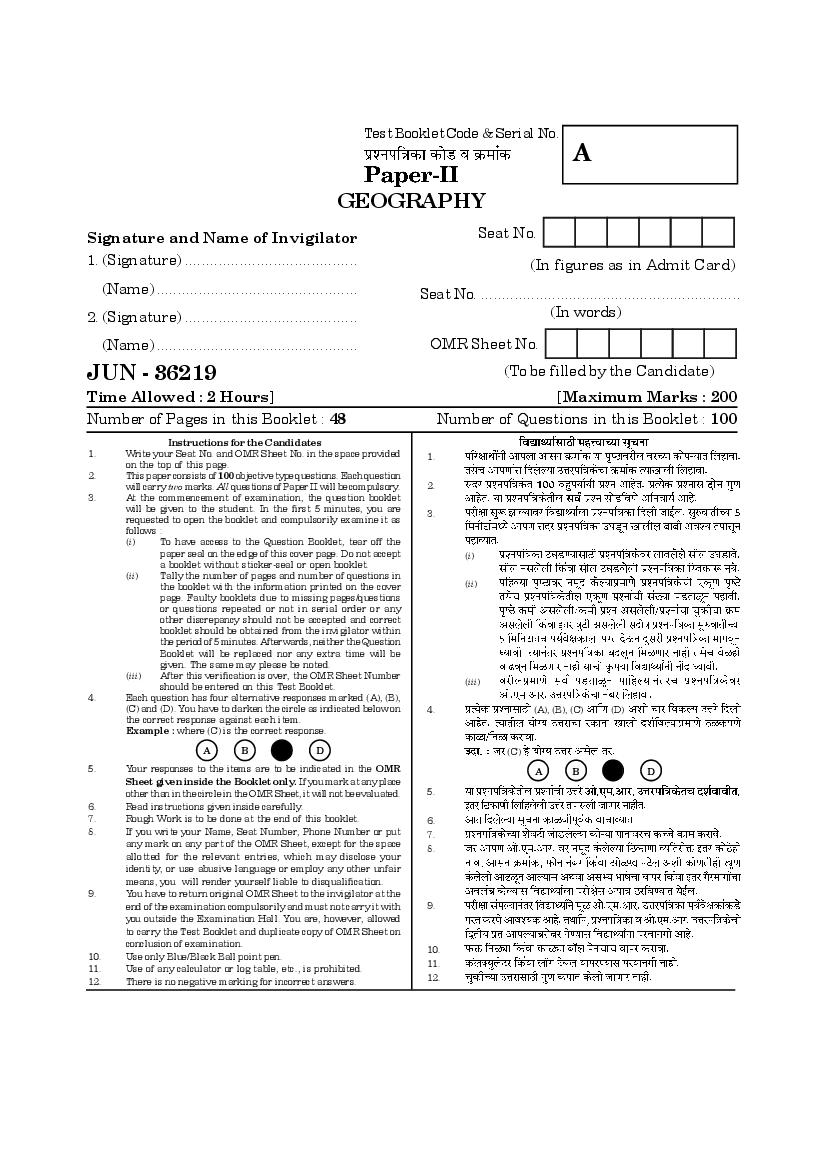
A
GEOGRAPHY
Signature and Name of Invigilator Seat No.
1. (Signature) ......................................... (In figures as in Admit Card)
(Name) ................................................ Seat No. ..............................................................
2. (Signature) ......................................... (In words)
(Name) ................................................ OMR Sheet No.
JUN - 36219 (To be filled by the Candidate)
Time Allowed : 2 Hours] [Maximum Marks : 200
Number of Pages in this Booklet : 48 Number of Questions in this Booklet : 100
Instructions for the Candidates
1. Write your Seat No. and OMR Sheet No. in the space provided 1.
on the top of this page.
2. This paper consists of 100 objective type questions. Each question
will carry two marks. All questions of Paper II will be compulsory. 2.
3. At the commencement of examination, the question booklet
will be given to the student. In the first 5 minutes, you are 3.
requested to open the booklet and compulsorily examine it as
follows :
(i) To have access to the Question Booklet, tear off the
paper seal on the edge of this cover page. Do not accept (i)
a booklet without sticker-seal or open booklet.
(ii) Tally the number of pages and number of questions in
the booklet with the information printed on the cover (ii)
page. Faulty booklets due to missing pages/questions
or questions repeated or not in serial order or any
other discrepancy should not be accepted and correct
booklet should be obtained from the invigilator within
the period of 5 minutes. Afterwards, neither the Question
Booklet will be replaced nor any extra time will be
given. The same may please be noted.
(iii) After this verification is over, the OMR Sheet Number
(iii)
should be entered on this Test Booklet.
4. Each question has four alternative responses marked (A), (B),
(C) and (D). You have to darken the circle as indicated below on 4. (A), (B), (C) (D)
the correct response against each item.
Example : where (C) is the correct response.
A B D (C)
5. Your responses to the items are to be indicated in the OMR A B D
Sheet given inside the Booklet only. If you mark at any place
other than in the circle in the OMR Sheet, it will not be evaluated. 5.
6. Read instructions given inside carefully.
7. Rough Work is to be done at the end of this booklet. 6.
8. If you write your Name, Seat Number, Phone Number or put 7.
any mark on any part of the OMR Sheet, except for the space
8.
allotted for the relevant entries, which may disclose your
identity, or use abusive language or employ any other unfair
means, you will render yourself liable to disqualification.
9. You have to return original OMR Sheet to the invigilator at the
end of the examination compulsorily and must not carry it with 9.
you outside the Examination Hall. You are, however, allowed
to carry the Test Booklet and duplicate copy of OMR Sheet on
conclusion of examination.
10.
10. Use only Blue/Black Ball point pen.
11.
11. Use of any calculator or log table, etc., is prohibited.
12. There is no negative marking for incorrect answers. 12.
Page 2
Page 3
Paper II
II
Time Allowed : 120 Minutes] [Maximum Marks : 200
Note : This paper contains Hundred (100) multiple choice questions. Each question
carrying Two (2) marks. Attempt All questions.
(100) (2)
1. ................... has popularized the 1. ...................
concept of ‘Uniformitarianism’ in a (1830)
book ‘Principles of Geology’ (1830).
(A) James Hutton (A)
(B) C. Lyell (B)
(C) W. Penck (C)
(D) A. Wegner (D)
2. The feature ‘Scroll Lake’ is related 2.
to .................
(A) Playa (A)
(B) Karstic (B)
(C) Glacial melt (C)
(D) Riverine (D)
3. ‘Paternoster Lake’ is a ..................... 3.
feature.
(A)
(A) Riverine
(B) Aeolian (B)
(C) Karstic (C)
(D) Glacial (D)
3 [P.T.O.
Page 4
polished by ................ action of wind.
(A) Abrasive (A)
(B) Deflation (B)
(C) Attrition (C)
(D) Corrosion (D)
5. Match List-I and List-II and select 5. I II
the correct answer using the codes
given below :
I
List I
(Theories/Hypothesis)
(a)
(a) Geosynclinal theory
(b)
(b) Tetrahedral Hypothesis
(c) Stationary wave theory (c)
(d) Subsidence theory (d)
List II II
(Related Aspects)
(1) Origin of tides (1)
(2) Origin of coral reef and atolls (2)
(3) Mountain building (3)
(4) Origin of continents and ocean (4)
basins
Codes :
(a) (b) (c) (d)
(a) (b) (c) (d)
(A) (3) (4) (2) (1)
(A) (3) (4) (2) (1)
(B) (4) (3) (2) (1)
(B) (4) (3) (2) (1)
(C) (3) (4) (1) (2)
(C) (3) (4) (1) (2)
(D) (4) (3) (1) (2) (D) (4) (3) (1) (2)
4
Page 5
ordering when a stream of 2nd order
joins 3rd order stream, the order of
higher order stream will ...........
(A) Increase (A)
(B) Decrease (B)
(C) Remain same (C)
(D) Be added (D)
7. The river with meagre source of 7.
water that is left after the river
capture is known as ...........
(A)
(A) Rejuvenated River
(B)
(B) Captured River
(C) Captor River (C)
(D) Misfit River (D)
8. Which of the following factors 8.
influence the type and rate of
weathering ?
(1)
(1) Soil
(2)
(2) Climate
(3)
(3) Vegetation cover
(4) Rock structure (4)
(5) Topography (5)
(A) (1), (2), (3) and (4) (A) (1), (2), (3) (4)
(B) (2), (3), (4) and (5) (B) (2), (3), (4) (5)
(C) (1), (2), (3) and (5) (C) (1), (2), (3) (5)
(D) (1), (2), (4) and (5) (D) (1), (2), (4) (5)
5 [P.T.O.
Page 6
is the product of erosion ?
(A) Drumlins, Moraines, Aretes
(A)
(B) U-shaped valleys, Ventifacts,
(B)
Natural Levee
(C) Eskers, Fjords, Outwash plain
(C)
(D) Cirques, V-shaped valleys,
Demoiselles (D)
10. Assertion (A) : Deflation basins are 10. (A) :
erosional features and may be upto
several kilometers in diameter.
Reason (R) : Removal of sand
(R) :
particles by the wind is a cause of
Deflation basin formation.
Which one of the following is
correct ?
(A) Both (A) and (R) are true and
(A) (A) (R) (R)
(R) is the correct explanation
(A)
of (A)
(B) Both (A) and (R) are true and (B) (A) (R) (R)
(R) is not the correct (A)
explanation of (A)
(C) (A) (R)
(C) (A) is true but (R) is false
(D) (A) (R)
(D) (A) is false but (R) is true
6
Page 7
to be cooled to reach saturation
is ..................
(A)
(A) Dew-point temperature
(B)
(B) Dry bulb temperature
(C)
(C) Wet bulb temperature
(D) Boiling point temperature (D)
12. Arrange the following in terms of 12.
decreasing albedo :
(1) Fresh show (1)
(2) Pine forest (2)
(3) Glacier ice (3)
(4) Loamy soil (4)
(A) (1), (3), (4), (2) (A) (1), (3), (4), (2)
(B) (1), (3), (2), (4) (B) (1), (3), (2), (4)
(C) (3), (1), (2), (4) (C) (3), (1), (2), (4)
(D) (3), (1), (4), (2) (D) (3), (1), (4), (2)
7 [P.T.O.
Page 8
radiation is negative.
Reason (R) : In the afternoon, net
radiation decreases as insolation (R) :
decreases.
Select your answer from the codes
given below :
(A) (A) (R)
(A) Both (A) and (R) are true and
(R) is proper explanation of (A) (R) (A)
(B) Both (A) and (R) are true but (B) (A) (R) (R)
(R) is not the correct explana-
(A)
tion of (A)
(C) (A) is true but (R) is false (C) (A) (R)
(D) (A) is false but (R) is true (D) (A) (R)
14. The branch of climatology which 14.
analyzes proxy data to reconstruct
past climate is named as ..............
(A) Synoptic climatology
(A) (Synoptic)
(B) Dynamic climatology
(B)
(C) Paleoclimatology
(C)
(D) Regional climatology (D)
15. These clouds are high, white and
15.
thin :
(A)
(A) Cirrus
(B) Stratus (B)
(C) Cumulus (C)
(D) Stratocumulus (D)
8
Page 9
Köppens climate classification and I
their matching climate type (List-II) II
are given.
-I -II
Match List-I and List-II and select
the correct answer from the codes
given below : I
List I (a) Am
(a) Am (b) BSh
(b) BSh (c) ET
(c) ET (d) CWb
(d) CWb II
List II
(1)
(1) Tundra climate
(2)
(2) Hot semi-arid climate
(3)
(3) Tropical monsoon climate
(4)
(4) Subtropical highland climate
Codes :
(a) (b) (c) (d)
(a) (b) (c) (d)
(A) (2) (3) (4) (1)
(A) (2) (3) (4) (1)
(B) (3) (2) (1) (4) (B) (3) (2) (1) (4)
(C) (3) (4) (1) (2) (C) (3) (4) (1) (2)
(D) (2) (3) (1) (4) (D) (2) (3) (1) (4)
9 [P.T.O.
Page 10
17. 1.5
measured at a standard height of 1.5
meters ?
(A) The winds are lighter at this (A)
level
(B)
(B) By international law
(C) To ensure an accurate reading (C)
insulated from surface effects
(D) To allow the observe to read the
(D)
temperature at eye level
without stooping
18. Which statement is incorrect 18.
regarding the Coriolis force ?
(A) It is always directed at right (A)
angle to the direction of wind
(B) It deflects winds to the right in (B)
northern hemisphere and to the
left in southern hemisphere
(C) It directly affects wind speed (C)
(D) It is strongest at the poles and (D)
weakens equatorwards
10
Page 11
atmospheric layers (List-I) and II
atmospheric layers (List-II) are
I II
given. Match List-I and List-II and
select the correct answer from the
codes given below : I
List I (a)
(a) Reflects radio waves back to (b)
earth
(c)
(b) Fall in temperature stops
(c) Temperature falls with height (d)
(d) Contains most of ozone II
List II (1)
(1) Stratosphere (2)
(2) Troposphere
(3)
(3) Ionosphere
(4) Tropopause (4)
Codes :
(a) (b) (c) (d) (a) (b) (c) (d)
(A) (1) (4) (2) (3) (A) (1) (4) (2) (3)
(B) (3) (1) (4) (2) (B) (3) (1) (4) (2)
(C) (1) (3) (2) (4) (C) (1) (3) (2) (4)
(D) (3) (4) (2) (1) (D) (3) (4) (2) (1)
20. Assertion (A) : The Siberian 20. (A) :
climate is conspicuosly absent in the
southern hemisphere.
Reason (R) : The southern (R) :
continents are marked by the
broadness in the high latitudes.
Select your answer from the codes
given below : (A) (A) (R)
(A) Both (A) and (R) are true and (R) (A)
(R) is proper explanation of (A)
(B) Both (A) and (R) are true but (B) (A) (R) (R)
(R) is not the correct (A)
explanation of (A) (C) (A) (R)
(C) (A) is true but (R) is false
(D) (A) is false but (R) is true (D) (A) (R)
11 [P.T.O.
Page 12
of ocean basins, ............. is at juvenile
stage.
(A)
(A) Red Sea
(B)
(B) Arabian Sea
(C) South China Sea (C)
(D) Dead Sea (D)
22. Assertion (A) : Ocean currents are 22. (A) :
seasonal or permanent unified
movement of ocean water.
(R) :
Reason (R) : Ocean currents are
driven mainly by seasonal winds.
Select the correct answer from the
following :
(A) Both (A) and (R) are true and (A) (A) (R)
(R) explains (A) (R) (A)
(B) Both (A) and (R) are true but (B) (A) (R)
(R) does not explain (A) (R) (A)
(C) (A) is true and (R) is false (C) (A) (R)
(D) (A) is false and (R) is true (D) (A) (R)
23. Which one of the following solute is 23.
major component by weight in sea
water ?
(A)
(A) Magnesium chloride
(B)
(B) Sodium sulphate
(C) Calcium carbonate (C)
(D) Sodium chloride (D)
12
Page 13
the high and low water spring tide
lines.
(A)
(A) Littoral
(B)
(B) Shallow water
(C) Bathyal (C)
(D) Abyssal (D)
25. Consider the following statement(s) 25.
related to the ocean acidification.
(I) It is a term used to describe the (I)
changes in the chemistry of the
World’s seas, primarily as a
result of burning fossil fuels.
(II) The CO2 in the water, which
(II)
leads to the formation of
carbonic acid, has caused the pH
0.1
of surface oceans to fall by 0.1
units, and it is projected to fall
0.3 – 0.4
a further 0.3 – 0.4 pH units by
the end of the century.
Select the correct code :
(A) Only (I) (A) (I)
(B) Only (II) (B) (II)
(C) Both (I) and (II) (C) (I) (II)
(D) Neither (I) nor (II) (D) (I) (II)
13 [P.T.O.
Page 14
with rounded wave crests are called
............... waves.
(A)
(A) Seiches
(B)
(B) Swell
(C) Clapotis (C)
(D) Tidal (D)
27. Assertion (A) : Salinity of the 27. (A) :
ocean water is not same everywhere.
Reason (R) : Salinity of the ocean (R) :
surface is exclusively controlled by
temperature.
Select the correct code from the
following codes :
Codes : (A) (A) (R)
(A) (A) is true but (R) is false (B) (A) (R)
(B) Both (A) and (R) are true but (R)
(R) is not the correct reason
(C) (A) (R)
(C) Both (A) and (R) are true
(D) (A) (R)
(D) Both (A) and (R) are false
28.
28. Generally seamounts are having
relief .................... meters above
reference surface.
(A) 300-500
(A) 300-500
(B) 500-700
(B) 500-700
(C) 700-900
(C) 700-900
(D) > 900 (D) > 900
14
Page 15
composed of ................... type of
rock.
(A)
(A) Andesite
(B)
(B) Granite
(C) Basalt (C)
(D) Mud (D)
30. Match the following : 30.
Ocean bottom configuration
(a) continental shelf (a)
(b) continental slope (b)
(c) ocean deeps (c)
(d) deep sea plains (d)
Characteristics :
(1) Covers two-third part of the
(1)
ocean floor.
(2) 3000 5000
(2) Depths between 3000 and 5000
fathoms
(3)
(3) Off broad low land coasts
(4)
(4) Abrupt change of gradient
(a) (b) (c) (d)
(a) (b) (c) (d)
(A) (2) (3) (1) (4) (A) (2) (3) (1) (4)
(B) (1) (4) (2) (3) (B) (1) (4) (2) (3)
(C) (3) (4) (2) (1) (C) (3) (4) (2) (1)
(D) (4) (3) (2) (1) (D) (4) (3) (2) (1)
15 [P.T.O.
Page 16
have lost ................. % of its %
population.
(A) 50
(A) 50
(B) 60
(B) 60
(C) 65
(C) 65
(D) 70 (D) 70
32. Some parts in urban areas tend to 32.
be warmer than their surroundings
is known as .............
(A) Lapse rate (A)
(B) The venturi effect (B)
(C) Urban Canopy layer effect (C)
(D) Urban heat island effect (D)
33. The complexity of any food web does 33.
not depend upon the ...............
(A) Diversity of organisms in the
systems (A)
(B) Length of the food chain (B)
(C) Homogeneity of organisms in
(C)
the systems
(D)
(D) Alternatives at different points
of consumers in the chain
16
Page 17
in the ocean is not determined
by .................
(A)
(A) Depth of the water
(B)
(B) The ocean currents
(C)
(C) Temperature and salinity
(D)
(D) Length of the day and night
35. It was emphasised by India that 35.
‘The removal of poverty is an
integral part of the goal of an
environmental strategy for the world
in ...........
(A) U.N. Conference on Human
Environment at Stockholm, (A)
1972
1972
(B) The Vienna Convention for the
Protection of the Ozone Layer, (B)
1985 1985
(C) Preparatory Committee
(C) 1991
Meeting, Geneva, 1991
(D) U.N. Conference on Environ- (D)
ment and Development, Nairobi,
1992
1992
17 [P.T.O.
Page 18
individual species to its environment
is known as ...............
(A)
(A) Synecology
(B)
(B) Autecology
(C) Community ecology (C)
(D) Population ecology (D)
37. Match the List-I and List-II and 37. -I II
select the correct answer from the
codes given below :
I
List I
(a)
(a) Carbon dioxide
(b)
(b) Methane
(c)
(c) Nitrous oxide
(d)
(d) CFC
II
List II
(1)
(1) Fertilizers
(2)
(2) Fossil fuels
(3) Paddy fields (3)
(4) Liquid coolants (4)
Codes :
(a) (b) (c) (d) (a) (b) (c) (d)
(A) (3) (2) (4) (1) (A) (3) (2) (4) (1)
(B) (2) (1) (3) (4) (B) (2) (1) (3) (4)
(C) (3) (4) (2) (1) (C) (3) (4) (2) (1)
(D) (2) (3) (1) (4) (D) (2) (3) (1) (4)
18
Page 19
known as the convention of ..............
(A) Wetlands of International
importance (A)
(B) Hilly Forests of National (B)
Significance
(C)
(C) The law of the seas
(D) Hazard waste management (D)
39. Deep ecology does not support : 39.
(A) Continuing inquiry into the
appropriate human roles on our
planet (A)
(B) Root cause analysis of
unsustainable practices (B)
(C) Enhancement of human
consumption
(D) Conservation and restoration of (C)
ecosystems (D)
40. Assertion (A) : One of the main 40. (A) :
objectives of the Central Pollution
Control Board (CPCB) is to
coordinate the activities of State
Pollution Control Boards and resolve
the dispute among them. (R) :
Reason (R) : The CPCB is the
international board and has a
central office as well as a network
of zonal offices located in various
places in the world.
Which one of the following is
correct ? (A) (A) (R) (R)
(A) Both (A) and (R) are true and (A)
(R) is the correct explanation (B) (A) (R) (R)
of (A)
(A)
(B) Both (A) and (R) are true and
(R) is not the correct (C) (A) (R)
explanation of (A)
(C) (A) is true but (R) is false (D) (A) (R)
(D) (A) is false but (R) is true
19 [P.T.O.
Page 20
history of demographic transition in
sequence using codes given :
(1)
(1) Low birth and death rates
(2) Decline in both birth and death (2)
rates
(3)
(3) High birth and death rates
(4)
(4) Decline in death rates while
birth rates remain high (A) (3), (4), (2), (1)
(A) (3), (4), (2), (1)
(B) (3), (2), (1), (4)
(B) (3), (2), (1), (4)
(C) (1), (2), (4), (3)
(C) (1), (2), (4), (3)
(D) (1), (3), (4), (2) (D) (1), (3), (4), (2)
42. Consider the following statements 42.
and select the correct option from the
codes given :
(1)
(1) A primate city is usually a
disproportionately large city.
(2)
(2) A primate city is the one that
is invariably a religious centre
(3) A primate city is exceptionally (3)
large compared to the second
largest city
(4)
(4) India has primate cities.
Codes :
(A) (1), (2) (3)
(A) (1), (2) and (3) are true
(B) (1), (3) (4)
(B) (1), (3) and (4) are true
(C) (3)
(C) Only (3) is true
(D) Only (1) is true (D) (1)
20
Page 21
43.
not alter the total size of the
population of a country ?
(A) External migration
(B) Internal migration (A)
(C) Higher fertility compared to
(B)
mortality
(C)
(D) Refugee migration across the
border (D)
44. Which is the most densely populated 44.
regions of the world ?
(A) Equatorial region (A)
(B) Tropical region (B)
(C) Temperate region (C)
(D) Sub-Arctic region (D)
21 [P.T.O.
Page 22
correct answer from the codes given
below :
I
List I
(Types of Age Pyramids)
(a) Stationary (a)
(b) Progressive (b)
(c) Regressive (c)
(d) Bell shaped (d)
List II II
(Characteristics)
(1) Low birth and death rates
(1)
(2) Unchanging fertility and
mortality (2)
(3) High birth and death rates (3)
(4) Declining birth rate and low (4)
mortality rate
Codes :
(a) (b) (c) (d)
(a) (b) (c) (d)
(A) (3) (2) (1) (4)
(A) (3) (2) (1) (4)
(B) (2) (4) (3) (1)
(B) (2) (4) (3) (1)
(C) (1) (3) (2) (4)
(C) (1) (3) (2) (4)
(D) (2) (3) (4) (1) (D) (2) (3) (4) (1)
22
Page 23
display large proportion of
population in younger age groups.
Reason (R) : Industrialization has (R) :
been a factor in bringing down
fertility rate.
Codes :
(A) Both (A) and (R) are true and (A) (A) (R) (R)
(R) is the correct explanation
(A)
of (A)
(B) Both (A) and (R) are true, but (B) (A) (R) (R)
(R) is not the correct (A)
explanation of (A)
(C) (A) (R)
(C) (A) is true but (R) is false
(D) (A) is false but (R) is true (D) (A) (R)
47. Which is a small settlement usually 47.
characterized by a single economic
activity ?
(A)
(A) Hamlet
(B)
(B) Village
(C) Rurban Centre (C)
(D) Urban fringe village (D)
23 [P.T.O.
Page 24
calculated as : 48.
(A) Number of people per square
unit of land (A)
(B) Number of people per square
unit of farm land (B)
(C) Number of farmers per unit of
farm land (C)
(D) Physical carrying capacity of
land (D)
49. A bulge in population pyramid 49.
indicates :
(A) Unusually high fertility or
(A)
mortality or changes in
population due to effects of
migration
(B) The effects of war or famines (B)
(C) That the population is ageing (C)
at an unusually fast pace
(D) That females join the workforce (D)
in large numbers
50. Ageing at the base occurs ............
50.
(A) When the proportion of the
population in child-age groups (A)
remains constant due to fertility
decline
(B) When child mortality rate (B)
shows distinct decline
(C)
(C) When fertility declines and new
birth cohorts are smaller than
previous ones
(D)
(D) When great fluctuation is seen
in successive age cohorts
24
Page 25
of moving and which are principally
made up of fuel costs and wages ?
(A) Overheads cost (A)
(B) Transfer cost (B)
(C) Line-haul cost (C)
(D) Comparative cost (D)
52. Which of the following is the correct 52.
sequence about the wind-energy
producing countries of the world in
descending order ? (A)
(A) Germany, Spain, USA, India
(B)
(B) Spain, China, Canada, India
(C)
(C) USA, Australia, Spain, India
(D)
(D) India, Spain, USA, Germany
53. Alfred Weber identified three factors 53.
that determine the location of
industries :
Transportation, Labour Costs and
...............
(A)
(A) Least cost
(B)
(B) Agglomeration
(C) Location of competitors (C)
(D) Maximum revenue location (D)
25 [P.T.O.
Page 26
whose economy is entirely dependent
on the production of petroleum ?
(A)
(A) Kuwait
(B)
(B) Venezuela
(C)
(C) Iraq
(D) Iran (D)
55. Which of the following statements 55.
is not correct about Nomadic
herding ?
(A)
(A) It is a form of intensive
subsistence agriculture
involving the grazing of
domesticated animals on
natural pastures (B)
(B) It is practised in large belt of
arid and semi-arid lands
(C)
(C) It is an aboriginal form of
livestock raising (D)
(D) Nomads select the type and
number of animals for the herd
according to local, cultural and
physical characteristics
56.
56. The Union and Pacific Railway
connects :
(A) New York to San Francisco (A)
(B) Halifax to Vancouver (B)
(C) Paris to Istanbul (C)
(D) Perth to Darwin (D)
26
Page 27
is/are not correct ? (a) 15
(a) V. Nath divided India into 15
macro regions
(b) 5
(b) Ashok Mitra divided India into
5 macro regions
(c) Prakash Rao and L.S. Bhatt (c)
divided the country into 7 7
macro regions (d) 13
(d) Chandrashekhar divided India
into 13 macro regions
(A) (a) (d)
(A) (a) and (d)
(B) (b) and (c) (B) (b) (c)
(C) (a) only (C) (a)
(D) (d) only (D) (d)
58. Select your answer from the codes 58. (A) :
given below :
Assertion (A) : Balance of trade
records the volume of goods and
services imported as well as exported
(R) :
by a country to other countries.
Reason (R) : If the value of exports
is more than the value of imports,
the country has a negative balance
of trade.
Codes : (A) (A) (R)
(A) Both (A) and (R) are true and
(R) (A)
(R) is the correct explanation
of (A) (B) (A) (R) (R)
(B) Both (A) and (R) are true, but
(A)
(R) is not the correct
explanation of (A) (C) (A) (R)
(C) (A) is true but (R) is false
(D) (A) is false but (R) is true (D) (A) (R)
27 [P.T.O.
Page 28
about Von Thunen’s theory is not
correct ?
(A) -I
(A) According to Thunen’s model
concentric ring-I has market
gardening and milk production (B) -II
(B) Thunen’s models concentric
ring-II has firewood and lumber
production
(C) -III
(C) Thunen’s model concentric ring-
III has livestock farming
(D) -IV
(D) Thunen’s model concentric ring-
IV has food crop farming with
fallow land
60. In year 2016, which one of the 60. 2016
following has the higher rank in
Human Development Index ?
(A)
(A) Sri Lanka
(B)
(B) Bhutan
(C) India (C)
(D) Bangladesh (D)
28
Page 29
India are generally concentrated in
relatively inaccessible parts of the
country.
Reason (R) : All the tribal people (R) :
in India practice shifting cultivation
Which of the following is correct ?
Codes :
(A) Both (A) and (R) are true and
(R) is the correct explanation (A) (A) (R) (R)
of (A) (A)
(B) Both (A) and (R) are true but
(B) (A) (R) (R)
(R) is not the correct
explanation of (A) (A)
(C) (A) is true but (R) is false (C) (A) (R)
(D) (A) is false but (R) is correct (D) (A) (R)
62. The National Health Policy (updated 62. 2017
in 2017) focuses on which of the
following ?
(a) Growing burden of the non-
(a)
communicable diseases.
(b) Emergence of robust health (b)
care industry
(c) Growing incidences of catastro- (c)
phic expenditure due to health
care costs.
Codes :
(A) (a) (b)
(A) (a) and (b)
(B) (a) (c)
(B) (a) and (c)
(C) (b) (c)
(C) (b) and (c)
(D) (a), (b) and (c) (D) (a), (b) (c)
29 [P.T.O.
Page 30
statement from the codes given
below :
A region is more diverse culturally
if it :
(a) has homogeneous population (a)
composition
(b)
(b) has heterogeneous population
composition. (c)
(c) receives voluminous in
migration. (d)
(d) is geographically isolated.
Codes :
(A) (a) (b)
(A) Only (a) and (b)
(B) (b)
(B) Only (b)
(C) (b) (c)
(C) Only (b) and (c)
(D) Only (c) and (d) (D) (c) (d)
64. Which boundaries result when a 64.
smaller state is absorbed by a larger
one ?
(A)
(A) Relict
(B)
(B) Superimposed
(C) Subsequent (C)
(D) Antecedent (D)
30
Page 31
Geostrategic realms ?
(A) Bassin (A)
(B) Cohen (B)
(C) Kjellen (C)
(D) Parker (D)
66. Harlan Barrows in the 1940s, for the 66. 1940
first time proposed which term that
encompasses the study of
how human responses to the
environment reflect the specific
composition of the culture group
involved ? (A)
(A) Cultural Geography
(B)
(B) Cultural Ecology
(C)
(C) Cultural integration
(D) Cutlural diffusion (D)
67. Which of the following is a rich 67.
source of data on the caste Hindu
Population ?
(A) 1921
(A) 1921 Census
(B) 1931 Census (B) 1931
(C) 1941 Census (C) 1941
(D) 1951 Census (D) 1951
31 [P.T.O.
Page 32
in which part of India ?
(A) Northern (A)
(B) Eastern (B)
(C) Southern (C)
(D) North-Western (D)
69. The presence of Baruhi, Kurukh-
69.
Oraon and Gondi dialects in North
India suggests the earlier stage of
destruction of which family of
languages ?
(A)
(A) Austro-Asiatic
(B)
(B) Dravidian
(C)
(C) Sino Tibetan
(D) Indo-European (D)
70. Which is not a characteristic of 70.
culture ?
(A) Culture is hereditary (A)
(B) Culture is dynamic (B)
(C) Culture is adaptive (C)
(D) Culture is symbolic (D)
32
Page 33
71. (A) :
organic unity in nature was based
on the principles of divine creation.
Reason (R) : Ritter was teleological
(R) :
in his approach.
Codes :
(A) Both (A) and (R) are true and
(R) is the correct explanation (A) (A) (R) (R)
of (A) (A)
(B) Both (A) and (R) are true and
(B) (A) (R) (R)
(R) is not the correct explanation
(A)
of (A)
(C) (A) (R)
(C) Both (A) and (R) are false
(D) (A) is true and (R) is false (D) (A) (R)
72. Which of the following is not correct 72.
with reference to post-modernism in
geography ?
(A)
(A) Scepticism towards grand
claims (B)
(B) Rejection of Metanarratives or
grand theory
(C)
(C) Deconstruction as a mode of
critical interpretation
(D) Use of binary classification (D)
33 [P.T.O.
Page 34
credited for having re-established
geography as an integrated
science ?
(A) Elisee Reclus, Ferdinand Von (A)
Richthofen Alfred Hettner and
Vidal-de-la-Blache
(B) Friedrich Ratzel, Arnold Guyot,
(B)
Alfred Hettner and Vidal-de-la-
Blache
(C) Friedrich Ratzel, Ferdinand (C)
Von Richthofen, Alfred Hettner
and Vidal-de-la-Blache
(D) Friedrich Ratzel, Ferdinand,
Von Richthofen, Alfred Hettner (D)
and Otto Schluter
74. Arrange the following philosophers 74.
in ascending order starting from
their periods :
(i)
(i) Eratosthenes
(ii)
(ii) Thales
(iii)
(iii) Aristotle
(iv)
(iv) Herodotus
(A) (i) (ii) (iii) (iv)
(A) (i) (ii) (iii) (iv)
(B) (ii) (i) (iv) (iii) (B) (ii) (i) (iv) (iii)
(C) (ii) (iv) (iii) (i) (C) (ii) (iv) (iii) (i)
(D) (iv) (ii) (i) (iii) (D) (iv) (ii) (i) (iii)
34
Page 35
75.
belief that geography and history
are methodologically distinct from
other systematic sciences because
they are peculiarly concerned with
the study of the unique and the
particular ?
(A)
(A) Positivism
(B)
(B) Humanism
(C)
(C) Radicalism
(D)
(D) Exceptionalism
76. In reaction to whose work, 76.
Hartshorne wrote several articles
and finally the book, ‘‘Perspective on
the Nature of Geography’’ ?
(A)
(A) Ackerman
(B) Haggett (B)
(C) Sauer (C)
(D) Schaefer
(D)
35 [P.T.O.
Page 36
not represent a dichotomy in
Geography ?
(A)
(A) Physical and Human
(B)
(B) Political and Historical
(C)
(C) Regional and Systematic
(D) Quantitative and Qualitative (D)
78. Humboldt studied the rocks of the 78.
Andes mountains and disproved the
earlier theory of sedimentary
origin of all rocks proposed by
whom ?
(A)
(A) Werner
(B)
(B) Buache
(C) Busching (C)
(D) Davis (D)
79. Who in 1905 clearly expressed the 79. 1905
logical arguments concerning the
place of the Earth’s body in the field
of Geography ?
(A)
(A) Ritter
(B) Hettner (B)
(C) Sauer (C)
(D) Richthofen (D)
36
Page 37
geography as the study of man-land
relationship from a deterministic
perspective, who viewed geography
as the study of covariants of human
distributions over the earth’s
surface ?
(A) Hettner (A)
(B) Ratzel (B)
(C) Richthofen (C)
(D) Schulter (D)
81. Read the statements and select the 81.
correct option given below :
(1)
(1) EMR travels at the speed of
light
(2)
(2) EMR cannot pass through
vacuum
(3)
(3) EMR has two fields : Electric
and magnetic
(4) The wavelength and frequency (4)
are proportional to each other
(A) (1), (2), (3) and (4) are true (A) (1), (2), (3) (4)
(B) (1), (3) and (4) are true (B) (1), (3) (4)
(C) (1) and (2) are true (C) (1) (2)
(D) (1) and (3) are true (D) (1) (3)
37 [P.T.O.
Page 38
and select the correct option :
(a) Vector data has complex data (a)
structure than raster data
(b) Vector data is not compatible (b)
with remote sensing images
(c) Vector data is efficient for (c)
network analysis
Codes :
(A) (a) and (b) are true but (c) is (A) (a) (b) (c)
false
(B) (a) (c) (b)
(B) (a) and (c) are true but (b) is
false
(C) (a), (b) (c)
(C) (a), (b) and (c) are true
(D) (b) (c) (a)
(D) (b) and (c) are true but (a) is
false
83. Distance between isotherms 83.
indicates :
(A)
(A) Temperature gradient
(B) Pressure anomaly (B)
(C) Temperature lag
(C)
(D) Deviation from normal
temperature (D)
38
Page 39
84.
for :
(A) Computation of population (A)
distribution
(B)
(B) Computation of pressure
distribution
(C)
(C) Computation of rainfall
distribution (D)
(D) Computation of elevation above
sea level
85. Interpolation of contours refers to : 85.
(A) Drawing contour lines on map,
(A)
when spot heights are given
(B) Measuring gradient along with
contour lines (B)
(C) Interpretation of contour lines
(C)
(D) Joining contour lines for specific
application (D)
39 [P.T.O.
Page 40
and select the correct option ?
(1) ‘+1’
(1) Strong correlation is when the
values are close to ‘+1’
(2) The value of ‘0’ (zero) represents (2) ‘0’
no correlation
(3) ‘–1’
(3) The value close to ‘–1’ represents
weak correlation
(A) (1)
(A) Only statement (1) is true
(B) Only statement (3) is true (B) (3)
(C) Statements (1) and (2) are true
(C) (1) (2)
but (3) is false
(3)
(D) Statements (1), (2) and (3) are
true (D) (1), (2) (3)
87. Which of the following would be best 87.
represented by the ‘Nearest
Neighbour Analysis’ ?
(A)
(A) Distribution of Settlements
(B)
(B) Density of Population
(C)
(C) Literacy rate
(D)
(D) Sex ratio
40
Page 41
88.
relationship among the following :
(A) Relative Humidity and
temperature (A)
(B) Climate and growing seasons of (B)
ages
(C)
(C) Temperature and rainfall
(D) Temperature and pressure (D)
89. Two statements are given below, one
89. (A) :
is labelled as Assertion (A) and
another labelled as Reason (R) :
Assertion (A) : Fog is the result
(R) :
of non-selective scattering of visible
EMR.
Reason (R) : Atmospheric
constituents larger than the EMR
wavelength result in scattering of all
visible rays.
Select the correct option from the
codes given below : (A) (A) (R) (R)
(A) Both (A) and (R) are true and
(A)
(R) is the correct explanation
of (A)
(B) (A) (R) (R)
(B) Both (A) and (R) are true but
(A)
(R) is not the correct
explanation of (A)
(C) (A) (R)
(C) (A) is true but (R) is false
(D) (A) is false but (R) is true (D) (A) (R)
41 [P.T.O.
Page 42
the correct option using the codes
given below :
I
List I
(Name)
(a)
(a) Microwave
(b)
(b) Near Infrared wave
(c)
(c) Ultraviolet wave
(d)
(d) Thermal wave
II
List II
(Wavelength)
(1) 8—9.2 µm
(1) 8—9.2 µm
(2) 0.3—0.4 µm
(2) 0.3—0.4 µm
(3) 7.5—11.5 µm
(3) 7.5—11.5 µm
(4) 0.77—0.91 µm
(4) 0.77—0.91 µm
Codes :
(a) (b) (c) (d)
(a) (b) (c) (d)
(A) (3) (4) (2) (1) (A) (3) (4) (2) (1)
(B) (1) (2) (4) (3) (B) (1) (2) (4) (3)
(C) (2) (1) (3) (4) (C) (2) (1) (3) (4)
(D) (3) (1) (2) (4) (D) (3) (1) (2) (4)
42
Page 43
are correct ?
(1)
(1) Large parts of the Gondwana
land were affected by glaciers
in the carboniferous period (2)
(2) Traces of the carboniferous
glaciation are found in the
(3)
Himalayas
(3) The Aravallis represent the
oldest hill range in India (4)
(4) The tertiary system is known as
the age of the Mammals
Codes :
(A) (1), (2) (3)
(A) (1), (2) and (3) only
(B) (1), (3) (4)
(B) (1), (3) and (4) only
(C) (1), (2) and (4) only (C) (1), (2) (4)
(D) (1), (2), (3) and (4) (D) (1), (2), (3) (4)
92. India’s Research Station ‘Himadri’ is 92.
located in the :
(A) Northern Himalayas (A)
(B) Western Himalayas (B)
(C) Antarctica (C)
(D) Arctic (D)
43 [P.T.O.
Page 44
climatic regions of India ?
(1) Stamp used 18°C isotherm of
(1)
mean monthly temperature for
January to divide the country
into two broad climatic regions. 18°C
(2) Stamp’s two major climatic
regions are further divided into (2)
eleven regions depending upon
the amount of rainfall and
temperature.
(3) Koeppen identified a close
relationship between the (3)
distribution of vegetation and
climate.
(4)
(4) Koeppen recognized five major
climatic groups, four of them are
based on precipitation and one
on temperature.
Codes :
(A) (1), (2) (4)
(A) (1), (2) and (4) only
(B) (2), (3) (4)
(B) (2), (3) and (4) only
(C) (1), (2) and (3) only (C) (1), (2) (3)
(D) (1), (2), (3) and (4) only (D) (1), (2), (3) (4)
94. Which of the following rivers is not 94.
cut by Tropic of Cancer ?
(A) Banas (A)
(B) Ken (B)
(C) Damodar (C)
(D) Hooghli
(D)
44
Page 45
(1) As per 2011 census, the rural-
(1) 2011
urban population share in
India is 68.84% and 31.16%
respectively. 68.84% 31.16%
(2) The growth of population in (2) 2001-2011
India during 2001-2011 has
increased
(3) The sex ratio in India has (3) 2001-2011
decreased since 2001-2011
(4) The absolute increase in urban
(4)
population has exceeded the
absolute increase in rural
population
Choose the correct statement(s) :
(A) (1)
(A) (1) only
(B) (1), (3) (4)
(B) (1), (3) and (4) only
(C) (1) and (2) only (C) (1) (2)
(D) (1), (2), (3) and (4) (D) (1), (2), (3) (4)
96. Assertion (A) : Jowar is grown both 96. (A) :
as Kharif as well as Rabi crop.
Reason (R) : Jowar is a rainfed crop (R) :
of dry farming areas where
irrigation is not used.
Codes :
(A) Both (A) and (R) are true and (A) (A) (R) (R) (A)
(R) explains (A)
(B) Both (A) and (R) are true but
(B) (A) (R) (R) (A)
(R) does not explain (A)
(C) (A) is true but (R) is false
(C) (A) (R)
(D) (A) is false but (R) is true
(D) (A) (R)
45 [P.T.O.
Page 46
shale gas are found :
(1) Cambay Basin (1)
(2) Kaveri Basin (2)
(3) Krishna-Godavari Basin (3)
Select the correct answer using the
codes given below :
(A) (2) only (A) (2)
(B) (1) and (2) only (B) (1) (2)
(C) (1) and (3) only (C) (1) (3)
(D) (1), (2) and (3) only (D) (1), (2) (3)
98. Choose the correct option : 98.
List I List II
I II
(1) Newsprint and — Nepanagar,
(1) —
Paper Mills M.P.
(2) Mysore Paper Mills — Mysore,
(2) —
Karnataka
(3) The Hindustan — Vellore, (3) —
Newsprint Tamil Nadu (4) —
(4) Tamil Nadu Newsprint — Chennai,
and Paper Ltd. Tamil Nadu
Codes :
(A) (1), (2) (4)
(A) (1), (2) and (4) only
(B) (1), (2) and (3) only (B) (1), (2) (3)
(C) (1) and (3) only (C) (1) (3)
(D) (2) and (4) only (D) (2) (4)
46
Page 47
are correct about Bogibeel bridge,
India’s longest rail cum road
bridge ?
(1) It is over Brahmaputra (1)
(2) It is between Dhemaji and (2)
Dibrugarh district
(3) The total length of the bridge
(3) 4.96
is 4.96 km
(4) 7
(4) It can withstand earthquakes of
magnitude upto 7 an Richter
scale
Codes :
(A) (1), (2) (3)
(A) (1), (2) and (3) only
(B) (1), (2) (4)
(B) (1), (2) and (4) only
(C) (1), (3) (4)
(C) (1), (3) and (4) only
(D) (1), (2), (3) and (4) (D) (1), (2), (3) (4)
100. Which of the following is true about 100.
proposed Bullet train route in
India ?
(A)
(A) Mumbai—Ahmedabad
(B)
(B) Mumbai—Hyderabad
(C) Mumbai—Nagpur (C)
(D) Delhi—Nagpur (D)
47 [P.T.O.
Page 48
48
Document Details
| Board / Org | Maharashtra Exams |
| Exam | Maharashtra State Eligibility Test |
| Type | Question Paper |
| Pages | 48 |
| Updated | 30 Apr 2026 |