GPAT 2027 Sample Paper
Finished viewing? Save it for later —
Download GPAT 2027 Sample Paper (PDF · 18 pages)About GPAT 2027 Sample Paper
GPAT 2027 Sample Paper is available here for free download. Published by NTA for GPAT, this sample paper can be viewed online or downloaded as a PDF (18 pages). Candidates preparing for GPAT can use GPAT 2027 Sample Paper to understand the exam pattern, the type of questions asked, and the overall difficulty level.
Frequently Asked Questions
How can I download GPAT 2027 Sample Paper?
Open this page and click the Download button to save GPAT 2027 Sample Paper as a PDF. It is completely free on AglaSem Docs.
Is GPAT 2027 Sample Paper free to download?
Yes. GPAT 2027 Sample Paper can be viewed online and downloaded as a PDF free of cost on AglaSem Docs.
How many pages does GPAT 2027 Sample Paper have?
GPAT 2027 Sample Paper contains 18 pages, which you can read online or download together as a single PDF.
Where can I find more GPAT study material?
You can find more GPAT question papers, sample papers, syllabus, and answer keys on AglaSem Docs.
GPAT 2027 Sample Paper – Text
Read the full text of this sample paper below — useful to quickly search, copy and reference the content online without downloading the PDF.
📄 View text version (18 pages)
Page 1
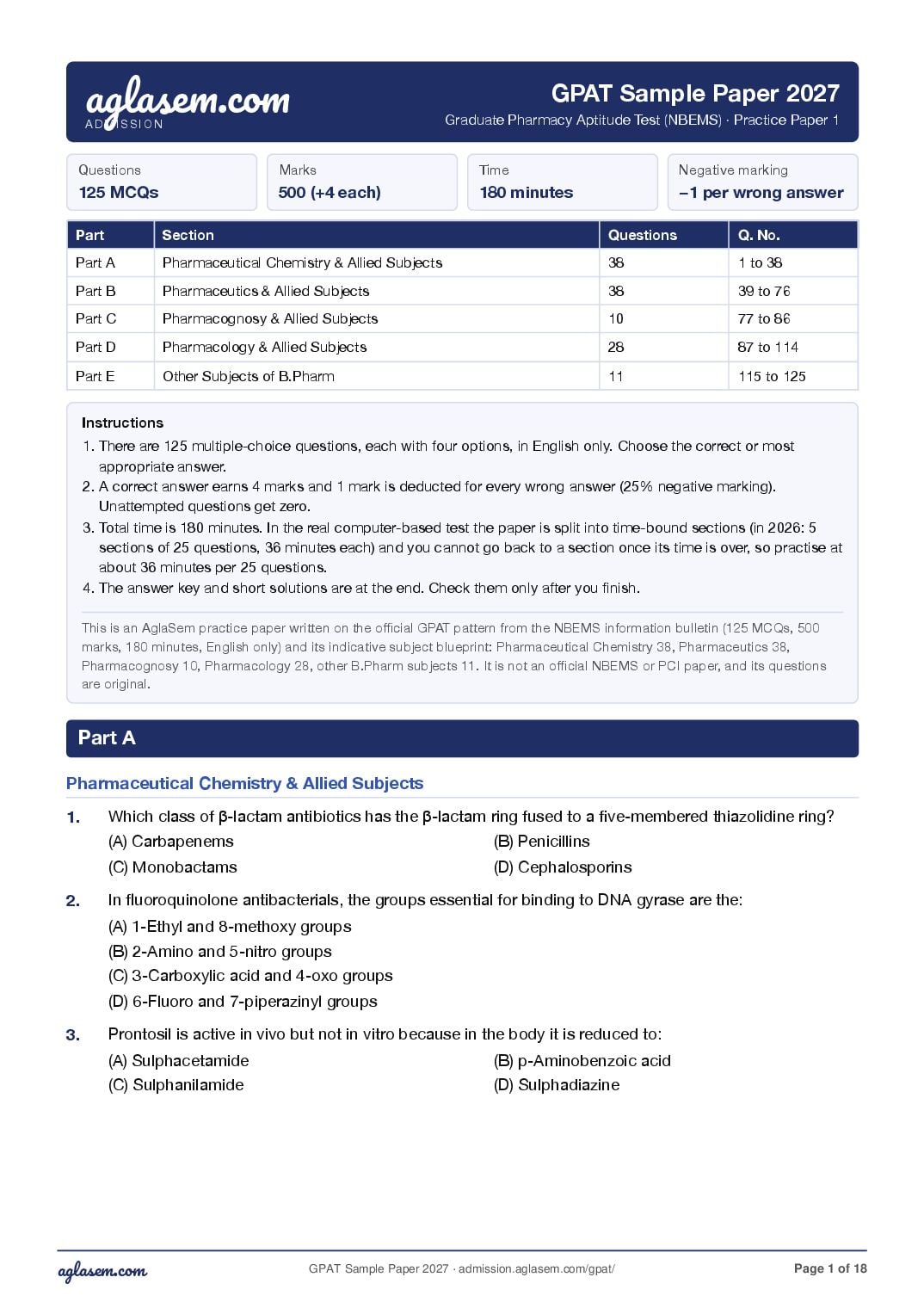
GPAT Sample Paper 2027
Graduate Pharmacy Aptitude Test (NBEMS) · Practice Paper 1
Questions Marks Time Negative marking
125 MCQs 500 (+4 each) 180 minutes −1 per wrong answer
Part Section Questions Q. No.
Part A Pharmaceutical Chemistry & Allied Subjects 38 1 to 38
Part B Pharmaceutics & Allied Subjects 38 39 to 76
Part C Pharmacognosy & Allied Subjects 10 77 to 86
Part D Pharmacology & Allied Subjects 28 87 to 114
Part E Other Subjects of B.Pharm 11 115 to 125
Instructions
1. There are 125 multiple-choice questions, each with four options, in English only. Choose the correct or most
appropriate answer.
2. A correct answer earns 4 marks and 1 mark is deducted for every wrong answer (25% negative marking).
Unattempted questions get zero.
3. Total time is 180 minutes. In the real computer-based test the paper is split into time-bound sections (in 2026: 5
sections of 25 questions, 36 minutes each) and you cannot go back to a section once its time is over, so practise at
about 36 minutes per 25 questions.
4. The answer key and short solutions are at the end. Check them only after you finish.
This is an AglaSem practice paper written on the official GPAT pattern from the NBEMS information bulletin (125 MCQs, 500
marks, 180 minutes, English only) and its indicative subject blueprint: Pharmaceutical Chemistry 38, Pharmaceutics 38,
Pharmacognosy 10, Pharmacology 28, other B.Pharm subjects 11. It is not an official NBEMS or PCI paper, and its questions
are original.
Part A
Pharmaceutical Chemistry & Allied Subjects
1. Which class of β-lactam antibiotics has the β-lactam ring fused to a five-membered thiazolidine ring?
(A) Carbapenems (B) Penicillins
(C) Monobactams (D) Cephalosporins
2. In fluoroquinolone antibacterials, the groups essential for binding to DNA gyrase are the:
(A) 1-Ethyl and 8-methoxy groups
(B) 2-Amino and 5-nitro groups
(C) 3-Carboxylic acid and 4-oxo groups
(D) 6-Fluoro and 7-piperazinyl groups
3. Prontosil is active in vivo but not in vitro because in the body it is reduced to:
(A) Sulphacetamide (B) p-Aminobenzoic acid
(C) Sulphanilamide (D) Sulphadiazine
GPAT Sample Paper 2027 · admission./gpat/ Page 1 of 18
Page 2
(A) Removes the acidic N–H needed for activity
(B) Makes the drug inactive until hydrolysed in the liver
(C) Lowers lipid solubility, giving slow onset and long action
(D) Increases lipid solubility: faster, shorter action
5. In 1,4-benzodiazepines such as diazepam, an electron-withdrawing group (Cl, NO₂) is essential for
activity at position:
(A) 5 (B) 3
(C) 9 (D) 7
6. In phenothiazine antipsychotics such as chlorpromazine, maximum activity needs the ring nitrogen and
the side-chain amino nitrogen to be separated by:
(A) Four carbon atoms (B) Two carbon atoms
(C) One carbon atom (D) Three carbon atoms
7. Methylation of the phenolic 3-OH group of morphine gives:
(A) Codeine (B) Thebaine
(C) Heroin (D) Nalorphine
8. Increasing the size of the N-substituent of noradrenaline (for example isopropyl in isoprenaline):
(A) Makes it selective for dopamine receptors
(B) Abolishes both α and β activity
(C) Increases β activity and decreases α activity
(D) Increases α activity and decreases β activity
9. Propranolol belongs to which structural class of β-blockers?
(A) Aryloxypropanolamines (B) Arylethanolamines
(C) Phenylpiperazines (D) Imidazolines
10. The ACE inhibitor with a free sulfhydryl (–SH) group, linked to skin rash and loss of taste, is:
(A) Lisinopril (B) Enalapril
(C) Captopril (D) Ramipril
11. Paracetamol is prepared industrially by acetylation of:
(A) p-Nitrophenol (B) p-Aminophenol
(C) Salicylic acid (D) Aniline
12. Primaquine, used to eradicate liver stages of Plasmodium vivax, is a(n):
(A) 8-Aminoquinoline (B) 4-Aminoquinoline
(C) Biguanide (D) Quinoline methanol
13. Cyclophosphamide is best described as a:
(A) Folic acid antagonist acting on DHFR
(B) Nitrogen mustard prodrug activated in the liver
(C) Inhibitor of mitotic spindle formation
(D) Pyrimidine antimetabolite of uracil
14. Acyclovir is an acyclic analogue of:
(A) Guanosine (B) Thymidine
(C) Cytidine (D) Adenosine
GPAT Sample Paper 2027 · admission./gpat/ Page 2 of 18
Page 3
(A) Famotidine (B) Nizatidine
(C) Ranitidine (D) Cimetidine
16. According to Lipinski's rule of five, poor oral absorption is more likely when a molecule has:
(A) More than 5 H-bond donors (B) Molecular weight below 500
(C) Fewer than 10 H-bond acceptors (D) A log P value below 5
17. Enalapril is an ester prodrug that is converted in the body to:
(A) Lisinopril (B) Captopril
(C) Enalaprilat (D) Benazeprilat
18. The most common phase II (conjugation) reaction of drugs in humans is:
(A) Methylation (B) Glucuronidation
(C) Glycine conjugation (D) Acetylation
19. A drug solution (ε = 15,000 L mol⁻¹ cm⁻¹) shows an absorbance of 0.45 in a 1 cm cell. Its concentration
is:
(A) 3.0 × 10⁻⁵ M (B) 6.75 × 10³ M
(C) 3.0 × 10⁻⁴ M (D) 1.5 × 10⁻⁵ M
20. A saturated aliphatic ketone shows its strong C=O stretching band in the IR spectrum near:
(A) 2250 cm⁻¹ (B) 3300 cm⁻¹
(C) 1715 cm⁻¹ (D) 1050 cm⁻¹
21. Tetramethylsilane (TMS) is used as the reference in ¹H NMR because:
(A) Its 12 equivalent protons give one sharp signal
(B) It is highly polar and dissolves every sample
(C) It absorbs strongly in the ultraviolet region
(D) It reacts with most samples to give sharp peaks
22. In the ¹H NMR spectrum of ethyl acetate (CH₃COOCH₂CH₃), the CH₂ protons appear as a:
(A) Singlet (B) Doublet
(C) Triplet (D) Quartet
23. A compound containing only C, H, N and O shows its molecular ion at m/z 121. By the nitrogen rule it
contains:
(A) Exactly two N atoms (B) No nitrogen atom at all
(C) An odd number of N atoms (D) An even number of N atoms
24. In TLC, a spot moves 3.0 cm while the solvent front moves 7.5 cm from the origin. The Rf value is:
(A) 2.50 (B) 0.60
(C) 0.40 (D) 0.30
25. The stationary phase most used in reverse-phase HPLC is:
(A) C18 (octadecyl) bonded silica
(B) Microcrystalline cellulose
(C) Unmodified silica gel with water
(D) Activated alumina with hexane
26. The most sensitive GC detector for halogenated compounds such as organochlorine pesticides is the:
(A) Thermal conductivity detector (B) Electron capture detector
(C) Flame ionisation detector (D) Flame photometric detector
GPAT Sample Paper 2027 · admission./gpat/ Page 3 of 18
Page 4
(A) Sodium hydroxide in water
(B) Perchloric acid in glacial acetic acid
(C) Sodium methoxide in toluene and methanol
(D) Hydrochloric acid in water
28. In the complexometric titration of Mg²⁺ with EDTA using Eriochrome Black T, the solution is buffered at
about pH:
(A) 4 (B) 10
(C) 12 (D) 7
29. Karl Fischer titration is used in pharmaceutical analysis to determine:
(A) Iron content (B) Chloride content
(C) Heavy metal content (D) Water content
30. The working electrode in classical polarography is the:
(A) Glass electrode
(B) Dropping mercury electrode
(C) Silver–silver chloride electrode
(D) Platinum wire electrode
31. In the IP limit test for iron, the reagent that reduces Fe³⁺ to Fe²⁺ and gives a purple colour in ammoniacal
medium is:
(A) Silver nitrate (B) Hydrogen sulphide
(C) Thioglycollic acid (D) Barium chloride
32. In the Gutzeit limit test for arsenic, the arsine produced gives a yellow-brown stain on:
(A) Starch-iodide paper (B) Litmus paper
(C) Lead acetate paper (D) Mercuric chloride paper
33. The radionuclide most used in diagnostic imaging, emitting 140 keV gamma rays with a half-life of
about 6 hours, is:
(A) Cobalt-60 (B) Iodine-131
(C) Phosphorus-32 (D) Technetium-99m
34. Aluminium hydroxide and magnesium hydroxide are combined in antacids mainly because:
(A) Both act as strong systemic alkalising agents
(B) Aluminium hastens the action of magnesium salts
(C) Magnesium prevents phosphate loss due to aluminium
(D) Their effects on the bowels offset each other
35. Reduction of benzene to 1,4-cyclohexadiene by sodium in liquid ammonia and ethanol is the:
(A) Clemmensen reduction
(B) Wolff–Kishner reduction
(C) Meerwein–Ponndorf–Verley reduction
(D) Birch reduction
36. Pyridine undergoes electrophilic aromatic substitution mainly at:
(A) N-1 (B) C-2
(C) C-4 (D) C-3
GPAT Sample Paper 2027 · admission./gpat/ Page 4 of 18
Page 5
(A) The absence of chiral carbon atoms
(B) Rapid racemisation in solution
(C) Strong hydrogen bonding
(D) An internal plane of symmetry
38. Aspirin (pKa 3.5) is in gastric fluid of pH 1.5. The ratio of its unionised to ionised form is about:
(A) 100 : 1 (B) 1 : 100
(C) 2 : 1 (D) 1 : 1
Part B
Pharmaceutics & Allied Subjects
39. According to the Noyes–Whitney equation, the dissolution rate of a drug increases when:
(A) Saturation solubility falls (B) The diffusion layer is thicker
(C) Particle size is increased (D) Particle size is reduced
40. A powder has a bulk density of 0.45 g/mL and a tapped density of 0.60 g/mL. Its Carr's compressibility
index is:
(A) 75% (B) 25%
(C) 33% (D) 15%
41. A dispersion whose viscosity falls as the shear rate rises, with no yield value, shows:
(A) Dilatant flow (B) Newtonian flow
(C) Plastic (Bingham) flow (D) Pseudoplastic flow
42. Thixotropy is best described as:
(A) Thickening of a dispersion when it is stirred fast
(B) Isothermal, reversible gel–sol change on agitation
(C) An irreversible rise in viscosity when it is heated
(D) Flow that begins only above a yield value
43. The HLB of a blend of 60% Tween 80 (HLB 15.0) and 40% Span 80 (HLB 4.3) is about:
(A) 8.6 (B) 19.3
(C) 9.65 (D) 10.7
44. Controlled flocculation of a pharmaceutical suspension is commonly brought about by adding:
(A) Sweeteners to mask bitter taste
(B) Excess wetting agent to raise zeta potential
(C) Electrolytes to reduce zeta potential
(D) Parabens as antimicrobial preservatives
45. By Stokes' law, if the particle radius in a suspension is halved, the rate of sedimentation:
(A) Falls to one-half (B) Falls to one-fourth
(C) Becomes four times (D) Doubles
46. The buffer capacity of a weak acid–salt buffer is maximum when:
(A) The total buffer concentration is minimum
(B) pH equals the pKa of the acid
(C) Only the free acid is present
(D) pH is two units above the pKa
GPAT Sample Paper 2027 · admission./gpat/ Page 5 of 18
Page 6
(A) 3.47 h (B) 10 h
(C) 6.93 h (D) 0.1 h
48. A target plasma concentration of 10 mg/L is needed at once for a drug with Vd = 40 L. The IV loading
dose is:
(A) 4 mg (B) 250 mg
(C) 50 mg (D) 400 mg
49. A 200 mg oral dose gives an AUC of 40 mg·h/L, and a 100 mg IV dose gives an AUC of 50 mg·h/L. The
absolute bioavailability is:
(A) 40% (B) 50%
(C) 20% (D) 80%
50. With repeated dosing at fixed intervals, steady state is practically reached after:
(A) Exactly one half-life (B) About 10–12 half-lives
(C) About 2 half-lives (D) About 4–5 half-lives
51. For two products to be bioequivalent, the 90% confidence interval of the test/reference ratio of AUC
and Cmax should lie within:
(A) 70.00–143.00% (B) 95.00–105.00%
(C) 80.00–125.00% (D) 90.00–110.00%
52. Which drug shows dose-dependent (Michaelis–Menten) elimination within its therapeutic range?
(A) Phenytoin (B) Lithium
(C) Gentamicin (D) Atenolol
53. A drug not bound to plasma proteins has a renal clearance of 600 mL/min (GFR 125 mL/min). It must
be:
(A) Actively secreted by the renal tubules
(B) Extensively reabsorbed in the tubules
(C) Filtered only at the glomerulus
(D) Bound strongly to plasma proteins
54. In the Biopharmaceutics Classification System, a Class II drug has:
(A) Low solubility, high permeability
(B) Low solubility, low permeability
(C) High solubility, low permeability
(D) High solubility, high permeability
55. Which excipient is a superdisintegrant in tablets?
(A) Sodium starch glycolate (B) Polyvinylpyrrolidone
(C) Lactose monohydrate (D) Magnesium stearate
56. Capping of tablets is the partial or complete separation of:
(A) Tablet material sticking to the punch faces
(B) Horizontal layers within the body of the tablet
(C) The upper or lower crown from the tablet body
(D) Particles of the coating from the core
57. Among the standard hard gelatin capsule sizes, the largest is:
(A) Size 00 (B) Size 000
(C) Size 5 (D) Size 0
GPAT Sample Paper 2027 · admission./gpat/ Page 6 of 18
Page 7
(A) Polyethylene glycol 6000 (B) Hydroxypropyl methylcellulose
(C) Polyvinylpyrrolidone (D) Cellulose acetate phthalate
59. In the pharmacopoeial friability test for uncoated tablets, the maximum acceptable loss in weight is:
(A) 0.1% (B) 10.0%
(C) 5.0% (D) 1.0%
60. The bacterial endotoxin test (BET) for parenteral products uses:
(A) A rise in rabbit body temperature
(B) Cultures in soybean–casein medium
(C) Limulus amoebocyte lysate
(D) Spores of Bacillus atrophaeus
61. A 1% w/v drug solution lowers the freezing point by 0.12 °C. 1% NaCl lowers it by 0.58 °C. The NaCl
needed to make 100 mL isotonic is about:
(A) 0.21 g (B) 0.69 g
(C) 0.90 g (D) 0.52 g
62. The most widely used preservative in multi-dose eye drops is:
(A) Phenol (B) Sodium benzoate
(C) Benzalkonium chloride (D) Chlorocresol
63. Cocoa butter suppository base should not be overheated during preparation because:
(A) It changes into low-melting polymorphs
(B) It turns rancid at once above 40 °C
(C) It reacts chemically with most drugs
(D) It becomes too hard to pour into moulds
64. Ten suppositories each containing 100 mg of drug are made in a 1 g mould. The displacement value of
the drug is 1.5. The base needed is:
(A) 9.33 g (B) 10.67 g
(C) 9.00 g (D) 8.50 g
65. In metered-dose inhalers, CFC propellants have been largely replaced by:
(A) Compressed nitrogen gas
(B) Hydrofluoroalkanes such as HFA-134a
(C) Carbon dioxide gas
(D) Liquefied hydrocarbons such as propane and butane
66. Which instability of an emulsion is irreversible?
(A) Sedimentation of droplets (B) Flocculation
(C) Creaming (D) Cracking
67. Aqueous parenterals that are autoclaved are best filled in:
(A) Type III (soda-lime) glass
(B) Type NP (general purpose) glass
(C) Type I (borosilicate) glass
(D) Type II (treated soda-lime) glass
68. A drug degrades by first-order kinetics with k = 0.0035 per day. Its shelf life (t₉₀) is about:
(A) 198 days (B) 30 days
(C) 105 days (D) 3 days
GPAT Sample Paper 2027 · admission./gpat/ Page 7 of 18
Page 8
(A) Balls slide over each other and grind by attrition
(B) Balls stick to the wall and grinding stops
(C) Grinding is fastest and most efficient
(D) Balls cascade and grind by impact
70. Freeze drying (lyophilisation) removes water from a product by:
(A) Sublimation of ice under vacuum
(B) Passing hot air through the product
(C) Absorption by a desiccant
(D) Evaporation at high temperature
71. The rate of filtration through a porous filter bed is described by:
(A) Fourier's law (B) Darcy's law
(C) Fick's law (D) Stokes' law
72. Flow of a liquid in a pipe at a Reynolds number of 1500 is:
(A) Transitional (B) Eddying
(C) Turbulent (D) Laminar
73. The standard moist-heat sterilisation cycle in an autoclave is:
(A) 60 °C at 30 psi for 1 hour
(B) 100 °C at normal pressure for 15 minutes
(C) 80 °C at 15 psi for 30 minutes
(D) 121 °C at 15 psi for 15 minutes
74. The biological indicator used to validate moist-heat (steam) sterilisation is spores of:
(A) Geobacillus stearothermophilus
(B) Escherichia coli
(C) Bacillus atrophaeus (B. subtilis var. niger)
(D) Staphylococcus aureus
75. In sterilisation, the D-value is the:
(A) Time to kill all the microorganisms present
(B) Time to reduce the microbial count by 90%
(C) Time to reduce the microbial count by 50%
(D) Temperature that kills 50% of microorganisms
76. Liposomes are vesicles made mainly of:
(A) Cross-linked albumin (B) Phospholipid bilayers
(C) Polymeric micelle cores (D) Cyclodextrin rings
Part C
Pharmacognosy & Allied Subjects
77. Digitoxin, a cardiac glycoside, is obtained from the leaves of:
(A) Strophanthus gratus (B) Thevetia peruviana
(C) Urginea indica (D) Digitalis purpurea
GPAT Sample Paper 2027 · admission./gpat/ Page 8 of 18
Page 9
(A) The unsaturated butenolide lactone ring
(B) Deoxy sugars (e.g. digitoxose)
(C) Free anthraquinones
(D) The steroid nucleus
79. The murexide test is given by:
(A) Indole alkaloids like reserpine
(B) Quinoline alkaloids such as quinine
(C) Purine alkaloids such as caffeine
(D) Tropane alkaloids such as atropine
80. Vincristine and vinblastine are obtained from:
(A) Rauwolfia serpentina (B) Catharanthus roseus
(C) Podophyllum hexandrum (D) Taxus brevifolia
81. Ergot, the source of ergometrine, is the dried sclerotium of:
(A) Aspergillus niger (B) Claviceps purpurea
(C) Penicillium notatum (D) Saccharomyces cerevisiae
82. Borntrager's test is used to detect:
(A) Anthraquinone glycosides (B) Cyanogenetic glycosides
(C) Saponin glycosides (D) Cardiac glycosides
83. The chief constituent of clove oil is:
(A) Menthol (B) Anethole
(C) Eugenol (D) Citral
84. The goldbeater's skin test is used to identify:
(A) Tannins (B) Alkaloids
(C) Resins (D) Volatile oils
85. The most widely used nutrient medium for plant tissue culture is:
(A) Sabouraud dextrose agar medium (B) MacConkey agar
(C) Nutrient agar (D) Murashige and Skoog medium
86. A high acid-insoluble ash value of a crude drug indicates:
(A) Contamination with sand and earthy matter
(B) Contamination with fungal growth
(C) The amount of moisture in the drug
(D) The total volatile oil present in the drug
Part D
Pharmacology & Allied Subjects
87. A competitive (surmountable) antagonist shifts the agonist's log dose–response curve:
(A) Rightward parallel shift, same maximum response
(B) Downward shift with a lower maximum response
(C) No change in the dose–response curve at all
(D) Parallel leftward shift with a higher maximum
GPAT Sample Paper 2027 · admission./gpat/ Page 9 of 18
Page 10
(A) TD₅₀ − ED₅₀ (B) ED₅₀/TD₅₀
(C) TD₅₀/ED₅₀ (D) ED₅₀ × TD₅₀
89. Which drug is a potent inducer of hepatic microsomal enzymes?
(A) Rifampicin (B) Erythromycin
(C) Ketoconazole (D) Cimetidine
90. In organophosphate poisoning, the drug given with atropine to reactivate cholinesterase is:
(A) Neostigmine (B) Naloxone
(C) Pralidoxime (D) Physostigmine
91. Which drug is used to diagnose myasthenia gravis because of its very short action?
(A) Atropine (B) Succinylcholine
(C) Pyridostigmine (D) Edrophonium
92. The first-line treatment of anaphylactic shock is:
(A) Intravenous chlorphenamine (B) Intramuscular adrenaline
(C) Inhaled salbutamol (D) Intravenous hydrocortisone
93. A characteristic adverse effect of prazosin is:
(A) Fainting from first-dose hypotension
(B) Bronchospasm in patients with asthma
(C) Persistent dry cough from bradykinin
(D) Rebound hypertension when it is stopped
94. Which β-blocker is cardioselective (β₁-selective)?
(A) Timolol (B) Propranolol
(C) Metoprolol (D) Pindolol
95. Carbidopa is combined with levodopa because it:
(A) Inhibits peripheral dopa decarboxylase
(B) Inhibits MAO-B in the brain
(C) Stimulates dopamine D₂ receptors
(D) Inhibits catechol-O-methyltransferase peripherally
96. The drug of choice for absence seizures in a child with no other seizure type is:
(A) Ethosuximide (B) Phenytoin
(C) Phenobarbitone (D) Carbamazepine
97. Fluoxetine acts by:
(A) Blocking noradrenaline and serotonin reuptake equally
(B) Blocking dopamine D₂ receptors
(C) Selectively inhibiting serotonin reuptake
(D) Inhibiting monoamine oxidase A
98. Lithium toxicity is likely to be precipitated by:
(A) Aluminium hydroxide antacids (B) A high-salt diet
(C) Thiazide diuretics (D) Regular use of paracetamol
99. The specific antidote for opioid overdose is:
(A) Naloxone (B) Flumazenil
(C) Physostigmine (D) Atropine
GPAT Sample Paper 2027 · admission./gpat/ Page 10 of 18
Page 11
(A) Nitrous oxide (B) Halothane
(C) Desflurane (D) Sevoflurane
101. The dry cough caused by ACE inhibitors is due to:
(A) Increased angiotensin II in the airways
(B) Blockade of β₂ receptors in the airways
(C) Direct irritation by the drug's sulphur
(D) Accumulation of bradykinin in the lungs
102. Digoxin increases myocardial contractility by inhibiting:
(A) L-type calcium channels (B) β₁-adrenergic receptors
(C) Membrane Na⁺/K⁺-ATPase (D) Phosphodiesterase III
103. Nitroglycerin relieves classical angina mainly by:
(A) Increasing the heart rate and contractility
(B) Venodilation that lowers cardiac preload
(C) Blocking β₁ receptors in the heart
(D) Dilating coronary arteries only
104. Statins lower LDL cholesterol by inhibiting:
(A) Bile acid reabsorption (B) Intestinal NPC1L1 transporter
(C) Hepatic HMG-CoA reductase (D) Lipoprotein lipase
105. Furosemide acts by inhibiting the:
(A) Na⁺-K⁺-2Cl⁻ cotransporter in Henle's loop
(B) Na⁺-Cl⁻ symporter in the distal tubule
(C) Epithelial Na⁺ channels in the collecting duct
(D) Carbonic anhydrase in the proximal tubule
106. The antidote for heparin overdose is:
(A) Vitamin K₁ (B) Protamine sulphate
(C) Desmopressin (D) Tranexamic acid
107. Omeprazole reduces gastric acid by irreversibly inhibiting the:
(A) Gastrin receptors (B) Muscarinic M₁ receptors
(C) H⁺/K⁺-ATPase of parietal cells (D) H₂ receptors on parietal cells
108. Ondansetron prevents chemotherapy-induced vomiting by blocking:
(A) Histamine H₁ receptors (B) Muscarinic receptors
(C) Dopamine D₂ receptors (D) Serotonin 5-HT₃ receptors
109. Sulfonylureas such as glibenclamide lower blood glucose by:
(A) Activating PPAR-γ in adipose tissue
(B) Activating AMP-activated protein kinase in liver
(C) Inhibiting intestinal α-glucosidase
(D) Closing ATP-sensitive K⁺ channels in β cells
110. Propylthiouracil treats hyperthyroidism because it:
(A) Blocks TSH receptors on the thyroid
(B) Destroys thyroid follicular cells by β radiation
(C) Blocks thyroid peroxidase and T4→T3 conversion
(D) Blocks iodide uptake by the thyroid
GPAT Sample Paper 2027 · admission./gpat/ Page 11 of 18
Page 12
(A) Gentamicin (B) Doxycycline
(C) Ampicillin (D) Azithromycin
112. Pyridoxine is given with isoniazid to prevent:
(A) Optic neuritis
(B) Ototoxicity and vestibular damage
(C) Hyperuricaemia
(D) Peripheral neuropathy
113. Type A adverse drug reactions are:
(A) Seen only after stopping the drug
(B) Seen only after long-term use
(C) Dose-related and pharmacologically predictable
(D) Not dose-related, unpredictable and often immune-mediated
114. Low-dose aspirin prevents thrombosis by:
(A) Inhibition of vitamin K epoxide reductase
(B) Irreversible inhibition of platelet COX-1
(C) Direct inhibition of thrombin
(D) Reversible blockade of platelet P2Y12 receptors
Part E
Other Subjects of B.Pharm
115. The natural pacemaker of the heart is the:
(A) Sinoatrial node (B) Purkinje fibres
(C) Atrioventricular node (D) Bundle of His
116. The normal glomerular filtration rate in a healthy adult is about:
(A) 125 mL/min (B) 25 mL/min
(C) 625 mL/min (D) 1.25 mL/min
117. Antidiuretic hormone (vasopressin) is released into the blood from the:
(A) Adrenal cortex (B) Posterior pituitary
(C) Thyroid gland (D) Anterior pituitary
118. The net gain of ATP when one glucose molecule is converted to two lactate molecules (anaerobic
glycolysis) is:
(A) 2 (B) 36
(C) 4 (D) 38
119. The Michaelis constant (Km) of an enzyme is the:
(A) Substrate concentration at Vmax
(B) Maximum velocity of the reaction
(C) Enzyme concentration needed to reach half of Vmax
(D) Substrate concentration at half of Vmax
120. The enzyme used in PCR because it withstands repeated heating to about 95 °C is:
(A) Reverse transcriptase (B) Taq DNA polymerase
(C) DNA ligase (D) Restriction endonuclease
GPAT Sample Paper 2027 · admission./gpat/ Page 12 of 18
Page 13
(A) Calcium oxalate (B) Monosodium urate
(C) Cholesterol (D) Calcium pyrophosphate
122. The Pharmacy Council of India was constituted under:
(A) The Drugs and Cosmetics Act, 1940
(B) The NDPS Act, 1985
(C) The Poisons Act, 1919
(D) The Pharmacy Act, 1948
123. The Drugs and Cosmetics Act of India was enacted in the year:
(A) 1985 (B) 1954
(C) 1940 (D) 1948
124. The median of 3, 7, 9, 12, 15 and 20 is:
(A) 12 (B) 9
(C) 10.5 (D) 11
125. In a hospital, the drug formulary is prepared and revised by the:
(A) Hospital Ethics Committee
(B) Medical Records and Audit Committee
(C) Pharmacy and Therapeutics Committee
(D) Infection Control Committee
GPAT Sample Paper 2027 · admission./gpat/ Page 13 of 18
Page 14
1 B 2 C 3 C 4 D 5 D 6 D 7 A 8 C 9 A 10 C
11 B 12 A 13 B 14 A 15 D 16 A 17 C 18 B 19 A 20 C
21 A 22 D 23 C 24 C 25 A 26 B 27 B 28 B 29 D 30 B
31 C 32 D 33 D 34 D 35 D 36 D 37 D 38 A 39 D 40 B
41 D 42 B 43 D 44 C 45 B 46 B 47 C 48 D 49 A 50 D
51 C 52 A 53 A 54 A 55 A 56 C 57 B 58 D 59 D 60 C
61 B 62 C 63 A 64 A 65 B 66 D 67 C 68 B 69 B 70 A
71 B 72 D 73 D 74 A 75 B 76 B 77 D 78 B 79 C 80 B
81 B 82 A 83 C 84 A 85 D 86 A 87 A 88 C 89 A 90 C
91 D 92 B 93 A 94 C 95 A 96 A 97 C 98 C 99 A 100 B
101 D 102 C 103 B 104 C 105 A 106 B 107 C 108 D 109 D 110 C
111 A 112 D 113 C 114 B 115 A 116 A 117 B 118 A 119 D 120 B
121 B 122 D 123 C 124 C 125 C
Solutions
Pharmaceutical Chemistry & Allied Subjects
1. (B) Penicillins have the penam nucleus (β-lactam + thiazolidine); cephalosporins have a six-membered
dihydrothiazine ring, carbapenems a pyrroline ring and monobactams no fused ring.
2. (C) The 3-COOH and 4-C=O of the 4-quinolone ring bind the enzyme–DNA complex; 6-F and the 7-piperazine
improve potency and spectrum but are not essential.
3. (C) Azo reduction of prontosil releases sulphanilamide, the active antibacterial.
4. (D) The thiobarbiturate is more lipophilic, enters the brain quickly and redistributes quickly, so it acts as an ultra-
short-acting IV anaesthetic.
5. (D) An electron-withdrawing group at C-7 is needed for activity; position 5 carries the phenyl ring and substitution at
6, 8 or 9 lowers activity.
6. (D) A three-carbon chain gives neuroleptic activity; a two-carbon chain (as in promethazine) gives mainly
antihistaminic activity.
7. (A) Codeine is 3-O-methylmorphine. Heroin is 3,6-diacetylmorphine and nalorphine is N-allylnormorphine.
8. (C) Bulky N-alkyl groups favour β-receptors; isoprenaline is an almost pure β agonist.
9. (A) Propranolol has an O–CH₂ group between the naphthalene ring and the ethanolamine side chain: an
aryloxypropanolamine.
10. (C) Captopril is the only common ACE inhibitor with a thiol group; the others are dicarboxylate-type.
11. (B) p-Aminophenol + acetic anhydride gives N-acetyl-p-aminophenol (paracetamol). Acetylating salicylic acid gives
aspirin.
12. (A) Primaquine is an 8-aminoquinoline; chloroquine is a 4-aminoquinoline, mefloquine a quinoline methanol and
proguanil a biguanide.
13. (B) Cyclophosphamide is activated by hepatic CYP enzymes to phosphoramide mustard (alkylating) and acrolein.
14. (A) Acyclovir (acycloguanosine) is phosphorylated by viral thymidine kinase and then inhibits viral DNA polymerase.
15. (D) Cimetidine has an imidazole ring (like histamine); ranitidine has a furan ring and famotidine and nizatidine a
thiazole ring.
16. (A) The rule flags MW > 500, log P > 5, more than 5 H-bond donors or more than 10 H-bond acceptors.
17. (C) Hepatic esterases hydrolyse enalapril to the active diacid enalaprilat.
GPAT Sample Paper 2027 · admission./gpat/ Page 14 of 18
Page 15
19. (A) Beer–Lambert law: c = A/(εb) = 0.45/15,000 = 3.0 × 10⁻⁵ mol/L.
20. (C) Ketone C=O absorbs near 1715 cm⁻¹; 3300 is O–H/N–H, 2250 is C≡N and 1050 is C–O stretching.
21. (A) TMS is inert and its 12 equivalent, highly shielded protons give one sharp signal set at δ 0, upfield of most
organic protons.
22. (D) The CH₂ has three neighbouring CH₃ protons, so by the n + 1 rule it splits into a quartet.
23. (C) An odd molecular mass means an odd number of nitrogen atoms.
24. (C) Rf = distance moved by solute / distance moved by solvent = 3.0/7.5 = 0.40.
25. (A) RP-HPLC uses a non-polar stationary phase (octadecylsilyl silica) with a polar mobile phase.
26. (B) The ECD responds strongly to electronegative atoms such as halogens; the FID is general for organics and the
FPD is selective for S and P.
27. (B) Glacial acetic acid enhances the basicity of weak bases, which are then titrated with perchloric acid (sodium
methoxide is used for weak acids).
28. (B) An ammonia–ammonium chloride buffer of pH 10 is used; at pH 12 Mg(OH)₂ would precipitate.
29. (D) The KF reagent (iodine, SO₂, a base and methanol) reacts quantitatively with water.
30. (B) The dropping mercury electrode renews its surface with every drop and has a high overpotential for hydrogen.
31. (C) Thioglycollic acid forms purple ferrous thioglycollate; BaCl₂ is used for sulphate and AgNO₃ for chloride.
32. (D) Arsine reacts with mercuric chloride paper; lead acetate cotton wool is used only to trap H₂S.
33. (D) ⁹⁹ᵐTc is a pure gamma emitter with ideal energy and half-life for imaging.
34. (D) Aluminium salts tend to cause constipation and magnesium salts diarrhoea; together these effects balance out.
Both are non-systemic antacids.
35. (D) Birch reduction partly reduces aromatic rings to non-conjugated 1,4-dienes.
36. (D) The ring nitrogen withdraws electrons; attack at C-3 avoids placing positive charge on nitrogen in the
intermediate.
37. (D) It has two chiral centres, but its internal mirror plane makes the molecule superimposable on its mirror image.
38. (A) For a weak acid, log(ionised/unionised) = pH − pKa = −2, so unionised : ionised = 100 : 1.
Pharmaceutics & Allied Subjects
39. (D) dC/dt = DA(Cs − C)/h: a smaller particle size gives a larger surface area A.
40. (B) CI = (tapped − bulk)/tapped × 100 = 0.15/0.60 × 100 = 25% (Hausner ratio 1.33).
41. (D) Shear-thinning without a yield value is pseudoplastic flow, seen with solutions of tragacanth or methylcellulose.
42. (B) A thixotropic gel becomes fluid on shaking and slowly rebuilds its structure on standing, at constant
temperature.
43. (D) HLB = 0.6 × 15.0 + 0.4 × 4.3 = 9.0 + 1.72 = 10.72.
44. (C) Electrolytes reduce the zeta potential so particles form loose flocs that settle fast but redisperse easily.
45. (B) v = 2r²(ρ − ρ₀)g/9η, so v ∝ r²; halving r gives one-fourth.
46. (B) Buffer capacity peaks when [salt] = [acid], i.e. pH = pKa.
47. (C) k = CL/Vd = 0.1 h⁻¹; t½ = 0.693/0.1 = 6.93 h.
48. (D) Loading dose = Ctarget × Vd = 10 mg/L × 40 L = 400 mg.
49. (A) F = (AUCoral/Doseoral)/(AUCiv/Doseiv) = (40/200)/(50/100) = 0.2/0.5 = 0.4.
50. (D) About 94–97% of steady state is reached after 4–5 half-lives, whatever the dose.
51. (C) The usual regulatory acceptance range is 80.00–125.00% for log-transformed AUC and Cmax.
52. (A) Phenytoin's metabolising enzymes saturate at therapeutic levels, so small dose increases can cause large rises
in plasma level.
53. (A) Renal clearance above GFR is possible only with net tubular secretion.
54. (A) BCS Class II drugs (e.g. ibuprofen, carbamazepine) are dissolution-rate limited.
GPAT Sample Paper 2027 · admission./gpat/ Page 15 of 18
Page 16
56. (C) Capping is loss of the top or bottom crown; separation into layers is lamination, and adhesion to punches is
picking or sticking.
57. (B) Capsule sizes run from 000 (largest, about 1.37 mL) to 5 (smallest).
58. (D) CAP is insoluble in acid but dissolves at intestinal pH; plain HPMC, PEG and PVP are water-soluble.
59. (D) After 100 drum rotations, a loss of not more than 1.0% of the tablet weight is generally acceptable.
60. (C) LAL from the horseshoe crab gels in the presence of endotoxin. The rabbit test is the older pyrogen test.
61. (B) Isotonic depression is 0.52 °C: w = (0.52 − 0.12)/0.58 = 0.69 g per 100 mL.
62. (C) Benzalkonium chloride, a quaternary ammonium compound, is effective at low concentration (about 0.01%).
63. (A) Overheated theobroma oil forms metastable polymorphs with low melting points, so the suppositories fail to set
or soften at room temperature.
64. (A) Base = 10 × 1 g − (10 × 0.1 g)/1.5 = 10 − 0.67 = 9.33 g.
65. (B) HFAs (HFA-134a, HFA-227) do not deplete stratospheric ozone.
66. (D) In cracking the droplets coalesce and the phases separate; shaking cannot restore the emulsion. Creaming is
reversible.
67. (C) Type I borosilicate glass is the most chemically resistant and suits all parenterals.
68. (B) t₉₀ = 0.105/k = 0.105/0.0035 = 30 days (198 days is the half-life).
69. (B) Centrifugal force pins the balls to the shell, so there is no cascading or impact; mills run at about 65–75% of
critical speed.
70. (A) The frozen product is dried by sublimation at low pressure, so heat-sensitive drugs are protected.
71. (B) Darcy's law relates flow rate to pressure drop, bed permeability, area, viscosity and bed thickness.
72. (D) Re below about 2000 gives laminar (streamline) flow; above about 4000 the flow is turbulent.
73. (D) Saturated steam at 121 °C (about 15 psi gauge) for 15 minutes is the standard cycle.
74. (A) G. stearothermophilus spores are highly resistant to moist heat; B. atrophaeus is used for dry heat and ethylene
oxide.
75. (B) D-value is the time at a given temperature for a one-log (90%) reduction in viable count.
76. (B) Liposomes are concentric phospholipid bilayers (often with cholesterol) around aqueous compartments.
Pharmacognosy & Allied Subjects
77. (D) Digitoxin comes from foxglove (Digitalis purpurea and D. lanata). Strophanthus gratus gives ouabain.
78. (B) Keller–Kiliani detects 2-deoxy sugars; the lactone ring is shown by Legal, Baljet and Kedde tests.
79. (C) Caffeine and other purines give a purple colour (murexide) with KClO₃/HCl and ammonia.
80. (B) These bisindole alkaloids come from the Madagascar periwinkle; Taxus gives paclitaxel and Podophyllum gives
podophyllotoxin.
81. (B) Ergot is the sclerotium of the fungus Claviceps purpurea that develops on rye.
82. (A) Free anthraquinones give a pink-red colour in the ammoniacal layer (e.g. senna, aloe, rhubarb).
83. (C) Clove oil contains about 70–90% eugenol. Menthol is from mint, citral from lemongrass and anethole from
anise/fennel.
84. (A) Tannins tan the goldbeater's skin (animal membrane), which turns brown or black with ferrous sulphate.
85. (D) MS medium (1962) is the standard plant tissue culture medium; the others are microbiological media.
86. (A) Acid-insoluble ash is mainly silica, so it shows adulteration or contamination with sand and soil.
Pharmacology & Allied Subjects
87. (A) Higher agonist doses overcome a competitive antagonist, so potency falls but efficacy (maximum) is
unchanged.
88. (C) TI = TD₅₀/ED₅₀ (LD₅₀/ED₅₀ in animals); a higher value means a wider safety margin.
GPAT Sample Paper 2027 · admission./gpat/ Page 16 of 18
Page 17
90. (C) Pralidoxime (2-PAM) removes the phosphoryl group from the enzyme if given before ageing.
91. (D) Edrophonium is a short-acting anticholinesterase (Tensilon test); pyridostigmine is used for maintenance
treatment.
92. (B) Adrenaline reverses bronchospasm and hypotension through α and β effects; antihistamines and steroids are
adjuncts.
93. (A) α₁ blockade causes marked postural hypotension with the first dose, so it is started at bedtime in a low dose.
94. (C) Metoprolol, atenolol and bisoprolol are β₁-selective; propranolol, timolol and pindolol are non-selective.
95. (A) Carbidopa does not cross the BBB; it stops peripheral conversion of levodopa, so more reaches the brain and
nausea is less.
96. (A) Ethosuximide blocks T-type Ca²⁺ channels in thalamic neurons; phenytoin and carbamazepine can worsen
absence seizures.
97. (C) Fluoxetine is a selective serotonin reuptake inhibitor (SSRI).
98. (C) Thiazides cause sodium loss, which increases renal reabsorption of lithium; a high-salt intake lowers lithium
levels.
99. (A) Naloxone is a pure opioid antagonist; flumazenil reverses benzodiazepines.
100. (B) MAC values are about 0.75% for halothane, 2% for sevoflurane, 6% for desflurane and over 100% for nitrous
oxide.
101. (D) ACE (kininase II) also breaks down bradykinin; its accumulation causes cough and, rarely, angioedema.
102. (C) Raised intracellular Na⁺ reduces Ca²⁺ removal via Na⁺/Ca²⁺ exchange, so more Ca²⁺ is available for
contraction.
103. (B) NO-mediated venodilation reduces preload and myocardial oxygen demand.
104. (C) HMG-CoA reductase is the rate-limiting enzyme of cholesterol synthesis; ezetimibe acts on NPC1L1.
105. (A) Loop diuretics block NKCC2 in the thick ascending limb; thiazides act on the distal tubule.
106. (B) Strongly basic protamine combines with acidic heparin to form an inactive complex; vitamin K reverses
warfarin.
107. (C) Proton pump inhibitors are activated in acid and bind covalently to the proton pump.
108. (D) It blocks 5-HT₃ receptors in the gut and the chemoreceptor trigger zone.
109. (D) Closing K-ATP channels depolarises β cells, opening Ca²⁺ channels and releasing insulin.
110. (C) PTU inhibits iodination and coupling (thyroid peroxidase) and also peripheral deiodination of T4 to T3.
111. (A) Aminoglycosides such as gentamicin accumulate in the inner ear and renal tubular cells.
112. (D) Isoniazid increases pyridoxine excretion, causing neuropathy; optic neuritis is due to ethambutol and
ototoxicity to streptomycin.
113. (C) Type A (augmented) reactions are extensions of the drug's known action; Type B (bizarre) reactions are
unpredictable.
114. (B) Aspirin acetylates platelet COX-1, stopping thromboxane A₂ for the platelet's whole lifespan.
Other Subjects of B.Pharm
115. (A) The SA node in the right atrium has the fastest intrinsic rate of firing.
116. (A) Normal GFR is about 125 mL/min, i.e. about 180 L/day.
117. (B) ADH is made in the hypothalamus and released from the posterior pituitary.
118. (A) Glycolysis makes 4 ATP but uses 2, giving a net gain of 2 ATP.
119. (D) Km is the substrate concentration at which the reaction rate is half its maximum; a low Km means high affinity.
120. (B) Taq polymerase comes from the thermophile Thermus aquaticus.
121. (B) Raised uric acid leads to monosodium urate crystal deposits; calcium pyrophosphate causes pseudogout.
122. (D) The Pharmacy Act, 1948 set up the PCI and the State Pharmacy Councils to regulate pharmacy education
and practice.
GPAT Sample Paper 2027 · admission./gpat/ Page 17 of 18
Page 18
124. (C) With six values in order, the median is the mean of the 3rd and 4th: (9 + 12)/2 = 10.5.
125. (C) The P&T Committee of doctors, pharmacists and nurses selects drugs for the formulary and frames drug-use
policy.
GPAT Sample Paper 2027 · admission./gpat/ Page 18 of 18
Document Details
| Board / Org | NTA |
| Exam | GPAT |
| Type | Sample Paper |
| Pages | 18 |
| Language | english |
| Updated | 27 Oct 2026 |