MAHA SET 2019 Question Paper 2 Law
Finished viewing? Save it for later —
Download MAHA SET 2019 Question Paper 2 Law (PDF · 28 pages)About MAHA SET 2019 Question Paper 2 Law
MAHA SET 2019 Question Paper 2 Law is available here for free download. Published by Maharashtra Exams for Maharashtra State Eligibility Test, this question paper can be viewed online or downloaded as a PDF (28 pages). Candidates preparing for Maharashtra State Eligibility Test can use MAHA SET 2019 Question Paper 2 Law to understand the exam pattern, the type of questions asked, and the overall difficulty level.
Frequently Asked Questions
How can I download MAHA SET 2019 Question Paper 2 Law?
Open this page and click the Download button to save MAHA SET 2019 Question Paper 2 Law as a PDF. It is completely free on AglaSem Docs.
Is MAHA SET 2019 Question Paper 2 Law free to download?
Yes. MAHA SET 2019 Question Paper 2 Law can be viewed online and downloaded as a PDF free of cost on AglaSem Docs.
How many pages does MAHA SET 2019 Question Paper 2 Law have?
MAHA SET 2019 Question Paper 2 Law contains 28 pages, which you can read online or download together as a single PDF.
Where can I find more Maharashtra State Eligibility Test study material?
You can find more Maharashtra State Eligibility Test question papers, sample papers, syllabus, and answer keys on AglaSem Docs.
MAHA SET 2019 Question Paper 2 Law – Text
Read the full text of this question paper below — useful to quickly search, copy and reference the content online without downloading the PDF.
📄 View text version (28 pages)
Page 1
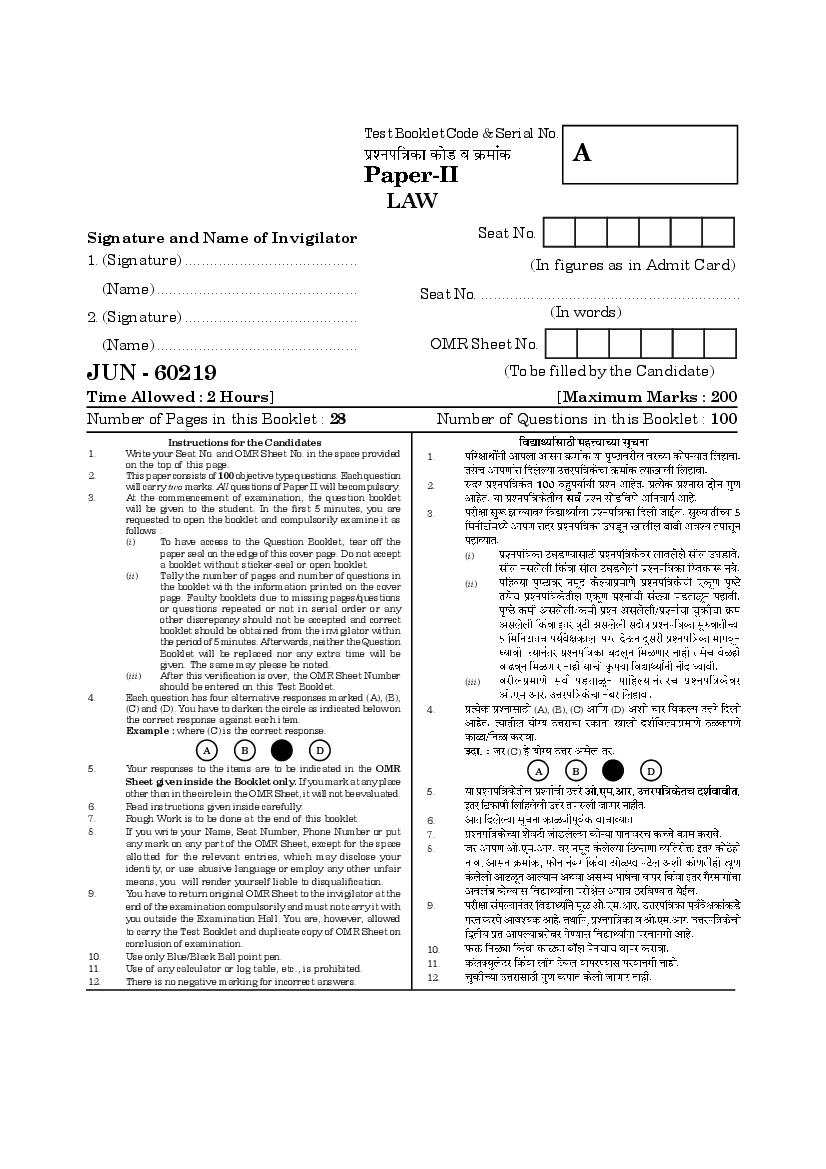
A
LAW
Signature and Name of Invigilator Seat No.
1. (Signature) ......................................... (In figures as in Admit Card)
(Name) ................................................ Seat No. ..............................................................
2. (Signature) ......................................... (In words)
(Name) ................................................ OMR Sheet No.
JUN - 60219 (To be filled by the Candidate)
Time Allowed : 2 Hours] [Maximum Marks : 200
Number of Pages in this Booklet : 28 Number of Questions in this Booklet : 100
Instructions for the Candidates
1. Write your Seat No. and OMR Sheet No. in the space provided 1.
on the top of this page.
2. This paper consists of 100 objective type questions. Each question
will carry two marks. All questions of Paper II will be compulsory. 2.
3. At the commencement of examination, the question booklet
will be given to the student. In the first 5 minutes, you are 3.
requested to open the booklet and compulsorily examine it as
follows :
(i) To have access to the Question Booklet, tear off the
paper seal on the edge of this cover page. Do not accept (i)
a booklet without sticker-seal or open booklet.
(ii) Tally the number of pages and number of questions in
the booklet with the information printed on the cover (ii)
page. Faulty booklets due to missing pages/questions
or questions repeated or not in serial order or any
other discrepancy should not be accepted and correct
booklet should be obtained from the invigilator within
the period of 5 minutes. Afterwards, neither the Question
Booklet will be replaced nor any extra time will be
given. The same may please be noted.
(iii) After this verification is over, the OMR Sheet Number
(iii)
should be entered on this Test Booklet.
4. Each question has four alternative responses marked (A), (B),
(C) and (D). You have to darken the circle as indicated below on 4. (A), (B), (C) (D)
the correct response against each item.
Example : where (C) is the correct response.
A B D (C)
5. Your responses to the items are to be indicated in the OMR A B D
Sheet given inside the Booklet only. If you mark at any place
other than in the circle in the OMR Sheet, it will not be evaluated. 5.
6. Read instructions given inside carefully.
7. Rough Work is to be done at the end of this booklet. 6.
8. If you write your Name, Seat Number, Phone Number or put 7.
any mark on any part of the OMR Sheet, except for the space
8.
allotted for the relevant entries, which may disclose your
identity, or use abusive language or employ any other unfair
means, you will render yourself liable to disqualification.
9. You have to return original OMR Sheet to the invigilator at the
end of the examination compulsorily and must not carry it with 9.
you outside the Examination Hall. You are, however, allowed
to carry the Test Booklet and duplicate copy of OMR Sheet on
conclusion of examination.
10.
10. Use only Blue/Black Ball point pen.
11.
11. Use of any calculator or log table, etc., is prohibited.
12. There is no negative marking for incorrect answers. 12.
Page 2
Page 3
Paper II
Time Allowed : 120 Minutes] [Maximum Marks : 200
Note : This paper contains Hundred (100) multiple choice questions. Each question
carrying Two (2) marks. Attempt All questions.
1. The Principle/s of Natural Law 4. The history of the Natural Law is
Theory. a tale of the search of mankind for
(A) Universal order governing all absolute justice and its failure. Who
men said this ?
(B) Inalienable rights of an (A) Friedmann
individual (B) Dias
(C) Both (A) and (B) (C) Dicey
(D) None of the above (D) Holmes
2. Kelsen’s Grund norm is similar to 5. The Jural Corelative of ‘Power’ is :
Prof. H.L.A. Hart’s rule :
(A) Liability
(A) Rule of adjudication (B) Duty
(B) Rule of change (C) Disability
(C) Rule of recognition
(D) Immunity.
(D) None of the above
6. Thomas Nagel claims, people are in
3. According to....................., law is a.............................only if they belong
found, not made. to the same state.
(A) Roscoe Pound (A) Natural relationship
(B) Prof. H.L.A. Hart (B) Human relationship
(C) John Austin (C) Contractual relationship
(D) Savigny (D) Justice relationship
3 [P.T.O.
Page 4
personality is also known as : Morals’ authored by :
(A) Concession theory (A) H.L.A. Hart
(B) Symbolist theory (B) J.S. Mill
(C) Purpose theory (C) A.L. Goodhart
(D) Fiction theory (D) P. Devlin
8. Intellectual Property Right is an 11. ‘‘We the people of India’ depicted in
example of : the Preamble are indicative of the :
(A) Incorporeal ownership (A) Source of the Constitution
(B) Beneficial ownership (B) Enforcement of the Constitution
(C) Equitable ownership (C) Adoption of the Constitution
(D) Contingent ownership (D) Polity of the Constitution
9. Which of the following is not in 12. The rights conferred by Part III are
Roscoe Pound’s Scheme of suspended during emergencies
Interests ? except :
(A) Individual Interests (A) Articles 19 and 20
(B) Public Interests (B) Articles 20 and 21
(C) National Interests (C) Articles 22 and 25
(D) Social Interests (D) Articles 24 and 25
4
Page 5
the correct answer from the codes
is not a member of any house of given below it :
Parliament can be appointed as a List I (Doctrines)
Minister subject to his becoming a (a) Doctrine of Severability
member of either House within a (b) Doctrine of Waiver of
Fundamental Rights
period of :
(c) Doctrine of Pith and Substance
(A) 1 year (d) Doctrine of colourable
legislation.
(B) 3 months
List II (Cases)
(C) 6 months (i) Basheshar Nath Vs
Commissioner of Income Tax
(D) 9 months
(ii) RMDC Vs Union of India
14. Which of the following Writ calls
(iii) K.C. Gajapati Narayana Deo
upon the holder of a public office to and other Vs State of Orissa
show to the court under what (iv) Prafulla Kumar Mukherjee Vs
The Bank of Commerce
authority he is holding that office.
Codes :
(A) Writ of Prohibition (a) (b) (c) (d)
(A) (ii) (i) (iv) (iii)
(B) Writ of Quo warranto
(B) (i) (ii) (iii) (iv)
(C) Writ of Mandamus
(C) (iii) (iv) (i) (ii)
(D) Writ of Certiorari (D) (iv) (iii) (ii) (i)
5 [P.T.O.
Page 6
Indian Constitution deals with the
body without observing principles of
temporary transitional and special
natural justice, where natural
provisions.
justice ought to have been observed
(A) Part IX
in................................
(B) Part XXII
(A) Void
(C) Part XXI
(B) Voidable
(D) Part X
(C) Valid
17. The Chief Election Commissioner
shall not be removed from his office (D) Void ab initio
except in like manner and on the
20. Which of the following is true about
like grounds as a :
discretionary power ?
(A) Governor
(A) Discretion is the power to make
(B) Minister
choice between different courses
(C) Judge of a Supreme Court
of action.
(D) Speaker of the Parliament.
(B) It is the power to give due
18. Administrative Law is based on the
regards to the legitimate
following basic postulate/s :
expectation of the affected
(A) Power is conferred on the
parties.
Administration by Law
(C) It is the power to make choice
(B) No power is absolute and
uncontrolled howsoever broad as per personal liking.
the power conferred. (D) It is the power to make choice
(C) Both (A) and (B) by applying principles of
(D) None of the above Natural Justice.
6
Page 7
law results in the law of nations and
or her home but who remains within
nations are absolutely bound to
his or her country’s borders is known
observe natural law ?
as......................
(A) Oppenheim
(A) Refugee
(B) Vattel
(C) Brierly (B) Immigrant
(D) Grotius (C) Internally displaced person
22. In which case the Permanent Court (D) Stateless person
of International Justice held that in
case of a conflict between a 25. The crime for which extradition is
customary rule and a treaty rule, the claimed should be a crime in the
latter shall prevail ? country extraditing and also in the
(A) S.S. Lotus case country claiming extradition. This
(B) S.S. Wimbledon principle is known as....................
(C) Nicaragua case (A) Rule of criminality
(D) Chorzow factory case
(B) Rule of speciality
23. Which of the following propositions
(C) Rule of double criminality
gives a correct explanation of
declaratory theory of recognition ? (D) Rule of double jeopardy.
(A) Act of recognition alone creates
26. The present Secretary General of
statehood.
United Nations Organisation is..........
(B) Act of recognition is merely a
formal acknowledgement of an (A) Boutros Boutros Ghali
established situation of fact.
(B) Ban Ki Moon
(C) Act of recognition has nothing
(C) Kofi Annan
to do with statehood.
(D) None of the above (D) Antonio Guterres
7 [P.T.O.
Page 8
investigation of the basis of the International Community’s first
attempt to formalize the laws of war
dispute and the submission of a
and war crimes in the nascent body
report embodying suggestions for a
of Secular International Law ?
settlement is known as....................
(A) Paris Convention
(A) Inquiry
(B) Geneva Convention
(B) Arbitration
(C) Hague Convention
(C) Conciliation (D) Vienna Convention
(D) Mediation 30. Which of the following conventions
provides that hospital ships may in
28. Which one of the following is not the
no circumstances be attacked or
principal organ of World Trade
captured but respected and
Organisation ?
protected ?
(A) General Bureau
(A) The First Geneva Convention
(B) Council for trade in goods (B) The Second Geneva Convention
(C) The Trade Policy Review Board (C) The Third Geneva Convention
(D) Ministerial Conference (D) The Fourth Geneva Convention
8
Page 9
the correct answer using codes given
and with the help of codes given
below it :
below point out the correct
List I
explanation :
(a) The state of mind of a man who
Assertion (A) : not only foresees but also desires
the possible consequences of his
Before a person can be convicted of
conduct.
criminal breach of trust, it must be
(b) The actor does not desire the
proved firstly, that there was an
consequences but foresees the
entrustment of property or a possibility and consciously takes
dominion over property. the risk
Reason (R) : (c) Personal information of the
person doing the act or the
To establish a charge of criminal conscious awareness of certain
breach of trust, it is not the duty of facts.
the prosecution to prove the precise (d) Failure to take reasonable care
mode of conversion,misappropriation to avoid causing injury or loss
to another person.
or misapplication by the accused of
List II
the property entrusted to him :
(i) Knowledge
Code :
(ii) Negligence
(A) Both A and R are individually (iii) Intention
true and R is the correct
(iv) Recklessness
explanation of A.
Codes :
(B) Both A and R are individually (a) (b) (c) (d)
true and R is not the correct
(A) (i) (ii) (iii) (iv)
explanation of A.
(B) (iv) (iii) (ii) (i)
(C) A is true but R is false (C) (iii) (i) (iv) (ii)
(D) A is false but R is true (D) (iii) (iv) (i) (ii)
9 [P.T.O.
Page 10
from severe pain due to old age and
(A) A mere agreement between two
diseases with his consent. ‘A’ has
or more persons to do an
committed :
unlawful act is enough
(A) Murder
(B) Some act or illegal omission
must take place in pursuance of (B) Attempt to murder
an engagement between two or (C) Culpable homicide not
more persons to do an unlawful amounting to murder
act.
(D) No offence
(C) There must be an intentional
36. Offence of criminal elopement is
aid by one person to another for
dealt under which provision of
the doing of an offence.
Indian Penal Code ?
(D) One person must instigate the
(A) Section, 497
other for the commission of an
(B) Section, 498
offence.
(C) Section 494
34. In which case the Supreme Court
held that, adultery cannot and (D) Section, 495
should not be a crime. It can be a 37. ..................looks at sanction as
ground for civil offence, a ground for instrument of rehabilitation and tries
divorce ? to mould the behaviour of criminal.
(A) V. Revathi Vs. U.O.I. (A) Preventive theory
(B) Yusuf Azis Vs. State of Bombay (B) Deterrent theory
(C) Sowmithri Vishnu Vs. U.O.I. (C) Reformative theory
(D) Joseph Shine Vs. U.O.I. (D) Retributive theory
10
Page 11
class or community promotes enmity
that a Criminal Injuries
between different groups liable to
Compensation Board should be
punish under Section........... of I.P.C.
established for the award of
(A) 121 A
compensation whether or not
(B) 153
conviction has taken place.
(C) 124 A
(A) Vishaka Vs. State of Rajasthan
(D) 153 A
(B) Delhi Domestic Working 41. Who amongst the following, has
Women’s Forum Vs. U.O.I. defined ‘tort’ as :
‘‘An infringement of right in rem of
(C) Chairman, Railway Board Vs.
a private individual giving a right
Chandrima Das
of compensation at the suit of the
(D) Nilabati Behera V. State of injured party.’’
Orissa (A) Sir John Salmond
(B) Frazer
39. The age of doli incapax in India
(C) Winfield
is.....................
(D) Pollock.
(A) A person who is below seven
42. The case of Rylands Vs. Fletcher
years of age.
deals with :
(B) A person who is in between (A) Liability of manufacturer
seven to twelve years of age towards consumers
(C) A person who is below sixteen (B) Non-natural use of land
years of age (C) Negligence of a person who has
undertaken the work
(D) A person who is below eighteen
(D) Non-intentional act of the
years of age. independent contractor.
11 [P.T.O.
Page 12
care.......... List I
(A) is objective and applicable to (a) Scienti non fit injuria
motor accidents cases only (b) Ex turpi causa non-oritur actio
(B) is objective and applies to all (c) Qui facit per alium facit per se
skilled defendants (d) Salus populi Supreme lex
(C) is both subjective and objective List II
and applies in relation to
(i) He who does an act through
professional defendants another is deemed in law to do
(D) is subjective and applies to the it himself
cases of vacarious liability. (ii) No injury is done to the person
who knowingly does an act
44. The test of directness for considering
and determining the remoteness of (iii) An action does not arise from
an immoral act.
damages has been determined in
which of the following cases : (iv) Things speak for themselves
(A) State of Haryana Vs. Santra (v) The welfare of people is supreme
law
AIR 2000 SC 1888
Codes :
(B) State of Punjab Vs. Shiv Ram
(a) (b) (c) (d)
AIR 2005 SC 105
(A) (ii) (iii) (i) (iv)
(C) Re Polemis and Furness Withy
and Co. Ltd. [1921] 3KB 560 (B) (ii) (iv) (i) (v)
(C) (ii) (iii) (i) (v)
(D) M.C. Mehta Vs. Union of India
AIR 1987 SC 965. (D) (iii) (ii) (i) (v)
12
Page 13
under law of torts, go through the
and answer by using codes below :
following statements :
Assertion (A) :
(i) Defamatory statement must be
The law takes cognizance of made in good faith
carelessness in the abstract. (ii) Defamatory statement must
Reason (R) : be made directly referring the
plaintiff.
Cause of action for negligence
(iii) Defamatory statement must be
accrues when real damage is
made with the intention of
suffered.
harming reputation of person.
Codes : (iv) The defendant need not believe
that such a statement would
(A) Both (A) and (R) are true and
harm the reputation of plaintiff.
(R) is right explanation of (A)
In the light of above, which of the
(B) Both (A) and (R) are true, but
following options are correct.
(R) is not right explanation of
(A) Only (i), (iii) and (iv) are correct
(A)
(B) Only (iii) and (iv) are correct
(C) (A) is right but (R) is wrong
(C) Only (iii) is correct
(D) (A) is wrong, but (R) is right. (D) Only (ii), (iii) and (iv) are correct
13 [P.T.O.
Page 14
48. Which of the following are the
removal of his one kidney in
elements of the tort of intentional Dr. Anand’s Hospital, due to
negligence of the surgeon, who
infliction of emotional distress ? performed the operation a piece of
cotton was left in his abdomen. The
(i) The defendant intended the same was removed by a second
conduct that caused the plaintiff surgery for which Sameer was not
paid any amount.
in distress
In the light of above facts, which one
of the following statements is
(ii) The defendant conduct was out-
correct ?
rageous or intolerable (A) Surgeon cann’t be held
responsible as surgery is
(iii) The plaintiff’s emotional distress professional art, highly technical
and having chances of human
was severe
error, for which he can’t held
liable, howerer Hospital has to
(iv) The defendant intended to
pay compensation.
cause emotional distress or (B) Surgeon can be held liable,
intended the conduct and was provided that Sameer is
successfully proved that he is
rackless about whether consumer and there is
deficiency in the service
emotional harm would result.
rendered. Again Sameer has
not paid for 2nd surgery.
Choose the correct option :
(C) Despite negligence, the hospital
(A) Only (i), (ii) and (iii) are correct and surgeon have defence under
‘‘Res Ipsa Loquitur.
(B) Only (iii) and (iv) are correct (D) Surgeon will be responsible.
The piece of cotton in the
(C) Only (ii) and (iii) are correct abdomen of Sameer is sufficient
proof and is a result of Res Ipsa
(D) Only (ii), (iii) and (iv) are correct Loquitur.
14
Page 15
properly defines the objectives and with the help to codes given
narrated in the Preamble of the below, point out the correct
Consumer Protection Act, 1986 ? explanation :
(A) An Act to provide the protective Assertion (A) :
mechanism of consumer An acceptance is to a proposal what
redressal system and further to a lighted match is to a train of
promote consumer movements gunpowder.
(B) An Act to provide better Reason (R) :
protection of the interests of the
Acceptance converts the offer into a
consumers and for that purpose
promise and then it is late to
to make provision for the
remove.
establishment of consumer
(A) Both A and R are true and R
councils and other authorities
is good explanation of A.
for the settlement of consumer
disputes. (B) Both A and R are true and
R is not a good explanation
(C) An Act to set up a mechanism
of A.
for consumer protection to
promote the constitutional (C) A is true but R is false.
objectives and establish the (D) A is false but R is true.
forum of consumer, seller and
52. Breach of contract can result in for :
promote consumer awareness.
(A) Liquidated damages
(D) An Act to promote consumerism
(B) Unliquidated damages
regule unfair trade practices,
safeguard from unfair (C) Both (A) and (B)
competition. (D) Neither (A) nor (B)
15 [P.T.O.
Page 16
B, a lunatic, with necessaries
of the Sale of Goods Act, 1930 to be
suitable to the style of their living.
the ‘whole delivery’.
Whether A can claim the reimbursed
from B’s property under which (A) The part delivery must be with
section of certain relations
intentions of serving it from the
resembling those created by
whole
contract ?
(A) 68 (B) The part delivery must be in the
(B) 69 progress of the whole
(C) 70 (C) Either (A) or (B)
(D) 71
(D) Both (A) and (B)
54. The right of the power to redeem
56. A right to participate in profits,
back the goods pledged continued
till : although strong but not a conclusive
(A) The hammer fallen for third test of partnership was laid down in :
time in an auction.
(A) Tellis Vs. Saldanha
(B) The sale was complete
(B) Grace Vs. Smith
(C) Sale money was received by
(C) Re; Somtow Iron Co.
auctioneer
(D) All of the above (D) Cox Vs. Hickman.
16
Page 17
applicable to :
and the only brain of the company,
(A) Promissory Note which is the body and the company
(B) Bank draft can and does act only through them.
(C) Cheque This was held in which of the
(D) Bill of Exchange following cases ?
58. What do you mean by a floating (A) Percival Vs. Wright
charge ?
(B) Allen Vs. Hyatt
(A) It is a charge on fixed and
(C) Bath Vs. Standard Land Co.
present assets which can be
Ltd.
used in the ordinary course of
business. (D) Coleman Vs. Myers
(B) It is a charge on present and 60. The Corporate Social Responsibility
future assets which can be used
Committee consists of :
in the ordinary course of
business (A) Four or more directors
(C) It is a charge on present and (B) Three or more directors of whom
future assets which can’t be used at least one should be
in the ordinary course of independent director
business
(C) Two or more directors all of
(D) It is a charge on present and
whom should be independent
fixed assets which cannot be
directors
used in the ordinary course of
business. (D) Two independent directors.
17 [P.T.O.
Page 18
correct answer using the codes given
with the help of the codes given
below (based on Hindu Marriage
below, choose the correct answer :
Act) :
(I) The Hindu Marriage Act List I
prohibits the marriage between (a) Impotency of husband
the persons who are within the (b) Option of puberty
prohibited degrees of (c) Neglect and desertion of wife
relationship with each other.
(d) Sapindas
(II) The contravention of the above List II
provision is punishable with (i) Repudiation of marriage by a
simple imprisonment or fine. decree of divorce u/s 13(2)
(ii) Void marriage
Codes :
(iii) Annulment of marriage u/s 12
(A) I is correct and II is incorrect
(iv) Order of maintenance
(B) Both I and II are incorrect
Codes :
(C) Both I and II are correct and (a) (b) (c) (d)
II is the result of violation (A) (i) (iii) (ii) (iv)
of I. (B) (iii) (i) (iv) (ii)
(D) Both I and II are not related (C) (ii) (i) (iii) (iv)
to each other under H.M. Act. (D) (iv) (ii) (i) (iii)
18
Page 19
65. Under Parsi Marriage and Divorce
leaving his mother, one daughter of
Act, 1936 no marriage shall be valid
deceased sister and two sons of his
deceased brother. The share of each if.........................
son of the deceased brother will
(A) The contracting parties are
be :
related to each other in any of
(A) 1/3
the degrees of consanguinity or
(B) 1/4
(C) 1/2 affinity
(D) 1/6 (B) Such marriage is not
64. Under section 6 of Hindu Minority
solemnized by performing
and Guardianship Act, 1956, the
Ashirvad ceremony
natural guardian of an illegitimate
minor child is................. (C) A male has not completed 21
(A) Mother
years of age and a female has
(B) Father
not completed 18 years of age
(C) Both mother and father
(D) The marriage is not performed
simultaneously
(D) Either mother or father at Agyari.
19 [P.T.O.
Page 20
66. Consider the following statements held that the second marriage of a
and choose the correct answer : person during the pendency of an
appeal against a divorce decree
would not be void in cases where the
Under The Indian Christian parties have decided not to pursue
Marriage Act, 1872 : the appeal ?
(A) Lila Gupta Vs. Laxmi Naraian
(I) A Christian marriage can take and others
(B) Anurag Mittal Vs. Mrs. Shaily
place at the house of the bride’s Mishra Mittal
mother (C) Revanasiddappa Vs. Mallikarjun
(D) K.S. Bhoopathy Vs. Kokila
(II) A marriage even if one of the
68. Match List I with List II and select
parties is a Hindu cannot be the correct answer from the codes
given below it :
dissolved by a decree of divorce
List I (Cases)
under Sec-13 of Hindu (a) Daniel Lahr. Vs. Union of India
Marriage Act. (b) Shayara Bano Vs. Union of
India
(III) When the marriage is (c) Sarla Mudgal Vs. Union of India
performed beyond permissible (d) Ahmedabad Women Action
Group Vs. Union of India.
hours and outside the church
List II (Decisions)
without the special licence is (1) Triple Talaq invalid
punishable. (2) Second marriage by conversion
invalid
Codes : (3) Validity of Muslim Women
(Protection of Rights on Divorce)
(A) Statement I is correct and II, Act, 1986
III are incorrect. (4) Personal Laws cannot be tested
on the basis of Fundamental
Rights.
(B) Statements I, II are correct and
Codes :
III is incorrect.
a) (b) (c) (d)
(C) Statements I, II, III are correct (A) (3) (1) (2) (4)
(B) (2) (1) (4) (3)
(D) Statement I is incorrect and II,
(C) (3) (1) (4) (2)
III are correct. (D) (4) (1) (3) (2)
20
Page 21
under Muslim Law means : earthquake cyclone or volcanic
(A) A man may not have two wives eruption is known as........................
at the same time
(A) Manmade pollution
(B) A man may not have at the
same time, two wives who so (B) Natural pollution
related to each other by
(C) Accidental pollution
consanguinity
(C) A man may not have at the same (D) Industrial pollution
time, two wives who are so related 72. Which protocol was adopted in order
to each other by consanguinity,
to ensure an adequate level of
affinity or fosterage.
protection in the field of safe transfer
(D) A man may not have at the
handling and use of living modified
same time, two wives who are
so related to each other by organisms ?
consanguinity, affinity or (A) Cartagena Protocol
fosterage, that if either of them
had been a male, they could not (B) Nagoya Protocol
have lawfully intermarried.
(C) Kyoto Protocol
70. Which of the following is not a
ground of divorce for wife under the (D) Nairobi Protocol
Dissolution of Muslim Marriage Act, 73. The chief wildlife warden cannot
1939 ?
grant permit to hunt to any person
(A) Husband neglected or has for which of the following purpose
failed to provide for her
under section 12 of wildlife
maintenance for a period of two
years (Protection) Act, 1972 ?
(B) Husband marries with another (A) Education
woman
(B) Scientific research
(C) Husband imprisoned for a
period of seven years or more (C) Collection of specimen for
personal use
(D) Husband treats her with
cruelty. (D) Scientific management
21 [P.T.O.
Page 22
Assessment’ has come from which expressed and guaranteed by law in
legislation ? the forms of :
(A) Environment (Protection) Act,
(A) Treaties
1986
(B) Customary International Law
(B) Air (Prevention and Control of
Pollution) Act, 1981 (C) General principles and other
sources of International Law
(C) National Environmental Policy
Act, 1969 (D) All of the above
(D) Water (Prevention and Control 77. In India, the Law on Persons with
of Pollution) Act, 1974 Disabilities (Equal Opportunities)
75. Under section 26 of National Green Act was enacted in the year...........
Tribunal Act, 2010 what is the
(A) 1975
penalty for failure to comply with
the orders of the Tribunal. (B) 2001
(A) Imprisonment up to two years (C) 1995
or with fine up to Rs. 5 crore
(D) 2000
or both
78. The second optional protocol of the
(B) Imprisonment up to five years
International Covenant on Civil and
or with fine up to Rs. 10 crore
or both Political Rights aims at the abolition
of the....................................
(C) Imprisonment up to two years
or with fine up to Rs. 10 crore (A) Child Labour
or both
(B) Death Penalty
(D) Imprisonment up to three years
(C) Slavery
or with fine up to Rs. 10 crore
or with both (D) Debt bondage
22
Page 23
the Rights of the Child (CRC) was stipulates that a person is entitled
adopted by the United Nations in to sell his copy of a copyrighted work
the year...................... to anyone without being required to
observe any conditions attached by
(A) 2003
the copyright owner to such sale.
(B) 1989
(A) Doctrine of Election
(C) 1966
(B) Doctrine of Prima facie sale
(D) 2006
(C) Doctrine of first sale
80. Who among the following shall be (D) Doctrine of original sale
deemed to be members as Ex-Officio
82. The industrial progress and cultural
members of National Human Rights
goods have a beneficial effect on
Commission under the Protection of
society. Thus IPR rights are
Human Rights Act, 1993 ?
incentive to the creator because of
(A) The Chairperson of the the profit they bring for the whole
National Commission for society.
Minorities The above statement represents
(B) The Chairperson of the which one of the theory of IPR ?
National Commission for the (A) The Utilitarian theory of IPR
Scheduled Castes and
(B) The Natural Right theory of
Scheduled Tribes
IPR
(C) The Chairperson of the
(C) The Ethics and Reward theory
National Commission for of IPR
Women
(D) The Personhood theory of IPR
(D) All of the above.
23 [P.T.O.
Page 24
the principle agreed upon in the deciding the dispute whether the
Berne Convention for Protection of trade mark of plaintiff and
Literary and Artistic Works (1886) ?
respondent are likely to be a
(A) National Treatment deceptively similar and may create
(B) Principle of protection to confusion the Apex court expressed—
original creator ‘‘........the proprietor of the trade mark
(C) Principle of Automatic cann’t enjoy monopoly over the entire
Protection class of goods and particularly, when
(D) Principle of Independence of he is not using the said trade mark
Protection in respect of certain goods falling
84. Which of the following rights always under the same class.’’
rests in the author and can’t be Choose the correct option :
transfer by assignment licence or
(A) National Sewing Thread Co.
sale ?
Ltd. Vs James Chadwick and
(A) Commercial Right of Licence
Bros AIR 1953 SC 357
(B) Performers Right of Performer
(B) Nestle India Ltd. Vs Mood
(C) Moral Rights of an author
Hospitality Pvt. Ltd. (2010) 42
(D) Right to edit and translate PTC 514 (Del) (DB)
85. A non-counterfeit product imported (C) Shree Nath Heritage Liquor
from another country without the
Pvt. Ltd. & Ors Vs Allied
permission of the intellectual
Blender and Distillers Pvt. Ltd.
property owner is called as :
(2015) 221 DLT 359.
(A) Counterfeit smuggling
(D) M/s Nandhini Deluxe Vs M/s
(B) IPR Piracy
Karnataka Co-operative Milk
(C) Parallel import Producers Federation Ltd. Civil
(D) Cross-Border import Appeal Nos. 2937-2942 of 2018.
24
Page 25
Geographical Indication ? appeal against the order of cyber
appellate tribunal ?
(A) Twenty years from the date of
(A) 30 days
Registration
(B) 60 days
(B) Ten years but may be renewed
(C) 90 days
from time to time for unlimited
(D) 180 days
period
90. As per S.66E of the internation
(C) Twenty years but may be from Technology Act, 2000 (As amended)
time to time for unlimited what is the punishment prescribed
period for violation of privacy ?
(A) Punished with the
(D) Ten years but may be renewed
imprisonment which may
extended for another ten years,
extend to three years and with
if manufacturer demonstrate fine not extending three lakh
the characteristic features of rupees
geographical indications still (B) Punished with the
exist with the product. imprisonment which may
extend to three years or with
88. Bio-diversity of a Geographical
fine not extending two lakh
region represents : rupees or both
(A) The diversity in the organism (C) Punishment with the
living in the region imprisonment which may extend to
five years or with fine not extending
(B) Endanger species found in the three lakh rupees or both
region
(D) Punishment with the
(C) Species epidemic to the region imprisonment which may
extend to one year or with fine
(D) Genetic diversity present in the
not extending two lakh rupees
dominant species of the region. or with both.
25 [P.T.O.
Page 26
is coined in the landmark judgment
of America disputes between citizen
given in :
and government are adjudicated by
(A) Cundey Vs Lindsay
the ordinary courts of law. Although
(B) Sivaji Dayanu Patil Vs Smt.
many disputes are dealt with by
Vatschala More
specialised tribunals, these are
(C) Rita Devi Vs New India
themselves subject to control by the
Assurance Comapny
ordinary courts and so
(D) Rylands Vs Fletcher.
the......................... is preserved.
92. Under which of the following form
of the government, only the central (A) Separation of power
government has primary law
(B) Rule of Law
making powers ?
(C) Independence of judiciary
(A) Federal
(B) Unitary (D) Legitimate expectation
(C) Confederation 95. Under the Competition Act, the
(D) Quasi federal power to check whether appreciable
93. Which of the following in not the adverse effect on competition has
essential characteristic of a Federal caused or not is that of :
Constitution ?
(A) CCI
(A) Distribution of powers
(B) Central Government
(B) A written constitution
(C) Supremacy of constitution (C) The Finance Minister
(D) Flexibility (D) Finance Commission
26
Page 27
99. The Parliamentary Commissioner for
modified the role of the Lord
Chancellor and strengthened the Administration is empowered under
independence of Judiciary in U.K.
(A) Supreme Court Act, 1981 the Parliamentary Commissioner
(B) Act of Settlement Act, 1967 to investigate complaints
(C) Appellate Jurisdiction Act,
1876 of any action relating to :
(D) The Constitution Reform Act,
2005. (A) Administrative, legislature and
97. The Supreme Court of India ruled judicial functions.
that there could not be any blanket
immunity from judicial review of
laws included in the Ninth Schedule (B) Which the person aggrieved has
in the case of :
or had a right to appeal
(A) Maneka Gandhi Vs Union of
India
(C) The person aggrieved has or
(B) ADM Jabalpur Vs Shivkant
Shukla had a remedy by way of
(C) Kihoto Holohon Vs Zachilhu proceedings in any court of law
(D) I.R. Coelho Vs State of Tamil
Nadu. (D) Any enactmentor by prerogative.
98. The amendment to the United States
Constitution only become effective 100. Who shall have the right to
3 information under Sec. 3 of the
after being ratified by th of the
4
states whereas the formal Right to Information Act, 2005 ?
amendment to same provisions need
special majority plus ratification by (A) All persons
the Legislatures of not less than :
(A) 3/4th of the states (B) All citizens
(B) One-half of the states
(C) All public authorities
(C) One-third of the states
(D) 1/4th of the states (D) Appropriate government.
27 [P.T.O.
Page 28
28
Document Details
| Board / Org | Maharashtra Exams |
| Exam | Maharashtra State Eligibility Test |
| Type | Question Paper |
| Pages | 28 |
| Updated | 30 Apr 2026 |