MAHA SET 2015 Question Paper 2 Physics
Finished viewing? Save it for later —
Download MAHA SET 2015 Question Paper 2 Physics (PDF · 20 pages)About MAHA SET 2015 Question Paper 2 Physics
MAHA SET 2015 Question Paper 2 Physics is available here for free download. Published by Maharashtra Exams for MAHA SET, this question paper can be viewed online or downloaded as a PDF (20 pages). Candidates preparing for MAHA SET can use MAHA SET 2015 Question Paper 2 Physics to understand the exam pattern, the type of questions asked, and the overall difficulty level.
Frequently Asked Questions
How can I download MAHA SET 2015 Question Paper 2 Physics?
Open this page and click the Download button to save MAHA SET 2015 Question Paper 2 Physics as a PDF. It is completely free on AglaSem Docs.
Is MAHA SET 2015 Question Paper 2 Physics free to download?
Yes. MAHA SET 2015 Question Paper 2 Physics can be viewed online and downloaded as a PDF free of cost on AglaSem Docs.
How many pages does MAHA SET 2015 Question Paper 2 Physics have?
MAHA SET 2015 Question Paper 2 Physics contains 20 pages, which you can read online or download together as a single PDF.
Where can I find more MAHA SET study material?
You can find more MAHA SET question papers, sample papers, syllabus, and answer keys on AglaSem Docs.
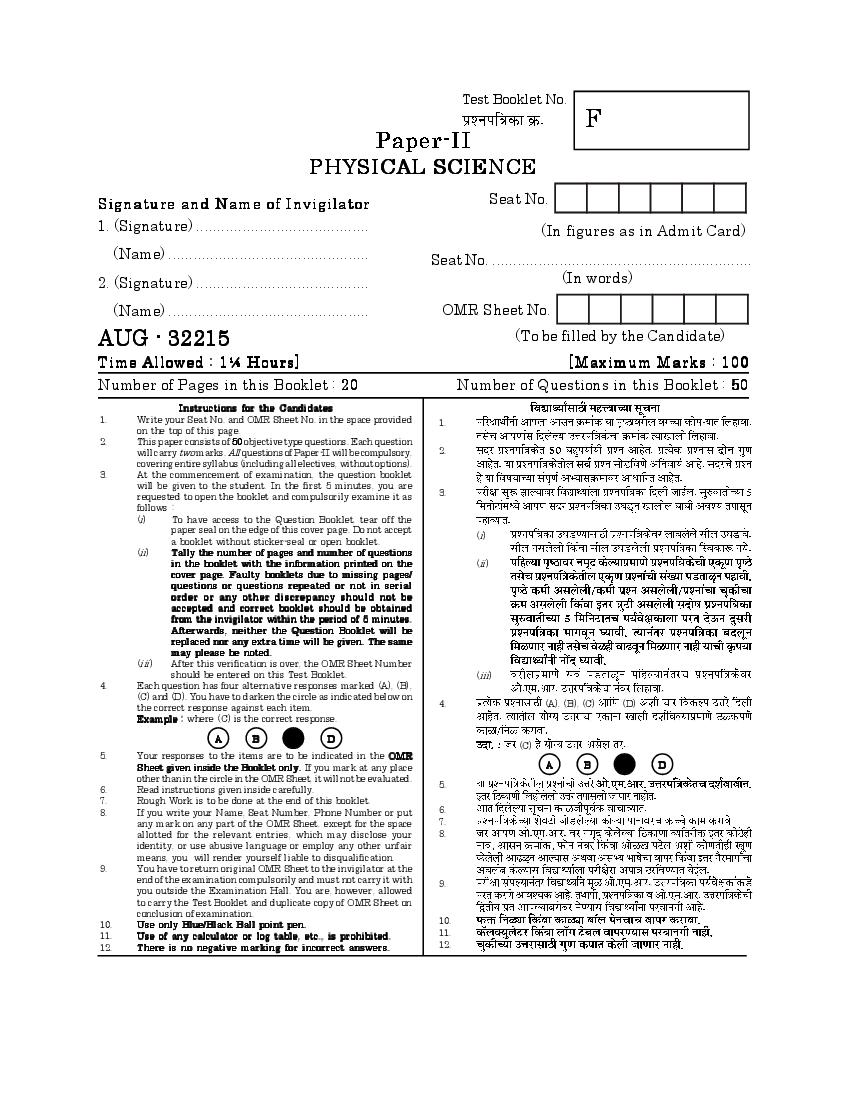
MAHA SET 2015 Question Paper 2 Physics – Text
Read the full text of this question paper below — useful to quickly search, copy and reference the content online without downloading the PDF.
📄 View text version (20 pages)
Page 1
F
PHYSICAL SCIENCE
Signature and Name of Invigilator Seat No.
1. (Signature) ......................................... (In figures as in Admit Card)
(Name) ................................................ Seat No. ..............................................................
2. (Signature) ......................................... (In words)
(Name) ................................................ OMR Sheet No.
AUG - 32215 (To be filled by the Candidate)
Time Allowed : 1¼ Hours] [Maximum Marks : 100
Number of Pages in this Booklet : 20 Number of Questions in this Booklet : 50
Instructions for the Candidates
1. Write your Seat No. and OMR Sheet No. in the space provided 1.
on the top of this page.
2. This paper consists of 50 objective type questions. Each question
will carry two marks. All questions of Paper-II will be compulsory, 2.
covering entire syllabus (including all electives, without options).
3. At the commencement of examination, the question booklet
will be given to the student. In the first 5 minutes, you are
requested to open the booklet and compulsorily examine it as 3.
follows :
(i) To have access to the Question Booklet, tear off the
paper seal on the edge of this cover page. Do not accept
(i)
a booklet without sticker-seal or open booklet.
(ii) Tally the number of pages and number of questions
in the booklet with the information printed on the (ii)
cover page. Faulty booklets due to missing pages/
questions or questions repeated or not in serial
o rder or any other discre pancy should not be
accepted and correct booklet should be obtained
from the invigilator within the period of 5 minutes.
Afterwards, neither the Question Booklet will be
replaced nor any extra time will be given. The same
may please be noted.
(iii) After this verification is over, the OMR Sheet Number
should be entered on this Test Booklet. (iii)
4. Each question has four alternative responses marked (A), (B),
(C) and (D). You have to darken the circle as indicated below on
the correct response against each item. 4. (A), (B), (C) (D)
Example : where (C) is the correct response.
A B D
(C)
5. Your responses to the items are to be indicated in the OMR
Sheet given inside the Booklet only. If you mark at any place A B D
other than in the circle in the OMR Sheet, it will not be evaluated.
5.
6. Read instructions given inside carefully.
7. Rough Work is to be done at the end of this booklet.
8. If you write your Name, Seat Number, Phone Number or put 6.
any mark on any part of the OMR Sheet, except for the space 7.
allotted for the relevant entries, which may disclose your 8.
identity, or use abusive language or employ any other unfair
means, you will render yourself liable to disqualification.
9. You have to return original OMR Sheet to the invigilator at the
end of the examination compulsorily and must not carry it with 9.
you outside the Examination Hall. You are, however, allowed
to carry the Test Booklet and duplicate copy of OMR Sheet on
conclusion of examination.
10. Use only Blue/Black Ball point pen. 10.
11. Use of any calculator or log table, etc., is prohibited. 11.
12. There is no negative marking for incorrect answers. 12.
Page 2
Page 3
Paper II
Time Allowed : 75 Minutes] [Maximum Marks : 100
Note : This Paper contains Fifty (50) multiple choice questions. Each question
carries Two (2) marks. Attempt All questions.
3. The constant term ( a 0 ) in the
1. If a is a constant vector, then
Fourier series expansion of the
· a r is equal to : function f(x) = x2 for – < x <
is :
(A) 2
(A) a
(B) 2/3
(B) 2a
(C) /2
(C) 0 3/3
(D)
(D) a/2 4. Fourier transform of unit step
2. The volume of the parallelepiped function :
with sides : 1 x 0
x
0 x 0
a iˆ 2 ˆj 3 kˆ,
is :
b 4 iˆ 5 ˆj 6 kˆ and
1
(A)
2 k
c 7 iˆ 8 ˆj 10 kˆ is :
1
(A) 2 3 (B) k
2
(B) 2 1 1
(C)
2 k2
(C) 3
1
(D) 3 (D) e k
2 k
3 [P.T.O.
Page 4
5. The residue of at z = ia 7. y ( x ) satisfies the differential
z2 a2
is : equation :
(A) ia/2 d2y
y cosec x
dx 2
(B) ia
The complementary function part
(C) ia2 yc of y(x) is given by :
(D) ia2/2 (A) yc(x) = c1 sin x + c2 cos x
6. A deck of 5 cards (each carrying a
(B) yc(x) = xeix
distinct number from 1 to 5) is
(C) yc(x) = (c1 sin x + c2 cos x) ex
shuffled thoroughly. Two cards are
(D) yc(x) = c1ex + c2 cos x
then removed one at a time from the
deck. What is the probability that 8. A, B, C, D are (n × n) matrices, each
the two cards are selected with the with non-zero determinant. If :
number on the first card being one
ABCD = I,
higher than the number on the
then B–1 is :
second card ?
(A) D–1C–1A–1
(A) 1/5
(B) 4/25 (B) CDA
(C) 1/4 (C) ADC
(D) 2/5 (D) does not exist
4
Page 5
9. The degrees of freedom for a particle
the Lagrangian is due to “space is
falling under gravity (without air isotropic” characteristic of the
inertial frame of reference ?
resistance) are : (A) Invariant to translation
(B) Invariant to time
(A) Zero
(C) Invariant to rotation
(D) Explicit function of time
(B) One
12. For a given system, Hamiltonian
H(q, p) is defined as :
(C) Two
H(q, p) = p + 1 p 2 · sin q |p| 1.
The Hamilton’s equations of motion
(D) Three
are :
p sin q
10. A particle of mass m is released from (A) q 1 ,
1 p2
height h. Its velocity at the position p 1 p 2 cos q
when it has covered a distance equal p cos q
(B) q 1 ,
1 p2
to (h/2) is :
p 1 p 2 cos q
2g 2 p cos q
(A) v = (C) q 1 ,
h 1 p2
2g p 1 p 2 cos q
(B) v =
h
p sin q
(D) q 1 ,
(C) v = g. h 1 p2
(D) v = g.h p 1 p 2 cos q
5 [P.T.O.
Page 6
central force, which of the following pendulum rotates with infinite
quantities is invariant ? period, when it is located at ( is the
(A) Linear velocity lattitude of location) :
(B) Angular velocity (A) = 90°N
(C) Linear momentum (B) = 60°N
(D) Angular momentum (C) = 30°N
14. Which of the following statements (D) = 0°
holds true for a rigid rotator (or
16. An observer is moving with
rotor) ?
relativistic speed u . His length
(A) All the three principal moments
measurements along the direction
of inertia are different
of velocity are half of the
(B) All the three principal moments measurements made when he
of inertia are equal
was at rest. His time measurement
(C) Two of the three principal of 1 hr. when he was at rest, now
moments of inertia are equal becomes :
and the third one is non-zero
(A) 30 minutes
and different
(B) 01 hour
(D) Two of the three principal
moments of inertia are equal (C) 02 hours
and the third one is zero (D) Infinite hours
6
Page 7
17. The magnetic induction B at point
100 electric dipoles of unit moments.
O in the figure is given as : What would be the flux of electric
field emanating from the cube ?
20
(A) V cm
0
100
(B) V cm
30 0
(C) Zero V cm
200
(D) V cm
0
19. A uniform current 20 A flows
0
I 1 1 through a copper pipe of inner
(A) 4 R1 R2 radius 10 cm. Which of the following
statements is valid ?
(A) The magnetic field is non-zero
0I except along the axial points of
(B) R1 R 2
4 the pipe.
(B) The magnetic field everywhere
inside the pipe is zero.
0
I 1 1
(C) 4 R1 R2 (C) The magnetic field everywhere
inside the pipe is constant and
non-zero.
0I (D) The magnetic field is non-
(D) R1 + R 2
4 uniform inside the pipe.
7 [P.T.O.
Page 8
homogeneous linear dielectric magnetic field is more appropriately
material is placed in an uniform expressed as :
electric field E 0 . The resultant (A) a bound magnetization current
density J
electric field E inside the dielectric M
sphere is : (B) a free current density J
(C) stationary electric charges
(D) a free current density J and a
time-varying electric field D
22. The continuity equation for charges
and currents is not explicitly written
in the Maxwell’s equations. This is
because :
(A) It is not a universal law and
(A) Zero
holds good in certain cases only
(B) Uniform non-zero and parallel
(B) It is difficult to prove the
to E 0 continuity equation rigorously
(C) Uniform non-zero and anti- (C) It is not required for time-
varying electromagnetic fields
parallel to E 0
(D) It is already included implicitly
(D) Non-uniform but along E 0 in the Maxwell’s equations
8
Page 9
23. If A and V are the vector and
propagating in certain medium
such that the ratio of the electric
scalar potentials, respectively,
energy density to the magnetic
energy density is 0.01. Which of the
then the Lorentz gauge in time- following statements is valid for
this medium ?
varying electromagnetic case is
(A) Conduction current is about
100 times larger than the
given by : displacement current
(B) Conduction and displacement
V
(A) A 0 0 currents are of the same
t
magnitude
V
(B) ·A 0 0 (C) Displacement current is about
t
100 times larger than the
A conduction current
(C) ·V 0 0
t
(D) The medium through which the
V EM wave is propagating is a
(D) ·A 0 0
t
dielectric
9 [P.T.O.
Page 10
25. A proton of mass m and charge Q
a common eigenfunction . What
is moving in counter-clockwise
is the value of the commutator
direction in a crossed uniform
[ Â , B̂ ] ?
magnetic field of induction B (A) 1
pointed into the plane of the paper. (B) i
If v and R are the velocity and (C) Â – B̂
(D) Zero
radius of the orbit, then angular
27. Standing wave with wave function
momentum p acquired by the
(x) = A sin kx, (corresponding to
particle is given by :
particles of mass m) gives rise to
current density equal to :
(A) p = QBR
(A) | A| 2 k / m
QB
(B) p =
R
(B) | A| 2 k
QB
(C) p =
mR (C) | A| 2 sin k x cos k x m
QBR
(D) p = (D) Zero
m
10
Page 11
potential V(x). At x = a, if V has a
moving in one-dimensional time
finite discontinuity (jump), then
independent potential V( x ) is
which of the following is true for its
r ep r esen t ed b y ( x ) = e –iax + b
wave function ! and its first
where a and b are real constants.
derivative !" at x = a ?
This means that the potential V(x)
(A) Both ! and !" are discontinuous
is of the form :
(B) Both ! and !" are continuous
(A) V(x) # x
(C) ! is continuous and !" must be
(B) V(x) # x2
discontinuous
(C) V(x) = constant
(D) ! is discontinuous and !" must
(D) V(x) = e–ax + b
be continuous
11 [P.T.O.
Page 12
31. Which of the following is an
one-dimensional system, the
Hamiltonian is : eigenfunction of linear momentum
p 2x
H = + ½m$2x2 + %x = H0 + %x
2m operator , such that the
i x
where % is very small. The
eigenfunction describes a particle
eigenvalues of H0 are $ n ½
with (0) x as eigenfunctions.
n moving in free space in the
Which of the following is correct ?
direction of positive x -axis, with
(A) The energy levels are not
changed since all eigen- zero uncertainty in the linear
functions (0) x have definite
n
momentum ?
parity
(B) All energy levels are shifted (A) e–kx
by a constant amount
(B) eikx
(C) Only n = odd energy
eigenvalues are shifted
(C) cos kx
(D) Only n = even energy
(D) sin kx
eigenvalues are shifted
12
Page 13
32. A system in one-dimension is in a
for a bound state of finite square
state described by :
well potential (width a and depth
V0) is :
(x, t) = A exp{i(px – Et)/ } +
(A) Zero
B exp{–i(px + Et)/ }
(B) Depends on V0
A and B are complex numbers, p
(C) Depends on a
and E are real. The probability (D) Depends on V0a2
34. L is quantum mechanical operator
current density is given by :
of orbital angular momentum.
(A) p/m L × L is equal to :
(A) 0
(B) (|A| – |B|) p/m
(B) i L
(C) (|A|2 + |B|2) p/m
(C) l(l + 1) 2
(D) (|A|2 – |B|2) p/m (D) L 2
13 [P.T.O.
Page 14
thermometer in thermal equilibrium
is in thermal equilibrium with a
with system A at temperature TA
heat reservoir at temperature T.
measures a pressure pA. When the
The pressure of the system remains
same thermometer is brought in
constant at the pressure of the
thermal equilibrium with another
system B at temperature TA/3, the reservoir p . Such a process is
pressure in the thermometer will
called :
now be :
(A) Isothermal process
(A) pA/3
(B) Adiabatic and isochoric process
(B) 2
pA 3
(C) Isochoric process
(C) 3pA
(D) p A 3 (D) Isobaric and isothermal process
14
Page 15
V at pressure P and temperature T.
two temperatures T 1 and T 2 as
One wall of the box is moved at a
shown in the diagram. very high speed so that the volume
is doubled. Which of the following
is true ?
(A) P, T both increase
(B) P, T both decrease
(C) P increases, T decreases
(D) P decreases, T increases
39. A thermodynamic system is
characterized by independent
variables entropy S and volume V
The maximum efficiency of the
and dependent variables pressure P
and temperature T. Then which of
engine &max is given by :
the following is true ?
T1 P T
(A) &max = 1 – (A)
T2 S V S
V
T2 P T
(B) &max = (B)
T1 S V V S
T2 P T
(C) &max = 1 + (C)
T1 T V V S
T2 P T
(D) &max = 1 – (D)
T1 T V V S
15 [P.T.O.
Page 16
particles. Each particle can occupy
of solids, the specific heat at low
any of the two energy states with
energy 0 and . The system is in temperature has the following
thermal equilibrium with a heat temperature dependence :
reservoir at temperature T. Its
(A) T 3/2
partition function will be :
(A) Z = 1 + 3e–' + 3e–2' + e–3' (B) T 2
(B) Z = 1 + e–'
(C) T 3
(C) Z = 1 + e–3'
(D) T 1/2
(D) Z = 1 + e–' + e–2' + e–3'
41. Considering the Maxwell-Boltzmann 43. In Signal generators :
distribution of speeds of molecules,
(A) Energy is created
the average speed of the molecule
of mass m at temperature T is : (B) Energy is generated
3k T (C) Energy is converted from a
(A)
m
simple d.c. source into a.c.
8k T
(B)
m energy at some specific
(C) 0
frequency
2k T
(D) (D) Energy is maintained
m
16
Page 17
connected in series to a vacuum
across a 10 k( resistor is applied to
chamber, the ultimate pressure can
CRO. The screen shows a sinusoidal
be achieved is closest to :
signal of total vertical occupancy
(A) 1 × 10⁻⁶ Torr
3 cm and total horizontal occupancy
(B) 1 × 10⁻⁵ Torr
of 2 cm. The front-panel controls of
(C) 1 × 10⁻³ Torr
V/div and time/div are on 2 V/div
(D) 1 × 10⁻⁹ Torr
and 2 ms/div respectively. Find out
46. Which of the following noise can be
the frequency of the waveform : reduced by integration of the
signal ?
(A) 250 kHz
(A) White noise
(B) 250 Hz
(B) Shot noise
(C) 2.5 kHz
(C) Flicker noise
(D) 25 kHz (D) Environmental noise
17 [P.T.O.
Page 18
100 ml and a capillary of 0.5 mm
P-N junction diode is used ?
diameter. The pressure indicated by
(A) G.M. counter a reading of 25 cm of mercury
corresponds to :
(B) Scintillation counter
(A) 24.54 × 10⁻⁹
(C) Lithium drifted detector
(B) 12.27 × 10⁻¹⁰
(D) Ionisation chamber (C) 1.227 × 10⁻³
48. An oil drop has a weight of (D) 2.454 × 10⁻⁸
50. A transparent film of glass of
3.2 × 10⁻¹³ N. With an electric field
refractive index 1.5 is introduced
of 5 × 10⁵ V/m between the plates
normally in the path of one of the
of Millikan’s oil-drop apparatus, this interfering beams of Michelson’s
drop is observed to be essentially interferometer which is illuminated
with light of wavelength 4800 Å.
balanced. The charge on the drop in
This causes 500 dark fringes to
electron charge units is : sweep across the field of view. The
thickness of the film is :
(A) 2 electrons
(A) 0.012 cm
(B) 4 electrons
(B) 0.024 cm
(C) 3 electrons
(C) 0.005 cm
(D) 6 electrons (D) 0.015 cm
18
Page 19
19 [P.T.O.
Page 20
20
Document Details
| Board / Org | Maharashtra Exams |
| Exam | MAHA SET |
| Type | Question Paper |
| Pages | 20 |
| Updated | 30 Apr 2026 |