MAHA SET 2019 Question Paper 2 History
Finished viewing? Save it for later —
Download MAHA SET 2019 Question Paper 2 History (PDF · 40 pages)About MAHA SET 2019 Question Paper 2 History
MAHA SET 2019 Question Paper 2 History is available here for free download. Published by Maharashtra Exams for MAHA SET, this question paper can be viewed online or downloaded as a PDF (40 pages). Candidates preparing for MAHA SET can use MAHA SET 2019 Question Paper 2 History to understand the exam pattern, the type of questions asked, and the overall difficulty level.
Frequently Asked Questions
How can I download MAHA SET 2019 Question Paper 2 History?
Open this page and click the Download button to save MAHA SET 2019 Question Paper 2 History as a PDF. It is completely free on AglaSem Docs.
Is MAHA SET 2019 Question Paper 2 History free to download?
Yes. MAHA SET 2019 Question Paper 2 History can be viewed online and downloaded as a PDF free of cost on AglaSem Docs.
How many pages does MAHA SET 2019 Question Paper 2 History have?
MAHA SET 2019 Question Paper 2 History contains 40 pages, which you can read online or download together as a single PDF.
Where can I find more MAHA SET study material?
You can find more MAHA SET question papers, sample papers, syllabus, and answer keys on AglaSem Docs.
MAHA SET 2019 Question Paper 2 History – Text
Read the full text of this question paper below — useful to quickly search, copy and reference the content online without downloading the PDF.
📄 View text version (40 pages)
Page 1
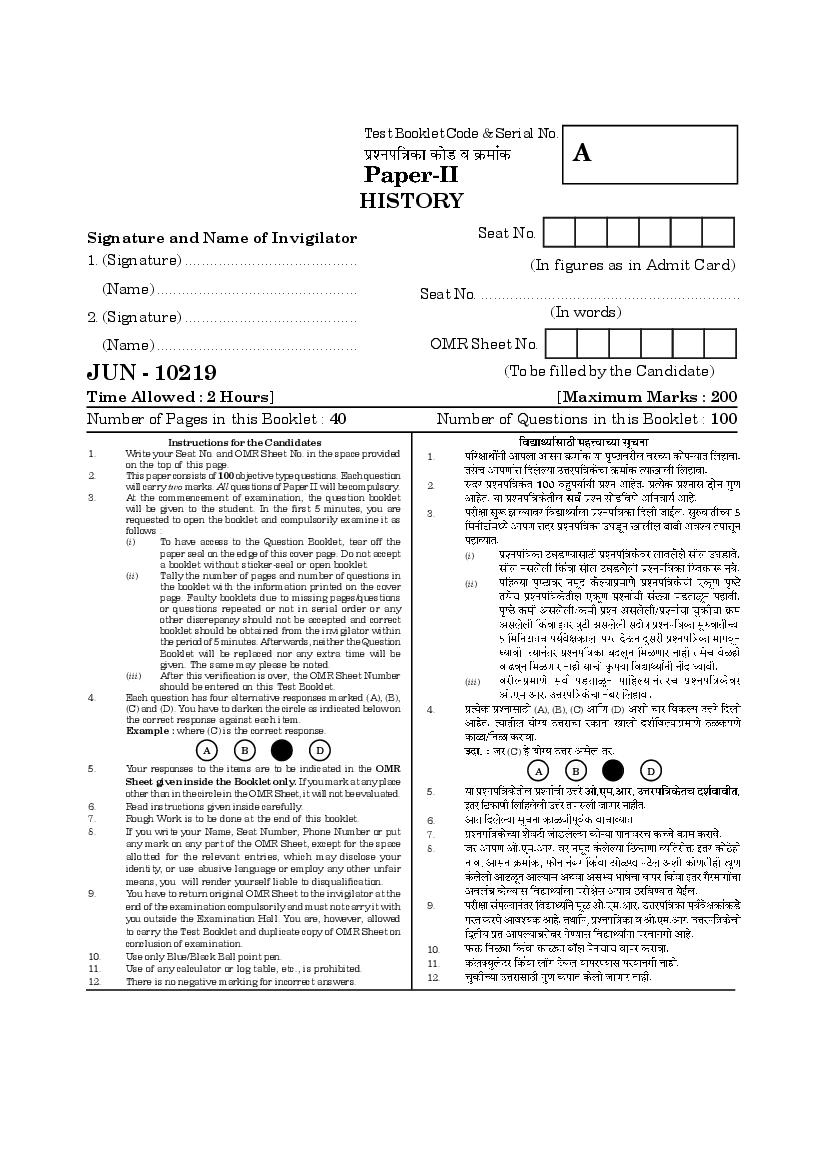
A
HISTORY
Signature and Name of Invigilator Seat No.
1. (Signature) ......................................... (In figures as in Admit Card)
(Name) ................................................ Seat No. ..............................................................
2. (Signature) ......................................... (In words)
(Name) ................................................ OMR Sheet No.
JUN - 10219 (To be filled by the Candidate)
Time Allowed : 2 Hours] [Maximum Marks : 200
Number of Pages in this Booklet : 40 Number of Questions in this Booklet : 100
Instructions for the Candidates
1. Write your Seat No. and OMR Sheet No. in the space provided 1.
on the top of this page.
2. This paper consists of 100 objective type questions. Each question
will carry two marks. All questions of Paper II will be compulsory. 2.
3. At the commencement of examination, the question booklet
will be given to the student. In the first 5 minutes, you are 3.
requested to open the booklet and compulsorily examine it as
follows :
(i) To have access to the Question Booklet, tear off the
paper seal on the edge of this cover page. Do not accept (i)
a booklet without sticker-seal or open booklet.
(ii) Tally the number of pages and number of questions in
the booklet with the information printed on the cover (ii)
page. Faulty booklets due to missing pages/questions
or questions repeated or not in serial order or any
other discrepancy should not be accepted and correct
booklet should be obtained from the invigilator within
the period of 5 minutes. Afterwards, neither the Question
Booklet will be replaced nor any extra time will be
given. The same may please be noted.
(iii) After this verification is over, the OMR Sheet Number
(iii)
should be entered on this Test Booklet.
4. Each question has four alternative responses marked (A), (B),
(C) and (D). You have to darken the circle as indicated below on 4. (A), (B), (C) (D)
the correct response against each item.
Example : where (C) is the correct response.
A B D (C)
5. Your responses to the items are to be indicated in the OMR A B D
Sheet given inside the Booklet only. If you mark at any place
other than in the circle in the OMR Sheet, it will not be evaluated. 5.
6. Read instructions given inside carefully.
7. Rough Work is to be done at the end of this booklet. 6.
8. If you write your Name, Seat Number, Phone Number or put 7.
any mark on any part of the OMR Sheet, except for the space
8.
allotted for the relevant entries, which may disclose your
identity, or use abusive language or employ any other unfair
means, you will render yourself liable to disqualification.
9. You have to return original OMR Sheet to the invigilator at the
end of the examination compulsorily and must not carry it with 9.
you outside the Examination Hall. You are, however, allowed
to carry the Test Booklet and duplicate copy of OMR Sheet on
conclusion of examination.
10.
10. Use only Blue/Black Ball point pen.
11.
11. Use of any calculator or log table, etc., is prohibited.
12. There is no negative marking for incorrect answers. 12.
Page 2
Page 3
Paper II
II
Time Allowed : 120 Minutes] [Maximum Marks : 200
Note : This Paper contains Hundred (100) multiple choice questions. Each question
carrying Two (2) marks. Attempt All questions.
(100) (2)
1. Which of the following ancient sites 1.
is not associated with the Megalithic
culture ?
(A)
(A) Yellesvaram
(B)
(B) Adichanallur
(C)
(C) Junnar
(D)
(D) Brahmagiri
2.
2. Which of the following sites does not
represent the Chalcolithic culture ?
(A)
(A) Kayatha
(B)
(B) Jorwe
(C)
(C) Brahmapuri
(D) Savalda (D)
3. ............................. was a Harappan 3.
trading post in Afghanistan.
(A) Shortughai (A)
(B) Chanhudaro (B)
(C) KotDiji (C)
(D) Amri (D)
3 [P.T.O.
Page 4
Harappan site of............................
(A) Banavali (A)
(B) Rakhigarhi (B)
(C) Surkotada
(C)
(D) Lothal
(D)
5. ......................tribe in Baluchistan
5.
speak a language similar to the
Tamil language.
(A)
(A) Mundas
(B)
(B) Brahui
(C)
(C) Bhils
(D)
(D) Santhals
6.
6. The entry port for trade between the
Indus trading centers and
Mesopotamia was..........................
(A) Elam (A)
(B) Bahrain (B)
(C) Oman (C)
(D) Afghanistan (D)
4
Page 5
yielded any evidence related to the
Indo-Roman trade ?
(A)
(A) Ter
(B)
(B) Junnar
(C)
(C) Adam
(D)
(D) Morgaon
8. Which of the following is not the Pre- 8.
natal samskara ?
(A) Garbhadhana (A)
(B) Pumsavana (B)
(C) Karnavedha (C)
(D) Simantonnayana
(D)
9. Which of the following compositions
9.
ascertains that Panini and
Vararuchi were contemporaries of
the Nandas ?
(A) Bruhatkatha (A)
(B) Gathasaptasati (B)
(C) Tolkapiyam (C)
(D) Mrichhakatikam (D)
5 [P.T.O.
Page 6
invaded India, Magadha was ruled
by................................
(A) Chandragupta Maurya (A)
(B) Mahapadma Nanda (B)
(C) Dhana Nanda
(C)
(D) Udayin
(D)
11. According to Megasthenes, the
11.
Pandya Kingdom was famous
for.............................
(A)
(A) Silk
(B)
(B) Bronze
(C)
(C) Weapons
(D)
(D) Pearls
12.
12. The trade with Barigaza flourished
under the control of Western
Kshatrapa named..........................
(A) Nahapana (A)
(B) Rudradamana (B)
(C) Jivadamana (C)
(D) Rudrasimha II (D)
6
Page 7
mention the repairing work of
Sudarshan reservoir ?
(A) Hathigumpha inscription of
(A)
Kharavela
(B)
(B) Nashik inscription of Nahapana
(C)
(C) Junagadh inscription of
Rudradaman I (D)
(D) Bhitari Pillar inscription of 14.
Skandagupta
14. Gupta era commences from..............
(A)
(A) 340 A.D.
(B)
(B) 330 A.D.
(C)
(C) 320 A.D.
(D)
(D) 310 A.D.
15.
15. Which of following Gupta kings had
issued copper coins ?
(A) Chandragupta I (A)
(B) Kumaragupta I (B)
(C) Shrigupta (C)
(D) Ghatotkachgupta (D)
7 [P.T.O.
Page 8
had issued ‘Ashvamedh’ type of gold
coin ?
(A)
(A) Chandragupta I
(B)
(B) Kumaragupta I
(C) Kumaragupta II (C)
(D) Ramagupta (D)
17. Brahmatayam in Sangam literature
17.
refers to............................
(A) Most sacred place
(A)
(B) Group of invited Brahmin
priests (B)
(C) Gift of revenue free villages to
(C)
Brahmin priests
(D) Entire sequence of ritual
(D)
arranged for a particular
occasion
8
Page 9
plates throws light on the
administrative measures taken
during drought ?
(A) Sohgaura (A)
(B) Chinchani
(B)
(C) Shankarpur
(C)
(D) Mandhal
(D)
19. ‘Sahini’ were...................................
(A) The men in charge of 19.
entertainers
(A)
(B) The men in charge of
(B)
production unit
(C) The men in charge of royal (C)
household
(D)
(D) The men in charge of Cavalry
20.
20. During Ancient Indian times, the
title ‘Kaisar’ was taken mainly by
the following ruling family :
(A)
(A) Maurya
(B)
(B) Satavahana
(C)
(C) Kanishka
(D) Gupta (D)
9 [P.T.O.
Page 10
Indian mathematicians composed
Shulba Sutra, the text in which
basic concepts of mathematics are
discussed ? (A)
(A) Baudhayana (B)
(B) Aryabhatta
(C)
(C) Brahmagupta
(D)
(D) Varahmihir
22.
22. During Satavahana times the terms,
Katak and Skandhawar were used
in the context of........................... (A)
(A) Fertile land (B)
(B) Disaster
(C)
(C) Army base
(D)
(D) Market place
23.
23. The famous inscription of
Vasishtiputra Pulumavi, in which he
explains that Queen Gotami
Balasiri, mother of Gotamiputra,
caused the built a cave for (Buddhist)
Samgha, is located at........................
(A)
(A) Aurangabad
(B)
(B) Nashik
(C) Junnar (C)
(D) Paithan (D)
10
Page 11
cutshrines at Mahabalipuram were
excavated during the rule of the
Pallava King..............................
(A)
(A) Simhavishnu
(B)
(B) Mahendravarman I
(C) Narasimhavarman I (C)
(D) Nandivarman II (D)
25. ........................ is not an example of 25.
the temple site of the Vikatakas.
(A) Mandhal
(A)
(B) Hamalapuri
(B)
(C) Ramtek
(C)
(D) Nagara
(D)
26. The Sthanu Ravi copper plate
inscriptions record an agreement 26.
between merchants of the Malabar
coast and some Christian merchants
from..................................
(A)
(A) Venice
(B)
(B) The Persian Gulf region
(C)
(C) The Black Sea region
(D) The Coromandel coast (D)
11 [P.T.O.
Page 12
monk mentioned in the inscription
of Ajanta Cave No. 24, is
(A) Anand (A)
(B) Sthavirachal
(B)
(C) Ashvaghosh
(C)
(D) Dhammapal
(D)
28. The official named Uparakshita in
the Satavahana adimistration, was
28.
in charge of................................
(A) Espionage
(B) Currency system (A)
(C) Building caves (B)
(D) Finance and accounts
(C)
29. Damras was the term used for.............
(D)
(A) Feudal lords in early Medieval
Kashmir 29.
(B) Mints in early Medieval
(A)
Kashmir
(C) Traders in early Medieval (B)
Kashmir
(C)
(D) Beggars in early Medieval
Kashmir (D)
12
Page 13
Vakataka rule ?
(A) Vindhyashakti
(A)
(B) Rudrasen I
(C) Pravarsen I (B)
(D) Pruthvisen I (C)
31. Which of the following Rashtrakuta
(D)
Kings established his capital at
Manyakhet ? 31.
(A) Dantidurg
(B) Amoghvarsh I
(A)
(C) Krishna I
(B)
(D) Govind II
32. Which of the following temples is not (C)
an example of the Chola temple
(D)
architecture ?
(A) Brahmapurishvara Temple, 32.
Pullamangai
(B) Kailasanatha Temple,
(A)
Tirupattur
(C) Nageshvaraswami Temple, (B)
Kumbhakonam
(C)
(D) Airavateshvara Temple
Darasuram (D)
13 [P.T.O.
Page 14
flourished during the rule of the
Paramaras ?
(A)
(A) Dravida
(B)
(B) Vesara
(C)
(C) Hemadapanti
(D)
(D) Bhumija
34.
34. Warangal fort was defended by two
walls, the outer made of..................
and the inner of......................
(A)
(A) Earth and granite
(B)
(B) Brick and stone
(C)
(C) Earth and wood
(D)
(D) Basalt and granite
35. The Yadavas of Devgiri had issued 35.
gold coins popularly known as.........
(A) Padmatankas (A)
(B) Dinar (B)
(C) Karshapana (C)
(D) Gadhiya (D)
14
Page 15
of Ghur was directed against.............
(A) Multan (A)
(B) Sindh (B)
(C) Punjab (C)
(D) Gujarat (D)
37. In which of the following works of 37.
Amir Khusrau do we get a
description of siege implements ?
(A) Nuh Siphir (A)
(B) Khazain-ul-Futuh (B)
(C) Tughlaq Nama (C)
(D) Tarikh-i-Alai (D)
38. In the decisive battle of Amroha, in 38.
which the Mongols were defeated,
who led Alauddin’s forces ?
(A) Malik Nayak (A)
(B) Qutlugh Khan (B)
(C) Zafar Khan (C)
(D) Ali Beg (D)
15 [P.T.O.
Page 16
Alauddin’s Measures ?
(A) Peasants (A)
(B) Soldiers (B)
(C) Muqaddams and traders
(C)
(D) Nobility
(D)
40. When was the city of Burhanpur
40.
founded and by whom ?
(A)
(A) Malik Ahmad in 1380
(B)
(B) Nasir Khan in 1399
(C)
(C) Malik Muhammad in 1400
(D)
(D) Sikandar Lodi in 1520
41.
41. According to which medieval source
were elephants to be found in the
Rajpipla forests of Gujarat ?
(A) Ibn Batuta (A)
(B) Abdul Hamid Lahori (B)
(C) Abul Fazl (C)
(D) Abbas Sarwani (D)
16
Page 17
Sultanate was established in India ?
(A) Faruqi
(A)
(B) Madurai
(B)
(C) Arcot
(C)
(D) Tiruchirapalli
(D)
43. Athanasius Nikitin was
a..............traveller. 43.
(A) Russian
(B) Italian (A)
(C) Portuguese (B)
(D) Spanish (C)
44. During the period of Muhammad bin (D)
Tughlaq, the office of the diwan-i-
44.
mazalim handled...........................
(A) Cases concerning revenue
adjustment
(A)
(B) Cases of madad-i-ma’ash grants
(B)
(C) Cases involving the
bureaucracy (C)
(D) The actual collection of revenue (D)
17 [P.T.O.
Page 18
45.
an embassy to the Ottoman Sultan
Suleiman ?
(A) Burhan Nizam Shah of (A)
Ahmadnagar
(B)
(B) Sultan Bahadur Shah of
Gujarat (C)
(C) Sultan Ali Adil Shah of Bijapur
(D)
(D) Sultan Yusuf Quli Shah of
Golconda 46.
46. To whom were the titles asvapati
and gajapati applied in the sources
of the Deccan and the south ?
(A) Vijayanagar rulers and the (A)
Ganga kings of Odisha
(B) Chalukyas and the Shilaharas
(B)
(C) Chola rulers and the Pandya
rulers of Madurai
(C)
(D) Vijayanagar rulers and the
(D)
Bahmani Sultans
18
Page 19
sthaladayam found in Vijayanagar
period inscriptions ?
(A)
(A) Tax on grain
(B) A form of forced labour (B)
(C) Transit duty (C)
(D) Tax on plough oxen (D)
48. Which Mughal Prince got the
48.
Bijapur and Golconda to sign the
Deed of Submission ?
(A) Khurram
(B) Salim (A)
(C) Dara Shikoh (B)
(D) Jalaluddin (C)
49. According to the 17th century text
(D)
Vyavaharmayukha, watan land was
to be considered.............................. 49.
(A) Private property
(B) Ritual and traditional rights in (A)
the village
(B)
(C) Inherited and communal
(C)
property
(D) Assignable land (D)
19 [P.T.O.
Page 20
(A) A tax on metal
(A)
(B) A tax on paper
(B)
(C) A tax on cloth
(C)
(D) A tax on looms
51. The kaniyatchi of Chola and (D)
Vijayanagar period of South India
51.
were.............................
(A) Upper castes associated with
temple management (A)
(B) Bhakti saints
(C) Weavers (B)
(D) Dominant landed classes
(C)
52. The final surrender of the Mewar
Rana took place : (D)
(A) At the beginning of Jahangir’s 52.
reign
(B) Towards the end of Akbar’s
(A)
reign
(C) Towards the end of Jahangir’s (B)
reign
(C)
(D) During the period of Shah
(D)
Jahan’s governorship of
Rajasthan
20
Page 21
(A) Documents giving details of
(A)
land owned by peasants
(B) Documents that give the prices
of indigo and sugarcane (B)
(C) Documents about customs
collected at Surat port (C)
(D) Documents of the nagarsheths
of Ahmedabad
(D)
54. The earliest reference to the term
balutedar is found in the..................
54.
(A) Jnyaneshwari
(B) Seeta Swayamvar
(C) Pune Peth Kaifiyat (A)
(D) Radha-madhav Vilasa champu (B)
55. The Bundelas began to come to (C)
prominence after :
(D)
(A) The establishment of a capital
at Orchcha 55.
(B) The murder of Abul Fazl (A)
(C) The attack on Orchcha by Shah (B)
Jahan
(C)
(D) The conquest of Malwa by
Akbar (D)
21 [P.T.O.
Page 22
.................................
(A)
(A) Karnataka
(B) Gujarat (B)
(C) Tamil Nadu (C)
(D) The Doab region
(D)
57. Which two political institutions are
regarded by historians as the 57.
‘backbone of the Vijayanagar
Empire ?
(A) The nayankara and ayagar
system (A)
(B) The ayagar system and the (B)
Ainnurruvar
(C)
(C) The nayankara system and the
temple (D)
(D) The temple and the ayagar
58.
system
58. In the Bahmani period, the port of
Dabhol was known as........................ (A)
(A) Mustafabad
(B)
(B) Nasratpur
(C)
(C) Bandar Mubarak
(D) Islamabad (D)
22
Page 23
was called.........................in Mughal
times.
(A)
(A) Narnal
(B)
(B) Gajal
(C)
(C) Arraba
(D)
(D) Shutrnal
60.
60. Where is Aurangzeb’s tomb ?
(A)
(A) Delhi
(B)
(B) Agra
(C)
(C) Khuldabad
(D)
(D) Daulatabad
61.
61. The Sufi saint Muhammad Banda
Nawaz is better known as...............
(A) Baba Farid (A)
(B) Gesudaraz (B)
(C) Baba Palangposh (C)
(D) Shaikh Mohammad (D)
23 [P.T.O.
Page 24
viceroy of Portuguese territory of
Goa from 1505-1509 ?
(A) Afonso d’Albuquerque (A)
(B) Francisco de Almeida (B)
(C) Vasco da Gama (C)
(D) Father Stevens (D)
63. An early Dutch traveler to India and 63.
Indonesia was..............................
(A) Francisco Pelsaert (A)
(B) Peter Floris (B)
(C) Adrian van Rheede (C)
(D) John Huyghen van Linschoten (D)
64. The cities of Sultanpur and Bandar 64.
Mubarak are better known as..........
and .................
(A) Madurai and Nagapattinam (A)
(B) Dwarasamudra and Kalyani (B)
(C) Chaul and Vengurla (C)
(D) Warangal and Surat (D)
24
Page 25
described two routes from Surat to
Agra, one via.................. and the other
via........................
(A) Burhanpur and Ahmedabad
(A)
(B) Burhanpur and Sironj
(C) Merta and Kota (B)
(D) Gwalior and Kota (C)
66. In the 16th and 17th centuries, what (D)
feature did the ports of Gandevi,
66.
Chaul and Narsapur share ?
(A) They were all on the west coast
of India
(B) They were all centres of ship (A)
building
(C) They were all under the control
(B)
of the Portuguese
(C)
(D) They were all centres of
Armenian merchants (D)
25 [P.T.O.
Page 26
descendants of a saint from Kirman,
is located in.............................
(A) Chaul
(A)
(B) Vengurla
(B)
(C) Bidar
(C)
(D) Nagpur
68. The segmentary state model was (D)
based on the study of................
68.
by.................
(A) Chola state, Burton Stein
(A)
(B) Alur society, Aidan Southall
(B)
(C) Rajput lineages, Richard Fox
(C)
(D) Vijayanagar state, N.
Karashima (D)
69. The Ragamala paintings are typical
69.
of the..................... style of the 18th
century.
(A)
(A) Deccan
(B) Kangra (B)
(C) Rajput (C)
(D) Pahari (D)
26
Page 27
transaction in which the rich
bankers of Bengal and Mir Jafar
sold out the Nawab to the
(A)
English ?
(A) N.K. Sinha (B)
(B) K.M. Pannikar (C)
(C) R.S. Sharma (D)
(D) N.L. Chatterjee 71.
71. The Jagat Seths were an influential
......................... family in Bengal.
(A)
(A) Noble
(B)
(B) Banking
(C)
(C) Military
(D)
(D) Physician
72.
72. Mir Jafar shifted his capital from
Murshidabad to............................
(A)
(A) Monghyr
(B) Midnapur (B)
(C) Burdwan (C)
(D) Lakhnauti (D)
27 [P.T.O.
Page 28
system of Government ?
(A) Madras (A)
(B) Bengal (B)
(C) Bombay (C)
(D) Pondicherry (D)
74. Who among the following is known 74.
as the ‘liberator of Indian Press’ ?
(A) Lord William Bentinck (A)
(B) Charles Metcalfe (B)
(C) Lord Macaulay (C)
(D) Lord Dalhousie (D)
75. The Lancashire cotton textiles were 75.
first introduced in India, in................
(A) 1786 (A) 1786
(B) 1815 (B) 1815
(C) 1831 (C) 1831
(D) 1852 (D) 1852
28
Page 29
was established in Pune in 1798. Its
student, who famously made the
drawings of Ellora as he
accompanied Sir Charles Malet in
his artistic expedition was.................. (A)
(A) Erloo Bin Narayan
(B)
(B) Dhakji Dadaji
(C)
(C) Gangaram Tambat
(D)
(D) Vasudev Kamat
77.
77. Witnessing the devastation of the
Indian textile industries, William
Bentinck remarked, ‘‘The bones of
the..........................are bleaching the
plains of India’’.
(A)
(A) Cotton Traders
(B)
(B) Cotton Weavers
(C)
(C) Mill Workers
(D) Cotton Farmers (D)
29 [P.T.O.
Page 30
with............................cultivation.
(A) Wheat (A)
(B) Cotton
(B)
(C) Sugarcane
(C)
(D) Indigo
(D)
79. This person led a revolt against the
79.
moneylenders and the British in
Ahmednagar and Nasik region. The
British had declared a Prize of Rs.
5,000 to capture him.
(A) Fond Sawant (A)
(B) Narsappa (B)
(C) Shivkar Bapuji Talapade (C)
(D) Raghoji Bhangre (D)
80. Around 1840-41, this freedom fighter 80.
had conquered the fort of Badami
with the help of other soldiers and
hoisted the flag of the Chhatrapati
of Satara on this fort.
(A)
(A) Sevaram Bhill
(B)
(B) Narsingrao Petkar
(C) Umaji Naik (C)
(D) Lahuji Salve (D)
30
Page 31
batch of doctors that graduated from
the Grant Medical College in 1850
and was a great patron of arts and
theatre.
(A) Bhau Daji Lad (A)
(B) Vishram Ramji Ghole (B)
(C) R.G. Bhandarkar (C)
(D) Jagannath Shankarsheth
(D)
82. Who among the following criticised
82.
the University Act of 1904.
commenting that the Indian
Universities had become some of the
world’s most governmental
institutions ?
(A)
(A) Hunter Commission
(B)
(B) Sadler Commission
(C)
(C) Radhakrishnan Commission
(D) Kothari Commission (D)
83. ..........................was one of the founders 83.
of the Veda Samaj which was
founded in 1864.
(A)
(A) Shreedharalu Naidu
(B)
(B) Dayanand
(C) Dadoba Pandurang (C)
(D) Mahatma Phule (D)
31 [P.T.O.
Page 32
Commentaries on the Quran’’, this
reformer argued that the Word of
God should be interpreted through
the work of God which is open for
all to see. (A)
(A) Rashid Ahmed Gangohi (B)
(B) Syed Ahmed Khan (C)
(C) Mahmud ul Hasan
(D)
(D) Syed Ahmed Barelvi
85.
85. ........................was a founder member
of the ‘Goa Youth League’.
(A)
(A) Beatris de Menzes Braganza
(B)
(B) Mohan Ranade
(C)
(C) Dayanand Bandodkar
(D) Pandit Nehru (D)
32
Page 33
‘‘policy of assimilation’’ is based
on :
(A)
(A) The idea that colonizers can be
enriched when adapting to the
native culture of an area
(B)
(B) The idea that local people
deserved the right to maintain
their native culture
(C) The idea that native populations (C)
know what is best for survival
in that area
(D) The idea that local people would
(D)
eventually be absorbed into the
colonizers’ culture
87.
87. What is the meaning of the title of
Tilak’s book ‘Orion’ ?
(A)
(A) Name of a Constellation
(B) Aryan Invasion (B)
(C) Vedic Sweetmeat (C)
(D) A Vedic Deity (D)
33 [P.T.O.
Page 34
Reorganisation Commission
included a jurist, S. Fazl Ali, a Social
Worker, H.N. Kunzru and a
Historian.........................
(A)
(A) Jawaharlal Nehru
(B) N.V. Gadgil (B)
(C) K.M. Panikkar (C)
(D) R.C. Mujumdar (D)
89. Servants of India Society, All India 89.
Women’s Conference and the Indian
History Congress were all founded
in this city :
(A)
(A) Poona
(B) Bombay (B)
(C) Calcutta (C)
(D) Delhi (D)
90. This anthropologist is the author of 90.
Maharashtra Sanskruti, which deals
with the culture of Maharashtra :
(A)
(A) Durga Bhagwat
(B)
(B) G.S. Ghurye
(C) Irawati Karve (C)
(D) Gunther Sontheimer (D)
34
Page 35
refugees with cultivable land was
completed by......................... Director
General of Rehabilitation by 1949.
(A)
(A) Sardar Tarlok Singh
(B)
(B) Vijayalaxmi Pandit
(C)
(C) Sardar Baldev Singh
(D)
(D) Sarojini Naidu
92. -I -II
92. Match List I with List II and
choose the correct answer from the
codes given below the list :
List I -I
(a) P.E. Roberts (a)
(b) Anil Seal (b)
(c) V.P. Menon (c)
(d) P.J. Griffiths (d)
List II -II
(i) Transfer of Power in India (i)
(ii) India under Wellesley (ii)
(iii) Emergence of Indian
(iii)
Nationalism
(iv)
(iv) The British Impact on India
Codes :
(a) (b) (c) (d)
(a) (b) (c) (d)
(A) (iv) (i) (ii) (iii) (A) (iv) (i) (ii) (iii)
(B) (ii) (iii) (i) (iv) (B) (ii) (iii) (i) (iv)
(C) (iii) (ii) (i) (iv) (C) (iii) (ii) (i) (iv)
(D) (ii) (iv) (iii) (i) (D) (ii) (iv) (iii) (i)
35 [P.T.O.
Page 36
compared to.......................
(A) Mazzini
(A)
(B) Bismarck
(B)
(C) Lenin
(C)
(D) Leo Tolstoy
(D)
94. Arrange the following in
94.
chronological order and select the
correct answer from the codes given
below : (i)
(i) Cripps Mission
(ii)
(ii) Gandhi-Irwin Pact
(iii)
(iii) Simon Commission
(iv)
(iv) Partition of the Country
Codes :
(A) (i) (ii) (iii) (iv)
(A) (i) (ii) (iii) (iv)
(B) (ii) (i) (iv) (iii)
(B) (ii) (i) (iv) (iii)
(C) (ii) (i) (iii) (iv) (C) (ii) (i) (iii) (iv)
(D) (iii) (ii) (i) (iv) (D) (iii) (ii) (i) (iv)
36
Page 37
the Indus’ ?
(A) Clive Dewey (A)
(B) Michael Adas (B)
(C) John Hobson
(C)
(D) Dharampal
(D)
96. How many stages did Immanuel
96.
Wallerstein identify in his World
Systems theory ?
(A)
(A) Two
(B)
(B) Three
(C)
(C) Four
(D)
(D) Five
97.
97. In art history, .................. is seen as
being at the forefront of nationalist
responses to colonial interpretations.
(A) Rajendralala Mitra (A)
(B) JDM Beglar (B)
(C) Ram Raz (C)
(D) Ananda K. Coomaraswamy (D)
37 [P.T.O.
Page 38
associated with which one of the
following schools of historical
(A)
writing ?
(A) Marxist School (B)
(B) Positivist School
(C)
(C) Annales School
(D)
(D) Subaltern School
99.
99. According to Church historiography,
what is a chronicle ?
(A) A biography of a great man (A)
(B) A biography of a saint
(B)
(C) An account of the rise of the
(C)
Church
(D)
(D) A detailed account of events in
a particular place and time
38
Page 39
choose the correct answer from the
codes given below :
List I -I
(a) Marc Bloch (a)
(b) Fernand Braudel (b)
(c) Emmanuel Le Roy Ladurie (c)
(d) Jacques Derrida (d)
List II -II
(i) The Structures of Everday Life (i)
(ii) Writing and Difference (ii)
(iii) The Territory of the Historian (iii)
(iv) The Historian’s Craft (iv)
Codes :
(a) (b) (c) (d) (a) (b) (c) (d)
(A) (iv) (iii) (ii) (iv) (A) (iv) (iii) (ii) (iv)
(B) (iv) (i) (iii) (ii) (B) (iv) (i) (iii) (ii)
(C) (i) (ii) (iii) (iv) (C) (i) (ii) (iii) (iv)
(D) (ii) (iii) (iv) (i) (D) (ii) (iii) (iv) (i)
39 [P.T.O.
Page 40
40
Document Details
| Board / Org | Maharashtra Exams |
| Exam | MAHA SET |
| Type | Question Paper |
| Pages | 40 |
| Updated | 30 Apr 2026 |