HBSE Class 11 Syllabus 2027 Bio Technology
Finished viewing? Save it for later —
Download HBSE Class 11 Syllabus 2027 Bio Technology (PDF · 9 pages)About HBSE Class 11 Syllabus 2027 Bio Technology
HBSE Class 11 Syllabus 2027 Bio Technology is available here for free download. Published by Haryana Board for Class 11, this syllabus can be viewed online or downloaded as a PDF (9 pages). Candidates preparing for Class 11 can use HBSE Class 11 Syllabus 2027 Bio Technology to understand the exam pattern, the type of questions asked, and the overall difficulty level.
Frequently Asked Questions
How can I download HBSE Class 11 Syllabus 2027 Bio Technology?
Open this page and click the Download button to save HBSE Class 11 Syllabus 2027 Bio Technology as a PDF. It is completely free on AglaSem Docs.
Is HBSE Class 11 Syllabus 2027 Bio Technology free to download?
Yes. HBSE Class 11 Syllabus 2027 Bio Technology can be viewed online and downloaded as a PDF free of cost on AglaSem Docs.
How many pages does HBSE Class 11 Syllabus 2027 Bio Technology have?
HBSE Class 11 Syllabus 2027 Bio Technology contains 9 pages, which you can read online or download together as a single PDF.
Where can I find more Class 11 study material?
You can find more Class 11 question papers, sample papers, syllabus, and answer keys on AglaSem Docs.
HBSE Class 11 Syllabus 2027 Bio Technology – Text
Read the full text of this syllabus below — useful to quickly search, copy and reference the content online without downloading the PDF.
📄 View text version (10 pages)
Page 1
HBSE Class 11 Syllabus
2027 Bio Technology
EXAM YEAR TYPE SUBJECT
Haryana Class 11 2027 Syllabus Biotechnology
Notes · Sample Papers · Previous Year Papers · Mock Tests
Page 2
.co s e m
s em l a
a ag
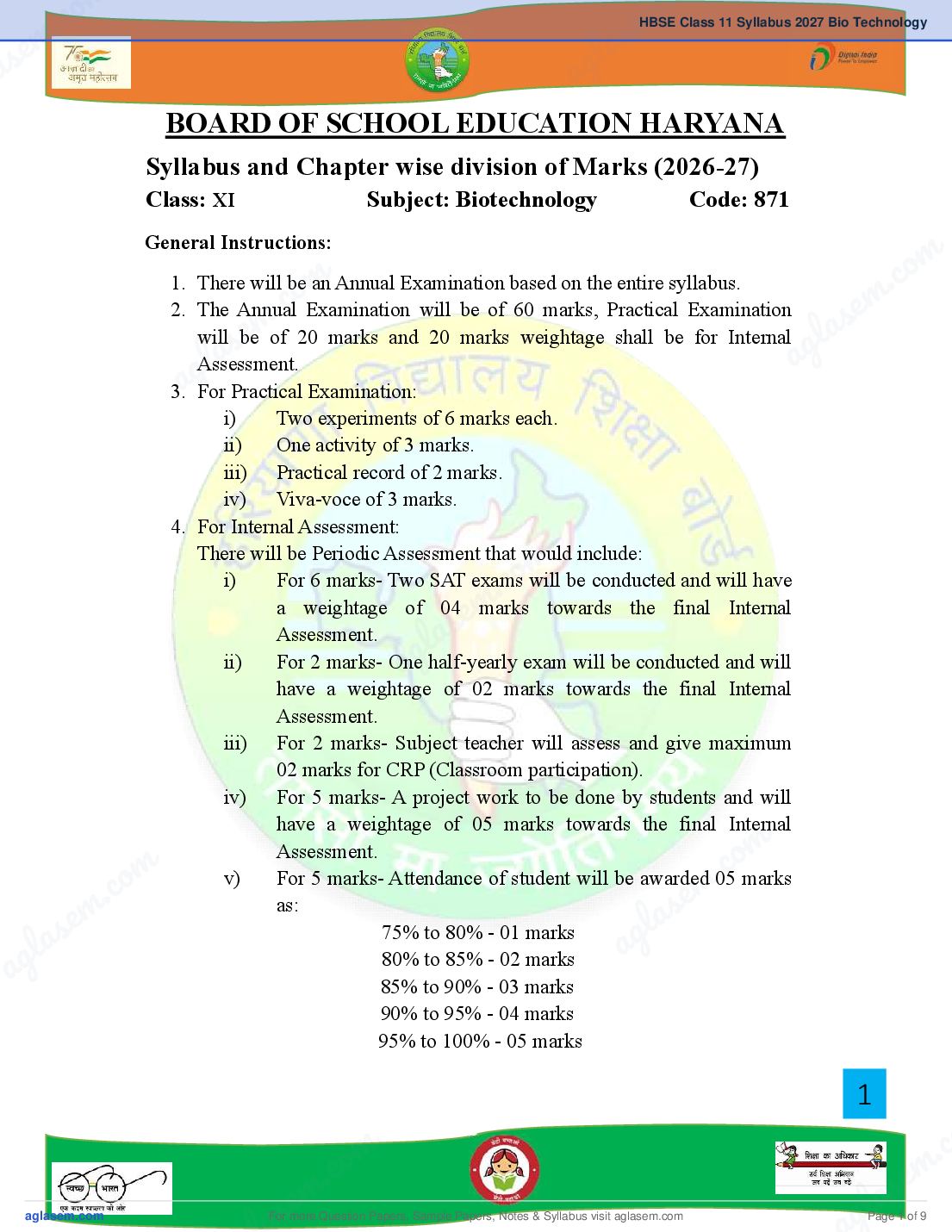
BOARD OF SCHOOL EDUCATION HARYANA
Syllabus and Chapter wise division of Marks (2026-27)
Class: XI Subject: Biotechnology Code: 871
General Instructions:
m
om
1. There will be an Annual Examination based on the entire syllabus. . co
. c em
2. The Annual Examination will be of 60 marks, Practical Examination
em l as
l as
will be of 20 marks and 20 marks weightage shall be for Internal
ag
agAssessment.
3. For Practical Examination:
i) Two experiments of 6 marks each.
ii) One activity of 3 marks.
iii) Practical record of 2 marks.
iv) Viva-voce of 3 marks.
4. For Internal Assessment:
There will be Periodic Assessment that would include:
m
i)
.co
For 6 marks- Two SAT exams will be conducted and will have
m
e
a weightage of 04 marks towards the final Internal
s
Assessment.
l a
ii) ag
For 2 marks- One half-yearly exam will be conducted and will
have a weightage of 02 marks towards the final Internal
Assessment.
iii) For 2 marks- Subject teacher will assess and give maximum
02 marks for CRP (Classroom participation).
iv) For 5 marks- A project work to be done by students and will
have a weightage of 05 marks towards the final Internal
m
.co
Assessment.
m
.co m
v) For 5 marks- Attendance of student will be awarded 05 marks
m as: s e
s e g la
la
75% to 80% - 01 marks
g 80% to 85% - 02 marks a
a 85% to 90% - 03 marks
90% to 95% - 04 marks
95% to 100% - 05 marks
1
m . c
c. o s e m
s em
For more Question Papers, Sample Papers, Notes & Syllabus visit
gl a
Page 1 of 9
Page 3
Class- XI Subject-Biotechnology Code:871
Sr. no Unit Chapter Marks
1 Biotechnology: An Biotechnology: 5
Overview An Overview
2 Molecules of Life Biomolecules:
Building Blocks 18
Macromolecules:
Structure and
Function
3 Genetics and Molecular Concepts of
Biology Genetics
Genes and 17
Genomes:
Structure and
Function
4 Cells and Organisms The Basic Unit of
Life 20
Cell Growth and
Development
Total 60
Practical Examination 20
Internal Assessment 20
Grand Total 100
2
For more Question Papers, Sample Papers, Notes & Syllabus visit Page 2 of 9
Page 4
.co s e m
s em l a
a ag
Unit I: BIOTECHNOLOGY: AN OVERVIEW
Chapter 1: Biotechnology: An Overview
Historical Perspectives: Microorganisms as causative agents of
fermentation; Technology and applications of Biotechnology:
m
co
Bioprocessing Technology, Cell Culture, Recombinant DNA Technology,
. c om
Cloning, Protein Engineering, Biosensors, Nanobiotechnology; Global
e m .
em
Market of Biotech Products: Public Perception of Biotechnology;
l as
l as
Biotechnology in India and Global Trends: Indian scenario, Global
ag
agscenario
Unit II: MOLECULES OF LIFE
Chapter 1: Biomolecules: Building Blocks
Building Blocks of Carbohydrates - Sugars and Their Derivatives:
Properties of sugars; Building Blocks of Proteins -Amino Acids:
m
Properties of amino acids; Vitamins and coenzymes; Building Blocks of
.co
Lipids -- Simple Fatty Acids; Sphingosine; Glycerol and Cholesterol:
m
e
Properties of lipids; Building Blocks of Nucleic Acids – Nucleotides:
s
l a
Properties of nucleotides; Biochemical Transformations: Carbohydrate
ag
metabolism: Overview of Metabolism- Catabolism, Anabolism and ATP,
Catabolism of glucose and other hexoses, Photosynthesis: Calvin cycle of
CO2 assimilation, Photorespiration, Nitrogen Fixation: Nitrogenase,
Nitrogen fixation and organic farming
Unit II: MOLECULES OF LIFE
Chapter 2: Macromolecules: Structure and Function
o m
m . c
.co
Carbohydrates-The Energy Givers; Proteins - The Performers:
m
e –
e m a s
Protein structure, Determination of amino acid sequences
lsecondary
las Primary structure, Sequencing strategies, Proteing
a tertiary structures-
ag structures- alpha –helices and ß-pleats, Protein
3-D structure, Protein quaternary structures; Proteins in action:
Enzymes - The Catalysts: Properties of enzymes, Catalytic power
of enzymes, Use of Enzymes in Biotechnology; Lipids and
Biomembranes - The Barriers: Functions of Biomembranes;
Nucleic Acids - The Managers 3
m . c
c. o s e m
s em
For more Question Papers, Sample Papers, Notes & Syllabus visit
gl a
Page 3 of 9
Page 5
Chapter 1: Concepts of Genetics
Historical Perspective; Mendelian genetics: Mendel's laws of
inheritance: Law of segregation, Law of independent assortment, The role
of chromosomes in inheritance; Multiple Alleles; Linkage and Crossing
Over: Genetic recombination; Genetic Mapping; Gene Interaction;
Sex-Linked Inheritance; Extranuclear Inheritance; Quantitative
Inheritance; Genes at the Population Level
Unit III: GENETICS AND MOLECULAR BIOLOGY
Chapter 2: Genes and Genomes: Structure and Function
DNA as genetic material: Identification of DNA as the transforming
principle, The Hershey - Chase experiment; DNA Replication: Overall
principle of DNA replication, Meselson and Stahl experiment, Molecular
mechanism of DNA replication, Replicative machinery: enzymes in DNA
replication, Semidiscontinuous replication; Fine Structure of the Gene;
From Gene to Protein; Transcription-The Basic Process; Genetic
Code; Translation: Transfer RNA (tRNA): The adaptor molecules,
Charging the tRNA: Attachment of amino acid to tRNA, Ribosomes: The
cellular protein synthesizing machinery, Mechanism of translation:
Initiation, Elongation, Termination; Regulation of Gene Expression:
Regulation of gene expression in prokaryotes, lac operon, Control of gene
expression in eukaryotes; Mutations: Genome, chromosome and gene
mutations; DNA Repair; Human Genetic Disorders: Pedigree Analysis;
Genome Organization: Viral genomes, Prokaryotic genomes
Unit IV: CELL AND DEVELOPMENT
Chapter 1: The Basic Unit of Life
Cell Structure and Components: Cell membrane: Membrane proteins,
Membrane lipids, Cell organelles: Nucleus, Cytoplasm, Endoplasmic
reticulum (ER), Ribosomes, Golgi apparatus, Lysosomes, Peroxisomes,
Mitochondria, Plastids, Cytoskeleton; Tissues and Organs: Animal
tissues: Epithelial tissue, Connective tissue, Muscle tissue, Nervous
4
For more Question Papers, Sample Papers, Notes & Syllabus visit Page 4 of 9
Page 6
.co s e m
s em l a
a ag
tissue, Plant Tissues: Simple plant tissues, Complex plant tissues, Organs:
Stem Cells; Biodiversity; Organization of Life
Unit IV: CELL AND DEVELOPMENT
Chapter 2: Cell Growth and Development
m
om
Cell Division: Mitosis: Prophase, Prometaphase, Metaphase, Anaphase, . co
. c
Telophase, Cytokinesis, Meiosis: Meiosis I (Prophase I, Metaphase I, e m
e m
Anaphase I, Telophase I and Cytokinesis), Meiosis II; (Prophase II, Meta l as
l as
Phase II, Anaphase II, Telophase II) Cell Cycle: Cell cycle regulation; ag
agCell Communication; Movement: Amoeboid movement, Movement by
cilia and flagella, Muscle and movement; Nutrition: Elements of
nutrition, Plant nutrition, Animal nutrition, Nutrition in microbes;
Gaseous Exchange: Gas exchange surfaces (Both Plants & animals),
Gas exchange in plants; Internal transport: Internal transport in
animals, Internal transport in plants; Maintaining the internal
environment: Regulation of water: Why and How water is regulated,
m
m .co
Regulation of temperature: Why and How temperature is regulated;
Reproduction: Reproduction in microbes, Reproduction in plants:
s e
a
Asexual reproduction, Sexual reproduction, Reproduction in animals:
l
ag
Asexual reproduction, Sexual reproduction, Human reproduction; In
vitro Fertilization; Animal and Plant Development: Animal
development, Plant development; Immune Response in Humans and
Animals: The immune system, The immune response; Programmed
Cell Death; Defense Mechanisms in Plants: Passive defense, Active
defense
Practicals:
m
m .co
.co m
1. Preparation of buffers and pH determination
m s e
s e 2. Sterilization techniques
g la
g la 3. Preparation of bacterial growth medium a
a 4. Cell counting
5. Sugar Estimation using Di Nitro Salicylic Acid test (DNS test)
6. Assay for amylase enzyme
7. Protein estimation by biuret method 5
m . c
c. o s e m
s em
For more Question Papers, Sample Papers, Notes & Syllabus visit
gl a
Page 5 of 9
Page 7
Month wise Syllabus Teaching Plan (2026-27)
Class: XI Subject: Biotechnology Code: 871
Month Subject-Content Teaching Revision Practical
Periods Periods Work
April Unit I 8 2
Chapter 1:
Biotechnology: An
Overview
Unit II
Chapter 1: 12 2
Biomolecules: Building
Blocks
Practical: Preparation of
buffers and pH 4
determination
May Unit II 20 4
Chapter 2:
Macromolecules:
Structure and Function
Practical: Sterilization 6
Techniques
June Summer Vacation (Any Project work should be given related to
above chapters)
July Unit III
Chapter 1: Concepts of 16 2
Genetics
Practical: Preparation of
bacterial growth 4
medium
6
For more Question Papers, Sample Papers, Notes & Syllabus visit Page 6 of 9
Page 8
.co s e m
s em l a
a ag
Practical: Cell counting 2
August Unit III
Chapter 2: Genes and 20 4
Genomes: Structure and
Function m
om . co
. c em
e m Practical: Sugar
l as
l as Estimation using Di 4
ag
ag Nitro Salicylic Acid test
(DNS test)
Practical: Assay for
amylase enzyme 2
September Revision for Half- 16
Yearly Exam
m
Half-Yearly Exam
m .co
October Unit IV
s e 20 4
Chapter 1: The Basic
l a
Unit of Life ag
Practical: Protein 4
estimation by biuret
method
November Unit IV
Chapter 2: Cell Growth
m
.co
and Development (Cell 16 2
m
.co m
Division, Cell Cycle,
m Cell Communication, s e
s e g la
la
Movement)
g a6
a December Unit IV
Chapter 2: Cell Growth
24
and Development
(Nutrition, Gaseous
Exchange, Internal
Transport, Maintaining 7
m . c
c. o s e m
s em
For more Question Papers, Sample Papers, Notes & Syllabus visit
gl a
Page 7 of 9
Page 9
Environment,
Reproduction, In vitro
Fertilization, Animal
and Plant Development,
Immune response in
Humans and Animals,
Programmed Cell
Death, Defense
Mechanisms in Plants)
January Revision 16
February Revision 24
March Annual Examination
Note:
Subject teachers are advised to direct the students to prepare notebook of
the Terminology/Definitional Words used in the chapters for enhancement
of vocabulary or clarity of the concept.
Prescribed Books:
1. Biotechnology - Text book for Class XI, CBSE Publication
2. Laboratory Manual-Biotechnology-Class XI, CBSE Publication
8
For more Question Papers, Sample Papers, Notes & Syllabus visit Page 8 of 9
Page 10
.co s e m
s em l a
a ag
Question Paper Design (2026-27)
Class: XI Subject: Biotechnology
Code: 871 Time : 02:30 Hrs
m
om . co
. c e m
em
Competencies Marks Percentage
l as
s
la Knowledge 24 40% ag
g
a Understanding 18 30%
Application 12 20%
Skill 6 10%
Total 60 100%
m
Type of Marks Number c. o Description Total Marks
Question
e m
Objective 1 15as 6 Multiple Choice 15
l
Questions ag Questions
3 Fill in the Blanks
Questions
3 One-Word Answer
Type Questions
3 Assertion-Reason
Questions
m 12
.co
Very Short 2 6 Internal Choice will be
m
.co
Answer Type given in any 2 Questions
m Question s em
s e Short Answer 3 6 g labe
Internal Choice will 18
g la Type Question a
given in any 2 Questions
a
Essay Answer 5 3 Internal options will be 15
Type Question given in all the questions
Total 30 60
9
m . c
c. o s e m
s em
For more Question Papers, Sample Papers, Notes & Syllabus visit
gl a
Page 9 of 9
Document Details
| Board / Org | Haryana Board |
| Exam | Class 11 |
| Type | Syllabus |
| Pages | 9 |
| Updated | 04 Nov 2026 |