CBSE Class 12 Sample Paper 2022 for Yoga Term 1
Finished viewing? Save it for later —
Download CBSE Class 12 Sample Paper 2022 for Yoga Term 1 (PDF · 7 pages)About CBSE Class 12 Sample Paper 2022 for Yoga Term 1
CBSE Class 12 Sample Paper 2022 for Yoga Term 1 is available here for free download. Published by CBSE for Class 12, this sample paper can be viewed online or downloaded as a PDF (7 pages). Candidates preparing for Class 12 can use CBSE Class 12 Sample Paper 2022 for Yoga Term 1 to understand the exam pattern, the type of questions asked, and the overall difficulty level.
Frequently Asked Questions
How can I download CBSE Class 12 Sample Paper 2022 for Yoga Term 1?
Open this page and click the Download button to save CBSE Class 12 Sample Paper 2022 for Yoga Term 1 as a PDF. It is completely free on AglaSem Docs.
Is CBSE Class 12 Sample Paper 2022 for Yoga Term 1 free to download?
Yes. CBSE Class 12 Sample Paper 2022 for Yoga Term 1 can be viewed online and downloaded as a PDF free of cost on AglaSem Docs.
How many pages does CBSE Class 12 Sample Paper 2022 for Yoga Term 1 have?
CBSE Class 12 Sample Paper 2022 for Yoga Term 1 contains 7 pages, which you can read online or download together as a single PDF.
Where can I find more Class 12 study material?
You can find more Class 12 question papers, sample papers, syllabus, and answer keys on AglaSem Docs.
CBSE Class 12 Sample Paper 2022 for Yoga Term 1 – Text
Read the full text of this sample paper below — useful to quickly search, copy and reference the content online without downloading the PDF.
📄 View text version (7 pages)
Page 1
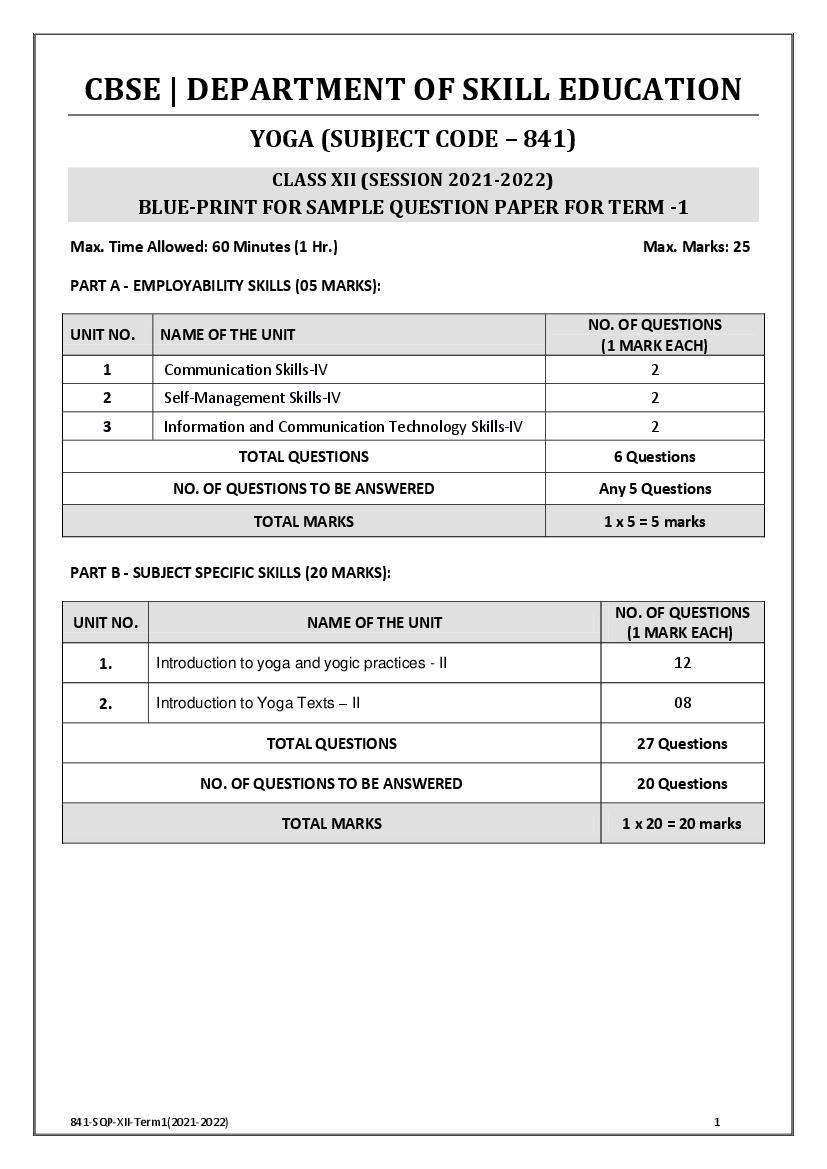
YOGA (SUBJECT CODE – 841)
CLASS XII (SESSION 2021-2022)
BLUE-PRINT FOR SAMPLE QUESTION PAPER FOR TERM -1
Max. Time Allowed: 60 Minutes (1 Hr.) Max. Marks: 25
PART A - EMPLOYABILITY SKILLS (05 MARKS):
NO. OF QUESTIONS
UNIT NO. NAME OF THE UNIT
(1 MARK EACH)
1 Communication Skills-IV 2
2 Self-Management Skills-IV 2
3 Information and Communication Technology Skills-IV 2
TOTAL QUESTIONS 6 Questions
NO. OF QUESTIONS TO BE ANSWERED Any 5 Questions
TOTAL MARKS 1 x 5 = 5 marks
PART B - SUBJECT SPECIFIC SKILLS (20 MARKS):
NO. OF QUESTIONS
UNIT NO. NAME OF THE UNIT
(1 MARK EACH)
1. Introduction to yoga and yogic practices - II 12
2. Introduction to Yoga Texts – II 08
TOTAL QUESTIONS 27 Questions
NO. OF QUESTIONS TO BE ANSWERED 20 Questions
TOTAL MARKS 1 x 20 = 20 marks
841-SQP-XII-Term1(2021-2022) 1
Page 2
YOGA (SUBJECT CODE – 841)
CLASS XII (SESSION 2021-2022)
SAMPLE QUESTION PAPER FOR TERM -1
Max. Time Allowed: 60 Minutes (1 Hr.) Max. Marks: 25
General Instructions:
1. Please read the instructions carefully
2. This Question Paper is divided into 03 sections, viz., Section A, Section B and Section C.
3. Section A is of 05 marks and has 06 questions on Employability Skills.
4. Section B is of 15 marks and has 20 questions on Subject specific Skills.
5. Section C is of 05 marks and has 07 competency-based questions.
6. Do as per the instructions given in the respective sections.
7. Marks allotted are mentioned against each Section/question.
8. All questions must be attempted in the correct order
SECTION A
Answer any 5 questions out of the given 6 questions on Employability Skills (1 x 5 = 5 marks)
1. The two types of communication are: 1
a) Gestures and body language
b) Written and reading
c) Verbal and non – Verbal
d) Language and listening
2. All formulas in Spreadsheet begin with _____ Sign 1
a) &
b) =
c) @
d) #
3. _____________ is feeling extremely nervous and worried because you believe that 1
other people do not like you or are trying to harm You.
a) Paranoid
b) Antisocial
c) Narcissistic
d) Dependent
841-SQP-XII-Term1(2021-2022) 2
Page 3
completing a task is:
a) Slf analysis
b) Self behaviour
c) Self motivation
d) Self implementation
5. Identify the following: 1
a) Writing Skill
b) Paragraph writing
c) Article writing
d) None of these
6. Which source is not a form of motivation and inspiration ? 1
a) Books
b) Gossip
c) Dreaming
d) Music
SECTION B
Answer any 15 questions out of the given 20 questions (1 x 15 = 15 marks)
7. Which is the Sanskrit root (verb form) for the etymological derivation of the word “yoga”?
a) Yog
b) Yuge
c) Yuj
d) Yuje
8. Which of the following is not shat kriya. 1
a) Kapalbhati
b) Basti
c) Nauli
d) Murchha
9. ShatKarmas are the technique used for 1
a) External cleansing
b) Cleansing of GIT
c) To remove the excessive dosahas from all parts of body
d) To clean the mind
10. Which of the following kriya is beneficial for reducing excess acidity & gas from the body? 1
a) Neti
b) Tratak
c) Kapalbhati
d) None of these
11. Asana according to patanjali is 1
a) Sthramasanam
b) Sukhamasanam
c) Sthiram sukam asanam
841-SQP-XII-Term1(2021-2022) 3
Page 4
12. Which of the following are important during the practice asanas? 1
a) Stability
b) Comfort
c) Effortlessness
d) All the above
13. Which of the following is not a process of pranayama? 1
a) Rechaka
b) Puraka
c) Kmbhaka
d) Samyaka
14. Which one of the following is not the proved effect of meditation? 1
a) Decreased anxiety
b) Relief from headache
c) Normalise Blood pressure
d) Increases cortisol
15. Arrange the following kriyas in sequential order: 1
1) Dhauti 2) Basti 3) Neti 4) Nauli 5) Trataka 6) Kapalbhati
a) I, III, IV, II, VI, V
b) III, IV, II, I, V, VI
c) VI, V, III, I, IV, II
d) I, II, III, IV, V, VI
16. Dress for yogasana practice should be 1
a) Tight fitting jeans
b) Costly and sophisticated dresses
c) Protective covering from head to toe
d) Loose fitting & comfortable
17. Which practice of involves drawing of air through the mouth 1
a) Ujjai
b) Sitkari
c) Bhramari
d) Bhastrika
18. Pranayama is cutting down the speed of 1
a) Mind
b) Anger
c) Jealousy
d) Inhalation-Exhalation
19. Meditation of being aware of the sounds and activities happening around you is known as? 1
a) Focused meditation
b) Mindfulness meditation
c) Myntra meditation
d) Spiritual meditation
20. . Tamasic diet includes foods like: 1
a) Pulses
b) Wheat
c) Fermented food
d) None of the above
841-SQP-XII-Term1(2021-2022) 4
Page 5
a) Two
b) One
c) Four
d) Three
22. In Bhakti yoga, the word ‘bhakti’ is discussed from the word 1
a) Bhaj
b) Bhagad
c) Bhagaj
d) Bhajaq
23. Satvic diet is a diet based on foods that contain one of the three yogic qualities known as? 1
a) Sitta
b) Sattva
c) Rajas
d) Tamas
24. Mitahara is defined as 1
a) Only agreeable food
b) Only sweet food
c) Agreeable and sweet food
d) None of the above
25. Given below are the statements about karma yogi select the correct code. 1
a) Karmayogi works for attaining liberation
b) Karmayogi works for heaven
c) Karmayogi works for lokasamgraha
d) Karmayogi works for the renunciation of all the karma
26. Dharna comes in which eight limbs of yoga? 1
a) Fifth
b) Sixth
c) Seventh
d) Eighth
27. Which day is celebrated as International Day of Yoga? 1
a) June 20
b) June 21
c) June 22
d) June 23
841-SQP-XII-Term1(2021-2022) 5
Page 6
(COMPETENCY BASED QUESTIONS)
Answer any 5 questions out of the given 7 questions (1 x 5 = 5 marks)
The Covid – 19 pandemic has become a major global challenge, especially for
Health care sector. In the current situation where the number of positive cases of
Covid-19 is outstripping existing health care facilities, an economically feasible
therapeutic option is of critical importance. Strategies that can improve immune
surveillance and resilience in terms of reduction in inflammatory markers and
improvement in the activity of the specific immune cells involved in the
pathogenesis of COVID-19 is the need of the hour. Non –specific ways of
improving overall lost immunity are the need of the hour. Thus, traditional Indian
systems of treating ailments through yogasana should be explored for their
potential role in improving lost immunity and reducing severity of the infection.
Yogaasana and Pranayama emphasise on modulation of lost factor such as
regulation and moderation of the lifestyle factors. Host immunity is down regulated
due to altered lifestyle patterns such as consumption of unwholesome food,
physical activity, improper sleep, wake cycle, and increase in workload, stress and
addictions. This results in fragility of the immune resilience that make the lost
succumb to the virulence of the virus. Thus, the aim of yoga therapeutics is to
enhance lost immunity and reduce the extent of infection and inflammation in the
body by balancing body hormones and lifestyle factors.
The Practice of asanas i.e. Sarvangasana, Halasana, Bhujangasana, Shalbhasana,
Dharunasana, Vajrasana, Tadasana, and Anulom-Viloma etc.involves the body,
breath and mind, affecting many systems simultaneously and resulting in reduced
anxiety and perceived stress and increase positive well-being. The impact of asana
and pranayama on mental well-being, has been suggested to be mediated mainly
by improvement in autonomic responses to stress and copying behaviours.
Yogic practice is linked to improved immunity and stress regulation as well as
better emotional regulation. Yogasana can be helpful across a broad range of
symptoms of mental illness.
28 Strategies that can improve immune surveilence and improvement in the activity of 1
the specific immune cells involve.
a) Pathogensis
b) RBC
c) WBC
d) Platelets Counts
29 Aim of Yoga therapeutic is to enhance. 1
a) Inflammation in the Body
b) Immunity and Reduce infection
c) Lifestyle
d) Reduce addiction
841-SQP-XII-Term1(2021-2022) 6
Page 7
a) Increasing aggression
b) Increasing hypertrophy of the muscles
c) Increasing lifestyle diseases
d) Better emotional regulation
31 The Practice of Asanas involves. 1
a) The body
b) Breath and mood
c) The positive well-being
d) All of the above
32 The impact of asana and pranayama on mental well-being linked to 1
a) Responses to stress
b) Copying behaviour
c) Autonomic response
d) All of the above
33 Traditional Indian System of Treating ailments through 1
a) Yogasana
b) Exercise
c) Gym
d) Aerobics
34 Anuloma – Viloma involves 1
a) Body only
b) Mind only
c) Breath only
d) The body, breath & mind
841-SQP-XII-Term1(2021-2022) 7
Document Details
| Board / Org | CBSE |
| Exam | Class 12 |
| Type | Sample Paper |
| Pages | 7 |
| Updated | 30 Apr 2026 |