MAHA SET 2018 Question Paper 2 Philosophy
Finished viewing? Save it for later —
Download MAHA SET 2018 Question Paper 2 Philosophy (PDF · 24 pages)About MAHA SET 2018 Question Paper 2 Philosophy
MAHA SET 2018 Question Paper 2 Philosophy is available here for free download. Published by Maharashtra Exams for MAHA SET, this question paper can be viewed online or downloaded as a PDF (24 pages). Candidates preparing for MAHA SET can use MAHA SET 2018 Question Paper 2 Philosophy to understand the exam pattern, the type of questions asked, and the overall difficulty level.
Frequently Asked Questions
How can I download MAHA SET 2018 Question Paper 2 Philosophy?
Open this page and click the Download button to save MAHA SET 2018 Question Paper 2 Philosophy as a PDF. It is completely free on AglaSem Docs.
Is MAHA SET 2018 Question Paper 2 Philosophy free to download?
Yes. MAHA SET 2018 Question Paper 2 Philosophy can be viewed online and downloaded as a PDF free of cost on AglaSem Docs.
How many pages does MAHA SET 2018 Question Paper 2 Philosophy have?
MAHA SET 2018 Question Paper 2 Philosophy contains 24 pages, which you can read online or download together as a single PDF.
Where can I find more MAHA SET study material?
You can find more MAHA SET question papers, sample papers, syllabus, and answer keys on AglaSem Docs.
MAHA SET 2018 Question Paper 2 Philosophy – Text
Read the full text of this question paper below — useful to quickly search, copy and reference the content online without downloading the PDF.
📄 View text version (24 pages)
Page 1
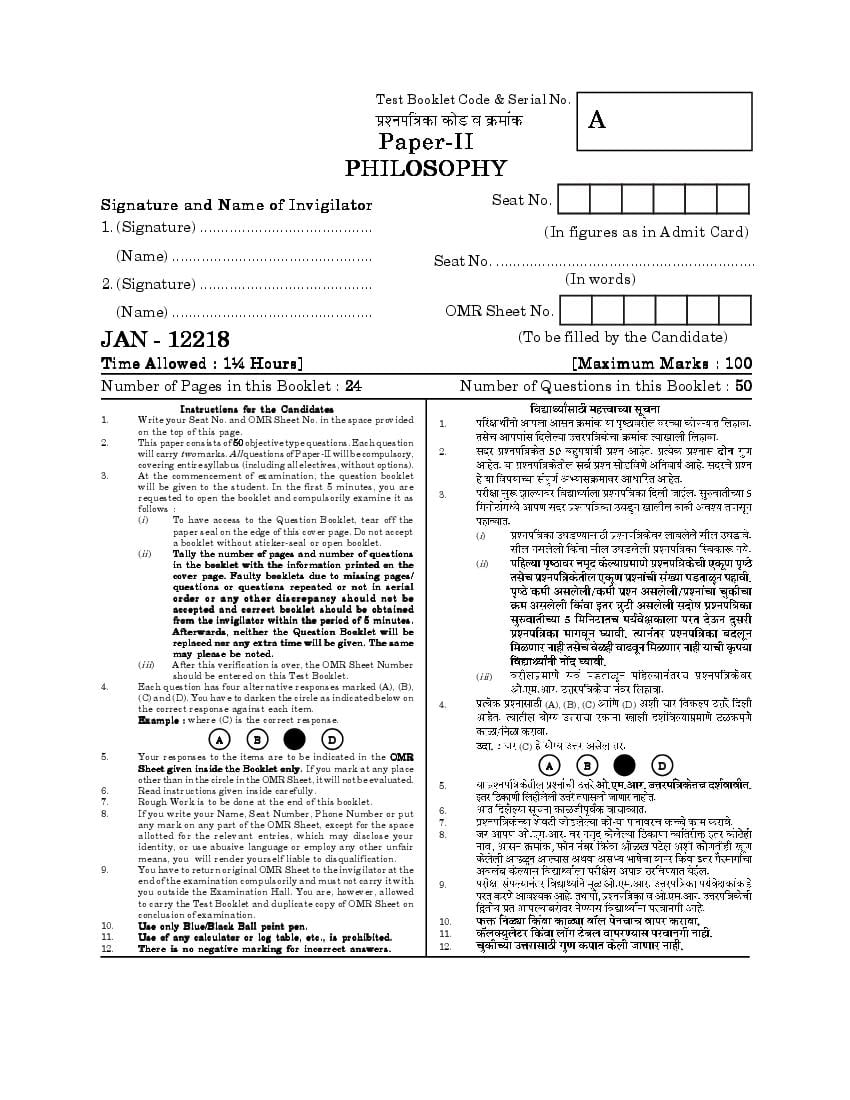
A
PHILOSOPHY
Signature and Name of Invigilator Seat No.
1. (Signature) ......................................... (In figures as in Admit Card)
(Name) ................................................ Seat No. ..............................................................
2. (Signature) ......................................... (In words)
(Name) ................................................ OMR Sheet No.
JAN - 12218 (To be filled by the Candidate)
Time Allowed : 1¼ Hours] [Maximum Marks : 100
Number of Pages in this Booklet : 24 Number of Questions in this Booklet : 50
Instructions for the Candidates
1. Write your Seat No. and OMR Sheet No. in the space provided 1.
on the top of this page.
2. This paper consists of 50 objective type questions. Each question
will carry two marks. All questions of Paper-II will be compulsory, 2.
covering entire syllabus (including all electives, without options).
3. At the commencement of examination, the question booklet
will be given to the student. In the first 5 minutes, you are
requested to open the booklet and compulsorily examine it as 3.
follows :
(i) To have access to the Question Booklet, tear off the
paper seal on the edge of this cover page. Do not accept (i)
a booklet without sticker-seal or open booklet.
(ii) Tally the number of pages and number of questions
in the booklet with the information printed on the (ii)
cover page. Faulty booklets due to missing pages/
questions or questions repeated or not in serial
o rder or any other discre pancy should not be
accepted and correct booklet should be obtained
from the invigilator within the period of 5 minutes.
Afterwards, neither the Question Booklet will be
replaced nor any extra time will be given. The same
may please be noted.
(iii) After this verification is over, the OMR Sheet Number
should be entered on this Test Booklet. (iii)
4. Each question has four alternative responses marked (A), (B),
(C) and (D). You have to darken the circle as indicated below on
the correct response against each item. 4. (A), (B), (C) (D)
Example : where (C) is the correct response.
A B D
(C)
5. Your responses to the items are to be indicated in the OMR
Sheet given inside the Booklet only. If you mark at any place A B D
other than in the circle in the OMR Sheet, it will not be evaluated.
5.
6. Read instructions given inside carefully.
7. Rough Work is to be done at the end of this booklet.
8. If you write your Name, Seat Number, Phone Number or put 6.
any mark on any part of the OMR Sheet, except for the space 7.
allotted for the relevant entries, which may disclose your 8.
identity, or use abusive language or employ any other unfair
means, you will render yourself liable to disqualification.
9. You have to return original OMR Sheet to the invigilator at the
end of the examination compulsorily and must not carry it with 9.
you outside the Examination Hall. You are, however, allowed
to carry the Test Booklet and duplicate copy of OMR Sheet on
conclusion of examination.
10. Use only Blue/Black Ball point pen. 10.
11. Use of any calculator or log table, etc., is prohibited. 11.
12. There is no negative marking for incorrect answers. 12.
Page 2
Page 3
Paper II
II
Time Allowed : 75 Minutes] [Maximum Marks : 100
Note : This paper contains Fifty (50) multiple choice questions, each carrying
Two (2) marks. Attempt All questions.
(50) (2)
ada is 1.
known as :
(A)
(A) Visvakarama
(B)
(B) Prajapati
(C)
(C) Sahasraka
(D)
(D) Sahasra Sirsu
2. Which of the following are 2.
materialists (Jadavadi) ?
(A)
(A) Naiyayikas
(B)
(B) Vais esikas
(C)
(C) Carvakas
(D) Advaitins (D)
3 [P.T.O.
Page 4
the correct answer from the codes
given below :
I
List I
(a)
(a) Jivas
(b)
(b) Vaikuntha
(c)
(c) Prapatti
(d)
(d) Ramanuja
II
List II
(1)
(1) Liberation
(2)
(2) Nitya, Mukta, Baddha
(3)
(3) Nitya Jivas
(4)
(4) Brahmaparinamavada
Codes :
(a) (b) (c) (d)
(a) (b) (c) (d)
(A) (1) (2) (3) (4)
(A) (1) (2) (3) (4)
(B) (2) (3) (1) (4) (B) (2) (3) (1) (4)
(C) (1) (3) (2) (4) (C) (1) (3) (2) (4)
(D) (4) (3) (2) (1) (D) (4) (3) (2) (1)
4
Page 5
rejects anumana as a valid source
of knowledge ?
(A)
(A) Nyaya
(B)
(B) Jainism
(C)
(C) Buddhism
(D) Carvaka (D)
5. Which of the following is Vritti 5.
(modification of citta ) as advocated
by yogadarsana ?
(A)
(A) Nidra (sleep)
(B)
(B) Antahkaran
(C)
(C) Manas (mind)
(D)
(D) Dravya (substance)
5 [P.T.O.
Page 6
arguments for existence of prakriti
in Samkhyakarika ?
(A)
(A) Bhedanam Parimanat
(B)
(B) Asadakaranat
(C)
(C) Bhoktrubhavat
(D) Adhisthana (D)
7. Nibbana as understand by 7.
Buddhism indicates :
(A) Cessation of body
(A)
(B) Cessation of fruits
(B)
(C) Cessation of suffering
(C)
(D) Cessation of action
(D)
6
Page 7
Sadhana (External means) of
Astanga Yoga ?
(A)
(A) Asan
(B)
(B) Dharana
(C)
(C) Dhyan
(D)
(D) Samadhi
9. Which of the following statements 9.
is true ?
(A)
(A) Both Prabhakara and
Kumarila do not accept
Anupalabdhi as a pramana
(B) Prabhakara does not accept (B)
Anupalabdhi but Kumarila
does
(C) Prabhakara does not accept
(C)
any of the Pramanas
(D) Prabhakara and Kumarila (D)
accept anupalabdhi as a
pramana
7 [P.T.O.
Page 8
ship between soul and body is ............
(A) Aprthaksiddhi (A)
(B) Ayutasiddhi (B)
(C) Prapatti (C)
(D) Samavaya (D)
11. The concepts of Niskama Karma 11.
and devotion are emphasized by :
(A) Samkaracarya (A)
(B) Ramanujacarya (B)
(C) Madhvacarya (C)
(D) Vallabhacarya (D)
8
Page 9
tradition is associated with :
(A) Rta (A)
(B) Rna (B)
(C) Dharma (C)
(D) Yajna (D)
13. Which of the following is not 13.
maintained by Sankara ?
(A) Atman and Brahman are
(A)
identical
(B)
(B) J iva and Brahman are
identical (C)
(C) Jagat is superimposition (D)
(D) Atman is created by Brahman
9 [P.T.O.
Page 10
(A) Monotheist (A)
(B) Polytheist (B)
(C) Positivist (C)
(D) Sceptic (D)
15. ‘‘ Uttisthata (Arise), Jagrata 15.
(Awake), Prapya Varannibodhata
(stop not till the goal is reached)’’ is
oft-quoted by :
(A)
'
(A) Sr i Aurobindo
(B)
(B) Radhakrishnan
(C) Iqbal (C)
(D) Swami Vivekananda (D)
10
Page 11
by Dr. Ambedkar ?
(A) Who were the Shudras ? (A)
(B) Annihilation of Caste (B)
(C) Buddha and his Dhamma (C)
(D) Svaraj in Ideas (D)
17.
17. According to Aurobindo the goal of
evolution is ............
(A)
(A) Integration
(B) Divine life (B)
(C) Bliss (C)
(D)
(D) Liberation
18. Philosophy of K.C. Bhattacharya is 18.
labelled as :
(A) Absolute Idealism (A)
(B) Transcendental Idealism (B)
(C) Logical Idealism (C)
(D) Pure Idealism (D)
11 [P.T.O.
s
Page 12
the correct answer from the codes
given below :
I
List I
(a)
(a) Radhakrishnan
(b)
(b) K.C. Bhattacharya
(c)
(c) Swami Vivekananda
(d)
(d) Sri Aurobindo
II
List II
(1)
(1) Integral Yoga
(2)
(2) Universal Religion
(3)
(3) Transcendental Idealism
(4)
(4) Universal Redemption
Codes :
(a) (b) (c) (d)
(a) (b) (c) (d)
(A) (2) (4) (1) (3)
(A) (2) (4) (1) (3)
(B) (3) (4) (2) (1)
(B) (3) (4) (2) (1)
(C) (4) (3) (2) (1)
(C) (4) (3) (2) (1)
(D) (4) (2) (3) (1) (D) (4) (2) (3) (1)
20. ............ believed that freedom does 20.
not come through effort but it is the
perception of truth that liberates.
(A)
(A) J. Krishnamurti
(B)
(B) K.C. Bhattacharya
(C) Rabindranath Tagore (C)
(D) Mahatma Gandhi (D)
12
Page 13
important for J. Krishnamurti ?
(A) Yes (A)
(B) No (B)
(C) Cant’s say (C)
(D) Neither (A) nor (B) (D) (A) (B)
22. Identify the work not written by 22.
Gandhi from the following :
(A) The Story of My Experiments
(A)
with Truth
(B)
(B) Young India
(C) Discovery of India (C)
(D) Hind Swaraj
(D)
13 [P.T.O.
Page 14
observation of the ‘‘universe as a
symphony’’ to ‘‘music-maker’’ (God)
which reminds us of :
(A)
(A) Ontological proof
(B)
(B) Cosmological proof
(C)
(C) Teleological proof
(D)
(D) Moral proof
24. ‘‘Man is the measure of all things’’ 24.
said :
(A) Protagoras (A)
(B) Socrates
(B)
(C) Parmenides
(C)
(D) Gorgias
(D)
14
Page 15
25. Parmenides rejects the reality of :
(A)
(A) Motion
(B)
(B) Multiplicity
(C)
(C) Change
(D)
(D) All of the above
26. Socrates was mainly concerned with 26.
the issues pertaining to :
(A) Ethics (A)
(B) Psychology (B)
(C) Epistemology (C)
(D) Metaphysics (D)
27. Recollection theory of knowledge is 27.
put forth by :
(A) Plato
(A)
(B) Aristotle
(B)
(C) St. Aquinas
(C)
(D) Thales
(D)
15 [P.T.O.
Page 16
Plato’s Philosophy.
(A) Doctrine (A)
(B) Knowledge (B)
(C) Opinion (C)
(D) Theory (D)
29. According to Plato, particulars are 29.
not :
(A)
(A) Copies of forms
(B)
(B) Shadows of forms
(C)
(C) Identical with forms
(D) Imitations of forms (D)
30. According to Aristotle, universals 30.
are :
(A) Transcendent to particulars (A)
(B) Immanent in the particulars (B)
(C) Concepts in the mind (C)
(D) Names in langauge (D)
16
Page 17
the philosophy of :
(A) Sophists (A)
(B) Atomists (B)
(C) Plato (C)
(D) Aristotle (D)
32. Substance according to Aristotle is 32.
not :
(A)
(A) A grammatical subject
(B) A logical subject (B)
(C) That which exists independently
(C)
(D) That which exists in the other
(D)
world
33. Ontological argument is based on 33.
the concept of God as :
(A) a perfect being (A)
(B) a necessary being (B)
(C) the creator of the world (C)
(D) the unmoved mover (D)
17 [P.T.O.
Page 18
St. Anselm was criticized by :
(A) St. Aquinas
(A)
(B) Kant
(B)
(C) Descartes (C)
(D) Spinoza (D)
35. Which of the following arguments is 35.
not given by St. Aquinas to prove
the existence of God ?
(A) Ontological argument (A)
(B) Argument from contingency (B)
(C) Argument from graded (C)
excellence
(D) Argument from origin of motion (D)
36. St. Augustine was mainly infleunced 36.
by the philosophy of :
(A) Plato (A)
(B) Aristotle (B)
(C) Socrates (C)
(D) Pythagoras (D)
18
Page 19
is :
(A) Mind (A)
(B) Body (B)
(C) Nature (C)
(D) Idea (D)
38. According to Descartes, our 38.
knowledge of the external world is
a/an :
(A)
(A) Perceptual knowledge
(B)
(B) Intuitive knowledge
(C) Deductive knowledge (C)
(D) Innate knowledge (D)
19 [P.T.O.
Page 20
(A) Non-physical substance (A)
(B) Physical substance (B)
(C) Existent (C)
(D) Absolute idea (D)
40. According to Locke, sound is a/an : 40.
(A) Primary quality (A)
(B) Secondary quality (B)
(C) Accidental quality
(C)
(D) Composite of (A) and (B)
(D) (A) (B)
41. The author of ‘An Essay Concerning
41.
Human Understanding’ is :
(A) Hume (A)
(B) Locke (B)
(C) Kant (C)
(D) Berkeley (D)
20
Page 21
philosphy is a/an :
(A) Conclusion of inquiry (A)
(B) Method of inquiry (B)
(C) Basic proposition of inquiry (C)
(D) Inference (D)
43. In Kant’s philosophy, space and time 43.
are :
(A) Judgements (A)
(B) Categories (B)
(C) Forms of intuition (C)
(D) Observable objects (D)
44. Hegel maintains that contradictory 44.
aspects of things can be understood
only as :
(A)
(A) Logical signs
(B)
(B) Part of an organic system
(C) Part of a formal logical system (C)
(D) Mental formations (D)
21 [P.T.O.
Page 22
‘Apollonian and Dionysian’ refer
to :
(A) Greek Gods (A)
(B) Forces (B)
(C) Myths (C)
(D) Mental images (D)
46. Heidegger’s term Dasein 46.
appropriately refers to :
(A) Fundamental being (A)
(B) Being-in-itself (B)
(C) Being-in-the-world (C)
(D)
(D) Being-for-itself
47. Kant maintains that conditions of 47.
genuine knowledge consist of :
(A) Analytic judgements only (A)
(B) Synthetic judgements only (B)
(C) Synthetic a priori judgements (C)
(D) Synthetic a posteriori (D)
22
Page 23
morality is an example of :
(A) Will to power (A)
(B) Slave morality (B)
(C) Master morality (C)
(D) Rational morality (D)
49. According to Moore, Berkeley’s
49.
idealism fails to distinguish
between :
(A) Logical and Psycholgoical (A)
object
(B)
(B) Consciousness and the subject
of consciousness (C)
(C) Consciousness and the object of
(D)
consciousness
(D) Perceived and imagined object
50. According to Ambedkar which of the 50.
following statements is not true ?
(A) To maintain purity of life is
(A)
Dhamma
(B) To reach perfection in life is (B)
Dhamma
(C)
(C) To live in nibbana is Dhamma
(D) To believe in God is Dhamma (D)
23 [P.T.O.
Page 24
24
Document Details
| Board / Org | Maharashtra Exams |
| Exam | MAHA SET |
| Type | Question Paper |
| Pages | 24 |
| Updated | 30 Apr 2026 |