CBSE Class 12 Sample Paper 2022 for Textile Design Term 1
Finished viewing? Save it for later —
Download CBSE Class 12 Sample Paper 2022 for Textile Design Term 1 (PDF · 7 pages)About CBSE Class 12 Sample Paper 2022 for Textile Design Term 1
CBSE Class 12 Sample Paper 2022 for Textile Design Term 1 is available here for free download. Published by CBSE for Class 12, this sample paper can be viewed online or downloaded as a PDF (7 pages). Candidates preparing for Class 12 can use CBSE Class 12 Sample Paper 2022 for Textile Design Term 1 to understand the exam pattern, the type of questions asked, and the overall difficulty level.
Frequently Asked Questions
How can I download CBSE Class 12 Sample Paper 2022 for Textile Design Term 1?
Open this page and click the Download button to save CBSE Class 12 Sample Paper 2022 for Textile Design Term 1 as a PDF. It is completely free on AglaSem Docs.
Is CBSE Class 12 Sample Paper 2022 for Textile Design Term 1 free to download?
Yes. CBSE Class 12 Sample Paper 2022 for Textile Design Term 1 can be viewed online and downloaded as a PDF free of cost on AglaSem Docs.
How many pages does CBSE Class 12 Sample Paper 2022 for Textile Design Term 1 have?
CBSE Class 12 Sample Paper 2022 for Textile Design Term 1 contains 7 pages, which you can read online or download together as a single PDF.
Where can I find more Class 12 study material?
You can find more Class 12 question papers, sample papers, syllabus, and answer keys on AglaSem Docs.
CBSE Class 12 Sample Paper 2022 for Textile Design Term 1 – Text
Read the full text of this sample paper below — useful to quickly search, copy and reference the content online without downloading the PDF.
📄 View text version (7 pages)
Page 1
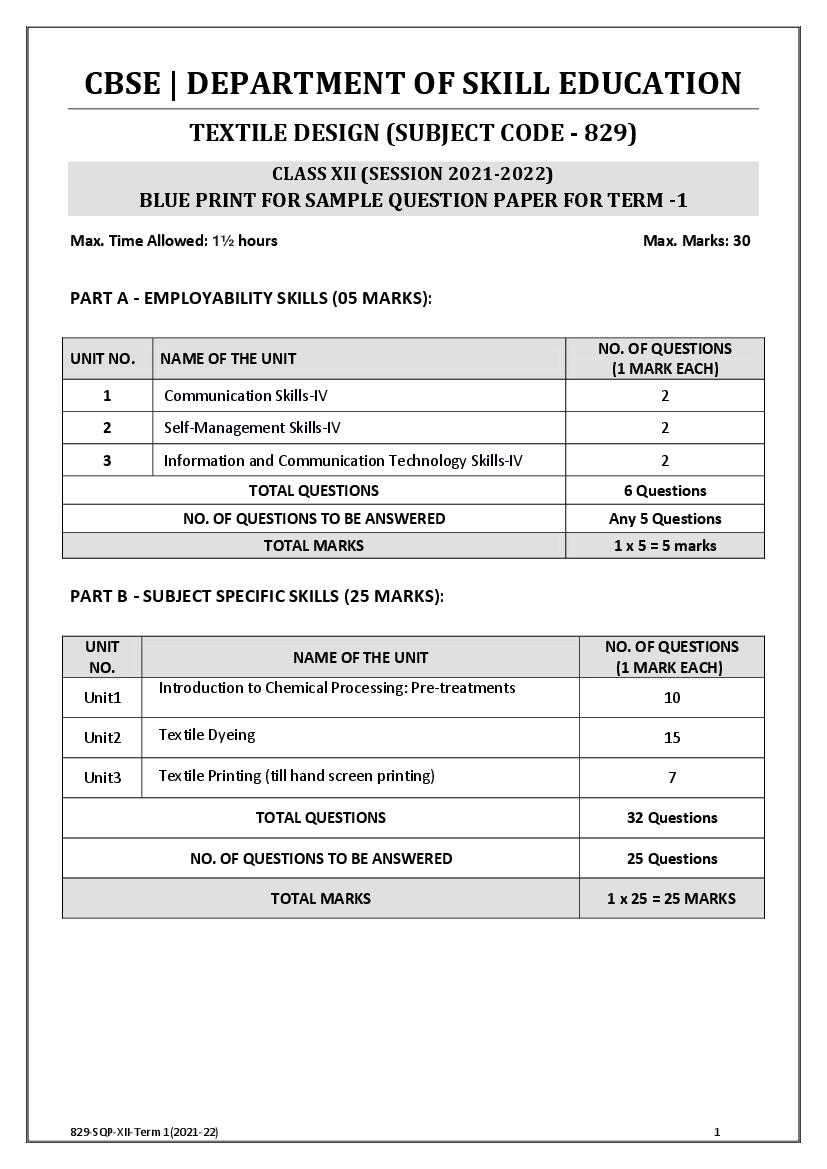
TEXTILE DESIGN (SUBJECT CODE - 829)
CLASS XII (SESSION 2021-2022)
BLUE PRINT FOR SAMPLE QUESTION PAPER FOR TERM -1
Max. Time Allowed: 1½ hours Max. Marks: 30
PART A - EMPLOYABILITY SKILLS (05 MARKS):
NO. OF QUESTIONS
UNIT NO. NAME OF THE UNIT
(1 MARK EACH)
1 Communication Skills-IV 2
2 Self-Management Skills-IV 2
3 Information and Communication Technology Skills-IV 2
TOTAL QUESTIONS 6 Questions
NO. OF QUESTIONS TO BE ANSWERED Any 5 Questions
TOTAL MARKS 1 x 5 = 5 marks
PART B - SUBJECT SPECIFIC SKILLS (25 MARKS):
UNIT NO. OF QUESTIONS
NAME OF THE UNIT
NO. (1 MARK EACH)
Introduction to Chemical Processing: Pre-treatments
Unit1 10
Unit2 Textile Dyeing 15
Unit3 Textile Printing (till hand screen printing) 7
TOTAL QUESTIONS 32 Questions
NO. OF QUESTIONS TO BE ANSWERED 25 Questions
TOTAL MARKS 1 x 25 = 25 MARKS
829-SQP-XII-Term 1(2021-22) 1
Page 2
TEXTILE DESIGN (SUBJECT CODE - 829)
CLASS XII (SESSION 2021-2022)
SAMPLE QUESTION PAPER FOR TERM -1
Max. Time Allowed: 1½ hours Max. Marks: 30
General Instructions:
1. Please read the instructions carefully
2. This Question Paper is divided into 03 sections, viz., Section A, Section B and Section C.
3. Section A is of 05 marks and has 06 questions on Employability Skills.
4. Section B is of 20 marks and has 25 questions on Subject specific Skills.
5. Section C is of 05 marks and has 07 competency-based questions.
6. Do as per the instructions given in the respective sections.
7. Marks allotted are mentioned against each section/question.
8. All questions must be attempted in the correct order
SECTION A
Answer any 5 questions out of the given 6 questions on Employability Skills (1 x 5 = 5 marks)
1. In active listening, ‘this’ indicates to the speaker if you are listening or not. Also, it is 1
advisable to keep your hand and feet still while talking to someone. What does ‘this’
indicates here?
a. Eye contact
b. Gestures
c. Giving feedback
d. Speech
2. Ravi is never interested to attend any social gathering. He distant and detach himself from 1
people. He seems to be indifferent. Identify the personality disorder faced by him.
a. Schizoid
b. Borderline
c. Narcissistic
d. Obsessive-compulsive personality
3. What will you do to select the entire worksheet? 1
a. CTRL + B
b. CTRL + Z
c. CTRL + C
d. CTRL + A
829-SQP-XII-Term 1(2021-22) 2
Page 3
verb.
a. simple sentence
b. complex sentence
c. passive sentence
d. active sentence
5. Sanchit is a hardworking, organized and dependable employee of his company. 1
According to trait theory, what kind of personality does he have?
a. Extraversion
b. Agreeableness
c. Conscientiousness
d. Confident
6. Select the steps to auto filter in the worksheet. 1
a. Data➢ Filter ➢ Standard Filter.
b. Data➢ Filter ➢ Sort Filter
c. Data➢ Filter ➢ Auto Filter.
d. Data➢ Filter ➢ Page layout.
SECTION B
Answer any 20 questions out of the given 25 questions (1 x 20 = 20 marks)
7. Which is the natural impurity present on wool fibre? 1
a. Sweat deposited on the sheep‟s or goat‟s hair.
b. Dust particle deposited on the sheep‟s or goat‟s hair.
c. Natural colour deposited on the sheep‟s or goat‟s hair.
d. Dust particle & natural colour both deposited on the sheep’s or goat’s hair.
8. What is the right sequence of basic steps of creating a bandhani textile? 1
a. Tracing of design, Tying of fabric, Opening the ties
b. Tracing of design, Tying of fabric, Dyeing of fabric in the lightest colour
c. Tying of fabric, Dyeing of fabric in the lightest colour, Tracing of design
d. Opening the ties, Dyeing of fabric in the lightest colour, Tracing of design
9. In hand block printing method, the outline wooden block is known as ________. It is ½+
followed by printing of other filling blocks known as _______ 1/2
a. rekh, khaka
b. khaka, gad.
c. Tukda & gad
d. rekh, gad.
829-SQP-XII-Term 1(2021-22) 3
Page 4
a. Removes protruding fibers from both sides of fabric.
b. Weave of the fabric is disoriented
c. makes fabric less absorbent in nature
d. leads to unleveled dyeing.
11. Which of the following is the limitation of Hand Screen Printing? 1
a. Half tone designs are not possible
b. Fine-line paisley prints are possible
c. production is uneven
d. production becomes unstable
12. Wooden tables used for block printing are padded with layers of felt/ blanket material 1
and covered with fine muslin. Why?
a. absorbs extra dye
b. comfortable for printer
c. maintains the consistency of printing paste.
d. Less consumption of dye
13. For removal of starch from fabric, it is being impregnated in the ___________and stored 1
for _____________.
a. Cold water, 8-12 hours
b. de-sizing bath, ½ hours
c. dye bath, 8-12 hours
d. de-sizing bath, 8-12 hours
14. The brightly coloured Kalamkari is better known as __________ in Europe. 1
a. Patterned fabric
b. Muslin
c. Chintz
d. Dyed fabric
15. During singeing process, fabric is passed over an open flame at a high speed to prevent 1
____________.
a. Scorching
b. Colour fading
c. Shrinkage
d. Fraying
16. Starch is an added impurity in a yarn during manufacturing process : 1
a. To reduce the breakage of yarn during the weaving operation.
b. To make yarn smooth during the weaving operation
c. To make yarn long during the weaving operation.
d. To make yarn short during the weaving operation.
17. Name the substance which treats the fabric for scouring process. 1
a. strong alkali solution
b. strong acidic solution
c. weak alkali solution
d. weak acidic solution
829-SQP-XII-Term 1(2021-22) 4
Page 5
which is nowadays available as a sari worn on auspicious occasions is called as
___________.
a. Gharcholu
b. Chandrokhani
c. Abo
d. Leheriya
19. In which dyeing method loose fibers are dyed by circulating the dye liquor continuously 1
through fibers?
a. Stock dyeing
b. Yarn dyeing
c. Garment dyeing
d. Fabric dyeing
20. Which are the two major centers of bandhani in Gujarat? 1
a. Jamnagar, Bhavnagar
b. Rajkot and Bikaner
c. Porbandar and Bikaner
d. Jamnagar and Bikaner
21. Which chemical is also called as “Universal bleaching agent”? 1
a. Hydrogen peroxide
b. Hydrogen chloride
c. Hydrogen oxide
d. Hydro sodium
22. Hank dyeing Machine is used for _____________ 1
a. Fibre dyeing
b. Garment dyeing
c. Yarn dyeing
d. Cross dyeing
23. 1
Why the ties of the tie-dyed fabric are kept tied till purchased by a consumer?
a. in order to differentiate between a bandhani textile and a printed imitation
b. in order it too look pleasing to customer
c. in order to save storage space.
d. in order it to look compact
24. Before the beginning of printing process, pins are inserted _________ on the fabric 1
edges. This is to avoid the shifting of fabric when printing is taking place.
a. Vertically
b. Diagonally
c. Horizontally
d. Backwards
829-SQP-XII-Term 1(2021-22) 5
Page 6
a. Robin blue, Ujala
b. Tinopal , Ranipol
c. Robun blue, Ranipol
d. Tinapol, Ujala
26. The traditional odhani for a Muslim bride in red and black colour is called___________. 1
a. Chandrokhani
b. Bandhani
c. Bandhej
d. Patola
27. Dope dyeing is executed: 1
a. in the combed wool sliver stage.
b. after the fiber has been spun into yarn
c. after a manmade fiber is extruded through the spinneret.
d. before a manmade fiber is extruded through the spinneret.
28. This is the third group of direct dyes that is further identified as naphthol and rapidogen 1
types. Identify the dye.
a. Azoic dyes
b. Direct dyes
c. Vat dyes
d. Basic dyes
29. Newly constructed fabric is also called as gray good. What does ‘gray’ denote here? 1
a. Appearance
b. Hand/Feel
c. Raw/unfinished
d. Colour
30. How the typical ‘piliya’ does looks like? 1
a. largely yellow in colour with red appearing in borders, big central circular motif
and four smaller circles around it .
b. fine checkered pattern created by crisscrossing diagonal lines.
c. tie-dye motifs range from very simple to complex forms including geometric and
floral designs.
d. Checkered & striped pattern
31. When was first synthetic dye derived and from where? 1
a. 1856, coal tar
b. 1756, coal tar
c. 1777, coal tar
d. 1877, coal tar
829-SQP-XII-Term 1(2021-22) 6
Page 7
(COMPETENCY BASED QUESTIONS)
Answer any 5 questions out of the given 7 questions (1 x 5 = 5 marks)
It is a small village in Rajasthan, which is known for its mud-resist block prints. The motifs are inspired
by the 17th century Persian culture.
32. Identify the name of this village. 1
a. Bagru
b. Bishnoi
c. Chomu
d. Rampur
33. Which of the following motifs are inspired from Persian culture? 1
a. suraj ka phool, chakri, anguthi, gende ka phool.
b. Tombs and flowers
c. Mosque
d. leaves
34. The mud resist paste is used : 1
a. to resist the fabric from being stained from dirt
b. to let the dye penetrate through it
c. to resist the penetration of dyes
d. to give texture on the surface
35. How is resulting effect of dark and deep background with light coloured prints 1
achieved?
a. by resisting and mordanting.
b. by resisting and bleaching
c. by resisting and washing.
d. by resisting and cleaning
36. Which style of printing is mainly used here? 1
a. Screen printing
b. Block printing
c. Rotary printing
d. Roller printing
37. A resisting paste ‘dabu’ is made up of: 1
a. clay and gum
b. clay and sand
c. gum and sand
d. clay & mordant
38. Rajasthan is known for its _____________________. 1
a. colorful block printed fabrics
b. colorful digitally printed fabrics
c. colorful rotary printed fabrics
d. colorful rotary printed fabrics
829-SQP-XII-Term 1(2021-22) 7
Document Details
| Board / Org | CBSE |
| Exam | Class 12 |
| Type | Sample Paper |
| Pages | 7 |
| Updated | 30 Apr 2026 |