MAHA SET 2018 Question Paper 2 Physical Education
Finished viewing? Save it for later —
Download MAHA SET 2018 Question Paper 2 Physical Education (PDF · 24 pages)About MAHA SET 2018 Question Paper 2 Physical Education
MAHA SET 2018 Question Paper 2 Physical Education is available here for free download. Published by Maharashtra Exams for Maharashtra State Eligibility Test, this question paper can be viewed online or downloaded as a PDF (24 pages). Candidates preparing for Maharashtra State Eligibility Test can use MAHA SET 2018 Question Paper 2 Physical Education to understand the exam pattern, the type of questions asked, and the overall difficulty level.
Frequently Asked Questions
How can I download MAHA SET 2018 Question Paper 2 Physical Education?
Open this page and click the Download button to save MAHA SET 2018 Question Paper 2 Physical Education as a PDF. It is completely free on AglaSem Docs.
Is MAHA SET 2018 Question Paper 2 Physical Education free to download?
Yes. MAHA SET 2018 Question Paper 2 Physical Education can be viewed online and downloaded as a PDF free of cost on AglaSem Docs.
How many pages does MAHA SET 2018 Question Paper 2 Physical Education have?
MAHA SET 2018 Question Paper 2 Physical Education contains 24 pages, which you can read online or download together as a single PDF.
Where can I find more Maharashtra State Eligibility Test study material?
You can find more Maharashtra State Eligibility Test question papers, sample papers, syllabus, and answer keys on AglaSem Docs.
MAHA SET 2018 Question Paper 2 Physical Education – Text
Read the full text of this question paper below — useful to quickly search, copy and reference the content online without downloading the PDF.
📄 View text version (24 pages)
Page 1
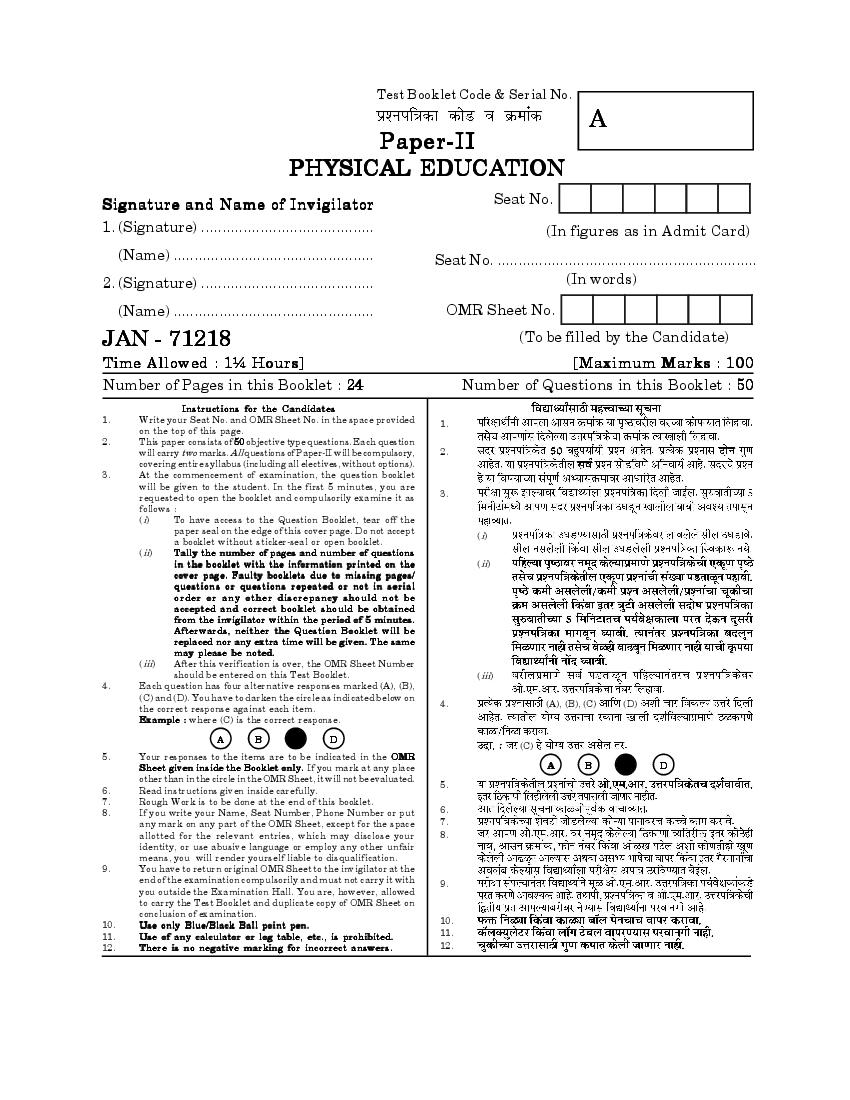
A
Paper-II
PHYSICAL EDUCATION
Signature and Name of Invigilator Seat No.
1. (Signature) ......................................... (In figures as in Admit Card)
(Name) ................................................ Seat No. ..............................................................
2. (Signature) ......................................... (In words)
(Name) ................................................ OMR Sheet No.
JAN - 71218 (To be filled by the Candidate)
Time Allowed : 1¼ Hours] [Maximum Marks : 100
Number of Pages in this Booklet : 24 Number of Questions in this Booklet : 50
Instructions for the Candidates
1. Write your Seat No. and OMR Sheet No. in the space provided 1.
on the top of this page.
2. This paper consists of 50 objective type questions. Each question
will carry two marks. All questions of Paper-II will be compulsory, 2.
covering entire syllabus (including all electives, without options).
3. At the commencement of examination, the question booklet
will be given to the student. In the first 5 minutes, you are
requested to open the booklet and compulsorily examine it as 3.
follows :
(i) To have access to the Question Booklet, tear off the
paper seal on the edge of this cover page. Do not accept (i)
a booklet without sticker-seal or open booklet.
(ii) Tally the number of pages and number of questions
in the booklet with the information printed on the (ii)
cover page. Faulty booklets due to missing pages/
questions or questions repeated or not in serial
o rder or any other discre pancy should not be
accepted and correct booklet should be obtained
from the invigilator within the period of 5 minutes.
Afterwards, neither the Question Booklet will be
replaced nor any extra time will be given. The same
may please be noted.
(iii) After this verification is over, the OMR Sheet Number
should be entered on this Test Booklet. (iii)
4. Each question has four alternative responses marked (A), (B),
(C) and (D). You have to darken the circle as indicated below on
the correct response against each item. 4. (A), (B), (C) (D)
Example : where (C) is the correct response.
A B D
(C)
5. Your responses to the items are to be indicated in the OMR
Sheet given inside the Booklet only. If you mark at any place A B D
other than in the circle in the OMR Sheet, it will not be evaluated.
5.
6. Read instructions given inside carefully.
7. Rough Work is to be done at the end of this booklet.
8. If you write your Name, Seat Number, Phone Number or put 6.
any mark on any part of the OMR Sheet, except for the space 7.
allotted for the relevant entries, which may disclose your 8.
identity, or use abusive language or employ any other unfair
means, you will render yourself liable to disqualification.
9. You have to return original OMR Sheet to the invigilator at the
end of the examination compulsorily and must not carry it with 9.
you outside the Examination Hall. You are, however, allowed
to carry the Test Booklet and duplicate copy of OMR Sheet on
conclusion of examination.
10. Use only Blue/Black Ball point pen. 10.
11. Use of any calculator or log table, etc., is prohibited. 11.
12. There is no negative marking for incorrect answers. 12.
Page 2
Page 3
Paper II
II
Time Allowed : 75 Minutes] [Maximum Marks : 100
Note : This paper contains 50 multiple choice questions. Each carrying
Two (2) marks. Attempt All questions.
50 (2)
1. Idealism philosophy is developed 1.
by .................... .
(A)
(A) Plato
(B)
(B) Thomas
(C)
(C) Darwin
(D)
(D) Maslow
2. The central theme of Physical 2.
Education is ................. .
(A) Fitness (A)
(B) Man (B)
(C) Motion (C)
(D) Man in motion (D)
3 [P.T.O.
Page 4
psychological health” is propounded
by .................... .
(A)
(A) Allport
(B)
(B) Adler
(C)
(C) Freud
(D) Eysenck (D)
4. Which one of the following 4.
components comes under social
motive ?
(A)
(A) Competition
(B)
(B) Self-esteem
(C) Aggression (C)
(D) Recognition (D)
5. Learning plateau is .................. . 5.
(A) Unavoidable (A)
(B) Avoidable (B)
(C) Manageable (C)
(D) Both (A) and (B) (D) (A) (B)
4
Page 5
(OBLA) is also known as :
(A) Aerobic threshold (A)
(B) Anaerobic threshold (B)
(C) Lactation (C)
(D) Both (A) and (B) (D) (A) (B)
7. Women athletes who are using 7.
anabolic steroids are inviting health
hazards relating to :
(1) Liver dysfunction
(1)
(2) Muscle atropy
(2)
(3) Breast cancer
(3)
(4) Infertility
(4)
(5) Growth of male secondary
(5)
sexual characteristics
Find out the correct combination
from the following codes :
(A) (2), (3) and (5) are correct (A) (2), (3) (5)
(B) (1), (4) and (5) are correct (B) (1), (4) (5)
(C) (2), (4) and (5) are correct (C) (2), (4) (5)
(D) (1), (3) and (5) are correct (D) (1), (3) (5)
5 [P.T.O.
Page 6
oxidation is transported through
blood as ................. .
(A) Carbonic acid (A)
(B) Lactic acid (B)
(C) Oxy-haemoglobin (C)
(D) Carboxy-haemoglobin (D)
9. With cardiorespiratory endurance 9.
training programme both men and
women experiences :
(A)
(A) Gain in Body Mass
(B) FFM
(B) Gain in FFM
(C) Gain in Body Fat (C)
(D) None of the above (D)
6
Page 7
using ................. .
(A) Diathermy (A)
(B) Infrared (B)
(C) Ultraviolet (C)
(D) Ultrasound (D)
11. Biceps Femoris is the major muscle 11.
of ................... .
(A) Anterior side of upper arm (A)
(B) Posterior side of upper arm (B)
(C) Anterior side of thigh muscle (C)
(D) Posterior side of thigh muscle (D)
12. Kyphosis is the deformity of 12.
vertebral column at .................... .
(A) Cervical region (A)
(B) Coccygeal region (B)
(C) Thoracic region (C)
(D) Lumbar region (D)
7 [P.T.O.
Page 8
proportional to ................... .
(A) Weight of the body
(A)
(B) Height of the body
(B)
(C) Size of the base of support
(C)
(D) Position of C. G. from edge of
support (D)
14. The inertia of an object tends to 14.
cause the objects :
(A)
(A) To increase the speed
(B) To decrease the speed (B)
(C) To resist any change in the
(C)
state of motion
(D)
(D) To decelerate due to friction
15. When is massage not prescribed ? 15.
(A) Muscle soreness (A)
(B) Body fatigue (B)
(C) Skin disease (C)
(D) Muscle stiffness (D)
8
Page 9
are :
(I)
(I) Team satisfaction
(II)
(II) Individual performance
(III)
(III) Team ranking in competition
(IV)
(IV) Social support
Find the correct combination :
(A) (I), (IV)
(A) (I), (IV)
(B) (II), (III)
(B) (II), (III)
(C) (IV), (III)
(C) (IV), (III)
(D) (I), (II) (D) (I), (II)
17. Sociological thinking in education 17.
has its impact on .................. .
(A)
(A) Objective
(B)
(B) Ends in education
(C) Both (A) and (B)
(C) (A) (B)
(D) None of the above (D)
9 [P.T.O.
Page 10
take place during :
(A) Puberty (A)
(B) Infancy (B)
(C) Childhood (C)
(D) Adolescence (D)
19. The personal factors in learning 19.
as .................. .
(A)
(A) Heredity factors
(B)
(B) Fitness factors
(C)
(C) Psychological factors
(D)
(D) All of the above
20. Which of the following is a 20.
secondary law of learning ?
(A)
(A) Law of readiness
(B)
(B) Law of recency
(C)
(C) Law of exercise
(D) Law of effect (D)
10
Page 11
initiated a five-week summer course
in indigenous activities to award
certificate as Vyayam Visharad.
(A) 1914 (A) 1914
(B) 1947 (B) 1947
(C) 1924 (C) 1924
(D) 1917 (D) 1917
22. The post graduation degree 22.
‘Masters of Sports Coaching’ is of
duration .................... .
(A) 5
(A) 5 years
(B) 1
(B) 1 year
(C) 3
(C) 3 years
(D) 2 years (D) 2
11 [P.T.O.
Page 12
23.
professional ethics ?
(A)
(A) Harmony between people and
their environment
(B)
(B) Promotion of cooperative
system for self-expression
(C) Development of non-cooperation (C)
and self-centered
(D)
(D) Development of good character
24. The establishment of the LNCPE, 24.
(now LNIPE) Gwalior in the
year .................... .
(A) 1914 (A) 1914
(B) 1920 (B) 1920
(C) 1957 (C) 1957
(D) 1947 (D) 1947
12
Page 13
under principles of curriculum
framework ?
(A)
(A) Rigidity
(B) Explicit knowledge of core (B)
values
(C)
(C) Flexibility
(D)
(D) Development approach
26. “A state of complete physical, mental 26.
and social well-being and not merely
absence of disease or infirmity for
socially and economically productive
life.” This definition of health is
given by :
(A)
(A) World Health Organization
(B)
(B) International Olympic Committee
(C)
(C) Indian Olympic Association
(D) Indian Health Organization (D)
13 [P.T.O.
Page 14
carbohydrate (glucose) in the body
yields ..................... kilocalories of
energy. (A) 2.0
(A) 2.0 kilocalories
(B) 4.2
(B) 4.2 kilocalories
(C) 9.0
(C) 9.0 kilocalories
(D) 7.0
(D) 7.0 kilocalories
28. Indigestible fibrous material in the 28.
food is known as ..................... such
as cellulose in fruits and vegetables
and connective tissues in meat and
fish.
(A)
(A) Minerals
(B)
(B) Vitamins
(C)
(C) Roughage
(D) Proteins (D)
14
Page 15
endurance, flexibility, mascular
strength and muscular endurance
are components of .................... .
(A)
(A) Performance related fitness
(B)
(B) Motor abilities
(C)
(C) General motor fitness
(D)
(D) Health-related fitness
30. Hepatitis is an infection of 30.
the .................... .
(A)
(A) Brain
(B)
(B) Bones
(C)
(C) Muscles
(D) Liver (D)
31. The sum of total pre-requisites 31.
possessed by a person which will
enable him to achieve high
performance in a sport in future
is .................... . (A)
(A) Sport achievement
(B)
(B) Sport performance
(C)
(C) Sport fitness
(D) Sport talent (D)
15 [P.T.O.
Page 16
among sports persons or sports
teams is .................. .
(A)
(A) Sport fitness
(B)
(B) Sport exercise
(C)
(C) Sport competition
(D)
(D) Sport activity
33. Muscular strength and endurance 33.
can improve ..................... and
prevent .................. .
(A) Posture, Injury (A)
(B) Balance, Flexibility (B)
(C) Posture, Flexibility (C)
(D) Balance, Co-ordination (D)
16
Page 17
34.
generally use .................. .
(A) More weight and fewer
repetitions
(A)
(B) Less weight and fewer
repetitions (B)
(C) More weight and more
(C)
repetitions
(D) Less weight and more
(D)
repetitions
35. Training program need to vary 35.
to ................... .
(A) Avoid boredom and maintain (A)
athletes interest
(B) Avoid adaptation (B)
(C) Avoid frequency (C)
(D) Avoid intensity (D)
17 [P.T.O.
Page 18
ranges between .................. .
(A) 00 — 1.00 (A) 00 — 1.00
(B) (–1) — 00 (B) (–1) — 00
(C) 1.00 — 00 (C) 1.00 — 00
(D) (–1.00) — 1.00 (D) (–1.00) — 1.00
37. Mode is a measure of central 37.
tendency. It is considered as ............ .
(A) Average of the score (A)
(B) Most frequently occurring score (B)
(C) Value in middle (C)
(D) Sum of all scores (D)
38. Cluster sampling is type of .............. . 38.
(A) Purposive sampling (A)
(B) Probability sampling (B)
(C) Non-probability sampling (C)
(D) Non-random sampling (D)
18
Page 19
depth study and evaluation of
available information to explain the
nature of complex phenomenon is :
(A)
(A) Experimental Research
(B)
(B) Analytical Research
(C)
(C) Descriptive Research
(D) Qualitative Research (D)
40. A variable that is responsible for 40.
bringing change is called ............. .
(A) Controlled variable (A)
(B) Dependent variable (B)
(C) Independent variable (C)
(D) Constant variable (D)
41. Which of the following rating 41.
represent the pure mesomorph
individual ?
(A) 7-1-1
(A) 7-1-1
(B) 1-7-1
(B) 1-7-1
(C) 1-1-7 (C) 1-1-7
(D) 6-2-2 (D) 6-2-2
19 [P.T.O.
Page 20
components with their respective
tests :
List I I
(a) Cardiovascular endurance (a)
(b) Power (b)
(c) Agility (c)
(d) Speed (d)
List II II
(i) Sit and reach (i)
(ii) 1 mile run/walk (ii)
(iii) 30 m fly (iii)
(iv)
(iv) Shuttle run
(v)
(v) Standing broad jump
Codes :
(a) (b) (c) (d)
(a) (b) (c) (d)
(A) (iv) (iii) (i) (ii)
(A) (iv) (iii) (i) (ii)
(B) (i) (v) (iv) (iii)
(B) (i) (v) (iv) (iii)
(C) (ii) (v) (iv) (iii)
(C) (ii) (v) (iv) (iii)
(D) (iv) (i) (v) (iii) (D) (iv) (i) (v) (iii)
20
Page 21
43.
definitions describes the term
“validity” ?
(A)
(A) Consistency of the test
(B)
(B) Honesty of the test
(C)
(C) Value representative of particular
population
(D)
(D) Usefulness
44.
44. The instrument used for measuring
range of motion in joint is ............. .
(A) Calliper (A)
(B) Dynamometer (B)
(C) Ergometer (C)
(D) Goniometer (D)
21 [P.T.O.
Page 22
movement is the point of focus rather
than the outcome of the skill
performed ?
(A)
(A) Product evaluation
(B)
(B) Summative evaluation
(C)
(C) Process evaluation
(D)
(D) Formative evaluation
46. Which of the following is considered 46.
a technique rather than a method ?
(A) Command (A)
(B) Voice deflection (B)
(C) Lecture (C)
(D) Small group interaction (D)
47. Which of the following is not 47.
considered as a basic means of
learning ?
(A)
(A) Inspirating
(B)
(B) Perception
(C) Inscription (C)
(D) Interaction (D)
22
Page 23
students the sense of ................. .
(A) Achievements (A)
(B) Involvement (B)
(C) Humour (C)
(D) Enjoyment (D)
49. The best method of sports 49.
administration is ................. .
(A) Autocratic (A)
(B) Democratic (B)
(C) Dictatorial (C)
(D) Laissez-faire (D)
50. Which of the following is against the 50.
principles of organization ?
(A) Overlapping of authority (A)
(B) Proper decentralization (B)
(C) Delegation of power (C)
(D) Proper communication (D)
23 [P.T.O.
Page 24
24
Document Details
| Board / Org | Maharashtra Exams |
| Exam | Maharashtra State Eligibility Test |
| Type | Question Paper |
| Pages | 24 |
| Updated | 30 Apr 2026 |