MAHA SET 2015 Question Paper 3 Journalism _ Mass Communication
Finished viewing? Save it for later —
Download MAHA SET 2015 Question Paper 3 Journalism _ Mass Communication (PDF · 40 pages)About MAHA SET 2015 Question Paper 3 Journalism _ Mass Communication
MAHA SET 2015 Question Paper 3 Journalism _ Mass Communication is available here for free download. Published by Maharashtra Exams for MAHA SET, this question paper can be viewed online or downloaded as a PDF (40 pages). Candidates preparing for MAHA SET can use MAHA SET 2015 Question Paper 3 Journalism _ Mass Communication to understand the exam pattern, the type of questions asked, and the overall difficulty level.
Frequently Asked Questions
How can I download MAHA SET 2015 Question Paper 3 Journalism _ Mass Communication?
Open this page and click the Download button to save MAHA SET 2015 Question Paper 3 Journalism _ Mass Communication as a PDF. It is completely free on AglaSem Docs.
Is MAHA SET 2015 Question Paper 3 Journalism _ Mass Communication free to download?
Yes. MAHA SET 2015 Question Paper 3 Journalism _ Mass Communication can be viewed online and downloaded as a PDF free of cost on AglaSem Docs.
How many pages does MAHA SET 2015 Question Paper 3 Journalism _ Mass Communication have?
MAHA SET 2015 Question Paper 3 Journalism _ Mass Communication contains 40 pages, which you can read online or download together as a single PDF.
Where can I find more MAHA SET study material?
You can find more MAHA SET question papers, sample papers, syllabus, and answer keys on AglaSem Docs.
MAHA SET 2015 Question Paper 3 Journalism _ Mass Communication – Text
Read the full text of this question paper below — useful to quickly search, copy and reference the content online without downloading the PDF.
📄 View text version (40 pages)
Page 1
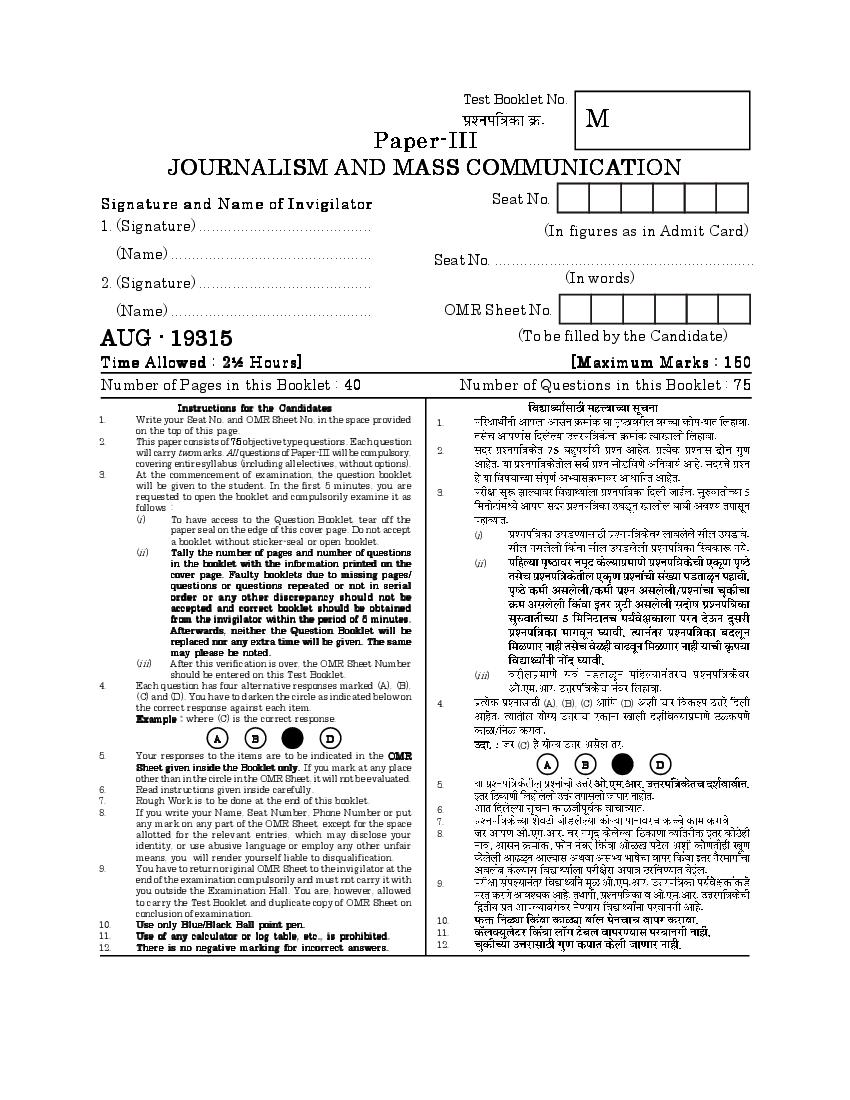
M
JOURNALISM AND MASS COMMUNICATION
Signature and Name of Invigilator Seat No.
1. (Signature) ......................................... (In figures as in Admit Card)
(Name) ................................................ Seat No. ..............................................................
2. (Signature) ......................................... (In words)
(Name) ................................................ OMR Sheet No.
AUG - 19315 (To be filled by the Candidate)
Time Allowed : 2½ Hours] [Maximum Marks : 150
Number of Pages in this Booklet : 40 Number of Questions in this Booklet : 75
Instructions for the Candidates
1. Write your Seat No. and OMR Sheet No. in the space provided 1.
on the top of this page.
2. This paper consists of 75 objective type questions. Each question
will carry two marks. All questions of Paper-III will be compulsory, 2.
covering entire syllabus (including all electives, without options).
3. At the commencement of examination, the question booklet
will be given to the student. In the first 5 minutes, you are
requested to open the booklet and compulsorily examine it as 3.
follows :
(i) To have access to the Question Booklet, tear off the
paper seal on the edge of this cover page. Do not accept
(i)
a booklet without sticker-seal or open booklet.
(ii) Tally the number of pages and number of questions
in the booklet with the information printed on the (ii)
cover page. Faulty booklets due to missing pages/
questions or questions repeated or not in serial
o rder or any other discre pancy should not be
accepted and correct booklet should be obtained
from the invigilator within the period of 5 minutes.
Afterwards, neither the Question Booklet will be
replaced nor any extra time will be given. The same
may please be noted.
(iii) After this verification is over, the OMR Sheet Number
should be entered on this Test Booklet. (iii)
4. Each question has four alternative responses marked (A), (B),
(C) and (D). You have to darken the circle as indicated below on
the correct response against each item. 4. (A), (B), (C) (D)
Example : where (C) is the correct response.
A B D
(C)
5. Your responses to the items are to be indicated in the OMR
Sheet given inside the Booklet only. If you mark at any place A B D
other than in the circle in the OMR Sheet, it will not be evaluated.
5.
6. Read instructions given inside carefully.
7. Rough Work is to be done at the end of this booklet.
8. If you write your Name, Seat Number, Phone Number or put 6.
any mark on any part of the OMR Sheet, except for the space 7.
allotted for the relevant entries, which may disclose your 8.
identity, or use abusive language or employ any other unfair
means, you will render yourself liable to disqualification.
9. You have to return original OMR Sheet to the invigilator at the
end of the examination compulsorily and must not carry it with 9.
you outside the Examination Hall. You are, however, allowed
to carry the Test Booklet and duplicate copy of OMR Sheet on
conclusion of examination.
10. Use only Blue/Black Ball point pen. 10.
11. Use of any calculator or log table, etc., is prohibited. 11.
12. There is no negative marking for incorrect answers. 12.
Page 2
Page 3
Paper III
III
Time Allowed : 2½ Hours] [Maximum Marks : 150
Note : This paper contains Seventy Five (75) multiple choice questions, each
question carrying Two (2) marks. Attempt All questions.
(75) (2)
1. The term ‘mesmerism’ is used in 1.
reference to the ways in which :
(A) Society influences individuals (A)
(B)
(B) Individuals memorise theological
lessons
(C)
(C) Franz Mesmer teaches his
students
(D)
(D) Media influence people
2.
2. Colour printing demands colour :
(A) Integration
(A)
(B) Dilution
(B)
(C) Separation (C)
(D) Concentration (D)
3 [P.T.O.
Page 4
awards for the best stories for the
coverage of conflict in Indian Print
media ?
(A)
(A) PII-ICRC
(B)
(B) PIB
(C)
(C) UNI
(D) PTI (D)
4. Simultaneous transmission of 4.
several channels of compressed
digital contents of television is
referred to as :
(A)
(A) Digicast
(B)
(B) Narrowcast
(C)
(C) Personalcast
(D) Multicast (D)
4
Page 5
established industrial order which
serves primarily to maintain,
stabilize and reinforce rather than
alter, threaten or weaken convential
beliefs and behaviours.” This
statement by Gross (1977) aptly
sums up which of the following
theories of media effects ?
(A)
(A) Spiral of silence effect
(B) Knowledge gap effect
(B)
(C) Catharsis effect
(D) Cultivation effect (C)
6. Which of the following is not a
feature of the ‘Cultural-Reception (D)
Analysis’ tradition of mass-media
audience research ?
6.
(A) Emphasis on the socio-cultural
context of media use
(B) Emphasis on ethnographic and (A)
qualitative methods
(C) Importance attached to the (B)
intense power of media content
or messages (C)
(D) Importance attached to the
interpretative power of media (D)
audiences
5 [P.T.O.
Page 6
people :
(A)
(A) discriminate against other
people to gain the dominant
advantage in the communi-
cation process
(B)
(B) select, organise and interpret
data in order to give meaning
to a message
(C) select, organise and interpret (C)
information in order to under-
stand non-verbal messages
(D) find the difference between two
(D)
messages
8. Which of the following is not true 8.
about feedback ?
(A) Feedback can be verbal or non-
(A)
verbal
(B) It is always immediately
available (B)
(C) It indicates effective under- (C)
standing or misunderstanding
of the message
(D)
(D) It follows sending of the
message
6
Page 7
‘enlargement’ refers to the expansion
of :
(A)
(A) Limbs as a growth of human
body
(B)
(B) People’s system of knowledge
and beliefs
(C)
(C) Media technology
(D) Material structure (D)
10. Who has pioneered the use of the 10.
term ‘information society’ ?
(A) Alvin Toffler (A)
(B) Daniel Bell (B)
(C) Yoneji Masuda (C)
(D) William Martin (D)
11. Who popularised the metaphor ‘The
11.
Information Superhighway’ for a
wired universe interlinked by
networks of computers in early
1990s ?
(A) John Naisbett (A)
(B) Vincent Mosco (B)
(C) Al Gore (C)
(D) Manuel Castell (D)
7 [P.T.O.
Page 8
Czechoslovakian (1933) movie
‘Ecstasy’ ?
(A) Andre Bazin
(A)
(B) Gustav Machaty
(B)
(C) D.W. Griffith
(D) Sergei Eisenstein (C)
13. What do most audience measure- (D)
ment exercises carried out in
13.
‘structuralist’ mode by media
industry primarily focus on ?
(A) Frequency of instance of media
use
(B) Internalization of media (A)
message
(B)
(C) Effects of media content on
(C)
behaviour
(D) Aesthetic appreciation of media
content (D)
8
Page 9
appropriate method to carry out
a research on the ‘framing’ of an
issue by media over a long period
of time ?
(A) Survey of audiences
(B) Content Analysis (A)
(C) Experimental Method (B)
(D) Visual Analysis (C)
15. Identify the correct hierarchy of the (D)
designations from the top-most post 15.
to the lowest post in a typical
newspaper set-up :
(A) Resident Editor, Executive (A)
Editor, News-editor, Sub-editor
(B) Executive Editor, Sub-editor, (B)
Resident Editor, News-editor
(C) Resident Editor, Executive (C)
Editor, Sub-editor, News-editor
(D) Executive Editor, Resident (D)
Editor, News-editor, Sub-editor
9 [P.T.O.
Page 10
circulation of the printed copies of
newspaper is on fast decline.
However, in India this trend is not
yet seen as significantly as in the
case of the developed countries. This
could be mainly attributed to : (i)
(i) high standards of ethical
journalism (ii)
(ii) increase in the literacy (iii)
(iii) low rates of price and
subscription of newspapers
(iv)
(iv) decrease in the import cost of
newsprint
(A) (i) ( ii )
(A) Only options (i) and (ii ) are
correct
(B) (ii ) (iii )
(B) Only options (ii) and (iii) are
correct
(C) (iii ) (iv )
(C) Only options (iii) and (iv) are
correct
(D) Only options (i) and (iv) are (D) ( i) ( iv )
correct
10
Page 11
in the correct chronological order :
Pudhari, Maharashtra Times,
Loksatta, Dnyanprakash
(A)
(A) Pudhari, Loksatta, Maharashtra
Times, Dnyanprakash
(B)
(B) Loksatta, Pudhari, Maharashtra
Times, Dnyanprakash
(C)
(C) Maharashtra Times, Loksatta,
Dnyanprakash, Pudhari
(D)
(D) Dnyanprakash, Pudhari,
Loksatta, Maharashtra Times
18.
18. In the context of Indian television
NBA is a :
(A) Constitutional Regulatory Body (A)
(B) Self-regulatory body (B)
(C) Judicial body for media (C)
(D) Quasi-judicial body for media (D)
11 [P.T.O.
Page 12
normative or regulatory body in the
context of Indian Media ?
(A) PCI
(A)
(B) ASCI
(B)
(C) CBFC
(D) ABC (C)
20. Although film songs were very (D)
popular in India they were banned
20.
on All India Radio by Information
and Broadcasting Minister B.V.
Keskar in the 1950s. A classical
music enthusiast himself, he
encouraged classical music on AIR
instead in order to ‘elevate’ the
musical taste of people. This
perspective to look down upon
‘popular’ and look up to ‘classical’ is
very similar to the perspective held
by :
(A) Theodore Adorno of Frankfurt
School
(B) Marshall McLuhan of Toronto (A)
School
(B)
(C) George Gerbner of Birmingham
School (C)
(D) Stuart Hall of Chicago School (D)
12
Page 13
pronounced that the ‘airwaves are
public property’ and could not be
monopoly of government or business.
How did the government react to
this pronouncement in terms of
policy change ?
(A) Foreign direct investment
was allowed in the field of (A)
broadcasting
(B) Community radio stations were
(B)
allowed to operate
(C) Radio waves were opened up for
auction to private bidders (C)
(D) A public trust was established
to upgrade and distribute (D)
airwaves
22. What is a research design ?
(A) Way of conducting research
22.
that is not grounded in theory
(A)
(B) The choice between using
qualitative or quantitative
methods (B)
(C) The style in which you present
your research findings
(C)
(D) A framework for every stage of
the collection and analysis of (D)
data
13 [P.T.O.
Page 14
India guidelines the Press shall not
tape-record anyone’s conversation
without that person’s knowledge or
consent, except : (i)
(i) when the editor says so (ii)
(ii) where the recording is
necessary to protect the
journalist in a legal action
(iii)
(iii) when the court says so
(iv) for a ‘compelling good reason’ (iv)
(A) Only (i) is true (A) ( i)
(B) (ii) and (iii) are true (B) (ii) (iii)
(C) Only (ii) is true
(C) (ii)
(D) (ii) and (iv) are true
(D) (ii) (iv)
24. Public relations people who use
Video News Releases take 24.
advantage of the fact that :
(A) Many news organisations do (A)
not review them before broad-
casting
(B)
(B) Reporters hired to make them
have many industry contacts
(C) They can cover stories some
local news operations are not (C)
able to
(D) Their production values may be
better than those of local (D)
stations
14
Page 15
on technology, culture and the
media have been source of
considerable debates in media
studies who wrote ‘The Mechanical
Bride : Folklore of Industrial Man
(1951)’ and ‘War and Peace in the
Global Village (1968)’ is :
(A)
(A) Marshall McLuhan
(B)
(B) Denis McQuail
(C)
(C) Claude Shannon
(D)
(D) Wilbur Schramm
26.
26. Who among these is not a
commentator on the Natyashastra ?
(A)
(A) Narada
(B) Abhinavgupta (B)
(C) Shankuka (C)
(D) Bhattanayaka (D)
15 [P.T.O.
Page 16
was :
(A) Balance of trade
(A)
(B) Poverty
(B)
(C) Unbalanced radio spectrum
(C)
(D) Agricultural dominance
(D)
28. Transmission of a programme from
28.
an earth station to a satellite is
called :
(A) Uploading (A)
(B) Uplinking (B)
(C) Downloading (C)
(D) Downlinking
(D)
29. Which was the first radio
29.
communication satellite launched
in 1963 ?
(A)
(A) Telstar
(B)
(B) Radio America
(C) Intelsat (C)
(D) Sputnik (D)
16
Page 17
with coining the word ‘Akashvani’
for AIR ?
(A) Rabindranath Tagore (A)
(B) G.D. Madgulkar (B)
(C) M.V. Gopalaswamy (C)
(D) Narayana Kasturi (D)
31. On August 30, 1935 who was 31.
appointed the first Controller of
Broadcasting in India ?
(A) Narayana Kasturi (A)
(B) Lionel Fielden (B)
(C) M.V. Gopalaswamy (C)
(D) Susan Bassnett (D)
17 [P.T.O.
Page 18
for the regulation of the printing
presses and of periodicals containing
news, for preservation of copies of
books and for the registration of (A)
books :
(B)
(A) Press Act, 1853
(C)
(B) PCI, 1960
(C) Press and Registration of Books (D)
Act, 1867
33.
(D) IPC, 1860
33. Planned publicity that spreads
rapidly not only by ‘word of mouth’
but also by e-Mail and social
networking sites is called :
(A) Strategic Advertising (A)
(B) Viral Advertising (B)
(C) Customized Advertising (C)
(D) Off and On-line Advertising (D)
18
Page 19
34.
opened the way to the development
of communication theory was the
publication of ‘A mathematical
theory of communication’ by :
(A)
(A) Paul Lazarsfeld and Wilbur
Schramm (B)
(B) Shannon and Weaver (C)
(C) Harold Laswell
(D)
(D) Alan Turing
35.
35. In 1960, David Berlo created the
SMCR model of communication.
SMCR stands for :
(A) Semiotic-message-course-reply
(A)
(B) S e n d e r - m e d i u m - c h a n n e l -
receiver (B)
(C) S e n d e r - m e s s a g e - c h a n n e l -
(C)
receiver
(D) Sender-message-course-receiver (D)
19 [P.T.O.
Page 20
measured in megabytes, which
determines the amount of data
the computer can process and
temporarily store at any moment
(A)
is called :
(A) Storage memory (B)
(B) Cache memory (C)
(C) Read only memory (D)
(D) Random Access Memory
37.
37. ‘Pong’, Space Invaders, Pac-man
are :
(A)
(A) Early home video games
(B)
(B) New Android apps
(C)
(C) Software used for computer
games
(D)
(D) First scifi cartoons in
Newspapers
20
Page 21
“Cultivation Analysis” refers to :
(A) The more people view television,
the more their ideas correspond
(A)
with the ‘television view’
(B) An attitude or orientation
towards a particular culture
through media (B)
(C) The consequences or outcome of
Agenda setting can be studied
(C)
through this analysis
(D) Cope-up mechanism, when
there is general decline of the (D)
mass audiences
39. Public relations is defined as the art
or science of :
39.
(A) expressing one’s political
opinions to the public
(A)
(B) attempting to get various
sectors of the public to have a
better relationship with each (B)
other
(C) establishing and promoting a
(C)
favourable relationship with the
public
(D) making public the details of (D)
celebrities relationships
21 [P.T.O.
Page 22
model of communication are :
(A) sender, telephone, receiver, (A)
status, message, interference
and feedback
(B) sender, channel, message,
(B)
perception, feelings and
attitudes
(C)
(C) sender, receiver, channel,
message, interference, feedback
and context
(D) content, sender, feedback, (D)
perception, attitudes, receiver
and status
41. According to the Agenda-Setting 41.
Theory the media influences public
agenda by :
(A)
(A) Giving more exposure to
particular topics
(B)
(B) Telling the audience that a
topic is good or bad
(C)
(C) Offering all sides and opinions
of the issue
(D) Polling viewers and readers (D)
about their options
22
Page 23
television viewers “watch by the
clock” rather than choosing specific
programmes ?
(A)
(A) Audience
(B)
(B) Cultivation
(C)
(C) Uses and Gratifications
(D)
(D) Framing
43.
43. The Supreme Court in March, 2015
held that Section 66A of the IT Act
was unconstitutional because :
(i)
(i) it failed the clear and present
danger test
(ii)
(ii) it failed the Hicklin test
(iii) it failed the Miller test (iii)
(iv) it failed the tendency to create (iv)
public disorder test
(A) (ii) and (iii) are correct (A) (ii) (iii)
(B) (i) and (ii) are correct (B) (i) (ii)
(C) (iii) and (iv) are correct (C) (iii) (iv)
(D) (ii) and (iv) are correct (D) (ii) (iv)
23 [P.T.O.
Page 24
(A) A plot that relates to an ocean (A)
liner
(B) A plot that moves forward in a
(B)
straight line without flashbacks
or digressions
(C) A plot that includes time travel
(C)
(D) Editing on a computer
(D)
45. The main goal of early press agentry
was : 45.
(A) to use hype to generate (A)
publicity for clients
(B) to impress upon the public the
(B)
importance of publicity
(C) to make corporate clients
(C)
appear to be interested in social
responsibility
(D) resolve scandals by being as
truthful as possible with the (D)
public
24
Page 25
referencing suggests that works you
have cited within the text of the
report should be in this form :
(A) State first and last name of the (A)
author
(B)
(B) Use the author second name
and date of publication
(C)
(C) Use an asterick and a foot note
(D) Insert the complete citation in
(D)
parenthesis
47. Which of the following is not an
47.
assumption of the Uses and
Gratifications theory ?
(A)
(A) Value judgements of media
content can only be assessed by
audience (B)
(B) The audience is active and its
media use is goal oriented
(C) The media compete with other (C)
resources for need satisfaction
(D) The audience accepts what (D)
media gives passively
25 [P.T.O.
Page 26
‘cue’ is used for :
(A) Written Introduction read by a (A)
newsreader that links into
audio or video
(B)
(B) Prioritizing news items and
giving headlines
(C)
(C) Written part of news story
(D)
(D) Shots used in a picture sequence
49. Value judgements should be avoided
49.
while writing :
(A) Features
(A)
(B) Articles
(B)
(C) News stories (C)
(D) Editorials (D)
26
Page 27
messages into verbal and non-verbal
signs is referred to as :
(A) Encoding
(A)
(B) Mediation
(B)
(C) Decoding
(C)
(D) Channelisation
(D)
51. The addressability of Mass
51.
Communication is altered by :
(A) The Folk Media
(A)
(B) The Personality Oriented
(B)
Media
(C) The Digital Media (C)
(D) The non-real time media (D)
27 [P.T.O.
Page 28
................................. processes in the
pyramid of communication.
(A)
(A) Interpersonal
(B)
(B) Intergroup
(C)
(C) Intragroup
(D)
(D) Society-wide
53.
53. Name the city where the
International Film Festival was
held in 1951.
(A)
(A) Delhi
(B)
(B) Bombay
(C)
(C) Calcutta
(D)
(D) Pune
54.
54. Who encouraged first the philosophy
Television without frontiers ?
(A) European Union (A)
(B) China (B)
(C) Canada (C)
(D) The United States of America (D)
28
Page 29
activity ?
(A) Dependent
(A)
(B) Individual
(B)
(C) Institutional
(C)
(D) Political
(D)
56. M.L. DeFleur’s model of the
56.
American mass media system is
based on what type of differentiated
audience ?
(A)
(A) Colour differentiated
(B)
(B) Status differentiated
(C) Religion differentiated (C)
(D) Taste differentiated (D)
29 [P.T.O.
Page 30
steps used for persuation to attend
their messages :
(A) Attention, need, visualization, (A)
satisfaction
(B) Need, attention, visualization,
(B)
satisfaction
(C) Satisfaction, visualization,
(C)
attention, need
(D) Visualization, need, attention,
(D)
satisfaction
58. According to a survey by C.J.
58.
Neilson Research Inc., an average
reader is expected to read a
minute :
(A) 200 words (A)
(B) 250 words (B)
(C) 300 words (C)
(D) 350 words (D)
30
Page 31
are the part of :
(A) Message speed (A)
(B) Interpretation (B)
(C) Investigation
(C)
(D) Non-responsiveness
(D)
60. Communication Process is funda-
60.
mental to all our processes :
(A) Psychological
(A)
(B) Social
(B)
(C) Social and Cultural
(C)
(D) Psychological and Social
(D)
61. Expression of opinion as to the
61.
public conduct of public servants
is not :
(A) a breach of privilege (A)
(B) contempt of public servants (B)
(C) violation of service protection (C)
(D) defamatory (D)
31 [P.T.O.
Page 32
national Film Festival-1951 was
organised :
(A)
(A) Calcutta
(B)
(B) Bombay
(C)
(C) Pune
(D)
(D) Delhi
63. Every media researcher should 63.
attempt to eliminate the influence
of : (A)
(A) Continuous variables
(B)
(B) Independent variables
(C)
(C) Control variables
(D)
(D) Dependent variables
64.
64. The relationship of the sign to
others in its system is called by
Saussure as :
(A) Reality (A)
(B) Externality (B)
(C) Changeability (C)
(D) Value (D)
32
Page 33
Gerbner’s model refers :
(A) Access (A)
(B) Control (B)
(C) Noise (C)
(D) Feedback (D)
66. Like censorship, licensing was a 66.
European institution to control the
press and was introduced in Bengal
in 1823 through which regulation ? (A)
(A) Hickey’s Regulation (B)
(B) James’ Regulation (C)
(C) Adam’s Regulation (D)
(D) Mycroft’s Regulation 67.
67. If a publication is half the size of
a broadsheet, it is called :
(A) Tabloid (A)
(B) Digest (B)
(C) Single dummy (C)
(D) Double dummy (D)
33 [P.T.O.
Page 34
has the status of :
(A) Dominant Discourse (A)
(B) Conflict Value (B)
(C) Unintended Exchange (C)
(D) Limited Judgement (D)
69. To a positivist researcher, reality 69.
is :
(A) Critical (A)
(B) Objective (B)
(C) Interpretative (C)
(D) Conventional (D)
70. Which medium of communication is 70.
used since a long for representing
the cultural traits of the societies ?
(A) Digital medium (A)
(B) Representational medium (B)
(C) Presentational medium (C)
(D) Mechanical medium (D)
34
Page 35
a major component to be in ones
personality in the process of
development communication ?
(A)
(A) Sympathy
(B) Apathy (B)
(C) Empathy (C)
(D) Telepathy
(D)
72. After Justice Markandeya Katju,
72.
who has been nominated as
Chairman of Press Council of India
on 25th November, 2014 :
(A) Justice Keshav Sathe
(A)
(B) Justice Chandramauli Kumar
(B)
Prasad
(C)
(C) Justice K. Jayachandra Reddy
(D) Justice G.N. Ray (D)
35 [P.T.O.
Page 36
Read the following passage and
answer the questions :
There had already been a range of
outlets for the dissemination of
topical information before the
introduction of printing to Western
Europe in the middle of the Fifteenth
century, but these had most often
involved a great deal of centralised
control — political or ecclesiastical
— took the form of proclamations
sacred manuscripts, edicts or formal
announcements of state decisions. To
these we can add the informal
commentary and dissemination of
the ballad. The former depended on
handwritten manuscripts, the later
on traditions of oral transmission. As
commodity capital established itself
in the Early Modern period,
possession of extensive information
36
Page 37
world was as much a matter of social
status as it was of political or
economic survival, and consequently
printing enabled an increased flow
of both official and unofficial news
in various forms. Both began a
loosening up of the social networks
of communication by increasing the
number and range of voices in
circulation. Newsletter writers had
started to develop a structured form
of information distribution following
on from the kind perfected by the
Fuggars, a powerful banking family
in Central Europe in the mid-
fifteenth century, who employed a
chain a well-placed informants to
provide them with the latest news
pertaining to their business and
political interests from around their
trading areas of Western Europe
and the Middle East.
37 [P.T.O.
Page 38
information disseminators in the
Fifteenth century ?
(A) Edicts (A)
(B) Pamphlets
(B)
(C) State Gazetteers
(C)
(D) Written books
(D)
74. Why did possession of more
74.
information by people take place in
Europe ?
(A)
(A) Political Reasons
(B)
(B) Social Status
(C)
(C) Financial Issues
(D)
(D) Oral Transmissions
75. What technique was perfected by 75.
‘Fuggers’ to obtain information ?
(A) Newsletters (A)
(B) Unofficial news (B)
(C) Employment of Informants (C)
(D) Printing (D)
38
Page 39
39 [P.T.O.
Page 40
40
Document Details
| Board / Org | Maharashtra Exams |
| Exam | MAHA SET |
| Type | Question Paper |
| Pages | 40 |
| Updated | 30 Apr 2026 |