Karnataka SSLC Answer Key April 2019 Sociology English Medium
Finished viewing? Save it for later —
Download Karnataka SSLC Answer Key April 2019 Sociology English Medium (PDF · 11 pages)About Karnataka SSLC Answer Key April 2019 Sociology English Medium
Karnataka SSLC Answer Key April 2019 Sociology English Medium is available here for free download. Published by Karnataka Board for Class 10, this answer key can be viewed online or downloaded as a PDF (11 pages). Candidates preparing for Class 10 can use Karnataka SSLC Answer Key April 2019 Sociology English Medium to understand the exam pattern, the type of questions asked, and the overall difficulty level.
Frequently Asked Questions
How can I download Karnataka SSLC Answer Key April 2019 Sociology English Medium?
Open this page and click the Download button to save Karnataka SSLC Answer Key April 2019 Sociology English Medium as a PDF. It is completely free on AglaSem Docs.
Is Karnataka SSLC Answer Key April 2019 Sociology English Medium free to download?
Yes. Karnataka SSLC Answer Key April 2019 Sociology English Medium can be viewed online and downloaded as a PDF free of cost on AglaSem Docs.
How many pages does Karnataka SSLC Answer Key April 2019 Sociology English Medium have?
Karnataka SSLC Answer Key April 2019 Sociology English Medium contains 11 pages, which you can read online or download together as a single PDF.
Where can I find more Class 10 study material?
You can find more Class 10 question papers, sample papers, syllabus, and answer keys on AglaSem Docs.
Karnataka SSLC Answer Key April 2019 Sociology English Medium – Text
Read the full text of this answer key below — useful to quickly search, copy and reference the content online without downloading the PDF.
📄 View text version (11 pages)
Page 1
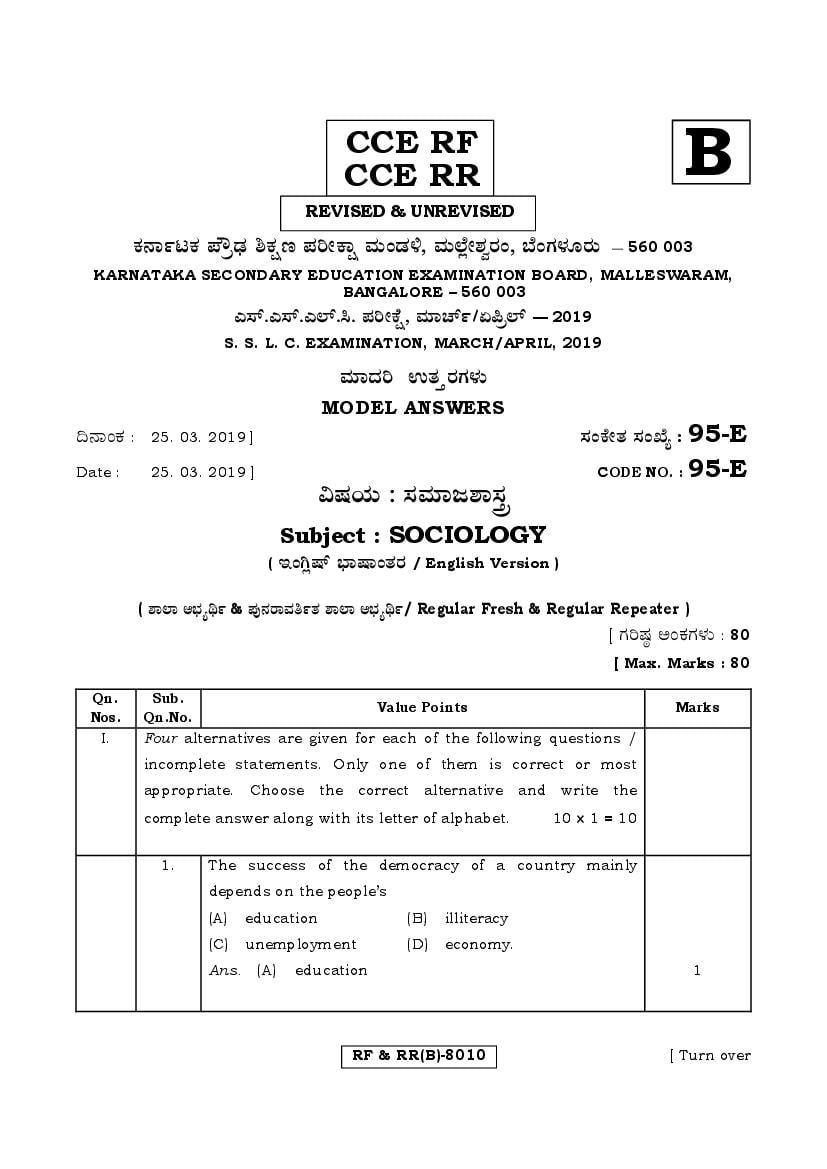
CCE RR B
REVISED & UNREVISED
O⁄´¤%lO⁄ ÆË√v⁄ ÃO⁄–y Æ⁄¬fiO¤– »⁄flMs⁄ÿ, »⁄fl≈Ê«fiÀ⁄ ¡⁄M, ∑ÊMV⁄◊⁄‡¡⁄fl — 560 003
KARNATAKA SECONDARY EDUCATION EXAMINATION BOARD, MALLESWARAM,
BANGALORE – 560 003
G—È.G—È.G≈È.“. Æ⁄¬fiOÊ⁄–, »⁄·¤^È%/HØ√≈È — 2019
S. S. L. C. EXAMINATION, MARCH/APRIL, 2019
»⁄·¤•⁄¬ D}⁄ °¡⁄V⁄◊⁄fl
MODEL ANSWERS
¶´¤MO⁄ : 25. 03. 2019 ] —⁄MOÊfi}⁄ —⁄MSÊ¿ : 95-E
Date : 25. 03. 2019 ] CODE NO. : 95-E
…Œ⁄æ⁄fl : —⁄»⁄·¤dÀ¤—⁄°
Subject : SOCIOLOGY
( BMW«ŒÈ ∫¤Œ¤M}⁄¡⁄ / English Version )
( À¤≈¤ @∫⁄¥¿£% & Æ⁄‚¥´⁄¡¤»⁄~%}⁄ À¤≈¤ @∫⁄¥¿£%/ Regular Fresh & Regular Repeater )
[ V⁄¬Œ⁄r @MO⁄V⁄◊⁄fl : 80
[ Max. Marks : 80
Qn. Sub.
Value Points Marks
Nos. Qn.No.
I. Four alternatives are given for each of the following questions /
incomplete statements. Only one of them is correct or most
appropriate. Choose the correct alternative and write the
complete answer along with its letter of alphabet. 10 × 1 = 10
1. The success of the democracy of a country mainly
depends on the people’s
(A) education (B) illiteracy
(C) unemployment (D) economy.
Ans. (A) education 1
RF & RR(B)-8010 [ Turn over
Page 2
Value Points Marks
2. The word ‘caste’ is derived from Portuguese and Spanish
language word
(A) coastal (B) community
(C) caspa (D) casta.
Ans. (D) casta 1
3. The leader of Bardoli Satyagraha was
(A) Mahatma Gandhi (B) Lal Bahadur Shastry
(C) Bal Gangadhar Tilak (D) Sardar Patel.
Ans. (D) Sardar Patel 1
4. A well organised protest group may convert itself into a
(A) co-operative society (B) guild
(C) pressure group (D) Congress.
Ans. (C) pressure group 1
5. India is basically
(A) a developed country
(B) an industrial country
(C) an agriculturist country
(D) a communist country.
Ans. (C) an agriculturist country 1
6. The year 1975 was declared as International Women’s
Year by
(A) IMF (B) UNESCO
(C) UNICEF (D) ILO.
Ans. (B) UNESCO 1
RF & RR(B)-8010
Page 3
Value Points Marks
7. Gandhiji referred to Adivasis as
(A) Tribals (B) Dravidians
(C) Girijans (D) Harijans.
Ans. (C) Girijans 1
8. The newspaper ‘Kesari’ was started by
(A) Mahatma Gandhi (B) Annie Besant
(C) Tilak (D) Raja Rammohan Roy.
Ans. (C) Tilak 1
9. Pakka food means
(A) boiled and prepared by water
(B) boiled in milk and prepared
(C) prepared by Ghee
(D) raw food of vegetables and fruits.
Ans. (C) prepared by Ghee 1
10. The Samaj started by Atmaram Pandurang
(A) Prarthana Samaj (B) Brahmo Samaj
(C) Arya Samaj (D) Satya Shodhak Samaj.
Ans. (A) Prarthana Samaj 1
II. 11. Match the following list ‘A’ with list ‘B’ and write :
5×1=5
A B
a) Mahaveera i) Brahmo Samaj
b) Jyoti Rao Phule ii) Prarthana Samaj
c) Dayanand Saraswati iii) Sikhism
d) Raja Rammohan Roy iv) Satya Shodhak
Samaj
e) Guru Nanak v) Arya Samaj
vi) Jainism
vii) Parseeism
RF & RR(B)-8010 [ Turn over
Page 4
Value Points Marks
a) Mahaveera vi) Jainism 1
b) Jyoti Rao Phule iv) Satya Sodhak Samaj 1
c) Dayananda Saraswati v) Arya Samaj 1
d) Raja Rammohan Roy i) Brahmo Samaj 1
e) Guru Nanak iii) Sikhism 1
III. Answer the following questions in a sentence each : 15 × 1 = 15
12. What are the main objectives of modernisation ?
— Scientific progress
— Human prosperity. 1
13. What is Industrialization ?
Industries — country’s main occupation. 1
14. What is the main reason for increasing migration ?
Unemployment. 1
15. What were the main objectives of French revolution ?
Liberty, equality, fraternity. 1
16. Who is the author of the book ‘Caste and Race in India’ ?
G.S. Ghuriye 1
RF & RR(B)-8010
Page 5
Value Points Marks
17. Why was Raja Rammohan Roy called father of Indian
Renaissance ?
Pioneer in socio-religious reform movement. 1
18. What is Sati system ?
Wife burning herself with her husband in funeral. 1
19. Who was the first woman President of India ?
Pratibha Patil. 1
20. What is Adult Education ?
Bringing literacy in adults. 1
21. Which is known as ‘Silicon Valley’ of Karnataka ?
Bangalore. 1
22. Where were Radio Clubs first established in India ?
Kolkata and Chennai. 1
23. Name the king who provided reservation for non-
Brahmins in Karnataka.
Krishnaraja Wodeyar IV. 1
RF & RR(B)-8010 [ Turn over
Page 6
Value Points Marks
24. Who was the leader of Chinese Revolution in 1949 ?
Mao-Tse Tung 1
25. How did Prarthana Samaj secure a special place in
Hindu religion ?
Advocated Bhaktipanth.
Service to human society is service to God. 1
26. Name the queen who revolted against British in
Karnataka.
Kittur Rani Chennamma. 1
IV. Answer the following questions in about two to four sentences
each : 14 × 2 = 28
27. What is the role of Science and Technology in social
change ?
— use of machineries — communicational tools
— transport — agricultural improvements. 2
28. What are the consequences of industrialisation on social
change ?
Modernisation — opportunities for education —
civilization — cultured life — education — earning. 2
RF & RR(B)-8010
Page 7
Value Points Marks
29. Women are becoming more and more independent in
economy. Why ?
Educated employed women are increasing —
improvement in status of women. 2
30. Explain how illiteracy is a hurdle for social change.
— inefficient to understand
— new inventions and technology will not agree
— cannot accept changes in agriculture. 2
31. How does regional imbalance become an obstacle for
social change ?
— inequality between urban and rural areas
— science & technology influence urban areas
— slower pace of industrialisation. 2
32. What is the social change that has taken place by the
process of sanskritisation & westernisation ?
— belief — equal in the eyes of law increasing
— restrictions on food habits — decreasing
— once associated with caste has changed. 2
RF & RR(B)-8010 [ Turn over
Page 8
Value Points Marks
33. What are the objectives of social movements ?
— change in authority
— change in value
— training to express
— training to protest against change. 2
34. Kabir had to face the fury of both the religions. Why ?
— exposed to worst factors of both Hindu and Muslim
religions. 2
35. What are the ideals of protest movements ?
— all members follow
— support participants by motivating
— provide optimistic views
— save themselves from external power. 2
36. Name the prominent personalities who worked for
women’s education in India.
Maharshi Karve, Mahatma Phule, Dadabhai Naoroji,
Gokhale, Gandhiji, Vivekananda, Iswar Chandra. 2
RF & RR(B)-8010
Page 9
Value Points Marks
37. Which are the legislations regarding marriages passed in
India during the British rule ?
Sati Abolition Act
Widow Remarriage Act
Civil Marriage Act
Child Marriage Act. 2
38. Give the definitions of tribe according to S. F. Nadel and
Bogardus.
— S. F. Nadel — ‘A society which has definite language,
culture and political boundary’.
— Bogardus — ‘A tribe is a group based on kinship,
single religion and protective mechanism or need of
protection’. 2
39. Which are the three approaches framed by Indian
Government for the tribal development ?
— Policy of Isolation
— Policy of Assimilation
— Policy of Integration. 2
40. Name the types of mass media with examples.
— Print media — Newspapers, Magazines, Books
— Electronic media — Radio, TV, Internet. 2
RF & RR(B)-8010 [ Turn over
Page 10
Value Points Marks
V. Answer the following questions in about three to six sentences
each : 6 × 3 = 18
41. What are the features of social change ?
— social change is continuous
— is universal
— change in human relations
— form and momentum are different
— is indefinite
— is an objective concept
— planned and unplanned change
— repeated and long term concept. 3
42. What are the features of caste system ?
— part of Hindu society
— decided on the basis of birth
— has its own custom
— one should not violate
— imposes certain restrictions on food, dress, etc. 3
43. Explain Satya Shodhak Samaj’s role in social reform
movement.
— movements against ignorance and helplessness
— against casteism
— against farmers exploitation
— against Sati
— encouraged girl child education
— organised social reform movements. 3
RF & RR(B)-8010
Page 11
Value Points Marks
44. Mention the women organisations that brought
awareness and progress among women during British
period in India.
— Arya Mahila Samaj and Sharada Sadan
— Bharat Mahila Parishad
— Bharat Sthri Mahamandal
— Sthriyara Bharatiya Sangha
— Akhil Bharatiya Mahila Parishad
— Kasturba Gandhi Rashtriya Smarak Pratisthan. 3
45. Explain the social changes among the Indian tribes.
— Educational changes
— Health and housing facilities
— Agriculture and dairy farming
— Tribal handicrafts and other skills
— Yearmarked development 3
46. How do cinemas reflect the social values ?
— fan association organisations
— involving in social services
— moral values adopted in personal life
— actors & actresses become reference groups
— luxurious life styles depicted in the advertisements
— scientific approaches. 3
VI. Answer the following question : 1×4=4
47. Explain the relationship between economic development
and social change.
— Low economic development leads to refuse social
change
— globalisation, privatization and liberalisation policies
cause economic imbalance causing gaps
— economic inequality — threat to social change.
4
RF & RR(B)-8010 [ Turn over
Document Details
| Board / Org | Karnataka Board |
| Exam | Class 10 |
| Type | Answer Key |
| Pages | 11 |
| Updated | 09 Jun 2026 |