NCERT Solutions Class 6 Social Science Chapter 12 Grassroots Democracy part 3 Local Government in Urban Areas
Finished viewing? Save it for later —
Download NCERT Solutions Class 6 Social Science Chapter 12 Grassroots Democracy part 3 Local Government in Urban Areas (PDF · 42 pages)About NCERT Solutions Class 6 Social Science Chapter 12 Grassroots Democracy part 3 Local Government in Urban Areas
NCERT Solutions Class 6 Social Science Chapter 12 Grassroots Democracy part 3 Local Government in Urban Areas is available here for free download. Published by NCERT for Class 6, this solution can be viewed online or downloaded as a PDF (42 pages). Candidates preparing for Class 6 can use NCERT Solutions Class 6 Social Science Chapter 12 Grassroots Democracy part 3 Local Government in Urban Areas to understand the exam pattern, the type of questions asked, and the overall difficulty level.
Frequently Asked Questions
How can I download NCERT Solutions Class 6 Social Science Chapter 12 Grassroots Democracy part 3 Local Government in Urban Areas?
Open this page and click the Download button to save NCERT Solutions Class 6 Social Science Chapter 12 Grassroots Democracy part 3 Local Government in Urban Areas as a PDF. It is completely free on AglaSem Docs.
Is NCERT Solutions Class 6 Social Science Chapter 12 Grassroots Democracy part 3 Local Government in Urban Areas free to download?
Yes. NCERT Solutions Class 6 Social Science Chapter 12 Grassroots Democracy part 3 Local Government in Urban Areas can be viewed online and downloaded as a PDF free of cost on AglaSem Docs.
How many pages does NCERT Solutions Class 6 Social Science Chapter 12 Grassroots Democracy part 3 Local Government in Urban Areas have?
NCERT Solutions Class 6 Social Science Chapter 12 Grassroots Democracy part 3 Local Government in Urban Areas contains 42 pages, which you can read online or download together as a single PDF.
Where can I find more Class 6 study material?
You can find more Class 6 question papers, sample papers, syllabus, and answer keys on AglaSem Docs.
NCERT Solutions Class 6 Social Science Chapter 12 Grassroots Democracy part 3 Local Government in Urban Areas – Text
Read the full text of this solution below — useful to quickly search, copy and reference the content online without downloading the PDF.
📄 View text version (36 pages)
Page 1
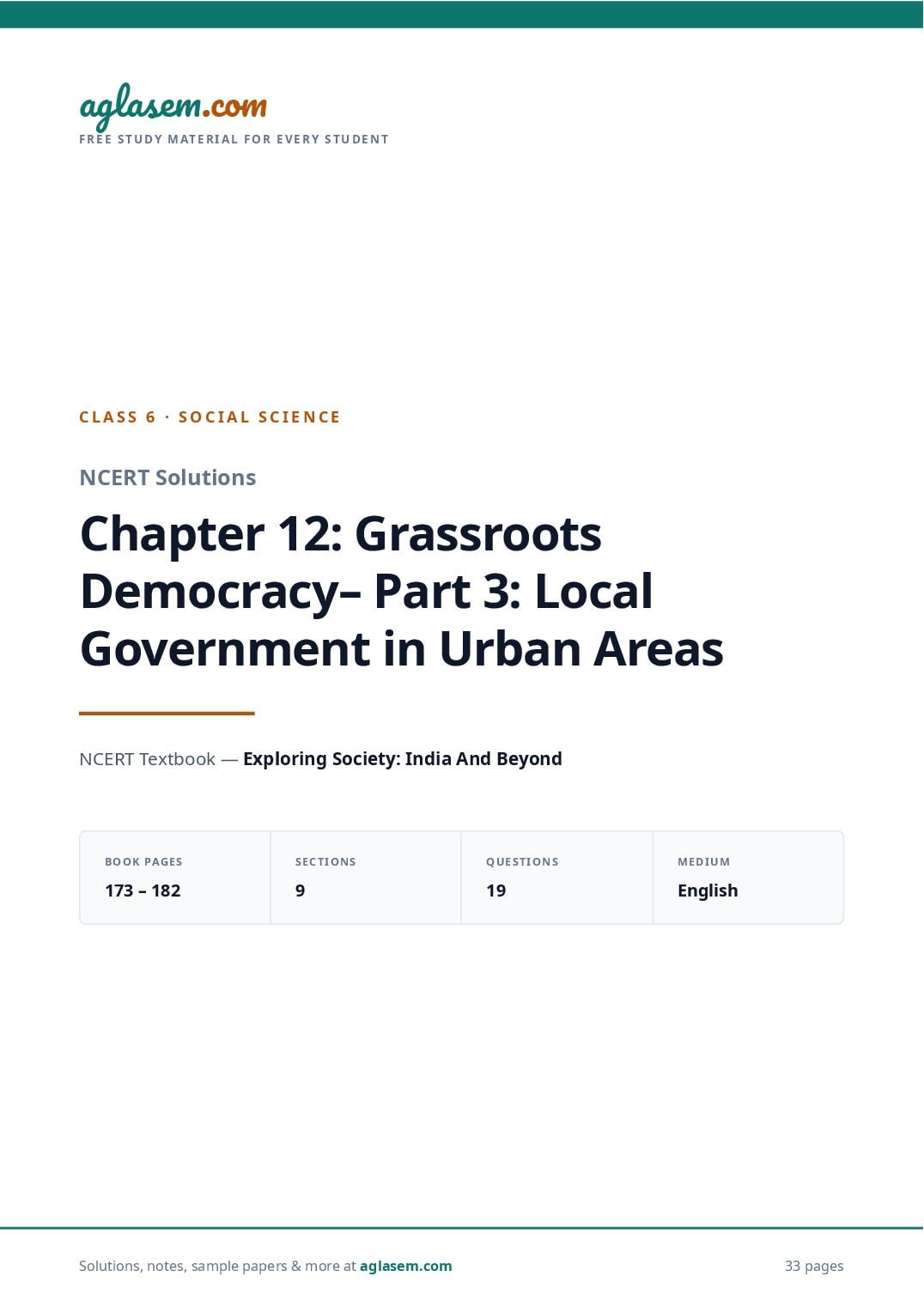
CLASS 6 · SOCIAL SCIENCE
NCERT Solutions
Chapter 12: Grassroots
Democracy – Part 3: Local
Government in Urban Areas
NCERT Textbook — Exploring Society: India And Beyond
BOOK PAGES SECTIONS QUESTIONS MEDIUM
173 – 182 9 19 English
Solutions, notes, sample papers & more at 35 pages
Page 2
CLASS 6 · SOCIAL SCIENCE · EXPLORING SOCIETY: INDIA AND BEYOND
NCERT Solutions — Chapter 12: Grassroots Democracy
– Part 3: Local Government in Urban Areas
Complete NCERT Solutions for Class 6 Social Science Chapter 12 Grassroots Democracy – Part 3: Local
Government in Urban Areas from the NCERT textbook Exploring Society: India and Beyond. Every question of
the chapter is answered — The Big Questions, all four LET’S EXPLORE boxes, the THINK ABOUT IT box on
Indore, the in-text questions inside the Sameer–Anita conversation on pages 179–181, Before we move on …
and all five Questions, activities and projects — with the pyramid of Fig. 12.2 on page 175 and the services
chart of Fig. 12.4 on page 178 read off the printed page, and with fresh diagrams and tables comparing the
Municipal Corporation, Municipal Council and Nagar Panchayat, showing who is elected and who is
appointed, and setting out where an urban local body’s money comes from.
TEXTBOOK BOOK PAGES
Exploring Society: India and Beyond (Class 6) 173 – 182
SECTIONS QUESTIONS
9 19
MEDIUM
English
The Big Questions — Page 173
Chapter opening
THE BIG QUESTIONS
Q1 What are urban local bodies and what are their functions?
ANSWER
Urban local bodies are the elected governments of our cities and towns — the urban twin
of the Panchayats you met in Chapter 11. The chapter’s own definition is on page 175:
“Local government structures in urban areas are called ‘urban local bodies’.
They are decentralised, which means that instead of operating under a central authority
at the top, the local communities have a direct say on how their areas are managed
or the issues they face.”
And the sentence that follows tells you what they are for: “It is a mechanism for citizens living in
an area to come together and take decisions about what is best for them.”
Page 1 of 35
Page 3
There are three kinds, and population decides which one a place gets (page 179).
URBAN ALSO CALLED POPULATION IT KIND OF HEAD OF THE
LOCAL SERVES PLACE ELECTED
BODY BODY
Municipal ‘Mahanagar Nigam’ Above 10 lakhs A large city — Mayor, with a
Corporation (Nagar Nigam) Mumbai, Chennai, Deputy Mayor
Indore
Municipal ‘Nagar Palika’; in Between 1 and 10 lakhs A smaller city or a Chairperson or
Council Fig. 12.2 also ‘City big town President
Council’
Nagar Nagar Palika Smaller populations — A town, or a village Chairperson
Panchayat Parishad in some below about 1 lakh area that is turning
States into a town
Careful: a Nagar Panchayat is an urban body, not a village one. Its name contains
the word ‘Panchayat’, but it sits on the right branch of Fig. 12.2, with the Municipal
Corporation and the Municipal Council — not on the left with the Gram Panchayat.
How an urban local body is put together. A city is first cut into wards — “Cities and towns are
divided into smaller units called ‘wards’” (page 176). The voters of each ward elect one
representative, the ward councillor (called a corporator in many corporations). All the
councillors together make up the council, and they choose the Mayor or Chairperson from
among themselves. Alongside this elected side stands an appointed side, headed by the
Municipal Commissioner, who is posted by the State Government and actually runs the offices,
the machines and the staff.
Page 2 of 35
Page 4
How an urban local body is put together
THE ELECTED SIDE — chosen by the people THE APPOINTED SIDE — posted by the State
MAYOR / CHAIRPERSON State Government
makes the law under which the body works
choose from among themselves
appoints
decides
The Council of the urban local body
all the elected councillors sitting together MUNICIPAL COMMISSIONER
Chief Municipal Officer in a Council
together form
carries out
Ward Councillor
one from each ward; a Ward Committee helps
The municipal staff
engineers, health officers, sanitation workers,
elect
fire staff, tax and record clerks
People of the Ward
every adult voter living in that ward
The two sides of a city government. The people elect the councillors, and the councillors decide; the
State appoints the Commissioner, and the Commissioner’s staff carry the decisions out.
What are their functions? The chapter gives the list on page 176: “urban local bodies are
responsible for a range of functions — helping take care of the infrastructure, maintaining the
burial ground, garbage collection and disposal, checking the implementation of government
schemes, collecting local taxes and fines, and so on. They also have some role in planning for
the area’s economic and social development.”
Fig. 12.4 on page 178 turns that list into pictures. Here is what the Indore Municipal Corporation
actually does, exactly as the figure shows it:
Page 3 of 35
Page 5
a g l
Class 6 Social Science Chapter 12 Grassroots Democracy – Part 3: Local Government in Urban Areas AglaSem · NCERT Solutions
co m
m.
GROUP IN SERVICES SHOWN WHAT KIND OF WORK THIS IS
FIG. 12.4
m as e
. c o a g l
s e m
Money it collects Property tax · Water charges · Business, “Collecting local taxes and fines” — this is
g l a
a
hoardings, trade licenses how the Corporation pays for everything else
Cleanliness Solid waste management · Tree cutting & tree “Garbage collection and disposal”, and care of
m
.co ag
transportation the city’s greenery
a s e· m
various licenses ag
l
Records and CRM — marriage certificate CRM — Registering and permitting: the Corporation is
permissions the city’s record-keeper
Safety and CRM — fire services · CRM — water tanker,
co m
Protecting life and property when something
em.
emergencies debris clearance goes wrong
m l as
m .co
Listening to
a g
se
CRM — grievances A complaint window, so a citizen can report a
l a
citizens problem and follow it up
g
a Services on Water tanker · Septic tanker · Auditorium · Things a family or a locality can ask for when
a s
com agl
request Funeral van · Mobile toilet · Ambulance it needs them
m .
e
s footnote says CRM: Citizen Relationship
aown
a g l
What CRM means: the figure’s
Management — the system through which a citizen asks for a service or files a
complaint and can then track it. The figure also notes that “the list of services offered
co m
m .
e
by the Indore Municipal Corporation is simplified here”, so a real corporation does
m l as
.co g
even more.
m a
l a se
ag Why the ward matters so much: a city of 20 lakh people cannot meet in one hall
the way a Gram Sabha does. So the city is broken into wards small enough for a
se m
com g l a
.
councillor to know, and the ward committee handles the small, urgent things —
m a
ase
“conducting health camps, organising a campaign against the use of single-use
agl
plastics”, and watching for “a water leak, a blocked drain, a damaged road”. The
ward is where an ordinary city-dweller actually touches their government.
co m
m .
m as e
.co a g l
se m
g l a
a c
m .
m a s e
e m . co agl
g l as
a
co m
m .
m as e
.co
a g l Page 4 of 35
Page 6
Did you know? Urban local bodies got their present constitutional footing from the
74th Constitutional Amendment Act, 1992, which came into force on 1 June 1993
— the twin of the 73rd Amendment that you met in Chapter 11. It added Part IXA,
‘The Municipalities’, to the Constitution and it is the reason the chapter names
exactly three kinds of body: a Nagar Panchayat for an area in transition from rural
to urban, a Municipal Council for a smaller urban area, and a Municipal
Corporation for a larger urban area. The Amendment also fixed a five-year term
for every municipality, required elections to be held by a State Election
Commission, reserved seats for Scheduled Castes and Scheduled Tribes and not
less than one-third of the seats for women, provided for Ward Committees in
bigger municipalities, and listed 18 subjects in a new Twelfth Schedule that States
may hand over to their municipalities. The exact population figures are fixed by each
State, which is why the chapter’s 1-lakh and 10-lakh marks are a general rule rather
than a number written in the Constitution.
Q2 Why are they important in governance and democracy?
ANSWER
Because a city’s daily problems are local problems, and only a local government can be
reached in time. A blocked drain, an overflowing dustbin, a street light that has failed, a leaking
water pipe — nobody can write to the State capital about these and wait. The chapter’s answer,
on page 175, is that urban local bodies are “a mechanism for citizens living in an area to come
together and take decisions about what is best for them”.
Five reasons, each of which the chapter itself supports:
They bring decisions down to the people. Being “decentralised” means that “instead of
operating under a central authority at the top, the local communities have a direct say on
how their areas are managed or the issues they face”. That is self-government, not
administration from far away.
They are elected, so they answer to us. “As with the rural context, urban local bodies have
elected members who represent the local citizens” (page 181). Anita says the same thing in
her own words on page 180: “we have local bodies and elected representatives who
represent us and our interests”. If a councillor ignores the ward, the ward can vote
differently next time.
They deliver the services that make city life possible. Water, waste, roads, street lighting,
licences, fire services, records — the whole of Fig. 12.4. A city where these stop working
stops working itself.
They make participation possible in a place where everyone is a stranger. Anita admits
that in a city “people are more independent and often don’t even know their neighbours”.
Wards and ward committees create a small enough unit for a citizen to take part in — a
Page 5 of 35
Page 7
health camp, a plastic-free campaign, a complaint about a broken road.
They train citizens in democracy. Sameer’s story on page 181 — children spotted a low-
hanging electric wire, reported it, and got an electric post shifted — is exactly what the
chapter wants a reader to try in a city too. Anita’s conclusion is the chapter’s conclusion:
“that’s how democracy should work. It seems more complicated in the city, but the idea is the
same — everyone’s voice matters.”
Why democracy here has two halves, not one: the chapter is careful to say that
citizens have duties as well as votes. “For these bodies to be able to perform their
functions efficiently, people living in the city must also perform their duties, which
means that they must show care and concern for their area (remember, this is a
participatory democracy).” If nobody segregates waste, no corporation can keep a
city clean; if nobody reports a leak, precious water is simply lost. Urban local bodies
and citizens are two hands of the same work.
Tip for the exam: if a question asks “why are urban local bodies important”, do not
only list their services. Give the democratic reason first — they are elected, close to
the people and answerable to them — and then the practical reason, that they
deliver the services citizens use every day.
LET’S EXPLORE — Page 174
Introduction — why a city is more complex than a village
LET’S EXPLORE
Q1 Why is a city like Kolkata, Chennai or Mumbai more complex and diverse than a
village or a town?
ANSWER
Because a big city holds far more people, far more kinds of people, and far more kinds of
work in the same space — and every one of those differences adds something a local
government must manage.
Page 6 of 35
Page 8
WHAT A VILLAGE OR A SMALL KOLKATA, CHENNAI OR MUMBAI
DIFFERS TOWN
Size A few hundred to a few thousand Many lakhs, even crores of people, spread over hundreds
people; often one main settlement of wards
Where people Most families have lived there for People arrive from every district and State for work,
came from generations study and treatment — so languages, foods, festivals and
dress all mix
Work Mostly farming and a few crafts, Ports, factories, offices, hospitals, colleges, markets,
trades and services transport, film and software — hundreds of occupations
side by side
Services Drinking water, a road, a school, a Piped water and sewers, buses and trains, traffic signals,
needed health centre thousands of tonnes of garbage a day, fire services,
hospitals, drainage against floods
Knowing one “Everyone knows everyone else and “People are more independent and often don’t even know
another pitches in to help each other out” their neighbours” (Anita, page 180)
(Sameer, page 180)
How decisions A Gram Sabha of all adult voters can Impossible to gather everyone — so wards, ward
are taken meet in one place committees and elected councillors are needed
That is exactly why the chapter says on page 174 that “since the latter is generally more complex
and diverse than the former, it is understandable that the urban governance system needs to be
more complex too”.
Try this: stand at a busy crossing in your nearest town or city for ten minutes and
count the different kinds of shop, vehicle, uniform and language you notice. Then do
the same in a quieter, smaller place. The two lists are the difference this question is
asking about.
Q2 With your classmates, make a list of diverse communities residing in any city that
you are familiar with. How many were you able to list? What else do you observe in
the list?
ANSWER
This is a class activity, so the real answer is the list your own class makes. Here is how to do
it well, and a model to compare against.
Method:
1. Pick one city everybody knows — the one you live in, or the nearest big city.
Page 7 of 35
Page 9
2. On the board, make columns for the different ways people can differ: language, State or
region they came from, religion, occupation, food habits, festivals celebrated.
3. Every student adds what they actually know — from their own family, their neighbours, their
classmates, shopkeepers near their home. Add nothing you have only guessed.
4. Count the entries. Then look at the list as a whole and ask what it shows.
Sample answer (a class in a large Indian city might list something like this):
WAY OF SOME OF WHAT THE CLASS LISTED
DIFFERING
Languages heard Hindi, Marathi, Tamil, Bengali, Telugu, Odia, Bhojpuri, Urdu, Malayalam, Gujarati, English
Where families came Nearby villages of the same district; other districts; Bihar, Odisha, Rajasthan, Kerala, the
from North-East; and families settled here for generations
Festivals on the street Diwali, Eid, Christmas, Pongal, Durga Puja, Baisakhi, Chhath, Buddha Purnima, local temple
and church feasts
Kinds of work Shopkeepers, drivers, construction workers, teachers, nurses, tailors, sanitation workers, office
staff, street vendors, fishers, IT workers
What else do you observe in the list? Four things are usually worth saying out loud:
The list is never finished. However many the class names, someone remembers one more
the next day. A city’s diversity cannot be counted exactly.
The same person belongs to several groups at once. A shopkeeper can be a Tamil speaker,
a Christian, a cricket fan and a resident of Ward 14, all together. Communities overlap; they
are not boxes.
Different communities share the same services. The same water pipe, bus, hospital and
dustbin serves all of them — which is why the local body must treat everyone equally.
The class itself is part of the diversity. The list is usually drawn straight from the students’
own homes.
Why the chapter asks this before teaching the structure: it wants you to feel why
urban governance is complicated before you learn how it is organised. A body that
must serve dozens of communities at once needs clear rules, elected representatives
from every ward, and a way of hearing complaints — which is precisely what the rest
of the chapter describes.
LET’S EXPLORE — Page 175
Page 8 of 35
Page 10
a g l
Class 6 Social Science Chapter 12 Grassroots Democracy – Part 3: Local Government in Urban Areas AglaSem · NCERT Solutions
Fig. 12.2 — the pyramid of Indian governance
co m
em.
m as
LET’S EXPLORE
.co a g l
s m 12.2 above, what similarities and differences do you notice between the
eFig.
gl aIn
a
Q1
Panchayati Raj system and the urban local government?
co m
e m . ag
g l as
a
co m
em.
as
Union Government
m l
.co g
at the
m a
se
national level
g l a
a State Government
m a s
.co agl
Local Government
a s em—
a gl Rural
Panchayati Raj Institutions
Urban —
Urban Local Bodies
co m
.
Zila Panchayat
Municipal Corporation or
e m
m l as
.co
Municipal Council or City
a g
Council (Nagar Panchayat)
sem
Panchayat Samiti
a
agl Gram Panchayat Ward Committee
se m
Gram Sabha
com
People of the Ward
g l a
m . a
ase
agl
Not to scale
Fig. 12.2
co m
Fig. 12.2, page 175 — the pyramid of government redrawn. The top three levels are
m .
common to the whole country; below the Local Government level the pyramid splits into
a rural branch (left) and an urban branch e
m a s
agl
(right).
. co
e m
g l as
a c
ANSWER
m .
m a s e
co agl
First, read the figure carefully. Fig. 12.2 on page 175 is a pyramid. The top three blocks are
m .
se
common to the whole country — Union Government at the national level, then State
l a
ag on the left, and Urban — Urban Local Bodies on the right. The
Government, then Local Government. Below that the pyramid splits into two branches: Rural
— Panchayati Raj Institutions
caption adds “Not to scale”.
co m
m .
m as e
.co
a g l Page 9 of 35
Page 11
The two branches of local government (Fig. 12.2, page 175, redrawn)
UNION GOVERNMENT — national level
STATE GOVERNMENT
LOCAL GOVERNMENT
RURAL — URBAN —
Panchayati Raj Institutions Urban Local Bodies
Zila Panchayat Municipal Corporation or
Municipal Council or City Council
Panchayat Samiti (Nagar Panchayat)
Gram Panchayat Ward Committee
Gram Sabha People of the Ward
THE PEOPLE — the base on which the whole pyramid stands
Read it upward: the people are at the bottom, the Union Government at the top. “Not to scale.”
Fig. 12.2 redrawn as two ladders. The three blocks at the top are shared; below them the rural branch
has one tier more than the urban branch.
Similarities
Both are ‘local government’. They grow out of the same block of the pyramid, and both sit
below the State Government — so both work under laws made by the State.
Both stand on the people. The rural ladder ends in the Gram Sabha; the urban ladder ends
in the People of the Ward. In both, the base of the pyramid “is the local level, closer to the
people”.
Both work through elected representatives. Villagers elect their Gram Panchayat; city
people elect their ward councillors.
Both are decentralised and both are meant for self-government. Both handle local
services, both raise some local taxes, and in both the citizens have duties as well as rights.
Both have a small committee at the base above the people — the Gram Panchayat on
one side, the Ward Committee on the other.
Differences
Page 10 of 35
Page 12
RURAL — PANCHAYATI RAJ URBAN — URBAN LOCAL BODIES
INSTITUTIONS
Number of tiers Four rows — Zila Panchayat, Three rows — the Municipal Corporation / Municipal
in Fig. 12.2 Panchayat Samiti, Gram Panchayat, Council / City Council (Nagar Panchayat), the Ward
Gram Sabha Committee, and the People of the Ward
Top body Always the Zila Panchayat, for a Depends on population — Corporation, Council or
whole district Nagar Panchayat, for one city or town
Smallest unit The village, with a Gram Sabha of all The ward, a part of a city, with a Ward Committee
its adult voters
Direct Strong — the Gram Sabha itself is a Weaker — a city cannot gather all its people, so almost
participation meeting of all the voters everything runs through elected councillors
Middle level There is one — the Panchayat Samiti There is none in the figure; the ward reports straight to
links village and district the city body
Kind of work Agriculture, village roads, drinking Piped water and sewerage, city solid waste, street
water, village schools and health lighting, licences, fire services, hoardings, building
centres permissions
Why the urban side has one tier fewer: the rural side must climb from a village of
a few hundred people all the way to a whole district, so it needs a step in between. A
city is already one continuous settlement under one body — from the ward you
reach the city government in a single step. The word ‘Panchayat’ appears on both
sides, but a Nagar Panchayat is urban and a Gram Panchayat is rural.
Read the figure exactly: the urban box on page 175 reads “Municipal Corporation
or Municipal Council or City Council (Nagar Panchayat)”. It is one box holding three
alternatives, not three tiers stacked on top of each other. A given town has only one
of them.
LET’S EXPLORE — Page 177
Page 11 of 35
Page 13
Urban Local Bodies — the duties of a responsible citizen
LET’S EXPLORE
Q1 Can you think of four or five more actions that responsible citizens might take to
help their area of the city?
ANSWER
The chapter has already given two examples on page 177 — follow the instructions on waste
segregation so that “garbage collection becomes easier”, and report a water leak promptly so
that it “will prevent further wastage of precious water”. Here are five more, each matched to the
municipal function it helps.
WHAT A RESPONSIBLE CITIZEN DOES WHICH WHY IT MAKES A
MUNICIPAL DIFFERENCE
WORK IT HELPS
1. Never throw waste on the street or in a drain Solid waste A drain choked with plastic is the
— use the dustbin and hand waste to the management commonest cause of a flooded road
collection vehicle in the monsoon
2. Pay property tax and water charges on time Collection of local This is the money the body uses for
taxes roads, water and sanitation. Unpaid
tax means unbuilt roads
3. Report problems through the proper channel Grievances, repairs, A body cannot repair a fault it has
— the ward committee, the councillor, or the infrastructure not been told about; a written
CRM grievance system of Fig. 12.4 complaint can be tracked
4. Take part in ward activities — health camps, Public health and the Ward committees “facilitate
tree planting, cleanliness drives, the campaign environment activities such as conducting health
against single-use plastics camps”; they need volunteers to
succeed
5. Look after public property — do not damage Maintenance of Every rupee spent replacing what
street lights, bus stops, park benches, taps or infrastructure was broken on purpose is a rupee
signboards; do not stick posters on walls not spent on something new
6. Save water and electricity, and keep your own Water supply and A city’s water is shared. What one
frontage clean — mend a dripping tap, do not let cleanliness household wastes, another
a hose run, sweep the space in front of your household does not get
house or shop
Two more that older students can add: vote in the municipal election and encourage the
adults at home to vote; and follow the rules the city depends on — park where parking is
allowed, do not encroach on a footpath, and obey traffic signals.
Page 12 of 35
Page 14
Why this box comes here: the paragraph just above it says that “for these bodies to
be able to perform their functions efficiently, people living in the city must also
perform their duties”. The chapter is making a single point twice — a participatory
democracy has no spectators. The urban local body supplies the system; the citizens
supply the care.
Try this in your own class: pick just one of the actions above and do it for a month
as a class project — say, a segregated-waste corner in the classroom, or a written
complaint to the ward office about one real problem near the school. Record what
happened. That single record is worth more than a list of ten promises.
THINK ABOUT IT — Page 179
Indore and the Swachh Survekshan
THINK ABOUT IT
Q1 Indore in Madhya Pradesh has been awarded the cleanest city in India under the
Swachh Survekshan government scheme for seven years in a row. What could have
been the role of Indore citizens in this achievement?
ANSWER
The award went to the city, but no corporation can sweep a city clean on its own. Indore’s
record was possible because lakhs of ordinary households changed what they do every single
morning. That is the whole answer, and here is what it looks like in practice.
They separated their waste at home. Wet kitchen waste in one bin, dry waste in another,
and in Indore even further into more streams. This is the single habit on which everything
else rests — mixed waste cannot be composted or recycled, so it goes to a dump.
They handed waste to the collection vehicle instead of throwing it out. When a vehicle
comes down the lane every day and every family waits for it, the street bins disappear — and
with them the smell, the stray animals and the roadside heaps.
They stopped using the street as a bin. No throwing from a moving vehicle, no dumping in
an empty plot, no spitting, no littering after a function. This is a change of habit, not of
technology.
They accepted rules and fines, and paid the user charge. A cleanliness system costs
money and needs discipline; citizens supported both instead of resisting them.
They took part and they watched. Residents’ associations, shopkeepers, schoolchildren,
safai mitras and self-help groups joined cleanliness drives, spread the message, and
reported places that were still dirty — using exactly the kind of grievance system shown as
“CRM — GRIEVANCES” in Fig. 12.4 on page 178.
Page 13 of 35
Page 15
a g l
Class 6 Social Science Chapter 12 Grassroots Democracy – Part 3: Local Government in Urban Areas AglaSem · NCERT Solutions
They kept it up for years. Winning once can be luck; winning “for seven years in a row”
co m
means the habit stayed after the campaign ended. That is citizens, not officials.
em.
m l as
.co a g
s em
Why this is exactly the chapter’s point: page 177 says that “for these bodies to be
a
gl to perform their functions efficiently, people living in the city must also perform
aable
their duties… For instance, if people carefully follow instructions regarding waste
co m
ag
segregation, garbage collection becomes easier.” Indore is the living proof. The
m .
e
Municipal Corporation supplied the vehicles, the routes, the processing plants and
as
a g l
the staff; the citizens supplied the segregation, the discipline and the pride. Remove
either half and the result collapses.
. c om
Did you know? Swachh Survekshan is the annual cleanliness surveyem
m a s of Indian cities
. co under the Swachh Bharat Mission (Urban). Cities are
conducted
a glscored on things
a s emas door-to-door collection, waste processing, the state of public and
gl community toilets, and — importantly — on citizen feedback. So a city’s residents
such
a
s
literally help decide their own city’s marks.
m a
m .co agl
l a se
g
Think further: ask what your own city or town would score. Which single change by
a
residents would raise it the most? Usually the answer is the same everywhere —
m
segregate at source, and hand it over daily.
. co
e m
m l as
.co a g
semEXPLORE — Page 179
la of urban local body, and how they are funded
LET’S
agTypes
se m
com l a
LET’S EXPLORE
. a g
e m
s State and from a few neighbouring States. These may
g l ayour
include the city youalive in or the city nearest to your town or village. How will you
Q1 Select a few cities, from
m
find out if they have a Nagar Panchayat, Municipal Council or Municipal
. co
m
Corporation? Draw a table with the names of the cities and the type of urban local
m as e
.co l
body each of them has.
a g
a s emANSWER
agl
.c
m
First fix the rule, then go and check. The rule is given on page 179 and depends only on
m a s e
agl
population.
. co
e m
g l as
a
co m
m .
m as e
.co
a g l Page 14 of 35
Page 16
POPULATION OF THE CITY OR HIGHEST URBAN LOCAL ALSO CALLED
TOWN BODY
Above 10 lakhs Municipal Corporation ‘Mahanagar Nigam’ / Nagar
Nigam
Between 1 and 10 lakhs Municipal Council ‘Nagar Palika’ / City Council
Smaller populations (below about 1 lakh) Nagar Panchayat Town Panchayat in some States
How will you find out? Five honest ways, best first:
1. Look at the name on the office itself. Every urban body has a board — “___ Municipal
Corporation”, “___ Nagar Palika Parishad”, “___ Nagar Panchayat”. So does the water bill, the
property tax receipt and the birth or marriage certificate issued in that town.
2. Look at the dustbins, water tankers and street-light poles. They usually carry the body’s
name and its logo.
3. Ask at the ward office, or ask your ward councillor, or ask an adult who pays property tax
there.
4. Check the official website of the city and of your State’s Urban Development / Local Self-
Government department. Most States publish a full list of their corporations, councils and
nagar panchayats.
5. Use the population as a cross-check, not as the answer. Look up the town’s population and
see whether the body you found matches the rule above.
Model table — draw it like this and fill in your own cities. The last column is the one that makes
you think.
Page 15 of 35
Page 17
CITY OR TOWN STATE TYPE OF URBAN LOCAL HOW I FOUND
BODY OUT
The city I live in / nearest to me My State … Name board on the
municipal office
My State’s capital My State Municipal Corporation (in Property tax receipt seen
almost every State) at home
A big town in my district My State … State department
website
A small town near the district My State … Asked at the ward office
border
A city in a neighbouring State Neighbouring … Its official city website
State
A hill town or a new town in a Neighbouring … Name printed on its
neighbouring State State water tanker
Two things you will probably discover, and both are correct:
1. Some towns whose population has crossed a mark still have the older, smaller
kind of body — because the change has to be notified by the State Government, and
that takes time.
2. The exact population figures differ from State to State. The Constitution lets each
State decide, taking into account population, density, revenue and how many people
work outside farming. So treat the 1-lakh and 10-lakh marks as the general rule the
chapter gives, and be ready for a local exception.
Why the type matters: a Municipal Corporation has more wards, a bigger budget,
more powers and its own Municipal Commissioner. A Nagar Panchayat runs a small
town with a much smaller staff. So knowing which body governs a place tells you
roughly how much it can do on its own — and whom you should approach with a
complaint.
Page 16 of 35
Page 18
Q2 How do urban local bodies fund their activities? (Hint: Look carefully at the pictures
of the functions performed by Indore Municipal Corporation in Figure 12.4 on page
178.) Are some of them paid services?
SERVICES UNDER THE INDORE MUNICIPAL CORPORATION
SOLID WASTE BUSINESS, HOARDINGS,
PROPERTY TAX WATER CHARGES
MANAGEMENT TRADE LICENSES
CRM* — MARRIAGE CRM — FIRE CRM — VARIOUS CRM — WATER TANKER,
CERTIFICATE SERVICES LICENSES DEBRIS CLEARANCE
Complaint
TREE CUTTING & TREE TRANSPORTATION CRM — GRIEVANCES
CRM — SERVICES ON REQUEST
Water Tanker Septic Tanker Auditorium Funeral Van Mobile Toilet Ambulance
*CRM: Citizen Relationship Management.
(The list of services offered by the Indore Municipal Corporation is simplified here.)
Fig. 12.4. Services under the Indore Municipal Corporation
Fig. 12.4, page 178 — the chart of services redrawn from the book. In the textbook each
cell carries a photograph of that service; here a simple drawing stands in its place, with
the same headings and the same arrangement.
ANSWER
Start where the hint points. Look at the very first row of Fig. 12.4 on page 178 — PROPERTY
TAX, WATER CHARGES, and BUSINESS, HOARDINGS, TRADE LICENSES. Those three panels are
not services the Corporation gives; they are money the Corporation takes in. And page 176 says
the same thing in words: urban local bodies are responsible for “collecting local taxes and fines”.
Where the money comes from — four streams:
Page 17 of 35
Page 19
STREAM EXAMPLES SEEN IN FIG. 12.4?
1. Its own taxes Property tax on houses, shops and land — usually the largest Yes — “PROPERTY TAX”
single source; tax on advertisements and hoardings; in some and “BUSINESS,
States a tax on vehicles or entertainment HOARDINGS, TRADE
LICENSES”
2. User charges Water charges; sewerage and solid-waste user fees; trade and Yes — “WATER
and fees shop licence fees; building permission fees; market and CHARGES”, the licence
parking fees; fees for a marriage or birth certificate; rent from panels, and the “CRM —
municipal shops, halls and land; fines for littering or illegal SERVICES ON REQUEST”
construction row
3. Money from the Grants, and a share of State taxes, worked out on the advice of No — this does not show up
State Government the State Finance Commission that each State sets up every in a picture of services
five years
4. Money from the Grants recommended by the Central Finance Commission; Indirectly — Swachh
Central and scheme funds such as the Swachh Bharat Mission Survekshan on page 179
Government and (Urban), AMRUT for water and sewerage, PMAY (Urban) belongs to this stream
schemes for housing and the Smart Cities Mission. Bigger corporations
may also borrow, sometimes by issuing municipal bonds
Are some of them paid services? Yes — many are. Read Fig. 12.4 again with that question in
mind:
SERVICE IN FIG. 12.4 USUALLY PAID OR FREE?
Water supply Paid — the panel is literally called “WATER CHARGES”
Business, hoardings and trade licences; Paid — a fee is charged for issuing and renewing each licence
various licences
Marriage certificate and other records Paid — usually a small fixed fee
Water tanker, septic tanker, debris Paid — booked on request at a fixed rate
clearance
Auditorium (the municipal hall) Paid — rented out for functions
Tree cutting and tree transportation Paid, and permission is needed first
Solid waste collection Often a small monthly user charge, on top of property tax
Fire services, ambulance, funeral van, Usually free or heavily subsidised, because they are emergencies or basic
mobile toilet, grievance redressal dignity — though a few cities charge a nominal amount for some of them
Page 18 of 35
Page 20
a g l
Class 6 Social Science Chapter 12 Grassroots Democracy – Part 3: Local Government in Urban Areas AglaSem · NCERT Solutions
co m
m.
Why a city charges for some things and not for others: a charge does two jobs at
m l a se
once — it raises money, and it discourages waste. If water were completely free, a
o
m .c would cost the household nothing, and the whole cityagwould pay. But
leaking tap
l a se should have to hesitate before calling a fire engine or an ambulance, so
g are kept free. That is the line most municipal bodies draw. Emergencies free;
nobody
athose
conveniences paid.
co m
e m . ag
g l as
a
Check it yourself: ask at home to see a property tax receipt or a water bill. Look for
the name of the urban local body printed on it, the period it covers, and what the
amount is calculated on. You are looking at your own family’s share in the running of
co m
your city.
e m.
m l as
m .co a g
l a se
a g
In-text Questions — Pages 179–181
m a s
agl
Sameer and Anita — a village boy and a city girl compare notes
m .co
l a se
g
Oh, really? What’s it like in the city?
a
Q1
c om
ANSWER
.
m Her reply, in the
Sameer asks this on page 179, and Anita answers it in the next few lines.
s e
. c
book’s own la everywhere. There
om words, is that the city is “busy and crowded, with tall abuildings
g
arem
s e
glaAlso, people are more independent and often don’t even know their neighbours.”
so many people rushing around all the time, and it’s noisy compared to the quietness here.
a
But she immediately corrects the impression that a city has no community. “There’s still some
se m
com
sense of community in the city. Just the other day, following heavy rains, a house collapsed two
g l a
m . a
e
streets away. Dozens of people gathered from all over the place to help clear the rubble and
g l as
make sure no one was trapped inside.”
a
Put the two halves of the conversation side by side and you have the chapter’s comparison in
m
miniature:
. co
em
m l as
m .co a g
l a se
ag
.c
s e m
m a
e m . co agl
g l as
a
co m
m .
m as e
.co
a g l Page 19 of 35
Page 21
THE CITY, AS ANITA THE VILLAGE, AS SAMEER DESCRIBES IT
DESCRIBES IT
How it feels Busy, crowded, noisy, tall buildings, Quiet; everyone knows everyone else
people rushing all the time
Neighbours “People are more independent and often Everyone “pitches in to help each other out”
don’t even know their neighbours”
Working Comes out in a crisis — dozens gathered Every day — “we work together in the fields, celebrate
together to clear the rubble of a collapsed house festivals together, and even make decisions as a
community”
Local “Local bodies and elected representatives The Gram Panchayat and Gram Sabha — “only
government who represent us and our interests” bigger”, as Sameer puts it about the city
Being heard Harder — the city is large, so it works Easier — “Sometimes, even us kids can get heard”
through wards and councillors
Why the book uses a conversation instead of a paragraph: Sameer and Anita
each know only half the country. Neither one’s life is the ‘normal’ one. By the end of
page 181 both have learnt something, and Anita states the moral herself — “It
seems more complicated in the city, but the idea is the same — everyone’s voice
matters.”
Q2 Doesn’t the local government help in such cases?
ANSWER
Yes — and Anita says so at once: “Yes, it does. In fact, we have local bodies and elected
representatives who represent us and our interests.” Sameer’s own comment is the sentence to
remember: “it sounds like our village Panchayat, only bigger.”
Take the exact case in the conversation — a house that collapsed after heavy rain — and see
what the urban local body does at each stage:
Page 20 of 35
Page 22
STAGE WHAT THE URBAN LOCAL BODY DOES
At once Fire services and rescue reach the spot; the disaster or emergency cell is alerted; the area is cordoned
off so nobody else is hurt
Within hours Debris clearance — exactly the “CRM — WATER TANKER, DEBRIS CLEARANCE” service in
Fig. 12.4 on page 178; ambulances; drinking water by tanker; temporary shelter and mobile toilets
In the following Engineers inspect the neighbouring buildings and mark the unsafe ones; drains are cleared; relief is
days arranged, often together with the State government
Afterwards Building rules are enforced more strictly; permissions and repairs are checked; the ward committee
reports what still needs doing
But notice what the neighbours did first. “Dozens of people gathered from all over the place
to help clear the rubble and make sure no one was trapped inside.” The people were there
before any official vehicle could arrive. That is not a failure of the local body — it is what the
chapter means by participatory democracy: “for these bodies to be able to perform their
functions efficiently, people living in the city must also perform their duties”.
Why Sameer’s comparison is exactly right: a Gram Panchayat and a Municipal
Corporation differ in size, staff and budget — not in principle. Both are chosen by
the people of the area, both handle the problems of that area, and both can be
questioned by the people who elected them. Sameer’s own story on page 181 proves
the point from the other side: children noticed “an electricity wire… hanging
dangerously low”, reported it, explained to a Gram Sabha member that the electric
post should be shifted — “And it was done!” A ward committee in a city is the place
where a city child would take the same complaint.
Tip: if you are asked in an exam to compare the village and city systems using this
conversation, quote Sameer’s line — “it sounds like our village Panchayat, only
bigger” — and then give one clear difference: a Gram Sabha can meet as a whole, a
city cannot.
Before we move on … — Page 181
Page 21 of 35
Page 23
The chapter in three points
BEFORE WE MOVE ON …
Q1 In urban areas, decentralised governance works through different urban local
bodies, which fulfil various functions affecting the citizens’ lives.
ANSWER
Three ideas are packed into this one line — ‘decentralised’, ‘different urban local bodies’
and ‘functions affecting the citizens’ lives’. Take them one at a time.
Decentralised. Page 175 explains the word: “instead of operating under a central authority at
the top, the local communities have a direct say on how their areas are managed or the issues
they face”. A city’s garbage is decided in that city, not in a distant capital.
Different urban local bodies. Page 179 names all three, and population decides which one a
place gets:
BODY POPULATION EXAMPLE FROM THE CHAPTER
Municipal Above 10 lakhs Greater Mumbai (Fig. 12.1), Greater Chennai (Fig. 12.3), Indore
Corporation (Fig. 12.4)
Municipal Council Between 1 and 10 Shown in Fig. 12.2 as ‘Municipal Council or City Council’
lakhs
Nagar Panchayat Smaller populations Shown in Fig. 12.2, in brackets
Functions affecting the citizens’ lives. Page 176 lists them — “helping take care of the
infrastructure, maintaining the burial ground, garbage collection and disposal, checking the
implementation of government schemes, collecting local taxes and fines, and so on”, plus “some
role in planning for the area’s economic and social development”. Fig. 12.4 on page 178 shows
the same list as photographs, right down to the ambulance and the mobile toilet.
One line for revision: Corporation above 10 lakhs · Council between 1 and 10 lakhs ·
Nagar Panchayat below that — and every one of them is built on wards.
Q2 As with the rural context, urban local bodies have elected members who represent
the local citizens.
ANSWER
This is the sentence that makes an urban local body a piece of democracy and not just an
office. The people of each ward elect their representative — Fig. 12.2 shows the chain from the
bottom up: People of the Ward → Ward Committee → Municipal Corporation or Municipal
Page 22 of 35
Page 24
Council or City Council (Nagar Panchayat). Anita states it in the conversation on page 180:
“we have local bodies and elected representatives who represent us and our interests”.
Elected and appointed are not the same thing — this is the point most often got wrong in an
exam.
ELECTED — CHOSEN BY THE APPOINTED — POSTED BY THE STATE
PEOPLE GOVERNMENT
Who Ward councillors (corporators); and, from The Municipal Commissioner of a Corporation (a
among them, the Mayor of a Corporation or Chief Municipal Officer in a Council), with engineers,
the Chairperson of a Council or Nagar health officers, tax staff and sanitation staff under them
Panchayat
How they By winning a municipal election in a ward By being posted to the job as a government officer
get there
What they Decide — pass the budget, approve works, Execute — run the departments, spend the sanctioned
do raise the ward’s problems, hold the money, supervise the daily work
administration to account
Whom The voters of their ward at the next election The council and the State Government
they
answer to
The rural parallel is exact. A Gram Panchayat has elected members and a Sarpanch, helped by
an appointed Panchayat Secretary. A Municipal Corporation has elected councillors and a Mayor,
helped by an appointed Municipal Commissioner. Same design, larger scale.
Why both halves are necessary: elected members know what a locality needs but
cannot personally lay a pipe or run a fire station; officials have the training and the
machinery but are not answerable to the voters. Put them together and you get
expertise that stays under the people’s control. That is why the phrase “who
represent the local citizens” matters — the officials work for the city, but the
councillors speak for it.
Did you know? Under the 74th Constitutional Amendment, a municipality has a
fixed term of five years, its elections are conducted by the State Election
Commission, and seats are reserved for Scheduled Castes and Scheduled Tribes and
for women — not less than one-third of the total. So women’s representation is
protected in cities exactly as it is in Panchayats.
Page 23 of 35
Page 25
a g l
Class 6 Social Science Chapter 12 Grassroots Democracy – Part 3: Local Government in Urban Areas AglaSem · NCERT Solutions
co m
m.
The citizens also have duties to ensure that the local bodies are able to perform
e
Q3
m l as
.co
their functions efficiently.
a g
se m
g l a
a
ANSWER
The chapter ends on duties, not on rights — and that is deliberate. Page 177: “for these
m
bodies to be able to perform their functions efficiently, people living in the city must also
. co ag
m
perform their duties, which means that they must show care and concern for their area
l a se
(remember, this is a participatory democracy)”.
ag show how small the required action is, and how large the
The two examples the book itself gives
result:
. c om
a s em
om
WHAT THE CITIZEN DOES WHAT THE LOCAL BODY CAN THEN DO
. c “Garbage collection becomes easier” a
gl
s e m follow instructions regarding
a segregation”
“Carefully — and the waste can actually be
agl
waste composted or recycled instead of dumped
a s
“Notice a water leakage in a street” and “Reporting it promptly will prevent further wastage of precious
m
.co agl
report it promptly water”
a s embody has the money to build and repair — that is stream 1 of its
a gl funding
Pay property tax and water charges on time The
co m
.
Use the ward committee, the councillor or The body learns about a fault it could not have seen for itself
the grievance system
se m
com and cleanliness drives, l a
Join .campaigns
m ag of repairing damage
aselook after public property
Public money goes into new work instead
agl
Indore is the proof. Seven years in a row as India’s cleanest city was not won by the
se m
com g l a
.
Corporation alone — it was won in lakhs of kitchens where the wet waste and the dry waste
m a
ase
went into different bins every morning.
a gl
Why ‘participatory’ is the key word of the whole chapter: the chapter opened on
page 174 by defining good governance as empowering citizens “so they may actively
co m
m .
e
participate in their country’s functioning”. It closes by asking the reader to do exactly
m l as
.co g
that. A local body can be efficient only where citizens are careful — otherwise the
em a
s
same complaint returns week after week, and the same money is spent twice.
l a
ag c
m .
Tip for the exam: in any answer about urban local bodies, add one sentence on the
a s e
. com
citizen’s duty. It is the point the chapter makes three separate times — on pages 174,
agl
177 and 181 — and it is theem
a s easiest mark to earn.
agl
co m
m .
m as e
.co
a g l Page 24 of 35
Page 26
Questions, activities and projects — Pages 181–182
End-of-chapter exercise
Q1 On your way to school, you and your friends notice that a water pipe is leaking. A
lot of water is being wasted on account of the leak. What would you and your
friends do in such a situation?
ANSWER
Report it the same day, to the right office, with the exact location. The chapter’s own
instruction on page 177 is that “if they notice a water leakage in a street, reporting it promptly
will prevent further wastage of precious water.”
What we would do, step by step:
1. Note the exact place. Street name, the nearest house or shop number, the nearest
landmark, and the pole or manhole number if there is one. A complaint that says “near the
market” cannot be acted on; one that says “opposite House No. 42, Gandhi Road, near the
blue water tank” can.
2. Take a photograph, or make a quick note of the time and how fast the water is
running. A photograph makes a complaint impossible to ignore.
3. Do not try to repair it ourselves, and do not touch the pipe. A mains pipe is under
pressure, and there may be an electric cable in the same trench. Keep small children away.
4. Report it at once. Tell a teacher on reaching school and ask for a complaint to be made
from the school, and also tell an adult at home. Then use whichever of these is available: the
municipal helpline or complaint number printed on the water bill; the city’s CRM grievance
system, exactly like “CRM — GRIEVANCES” in Fig. 12.4 on page 178; the ward office or the
ward councillor; the water works department counter.
5. Note the complaint number the office gives, and follow up after two or three days if
nothing has happened.
6. Tell the neighbours nearby, so that more than one complaint reaches the same office — a
repeated complaint is attended to faster.
Why hurrying matters: a leak does three kinds of damage at once. It wastes
treated drinking water that the city paid to clean and pump. It softens and breaks
the road above it, which then costs far more to rebuild. And once the pressure inside
the pipe drops, dirty water can be sucked in through the crack, which can make
people ill. A leak reported on the first morning is a small repair; the same leak
reported after a month is a dug-up road.
Page 25 of 35
Page 27
Sample complaint you can copy: “Water leakage from the main pipeline in front of
House No. 42, Gandhi Road, Ward 7, near the blue overhead tank. Noticed on 12
August at about 8 a.m., water flowing continuously across the road. Please repair
urgently. — Students of Class 6, Government Middle School, Gandhi Road.”
Q2 Invite a member of an urban local body near you to your class. Discuss with them
their role and responsibilities. Prepare a set of questions to ask them so that the
meeting is fruitful.
ANSWER
This is an activity, so the marks are in the preparation. Do it in three stages.
1. Before the visit
Find out who represents your school’s ward — the ward councillor, or a member of the ward
committee, or an officer of the municipal body.
Write a short invitation letter from the class, signed by the class teacher, giving the date, the
time, the duration (say 40 minutes) and the topic.
Read this chapter again so that nobody asks something the book has already answered.
Divide the questions among students, so that everyone asks one and nobody repeats.
Appoint two students to take notes and one to thank the guest at the end.
2. A set of questions that will actually make the meeting fruitful
Page 26 of 35
Page 28
THEME QUESTIONS TO ASK
Their role Which ward do you represent, and how many people live in it? How were you elected, and for how
long is your term? What exactly is your work in a normal week?
The body itself Is ours a Municipal Corporation, a Municipal Council or a Nagar Panchayat, and why? How many
wards does it have? Who is the Mayor or Chairperson, and what does the Commissioner do?
Services Which services does our body provide? How is our garbage collected and where does it finally go?
Where does our drinking water come from?
Money Where does the body’s money come from, and which is the biggest source? Which services are paid
for and which are free? How is it decided which ward gets what?
Complaints How should a citizen make a complaint? How long does a repair usually take? What is the most
common complaint you receive?
Problems and What is the hardest problem in our ward? What has improved in the last five years? What plan do
plans you have for our area next?
Us What can school students do to help our ward? Can students attend a ward committee meeting? What
one habit of ours makes your work hardest?
3. After the visit
Write the answers up as a one-page class report and put it on the notice board.
Send a short thank-you letter.
Pick one thing you learnt that the class can act on — and act on it.
Two rules for the day: ask about work, not politics — the chapter is about how a
body functions, not about parties or personalities; and ask open questions (“How
does…?”, “Why does…?”) rather than ones that can be answered with a yes or a no.
Q3 Discuss with adult members of your family and neighbourhood, and make a list of
their expectations from the urban local bodies.
ANSWER
Go and ask, then group the answers. Speak to at least six or seven adults who use the city
differently — a homemaker, a shopkeeper, a senior citizen, a daily-wage worker, an auto or taxi
driver, a person with a disability, and a young working woman. Ask each the same simple
question: “What is the one thing you most want our municipal body to do?”
Sample answer — a list collected in an ordinary Indian town, grouped by theme:
Page 27 of 35
Page 29
THEME WHAT PEOPLE SAID THEY EXPECT
Water Clean drinking water, at a fixed time every day, at good pressure; leaking pipes repaired quickly; a
fair water bill
Cleanliness Daily door-to-door garbage collection; no roadside heaps; clean and usable public toilets; drains
cleared before the monsoon
Roads and Pot-hole-free roads; footpaths free of encroachment; street lights that work; safe pedestrian crossings
lighting near schools
Health and Fogging and drain treatment against mosquitoes; a working ambulance and fire service; control of
safety stray animals
Common A clean park with drinking water and benches, a playground for children, trees along the road, a
spaces community hall people can afford
Services and Birth, death and marriage certificates without delay; licences renewed on time; simple, honest
records procedures
How they are A complaint that is acknowledged and actually acted on; information about how money is spent;
treated ward meetings that ordinary people can attend; equal attention to every locality, rich or poor
What you will notice in your own list — say this in the class discussion, because it is the real
learning:
Almost every expectation is about a basic service, not a grand project.
What people ask for depends on who they are. A shopkeeper wants parking and clean
frontage; a senior citizen wants footpaths and a park bench; a mother wants water timing
and a safe crossing.
Many expectations are the citizens’ duties turned around — people want clean streets, but
streets stay clean only if nobody litters.
Several items on the list are things the ward committee, not the whole corporation, can
settle.
Do it properly: write the person’s role (not their name), what they expect, and one
sentence of their own words. A quotation makes a project report come alive — and it
teaches you to listen before you write.
Page 28 of 35
Page 30
a g l
Class 6 Social Science Chapter 12 Grassroots Democracy – Part 3: Local Government in Urban Areas AglaSem · NCERT Solutions
co m
m.
Make a list of characteristics of a good urban local body.
e
Q4
m l as
.co a g
a
ANSWER
s em
a gl an urban local body the way the chapter judges one — by whether the citizens have
Judge
a real say, and whether the basic services actually work. Ten characteristics, in the order that
co m
ag
matters.
m .
as e
CHARACTERISTIC
g l
WHAT IT LOOKS LIKE IN PRACTICE
a
1. Truly representative Elections held on time in every ward; seats reserved for women and for disadvantaged
co m
m.
sections actually filled; councillors present in their wards, not only at election time
m as e
the ward.co body does not decide everything from one central officegl
2. Decentralised down to Ward committees that meet, take up local problems and are open to residents — the
em a
a s
l3. Responsive
ag A complaint is registered, given a number, acted on within a stated time, and the citizen
is told what happened
m a s
4. Efficient in basic services
m .co
Water daily, garbage collected daily, drains cleared before the rains, street lights
agl
l a se
working, roads repaired
5. Transparent and a g
The budget and the list of works are published; the accounts are audited; anyone may
om
accountable ask what a contract cost
Taxes and user charges are fair, collected properly and spentm . c
m
6. Financially sound
a s e on the city; the body does
. co agl
not depend entirely on grants
m
se7. Fair to every locality
l a
ag
The same standard of water, waste collection and lighting in a poor colony as in a
wealthy one
se m
8. Inclusive by design
places, spaces .for
m vendors, playgrounds for children
costreet
Ramps and usable footpaths, safe public toilets for women, drinking water in public
g l a
em a
a s
9. Forward-planning and gl for the city’s growth; waste processed rather than dumped; trees, parks and water
aPlans
green bodies protected; preparation for floods and heat
co m
m .
e
10. Participatory Citizens are invited into cleanliness drives, health camps and ward meetings — the body
com l as
treats residents as partners, not merely as taxpayers
. a g
m
ase
agl Why ‘participatory’ is last on the list but first in importance: characteristics 1 to 9
c
describe what a body does. The tenth decides whether the other nine survive. Indore
m .
m a s e
co agl
did not become India’s cleanest city because its Corporation was clever, but because
m .
e
its Corporation and its citizens worked at the same job. As page 177 puts it, the
g l as
citizens “must show care and concern for their area (remember, this is a participatory
democracy)”. a
co m
m .
m as e
.co
a g l Page 29 of 35
Page 31
Turn it into a project: take your own city and give it a mark out of 10 on these ten
points, with one piece of evidence for each. That is a far better answer than a list
learnt by heart — and you will remember it for years.
Q5 What are the similarities and differences between the Panchayati Raj system in
rural areas and the urban local bodies?
ANSWER
Both are local self-government; they differ in the number of tiers, the size of the unit and
the kind of work. Fig. 12.2 on page 175 puts the whole comparison in a single picture — one
pyramid, one ‘Local Government’ block, two branches growing out of it.
Similarities
Same place in the system. Both are the third level of Indian government, below the Union
and the State, and both work under laws made by the State.
Both are decentralised self-government. Local communities “have a direct say on how
their areas are managed or the issues they face”.
Both are elected by the people of the area, for a fixed term, through elections conducted
by the State Election Commission.
Both reserve seats for Scheduled Castes and Scheduled Tribes and for women — not less
than one-third.
Both have a small unit at the base — the village with its Gram Sabha, the ward with its
Ward Committee.
Both do the same kinds of thing: local services, sanitation, water, records, implementing
government schemes, collecting local taxes and fines, and planning for the area’s
development.
Both pair elected members with appointed officials — Sarpanch with Panchayat
Secretary, Mayor with Municipal Commissioner.
Both depend on citizens doing their part.
Differences
Page 30 of 35
Page 32
PANCHAYATI RAJ URBAN LOCAL BODIES (URBAN)
INSTITUTIONS (RURAL)
Where they work Villages and the countryside Cities and towns
Tiers in Fig. 12.2 Zila Panchayat, Panchayat Samiti, Gram Municipal Corporation / Municipal Council / City
Panchayat, Gram Sabha Council (Nagar Panchayat), Ward Committee,
People of the Ward
How the top body Always a Zila Panchayat for the district By population — Corporation above 10 lakhs,
is decided Council between 1 and 10 lakhs, Nagar Panchayat
below that
Basic unit The village The ward — a part of a city
Direct democracy Present — the Gram Sabha is a meeting Not possible on that scale; participation runs through
of all adult voters wards and councillors
Head Sarpanch or Pradhan of the Gram Mayor of a Corporation; Chairperson of a Council or
Panchayat Nagar Panchayat
Chief official Panchayat Secretary, with the Patwari Municipal Commissioner, with a large department-
for land records wise staff
Typical work Agriculture, village roads, drinking Piped water and sewerage, city solid waste, street
water, village school and health centre, lighting, fire services, building permissions, licences
common land and hoardings, traffic-related civic work
Money Smaller own income; depends more on Much larger own income — property tax, water
State and Central grants and scheme charges, licence fees; big corporations may even
funds borrow
Constitutional 73rd Constitutional Amendment, 1992 74th Constitutional Amendment, 1992 (Part IXA)
basis (Part IX)
Why the two look different but mean the same thing: the size of the unit changes
what is possible. In a village of 700 people, everyone can sit in one place, so the
Gram Sabha can take decisions directly. In a city of 20 lakh, that is impossible — so
the city is divided into wards and works through elected councillors. What does not
change is the principle: the people of an area choose those who govern it, and can
hold them to account. Sameer says it best on page 180 — the city system “sounds
like our village Panchayat, only bigger”.
Page 31 of 35
Page 33
Tip for the exam: answer this in two labelled halves — Similarities and Differences
— and give at least four points under each. Draw the two branches of Fig. 12.2 as a
small sketch if the question carries five marks or more; a correct diagram usually
earns a mark on its own.
Chapter at a glance
The chapter’s one idea: a city, like a village, should be run by the people who live in it.
Chapter 11 looked at the rural side of local government; this chapter looks at the urban
side. Cities are “generally more complex and diverse” than villages, “so it is understandable
that the urban governance system needs to be more complex too” — but the principle is
unchanged. This is participatory democracy: good governance “aims to empower the
citizens so they may actively participate in their country’s functioning”.
The whole Indian system fits into one pyramid — Fig. 12.2 on page 175. From the top:
Union Government at the national level → State Government → Local Government,
which then splits into two branches — Rural: Panchayati Raj Institutions on the left (Zila
Panchayat, Panchayat Samiti, Gram Panchayat, Gram Sabha) and Urban: Urban Local
Bodies on the right (Municipal Corporation or Municipal Council or City Council / Nagar
Panchayat, Ward Committee, People of the Ward). Chapter 11 explored the left side;
Chapter 12 explores the right.
Urban local bodies are decentralised. The chapter defines them on page 175: “Local
government structures in urban areas are called ‘urban local bodies’. They are
decentralised, which means that instead of operating under a central authority at the top,
the local communities have a direct say on how their areas are managed or the issues they
face.” It is “a mechanism for citizens living in an area to come together and take decisions
about what is best for them”.
The ward is the building block. “Cities and towns are divided into smaller units called
‘wards’”, and ward committees run health camps, campaign against single-use plastics, and
keep watch on “a water leak, a blocked drain, a damaged road” and report such problems to
the authorities. “However, the precise functioning of wards differs from State to State,
depending on the rules they make.”
Three kinds of urban local body, decided by population (page 179). Only cities with a
population above 10 lakhs have a Municipal Corporation (also called ‘Mahanagar Nigam’).
Between 1 and 10 lakhs, the highest body is a Municipal Council (also called ‘Nagar
Palika’). “Cities and towns with smaller populations have a Nagar Panchayat.” Chennai and
Indore, the two cities the chapter shows, both have a Municipal Corporation.
What they do, and what citizens must do in return. Urban local bodies look after
infrastructure, the burial ground, garbage collection and disposal, the implementation of
government schemes, the collection of local taxes and fines, and they have “some role in
planning for the area’s economic and social development”. Fig. 12.4 on page 178 shows the
Page 32 of 35
Page 34
Indore Municipal Corporation’s services — property tax, water charges, solid waste
management, trade licences, fire services, marriage certificates, grievances, and services on
request like a water tanker or an ambulance. But “for these bodies to be able to perform
their functions efficiently, people living in the city must also perform their duties” —
segregating waste, reporting a leak promptly, caring for their own area.
Two old corporations frame the chapter. Fig. 12.1 on page 173: the Municipal
Corporation of Greater Mumbai, originally the Bombay Municipal Corporation, created in
1865. Fig. 12.3 on page 177: the Madras Corporation (now Greater Chennai Corporation),
established on 29 September 1688 — “the oldest municipal institution in India”, whose
power to levy municipal taxes came from a Parliamentary Act of 1792, “which is when the
municipal administration properly began”.
Page 33 of 35
Page 35
a g l
Class 6 Social Science Chapter 12 Grassroots Democracy – Part 3: Local Government in Urban Areas AglaSem · NCERT Solutions
co m
m.
Quick revision
m l a se
m .co WHAT IT MEANS ag REMEMBERING
ase
TERM WHERE IT WORTH
agl
APPEARS IN
THE CHAPTER
m
.co ag
Urban local body “Local government structures in Page 175 The urban twin of a Panchayat
sem
(ULB) urban areas” — the right-hand branch of Fig.
a
agl
12.2
Decentralised “Instead of operating under a central Page 175 Decisions move down to the
authority at the top, the local
co m
people, not up to a distant
em.
communities have a direct say on office
m l as
.co
how their areas are managed”
a g
a s em
agl
Participatory Governance that “aims to empower Page 174 It gives citizens duties, not only
democracy the citizens so they may actively rights
participate in their country’s
om a s
agl
functioning”
. c
s e m
a
Ward The “smaller units” into which Page 176 The smallest unit of a city’s
“cities and towns are ldivided”
ag
government — you vote for the
councillor of your own ward
co m
.
Ward Committee The body at the ward level in Fig. Pages 175–176 “The precise functioning of
12.2, which facilitates health camps,
se m
wards differs from State to
m l a
.co ag
campaigns and the reporting of local State”
m
ase
problems
agl Municipal The highest urban body in cities Page 179; Figs. Mumbai, Chennai and Indore
Corporation with a population above 10 lakhs, 12.1, 12.3, 12.4 all have one
se m
com
“also called ‘Mahanagar Nigam’”
g l a
m . a
Municipal
gl ase
The highest body where the Page 179; Fig. Its head is a Chairperson or
Council
a
population is “between 1 and 10
lakhs”, “also called ‘Nagar Palika’”
12.2 (as ‘City
Council’)
President, not a Mayor
. com
m
Nagar Panchayat The body in “cities and towns with Page 179; Fig. Do not confuse it with a Gram
a se Panchayat is an urban body
com l
smaller populations” — below about 12.2 Panchayat — a Nagar
m . ag
1 lakh
e
as Mayor
agl
The elected head of a Municipal Not named in the Elected. The Municipal
chapter — Commissioner, who runs the
.c
m
Corporation, chosen by the elected
councillors
m
general office, is appointed
a s e
. co agl
knowledge
se m
l a
agCorporation, appointed
Municipal The chief executive officer of a Not named in the Appointed, not elected — like
Commissioner Municipal chapter — the Panchayat Secretary in
by the State Government Chapter 11
co m
m .
m as e
.co
a g l Page 34 of 35
Page 36
TERM WHAT IT MEANS WHERE IT WORTH REMEMBERING
APPEARS IN
THE CHAPTER
general
knowledge
Property tax and The main money an urban local Page 178 Urban bodies “collect local
user charges body raises itself — see taxes and fines” (page 176)
“PROPERTY TAX” and “WATER
CHARGES” in Fig. 12.4
Swachh The government cleanliness survey Page 179 The award went to a city, but
Survekshan under which Indore was “awarded the work was done by its
the cleanest city in India … for citizens
seven years in a row”
Madras Established 29 September 1688, Page 177, Fig. Now the Greater Chennai
Corporation “the oldest municipal institution in 12.3 Corporation
India”
Page 35 of 35
Document Details
| Board / Org | NCERT |
| Exam | Class 6 |
| Type | Solution |
| Pages | 42 |
| Language | english |
| Updated | 13 Oct 2026 |