NCERT Solutions Class 6 Social Science Chapter 13 the Value of Work
Finished viewing? Save it for later —
Download NCERT Solutions Class 6 Social Science Chapter 13 the Value of Work (PDF · 39 pages)About NCERT Solutions Class 6 Social Science Chapter 13 the Value of Work
NCERT Solutions Class 6 Social Science Chapter 13 the Value of Work is available here for free download. Published by NCERT for Class 6, this solution can be viewed online or downloaded as a PDF (39 pages). Candidates preparing for Class 6 can use NCERT Solutions Class 6 Social Science Chapter 13 the Value of Work to understand the exam pattern, the type of questions asked, and the overall difficulty level.
Frequently Asked Questions
How can I download NCERT Solutions Class 6 Social Science Chapter 13 the Value of Work?
Open this page and click the Download button to save NCERT Solutions Class 6 Social Science Chapter 13 the Value of Work as a PDF. It is completely free on AglaSem Docs.
Is NCERT Solutions Class 6 Social Science Chapter 13 the Value of Work free to download?
Yes. NCERT Solutions Class 6 Social Science Chapter 13 the Value of Work can be viewed online and downloaded as a PDF free of cost on AglaSem Docs.
How many pages does NCERT Solutions Class 6 Social Science Chapter 13 the Value of Work have?
NCERT Solutions Class 6 Social Science Chapter 13 the Value of Work contains 39 pages, which you can read online or download together as a single PDF.
Where can I find more Class 6 study material?
You can find more Class 6 question papers, sample papers, syllabus, and answer keys on AglaSem Docs.
NCERT Solutions Class 6 Social Science Chapter 13 the Value of Work – Text
Read the full text of this solution below — useful to quickly search, copy and reference the content online without downloading the PDF.
📄 View text version (35 pages)
Page 1
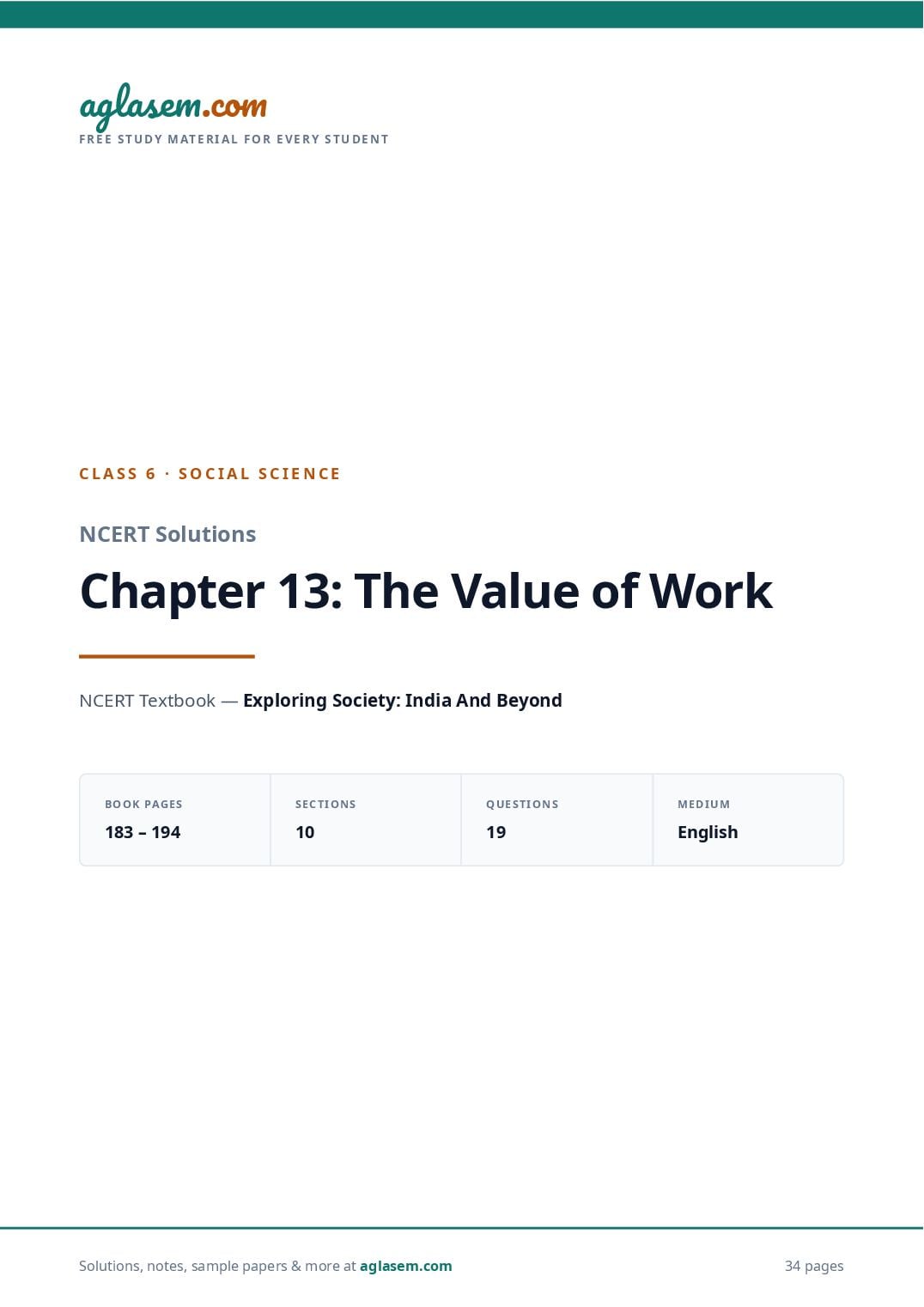
CLASS 6 · SOCIAL SCIENCE
NCERT Solutions
Chapter 13: The Value of Work
NCERT Textbook — Exploring Society: India And Beyond
BOOK PAGES SECTIONS QUESTIONS MEDIUM
183 – 194 10 19 English
Solutions, notes, sample papers & more at 34 pages
Page 2
CLASS 6 · SOCIAL SCIENCE · EXPLORING SOCIETY: INDIA AND BEYOND
NCERT Solutions — Chapter 13: The Value of Work
Complete NCERT Solutions for Class 6 Social Science Chapter 13 The Value of Work from the NCERT textbook
Exploring Society: India and Beyond. Every question of the chapter is answered — The Big Questions, all three
LET’S EXPLORE boxes (including both tables, on pages 185 and 191, filled in completely), all three THINK
ABOUT IT boxes, the in-text question about Rajesh’s ₹400 on page 190, Before we move on… and all four
Questions, activities and projects — with a worked value-addition diagram, and a full ‘kind of work →
example → paid or unpaid → who benefits’ table that shows why the unpaid work done at home and for the
community matters just as much as the work that earns a salary.
TEXTBOOK BOOK PAGES
Exploring Society: India and Beyond (Class 6) 183 – 194
SECTIONS QUESTIONS
10 19
MEDIUM
English
The Big Questions — Page 183
Chapter opening
THE BIG QUESTIONS
Q1 What are the different types of activities that people engage in?
ANSWER
People do hundreds of different things every day, but the chapter sorts every one of them
into just two groups — economic activities and non-economic activities. Page 185 says it
plainly: “Different types of activities, like the ones discussed above, are divided into two groups
or categories: economic activities and non-economic activities.”
Economic activity = work that “involves money or [is] performed in exchange for money or
money’s worth”
Non-economic activity = work that does “not generate income or wealth but [is] done out of
feelings like gratitude, love, care and respect”
Page 1 of 34
Page 3
The two kinds of activity people engage in
All the work people do
Does money or money’s worth change hands?
YES — ECONOMIC ACTIVITY NO — NON-ECONOMIC ACTIVITY
done in exchange for money or money’s worth done out of gratitude, love, care and respect
• a business person selling school bags • parents cooking food for the family
• a farmer selling produce in the market • helping children with schoolwork
• a lawyer arguing a case for a fee • youth taking care of the grandparents
• a truck driver carrying goods • family renovating the house together
• workers in a car factory • free Geography classes for the kids
• Geeta Aunty flying for the Air Force • sevā and langar at a gurudwara
• Rajesh the carpenter selling a chair • Swachh Bharat Abhiyan, Van Mahotsav
One question separates the two branches: does money or money’s worth change hands? Everything
else — how hard the work is, how useful it is, how much it is respected — is the same on both sides.
Now look at the same idea as a table, sorted by how the work is done and who gains from it.
Every example is from this chapter.
Page 2 of 34
Page 4
KIND OF EXAMPLE FROM THE CHAPTER PAID OR WHO BENEFITS
WORK UNPAID
Work for a Geeta Aunty, a pilot in the Indian Air Force; Paid — a fixed The worker’s family, and
salary Rohan, a software engineer; Kavya’s uncle, payment, generally everyone served — the
a bulldozer technician; Kavya’s aunt at the monthly country, the company, the
village post office village
Work for a Sahil, the farm labourer tilling a farmer’s Paid — a daily Sahil’s family, and the
wage land with a tractor wage, partly in cash orchard owner whose
and partly in land is tilled
mangoes (payment
in kind)
Work for a fee A lawyer arguing a case; a doctor; Kavya’s Paid — a fee for The client, the patient, the
aunt’s evening online classes for exam each service or each student — and the
preparation week professional
Making and Rajesh the carpenter; Anu’s parents’ shop Paid — profit, the The seller’s family, and
selling goods for uniforms and ready-made garments; the money left after every buyer who gets
school-bag seller; the farmer selling harvest paying for materials what they need
Household and Cooking food for the family; helping Unpaid — non- The whole family. If this
care work children with schoolwork; youth caring for economic work stopped, nobody
grandparents; Kabir’s grandfather running could go out to work at
errands for the home; Kavya’s aunt all
finishing “her share of the household
chores”
Voluntary Free Geography classes for the Unpaid — non- The neighbourhood, the
service for the neighbourhood kids; the stitching group economic community, and in the
community Anu’s mother helps; Rohan’s weekend end the whole country
computer classes; sevā and langar; Swachh
Bharat Abhiyan; Van Mahotsav
Why one activity can sit in both columns: Kavya’s aunt does exactly the same
thing — teaching — twice over. When she takes online classes and charges a weekly
fee, it is economic. When Kabir’s grandfather teaches Geography free, it is non-
economic. It is the payment that changes, not the teaching. That is why you must
always ask about the payment, never about how “important” the work looks.
Page 3 of 34
Page 5
Class 6 Social Science Chapter 13 The Value of Work
a g l AglaSem · NCERT Solutions
co m
m.
What is their contribution to our everyday lives?
e
Q2
m l as
.co a g
ANSWER
a s em
a gl them, these two kinds of activity produce everything you use and everything you
Between
rely on. Look at one ordinary school morning and count how many people’s work you have
co m
ag
already used before the first bell.
m .
ase
WHAT YOU DID
BEFORE SCHOOL a g l
WHOSE WORK MADE IT POSSIBLE ECONOMIC OR NON-
ECONOMIC
co m
m.
Woke up in a house Masons, carpenters like Rajesh, electricians, Economic
se
with a roof and a door plumbers
m
coswitched g l a
m . aEconomic
onsaelight
Drank water, Waterworks staff, linemen, engineers
a
agl Ate breakfast A farmer who grew the grain, a truck driver who Both — economic up to the
m a s
.co agl
carried it, a shopkeeper who sold it — and whoever shop, non-economic in the
em
cooked it at home kitchen
a s
l like Anu’s parents’ — and whoever in
Wore a clean uniform
a g
A tailor, a shop
the family washed and pressed it
Both
co m
Reached school safely A bus or auto driver, road-building technicians like
m
Economic
.
m
Kavya’s uncle, traffic police
as e
. c o a g l
s e min a clean classroom
a learnt
Sat Teachers on a salary, sanitation workers — and, on Both
agl
and cleanliness drives, the community itself
se m
m a
What economic activities contribute. They produce the goods and services a society needs,
o
.c Wood worth ₹600 becomes a chair worth ₹1,000 ag l
m
and they give the people who do them an income to live on. They also add value at every step
l a
— the chapter’s own point on pages
se 189–190.
because Rajesh worked on it;ga farmer’s wheat becomes flour, then bread, and is worth more at
a
each stage. Kavya’s new highway will cut the journey to the nearest town “from five hours to just
two hours” — so the technicians who build it hand a benefit to every traveller for years
co m
m .
as e
afterwards.
m l
.co a g
What non-economic activities contribute. Page 193 sums it up: they “contribute to social
mwelfare, personal wellbeing and enhance the overall quality of life”. In detail:
s e
agla
.c
They keep families running. Cooked food, clean clothes, homework help, care for the sick
and the old — the invisible work that makes it possible for anyone else to go out and earn.
s e m
. c om
They hold a community together. A langar feeds every visitor free; a plantation drive on
a gla
a s em the whole locality will one day sit in the shade.
Van Mahotsav puts trees where
a
They do jobs no salaryglwould ever cover. No corporation can keep every street clean by
itself — the Swachh Bharat Abhiyan works because ordinary citizens do the work themselves.
co m
m .
m as e
.co
a g l Page 4 of 34
Page 6
They give the giver something too. These practices “foster a sense of satisfaction and
gratitude for what we have”.
Why the chapter is called “The Value of Work” and not “The Value of Money”:
because value and money are not the same size. Money measures only what was
exchanged. A mother’s cooking, a grandfather’s free class, a neighbour who cleans
the street — none of that appears in any account book, and yet a village where
nobody did such things would be a poorer place to live in than a village where
everybody did. Money counts some work. Value belongs to all of it.
Tip: if an answer asks about “contribution”, always give both halves — the goods
and income that economic activities create, and the wellbeing, care and community
strength that non-economic activities create. An answer with only the first half
misses the whole point of this chapter.
LET’S EXPLORE — Page 185
Anu’s and Kabir’s story — filling the table
LET’S EXPLORE
Q1 What activities did the people in Anu’s and Kabir’s story engage in? Mention them in
the table given below: (Character in the story / Activities they are engaged in)
ANSWER
Here is the table filled in. The third column is left for the next LET’S EXPLORE box on page 187
— you will label it there.
Page 5 of 34
Page 7
CHARACTER IN ACTIVITIES THEY ARE ENGAGED IN
THE STORY
Geeta Aunty Works as a pilot in the Indian Air Force — she serves the country and receives a salary for it
Kabir’s grandfather Retired from the Border Security Force. Now he (i) gives free Geography classes to the
neighbourhood kids, (ii) tends the vegetable garden, and (iii) runs errands for the home
Anu’s father (Appa) Runs a shop selling uniforms and other ready-made garments; he leaves for the shop early
in the morning
Anu’s mother (Maa) (i) Helps at the family shop after the children leave for school, and (ii) contributes to a
voluntary group that teaches stitching to the women in the community
Rohan (Anu’s elder (i) Works as a software engineer in a company that makes computer applications, and (ii) on
brother) weekends volunteers to teach computer skills to those who have joined the youth
development programme of the nearby college
Anu and Kabir They go to school and study, and they play in the park — and here they are also observing
and thinking about the work people around them do
Check it yourself: the printed table has seven blank rows and this answer uses six.
Use the spare row for the taxi driver who brought Geeta Aunty home in the very
first line of the story — driving passengers for a fare is an activity too, and a good
reminder that the story has more workers in it than the ones who speak.
Why this table is worth doing slowly: notice how many people in one small story
do more than one kind of work. Maa works in a shop and teaches stitching for free.
Rohan writes software and volunteers. The grandfather has already given a whole
career to the country and is still working every day at home and in the
neighbourhood. Nobody in this story does only one thing, and nobody stops being
useful.
LET’S EXPLORE — Page 187
Page 6 of 34
Page 8
Classifying the same activities as economic or non-economic
LET’S EXPLORE
Q1 In the table given on page 185, did you notice the third empty column? Label this
column ‘economic / non-economic activity’. Now classify them according to the
nature of activity.
ANSWER
Yes — the third column was left blank on purpose. Label it ‘Economic / non-economic
activity’ and fill it like this. Ask only one question for each row: is money or money’s worth
being exchanged?
CHARACTER IN ACTIVITIES THEY ARE ECONOMIC / NON-ECONOMIC
THE STORY ENGAGED IN ACTIVITY
Geeta Aunty Serving as a pilot in the Indian Air Economic — she receives a salary (stated on
Force page 187)
Kabir’s grandfather Free Geography classes for the Non-economic — “free”, so no payment at all
neighbourhood kids
Tending the family’s vegetable Non-economic — the vegetables are for the
garden home, not for sale
Running errands for the home Non-economic — household work, done out of
care for the family
Anu’s father (Appa) Running the shop that sells uniforms Economic — goods are sold for money and the
and ready-made garments family earns from it
Anu’s mother (Maa) Helping at the family shop Economic — this is part of running the business
that earns the family’s income
Teaching stitching in a voluntary Non-economic — “voluntary”, so she is not paid
group for it
Rohan Working as a software engineer Economic — “is given a salary for it” (page 187)
Weekend computer classes at the Non-economic — page 187 says so in exactly
youth development programme these words: “This is a non-economic activity”
Anu and Kabir Going to school, studying, playing Non-economic — no money is exchanged by
them; studying is an investment in their future
The taxi driver Driving Geeta Aunty home from Economic — the passenger pays a fare for the
work ride
Page 7 of 34
Page 9
Careful — the trap in this exercise: three people in the story appear twice, once on
each side. Maa is economic at the shop and non-economic at the stitching group.
Rohan is economic on weekdays and non-economic on weekends. Grandfather’s
garden work is non-economic — but if he sold those vegetables in the market, the
very same digging would become economic. Classify the activity, never the person.
Why the school row confuses students: a teacher teaching in school is doing an
economic activity, because the school pays a salary. But you, sitting in the class and
learning, are not — you pay no one and earn nothing from it today. Studying is still
one of the most valuable things you can do, which is another proof that “non-
economic” is not a smaller word than “economic”.
THINK ABOUT IT — Page 187
Free teaching, and the non-economic work in your own family
THINK ABOUT IT
Q1 When Kabir’s grandfather voluntarily teaches the neighbourhood kids for free, is
that an economic activity or a non-economic activity? How is it different from your
teachers teaching you at school? Discuss with your classmates.
ANSWER
It is a non-economic activity. Grandfather charges nothing — the chapter’s own words on
page 184 are “providing free Geography classes to the neighbourhood kids”. No money and no
money’s worth changes hands, so by the definition on page 186 it is non-economic. He does it
out of exactly the feelings the book lists: care, affection and respect for the children of his
neighbourhood.
A school teacher is doing the very same work — but as an economic activity, because the
school employs them and pays them a salary (page 187: “A fixed regular payment generally
paid monthly by an employer to an employee”). Teaching is their profession; it is how their
family lives.
Page 8 of 34
Page 10
Class 6 Social Science Chapter 13 The Value of Work
a g l AglaSem · NCERT Solutions
co m
m.
KABIR’S GRANDFATHER YOUR SCHOOL TEACHER
m as e
Payment
.co
None — free
a g l
A monthly salary from the school
se m
g l a
a
Type of activity Non-economic Economic
Why they do it Out of love, care and a wish to give back It is their trained profession — and, for most
m
.co ag
to the neighbourhood teachers, also because they love teaching
em need
He does — whatever theschildren
a
agl
Who decides what is A syllabus, a timetable and a school calendar
taught that day
Duty and He may teach or not teach on any day;
co m
Must attend, complete the course, set and mark
em.
accountability nobody can require him to exams, answer to the school and to parents
m l as
m .co
Training and His own knowledge and long life
a g
A formal teaching qualification and regular
l a se
qualification experience training
g
a Value of the Exactly the same. A child who learns Geography learns it just as well from either of them
teaching itself
m a s
m.co agl
l a se
a g
Why this comparison matters: the difference between the two is only the
payment — not the usefulness, not the effort, not the skill, and certainly not the
respect either of them deserves. Being paid does not make work more valuable, and
co m
being unpaid does not make work less valuable. That single sentence is the heart of
m .
m ase
.co
this whole chapter.
a g l
a s em
a gl For your class discussion: ask the group one sharp question — “Should grandfather
be paid?” Some will say yes, his time is worth money. Others will say that a payment
se m
com g l a
. a
would change the friendly, easy nature of the class. Both answers are defensible,
m
ase
and hearing both is the point of the discussion. The strongest position is that his
agl
choice to give it free is itself valuable — it is sevā, the idea the chapter takes up on
page 191.
co m
m .
o m l a se
g
.c What are some non-economic activities that are important
a
s e mQ2 to you and your family?
a
agl
Why are they valuable?
.c
s e m
m a
agl
ANSWER
. co
se m
This is a personal question, so your answer must come from your own home. The method is
l a
ag go wrong if it were not done.
simple: think of one full day in your family and list every task that nobody was paid for. Then,
for each one, say what would
m
What a good answer must contain
. co
em
m l as
.co a g
Page 9 of 34
Page 11
At least five or six real activities from your own household and neighbourhood — not a
general list.
The name of the person who does each one, and roughly how much time it takes.
For each, a clear reason why it is valuable — the wellbeing, safety, learning, health or
happiness it creates.
One honest sentence about work that usually goes unnoticed in your home, and one idea for
sharing it more fairly.
Sample answer:
NON-ECONOMIC WHO DOES IT WHY IT IS VALUABLE
ACTIVITY IN MY
FAMILY
Cooking the day’s meals and My mother, and my father All of us stay healthy and nobody goes to school or
packing tiffins on Sundays work hungry. Bought food would cost far more
and would not be as good for us
Helping my younger sister with Me She learns, she is not scared of school, and it saves
her homework the family the cost of a tuition teacher
Giving my grandmother her My father and my aunt, by Her health stays steady, and she does not feel alone
medicines on time and sitting turns — this is care that no medicine can give
with her
Cleaning the house and Shared — my mother, my We stay free of illness, and sharing the roster
washing clothes brother and I have a means one person is not tired out while the others
weekly roster rest
Watering the plants in front of My grandfather Shade, cleaner air and a lane that everybody
the house and on our lane enjoys walking through
Cleaning the lane and the All the families of our The whole neighbourhood gains, and doing it
temple courtyard before a lane together together makes neighbours into friends
festival
Teaching two children in our My elder cousin Two children who were falling behind are now
lane to read, free, on Sunday reading — one person’s free hour changed their
mornings whole school year
Why they are valuable, in one paragraph you can write in an exam: None of these activities
earns a single rupee, yet our family could not function for even one day without them. They
keep us fed, clean, healthy and safe; they help us learn; they keep our elders cared for; and they
make our neighbourhood a place where people help one another. They are done out of love,
care, gratitude and respect — the very feelings page 186 names. Their value is not printed on
any bill, but it is felt by everyone in the house.
Page 10 of 34
Page 12
Try this at home: for one week, keep a small chart of every unpaid task done in your
house and who did it. Two things usually surprise students. First, how many hours
the total comes to — often more than a full working day. Second, how unevenly it is
shared. Sharing household work fairly among everyone — girls and boys, women
and men — is a real way of respecting the work, not just praising it.
THINK ABOUT IT — Page 189
Economic activities on your way to school, and how those people are paid
THINK ABOUT IT
Q1 On your way from home to school today, can you recall the various economic
activities that people are engaged in? In what ways do you think those people are
paid?
ANSWER
Recall the journey slowly, corner by corner — you will find you pass a dozen economic
activities before you reach the school gate. Then match each one to the way that person is paid.
The chapter gives you four ways: salary, wage, fee and payment in kind; add profit for
anyone who runs their own shop or business.
Sample answer:
Page 11 of 34
Page 13
WHO I SAW THE ECONOMIC HOW THEY ARE PAID
ACTIVITY
Milk vendor Delivering milk packets house to Profit on each packet sold; the dairy that employs a
house early in the morning delivery boy pays him a salary
Newspaper boy Dropping newspapers at each A monthly payment collected from each household
gate — part of it stays with him, part goes to the agency
Vegetable seller Selling vegetables from a cart or Profit — the difference between the mandi price
a stall and the selling price
Tea stall owner Making and selling tea and Profit; the helper who washes the glasses is paid a
snacks daily wage
Auto and bus driver Carrying passengers to work, The fare from each passenger; a city bus driver
school and market draws a monthly salary
Tailor Stitching and altering clothes in a A charge for each garment, which is a kind of fee
small shop for his skill
Cobbler Repairing and polishing shoes at A fee for each repair, paid in cash on the spot
the corner
Construction workers Building a house or repairing the A daily wage; the site engineer and the technician
road who runs the machine draw a monthly salary
Sanitation worker Sweeping the street and A salary or a wage from the municipality or its
collecting the garbage contractor
Chemist and doctor at Selling medicines; examining Profit on medicines; a consultation fee for the
the clinic patients doctor
Bank and post office Handling deposits, money orders A monthly salary — just like Kavya’s aunt at the
staff and letters village post office
Farm labourer in the Ploughing, weeding, harvesting A daily wage, sometimes partly in cash and partly
field beside the road as grain or fruit — payment in kind, like Sahil’s
mangoes
My school teacher and Teaching; keeping the gate safe A monthly salary from the school
the school guard
Page 12 of 34
Page 14
Why the same job can be paid in different ways: what decides it is how the work
is arranged, not what the work is. A driver employed by a transport company draws
a salary; a driver who owns his auto earns fares. A tailor in a factory earns a wage; a
tailor with his own shop earns a charge per garment. So when you answer, describe
the arrangement — “employed by…”, “owns his…”, “works by the day” — and the
right payment name follows on its own.
Did you notice? On the same walk you almost certainly passed non-economic
activities too — a neighbour sweeping the space in front of her gate, an elder
helping a child cross the road, volunteers filling a water pot for birds. They are not
on the list above because nobody is paid for them, but the road you walked on
would be a worse road without them.
In-text Question — Page 190
Value addition — Rajesh the carpenter
Q1 The wood for the chair costs ₹600. So, what is the remaining ₹400 (₹1,000 – ₹600)
for?
ANSWER
The ₹400 is the money value of Rajesh’s work — “the monetary value of Rajesh’s skill, time
and effort, which went into making that chair”. He did not find ₹400; he created it by turning
plain wood into a chair somebody wants to sit on. The chapter’s name for this is value addition.
Selling price of the chair = ₹1,000
Cost of the wood he bought = ₹600
Value added by Rajesh = ₹1,000 − ₹600 = ₹400
Page 13 of 34
Page 15
Class 6 Social Science Chapter 13 The Value of Work
a g l AglaSem · NCERT Solutions
co m
Value addition: how ₹600 of wood becomes a ₹1,000 chair
em.
m l as
.co a g
a s em ₹600
Wood from the market Rajesh works on it A finished chair
ag l his skill, his time,
his effort and his tools
₹1,000
what he paid for it what a buyer pays
co m
m . ag
l a se ADDED = ₹400
ag
VALUE
₹1,000 − ₹600 = ₹400. That gap is not a profit taken from anyone — it is the price of the work that
co m
m.
changed a pile of wood into a chair.
m as e
.co a g l
a s em
Why the buyer is happy to pay it: nobody wants to sit on ₹600 of loose wood. The
a gl chair is worth more to the buyer than the wood was, and the whole of that increase
came from Rajesh’s hands. This is what page 189 means when it says economic
a s
com agl
activities “add value at each stage of the process of transforming something into
m .
e
another form”. The same thing happens all around you — cotton becomes thread,
g l as the shirt in Anu’s parents’ shop, and each pair
thread becomes cloth, cloth becomes
a value.
of hands along the way adds
. c om
s e m Out of it he
Careful: the ₹400 is value added, not pure profit that Rajesh keeps.
c m pay for “special tools and other materials” — nails,
mustostill a polish, the cushion
glglue,
. a
m the seat — and for the wear on his saw and his workshop. What is left after all
eon
as that is his actual earning. So do not write “Rajesh earns ₹400 profit”; write “Rajesh
a g l
adds ₹400 of value, which covers his materials and pays for his skill, time and effort”.
se m
com g l a
m . a
ase
agl
Check it yourself: if Rajesh’s tools, nails and polish cost him ₹150 for that chair, how
much is left for his skill, time and effort? ₹400 − ₹150 = ₹250. And if he makes 4 such
chairs in a week, the value he adds in that week is 4 × ₹400 = ₹1,600.
co m
m .
m as e
.co a g l
m EXPLORE — Page 191
se
a
LET’S
ag l
.c
s e m
m a
e m . co agl
g l as
a
com
m .
m ase
.co
a g l Page 14 of 34
Page 16
Which activities and professions create monetary value?
LET’S EXPLORE
Q1 Put a ✓ against those activities/professions that you think create monetary value.
Can you add two activities and examples of money related value creation to the
empty rows at the end? (1. Baker 2. Tailor 3. Farmers repairing their tractor 4.
Doctor 5. Parents cooking dinner for their family 6. Scientist 7. Person taking care of
a sick grandparent 8. ____ 9. ____)
ANSWER
Tick a row only if somebody pays money, or money’s worth, for that work. Here is the
completed table, with rows 8 and 9 filled in.
Page 15 of 34
Page 17
NO. ACTIVITY / CREATES EXAMPLE OF MONEY-RELATED VALUE
PROFESSION MONETARY CREATION
VALUE?
1 Baker ✓ Buys flour, sugar and yeast for ₹200 and sells the bread
and cakes baked from them for ₹500 — the baking
added ₹300 of value
2 Tailor ✓ Charges ₹300 to stitch a kurta from cloth the customer
brings — the ₹300 is the price of his skill, exactly like
Rajesh’s ₹400
3 Farmers repairing ✗ (no tick) They repair their own tractor, so no payment passes
their tractor between anyone. Note the near-twin: a mechanic
repairing that same tractor for a charge would be ✓
4 Doctor ✓ Charges a consultation fee of ₹400, or draws a monthly
salary at a hospital
5 Parents cooking ✗ (no tick) Nobody pays for it — it is done out of love and care. Its
dinner for their family value to the family is huge, but it is not monetary value.
A cook in a restaurant doing the same cooking for wages
would be ✓
6 Scientist ✓ Draws a salary from a laboratory, a university or an
institute such as ISRO or CSIR, and the research may
lead to products worth crores
7 Person taking care of ✗ (no tick) Family care, given out of love and gratitude. A trained
a sick grandparent nurse hired to do the same nursing for a salary would
be ✓ — the work is identical, only the payment differs
8 Potter (added) ✓ Digs clay worth almost nothing, shapes and fires it, and
sells a set of matkas for ₹150 each in the weekly market
9 Bus driver (added) ✓ Draws a monthly salary for carrying hundreds of
passengers safely to work, school and market every
single day
Other good pairs you could use for rows 8 and 9: a barber (charges for a haircut) · a
fisherman (sells the day’s catch) · a weaver (sells handloom saris) · a mason (paid a daily wage
on a building site) · a mobile-repair shop owner (charges for each repair) · a courier delivery
agent (paid per delivery) · a beautician, an electrician, a plumber, an app developer.
Page 16 of 34
Page 18
Why rows 3, 5 and 7 do not get a tick — and why that is not an insult: the
question asks only about monetary value, and money only appears when there is an
exchange between people. The farmer’s repair, the parent’s cooking and the
grandchild’s nursing are all done inside the family, for the family. Look at what the
chapter itself does with such work — page 191 opens the very next section with the
line, “While non-economic activities may not involve money, the value they generate
is important in our lives.” No tick in this column is not a low mark for that work.
It only means this particular column is measuring rupees, and rupees cannot
measure everything.
Think a step further: a family that hires a cook, a nurse and a mechanic pays real
money every month for exactly the work that rows 3, 5 and 7 describe. So that work
always had a money value — it simply was never billed. Economists across the world
have been arguing for decades that unpaid household and care work should be
measured and reported, because leaving it out makes it invisible. In most countries,
and in India too, the greater share of this unpaid work is done by women;
recognising it, and sharing it fairly among everyone in a home, is one practical way
of putting this chapter into action.
THINK ABOUT IT — Page 193
Community participation, festivals and community programmes
THINK ABOUT IT
Q1 Many communities in India have similar practices that involve community
participation. Can you identify a few from your area?
ANSWER
Almost every part of India has a tradition of people working together without payment.
Ask your grandparents and your neighbours — you will find at least three or four in your own
area. Here are real examples from across the country to help you recognise yours.
Page 17 of 34
Page 19
PRACTICE WHERE IT IS FOUND WHAT PEOPLE DO TOGETHER
Shramdaan All over India Villagers give a day’s labour free to desilt a pond, repair
a bund, level a road or build a school wall
Halma Bhil community, Jhabua and Thousands gather on a hill on one day and dig trenches
Petlawad region of Madhya and pits to hold rainwater — an old tradition now used to
Pradesh fight drought
Kar sevā Gurudwaras everywhere, Devotees clean the sarovar and the premises, cook and
especially Punjab serve the langar, and wash the used dishes by hand
Ganeshotsav Maharashtra, Goa A whole street raises money together, builds the pandal,
mandals runs the ten-day programme and organises the visarjan
Cleaning the ghats Bihar, Jharkhand, eastern Uttar Families clean and level the riverbank and light the ghats
before Chhath Pradesh for everybody, not just for themselves
Pookalam and Kerala Neighbours make the flower carpet and the community
Onasadya feast together for Onam
Ther (temple car) Tamil Nadu, Odisha (Rath Yatra) Hundreds of hands pull the chariot — a task no single
pulling family could ever do
Community fishing Meghalaya, Manipur, Assam A village fishes a pond or stream together on one
appointed day and shares the catch
Community grain Many tribal areas, including Each family contributes grain after the harvest so that no
store Odisha and Chhattisgarh household goes hungry in a bad year
Building a house Villages across India, especially Neighbours give their labour free to raise a roof; the
together the North-East family only feeds them
Sample answer for your own area: “In our locality, all the families of our lane clean the lane
and whitewash the boundary wall together before Diwali. In the rainy season the young people
of our colony clear the drains so that water does not collect. Every year our resident welfare
association organises a blood donation camp and a tree plantation drive, and last summer
everyone contributed to set up a water pot and a shaded stand for birds and stray animals.
Nobody is paid for any of it.”
Why these practices survive: some jobs are simply too big for one family and too
small or too scattered for a government office. Cleaning one lane, desilting one
pond, running one festival — these fall exactly in that gap. Community participation
fills it, and it does something extra along the way: people who have worked side by
side once find it much easier to help each other again.
Page 18 of 34
Page 20
Class 6 Social Science Chapter 13 The Value of Work
a g l AglaSem · NCERT Solutions
co m
m.
We celebrate many festivals in India. During these festivals, people gather to
se
Q2
o m l a
organise all the various activities. They decorate the place together and share the
m .c they cook. Are these non-economic activities? Why adog you think they still
food that
l a se value?
hold
a g
m
ANSWER
. co ag
m
Yes — the work that the people themselves do at a festival is non-economic. Nobody pays
l a se
the neighbours who string the lights, sweep the courtyard, draw the rangoli, cook the prasad or
ag the feelings page 186 names — gratitude, love, care and
serve the food. They do it out of exactly
respect.
c o m
m .
AT THE SAME EXAMPLE
s e
ECONOMIC OR
.
FESTIVAL…
co m
ag la NON-ECONOMIC
m
se people do
l a
ag themselves, free
Work Decorating the pandal, drawing the rangoli, cooking and serving Non-economic
the community meal, singing in the bhajan group, cleaning up
s
afterwards
m new clothes; hiring a tent a
. coand
eorma band; paying an idol-maker, a priest, agl
s
Work people pay Buying flowers, sweets, lamps Economic
a
aglan electrician
others for house, a sound system
a photographer,
co m
.
Why the unpaid half still holds great value. Five reasons, and you can write any three of
them:
se m
o m l a
c a community. People who normally only nod at eachagother spend a week working
It .builds
m
se shoulder to shoulder. Neighbours become friends, and that helps long after the festival is
a
agl over.
It passes on culture. Children learn the songs, the rangoli patterns, the recipes and the
se m
com g l a
. a
rituals by doing them beside their elders — something no book or class can replace.
m
ase
It includes everybody. A community meal is shared by rich and poor alike. The chapter’s
a gl
own example of this is the langar, which “serve[s] food to every visitor for free”.
It teaches organisation and responsibility. Collecting contributions, dividing tasks,
keeping accounts, managing a crowd and cleaning up afterwards is real training in working
co m
m .
se
together.
o m l a
g enhance the overall quality of
.cactivities “contribute to social welfare, personal wellbeingaand
It gives joy and belonging. These are not small things. Page 193 says non-economic
se m
g l a
a
life” — this is precisely what a festival does.
.c
s e m
m a
e m . co agl
g l as
a
co m
m .
m as e
.co
a g l Page 19 of 34
Page 21
Did you notice? A festival also creates a great deal of economic activity around
itself — for the flower seller, the sweet shop, the tailor, the potter, the idol-maker, the
bus and the auto driver. So a festival is a fine example of the two kinds of activity
standing side by side and helping each other, which is how they usually work in real
life.
The one-line answer if you are short of time: the people’s own festival work is
non-economic because nobody is paid for it, but it holds value because it binds the
community, passes on culture, includes everyone and gives happiness — none of
which money could buy.
Q3 Can you identify community programmes that have been undertaken by your
school or in your locality? What did you observe during these programmes?
ANSWER
Every school runs more of these than students realise. Look back at your school year and
your locality, and list them; then write down what you actually saw — not what you think you
should say.
Common school and locality programmes
Page 20 of 34
Page 22
PROGRAMME WHAT IS DONE WHAT IT ACHIEVES
Swachhata drive Cleaning the school ground, the lane, a park or A cleaner, healthier place — and
a bus stop; putting up separate bins for wet and the habit of not littering it again
dry waste
Van Mahotsav / plantation Planting saplings in the school and the colony, Shade, cleaner air, and a lesson in
drive and — the harder part — watering them all looking after what you start
through the first summer
Health and eye check-up Doctors and volunteers examine students and Problems are found early; many
camp, blood donation camp residents free students get spectacles for the first
time
Literacy or tuition drive Senior students teach younger children, or help Real learning, and the teacher-
adults in the neighbourhood learn to read and student learns even more than the
sign their name pupil
Blanket, book or food Collecting and distributing warm clothes in Nothing useful is wasted, and
collection winter, or books and stationery at the start of children who could not afford
the session books get them
Water conservation, Repairing leaking taps, cleaning the water tank, Less water wasted, and a visible
rainwater harvesting digging a soak pit fall in the school’s water bill
Road safety and traffic Rallies, posters, street plays with the local Helmets worn, zebra crossings
awareness police used
Yoga Day, Fit India, sports Everyone takes part, including parents, staff Health, and a school that feels like
day for the locality and neighbours part of its neighbourhood
Sample answer — what I observed: “Our school held a Swachhata Abhiyan in the week of 2
October. Students of Classes 6 to 8, our teachers, the school staff and about twenty parents
cleaned the school ground, the lane outside and the bus stop, and we painted two dustbins
green and blue for wet and dry waste. Four things surprised me. First, how much rubbish two
hours of work removed — nineteen sacks from a lane we walk down every day without noticing.
Second, how much faster the work went once we divided into small groups with one task each,
instead of everybody doing everything. Third, that our principal and the sweeper worked side
by side with the same broom, and nobody thought it odd — which taught me more about the
dignity of work than any lesson. Fourth, that shopkeepers who had watched us in the morning
had swept the front of their own shops by the evening, without being asked. A month later the
lane was still cleaner than before, though not as clean as on that day, so we decided to repeat it
every second month.”
Page 21 of 34
Page 23
Tip for writing this answer: examiners are looking for observation, not praise.
Include at least one number (how many people, how many hours, how many
saplings), one thing that did not go as planned, and one thing you would do
differently next time. That turns a general paragraph into a real report.
Why school programmes matter beyond the day itself: the chapter says the
Swachh Bharat Abhiyan is “based on the collective efforts of all Indian citizens”, and
that “together, these efforts lead to a clean home, neighbourhood, society and
nation”. A school drive is where a citizen first practises being one of those citizens.
The saplings you water this year are the shade somebody sits in ten years from now.
Before we move on… — Page 193
The chapter in three points
BEFORE WE MOVE ON…
Q1 In this chapter, we learnt about economic and non-economic activities.
ANSWER
The whole chapter turns on one dividing line, and it is worth being able to state it in a
single breath.
Economic activity — involves money, or is done in exchange for money or money’s worth
Non-economic activity — earns no income or wealth; done out of gratitude, love, care and
respect
Page 22 of 34
Page 24
ECONOMIC ACTIVITY NON-ECONOMIC ACTIVITY
Money Yes — money or money’s worth is exchanged No
involved?
Purpose To earn an income and to produce goods and To help, to care, to give back, to serve
services
Examples Selling school bags in the market; a farmer Parents cooking food; helping children with
from the selling produce; a lawyer earning a fee; a truck schoolwork; youth caring for grandparents; the
chapter driver carrying goods; workers in a car factory; family renovating the house; free Geography
Geeta Aunty in the Air Force; Rajesh selling a classes; sevā and langar; Swachh Bharat Abhiyan;
chair Van Mahotsav
How the doer Salary, wage, fee, payment in kind, or profit Not paid — the return is satisfaction, gratitude
is paid and a stronger family or community
Counted in Yes Usually not — which is why this work is so
the country’s easily overlooked
income?
One line for revision: the difference is the payment, not the person and not the
importance of the work. The same person may do both in one day, and the same
task may be economic for one person and non-economic for another.
Q2 We also learnt about the value addition that economic activities create.
ANSWER
Value addition is the increase in an item’s value at each stage of turning it into something
else. Page 189: economic activities “add value at each stage of the process of transforming
something into another form. This is called value addition.”
Value added at a stage = value of what comes out − cost of what went in
Rajesh: ₹1,000 − ₹600 = ₹400
It is not only carpenters. Follow one shirt from the field to Anu’s parents’ shop and watch the
value climb at every pair of hands:
Page 23 of 34
Page 25
Class 6 Social Science Chapter 13 The Value of Work
a g l AglaSem · NCERT Solutions
co m
m.
STAGE WHO WORKS ON IT WHAT IT VALUE ADDED BY
as e
com
BECOMES
. a g l
e m
as
1 Farmer Cotton grown and Ploughing, sowing, watering, harvesting
agl
picked
2 Ginning and spinning mill Cotton becomes yarn Cleaning, carding and spinning
co m
. ag
worker
em
3 Weaver / power-loom
g l as
Yarn becomes cloth Weaving, dyeing, printing
worker a
4 Tailor Cloth becomes a shirt Cutting, stitching, finishing
co m
em.
m l as
.co
5 Truck driver The shirt reaches the Transport — a shirt in a warehouse is worth less
a g
se m
town than a shirt in a shop
l6a
a g Shopkeeper (Anu’s
parents)
The shirt reaches the
buyer
Stocking the right sizes, displaying, advising,
selling
om a s
e
. c
m exactly where money comes from in an agl
economy — from work, not g
s
Why this idea is important: it shows
la nowhere. Every rupee of the final price is
a from
somebody’s skill, time and effort at some stage of the chain. And it shows why a
country that only sells raw material earns far less than one that also processes it: the
co m
m .
value is added by the working, not by the owning.
m as e
.co a g l
se m
g l a
a We understood how non-economic activities contribute to social welfare, personal
m
Q3
wellbeing and enhance the overall quality of life.
a se
. com a g l
m
ase
agl
ANSWER
Take the three phrases one at a time — the chapter gives an example of each.
co m
m .
m as e
.co a g l
se m
g l a
a c
m .
m a s e
e m . co agl
g l as
a
co m
m .
m as e
.co
a g l Page 24 of 34
Page 26
WHAT IT WHAT IT MEANS THE CHAPTER’S EXAMPLE
CONTRIBUTES
TO
Social welfare The good of people outside your The langar that “serve[s] food to every visitor for free”;
own family — the the Swachh Bharat Abhiyan, whose “collective efforts
neighbourhood, the community, … lead to a clean home, neighbourhood, society and
the nation nation”; Van Mahotsav plantation drives
Personal wellbeing What the work does for the These practices “foster a sense of satisfaction and
person who does it and for gratitude for what we have”; parents cooking and
those closest to them helping with schoolwork; youth caring for grandparents
Overall quality of life Everything that makes a place Clean streets and parks, trees and shade, festivals worth
good to live in, which no salary being part of, neighbours you can count on
can buy for you alone
Why a society needs both kinds of activity. Economic activities give a country its goods,
services and incomes. Non-economic activities give it something economic activities cannot buy
— care, trust, cleanliness that lasts after the sweeper has gone home, and citizens willing to do
a thing simply because it needs doing. A place with plenty of the first and none of the second
would be rich and unpleasant to live in. This chapter asks you to see both, and to respect both.
The chapter’s closing thought, in Vivekananda’s words from page 183: “When
you are doing any work, do not think of anything beyond. Do it as worship, as the
highest worship, and devote your whole life to it for the time being.” He is not
talking about grand work. He is saying that the value of work lies in how it is done,
not in what it pays — which is exactly why the pilot, the bulldozer technician, the
farm labourer, the shopkeeper, the grandfather in his vegetable garden and the
parent in the kitchen all belong in the same chapter.
Questions, activities and projects — Page 193
End-of-chapter exercise
Q1 How are economic activities different from non-economic activities?
ANSWER
They differ in one thing only — whether money or money’s worth is exchanged. Everything
else follows from that.
Page 25 of 34
Page 27
Economic activities “are those that involve money or are performed in exchange for money
or money’s worth for the parties involved.” (page 185)
Non-economic activities “are those that do not generate income or wealth but are done out
of feelings like gratitude, love, care and respect.” (page 186)
BASIS OF ECONOMIC ACTIVITIES NON-ECONOMIC ACTIVITIES
DIFFERENCE
1. Money Money or money’s worth is exchanged No money is exchanged
2. Motive To earn an income; to produce goods and Gratitude, love, care, respect, a wish to serve
services for others
3. Income or Generates income and wealth for the doer Generates none
wealth
4. Form of Salary, wage, fee, payment in kind — or No payment; the return is satisfaction and
payment profit for a business gratitude
5. Who it is Customers, employers, clients — usually The family, the neighbourhood, the community,
usually for people outside the family the nation
6. Value addition Adds value at each stage — ₹600 wood Adds value to life, but not value that is priced in
becomes a ₹1,000 chair rupees
7. Examples A business person selling school bags; a Parents cooking for the family; helping children
farmer selling produce; a lawyer earning a with schoolwork; youth caring for grandparents;
fee; a truck driver; car factory workers; a family renovating its house; grandfather’s free
Geeta Aunty the Air Force pilot; Kavya’s Geography classes; the stitching group; sevā and
aunt at the post office; Sahil the farm langar; Swachh Bharat Abhiyan; Van Mahotsav
labourer
The one thing that is not a difference: importance. Both kinds of work are needed
and both deserve equal respect. The same activity can move from one column to the
other simply because of how it is arranged — cooking at home is non-economic; the
same cooking in a restaurant is economic. If the difference were about how valuable
the work is, that switch would make no sense.
Page 26 of 34
Page 28
Exam tip: answer this in a table with 4–6 bases of difference, and end with one
sentence saying that the difference is about payment and not about the worth of the
work. That last sentence is what separates a full-marks answer from an ordinary
one.
Q2 What kind of economic activities do people engage in? Illustrate with examples.
ANSWER
People earn a living in four broad ways, and this chapter gives a real person for each one.
KIND OF WHAT THE EXAMPLES FROM THE CHAPTER HOW THEY
ECONOMIC PERSON DOES ARE PAID
ACTIVITY
1. Growing things Produces food and raw The farmer selling produce in the market; Sale of the harvest;
(from land and material from the soil Sahil, the farm labourer tilling land with a a daily wage, part
nature) tractor; the mango orchard cash and part
payment in kind
2. Making things Turns raw material into Rajesh the carpenter making a chair from Profit on each item
a finished, more useful ₹600 of wood; workers employed in a car sold; a monthly
product — this is manufacturing factory salary or a wage
where value addition is for factory workers
clearest
3. Buying and Brings goods from The business person selling school bags; Profit — the
selling (trade) where they are made to Anu’s parents’ shop for uniforms and money left after
where they are needed ready-made garments paying for the
goods, the shop and
the staff
4. Providing Sells skill, care, safety Geeta Aunty, Air Force pilot; the lawyer Salary for
services or convenience rather arguing a case; the truck driver; Rohan, employees; a fee for
than a physical object software engineer; Kavya’s uncle, bulldozer each service by a
technician; Kavya’s aunt at the post office professional
and in her evening online classes; doctors,
teachers, bankers
Watch one family cover three of the four. Kavya’s aunt draws a salary at the village post office
and charges a weekly fee for online classes; Kavya’s uncle draws a salary as a construction
technician; Kavya’s father Rajesh makes and sells furniture. One household, three kinds of
economic activity, three ways of being paid.
Page 27 of 34
Page 29
Did you know? Beyond this chapter, economists give these four groups formal
names. Growing things is the primary sector; making things is the secondary
sector; and trade and services together form the tertiary sector. You will meet
these terms in a higher class — the ideas are already here in this chapter, only
without the labels.
Why every one of the four is needed: a farmer’s cotton is of no use without a mill
to spin it, a tailor to stitch it, a truck to carry it and a shop to sell it. Cut any one link
and the rest of the chain stops. No kind of economic activity is superior to another —
each one exists because the others need it.
Q3 There is great value attached to people who are engaged in community service
activities. Comment on this statement.
ANSWER
The statement is true, and the chapter shows exactly why. People engaged in community
service earn nothing at all, so by the definition on page 186 their work is non-economic. Yet
page 191 begins the section on it with the sentence that answers this question: “While non-
economic activities may not involve money, the value they generate is important in our lives.”
Five reasons why great value attaches to such people
They serve without expecting anything back. Page 192 says these practices are “a way of
contributing to society without expecting anything in return”. That is sevā, and it is one of
the oldest ideas in Indian life. The langar or community kitchen at a gurudwara “serve[s]
food to every visitor for free” — every visitor, without asking who they are.
They do work that money cannot get done. No municipality has enough staff to keep
every lane clean. The Swachh Bharat Abhiyan works because ordinary citizens do it
themselves, and “together, these efforts lead to a clean home, neighbourhood, society and
nation”.
They reach people that nothing else reaches. A grandfather’s free Geography class, a
voluntary group teaching stitching to the women of a community, Rohan’s weekend
computer classes at the youth development programme — each gives a skill to someone
who might not otherwise get it. A skill given free today becomes somebody’s livelihood
tomorrow.
They think beyond their own lifetime. Van Mahotsav, “the festival of forests”, brings
people together for tree plantation drives to spread awareness of “the value of trees and the
conservation of forests”. Whoever plants a tree at a Van Mahotsav will probably never sit in
its shade.
Page 28 of 34
Page 30
Class 6 Social Science Chapter 13 The Value of Work
a g l AglaSem · NCERT Solutions
They set an example that spreads. One family that segregates its waste changes a lane;
co m
one clean lane changes a colony. Community service multiplies in a way that a paid job
e m.
m l as
.co g
usually cannot.
em a
a s
gl deeper point: a society is held together by two different things — exchange,
awhere
The
I give you something because you pay me, and service, where I give you
co m
something because you need it. Money handles the first. Only people like these
e m .
handle the second. That is why the chapter asks you to attach value to them — not ag
g l as
as a courtesy, but because a society without them genuinely does not work.
a
. c om
Give an example from your own life: a good answer to this question names one
real person — a neighbour who teaches free, an uncle who organisesmthe blood
o m
camp, the group that cleans the pond every summerg— l a se
.cbe missing if they stopped. That single concrete example
donation
m a is worth more than a
and says what
s e
glapage of general praise.
would
a
m a s
m .co agl
l a se
g
What are the various ways in which people are compensated for various economic
a
Q4
activities? Give some examples.
co m
ANSWER
m .
m as e
cowho g l
The chapter names four ways, each with its own margin definition, and there is a fifth for
. a
e m
people
s
work for themselves.
agla
se m
com g l a
m . a
ase
agl
co m
m .
m as e
.co a g l
se m
g l a
a c
m .
m a s e
e m . co agl
g l as
a
co m
m .
m ase
.co
a g l Page 29 of 34
Page 31
WAY OF THE CHAPTER’S WHEN IT IS EXAMPLES
BEING DEFINITION PAID
PAID
Salary “A fixed regular payment The same amount Geeta Aunty, Air Force pilot; Rohan,
generally paid monthly by an every month, software engineer; Kavya’s uncle,
employer to an employee” whatever the day’s construction technician; Kavya’s aunt
(page 187) work happened to be at the village post office; teachers, bank
staff, nurses
Wage “A payment made by the By the day or by the Sahil, the farm labourer, “earns a daily
employer to the worker for a hour, usually paid at wage for his efforts”; masons, helpers
specific period of time” (page the end of that and loaders on a building site
189) period
Fee “A payment made to a person Once for each The lawyer “arguing a case and earning
or organisation in exchange for service given a fee”; a doctor’s consultation fee;
professional advice or services” Kavya’s aunt’s weekly fee for her
(page 185) online exam-preparation classes
Payment in “A non-cash payment that is Along with, or Sahil receives part of his payment “in
kind received for the work instead of, cash the form of mangoes of equal value”;
performed” (page 189) farm workers paid partly in grain; a job
that includes free housing or meals
Profit (for Not defined in the chapter, but Whenever a sale is Rajesh the carpenter: ₹1,000 − ₹600 of
the self- shown in it — what is left after made; it varies from wood − the cost of tools and materials;
employed) paying for materials and costs week to week Anu’s parents’ garment shop; the
school-bag seller; the farmer selling his
own harvest
Why the way of paying is chosen: it fits the way the work is arranged. Regular,
continuous work with one employer suits a salary — you are paid for your time
being available. Work that comes only on some days suits a wage — you are paid for
the days you actually work. A skill used once for one person suits a fee. A payment
in kind makes sense where there is plenty of a good product and less cash — which
is why it is common in farming, and why Sahil goes home with mangoes “of equal
value”. And someone who works for themselves is paid last of all, out of what
remains: that is profit.
Careful — the exam’s favourite confusion: salary is fixed and generally monthly;
wage is for a specific period of time such as a day or an hour. A shop assistant paid
₹12,000 on the first of every month earns a salary. A helper paid ₹500 at the end of
each day he comes earns a wage. Same shop, two different words.
Page 30 of 34
Page 32
Chapter at a glance
The chapter’s one idea: every kind of honest work has value, even when nobody pays
for it. Swami Vivekananda’s line opens the chapter — “When you are doing any work, do
not think of anything beyond. Do it as worship, as the highest worship, and devote your
whole life to it for the time being.” Whether a person flies an aircraft, drives a bulldozer,
stitches a shirt, tills a field, cooks a family’s dinner or teaches the neighbourhood children
for free, the work is worth respect.
All activities fall into two groups — economic and non-economic. Page 185 defines the
first: “Economic activities are those that involve money or are performed in exchange for
money or money’s worth for the parties involved.” Page 186 defines the second: “Non-
economic activities are those that do not generate income or wealth but are done out of
feelings like gratitude, love, care and respect.” The test is not how hard the work is or how
useful it is — it is only whether money or money’s worth changes hands.
The same person does both, often on the same day. Geeta Aunty flies for the Indian Air
Force and draws a salary (economic); Rohan writes computer applications for a salary
(economic) and teaches computer skills free at a youth development programme on
weekends (non-economic); Kavya’s aunt works at the village post office for a monthly salary,
charges a weekly fee for evening online classes, and finishes “her share of the household
chores” before leaving — work that earns nothing at all.
People are paid in four different ways, and the chapter names each one in a margin box:
a salary is “a fixed regular payment generally paid monthly by an employer to an employee”
(page 187); a wage is “a payment made by the employer to the worker for a specific period
of time” (page 189); a fee is “a payment made to a person or organisation in exchange for
professional advice or services” (page 185); and payment in kind is “a non-cash payment
that is received for the work performed” (page 189) — like the mangoes Sahil the farm
labourer takes home along with his cash wage.
Economic work adds value at every stage — this is value addition (pages 189–190).
Rajesh the carpenter buys wood for ₹600 and sells the finished chair for ₹1,000. The extra
₹400 is not magic and it is not a trick: “It is the monetary value of Rajesh’s skill, time and
effort, which went into making that chair.” Work is what turns cheap wood into a useful
chair, and value addition is the money name for that work.
Non-economic work carries value that money never measures. The chapter gives two
great examples — sevā, selfless service, seen “in many places such as temples,
gurudwaras, mosques and churches”, of which the langar or community kitchen is the best
known; and community participation, in the Swachh Bharat Abhiyan and in Van
Mahotsav, “the festival of forests”, whose tree plantation drives “bring together members
of the community”. These are “a way of contributing to society without expecting anything
in return”.
The work that is easiest to overlook is the work done at home. Cooking the family’s
food, helping a child with schoolwork, caring for a sick grandparent, running the errands of
the house — page 186 lists all of these as non-economic activities. No salary slip records
Page 31 of 34
Page 33
them and no market price is put on them, yet without them nobody else could leave for
work at all. Recognising this work, sharing it fairly among everybody in a household, and
respecting whoever does it is one of the real lessons of this chapter.
Page 32 of 34
Page 34
Quick revision
TERM WHAT IT MEANS WHERE IT WORTH REMEMBERING
APPEARS IN
THE CHAPTER
Economic An activity “that involves money or Page 185 The test is the exchange, not the
activity is performed in exchange for money effort — a pilot, a farmer, a truck
or money’s worth for the parties driver, a factory worker
involved”
Non- An activity that does “not generate Page 186 No money — but never “no value”
economic income or wealth but [is] done out of
activity feelings like gratitude, love, care and
respect”
Money’s “The monetary value that a person Page 185, margin Why a payment in mangoes still
worth places on an object based on the counts as payment
benefit that they derive from it”
Market “A place where people engage in the Page 185, margin Goods can be swapped for goods,
exchange of goods and services” “but in most markets these are
exchanged for money”
Fee “A payment made to a person or Page 185, margin A doctor, a lawyer — and Kavya’s
organisation in exchange for aunt’s weekly charge for her
professional advice or services” online classes
Salary “A fixed regular payment generally Page 187, margin Geeta Aunty, Rohan, Kavya’s uncle
paid monthly by an employer to an and Kavya’s aunt all draw one
employee”
Wage “A payment made by the employer to Page 189, margin Sahil the farm labourer earns a
the worker for a specific period of daily wage — salary is monthly,
time” wage is by the day or hour
Payment in “A non-cash payment that is received Page 189, margin Sahil’s mangoes “of equal value” —
kind for the work performed” goods instead of cash
Value The increase in value at “each stage Pages 189–190 ₹1,000 − ₹600 = ₹400, the money
addition of the process of transforming value of Rajesh’s skill, time and
something into another form” effort
Sevā Selfless service, seen “in temples, Page 191 The langar at a gurudwara “serves
gurudwaras, mosques and churches” food to every visitor for free”
Swachh A cleanliness mission “based on the Page 192 Shows what community
Bharat collective efforts of all Indian citizens participation can do that no single
Abhiyan to keep our surroundings clean” person can
Page 33 of 34
Page 35
Class 6 Social Science Chapter 13 The Value of Work
a g l AglaSem · NCERT Solutions
co m
m.
TERM WHAT IT MEANS WHERE IT WORTH REMEMBERING
as e
com
APPEARS IN
.
THE CHAPTER
a g l
e m
as “The festival of forests”, celebrated
agl
Van Pages 192–193 “The initiative brings together
Mahotsav “to promote awareness about the members of the community for
value of trees and the conservation of tree plantation drives”
co m
. ag
forests”
e m
g l as
a
co m
e m.
m l as
m .co a g
l a se
a g
m a s
m .co agl
l a se
a g
co m
m .
m as e
.co a g l
se m
g l a
a
se m
com g l a
m . a
ase
agl
co m
m .
m as e
.co a g l
se m
g l a
a c
m .
m a s e
e m . co agl
g l as
a
co m
m .
m as e
.co
a g l Page 34 of 34
Document Details
| Board / Org | NCERT |
| Exam | Class 6 |
| Type | Solution |
| Pages | 39 |
| Language | english |
| Updated | 13 Oct 2026 |